
Forgotten Weapons
Published 1 Jul 2022Historically speaking, the AutoMag 180 pistol has been a reaper of investors. Between 1971 and 1982, no fewer than six different companies went bankrupt trying to make a profit building Auto Mags. However, we may have finally reached the end of that streak …
In 2015, all the existing tools, parts, and IP related to the Auto Mag was sold to a new company (Auto Mag Ltd). Similar to the previous companies lured in by the glamour of this massive handgun, these new owners saw the list of existing parts (including several hundred frames) and figured they could assemble and sell a few hundred guns and make a nice return. Also similar to previous companies, they completed the deal and then discovered that those existing parts had major problems. Fundamentally, the Model 180 was simply not a mature design.
Where the new company has taken a new path is that they have spent the past 7 years reengineering the whole gun to fix its shortcomings. They have made a couple dozen design changes, although without changing anything fundamental in the appearance or operating principles of the gun. They have done things like lighten the firing pin, strengthen the locking lugs, tweak the magazine geometry, and so on — the changes that should have been make back in 1971 before the first example was ever shipped.
I came into this review with pretty low expectations — so many people have tried and failed to make a proper Automag that I really didn’t think Auto Mag Ltd would be able to pull it off. And yet to my happy surprise, it seems that they actually have. The gun ran flawlessly for me and was actually a lot of fun to shoot.
(more…)
November 3, 2022
Is the AutoMag Curse Over? The New Auto Mag 180-D
QotD: Why reading the news became less informative and more didactic
One of the small, pervasive changes that makes news stories seem both patronizing and politicized is the increasingly common practice of inserting judgmental adjectives into otherwise descriptive sentences. Telling readers that a statement is “false” while repeating it may be justified, if intrusive, but in other cases it’s an unnecessary tic.
Gone is the assumption that readers are intelligent people who can draw their own conclusions from a compelling presentation of the facts. Journalists now seem to live in fear that their readers won’t think correctly. Take this sentence from an interesting article on the evolution of American Sign Language: “For a portion of the 20th century, many schools for the deaf were more inclined to try to teach their students spoken English, rather than ASL, based on harmful beliefs that signing was inferior to spoken language.” (Emphasis added.)
If you read the article, you are highly unlikely to come to the conclusion that signing is anything less than a full-blown language, not inferior to spoken English. But the article never gives evidence that this incorrect 20th-century belief was harmful. It doesn’t discuss the pluses and minuses of signing, or why one belief was succeeded by another. That’s a different story. In the context of this story, the adjective is unnecessary, distracting, and insulting to the reader’s intelligence.
Virginia Postrel, “Shrinkflation, Disqualiflation, and Depression and more”, Virginia’s Newsletter, 2022-07-28.
November 2, 2022
Feeding King Tut
Tasting History with Max Miller
Published 1 Nov 2022
(more…)
Bill C-18’s scheme to force payment for online links threatens freedom of expression
Michael Geist considers the ways that the federal government’s Bill C-18 will suppress online freedom of expression in Canada:

“Automotive Social Media Marketing” by socialautomotive is licensed under CC BY 2.0

The study into the Online News Act continues this week as the government and Bill C-18 supporters continue to insist that the bill does not involve payment for links. These claims are deceptive and plainly wrong from even a cursory reading of the bill. Simply put, there is no bigger concern with this bill. This post explains why link payments are in, why the government knows they are in, and why the approach creates serious risks to the free flow of information online and freedom of expression in Canada.
[…]
Why is the government suspending the fair dealing rights of Internet platforms in the bill? Because it knows that the platforms don’t typically use the news in a manner that would be compensable. For example, the platforms may link to the news, feature a headline with the link or sometimes offer a one-or-two sentence summary or quote from the article. These uses are generally permitted under Canada’s fair dealing copyright law rules and do not require a licence or compensation. In other words, claiming that links might qualify for compensation requires setting aside the platforms’ copyright rights which places Canada in breach of its obligations under the Berne Convention, the international treaty that governs copyright law.
The government’s intervention into the final arbitration process is further evidence that it recognizes the weakness of the argument for payments for links. Bill C-18 mandates final offer arbitration, which encourages the parties to provide their very best final offer as part of the process since the arbitrator must select one or the other. Yet Section 39 gives the arbitration panel the right to reject an offer on several policy grounds. Why would such a provision be necessary in a final arbitration system that encourages submitting your best offer? It is only necessary if you fear one side will examine the evidence and proffer a low offer on the grounds that it does not believe that there has been a demonstration of compensable value. That is a real possibility in this case given that there should be no need to compensate for links and there is little else of value. In light of that risk, the government gives the arbitration panel the power to reject offers that do not meet the government’s policy objectives.
[…]
Aside from the obvious unfairness, the broader implications of this policy are even more troubling. Once government decides that some platforms must pay to permit their users to engage in certain expression, the same principle can be applied to other policy objectives. For example, the Canadian organization Journalists for Human Rights has argued that misinformation is akin to information pollution and that platforms should pay a fee for hosting such expression much like the Bill C-18 model. The same policies can also be expanded to other areas deemed worthy of government support. Think health information or educational materials are important and that those sectors could use some additional support? Why not require payments for those links from platforms. Indeed, once the principle is established that links may require payment, the entire foundation for sharing information online is placed at risk and the essential equality of freedom of expression compromised.
To be clear, supporting journalism is important. But Bill C-18’s dangerous approach ascribes value to links where there isn’t any, regulates which platforms must pay in order to permit expression from their users, and dictates which sources are entitled to compensation. This is an unprecedented government intervention into the media and freedom of expression. If the government believes that Facebook and Google should be paying more into Canada, tax them and use the funds for journalism support. If that isn’t enough, create a fund for participation in the news system with mandated contributions similar to the Cancon broadcast world. That may not be ideal, but it would at least keep the system arms length, remove the qualification issues, and reduce the market intervention.
I suspect the government fears that Canadians would easily recognize the risks associated with mandated payments for links and fundamental unfairness with the system envisioned by Bill C-18. It is why it has misled on the inclusion of link payments, rejected the Parliamentary Budget Officer’s estimates on who benefits, and sought to frame Facebook’s concerns as a threat, when the real threat lies in the bill itself. But despite those efforts, make no mistake: Bill C-18 is a law about forcing some platforms to pay for links. It gives the government the power to regulate who pays and which expression is worthy of payment. In doing so, it creates a threat to freedom of expression for all Canadians.
Essential Wood Finishes | Paul Sellers
Paul Sellers
Published 1 Jul 2022When it comes to wood finishes, for most, it is like watching paint dry, but we woodworkers must come up with something that makes our work look good, has durability, and is generally easy to apply. Over the years, I have tried most, and the two I lean on the most are shellac and water-based clear varnishes.
Chemicals as solvents used in paints have harmful effects, and we have become more conscious of the problems they cause. I wanted to let people know what I use in the day-to-day.
These two are the ones I rely on the most, but I do use other finishes from time to time.
(more…)
QotD: Being “the world’s policeman”
The United States took on the mantle of world’s policeman in the post-Second World War world. They have spent much of the last 60 years trying to keep the peace, and, interestingly, to maintain the balance of power. (Do not be fooled by the concept of the overwhelming superpower. Britain was a lot closer to being able to take on the rest of the world in the 19th century, when it really could defeat every other navy in the world combined; than the US is now, where it could perhaps face Iran, Russia and India simultaneously, as long as the European Union is friendly. Whoops, forgot China, the Balkans, Palestine, Syria, North Korea, Iraq, Afghanistan, Somalia and other little blips on the US horizon. Well let’s be honest, no one has ever been able to take on more than a few of the other powers simultaneously. NO one.)
For their troubles, they are usually pilloried by those all about them, particularly by up and coming powers who want their “place in the sun” – the Soviet Union and China being the stand-out examples. (Though there is a lot of whinging from old allies like France). For the last forty years (since Vietnam, and certainly since Gulf War One), there have been signs that the US voter is having serious second thoughts about the whole concept.
Britain was quite reluctant to take over later imperial dependencies, particularly leftover states of defeated Empires like Turkey, such as Iraq and Palestine: but also parts of Africa and Asia “of interest to no bugger”. They were never part of the British ideal of commercial empire, and were almost impossible to govern. They were abandoned as soon as possible.
The United States is currently experiencing the joys of taking over, or being responsible for unwanted bits of empire. Strangely the names Iraq and Palestine are occurring on that list, as well as Afghanistan and possibly other commitments to come. (The US has interfered in these areas far longer than Britain had before she was stuck with them). They cannot be considered part of a logical geopolitical empire (not even for oil conspiracy nuts), and will be abandoned as soon as possible.
The British voter responded to the world wars by wanting out of empire. Now. Some of the states thus “released” were well-developed societies with decent infrastructure and good literacy and rule of law concepts. India, Malta, Ceylon, Bermuda and Singapore spring to mind. Others were abandoned prematurely: without literacy, rule of law, good infrastructure, a developed civil service, practice of voting, or any of the other minor necessities for establishing a democratic state. See any list of African dictatorships.
The US voter is responding to current events by wanting out of the Middle East ASAP. They are intent on abandoning states to “democracy”, regardless of a lack of literacy, rule of law, good infrastructure, a developed civil service, practice of voting, or any of the other minor necessities for establishing a democratic state. Whoops.
Britain suffered from an immense artificial economic high after the Napoleonic war. This left the British economy extremely artificially inflated for eighty years, and still well above its realistic weight in the world for another fifty (and only really brought back to the field by the immense economic losses of two world wars). In the last twenty years Britain has held a more realistic place in the world economy for its population and industrial level (though still relatively inflated by an immense backlog of prestige and sometimes reluctant respect.).
The US suffered from an immense artificial economic high after WWII. This left the US economy artificially inflated for the rest of the century, and still well above its realistic weight in the world to the present. … Sometime in the next few decades, the US will probably return to a more realistic place in the world economy for its population and industrial level. (Minor variables like World War III may make this projection uncertain as to actual timing, but it will happen: simply because the US will not be able to largely sit out most of the next world wars and profiteer from everyone else’s ruin the way she could in the last two).
Nigel Davies, “The Empires of Britain and the United States – Toying with Historical Analogy”, rethinking history, 2009-01-10.
November 1, 2022
Ukraine unleashes the modern descendent of the “fireship” against Sevastopol
CDR Salamander on the Ukrainian attack on Russian shipping in Sevastopol harbour over the weekend:
The big navalist news over the weekend was unquestionably what appears to be a successful attack on the Russian Navy at Sevastopol by remotely piloted surface craft by the Ukrainians.
Some reports call them “drones” or other such descriptors, but really they appear to be an upscaled militarized remotely piloted surface vessel on a one way trip. There is a lot of expected hyperbole about the attack, and that is what I wanted to address today. I am concerned that the overhype by the ignorant, click hunting, or agenda driven people in the public space will cause us to miss the most important lesson here.
This attack was not historically significant in a larger sense, no more than the attack on the Moskva was. This is not a glimpse into the future of naval warfare. This was simply a continuation of sound naval tactics with a pedigree directly tracible thousands of years in to the past. Not to understand this is to dangerously not understand what happened.
First of all, let’s take a moment to state the obvious: the Russians should have been ready. They had about as clear of a warning as possible in September.
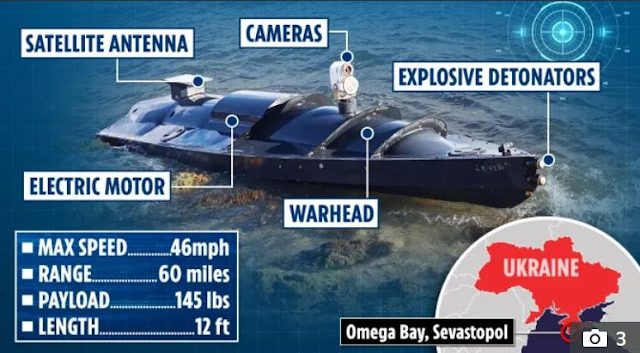
A MYSTERIOUS vessel widely believed to be a Ukrainian suicide drone has washed up near to a Russian naval base.
The vessel was found in Omega Bay, by the port of Sevastopol, which is home to Vladimir Putin’s Black Sea fleet.
We can safely assume — as the videos below seem to demonstrate — that the ones used in the attack are of the same design.
We will loop back to this point later, but just behold the simplicity of it via the article from The Sun linked above;
This is all COTS technology riding on either a canoe or ocean going kayak. If you have someone with an understanding of explosives and communications (the only part requiring military expertise +/-) and then any garden variety electrician, small engine pro, and fiberglass guy … you can run a production line of these on a shoestring budget at scale.
[…]
This is another demonstration that the military culture of Russia is broken. The human element in the Sevastopol was manifested in the complete lack of preparation for the attack in spite of the warnings so clearly provided in September.
As old as “fire ships” are to naval warfare are the defenses against them. They are as simple as the weapons you need to defend against them. Barriers at the water level and crew served weapons — preferable optically sighted — as a backup.
Part of the video above you can see both surface ship and helo gunfire taking out the threat from one boat, but other boats were able to approach surface ships underway and penetrate deep in to port.
Why?
What is one of the things we have repeatedly discussed here for the last 18-years? When war comes you never have enough of what? That’s right, anti-aircraft defenses and medium caliber guns including crew served weapons.
We build our ships around the most high-technology threats and equally exquisite defenses against them, but completely overlook the low-tech weapons that are just as deadly. We ignore mine warfare, and we also ignore threats as simple as a converted kayak. It isn’t sexy and the contracts awarded are small … but the threats are real.
Britain’s Final Assault – Falklands War
Historigraph
Published 29 Oct 2022In the closing days of May 1982, the British land campaign to recapture the Falkland Islands began, after an eight thousand mile voyage and weeks of battles at sea and in the air. With a beachhead established, British troops were now charged with rapidly defeating an Argentinian force that was more numerous and had spent weeks preparing defences. The Battle for the Falklands was about to begin.
(more…)
If it wasn’t for double standards, the legacy media wouldn’t have any standards at all
At Spiked, Brendan O’Neill calls out the US mainstream media for their blatant double standards on political violence after the as-yet still mystery-shrouded attack on the husband of the Speaker of the House of Representatives over the weekend:

Paul and Nancy Pelosi, 16 February, 2022.
Detail of a photo by Amos Ben Gershom via Wikimedia Commons.
It was the mention of zip ties that got me thinking. Apparently the man who allegedly broke into the San Francisco home of Nancy and Paul Pelosi on Friday was carrying zip ties. A possibly crazed individual approaching the home of a powerful politician with plastic fasteners that can be used to bind a person’s hands – it was both a nightmarish prospect and a familiar one, too. Wasn’t another public figure in the US recently targeted by someone who had zip ties? And a gun, a knife, pepper spray and a crowbar? Yes. It was Brett Kavanaugh. But many don’t remember that. Because thanks to the media, certain acts of political hate get less traction than others.
People are rightly horrified by what happened to Paul Pelosi on Friday. David DePape allegedly broke into the Pelosi home and yelled “Where is Nancy?”. She wasn’t there. DePape then allegedly attacked Mr Pelosi, who is 82, with a hammer. Pelosi suffered a skull fracture and is still in hospital, though he is expected to make a full recovery. This was a horrific assault on an elderly person, as well as seeming to have been motivated by a deep political animus. Sadly, it was not a one-off. There was a creepily similar incident at the home of Supreme Court justice Brett Kavanaugh in Maryland in June.
A 26-year-old man from California travelled to Maryland allegedly with the intention of murdering Kavanaugh. That’s what he is charged with – attempted murder. He was armed with a tactical knife, a Glock 17 pistol, zip ties and other murderous paraphernalia. The difference between Kavanaugh’s alleged tormentor and the man who allegedly broke into the Pelosi home is that the former failed to gain entry. He spied two US marshals close to Kavanaugh’s home and called off his deadly mission. Kavanaugh was luckier than Paul Pelosi.
It is unquestionable that the assault on the Pelosi home has caused more waves and fury among the media elites than the mercifully thwarted attempted assassination of Kavanaugh did. The Kavanaugh incident swiftly faded from public consciousness. One observer wrote of the media’s “eerie silence” on Kavanaugh. It was pointed out that the “attempted assassination of Brett Kavanaugh” was being downplayed by the New York Times the very day after it happened. On the NYT‘s homepage, the Kavanaugh story was 16th in order of importance, behind stories about the new Jurassic Park movie and Kelly Clarkson’s singing skills. In that day’s paper, it was on page 20. Nate Silver said it was “crazy” that the targeting of Kavanaugh was not “treated as a bigger story”. “There’s often more bias in which stories are deemed to be salient than how they’re written about it”, he said.
That is well said. Media bias is apparent not only in the information and takes that the media publish but also in what the media decree to be important in the first place. And it would appear that the targeting of a right-wing, pro-life justice is less important – a lot less important – than the targeting of the home of a Democratic, pro-choice politician. Politics is clearly at play here. Kavanaugh’s moral outlook runs counter to that of the liberal media and coastal elites, and thus he makes for an unsympathetic character. Nancy Pelosi, on the other hand – she’s the crusading Democrat the chattering classes love. An assault on her home moves the liberal elites profoundly.
On the rapidly changing reported details of the attack on Paul Pelosi, Jim Treacher has some salient questions:
First things first: Paul Pelosi is currently in the hospital recovering from his attack, and here’s wishing him a speedy recovery. It sounds horrible and I wouldn’t wish it on anybody. Crime in America is spiraling out of control.
Now …
The Pelosis are worth somewhere north of $100 million. Nancy Pelosi is the speaker of the United States House of Representatives, and second in the line of presidential succession. You’re telling me her husband Paul was alone in a house with no security or surveillance cameras? This lunatic David DePape just walked right up to the house and broke in?
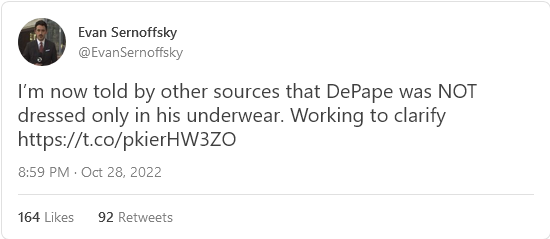
I’ve got other questions. The initial report was that DePape was in his underwear when the police caught him beating Pelosi with a hammer. Now we’re told that’s not true.
Wait, what? How do you get that detail wrong? Did it come from the police? I can understand misremembering the color of his pants. But the cops couldn’t tell whether he was wearing any?
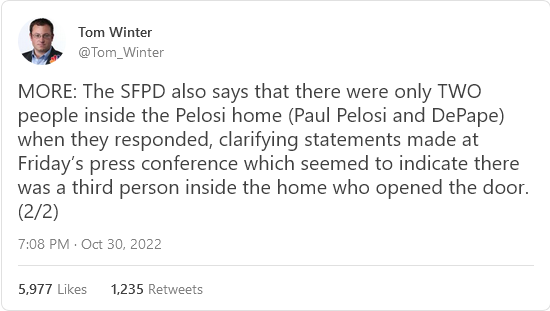
And then there’s this:
Okay, I’m just trying to picture the scene that the two responding officers saw: They entered the Pelosi home, found DePape attacking Pelosi, and stopped him.
How did they get into the house? Did they break down the door? Was it unlocked, or already open? Did DePape or Pelosi open it?
The story is that the police encountered DePape in the middle of beating Pelosi. So if DePape opened the door for them … why? Or if Pelosi opened the door for them … how?
I see a lot of people speculating that this was some sort of lovers’ quarrel, or a Grindr date gone wrong, or something along those lines. Doesn’t seem likely to me, but is it really outside the realm of possibility? Are you a homophobe? I thought we were supposed to accept all genders and preferences and whatnot. It’s 2022.
What is actually inside MSG and is it Safe? | Food Unwrapped
Food Unwrapped
Published 26 Feb 2022Jimmy heads to Thailand to see how MSG is made and get some expert opinions on if MSG is safe to eat.
(more…)
QotD: Spartan strategy during the Persian wars
The hammer Sparta has, of course, is hoplite battle. Sparta seeks to solve almost all of its issues by applying a hoplite phalanx to the problem, regardless of if the problem can be solved by a hoplite phalanx. Spartan strategic thinking is thus marred by both a failure to consider military solutions that did not consist of traditional hoplite battles, as well as an inability to consider or execute non-military solutions at all.
We can see the former weakness in Spartan planning in the Persian Wars. Spartan planning is both direct and unrealistic: find a choke-point, fortify it and hold it indefinately with a hoplite army. Attempted at Thermopylae this plan fails; the Battle of Thermopylae is often represented in popular culture as an intentional delaying action, but it was nothing of the sort – Herodotus is clear that this was supposed to be the decisive land engagement (Hdt. 7.175; Cf. Diodorus 11.4.1-5). The Spartans then attempt to recreate this plan at the Isthmus of Corinth and have to be rescued from their strategic stupidity by the Athenians, who threaten to leave the alliance if the plan isn’t abandoned (Hdt. 8.49-62). A blockade at the Isthmus would be easy for the Persian army to bypass – assuming it didn’t simply defeat it with generally superior Persian siegecraft – and worse yet was a diplomatic disaster given that it meant essentially writing Athens off as a loss, when the Athenian navy provided the bulk of the ships protecting the Isthmus.
Bret Devereaux, “Collections: This. Isn’t. Sparta. Part VII: Spartan Ends”, A Collection of Unmitigated Pedantry, 2019-09-27.
October 31, 2022
“If The Regime doesn’t have their canned narrative ready to go, it’s real news”
At Founding Questions, Severian offers some preliminary thoughts on the new field of “Brandonology”, specifically how to determine whether what’s in the legacy media is news or propaganda:
I’m throwing this out there now, because it’s shaping up to be a long-term project and I think we can all contribute to it as needed. But as Brandonology / FNGology is such a new discipline, it’ll help to lay in the foundations.
The first step in analyzing the “news” is determining whether or not it is, in fact, news. “News” here being defined as “an unplanned event — or catastrophic fuckup of a planned event — to which The Regime is forced to react in more or less real time”. Lot of that going around recently, such that we’re spoiled for choice. Pick pretty much any of the shenanigans in Ukraine: The botched assassination of Alexander Dugin; the Nordstream sabotage; the Ukrainian dirty bomb false flag. Those clearly fall into the “catastrophic fuckup of a planned event” category …
… or do they? Because as Z Man pointed out in great detail on his last podcast, all of that stuff seemed to catch The Regime flatfooted. Yeah, somebody planned those things, but that somebody wasn’t Brandon, or anyone close to Brandon, or anyone in position to prop up Brandon. Which is the surest tell for actual news (as defined above) right there: If The Regime doesn’t have their canned narrative ready to go, it’s real news.
The necessity of the canned narrative also allows the keen Brandonologist to anticipate the “news”. For instance, it has obviously started to dawn on The Regime that they’re going to get walloped in the midterms, so they’re trying out narratives as we speak. Z Man identified one I hadn’t seen, something about Brandon “inadvertently” saying something about the debt ceiling that’s supposed to give the Republicans all kinds of ammunition against him. I’m not so sure. I’ll have to look into it, but the fact that it squarely blames Brandon — who The Regime still insists is the very picture of mental acuity and vigor — pings my radar a bit. I think the stuff Her Nibs is rolling out is much likelier the Narrative being developed — she’s outright stating that “the Republicans” are going to engage in massive voter fraud.
Which to normal people is chutzpah beyond belief, but that’s how The Regime rolls. The 2016 election was, of course, full of Russian Hacking™. The 2020 election, by contrast, was the cleanest canvass in human history, and you’re an insurrectionist, a domestic extremist, and of course a racist if you dare to suggest the mere possibility of an American election being tampered with. But wouldn’t you know it, those dastardly Russians are going to rally here in 2022, because you can’t keep a Russian Hacker™ down. They might even hire a few prostitutes to pee on a bed for good measure; that’s how evil they are.
Further complicating the task, though, is that “botched op” thing. We’ve got Brandon et al. on record threatening Nordstream, so you know that was an American caper gone bad … but gone real, real bad, because if The Regime had been fully in the know, there’d have been a whole bunch of Tier Four Stoyak about lousy maintenance on the pipelines for months in advance.
Executed for Telling a Joke – October 30, 1943 – WAH 084
World War Two
Published 30 Oct 2022From a conference in Moscow the United Nations Alliance issues a warning to Nazi Germany about their atrocities, while those atrocities continue unabated.
(more…)
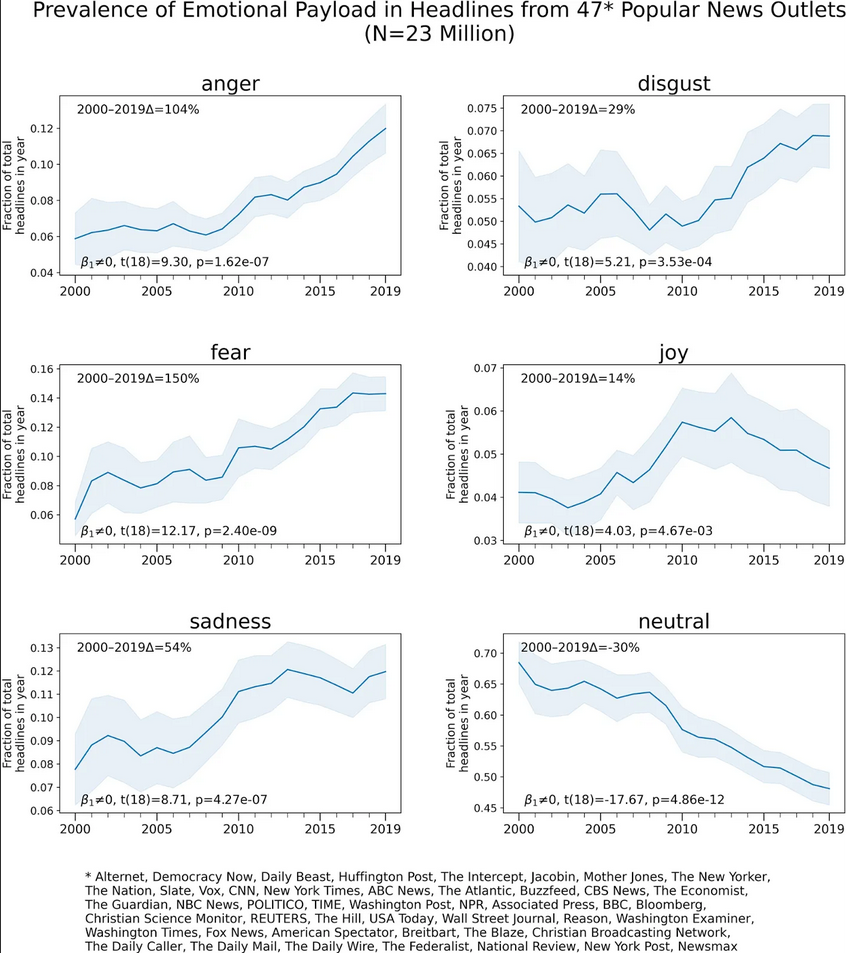
Why aren’t you as angry and afraid as the media wants you to be?
Chris Bray on the unrelenting din of fear porn you get if you pay any attention to the legacy media:
It’s like a magic act where the door to the secret compartment moves slowly and has a spotlight pointed at it, and the audience sees the illusion every time, because it’s literally not an illusion, being right out there in the open, but the magician still pretends that everyone watching is shocked and baffled by the trick.
So. Via Nellie Bowles, writing at Common Sense, this summary of findings from a recent study of the American news media:
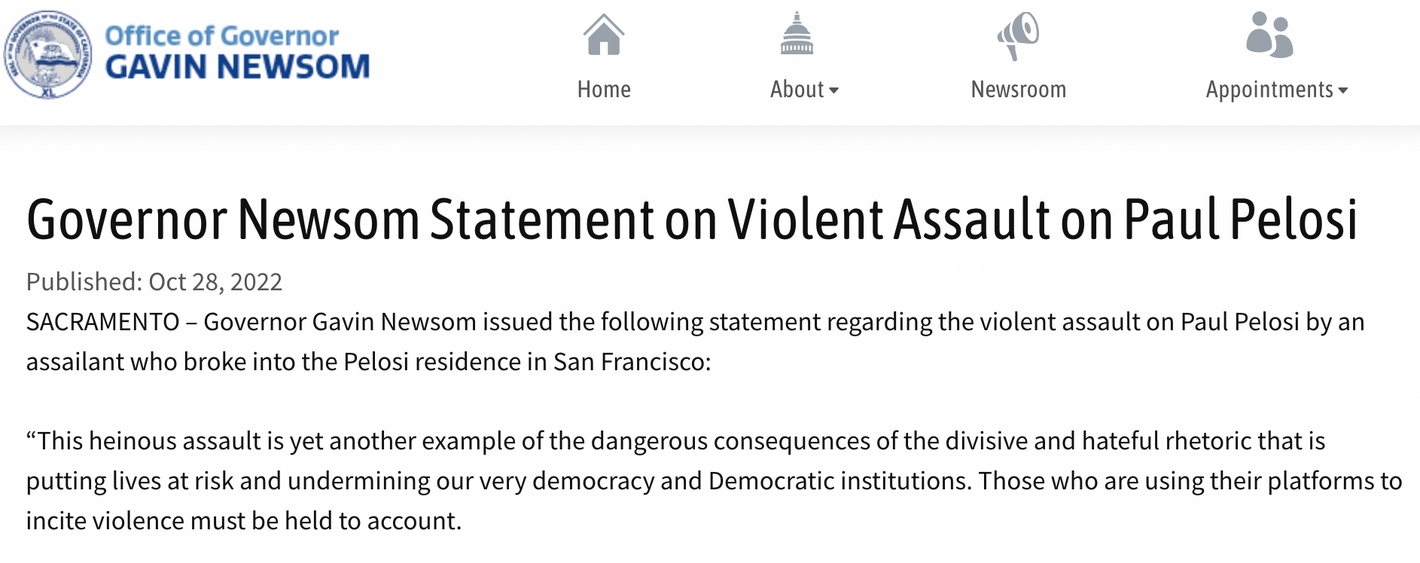
Today’s Standard-Issue Explanatory Line™ on Paul Pelosi being attacked in his home is that TRUMP TRUMP TRUMP, toxic far-right rhetoric!!!!! Ten minutes after the shabby break-in at the Katie Hobbs for Governor office was omfg literally Watergate before it evaporated into nothing much, a uniquely strange Berkeley nudist is a far-right puppet with an opening at the bottom for Donald Trump’s hand, steered by hateful rhetoric that incites violence:
[…]
Wouldn’t it be refreshing if the news media focused on a clear description of what happened before they got to the blame and politicization?
There are a dozen obvious things to say about all of this, even if you aren’t Steve Scalise — the double standard, the depiction of ordinary political criticism as “demonization”, the discarding of contradictory evidence to make round pegs fit square holes — and I’m mostly not going to bother saying them in any detail.
But the thing that has to be said is that the people who increasingly hold the attention of their audiences with hyperemotional clickbait, with the obvious manipulation of negative emotions, are warning us about the dangerous effects of hyperemotional rhetorical manipulation in the public sphere.
Ohhhhh, we’re about to LOSE OUR VERY DEMOCRACY! We tremble on the edge of a FASCIST TAKEOVER! And also, toxic rhetoric is bad.
Halloween Special: The Wild Hunt
Overly Sarcastic Productions
Published 30 Oct 2020It’s a Halloween special AND a miscellaneous myth! Who could ask for more? Today let’s dive into a very spooktacular folkloric motif and get real in the spirit of the season!
(more…)


