
Mrs Thatcher saved her country — and then went on to save an enervated “free world”, and what was left of its credibility. The Falklands were an itsy bitsy colonial afterthought on the fringe of the map, costly to win and hold, easy to shrug off — as so much had already been shrugged off. After Vietnam, the Shah, Cuban troops in Africa, Communist annexation of real estate from Cambodia to Afghanistan to Grenada, nobody in Moscow or anywhere else expected a western nation to go to war and wage it to win. Jimmy Carter, a ditherer who belatedly dispatched the helicopters to Iran only to have them crash in the desert and sit by as cocky mullahs poked the corpses of US servicemen on TV, embodied the “leader of the free world” as a smiling eunuch. Why in 1983 should the toothless arthritic British lion prove any more formidable?
And, even when Mrs Thatcher won her victory, the civilizational cringe of the west was so strong that all the experts immediately urged her to throw it away and reward the Argentine junta for its aggression. “We were prepared to negotiate before” she responded, “but not now. We have lost a lot of blood, and it’s the best blood.” Or as a British sergeant said of the Falklands: “If they’re worth fighting for, then they must be worth keeping.”
Mrs Thatcher thought Britain was worth fighting for, at a time when everyone else assumed decline was inevitable. Some years ago, I found myself standing next to her at dusk in the window of a country house in England’s East Midlands, not far from where she grew up. We stared through the lead diamond mullions at a perfect scene of ancient rural tranquility — lawns, the “ha-ha” (an English horticultural innovation), and the fields and hedgerows beyond, looking much as it would have done half a millennium earlier. Mrs T asked me about my corner of New Hampshire (90 per cent wooded and semi-wilderness) and then said that what she loved about the English countryside was that man had improved on nature: “England’s green and pleasant land” looked better because the English had been there. For anyone with a sense of history’s sweep, the strike-ridden socialist basket case of the British Seventies was not an economic downturn but a stain on national honor.
A generation on, the Thatcher era seems more and more like a magnificent but temporary interlude in a great nation’s bizarre, remorseless self-dissolution. She was right and they were wrong, and because of that they will never forgive her. “I have been waiting for that witch to die for 30 years,” said Julian Styles, 58, who was laid off from his factory job in 1984, when he was 29. “Tonight is party time. I am drinking one drink for every year I’ve been out of work.” And when they call last orders and the final chorus of “Ding Dong! The Witch Is Dead” dies away, who then will he blame?
During the Falklands War, the Prime Minister quoted Shakespeare, from the closing words of King John:
And we shall shock them: naught shall make us rue,
If England to itself do rest but true.For eleven tumultuous years, Margaret Thatcher did shock them. But the deep corrosion of a nation is hard to reverse: England to itself rests anything but true.
Mark Steyn, “The Uncowardly Lioness”, SteynOnline.com, 2019-05-05.
November 6, 2022
QotD: Thatcher and the Falklands
November 5, 2022
Psyops in theory and practice
Theophilus Chilton on the development of psyops and some examples of their use in US civilian contexts in recent years:
I trust that most readers are familiar with the concept of a “psyop”, a psychological operation designed to sway its targets in certain desired directions. Many of the mechanics of psyops were pioneered by the CIA and other intelligence agencies during the Cold War but have now been turned against civilian populations in the USA and elsewhere in an effort by the Regime to maintain control and minimise opposition to its various agendas. However, I’d like to make the point that psyops qualitatively differ from standard, run-of-the-mill propaganda such as governments have used for millennia.
The difference is primarily that of the time preferences involved. Whether it’s designed to whip up a population against an enemy or to try to obfuscate the truth about some particular event that has occurred, propaganda tends to operate on a shorter timescale and with more limited and simple policy goals in mind. It’s not surprising that modern propaganda techniques share a lot in common with commercial advertising designed to induce an “impulse buy” response in potential customers. Propaganda generally operates the same way — create a monodirectional response to a particular stimulus.
Psyops, on the other hand, are quite a bit more complex and generally involve the building of a narrative memeplex over the course of months, years, or even decades. Psyops are, of course, also fake but theirs is a fakeness that builds upon constant, repetitious narrative-building that lays out a foundational lens through which any individual incident or act can be systematically interpreted, adding them to the overall saga being told.
With conventional propaganda, the aim is to communicate Regime diktat to the average citizen. However, it does not necessarily expect the recipients to believe the propaganda, but merely comply with the goals. The Powers That Be in such cases don’t care why Havel’s greengrocer puts the sign up in his window, but merely that he does so. The primary purpose of psyops, on the other hand, is to ensure compliance by convincing the target to self-comply, rather than it having to be done by outside force or persuasion. It’s always touch and go when you’re making someone outwardly comply but inwardly they’re dissident. When the mark can be convinced to willingly self-police, this makes the government’s job easier since they don’t have to worry about this closet dissidence. The true believer is the best believer.
In essence, propaganda aims for immediate reactive persuasion while psyops seek long-term groundlaying that gives more all-inclusive means of maintaining overarching narrative control.
Now, a lot of people out there like to think they’re immune to psyops because “hurr durr I don’t beleeb da media!!” But they’re not. Indeed, a lot of these boomercon types are just as susceptible to psyops as anyone else when the right buttons are pushed. This is because they’ve been primed for it by the systematic, society-wide preparation of the psychological battle space without their ever realising it. In many cases, the foundations for a psyop are so culturally systematic that people don’t even realise what is happening.
For example, there are a ton of people out there who would pride themselves on being independent thinkers who nevertheless believed everything that was peddled during the covid and vaccine psyops. The reason for this is because they want to think of themselves as smart, knowledgeable about science, etc. Smart People believe the Right Things, after all. That, in turn, is the result of decades of psyops that have ensconced “science” as the arbiter of morality and truth in post-Christian America. So even when the science is fake or wrong, it is still accorded a moral authority that it does not deserve.
The Byzantine Empire: Part 8 – The Breakdown, 1025-1204
seangabb
Published 20 May 2022In this, the eighth video in the series, Sean Gabb explains how, having acquired the wrong sort of ruling class, the Byzantine Empire passed in just under half a century from the hegemonic power of the Near East to a declining hulk, fought over by Turks and Crusaders.
Subjects covered include:
The damage caused by a landed nobility
The deadweight cost of uncontrolled bureaucracy
The first rise of an insatiable and all-conquering West
The failure of the Andronicus Reaction
The sack of Constantinople in 1204Between 330 AD and 1453, Constantinople (modern Istanbul) was the capital of the Roman Empire, otherwise known as the Later Roman Empire, the Eastern Roman Empire, the Mediaeval Roman Empire, or The Byzantine Empire. For most of this time, it was the largest and richest city in Christendom. The territories of which it was the central capital enjoyed better protections of life, liberty and property, and a higher standard of living, than any other Christian territory, and usually compared favourably with the neighbouring and rival Islamic empires.
The purpose of this course is to give an overview of Byzantine history, from the refoundation of the City by Constantine the Great to its final capture by the Turks.
Here is a series of lectures given by Sean Gabb in late 2021, in which he discusses and tries to explain the history of Byzantium. For reasons of politeness and data protection, all student contributions have been removed.
(more…)
Repost: Remember, Remember the Fifth of November
Today is the anniversary of the Gunpowder Plot:
Everyone knows what the Gunpowder Plotters looked like. Thanks to one of the best-known etchings of the seventeenth century we see them “plotting”, broad brims of their hats over their noses, cloaks on their shoulders, mustachios and beards bristling — the archetypical band of desperados. Almost as well known are the broad outlines of the discovery of the “plot”: the mysterious warning sent to Lord Monteagle on October 26th, 1605, the investigation of the cellars under the Palace of Westminster on November 4th, the discovery of the gunpowder and Guy Fawkes, the flight of the other conspirators, the shoot-out at Holbeach in Staffordshire on November 8th in which four (Robert Catesby, Thomas Percy and the brothers Christopher and John Wright) were killed, and then the trial and execution of Fawkes and seven others in January 1606.
However, there was a more obscure sequel. Also implicated were the 9th Earl of Northumberland, three other peers (Viscount Montague and Lords Stourton and Mordaunt) and three members of the Society of Jesus. Two of the Jesuits, Fr Oswald Tesimond and Fr John Gerard, were able to escape abroad, but the third, the superior of the order in England, Fr Henry Garnet, was arrested just before the main trial. Garnet was tried separately on March 28th, 1606 and executed in May. The peers were tried in the court of Star Chamber: three were merely fined, but Northumberland was imprisoned in the Tower at pleasure and not released until 1621.
[. . .]
Thanks to the fact that nothing actually happened, it is not surprising that the plot has been the subject of running dispute since November 5th, 1605. James I’s privy council appears to have been genuinely unable to make any sense of it. The Attorney-General, Sir Edward Coke, observed at the trial that succeeding generations would wonder whether it was fact or fiction. There were claims from the start that the plot was a put-up job — if not a complete fabrication, then at least exaggerated for his own devious ends by Robert Cecil, Earl of Salisbury, James’s secretary of state. The government’s presentation of the case against the plotters had its awkward aspects, caused in part by the desire to shield Monteagle, now a national hero, from the exposure of his earlier association with them. The two official accounts published in 1606 were patently spins. One, The Discourse of the Manner, was intended to give James a more commanding role in the uncovering of the plot than he deserved. The other, A True and Perfect Relation, was intended to lay the blame on Garnet.
But Catesby had form. He and several of the plotters as well as Lord Monteagle had been implicated in the Earl of Essex’s rebellion in 1601. Subsequently he and the others (including Monteagle) had approached Philip III of Spain to support a rebellion to prevent James I’s accession. This raises the central question of what the plot was about. Was it the product of Catholic discontent with James I or was it the last episode in what the late Hugh Trevor-Roper and Professor John Bossy have termed “Elizabethan extremism”?
A working flight simulator, no computers necessary
Tom Scott
Published 4 Jul 2022There are only a few working Link Trainers left in the world: but before microprocessors, before display screnes, half a million pilots learned the basics of instrument flying inside one. More: https://www.most.org/explore/link-fli…
(more…)
QotD: The use of chemical weapons after WW2
Both Cold War superpowers stockpiled chemical weapons, but seem to have retained considerable ambivalence about their use. In the United States, chemical weapons seem to have been primarily viewed not as part of tactical doctrine, but as a smaller step on a nuclear deterrence ladder (the idea being that the ability to retaliate in smaller but still dramatic steps to deter more dramatic escalations; the idea of an “escalation ladder” belongs to Herman Kahn); chemical weapons weren’t a tactical option but baby-steps on the road to tactical and then strategic nuclear devices (as an aside, I find the idea that “tactical” WMDs – nuclear or chemical – could somehow be used without triggering escalation to strategic use deeply misguided). At the same time, there was quite a bit of active research for a weapon-system that had an uncertain place in the doctrine – an effort to find a use for a weapon-system the United States already had, which never quite seems to have succeeded. The ambivalence seems to have been resolved decisively in 1969 when Nixon simply took chemical weapons off of the table with an open “no first use” policy.
Looking at Soviet doctrine is harder (both because I don’t read Russian and also, quite frankly because the current epidemic makes it hard for me to get German and English language resources on the topic) The USSR was more strongly interested in chemical weapons throughout the Cold War than the United States (note that while the linked article presents US intelligence on Soviet doctrine as uncomplicated, the actual intelligence was ambivalent – with the CIA and Army intelligence generally downgrading expectations of chemical use by the USSR, especially by the 1980s). The USSR does seem to have doctrine imagine their use at the tactical and operational level (specifically as stop-gap measures for when tactical nuclear weapons weren’t available – you’d use chemical weapons on targets when you ran out of tactical nuclear weapons), but then, that had been true in WWII but when push came to shove, the chemical munitions weren’t used. The Soviets appear to have used chemical weapons as a terror weapon in Afghanistan, but that was hardly a use against a peer modern system force. But it seems that, as the Cold War wound down, planners in the USSR came around to the same basic idea as American thinkers, with the role of chemical weapons – even as more and more effective chemicals were developed – being progressively downgraded before the program was abandoned altogether.
This certainly wasn’t because the USSR of the 1980s thought that a confrontation with NATO was less likely – the Able Archer exercise in 1983 could be argued to represent the absolute peak of Cold War tensions, rivaled only by the Cuban Missile Crisis. So this steady move away from chemical warfare wasn’t out of pacifism or utopianism; it stands to reason that it was instead motivated by a calculation as to the (limited) effectiveness of such weapons.
And I think it is worth noting that this sort of cycle – an effort to find a use for an existing weapon – is fairly common in modern military development. You can see similar efforts in the development of tactical nuclear weapons: developmental dead-ends like Davy Crockett or nuclear artillery. But the conclusion that was reached was not “chemical weapons are morally terrible” but rather “chemical weapons offer no real advantage”. In essence, the two big powers of the Cold War (and, as a side note, also the lesser components of the Warsaw Pact and NATO) spent the whole Cold War looking for an effective way to use chemical weapons against each other, and seem to have – by the end – concluded on the balance that there wasn’t one. Either conventional weapons get the job done, or you escalate to nuclear systems.
(Israel, as an aside, seems to have gone through this process in microcosm. Threatened by neighbors with active chemical weapons programs, the Israelis seem to have developed their own, but have never found a battlefield use for them, despite having been in no less than three conventional, existential wars (meaning the very existence of the state was threatened – the sort of war where moral qualms mean relatively little) since 1948.)
And I want to stress this point: it isn’t that chemical munitions do nothing, but rather they are less effective than an equivalent amount of conventional, high explosive munitions (or, at levels of extreme escalation, tactical and strategic nuclear weapons). This isn’t a value question, but a value-against-replacement question – why maintain, issue, store, and shoot expensive chemical munitions if cheap, easier to store, easier to manufacture high explosive munitions are both more obtainable and also better? When you add the geopolitical and morale impact on top of that – you sacrifice diplomatic capital using such weapons and potentially demoralize your own soldiers, who don’t want to see themselves as delivering inhumane weapons – it’s pretty clear why they wouldn’t bother. Nevertheless, the moral calculus isn’t the dominant factor: battlefield efficacy – or the relative lack thereof – is.
Bret Devereaux, “Collections: Why Don’t We Use Chemical Weapons Anymore?”, A Collection of Unmitigated Pedantry, 2020-03-20.
November 4, 2022
Amnesty “literally means a pardon, i.e. the absence of punishment … for a crime committed in the past“
Sarah Reynolds considers the implications of what Emily Oster wrote in her Atlantic article suggesting a Covid-19 amnesty:
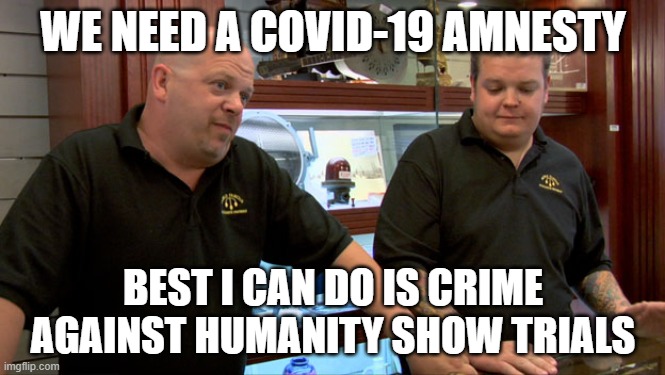
Now “amnesty” is a very specific word. It doesn’t mean forgiveness, it literally means a pardon, i.e. the absence of punishment … for a crime committed in the past.
It is a stark and loaded word indeed when used to refer to anything Covid-related because it establishes two parties: victims and perpetrators. Group 1: Those who committed crimes and could be in the legal sense pardoned of the criminal behavior they engaged in; and Group 2: those who will consequently not get justice.
The implication of such a dichotomy (if one were to appear) is horrifying.
The author alludes to the appeal and inevitability of forgiveness; I posit in contrast that forgiveness is a spiritual concept, one that may be inextricably linked to a religious belief for some, so she’s jumping the gun here because Forgiveness would be the stage after Justice, and only for those whose religion, faith, or spiritual practice also inspires or compels it.
Use of the word amnesty is terribly concerning to me because it insinuates that grave injustice has been committed. And if some horrible truth is coming out soon, her piece in the Atlantic serves as a way to beta test our/society’s future reaction to it — acting as the proverbial canary in the coal mine.
In other words, if we’re this outraged now knowing only what we know so far, how outraged will we be then, after this (speculated by me) coming newsflash triggers national indignation from coast to coast?
The most revealing part of the Professor’s piece in the Atlantic is this statement:
The standard saying is that those who forget history are doomed to repeat it. But dwelling on the mistakes of history can lead to a repetitive doom loop as well. Let’s acknowledge that we made complicated choices in the face of deep uncertainty, and then try to work together to build back and move forward.
No, vacuums are complicated. All those attachments.
Tyranny is quite straight-forward, in contrast.
Years ago, I read a book that taught the reader that people are often confessing and how to detect it. If you look at and listen to their word choices, you can sometimes find what it is they did in the past, what they fear will happen in the future, and clues about whether or not they are capable of remorse. Many of you who have watched my youtube or read my blog before I got on substack know how I like to do a communication analysis, and delineate a) what’s literally being said, b) what the person really meant, and c) the third and most important/revealing part, what’s being left unsaid. And I rarely hear people say, “it’s complicated”, unless they are feeling profound regret, fear of the consequences of those “complicated choices”, and plenty of denial of the emotional origin of that particular word choice. They don’t even know why they were compelled unconsciously to use that word … but we do. The stark truth would likely be anything but complicated and possibly horrifying. (For example, what if Oster got on twitter tomorrow and tweeted out, “I don’t think I feel regret or remorse like other people. Intellectually, I get it: the Pandemic response caused human beings unbearable pain and society irrevocable damage but it doesn’t really bother me per se and sometimes I even feel gratified by it, especially when I witness overt force (mandates) replace emotional manipulation (shame).” Now I’m sure Oster is a wonderful person with a fully intact moral compass who’s 100% able to empathetically relate to others!! But … IF … on the off chance it were a true statement so she did declare it on twitter, it might seem complicated to her, but to us it would be the simplest most logical explanation for her actions. We’d go, oh! She’s a sociopath! Oh my God, now it all makes perfect sense! Hahahahaha I get it now hahahahaha because we live in hell!!)
H/T to Chris Bray for the link.
“Dreadnought” – The King of the High Seas! – Sabaton History 114 [Official]
Sabaton History
Published 2 Nov 2022When the Dreadnought made its appearance in the early 20th century, it was the mightiest ship the world had ever seen, making all other gunships obsolete, including the rest of its own navy. It also sparked a naval arms race around the world, as many nations built such behemoths. But what were they actually like?
(more…)
Ontario parents brace for yet more school disruption as CUPE threatens a Friday walkout
Matt Gurney, writing in Toronto Life, recounts a fairly typical Ontario parent’s concerns at the latest stand-off between the Ontario government and the non-teaching educational workers represented by the Canadian Union of Public Employees (CUPE):

It’s one thing to watch the news as a journalist and wonder how to cover it. Over the last week or so, though, I’ve just been another parent wondering if my young kids are going to be out of school for an extended period. Again.
It’s all very familiar by now, of course. Can I shuffle my deadlines? Should we get rotating playdates going with neighbours so we can have some quiet in the house when we have an important Zoom call? Do we still have the number of that tutor we used during Covid, and should we call her again if this drags on? Anyway, there’s always the grandparents, right?
This is stress we don’t need — a kick in an already tender spot. I remind myself that, all things considered, others have it way worse: people on shift work, single parents, parents of kids with special needs, those for whom a missed shift means a missed rent payment or a skipped meal. But, even among the affluent and privileged, the frustration, the sense of weariness at more of this, is strong.
[…]
Let me repeat that: my son, now in the third grade, has never had a normal year of school. Preschool and JK? Sure. But then Covid struck mid-senior-kindergarten, in a year already disrupted by job actions from teachers during contract negotiations with the province. (Once the pandemic began, deals were quickly reached.) Schools closed and didn’t reopen. The next year, his first grade, was a complete fiasco, with schools opening and closing as the virus surged and waned. The second grade was better but still had a lot of shifting rules and a relatively brief shutdown after Christmas. This year was the first shot for my son to know a normal school year.
And there are thousands of other kids like him out there, each with a parent (or two) who worries that their child has already lost too much.
Don’t discount the guilt parents feel. We spent years telling our kids, “No, you can’t do this.” Denying them birthday parties, family trips, sports and activities, even just playdates. If you aren’t a parent and don’t understand why people might get so passionate about whether their kids stay in a classroom, don’t make the mistake of thinking it’s all about the lesson plan or just a desire to ship them off so that the house is quiet for a few hours. Those both matter, but the bigger concern for many is that we’re tired of saying no to our kids. We’re tired of telling them that they can’t do things. We’re tired of having things taken away from them.
We knew that measures to limit the spread of Covid were important. We went along, for the most part. We waited. We got our jabs. Many of us got our kids jabbed. In exchange, we want normalcy back. Not for us but for them.
The Ford government’s treatment of CUPE is undeniably heavy handed — probably on purpose, to send a signal to other unions. It’s also unnecessarily nasty. Ford could have struck a better deal with education workers, like imposing a short-term contract with a higher wage boost to help them ride out inflation, as I proposed weeks ago. That might have eased the concerns of parents out there who, though worried about their kids, don’t like Ford or what he’s doing.
I think Jen Gerson has it right here:

Tank Chats #157 | Ferret MKII & V | The Tank Museum
The Tank Museum
Published 1 Jul 2022Join David Fletcher for a new Tank Chat on the Ferret.
(more…)
QotD: History while it’s happening
Well, future historian, since I know how much that sucks, I’ll spare you. If you’re plowing through my papers (you’re welcome for all the Slave Leia pictures, by the way) and you get to the “Impeachment of Donald Trump” section, you’ll have something. Maybe nothing interesting, or particularly coherent, but at least it’s something. Professional courtesy.
If nothing else, this impeachment fiasco confirms that we’re ruled by fools. No earth-shattering insight, that, I realize, but there it is. Really it’s just math — since most people in all times and places have been fools, it stands to reason that nearly every human who has ever lived has had a large part of his fate decided by an idiot. This is true even of those blessed to have seen good leadership in action, as even the best men are fools about lots of things. Up to and including the things that make their reputations. George Washington, for instance, was indisputably a great leader, but a terrible general — with Cornwallis trapped on the Yorktown peninsula in Virginia, he had to be talked out of moving the Continental Army north, to reconquer New York. He was one of history’s great captains, but I bet I could take him in a game of Risk.
Severian, “Impeachment Thoughts”, Rotten Chestnuts, 2019-12-19.
November 3, 2022
Amnesty? How about “no”.
Tom Knighton on the recent trial balloons being sent up by certain media folks to test the willingness of us proles to “forgive and forget” their authoritarian cheerleading over the last two+ years:
Recently, a story over at The Atlantic proposed an amnesty over what happened during the COVID-19 pandemic. The idea was that we just let bygones be bygones and no one holds anyone else accountable for what happened.
Lives were ruined, people died alone and miserable — and in some cases, because they were alone and miserable — but we’re supposed to ignore all of that.
At Spiked, Lauren Smith says that the nasty authoritarian tendencies of those in power during the pandemic should absolutely not be forgotten:
As the Covid-19 pandemic fades from view, some may be tempted to forget those miserable two years of lockdowns, social distancing and other restrictions on our liberties. This is certainly the view of a widely shared article in the Atlantic, which calls for a “pandemic amnesty”. American economist Emily Oster asks us to “forgive one another for what we did and said when we were in the dark about Covid”. It quickly becomes clear why Oster would prefer us to move on.
During 2020 and 2021, Oster was very much on the side of lockdown. And she supported vaccine mandates in universities and for workers. In fairness to Oster, she did not support every Covid measure. She did, for instance, criticise how long it took for schools to re-open in the US back in the summer of 2020. Yet ultimately, she belonged to the side that was happy to criminalise meeting a friend for coffee or to separate people from their dying loved ones.
Now, with hindsight, Oster regrets some of her positions. The crux of her argument is that the people baying for more lockdowns, harsher restrictions and vaccine mandates couldn’t possibly have known any different at the time. She says that they couldn’t have known that outdoor transmission of Covid was rare, that schoolchildren were always a low-risk group and that cloth masks were virtually useless in preventing viral spread.
Many, however, did know these facts, including back in the spring of 2020. But those who said them out loud were quickly turned into pariahs.
Although Oster admits that those on the anti-lockdown side got many things right, she says this was merely a question of “luck”. But it should not have taken any great foresight to see the danger of lockdowns. They were responsible for the most significant loss of liberty in the history of the democratic world. Their impact on economic output was as profound as that of any war. Not since the days before universal education had so many kids been shut out of school. Worse still, those who did warn of these inevitable and dangerous consequences were met with derision and censorship.
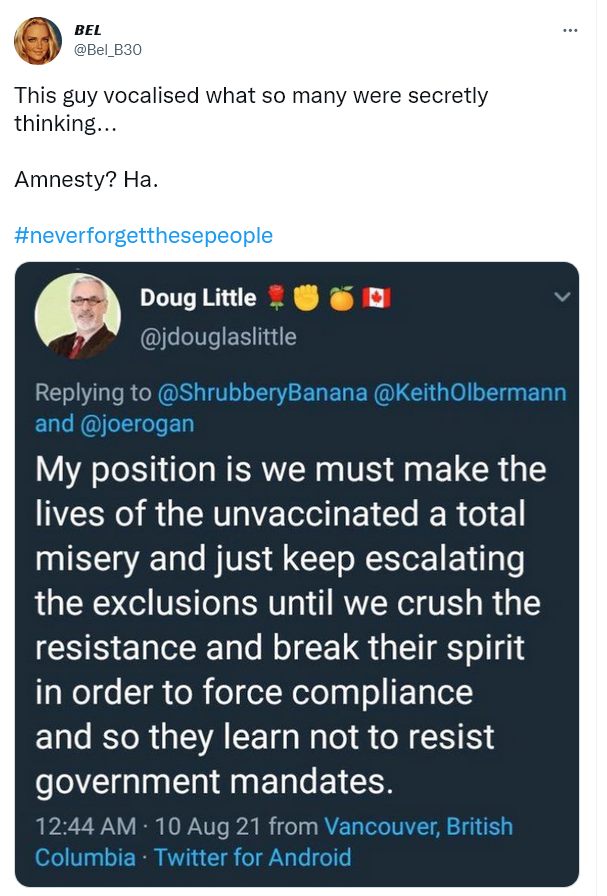
This is a pretty representative viewpoint of the lockdown mindset:
Your shooting board is too fancy! Use this classic design instead!
Rex Krueger
Published 2 Nov 2022Shooting boards have gotten crazy, but you can build a simpler shooting board.
(more…)
Twitter’s evolution from protecting celebrities to shaping “the narrative”
At Common Sense, Walter Kirn recounts his own recognition of how Twitter has changed since he first opened an account in 2009 (incidentally, the same year I did … but unlike Walter, I still have about the same number of followers there as I did in my first year):
The platform belonged to celebrities back then, who hawked their movies, albums, and TV shows in words that were their own, supposedly, fostering in fans a dubious intimacy with figures they knew only from interviews. One of these stars, an investor in the platform, was Ashton Kutcher, the prankish, grinning actor who became omnipresent for a spell and then, stupendously enriched, largely vanished from public consciousness. It seemed that Twitter had sped-up fame such that it bloomed and died in record time.
The power of the new platform struck me first in 2012. Two incidents. The first one, a small one, occurred in Indianapolis, where I’d gone to watch the Super Bowl. I attended a party the night before the game at which many Hollywood folk were present, including an actor on a cable TV show who played a roguish businessman. The actor was extremely drunk, lurching about and hitting on young women, and it happened that my wife, back home, whom I’d texted about the scene, was able to read real-time tweets about his antics from other partygoers. A few hours afterward she noticed that these tweets had disappeared. Instant reality-editing. Impressive.
I concluded that Twitter was in the business not only of promoting reputations, but of protecting them. It offered special deals for special people. Until then, I’d thought of it as a neutral broker.
[…]
My own habits on Twitter changed around that time. Observational humor had been my mainstay mode, but I realized that Twitter had become an engine of serious opinions on current affairs. On election night in 2016, while working at another journal, Harper’s, I was given control of the magazine’s Twitter feed and asked to think out loud about events while following them on cable news. I saw early that Trump was on his way to victory — or at least he was doing much better than predicted — and I offered a series of tart remarks about the crestfallen manners of various pundits who couldn’t hide their mounting disappointment.
The official election results were still unknown — Clinton retained a chance to win, in theory — but before the tale was told, my editors yanked my credentials for the account and gave them to someone else. The new person swerved from the storyline I’d set (which reflected reality) and adopted a mocking tone about Trump’s chances, even posting a picture of a campaign hat sitting glumly on a folding chair at his headquarters in New York City.
It struck me at first as pure denial. Later I decided that it was far more intentional — that my left-leaning magazine wished to preserve the illusion for its readers that the election’s outcome was unforeseeable, possibly to maintain suspense or so it could later act startled and disturbed in concert with its TV peers. Its Twitter feed, as a record of its reactions, had to align with this narrative.
I grew convinced that night that Twitter meant trouble for me. It had become an opinion-sculpting instrument, an oracle of the establishment, and I knew I would end up out of step with it, if only because I’m of a temperament which habitually goes against the flow to challenge and test the flow, to keep it honest. Mass agreement, in my experience, both as a person and a journalist, is typically achieved at a cost to reality and truth.
Is the AutoMag Curse Over? The New Auto Mag 180-D
Forgotten Weapons
Published 1 Jul 2022Historically speaking, the AutoMag 180 pistol has been a reaper of investors. Between 1971 and 1982, no fewer than six different companies went bankrupt trying to make a profit building Auto Mags. However, we may have finally reached the end of that streak …
In 2015, all the existing tools, parts, and IP related to the Auto Mag was sold to a new company (Auto Mag Ltd). Similar to the previous companies lured in by the glamour of this massive handgun, these new owners saw the list of existing parts (including several hundred frames) and figured they could assemble and sell a few hundred guns and make a nice return. Also similar to previous companies, they completed the deal and then discovered that those existing parts had major problems. Fundamentally, the Model 180 was simply not a mature design.
Where the new company has taken a new path is that they have spent the past 7 years reengineering the whole gun to fix its shortcomings. They have made a couple dozen design changes, although without changing anything fundamental in the appearance or operating principles of the gun. They have done things like lighten the firing pin, strengthen the locking lugs, tweak the magazine geometry, and so on — the changes that should have been make back in 1971 before the first example was ever shipped.
I came into this review with pretty low expectations — so many people have tried and failed to make a proper Automag that I really didn’t think Auto Mag Ltd would be able to pull it off. And yet to my happy surprise, it seems that they actually have. The gun ran flawlessly for me and was actually a lot of fun to shoot.
(more…)


