
World War Two
Published 29 Jul 2023Operation Cobra is the drop that finally opens the floodgates and the Allies make a breakthrough in Normandy; up in the Baltics the Soviets take Shaulyai, Dvinsk, and finally Narva, though their big prize this week is Lvov further south. This happens during the Poles’ Lvov Uprising, which ends badly for the Poles. Things also go badly for the Japanese on Guam, though, as their assault this week devastates their own troops.
(more…)
July 30, 2023
Bradley Unleashes His Cobra – WW2 – Week 257 – July 29, 1944
Comments Off on Bradley Unleashes His Cobra – WW2 – Week 257 – July 29, 1944
Letting a UN agency police “disinformation” online? What a great idea! With the best of intentions! What could possibly go wrong?
Savroula Pabst outlines the United Nations Development Program’s new online anti-disinformation tool, iVerify:

The United Nations Development Programme (UNDP) has quietly announced the rollout of an automated anti-disinformation tool, iVerify, this spring. The instrument, initially created to support election integrity, centers a multi-stakeholder approach spanning the public and private sectors to “provide national actors with a support package to enhance identification, monitoring and response capacity to threats to information integrity”.
The UNDP demonstrates how iVerify works in a short video, where anyone can send articles to iVerify’s team of local “highly-trained” fact-checkers to determine if “an article is true or not”. The tool also uses machine learning to prevent duplicate article checks, and monitors social media for “toxic” content which can then be sent to “verification” teams of fact-checkers to evaluate, making it a tool with both automated- and human-facilitated elements.
On its website, the UNDP makes a blunt case for iVerify as an instrument against “information pollution“, which they describe as an “overabundance” of harmful, useless or otherwise misleading information that blunts “citizens’ capacity to make informed decisions”. Identifying information pollution as an issue of urgency, the UNDP claims that “misinformation, disinformation, and hate speech threaten peace and security, disproportionately affecting those who are already vulnerable”.
But, behind this rhetoric of fact-checking expertise and protecting society’s most marginalized, iVerify, as a tool functionally claiming an ability to separate the true from the false, actually provides governments, adjacent institutions, and the global elite an opportunity for unprecedented dismissal, and perhaps thus subsequent censorship, of dissenting perspectives and inconvenient information and reporting, all behind the pedigree of a UN institution with international reach.
Comments Off on Letting a UN agency police “disinformation” online? What a great idea! With the best of intentions! What could possibly go wrong?
The Grave of the Man Who Never Was: Operation Mincemeat
Tom Scott
Published 7 Nov 2016In a cemetery in Huelva, in Spain, is the grave of Major William Martin, of the British Royal Marines. Or rather, it’s the grave of a man called Glyndwr Michael, who served his country during World War 2 in a very unexpected way … after his death.
(more…)
Comments Off on The Grave of the Man Who Never Was: Operation Mincemeat
QotD: Thomas Hobbes and Leviathan
… I’m not trying to cast Thomas Hobbes, of all people, as some kind of proto-Libertarian. The point is, for Hobbes, physical security was the overriding, indeed obsessive, concern. Indeed, Hobbes went so far as to make his peace with Oliver Cromwell, for two reasons: First, his own physical safety was threatened in his Parisian exile (a religious thing, irrelevant). Second, and most importantly, Cromwell was the Leviathan. The Civil Wars didn’t turn out quite like Hobbes thought they would, but regardless, Cromwell’s was the actually existing government. It really did have the power, and when you boil it down, whether the actually existing ruler is a Prince or a Leviathan or something else, might makes right.
One last point before we close: As we’ve noted here probably ad nauseam, modern English is far less Latinate than the idiom of Hobbes’s day. Hobbes translated Leviathan into Latin himself, and while I’m not going to cite it (not least because I myself don’t read Latin), it’s crucial to note that, for the speakers of Hobbes’s brand of English, “right” is a direction – the opposite of left.
I’m oversimplifying for clarity, because it’s crucial that we get this – when the Barons at Runnymede, Thomas Hobbes, hell, even Thomas Jefferson talked about “rights”, they might’ve used the English word, but they were thinking in Latin. They meant ius – as in, ius gentium (the right of peoples, “international law”), ius civile (“civil law”, originally the laws of the City of Rome itself), etc. Thus, if Hobbes had said “might makes right” – which he actually did say, or damn close, Leviathan, passim – he would’ve meant something like “might makes ius“. Might legitimates, in other words – the actually existing power is legitimate, because it exists.
We Postmoderns, who speak only English, get confused by the many contradictory senses of “right”. The phrase “might makes right” horrifies us (at least, when a Republican is president) because we take it to mean “might makes correct” – that any action of the government at all is legally, ethically, morally ok, simply because the government did it. Even Machiavelli, who truly did believe that might makes ius, would laugh at this – or, I should say, especially Machiavelli, as he explicitly urges his Prince, who by definition has ius, to horribly immoral, unethical, “illegal” (in the “law of nations” sense) behavior.
So let’s clarify: Might legitimates. That doesn’t roll off the tongue like the other phrase, but it avoids a lot of confusion.
Severian, “Hobbes (II)”, Founding Questions, 2020-12-11.
Comments Off on QotD: Thomas Hobbes and Leviathan
July 29, 2023
The brief – but vastly profitable – heyday of Parys Mountain
In the latest Age of Invention newsletter, Anton Howes discusses the engine behind the meteoric rise of Britain’s “Copper King”, Thomas Williams:
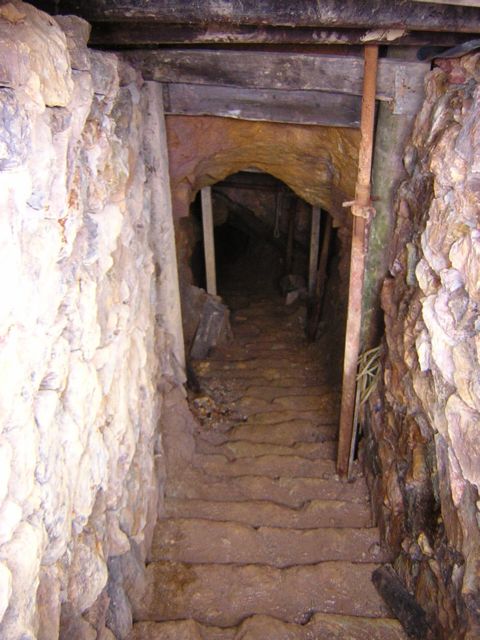
Parys Mine Shaft. View down a shaft at Parys Mine.
Photo by Stephen Elwyn Roddick – CC BY-SA 2.0
At the time More visited, Thomas Williams had only just begun his rapid rise to power. He was already a major industrialist and grown stupendously wealthy. When More asked about his stables, Williams apparently could not even estimate how many he possessed to the nearest ten. But Williams not yet even master of the mountain.
Nonetheless, the mining was well underway. The closest port, Amlwch, was already connected to the mountain by a new road that had been built for the Parys Mine Company’s sole use. Having not long ago been a village of just six houses, Amlwch had turned into a bustling port.
The mine itself was a source of fascination. “This differs from any mine I had ever seen or perhaps is anywhere else to be found, for the ore here instead of being met with in veins is collected into one great mass, so that it is dug in quarries and brought out in carts without any shafts being sunk”. Instead, the miners hollowed out the mountain itself, forming vast caverns that they supported by simply leaving vast columns of the ore untouched. He noted at least four or five of these caverns with ceilings forty feet high, with columns of yellow ore: “the whole seemed like the ruins of some magnificent building whose pillars had been of massy brass.”
It’s a fascinating insight into what Parys would have very briefly looked like, because today there is so little of the mountain left. Indeed, some of the caverns More got to see were already collapsing, with the rubble then needing to be sorted. He describes how one such piece of rubble — a two-ton chunk of ore — had to be bored, the cavity rammed with gunpowder and sealed with stones, and then exploded. “They are continually blowing up parts of the mine”, he noted, and was informed that the part of the mine he was visiting alone got through 10-12 tons of gunpowder per year. The mountain was disintegrating, punctuated by the occasional boom.
And as though that were not dramatic enough, the whole place smelled like hell. When More visited there were some seventy vast kilns upon the mountain for calcining the ore, burning off its sulphur. Each kiln held some 2,000 tons of ore, and when ignited with a little dried vegetation or coal it was so sulphurous that it took four months of furious burning for the ore to be sufficiently calcined. He noted that one had to keep to the windward side of the kilns, as “the fumes arising from them are very disagreeable and destroy all vegetables for a considerable distance around them.”
Comments Off on The brief – but vastly profitable – heyday of Parys Mountain
If you like the CRTC regulating the internet, you’ll love having them regulating video games!
Not satisfied with strenuously trying to break the internet for ordinary Canadians, the Trudeau government is now being lobbied to introduce regulation of video games, too:

Bill C-11 may have receded into the background of CRTC consultations and government policy directions, but Canadians concerned with user content, video game and algorithmic regulation would do well to pay attention. Lobby groups that fought for the inclusion of user content regulation in the bill have now turned their attention to the regulatory process and are seeking to undo government assurances that each of those issues – user content, algorithms and even video games – would fall outside of the scope of the regulatory implementation of the bill. In fact, if the groups get their way, Canadians would face unprecedented regulations with the CRTC empowered to create a host of new obligations that could even include requirements for Youtubers and TikTokers to register with the Commission. With a new Heritage Minister in place, the submissions raise serious concerns about whether the government will maintain its commitments regarding scoping out users, video games, and algorithms.
The most troubling publicly available document comes from a coalition that calls itself ACCORD, representing songwriters, composers, and music publishers. The group has posted its submission to the government’s consultation on the draft policy direction to the CRTC on Bill C-11. All submissions are not yet posted, but I should note that I also submitted a brief document, calling on the government to fully honour its commitment to exclude user content and algorithms from regulation and to establish limits on discoverability regulation.
The government’s draft direction had called for “minimizing” algorithmic regulation and the exclusion of user content and video game regulation. The music lobby is now calling on the government to rollback virtually all of its commitments on these issues. The draft direction states:
The Commission is directed not to impose regulatory requirements on
(a) online undertakings in respect of the programs of social media creators, including podcasts; and
(b) broadcasting undertakings in respect of the transmission of video games.
The lobby wants virtually all of this removed, deleting references to online undertakings and video games. Moreover, the directive speaks to Section 4.2, stating:
In exercising its powers under section 4.2 of the Act, the Commission is directed to set out clear, objective and readily ascertainable criteria, including criteria that ensure that the Act only applies in respect of programs that have been broadcast, in whole or in significant part, by a broadcasting undertaking that is required to be carried on under a licence or that is required to be registered with the Commission but does not provide a social media service.
Here too the lobby group wants most of the paragraph deleted. And while the government directed the CRTC to minimize algorithmic regulation for discoverability purposes, the groups wants those limitations removed as well. In short, the lobby groups validate the concerns expressed by thousands of Canadians that Bill C-11 opened the door to the regulation of user content, video games, and algorithms.
Comments Off on If you like the CRTC regulating the internet, you’ll love having them regulating video games!
French 75mm of 1897
vbbsmyt
Published 30 Dec 2021The French 75 is widely regarded as the first modern artillery piece. It was the first field gun to include a hydro-pneumatic recoil mechanism, which kept the gun’s trail and wheels perfectly still during the firing sequence. Since it did not need to be re-aimed after each shot, the crew could reload and fire as soon as the barrel returned to its resting position. In typical use the French 75 could deliver fifteen rounds per minute on its target, either shrapnel or high-explosive, up to about 8,500 m (5.3 mi) away. Its firing rate could even reach close to 30 rounds per minute, albeit only for a very short time and with a highly experienced crew. [wikipedia: https://en.wikipedia.org/wiki/Canon_d…]
The concept for the gun anticipated future conflict being a war of manoeuver — with massed infantry and cavalry attacks — based on the experience of the wars of 1870-1872. Consequently the gun was designed to be able to be moved easily, set up quickly and fire antipersonnel shells (shrapnel) rapidly, and without the need to reset the carriage after each shot. Two critical components were the cased ammunition (shell and cartridge as a single unit) and a recoil system that completely absorbed the recoil forces and returned the gun to its original position without disturbing the gun’s position.
This animation shows the actions necessary to prepare the gun from its “travelling” state to operational state. The carriage has to be “locked” into a fixed position and levelled. The operation of shrapnel shells depends upon setting a time fuse to explode the shell just in front of an attacking force, to shower them with balls, and demonstrates the French Débouchoir mechanical fuse setter that allowed time fuses to be set rapidly and accurately. The liquid (oil) and air (pneumatic) recoil mechanism used a “floating piston” — on one side hydraulic oil and on the other compressed air. The design must keep these two separated while allowing the free piston to move rapidly. The French design laid great emphasis on seals made of silver – being soft enough to conform to the sleeve housing, but as reported by the US when they started manufacturing the 75mm, the key element was highly precise machining of the sleeve housing the free piston.
The French 75mm of 1897 was of less use with the introduction of trench warfare, where howitzers and mortars being the primary artillery, but the 75mm retained some value, one use being firing shrapnel shells at aircraft. A longer time fuse had to be developed to reach the altitude that some aircraft flew at.
(more…)
Comments Off on French 75mm of 1897
QotD: How pre-modern cities shaped the surrounding landscape
Every town or city, of course, will be different. For agricultural societies especially, local terrain sharply constrains possible land uses. Some land is simply too wet or dry or rough or rocky or infertile for this or that purpose. In a modern city, apartments or factories or offices can be built almost anywhere; the sort of land suitable for intensive farming is more limited. This is even more true for pre-modern societies working without modern fertilizer, without electric-powered irrigation and without the industrial technology to massively reshape terrain (draining swamps, filling ravines, flattening hills, irrigating the desert, etc – some of these can be done with hand tools, but not to the extent we can today).
Still, we want to begin thinking about how cities impact the land around them without all of these difficult and confusing variables. We want to image a city, isolated and alone in the middle of an endless, flat and featureless plain. This is exactly what J. H. von Thünen did in The Isolated State (Der isolierte Staat). This kind of exercise can give us a baseline of what the landscape around a decent sized city might look like, which we can then modify to respond to different terrain, technology and social organization.
(Note: I would be remiss if I didn’t note that my discussion of these ideas owes heavily to Neville Morley’s Metropolis and Hinterland (1996), where he applied this very method to the city of Rome and its hinterland (and also first introduced me to von Thünen’s ideas). That book and also his Trade in Classical Antiquity are both great books to give a read if you want to begin building a sense of how pre-modern economies work).
The key factor von Thünen looks at is transportation costs. For a society without trains or trucks, moving bulk materials of any kind over long distances is extraordinarily expensive. Moving grain overland, for instance, would cause its cost to double after 100 miles. Thus land close to our theoretical city is extremely valuable for production, while land far away is substantially less valuable (because the end goal is transporting the agricultural production of that land to the city). As a result, transit costs – and thus distance – dominates how cities influence land-use patterns (along with population, which determines the intensity of the city’s influence).
Bret Devereaux, “Collections: The Lonely City, Part I: The Ideal City”, A Collection of Unmitigated Pedantry, 2019-07-12.
Comments Off on QotD: How pre-modern cities shaped the surrounding landscape
July 28, 2023
Ideology and Mediocrity: Inside the 12th SS Division Leadership
OTD Military History
Published 27 Jul 2023Historian Dr. Philip W. Blood discusses how the leadership of the 12th SS (Hitler Youth) Panzer Division were a clique of ideological motivated Nazis and most were promoted into their positions because of their loyalty to Hitler and Nazism and not because they were good soldiers.
Check out my full conversation with Philip Blood at the link below.
Waffen-SS Fantasies and the Commodification of War Crimes
https://youtube.com/live/vdZf_2tooSM
(more…)
Comments Off on Ideology and Mediocrity: Inside the 12th SS Division Leadership
Progressive objections to Oppenheimer
Disclaimer: I haven’t seen the movie, and have no immediate plans to do so. That said, there’s a lot of discussion about the movie, its successes and its failures and how it relates to today’s issues. Over at Founding Questions, Severian felt the need to do a proper fisking of one particularly irritating take:

This is one of two Oppenheimer stories that popped up this morning. I don’t watch tv and haven’t seen a movie in the theater in decades; I doubt I’ve seen more than a handful of “new” movies in the last ten years. So I really am not the target audience for this kind of thing, but … I don’t get it. Why is this movie such a big deal? Have they decided to simply create The One Pop Culture Thing out of whole cloth?
Anyway, let’s see what they have to say:
There’s a cabal online, and even in some professional circles, arguing that Nolan has made the bombing of Hiroshima and Nagasaki a sideshow: that Oppenheimer looks away from the devastating effects of what happened on August 6 and 9 1945.
I guess this is where the Historian in me will forever override the pop culture critic. Obviously Robert Oppenheimer knew he was developing a weapon. The difference between a nuclear bomb and a regular bomb is one of degree, not kind. American firebombing had already done to dozens of Japanese cities what Oppenheimer’s nuke did to Hiroshima. Curtis LeMay knew it, too — after the war, he said that he’d have been rightfully tried for war crimes had the outcome gone the other way. I simply cannot see how this man is uniquely culpable for anything … or if he is, then Rosie the Riveter should be held accountable for every bomber that rolled off the assembly line.
Anti-nuclear groups have been similarly disappointed, with Carol Turner from the Campaign for Nuclear Disarmament telling The Guardian that “the effect of the [Hiroshima and Nagasaki] blasts was to remove the skin in a much more gory and horrible way – in [Oppenheimer] it was tastefully, artfully presented.”
That‘s your objection? That people weren’t shown getting killed in a realistic-enough manner? Jesus Christ, do you people ever listen to yourselves? That’s fucking sick. You are a loathsome excuse for a human being, Carol Turner.
Although it says much about the morals and mechanics of war, Oppenheimer isn’t a war film: it’s ultimately about the internal conflict and persecution of one individual. To painstakingly focus on the Japanese victims would have made it an entirely different film, and one at odds with the rest of Nolan’s vision. (His fellow director James Cameron, meanwhile, is said to be planning a film on the victims of Hiroshima and Nagasaki.)
“Victims”. You keep using that word.
There is currently a trend for great cultural works, such as Oppenheimer, to be denigrated if they don’t tick certain boxes, and such complaints often come from the Left. A lack of focus on victims has been a frequent criticism: it’s an argument that gets wheeled out, for example, whenever a drama is being made about serial killers. Yet I don’t think artists are obliged to do this if it doesn’t fit into their own authorial vision.
I have to admit, I’m getting that old College Town feeling right now. The one where it feels like someone dropped some low-grade acid in my coffee, and I’m hallucinating. I know what all those words mean, but put together like that they don’t make any sense at all. On the most basic level, the objection here seems to be that movies require plots. A “drama about a serial killer”, for example (“drama” … what an odd word choice), requires murders. You know, mechanically speaking. But what does “focusing” on them add? Is it any more or less awful, learning that the dead guy killed at random by a lunatic was really into soccer and had a dog and liked classic rock?
And all this is before you consider that the most vocal critics of Oppenheimer are Leftists … the very same Leftists who are determined to fight to the very last drop of Ukrainian blood, and who seem to think that giving Zelensky tactical nukes is a super idea. Reading the Left’s pronouncements on Vladimir Putin, you’d be forgiven for thinking they’d like to nuke him twice, just to be sure.
Your concern for the “victims” of Hiroshima and Nagasaki rings a little hollow, gang, when you’ve been howling for blood 24/7 on Twitter for a year and a half.
Comments Off on Progressive objections to Oppenheimer
Merwin & Hulbert Revolvers
Forgotten Weapons
Published 21 Aug 2015The Merwin & Hulbert company was a short-lived firearms manufacturing partnership between designer Joseph Merwin and the Hulbert brothers as financiers. Merwin wanted to design a particularly strong and high-quality revolver, and he succeeded — his guns are arguably some of the best revolvers of the frontier era. The company made a wide variety of designs, but in this video I will be sticking to just the Frontier and Pocket Army models. Of particular note is the very clever unloading mechanism!
Comments Off on Merwin & Hulbert Revolvers
QotD: “Stakeholder” Capitalism
Of course, nobody participating in the push to replace shareholder capitalism with stakeholder capitalism would describe it this way. But then, euphemism and branding are each crucial tools in the Marxist’s verbal toolbox. So when you ask a stakeholder capitalist to describe stakeholder capitalism, what you ordinarily hear is that, as a business ethic, it combines the “sustainability” shareholder capitalism supposedly lacks with the “inclusivity” we’re not supposed to recognize is merely stultifying, policed conformity, the yield being a Woke capitalism that replaces production and consumption with “sharing and caring,” taking it out of the realm of the invisible and mechanical, as Adam Smith would have it, and placing it into the realm of values, where it can be used to shape the Greater Good the Marxist pretends he cares about. It’s fascism with a smiley face.
In the stakeholder capitalist system, investors aren’t — or at least, they shouldn’t be — solely interested in profits driven by production and consumption. And this is because to the stakeholder capitalist, itself a euphemism for collectivist corporatist, “it is well proven that our current form of Capitalism is inherently unsustainable because it requires endless growth on a planet with finite resources.”
Of course, none of this is “well proven” — the history of shareholder capitalism suggests the opposite, in fact, as innovation has led to the production of more and more out of less and less — but whether this is or isn’t the material case is incidental to those who are working on this inorganic worldwide paradigm shift commonly known as The Great Reset.
Because the move toward a “caring and sharing” worldwide economy, especially one that we’re told will be both sustainable and inclusive, requires those who care, those who share, and — most importantly, and at the very heart of the turn — those who get to determine what is cared about, who must do the sharing, and how most effectively to police the excesses that the ruling elite determine aren’t sustainable, while slowly dissolving the idea of the individual and his will to make way for an inclusive collective required to run the machinery of the self-installed Elect. It’s a global system of neo-Feudalism dressed in the finery of familiar values that have been deconstructed and re-signified, often without their consumers even aware that the values they reference — which were once commonly understood and largely shared by the civil society — are now their precise inverse: “tolerance”, thus, becomes the violent rejection of intolerance, as they define it; free speech is separated from “hate speech”, as they adjudicate it; individualism is but a controlling fiction maintained by the white male power structure that must be replaced by an ordered and value-determined collection of identity markers that construct you, while simultaneously acknowledging that there is no “you” beyond this assembly of discourses that assign your being its social situatedness, then places you within a collective of those with similar — though never identical — constructions. Once here, you are graded on the intersectional scale. Your relative worth and power come down to not to the content of your character, but rather to the collection and arrangement of your victimization tokens.
Jeff Goldstein, “Maybe I’ll be there to shake your hand, maybe I’ll be there to stakeholder capitalist the land”, protein wisdom reborn!, 2023-04-26.
Comments Off on QotD: “Stakeholder” Capitalism
July 27, 2023
Instead of a malignant conspiracy, consider the possibility it’s really a society-wide dearth of competence
Sarah Hoyt on a topic I’ve been pushing for years in casual conversation:

Recently, in a conversation between friends, the hypothesis was floated: what if all the burning farms, derailed trains, crop failures, etc. etc. etc. etc. ad scary nauseam aren’t really enemy action, but more a competency crisis.
As in these things happen not because big-bad is plotting against us, but because no one knows how to do the things they purportedly do anymore. Some kind of know, but they are hampered, slow, and sometimes hemmed in by counterproductive regulation or the result of previous “strokes of genius” decisions that broke the system.
I’m not going to bore anyone with what I know to be a massive crisis of competency plus inherited factors breaking ability to function in the field. I already did that at Mad Genius Club this morning, and am not unpacking the whole thing again.
But here’s the thing: All of us can live without a functioning fiction writing/selling market. Maybe not as pleasantly/happily, at least for those of us addicted to reading, but we can survive. We have old books to re-read, and if we get really desperate we can write our own fanfic.
It’s another thing when you talk of transportation or medicine, or farming, or – Well, everything else.
I have friends and fans in a lot of places. And almost everyone’s story is of being caught in the middle of a system where nobody knows or can do much of anything. It’s all the way the cogs and bureaucracy move. And the way they move is completely divorced from what needs done, or what anyone knows how to do.
To give an example: Suppose you were hired to haul buckets from a well. But when you actually get the job, you find out, no. Because of inherited systems, and what your superiors expect, you’re supposed to climb down the wall, hand over hand, and bring up water by the cupfull. And there are regulations in the works to make that by the spoonfull. However, you’ll be fully held to account if you can’t provide the amount of water the company is contracted for. You. Personally.
So, you do what you can. You fudge the books. On paper, you’re getting all this water up. Where the water goes no one knows, every one down stream (pardon the pun) from you does the same.
If this sounds like the soviet system? It is. It’s just that the directives don’t come directly and traceably from the government. (Though under the infestation of Bidentia they increasingly do.) Instead, they come from “experts” “scientists” “Studies” “marketing gurus.” And sometimes they are curtailed or made worse by agencies and regulations.
Yes, the managerial or worse “expert” class is the same that furnishes government. These are not your friends, are not meant to be your friends, and are convinced they know much more than you do.
What they know in fact is “how to manage.” But it’s not how to manage anything. They know theory of management (or whatever) derived from no reality (mostly from the writings of Marx, if you dig a little) and pushed ALL THE WAY DOWN.
It’s like — exactly like — being run by “experts” who memorized the Little Red Book. It might please those in power, but it has nothing to do with accomplishing the actual job in front of you.
Part of this has to do with colleges. Remember all those student demonstrations of the 60s? If you’re like me, and didn’t hit college till the eighties or younger, you might think these are, as the movies show, all anti-war and for civil rights, and all that jazz.
Unspoken to any of us is the fact that half of these demonstrations were to DUMB DOWN THE CURRICULUM. To demand easier grading. And social factors taken into account. And to “update” to “relevant things.”
The idea being that we were in a sort of an year zero and anything else, in the long storied glories of Western civ no longer counted, except for us to declare ourselves superior to it.
Comments Off on Instead of a malignant conspiracy, consider the possibility it’s really a society-wide dearth of competence
“Harvesting” Green Wood from the Side of the Road
Rex Krueger
Published 26 Jul 2023It’s just cutting up wood. Right?
(more…)
Comments Off on “Harvesting” Green Wood from the Side of the Road
The tourism blues
I must admit I’ve never enjoyed the “tourist” experience. Partly because I’m not comfortable in big crowds and I prefer the company of a small group — or just one other person — to the “everybody into the pool” model that many people seem to thrive on. Back when we could still afford to take holidays, Elizabeth and I carefully planned our trips to avoid, as best we could, everyone else’s favourite attractions. There are some things where crowds are a given (Bourbon Street in New Orleans, anywhere in Gettysburg, Pennsylvania, everywhere in or around London, etc.) but going as early as possible or at off-peak times helps keep the people-ness down to an almost acceptable level.
In The Line, Andrew Potter relates the lowlights of a trip to wonderfully scenic Banff, Alberta (which I visited once, and it was beautiful but very, very people-y even back in the 1980s):

“Banff Avenue, Banff” by InSapphoWeTrust is licensed under CC BY-SA 2.0 

 .
.
On an early-summer family vacation to the Rockies, we decided our first excursion would be to Johnston Canyon, which tops any number of “bucket list” rankings of things to do while in Banff.
Turns out we were just four of a few thousand other people who had the same idea. Despite getting to the parking lot just after eight a.m., we spent the next few hours shuffling along a narrow boardwalk, being pushed from behind by tourbusloads of Tilley-hatted boomers while dodging around young couples dragging infants in strollers up the canyon. At each prescribed Important Sight along the way, we’d stop for 20 minutes or so while everyone took turns taking selfies in every possible permutation of their group membership.
Back at the bottom, we vowed we wouldn’t do that again, so we spent the rest of our time in the area doing hikes drawn from the very bottom of the bucket lists, skipping the alleged must-dos like the Sulphur Mountain gondola, Moraine Lake, and Lake Louise. Apparently the town of Banff is lovely, but who knows. We never set foot in it.
Tourism presents the traveller with two main dilemmas: One is what it does to us (the visitors); the other is what it does to them (the visitees). These are problems, respectively, of authenticity and commodification. And as it turns out, they are just two ways of looking at the same underlying dynamic.
For many people, the aim of travel is self-perfection. We move about the Earth in the hope of having new experiences, discovering new cultures, feeling new emotions. We want to get out of our comfort zones, out of the ruts of the familiar and experience something exotic and authentic, as a way of getting in touch with our true or better selves.
The problem is other people have the same ambitions, the same drives and desires. And this creates a market amongst “locals” for these cravings for the authentic or the exotic, which gives rise to the modern tourist industry: Get on the tour bus; see the sight; do the thing; exit through the gift shop. This can be a highly dispiriting experience, leading one to question why one bothers going anywhere, ever.
Comments Off on The tourism blues


