Jago Hazzard
Published 13 Aug 2023Peep peep!
(more…)
December 19, 2023
Overthinking Thomas the Tank Engine: What Actually Is Thomas?
Comments Off on Overthinking Thomas the Tank Engine: What Actually Is Thomas?
QotD: The art of the Millennial celebrity memoir
“Who Am I?” asks Danny’s book, knowing full well who he is. To feign humility, the title does that Millennial thing: asks a question to which it knows the answer.
I have a cactus-like indifference to celebrity, to Danny Cipriani, to anyone over whom the kaffeeklatsch gushes. Danny was a gifted athlete who drained his Superman abilities in pursuit of celebrity. Little is more tragic than wasted talent.
The Romans thought celebrities were mentally deranged, and to be avoided. To this day, we’re yet to discover the secret behind their vastly superior self-healing concrete. The Romans had a point.
Anyway, Danny’s sex life, as documented in his book, would blush the cheeks of a Roman senator.
Danny has bedded scores of beautiful women. This happens when one is Hollywood handsome, rugged, cocky, and a known shagger. At the height of his bedhopping campaign, Danny featured permanently in the tabloid press, each week a new beauty attached to his arm.
In short, Danny could indulge himself senselessly and did so with the atomic energy of a nymphomaniac in the waiting room at Dignitas.
Reader, that’s it. That’s the story. A young man blessed with opportunities to shag beautiful women indulged those opportunities to shag beautiful women.
[…]
This book could have been a tweet.
Christopher Gage, “Spare a Thought: The inexorable rise of pitybragging”, Oxford Sour, 2023-09-12.
Comments Off on QotD: The art of the Millennial celebrity memoir
December 18, 2023
Napoleon Bonaparte on film
In The Critic, Peter Caddick-Adams considers the revival of the biopic, with emphasis on Napoleon Bonaparte, thanks to the recent Ridley Scott movie:
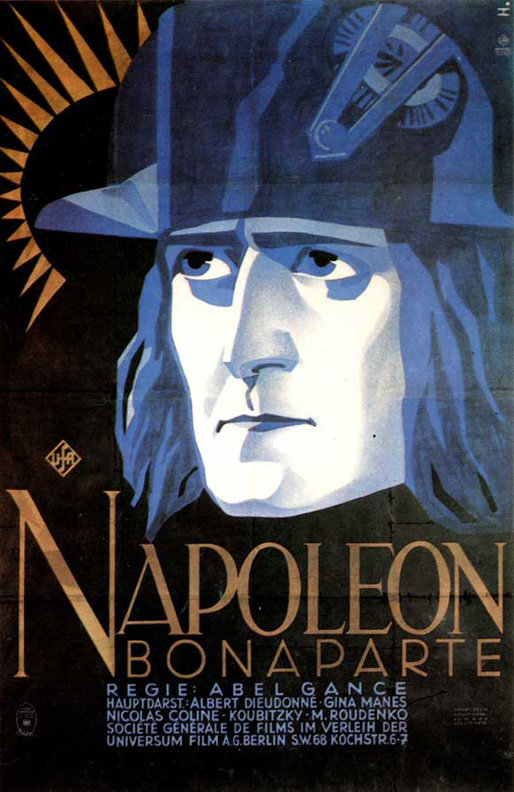
One of the posters for a much-shortened cut of Abel Gance’s Napoléon for the German market, 1927.
Some of the first motion pictures were biopics, initially silent. In portraying a high-minded individual, historical or contemporary, who has influenced our lives in some way, cinema’s hope is that some of the character’s prestige will rub off into the film. Both sides of the Atlantic have seen countless examples, because the genre is traditionally presented as culturally above a thriller, western or a musical. Its offer is an invitation to see history. Let us take Oppenheimer or Napoleon, with Cillian Murphy and Joachim Phoenix in the title roles. Viewers are attracted by the concept of a true story, be it the designer of the first atomic bomb, or the little emperor who dominated Europe. They may know little or a lot about the subject, even if only hazy knowledge from distant schooldays, but they start with more base knowledge than any other genre.
Gifted directors, in this case Christopher Nolan and Ridley Scott, with their cast hold our hands and walk us into an historical context, hinting at grandeur or importance. We are led into a panorama of life that’s now seen as great or significant. Whether you’re glued to a small screen nightly, or whether you go to the cinema only once or twice a year, the biopic demands attention as “education”, in a way a thriller, horror or romcom flick does not. We are sold the idea that reel history (which can never be real history) somehow merits our valuable time, more than mere “entertainment”.
Napoleon first burst onto the screen in 1927 with a silent-era masterpiece directed by Abel Gance. Far ahead of its time, the final scenes were shot by three parallel cameras, designed to be projected simultaneously onto triple screens, arrayed in a horizontal row called a Triptych, the process labelled “Polyvision” by Gance. It widened the cinematic aspect to a field of vision unknown then or since. The director tried to film the whole in his Polyvision, but found it too technical and expensive. When released, only the centre screen of footage was shown, to a specially composed score. Designed as one episode of several to tell the emperor’s life, which we would today label a franchise, the 1927 extravaganza came in at 5.5 hours, necessitating three intermissions, including one for dinner. Gance had interpreted his biopic as a grand opera. It has been much trimmed and revisited by other directors, including Francis Ford Coppola in the 1980s, and restoration of lost footage is still ongoing. I saw the 5.5-hour version in the Royal Festival Hall in 2000, with a score by Carl Davies (of World at War fame). For a film emerging from the Stone Age of cinematography, its excitingly modern ambition was worth my bum ache. I could see what all the fuss was about.
Curiously, the real value of Gance’s Napoléon was in technique rather than content. If you think of the silent era, it’s mostly the comics who come to mind, playing out their dramas in front of a single static camera. Gance seized this new medium, first embraced in December 1895 by the Parisian Lumière Brothers, and turned it on its head. Napoléon featured not just the Triptych experiment, but many other innovative techniques commonplace today. These included fast cutting between scenes of alternating dialogue, extensive close-ups, a wide variety of hand-held camera shots, location shooting, multiple-camera setups and film tinting (colouring), so altering cinematography for ever.
Although Rod Steiger gave us a different take on Napoleon in Sergei Bondarchuk’s Waterloo of 1970, with its leading actors of the day and massive cast of extras, comprising much of a Soviet army division in period costume and filmed behind the old Iron Curtain, Ridley Scott’s new Napoleon is clearly paying homage to the Gance Napoléon in ambition and length. Scott pretty much picks up the story where Gance left off, and he is able to deploy technology of which Gance could only dream. However, with both films, screenwriter, director and actors are at a disadvantage common to all biopics of having to work against the viewers’ check-list of facts they know, or expect to see included. Thus Scott, like Gance, relies on spectacular technique over storyline. This brings viewers, especially my fellow fuming historians, into a collision between historical truth and the possibilities of celluloid story-making.
Most of us have a mental picture of the character we are invited to watch, which constrains actors and their make-up teams, who have to imitate particular people, with all the wigs, prosthetics and accents that entails. Yet, to view the biopic as a piece of history is to miss the point of the motion picture industry. Pick up a screenplay, and you will be surprised at how few pages it comprises, how few words on each page. None read like a literary biography. With only 90–120 minutes in a typical movie, there is not enough time to cover a character’s full life — not even that of Napoleon in 5.5 hours. Instead, the challenge for the writing-directing team is to extract snippets of a life to demonstrate the evolution of character.
Comments Off on Napoleon Bonaparte on film
“I hashtag these foolish dupes ‘Useful Yidiots'”
Barbara Kay isn’t fond of the Jewish groups that provide media cover for antisemites:

Have you heard the expression, “Two Jews, three opinions”? Truly, we have always been a contentious people.
In judging the worthiness of any particular internal debate, our sages applied the criterion of motivation. Constructive debate, they decreed, was noble; debate intended to wound was ignoble. I consider “ignoble” any public rhetoric by Jews that provides both comfort and ammunition to our enemies.
These Jews can be found in academia and the media, as well as in anti-Zionist groups, such as Jewish Voice for Peace and the If not Now movement. All preface their public statements with “Speaking as a Jew” or similar tropes. They’re willingly trotted out by Israel-loathing activists to deflect charges of demonstrable antisemitism in their ranks. On X, I hashtag these foolish dupes “Useful Yidiots”.
For candour and ignobility, it is hard to beat a 2008 Facebook post by Useful Yidiot Michael Neumann, Trent professor of philosophy, and, not incidentally, the son of German Jewish refugees:
(My aim is to) help the Palestinians (and) I am not interested in the truth, or justice, or understanding, or anything else, except so far as it serves that purpose … If an effective strategy means that some truths about the Jews don’t come to light, I don’t care. If an effective strategy means encouraging reasonable anti-Semitism, or reasonable hostility to Jews, I also don’t care. If it means encouraging vicious racist anti-Semitism, or the destruction of the state of Israel, I still don’t care.
Neumann’s savage tone is typical of a certain sub-genre of Useful Yidiots. These are psychologically warped intellectuals who interpret their own or their family links to the Holocaust as a de facto moral credential endowing them with authority to promote the odious libel against Israel of Holocaust inversion: that is, the pernicious false allegation that Israel is to the Palestinians what the Nazis were to the Jews.
In their febrile imaginations, Israel is pure evil, while the Palestinians are blameless victims with no agency in the creation of their alleged Holocaust-level circumstances, and no power to effect change in their destiny. All expressions of Palestinians’ hatred for Jews (at Israel and abroad) and any form of violence against them qualify as justified “resistance”.
There is no better example of the type than Norman Finkelstein, in progressive circles a much admired historian, who has devoted his entire professional life to Holocaust inversion. His parents — alone of their entire families — survived Auschwitz and Maidanek. How their tragedy inspired Finkelstein’s rabid loathing for mainstream Jewry and Israel, always presented under cover of a near-ecstatic empathy with Palestinian suffering, is a question for psychoanalysts to solve if they can, but rabid is certainly the word for it (conservative intellectual and journalist Douglas Murray termed Finkelstein a “psychopath”).
Comments Off on “I hashtag these foolish dupes ‘Useful Yidiots'”
Battle Taxis | Evolution of the Armoured Personnel Carrier
The Tank Museum
Published 8 Sept 2023Tanks and infantry need to operate together. Tanks provide firepower and protection, the infantry support and protect the tanks. In this video, we look at that vital component of the equation, the Armoured Personnel Carrier and its transition into the modern Infantry Fighting Vehicle.
(more…)
Comments Off on Battle Taxis | Evolution of the Armoured Personnel Carrier
QotD: A short history of the (long) Fifth Century
First, its important to understand that the Roman Empire of the fourth and fifth centuries was not the Roman Empire of the first and second centuries (all AD, to be clear). From 235 to 284, Rome had suffered a seemingly endless series of civil wars, waged against the backdrop of worsening security situations on the Rhine/Danube frontier and a peer conflict in the east against the Sassanid Empire. These wars clearly caused trade and economic disruptions as well as security problems and so the Roman Empire that emerges from the crisis under the rule of Diocletian (r. 284-305), while still powerful and rich by ancient standards, was not as powerful or as rich as in the first two centuries and also had substantially more difficult security problems. And the Romans subsequently are never quite able to shake the habit of regular civil wars.
One of Diocletian’s solutions to this problem was to attempt to split the job of running the empire between multiple emperors; Diocletian wanted a four emperor system (the “tetrarchy” or “rule of four”) but what stuck among his successors, particular Constantine (r. 306-337) and his family (who ruled till 363), was an east-west administrative divide, with one emperor in the east and one in the west, both in theory cooperating with each other ruling a single coherent empire. While this was supposed to be a purely administrative divide, in practice, as time went on, the two halves increasing had to make do with their own revenues, armies and administration; this proved catastrophic for the western half, which had less of all of these things (if you are wondering why the East didn’t ride to the rescue, the answer is that great power conflict with the Sassanids). In any event, with the death of Theodosius I in 395, the division of the empire became permanent; never again would one man rule both halves.
We’re going to focus here almost entirely on the western half of the empire […]
The situation on the Rhine/Danube frontier was complex. The peoples on the other side of the frontier were not strangers to Roman power; indeed they had been trading, interacting and occasionally raiding and fighting over the borders for some time. That was actually part of the Roman security problem: familiarity had begun to erode the Roman qualitative advantage which had allowed smaller professional Roman armies to consistently win fights on the frontier. The Germanic peoples on the other side had begun to adopt large political organizations (kingdoms, not tribes) and gained familiarity with Roman tactics and weapons. At the same time, population movements (particularly by the Huns) further east in Europe and on the Eurasian Steppe began creating pressure to push these “barbarians” into the empire. This was not necessarily a bad thing: the Romans, after conflict and plague in the late second and third centuries, needed troops and they needed farmers and these “barbarians” could supply both. But […] the Romans make a catastrophic mistake here: instead of reviving the Roman tradition of incorporation, they insisted on effectively permanent apartness for the new arrivals, even when they came – as most would – with initial Roman approval.
This problem blows up in 378 in an event – the Battle of Adrianople – which marks the beginning of the “decline and fall” and thus the start of our “long fifth century”. The Goths, a Germanic-language speaking people, pressured by the Huns had sought entry into Roman territory; the emperor in the East, Valens, agreed because he needed soldiers and farmers and the Goths might well be both. Local officials, however, mistreated the arriving Goth refugees leading to clashes and then a revolt; precisely because the Goths hadn’t been incorporated into the Roman military or civil system (they were settled with their own kings as “allies” – foederati – within Roman territory), when they revolted, they revolted as a united people under arms. The army sent to fight them, under Valens, engaged foolishly before reinforcements could arrive from the West and was defeated.
In the aftermath of the defeat, the Goths moved to settle in the Balkans and it would subsequently prove impossible for the Romans to move them out. Part of the reason for that was that the Romans themselves were hardly unified. I don’t want to get too deep in the weeds here except to note that usurpers and assassinations among the Roman elite are common in this period, which generally prevented any kind of unified Roman response. In particular, it leads Roman leaders (both generals and emperors) desperate for troops, often to fight civil wars against each other, to rely heavily on Gothic (and later other “barbarian”) war leaders. Those leaders, often the kings of their own peoples, were not generally looking to burn the empire down, but were looking to create a place for themselves in it and so understandably tended to militate for their own independence and recognition.
Indeed, it was in the context of these sorts of internal squabbles that Rome is first sacked, in 410 by the Visigothic leader Alaric. Alaric was not some wild-eyed barbarian freshly piled over the frontier, but a Roman commander who had joined the Roman army in 392 and probably rose to become king of the Visigoths as well in 395. Alaric had spent much of the decade before 410 alternately feuding with and working under Stilicho, a Romanized Vandal, who had been a key officer under the emperor Theodosius I (r. 379-395) and a major power-player after his death because he controlled Honorius, the young emperor in the West. Honorius’ decision to arrest and execute Stilicho in 408 seems to have precipitated Alaric’s move against Rome. Alaric’s aim was not to destroy Rome, but to get control of Honorius, in particular to get supplies and recognition from him.
That pattern: Roman emperors, generals and foederati kings – all notionally members of the Roman Empire – feuding, was the pattern that would steadily disassemble the Roman Empire in the west. Successful efforts to reassert the direct control of the emperors on foederati territory naturally created resentment among the foederati leaders but also dangerous rivalries in the imperial court; thus Flavius Aetius, a Roman general, after stopping Attila and assembling a coalition of Visigoths, Franks, Saxons and Burgundians, was assassinated by his own emperor, Valentinian III in 454, who was in turn promptly assassinated by Aetius’ supporters, leading to another crippling succession dispute in which the foederati leaders emerged as crucial power-brokers. Majorian (r. 457-461) looked during his reign like he might be able to reverse this fragmentation, but his efforts at reform offended the senatorial aristocracy in Rome, who then supported the foederati leader Ricimer (half-Seubic, half-Visigoth but also quite Romanized) in killing Majorian and putting the weak Libius Severus (r. 461-465) on the throne. The final act of all of this comes in 476 when another of these “barbarian” leaders, Odoacer, deposed the latest and weakest Roman emperor, the boy Romulus Augustus (generally called Romulus Augustulus – the “little” Augustus) and what was left of the Roman Empire in the west ceased to exist in practice (Odoacer offered to submit to the authority of the Roman Emperor in the East, though one doubts his real sincerity). Augustulus seems to have taken it fairly well – he retired to an estate in Campania originally built by the late Republican Roman general Lucius Licinius Lucullus and lived out his life there in leisure.
The point I want to draw out in all of this is that it is not the case that the Roman Empire in the west was swept over by some destructive military tide. Instead the process here is one in which the parts of the western Roman Empire steadily fragment apart as central control weakens: the empire isn’t destroyed from outside, but comes apart from within. While many of the key actors in that are the “barbarian” foederati generals and kings, many are Romans and indeed (as we’ll see next time) there were Romans on both sides of those fissures. Guy Halsall, in Barbarian Migrations and the Roman West (2007) makes this point, that the western Empire is taken apart by actors within the empire, who are largely committed to the empire, acting to enhance their own position within a system the end of which they could not imagine.
It is perhaps too much to suggest the Roman Empire merely drifted apart peacefully – there was quite a bit of violence here and actors in the old Roman “center” clearly recognized that something was coming apart and made violent efforts to put it back together (as Halsall notes, “The West did not drift hopelessly towards its inevitable fate. It went down kicking, gouging and screaming”) – but it tore apart from the inside rather than being violently overrun from the outside by wholly alien forces.
Bret Devereaux, “Collections: Rome: Decline and Fall? Part I: Words”, A Collection of Unmitigated Pedantry, 2022-01-14.
Comments Off on QotD: A short history of the (long) Fifth Century
December 17, 2023
How RFK, Jr. helped destroy British Columbia’s resource-based economy
Elizabeth Nickson found herself added to one of Robert F. Kennedy Jr.’s fundraising mailing lists:
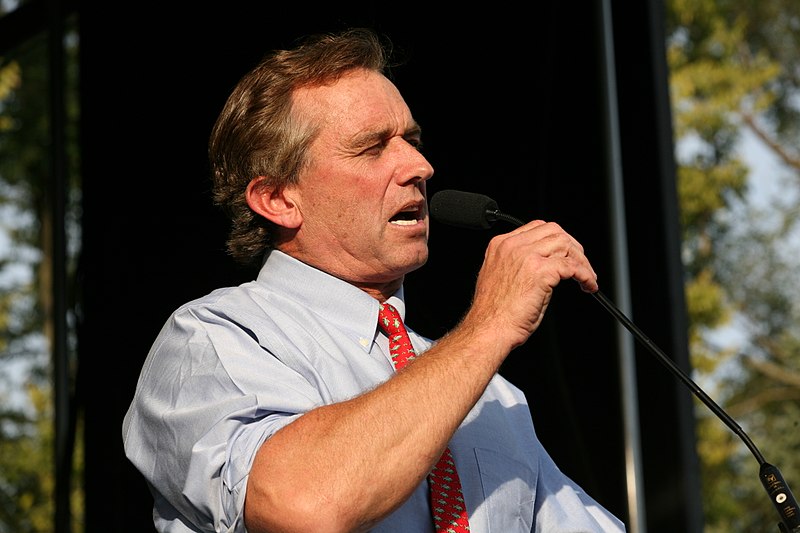
Robert F. Kennedy, Jr. speaking in Urbana, Illinois on October 14, 2007.
Photo by Daniel Schwen via Wikimedia Commons.
I am on RFKJr’s campaign mailing list, probably through Children’s Health Defence and they asked me for money, and I said sure, just as soon as he fixes the catastrophe he caused in the province where I live.
Got a message back!
It read, “Elizabeth, I am sure Robert would fix whatever harm he caused, can you explain?”
No problem, I said.
1. In British Columbia, we had the largest industrial forest in the world
2. It paid for education and universal “free” health care.
3. The environmental left decided to shut it down.
4. The reason for their protest was that the government, as was common practice, had sold cutting permits with long leaseholds. A new socialist government announced it was pulling the permits and taking those forests back.
5. In order not to lose all the invested money, which they had not only paid for upfront and in annual leasing charges, but paid taxes on, some for decades, lessees immediately clear cut their lands. Clear cuts are ugly. (but they are fire breaks)
6. That triggered the protest.
7. RFK Jr came in under RiverKeepers and supercharged the protest. His celebrity and glamour made the protest major international news. I was in London, I heard about it. More kids joined the protest. And then more and more. Until the government caved. Would it have happened without his presence? I do not think so. He gave very young people who had no access to power, nor any hope of it, ever, a very heady hit of significance and their lives took on huge huge meaning. For many it remains the high point of their lives. Because for the province, it was all downhill from there. All promise vanished and a grinding slow growth followed.
8. Over the ensuing ten years, cutting was diminished and heavy regulation covered the rest. By 2002, written regulations piled on top of each other stood seven feet high, taller than a man.
9. Forested communities died.
10. 100,000 families lost their livelihood.
11. Resource jobs have huge multipliers, not only forested towns died, so did regional metropolitan centers. Greens, replete with success, hit other resource industries – mining, ranching – which died. More families bankrupted.
12. They were told to go into tourism.
13. Which pays minimum wage and can only support a family if everyone, even the children, work. And, it’s seasonal.
14. Over time, the unmanaged forests became clogged with overgrowth, little trees like carrots pulled all the water from the forest floor, desiccated the soil and then pulled water from aquifers. The forests became tinder. And increasingly every summer, they explode in fire.
15. The government needed money.
16. Casinos provided it.
17. Asian cartels – you cannot imagine how violent they are – moved in and used the casinos to launder most of the drug money from North America. They bribed immigration, they bribed city government, they threatened anyone who tried to stand in their way.
18. They were so successful, human trafficking and child sex trafficking shot up. We have the second largest port on the west coast of North and South America. Through it streams container loads of drugs and trafficked children and women. At the port, you just stand aside, if you want to live. You think most of the fentanyl comes in through Mexico? Nope. It comes in through us.
19. The cartels do pay taxes. You think Black Rock is bad? These guys kill if they don’t get what they want. They are buying every business they can, to launder money through. The cartels also launder money through real estate in the city. That means housing is insanely expensive and property taxes are sky high. Canadians can’t afford to buy houses or live in the ones they own. A family making a median income has to pay 100% of income to buy a median priced house.
20. Crime is a) a driver of the economy and b) a principal source of government revenue.
21. Green has destroyed the province.
And that, I am afraid, is what celebrities do. It is why they are so hated, and one of the reason Hollywood is dying. They destroy the lives of ordinary men and women, and then move on to greater heights. Their lives are so privileged, they have absolutely no idea how people make money. And RFKJr, mind-numbingly privileged from birth, is the same. When asked about climate change, he says it’s happening but taxes won’t work. “Regenerative agriculture” he says, vaguely. It is true, regenerative agriculture could capture a lot of carbon, the amount debatable but it has promise. But cutting regulation? He has no, zero, absolutely no idea of how regulation punishes the non-elites. His is a black hole of ignorance and that is common; a majority have zero idea. Zero.
Comments Off on How RFK, Jr. helped destroy British Columbia’s resource-based economy
The Battle of the Bulge Begins – WW2 – Week 277 – December 16, 1944
World War Two
Published 16 Dec 2023Adolf Hitler’s Ardennes counteroffensive finally goes off this week, and it does indeed catch the Allies by surprise, and they suspend other offensive operations in the west. They are still attacking in Italy, and the Soviets are still advancing in Hungary, trying to cut off Budapest. In the Far East, there are Allied landings on Mindoro, and they are also on the march in Burma, hoping to pin down the enemy.
0:00 Intro
0:55 Recap
1:22 Street fighting in Athens
04:07 Operation Queen ends
06:33 Autumn Mist Offensive plans
09:51 Allied intelligence failures
12:26 The Ardennes Offensive Begins
16:57 Allied attacks in Italy and Soviet plans to surround Budapest
20:07 The Allied offensive in Burma
22:10 Mindoro Landings
24:33 Summary
25:14 Conclusion
(more…)
Comments Off on The Battle of the Bulge Begins – WW2 – Week 277 – December 16, 1944
Justapedia, the latest “new Wikipedia“
At Quillette, Shuichi Tezuka introduces the latest challenger to the ever-more-biased free online encyclopedia Wikipedia:

In the aftermath of Elon Musk’s purchase of Twitter late last year, the journalist Jon Levine asked him: “I wonder how much Wikipedia would cost?” Musk had recently complained that Wikipedia has a “non-trivial left-wing bias”, and a few months earlier, had commented that “Wikipedia is losing its objectivity.” But regardless of whether Musk would have liked to purchase the site, there never was any real possibility of that happening, as stated by Wikipedia’s symbolic leader Jimmy Wales: “Wikipedia is not for sale”.
Following this exchange, there were several discussions on Twitter (as it was called at the time) about whether Musk might create his own alternative to Wikipedia. In the end Musk did not make such an attempt, but approximately eight months later, someone else did.
This new online encyclopedia, known as Justapedia, is the latest in a long series of attempts by various individuals to create a competitor to Wikipedia. So far all previous attempts have either been unsuccessful, or morphed into something so unlike Wikipedia that they could no longer be considered a competitor. However, one thing working in Justapedia’s favor is that the need for such a competitor is stronger now than it has been in past years, due to several recent controversies revolving around the manipulation and/or politicization of Wikipedia, along with a widespread perception that Wikipedia has not done enough to prevent this type of problem.
Justapedia was recently publicized by Larry Sanger, who co-founded Wikipedia alongside Wales, during an interview with Russell Brand and in a subsequent blog post. This article will present a more detailed examination of Justapedia’s background, including some of the recent controversies that demonstrate why it is needed, as well as the poor record of success other Wikipedia alternatives have had up to this point. Will Justapedia succeed where most other Wikipedia competitors have failed?
Comments Off on Justapedia, the latest “new Wikipedia“
Mark Knopfler – “Sailing To Philadelphia” (The Studio Albums 1996-2007)
Mark Knopfler
Published 15 Jul 2022Official video to part 2 of Mark Knopfler’s The Studio Albums 1996-2007 featuring the remastered recordings from Sailing To Philadelphia.
(more…)
Comments Off on Mark Knopfler – “Sailing To Philadelphia” (The Studio Albums 1996-2007)
QotD: When “factions” coalesce into “parties”
Geographic expansion keeps that in check, the Federalist guys thought, because clever, ambitious men who feel themselves blocked by the Old Boys’ Network can always head west, to try their luck in one of the burgeoning frontier communities. Which worked — that’s the part the Federalist guys got right — but enough clever, ambitious men stayed back East that “factions” transformed into something much worse: Actual political parties.
Severian, “Real Federalism Has Never Been Tried”, Rotten Chestnuts, 2021-05-03.
Comments Off on QotD: When “factions” coalesce into “parties”
December 16, 2023
It was forty years ago today
 Elizabeth and I got married in Toronto on this date in 1983. It was a bit of a race to get to the courthouse on time — my so-called best man decided that he had to go back to Mississauga “for a shower” that morning, and was quite late getting back into Toronto. Trying to get a cab to hurry in downtown Toronto traffic was a waste of effort, so I very nearly missed my own wedding. Elizabeth was not pleased with me holding up the show (even though I could rightfully claim it wasn’t my fault). The rest of the day is rather a blur to me now.
 We had the reception that evening at a lovely house in the Playter Estates (during which my father tried to pick a fight with Elizabeth’s uncle), and then set off for our very brief honeymoon in Niagara-on-the-Lake the next day. We could only afford two nights at the Prince of Wales hotel, and because we got married on Saturday, we were in NOTL for Sunday and Monday nights. Back in 1983, Ontario still had fairly restrictive Sunday closing laws, so there was very little to do — almost everything was closed. (And that was probably for the best, as we had almost no money to spend anyway…)
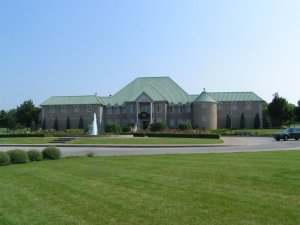 One of the few businesses we found open in the area was the original Chateau des Charmes estate winery (not the huge, imposing facility of today: a small industrial-looking building a few kilometres away), where the only person on duty was Mme Andrée Bosc who gave us an exhaustive tasting experience and showed us around the winery. Neither of us were experienced wine drinkers, so this was wonderful for both of us. I’d love to say that we started our wine cellar that day, but that would only be partially true: we bought about a dozen bottles of various Chateau des Charmes wines, but we couldn’t afford to restock after those had been opened. We visited the winery every year on our anniversary for about a decade, until we got out of the habit of going back to NOTL (which was around the time our son was born).
After our brief honeymoon, we both had to go back to our jobs. Very shortly after that, my employer (the almost-unknown-to-Google Mr Gameway’s Ark) went bankrupt, which was financially bad timing for us, having just spent most of our tiny cash hoard on our honeymoon.
Comments Off on It was forty years ago today
Do Droughts Make Floods Worse?
Practical Engineering
Published 5 Sept 2023The answer isn’t as simple as you might think!
One statistician famously said, “All models are wrong, but some are useful”. And even something as simple as the flow of water into the soil has so many complexities to keep track of. Like most answers to simple questions in engineering and in life: the answer is that it’s complicated.
(more…)
Comments Off on Do Droughts Make Floods Worse?
QotD: British meals – potatoes
George Orwell, “British Cookery”, 1946. (Originally commissioned by the British Council, but refused by them and later published in abbreviated form.)
Comments Off on QotD: British meals – potatoes
December 15, 2023
“Cletus is ’bout to go kinetic, y’all”!
Chris Bray turns to movie trailer analysis as a break from his usual work. Oh, wait, no it’s not really much of a break:
Cletus is ’bout to go kinetic, y’all. I got the news straight from brunch in Brentwood, where people really understand Middle America.
The trailer has dropped for a major new movie about an American civil war. No, not that one: the next one, with the dictatorial president who seizes an unconstitutional third term and refuses to leave the White House, and is an old white guy with big hair who drawls and thinks the world of himself and totally isn’t like any real person they’re trying to compare him to.
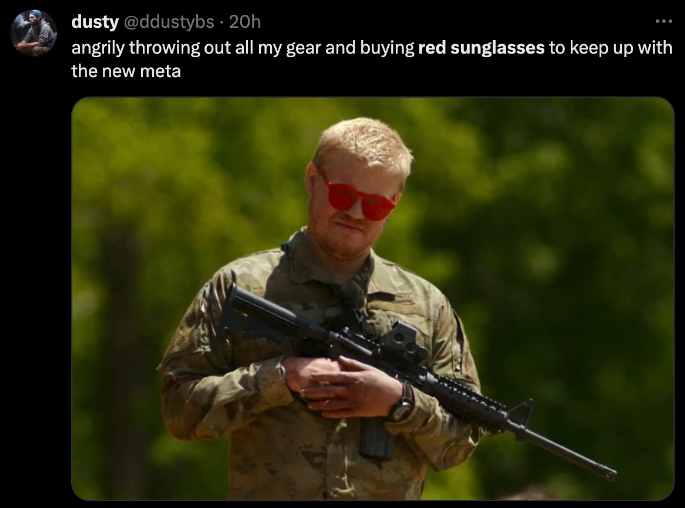
Note that the sniper in the thumbnail has camouflaged his rifle with a pile of spaghetti to avoid being seen, but is also wearing … nail polish? I am unfamiliar with this military doctrine, but if you ever find yourself in a war, wear bright shiny things so you blend in with the trees. I hope we’ve all seen the White House Christmas video this year, because I think they might also be gesturing at this brand of postmodern ghillie suit:
Civil War is Hollywood’s other “America collapsing soon” movie, behind the Obama-backed Leave the World Behind, which sounds like a form of torture. […]
You can watch the Civil War trailer to see how utterly dogshit banal it is, but my favorite detail is that Texas and California form an alliance against the US government and secede together. Yes, a long line of development executives said, Texas and California share a political agenda and would obviously make common cause in an insurgency.
I beg you to get drunk and discover on your own what professional entertainment journalists, a real category of human existence, are saying about this movie.



Severian also saw the trailer and as you’d guess it just blew him away:
So let’s see here … Florida and Texas seceding, necessitating the use of airstrikes — indeed, of all available force — against Americans? Check. Journalists as heroes? Check. Brown-skinned folks with funny accents as the only real Americans? Check. A rebel assault on the capitol, complete with explosions at the very heart of Our Democracy™? Check! I don’t think they actually said the names in the trailer — I kinda skimmed, because it’s nauseating — but whaddaya wanna bet the President of Real America has a name like, oh, I dunno … “Joe Ryder”, and the President of Godawful Redneckistan has a name kinda like “Ronald Rumph”?
They’re really steeling themselves to do Whatever It Takes, aren’t they?
Noted in the comments by Andrew: “Fun fact no. 1: there is only one facility in the US that manufactures explosive ordinance for the military. Fun fact no. 2: that facility is in Texas.”
Oh, and apparently red sunglasses are the new MAGA hat.