
Tom Ayling
Published Apr 28, 2024This is the story of Procopius’s Secret History Of Justinian – originally written around 550, but not published until 1623.
In this video we look at how Procopius wrote the text, how it survived, almost unknown, for 1,000 years, how it came to be published in the 1620s, and the extraordinary ramifications when it was.
00:00 Introduction
00:44 The Original Composition Of The Secret History
02:40 The Survival Of The Text In Greek Manuscripts
05:56 The Rediscovery And Publication Of The Secret History
08:23 Secret Histories Go ViralTo learn more about Secret Histories, sign up to receive my catalogue of rare books devoted to the subject – https://www.tomwayling.co.uk/register
I couldn’t have made this video without the help of two works in particular. The first is Brian Croke’s magisterial Procopius: From Manuscripts To Books: 1400-1850. The second is The Secret History In Literature, 1660-1820 which is edited by Rebecca Bullard and Rachel Carnell.
My name’s Tom and I’m an antiquarian bookseller – you can browse the books I have for sale on my website: https://www.tomwayling.co.uk/
August 13, 2024
The Original Secret History
QotD: The weird world of the Iliad
[Jane Psmith:] … as weird and crufty and full of archaism as it is, the Iliad is actually the first step in the rationalization of the ancient world. Like, it’s even weirder before.
Homer (“Homer“) presents the gods as having unified identities, desires, and attributes, which of course you have to have in order to have any kind of coherent story but which is not at all the way the Greeks understood their gods before him (or even mostly after). The Greeks didn’t have a priestly caste with hereditary knowledge, or Vedas, or anything like that, so their religion is even more chaotic than most primitive religions. “The god” is a combination of the local cult with its rituals, the name, the myths, and the cultic image, and these could (and often did) spread separately from one another. The goddess with attributes reminiscent of the ancient Near Eastern “Potnia Theron” figure is Hera, Artemis, Aphrodite, Demeter, or Athena, depending on where you are. Aphrodite is born from the severed testicles of Ouranos but is also the daughter of Zeus and Dione. “Zeus” is the god worshipped with human sacrifice on an ash altar at Mt. Lykaion but also the god of the Bouphonia but also a chthonic snake deity. Eventually these all get linked together, much later, primarily by Homer and Hesiod, but even after the stories are codified — okay, this is the king of the gods, he’s got these kids and this shrewish wife, he’s mostly a weather deity — the ritual substrate remains. We still murder the ox and then try the axe for the crime, which has absolutely nothing to do with celestial kingship but it’s what you do. If you’re Athenian. Somewhere else they do something completely different.
I also really enjoyed this book, and I think for similar reasons to you. Because you’re right, at the end of the classical world it wasn’t just the philosophers. One major theme in Athenian drama is the conscious attempt to impose rationality/democracy/citizenship/freedom (all tied together in the Greek imagination) in place of the bloody, chthonic, archaic world of heredity.1 It’s an attempt at a transition, and one which gets a lot of attention I think in part because people read the Enlightenment back into it. But my favorite part of the The Ancient City is Fustel de Coulanges’s exploration of the other end of the process: where did all the weird inherited ritual came from in the first place?!
The short version of the answer is “the heroön“. Or as he puts it: “According to the oldest belief of the Italians and Greeks, the soul did not go into a foreign world to pass its second existence; it remained near men, and continued to live underground.” Everything else follows from here: the tomb is required to confine the dead man, the burial rituals are to please him and bind him to the place, the grave goods and regular libations are for his use, and he is the object of prayers. Fustel de Coulanges is incredibly well-read (that one sentence I quoted above cites Cicero’s Tusculan Disputations, “sub terra censebant reliquam vitam agi mortuorum“, plus Euripides’ Alcestis and Hecuba), and he references plenty of Vedic and later Hindu texts and practices too. I also immediately thought of the Rus’ funeral described by ibn Fadlan and retold in every single book about the Vikings, in which, after all the exciting sex and human sacrifice is over, the dead man’s nearest kinsman circles the funerary ship naked with his face carefully averted from it and his free hand covering his anus. This seems like precautions: there’s something in the ship-pyre that might be able, until the rites are completed, to get out.2 And obviously we now recognize tombs and burial as being very important to the common ancestors of the classical and Vedic worlds — from Marija Gimbutas’s kurgan hypothesis to the identification of the Proto-Indo-Europeans with the Yamnaya culture (Ямная = pit, as in pit-grave) — their funerary practices have always been core to how we understand them. But I’m really curious how any of this would have worked, practically, for pastoral nomads! Fustel de Coulanges makes it sound like you have your ancestor’s tomb in your back yard, more or less, which obviously isn’t entirely accurate when you’re rolling around the steppe in your wagon.
I’d also be interested to see an archeological perspective on his next section, about the sacred hearth. This is the precursor of Vesta/Hestia and also Vedic Agni, the reconstructed *H₁n̥gʷnis (fire as animating entity and active force) as opposed to *péh₂ur (fire as naturally occurring substance). I looked back through my copy of The Wheel, the Horse, and Language and (aside from a passing suggestion that the hearth-spirit’s genderswap might be due to the western Yamnaya’s generally having more female-inclusive ritual practices, possibly from the influence of the neighboring Tripolye culture), I didn’t find anything. I suppose this makes sense — you can’t really differentiate between the material remains of a ritual hearth and a “we’re cold and hungry” hearth, especially if people are also cooking on the ritual hearth so there’s not a clear division anyway. But if anyone has done it I’d like to see.
I don’t know enough of the historiography to know whether Fustel de Coulanges was saying something novel or contentious in the mid-19th century, but he seems to be basically in line with more recent scholarship even if he’s not trendy. But The Ancient City can be read as a work of political philosophy as well as ancient history!
Jane and John Psmith, “JOINT REVIEW: The Ancient City, by Numa Denis Fustel de Coulanges”, Mr. and Mrs. Psmith’s Bookshelf, 2023-02-20.
1. And of course that tension is extra intriguing because the dramas are always performed at one of these inherited rituals, in this case the city-wide Great Dionysia festival, although it was a relatively late addition to the ritual calendar. Incidentally it’s way less bizarre than the Attic “rustic” Dionysia which is all goat sacrifices and phallus processions. (There’s also the Agrionia in Boeotia which is about dissolution and inversion and nighttime madness, and another example of “the god” being a rather fluid concept.)
2. Neil Price, in his excellent Children of Ash and Elm, says that the archaeological evidence seems to confirm this:
“Most of the objects [in the Oseberg ship burial] were deposited with great care and attention, but at the very end most of the larger wooden items — the wagons, sleds, and so on — were literally thrown onto the foredeck, beautiful things just heaved over the side from ground level and being damaged in the process. The accessible end of the burial chamber was then sealed shut by hammering planks across the open gable, but using any old piece of wood that seems to have been at hand. The planks were just laid across at random — anything to fill the opening into the chamber where the dead lay. The nails were hammered in so fast one can see where the workers missed, denting the wood and bending or breaking off the nail heads.”
August 12, 2024
Lions, foxes and wolves
N.S. Lyons tries to explain how Britain has gotten into its current social and political plight by recalling the works of Niccolò Machiavelli:
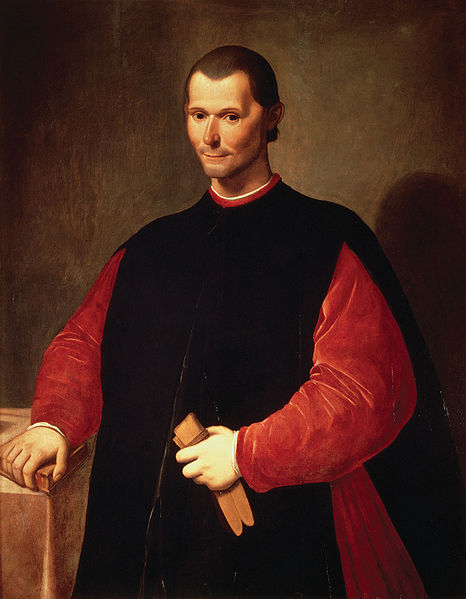
Portrait of Niccolò Machiavelli by Santi di Tito (1536-1603)
Via Wikimedia Commons.
The riots that have recently wracked the streets of the UK reflect decades of pent up public frustration with the country’s governing elite, especially their total refusal to control mass immigration despite vote after vote demanding they do exactly that. The pot has now boiled over. But the ongoing back-and-forth of ethnic violence also represents a signal that the British elite’s whole broader strategy of governing – one based in the fundamental personality of the ruling class itself – may be beginning to break down. And that carries some significant implications.
To understand why, however, we need to take a brief detour back about five centuries to Niccolò Machiavelli. He identified two archetypical psychological profiles of people who become leaders: the cunning but weak fox, who can outmaneuver his opponents but is “defenseless against wolves”; and the strong and brave lion, who likes to fight and who can scare off wolves but who is “defenseless against traps”. Machiavelli argued that a true statesman must embody both personalities, or risk destruction.
A distant student of Machiavelli, fellow Italian political theorist Vilfredo Pareto, would later expand the metaphor further. Observing history, he noted that the rise and fall of states and civilizations could be matched to a cyclical pattern in the collective personality of their ruling classes.
Nations are founded by lions, who are a society’s natural warrior class – its jocks, so to speak. They establish and expand a kingdom’s borders at the point of a sword, pacifying external enemies. Like Sparta’s Lycurgus or Rome’s Augustus, their firm hand often also puts an end to internal strife and establishes (or re-establishes) the rule of law. Their authority can be dictatorial, but it is relatively honest and straightforward in nature. They value directness and the clarity of combat. They are comfortable with the use of raw force, and open about their willingness to use it, whether against criminals or their own enemies. They have a firm sense of the distinction between enemies and friends in general – of who is part of the family and who is a prowling wolf to be guarded against. The security and stability they establish is what allows the nation to grow into prosperity.
Security and prosperity produce a proliferation of foxes. Foxes are unsuited to and deeply uncomfortable with the employment of force; they prefer intellectual and rhetorical combat, because they’re nerds. They seek to overcome obstacles through clever persuasion or the manipulation of people, information, narratives, and formal processes. If they have to use physical force they will, but prefer to disguise its nature and are prone to use it ineptly. The brainy and cosmopolitan foxes have talents the lions don’t, however: they are good at managing complexity and scale, navigating the nuances of diplomatic alliances, or extracting profits from an extensive empire.
As long as peace prevails, civilizations come increasingly to morally prize the indirect and diplomatic methods of foxes and to avoid and indeed abhor the strength and violence of lions. And as states grow larger and more complex, establishing new layers of bureaucracy, law, and procedure, this quickly favors the byzantine organizing and scheming of foxes. In comparison lions are inarticulate and unprepared for the traps of more underhanded mammals. So eventually a wholesale replacement of the elite occurs: the lions who founded the nation are pushed out of its leadership, marginalized and excluded by a class of foxes who see them as brutish relics of a barbaric age.
But a curious thing then happens, Pareto observed: the instability of societies overly dominated by foxes begins to increase relentlessly. The foxes, reluctant to properly distinguish and identify real threats, or to openly employ force even when necessary, find themselves defenseless against wolves both internal and external. When faced with escalating challenges, the foxes tend to resort to doubling down on their preferred strategy of misdirection, manipulation, and attempting to bury or buy off threats rather than confront them directly. This does nothing to solve problems that require the firm use of force, or the threat of it, such as keeping packs of wolves on the other side of the borders. Eventually, when things get bad enough, foxes may desperately lash out with violence, but do so indecisively, ham-fistedly, or in entirely the wrong direction. The wolves, for their part, can instinctively smell weakness and just keep coming.
Like the rest of the West, Britain has been ruled for decades now by an effete managerial elite whose system of technocratic control is absolutely characteristic of foxes. There could be no better example of this than how the government has attempted to manage immigration and the ethnic tensions it has brought to unhappily multi-cultural Britain. It has sought to control public perception of the problem, and indeed has strived mightily to pretend the entire problem simply doesn’t exist.
It has done so, in classic foxlike fashion, through careful control of media and online information, engaging in an effort to downplay inconvenient facts, obscure the identity of terrorists and violent criminals, memory-hole potentially divisive events, and censor counter-narratives. Those who have continued to speak out on the issue are smeared with reputation-destroying labels like “racist”, “xenophobic”, or “far right” in order to deflect others from listening to them. This reflects foxes’ consistent instinct to turn first and foremost to information warfare and narrative manipulation over direct confrontation. Hence the ruling elite’s immediate reaction to the latest riots: blaming them on “misinformation” and “unregulated social media” – the implication being that nothing at all would be amiss if the information common people had access to could just be better suppressed.
In Michigan, the mayor of Omena is Lucky
In The Free Press, Eric Spitznagel reports on the outcome of the most recent mayoral race in Omena, Michigan:
On July 20 in Omena, a small town in the “little finger” of northern Michigan, a crowd of about a hundred locals gathered in a church parking lot for the inauguration of their new mayor. A brass band played “The Stars and Stripes Forever” as Sally Viskochil, president of the local historical society, walked across the patriotically festooned stage to make the announcement.
“And our new mayor is …” There was a collective intake of breath. “Lucky!”
There was a smattering of applause, but a few members of the audience looked stunned. Mike McKenzie, 53, an Illinoisan with a summer home in Omena, turned to me, befuddled.
“Boy,” he said. “I guess people really are fed up with the old two-species system.”
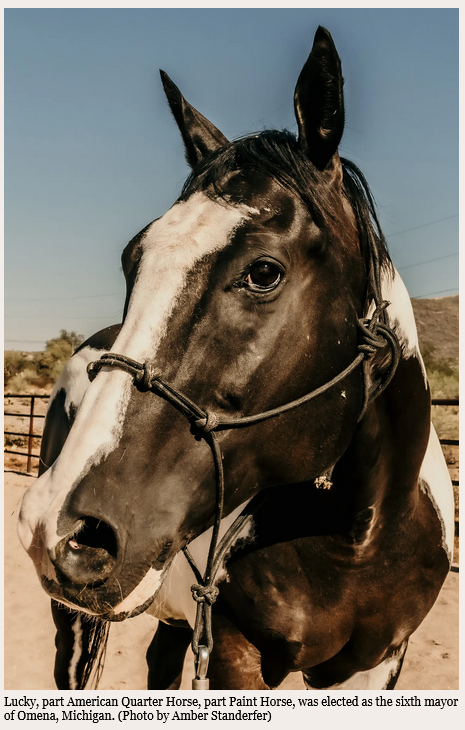
Lucky, after all, is a horse. He’s a cross between an American Quarter and an American Paint, to be precise, and the first equid to be elected mayor of Omena. Until now, this race has only ever been won by a dog — and, once, a cat. You could say Lucky was an underdog in securing the town’s highest office, except he beat twelve actual dogs, five cats, and a goat. Many of them were in attendance. The victor was not.
As the results sunk in, Rosie, the incumbent mayor, a Golden Labrador mix, wandered around the crowd, saying her goodbyes. The band broke into “Hail to the Chief” for her, and she paused, as if to listen.
Welcome to Omena’s triennial animal election. What began as a fundraising stunt for the local historical society in 2009 is now a source of heated political debate in this middle-of-nowhere Michigan village, population 355. As the crowd began to disperse, a small group of locals gathered under a tree to escape the sun, and to talk frankly.
“The horse isn’t even from here,” groused Cathy Stephenson, the campaign manager for Topsy & Turvy, domestic shorthair cats who ran on one ticket to be co-mayors.
“But isn’t he moving here?” another woman asked. “That’s what I heard.”
“Well, he should’ve waited to run till he lives here full time,” Stephenson said.
Lucky, who is 16, has lived 2,000 miles away in Cave Creek, Arizona, his entire life. He was conspicuously absent throughout the summer campaign season — but allowed to run because his human relatives have owned property in Omena for three generations and plan to relocate here in the fall.
“Premier Doug Ford’s plans for the demon liquor will lead us all to untold poverty and perdition”
In the National Post, Chris Selley points and laughs at the classist viewing-with-alarm and frenzied pearl-clutching over the impending rule change that will allow wine and beer to be sold (and even served) in convenience stores like the 7-Eleven chain:
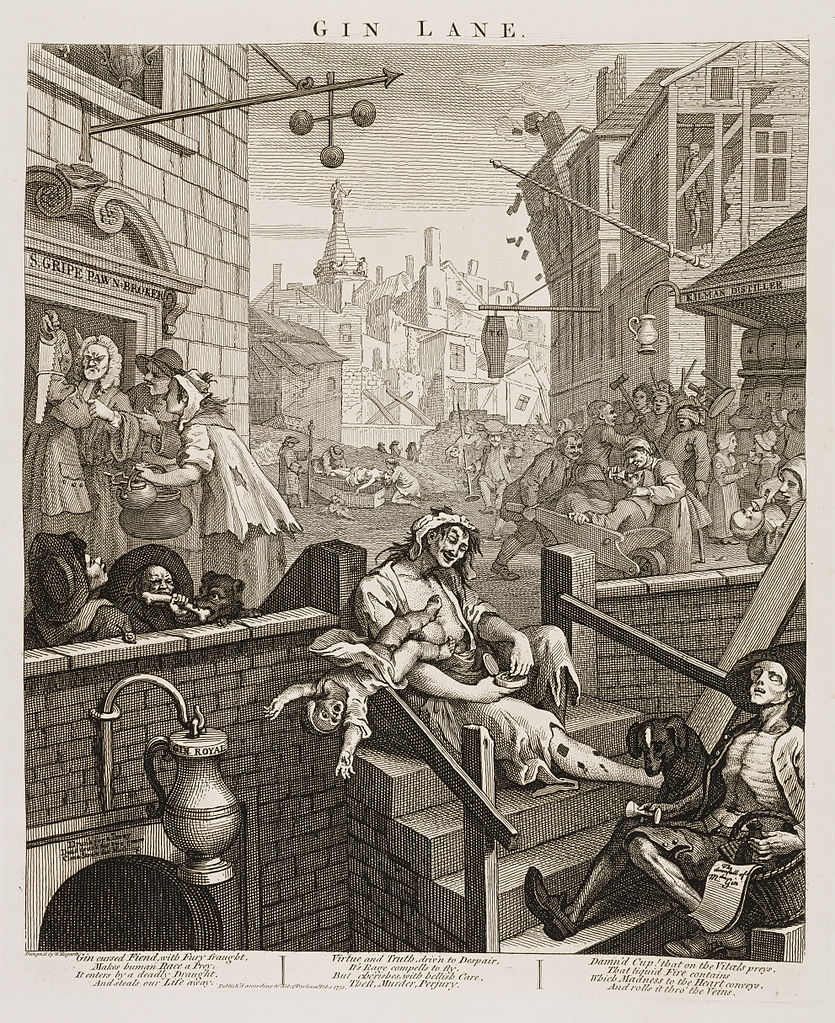
The plight of poverty-stricken Ontarians, forced to get drunk at their local 7-Eleven dive bar.
Gin Lane, from Beer Street and Gin Lane via Wikimedia Commons.
Ontario politics in recent weeks has played out as something like a real-time satire of itself, with the Latent Methodist Brigade still insisting Premier Doug Ford’s plans for the demon liquor will lead us all to untold poverty and perdition. The news this week has only made them more upset: Japanese convenience store empire 7-Eleven will open licensed areas in 58 of its 59 stores in Ontario, in which you can enjoy an alcoholic drink with your hot dog, nachos or chicken nuggets. The company says it’ll add 60 jobs.
Fifty-eight is not a large number, you will agree, in a province with many thousands of licensed premises, any of which might get you drunk and send you back out to your car or boat (though of course they shouldn’t). Some of those thousands of licensed premises are even attached to gas stations, I can report. And many gas-station convenience stores in Ontario sell beer, wine and liquor as independently run “LCBO agency stores”.
For the record, 7-Eleven announced they were doing this way back in December 2022. Pro-forma neo-puritan controversy ensued, and quickly died down. Two 7-Elevens already operate as licensed restaurants in Ontario, apparently without incident, along with 19 in Alberta. (Unfortunately, bien-pensant Ontarians are trained from birth to believe Alberta’s liquor-retail reforms in the 1990s were a grotesque misadventure that everyone there regrets.)
Nevertheless, the same pro-forma neo-puritan freakout is playing out again.
“Let me get this straight. 7-Eleven locations where people fuel up their cars will now allow folks to drink on the premises? What could possibly go wrong?” sneered JP Hornick, president of the Ontario Public Service Employees’ Union (OPSEU), who was last seen dragging LCBO employees into a disastrous tantrum-cum-strike over expanding retail access.
“We need a government that will focus on real things including bringing down hospital wait times, fixing schools and tackling the housing crisis as their signature achievements, amongst many more,” Toronto Coun. Josh Matlow correctly averred on Twitter … and then, as is the fashion here, went full non-sequitur: “Doug Ford made sure we could drink coolers inside a 7-Eleven.” As if the government decided it could only pick one.
(And can I just say here, any Toronto city councillor complaining about another politician’s lack of “signature achievements” is on bloody thin ice.)
Every fully paid-up member of the Laurentian Elite [Spit!] believes with all their flinty hearts that Alberta is a barren wasteland of ruined lives thanks to the demon liquor being sold in corner stores. Initial issues from a generation ago are firmly ensconced as “the way it is” with liberalized booze access out there in the wild west.
Robin Hood, But Make it ⚔️ICONIC⚔️
Jill Bearup
Published Apr 29, 2024The Adventures of Robin Hood (1938) is a classic, and I am hopefully unlikely to get in copyright trouble if I use huge chunks of it. So prepare for an exhaustive (or possibly exhausting) fight breakdown, and a few minor comments about Errol Flynn and parrying.
(more…)
QotD: The key attraction of video games to young men
That would explain video game escapism/addiction amongst men. It’s a little world where there are predictable rules and outcomes and one can succeed much easier than in the unpredictable real world with ever-changing rules.
I think this is a really important point deserving of more attention.
Yes. Video games are a drug aimed straight at the receptor that is male need for agency. They’re a superstimulus for it in exactly the same way that pornography is a superstimulus for desire.
I don’t have a policy prescription about this or anything. But it’s a connection that matters.
ESR, Twitter, 2024-05-06.
August 11, 2024
Tears are still a powerful weapon for female politicians
Janice Fiamengo on the tactic available to — and resorted to frequently — only females in politics, turning on the waterworks to generate sympathy and support:
Recently, a friend sent me a news article that illustrates, in small, the world of Anglophone politics, in which notions of what is owed to women, who are understood to be far more sensitive and fragile than men, operate alongside stern interdictions against stating that women are in any manner unsuited for strenuous, high stress roles.
Last week, an ABC News report detailed years-old allegations against a former aide to Josh Shapiro, the Governor of Pennsylvania who was, at the time of the article, one of Kamala Harris’s touted VP possibilities (she has since chosen Tim Walz, Governor of Minnesota). Shapiro’s former staffer, Mike Vereb, who resigned in 2023 over a sexual harassment allegation, is said to have brought a woman to tears in 2018 with threats made over the phone (“You will be less than nothing by the time Josh and I get done with you”, he is alleged to have said).
The woman, who runs an advocacy group, was left “weeping and in shock standing alone in a parking lot”. She did not report the alleged incident until she heard about the aide’s resignation five years later.
[…]
With the staffer long gone from Shapiro’s administration, the story had legs only because it was about a man who made a woman cry.
The problem is that women do cry rather frequently in politics. And complain. And perform their sensitivity to criticisms, monikers, crude jokes, the faux terror of J6, and bantering innuendo. Far too often such women make politics about them as women and about the trouble men allegedly cause them.
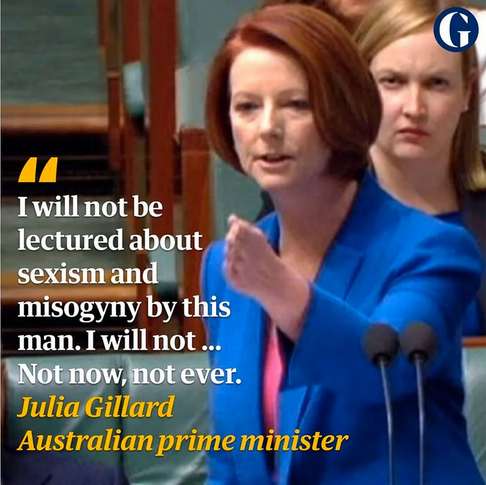
Such was the case with Australian Prime Minister Julia Gillard, who earned plaudits from feminists in 2012 for a fury-filled speech in the House of Representatives about sexism, in which she accused the opposition leader of misogyny for a number of statements he’d made that were not at all misogynistic, including that women were likely under-represented in Australian institutions of power because men were “more adapted to exercise authority”. Gillard also said she was “personally offended” (a more serious state of affairs, one assumes, than simply being “offended”) by the opposition leader’s contention that abortion was “the easy way out”. (The text of her speech is here.) “Julia Gillard’s Attack on Sexism Hailed as Turning Point for Australian Women” ran one enthusiastic headline. And perhaps it was, signaling the point at which women in politics stopped thinking they should accommodate themselves to the rigors of public life, and decided that politicians must instead accommodate themselves to the rigors of women’s demands.
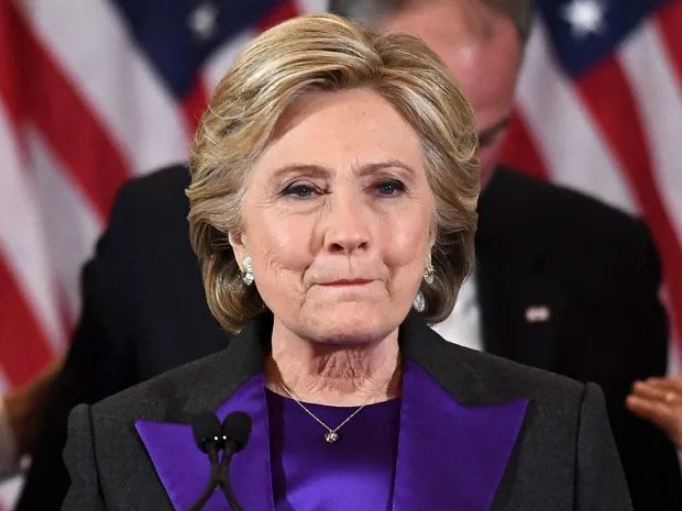
Even seemingly tough-as-nails Hillary Clinton has been allowed to go from interview to interview revisiting the now years-old indignity of her election loss in 2016, like a once-popular debutante who can’t believe she didn’t make the cheerleading squad. No man would ever be given such a prolonged pity party. Having contended for years that it was misogyny that prevented her from beating Donald Trump, she more recently pointed her finger at female voters’ failures of confidence: “They left me [in the final days of the campaign] because they just couldn’t take a risk on me, because as a woman, I’m supposed to be perfect“, she explained in May, 2024. No one seems to have informed Clinton that nothing reveals her crippling unsuitability for leadership than her embarrassing refusal to stop feeling sorry for herself.
And she is, alas, far from unique. Nicola Sturgeon, former First Minister of Scotland, sat and sobbed at last winter’s Covid-19 Inquiry in Edinburgh, deflecting critical questions about her government’s actions during the pandemic by proclaiming that she would carry the impact of them for as long as she lived. Forget the thousands of Scots who suffered or even died because of those decisions: the woman in charge was the one in need of compassion. Sturgeon had previously made a career of complaining about the sexism that allegedly put obstacles in the way of female politicians. Her focus on her own emotional discomfort at the Covid inquiry did more than any naysayers to indict the feminine style. How refreshing if either of these women could simply accept responsibility for their failures.
The US drops two atomic bombs on Japan – WW2 – Week 311 – August 10, 1945
World War Two
Published 10 Aug 2024This week atomic bombs are for the first time in history dropped on cities — Hiroshima and Nagasaki in Japan. The bombs kill over 100,000 people and flatten large parts of the urban area. The Japanese government is actually meeting while the second bomb is dropped to consider their response to the first and to the demands for unconditional surrender. The response is not just to that first bomb, though, for on the 8th the Soviets tell the Japanese not only that they will not help them negotiate some sort of settled peace with the other Allies, they too are declaring war on Japan, and indeed invade Manchuria. With two atomic bombs and an invasion instead of mediating help, Japanese Emperor Hirohito cuts off any debate and says that Japan will surrender. This could happen next week.
00:00 Intro
00:17 Recap
00:44 Hiroshima Bombing
02:35 The Bombing Mission
04:19 Descriptions Of The Blast
06:38 The Nagasaki Bomb
07:37 The Tactics
08:31 The Japanese Response
12:55 Soviets Invade Manchuria
16:18 Splitting Korea
18:07 Operation Zipper
19:31 End Notes
20:08 Summary
20:30 Conclusion
(more…)
Canada’s long-standing issues with national defence won’t be fixed by merely spending more money
In The Line, Greg Quinn explains why meeting the 2% of GDP NATO target for military spending isn’t going to solve Canada’s problems with the military:
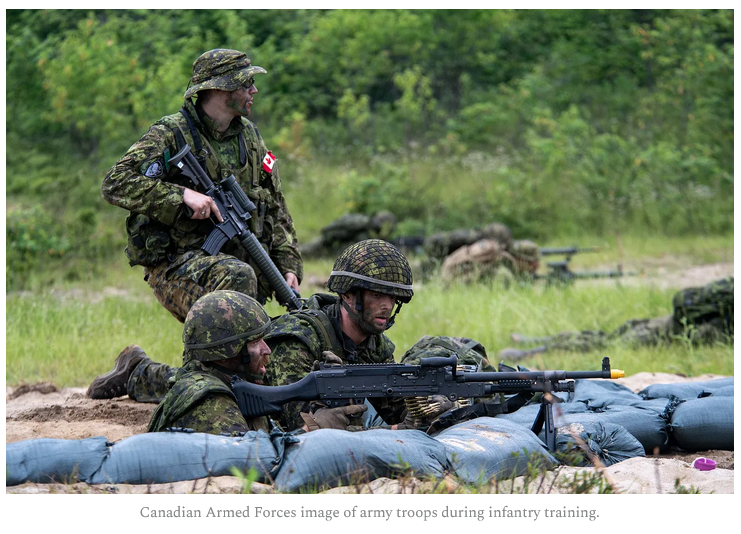
Canada isn’t pulling its weight on defence. Is that what Canadians want? Because it isn’t what its allies want. And the allies are more and more willing to say so.
Canada, and Prime Minister Justin Trudeau, likes to talk about how the country punches above its weight in NATO and global affairs more generally. It’s a cliché many countries have resorted to when put under pressure on one issue or another. (And I’ll confess that this includes my own United Kingdom, which I served as a diplomat for decades before my recent retirement.)
It’s also smoke and mirrors, which in Canada’s case on defence, hides an unhappy truth — Canada doesn’t pay its way.
Trudeau says Canada will meet the target of spending two per cent of GDP on defence in 2032. Some 18 years after NATO committed to it. At the moment Canada spends a paltry 1.37 per cent, or some $33.8 billion a year, on defence, damn near the bottom among the allies, in percentage terms. Ottawa claims this will increase to 1.76 per cent, or $49.5 billion, by 2030. If so, that will move Canada up a whopping two places to 25th.
Mind you, the Parliamentary Budget Office disputes even this, stating that Canada’s defence spending will peak at 1.49 per cent of GDP in 2025-26 before dropping (yes, dropping) to 1.42 per cent in 2029-30. Somebody is being economical with the truth.
[…]
The bottom line is simple — what does Canada (and the Canadian people) want its role in the world to be? Words are easy but they need to be backed by action. One of the most obvious demonstrations of action is spending on a defence force that is capable of deploying and acting on the global stage. More bluntly, of fighting and defeating a near-peer enemy as part of a coalition of allies.
If Canada doesn’t want to do that and prefers a defence force that is essentially a glorified local militia that focuses on domestic issues, well, fine. But let’s not pretend it is anything else. Let’s not talk about how much of a force for good Canada is in the world and let’s not try and fool Canada’s allies. They’re not as stupid as Canadian politicians want them to be.
And let’s not expect those allies to happily accept the situation and continue on as if nothing has changed. Canada already complains about being left out of AUKUS. Is it any wonder? More of that should be expected. If you don’t play the game and don’t pull your weight, then sadly, you don’t get the benefits of being in the grown-ups’ club.
Canadians owe themselves, and frankly owe their allies, an honest discussion about kind of role Canada actually wants to play in the world … and whether they’re willing to actually pay the bills required to play that role. Only after such an honest chat can Canadians, and their allies, calibrate their expectations accordingly.
M1 Thompson: Savage Simplifies the SMG
Forgotten Weapons
Published Apr 28, 2024The Thompson submachine gun struggled to find a market when it was originally produced, with the first batch of 15,000 Colt-made guns not finally all selling until the late 1930s. By that time, the clouds of war were gathering, and demand for submachine guns finally began to really grow. The US military had some Thompsons, and the British began buying as many as they could. The US wanted to increase production, and that meant simplifying the gun, both to reduce cost and to increase manufacturing efficiency. Talks to this end began in late 1941, and by February 1942 the engineers at Savage had a prototype of what would become the M1 Thompson.
This new version simplified almost every element of the gun, but most significantly it replaced the 3-piece Blish lock bolt with a solid one-piece affair that just worked as a normal blowback action. Unnecessary elements like the vertical front grip, Cutt’s compensator, quick-detach stock, and fancy contoured selector levers were discarded. The adjustable Lyman rear sight was replaced by a single metal tab with an aperture (quickly given a set of protective wings though, as the tab alone proved too fragile). The recoil guide rod was simplified, the oiling pads inside the receiver removed, and a simpler recoil buffer designed. The capability to use drum magazines was also discarded, and a new 30-round box magazine took their place.
The M1 was adopted in the spring of 1942, and July saw the first major delivery, of 48,000 guns. Simplification work continued, however, and by the end of October a yet-simpler M1A1 pattern was adopted. This model replaced the hammer mechanism with a fixed firing pin. As a result, M1 production lasted only about 5 months. A total of 285,480 M1 Thompsons were made, but most of these were retrofitted to M1A1 configuration by simply swapping in the simpler new bolt. Finding intact M1 configuration guns is rather unusual today as a result.
(more…)
QotD: Greek and Roman notions of courage
I would not rate a man worth mention or account
either for speed of foot or wrestling skill,
not even if he had a Cyclops’ size and strength
or could outrun the fierce north wind of Thrace;
I would not care if he surpassed Tithonus’ looks,
or Cinyras’ or Midas’ famous wealth,
or were more royal than Pelops son of Tantalus,
or had Adrastus’ smooth persuasive tongue,
or fame for everything save only valour: no,
no man’s of high regard in time of war
unless he can endure the sight of blood and death,
and stand close to the enemy and fight.
This is the highest worth, the finest human prize
and fairest for a bold young man to win.
It benefits the whole community and state,
when with a firm stance in the foremost rank
a man bides steadfast, with no thought of shameful flight,
laying his life and stout heart on the line,
and standing by the next man speaks encouragement
This is the man of worth in time of war.This is not a daring courage, but a stoic (in the general sense) courage – the courage of standing a place in the line. And note for Tyrtaeus, that courage is more important than skill, or strength or speed; it matters not how well he fights, only that he “bides steadfast” “with a firm stance”. There is no place for individual exploits here. Indeed, when Aristodemus (another Spartan), eager to regain his honor lost by having survived the Battle of Thermopylae, recklessly charged out of the phalanx to meet the Persian advance at the Battle of Plataea, Herodotus pointedly notes that he was not given the award for bravery by the Spartans who instead recognized those who had held their place in line (Hdt. 9.71; Herodotus does not entirely concur with the Spartan judgement).
This was a form of courage that was evolving alongside the hoplite phalanx, where either shameful retreat or a reckless charge exposed one’s comrades to danger by removing a shield from the line. While, as Lendon is quick to note, there was still a very important aspect of personal competition (seeking to show that you, personally, had more bravery to hold your position than others), this is a fundamentally collective, not individual style of combat and it has values and virtues to match. Indeed, the Greeks frequently disparaged the fighting style of “barbarians” who would advance bravely but retreat quickly as cowardly.
And so the man who holds his place in the group and does not advance recklessly is the bravest of Greeks, but among the Crow Native Americans would seem a coward, while the bravest Crow who cleverly and daringly attacked, raided and got away before the enemy could respond would in turn be regarded by the Greeks as a reckless coward, unworthy of honor. These notions of courage aren’t merely different, they are diametrically opposed demanding entirely different actions in analogous circumstances!
The translator will call both of these ideas “courage”, but clearly when one gets down to it, they demand very different things. And these are just two examples. As Lendon notes (op. cit.), the virtus of the Roman was not the same as the andreia of the Greek, though both words might well be translated as “courage” or “valor” (and both words, etymologically mean “manliness”, lest we forget that these are very gender-stratified societies). Roman virtus was often expressed in taking individual initiative, but always restrained by Roman disciplina (discipline), making that system of military values still different from either the Crow or the Greek system.
Bret Devereaux, “Collections: The Universal Warrior, Part IIa: The Many Faces of Battle”, A Collection of Unmitigated Pedantry, 2021-02-05.
August 10, 2024
British NPCs have all downloaded the latest patch – “Spaceship Man Bad!”
Elon Musk is the new Emmanuel Goldstein for British NPCs:

I always knew Britain’s liberals were secretly illiberal. That our chattering classes who genuflect at the altar of “human rights” would happily snatch away the rights of anyone who says something offensive online. That these dwellers of the leafy suburbs who weep over the jailing of dissidents in China will chortle over the sacking or blacklisting of dissidents at home, whether it’s women who think you can’t have a knob and be a lesbian or ex-Muslims whose criticisms of Islam are a tad too salty. And yet even I’ve been shocked by their frothing rage against Elon Musk in recent days. By their priestly demands that X be censured and possibly even wiped from the web. It’s one of the most batshit things I’ve seen in ages.
It’s not enough to call this a “mask-off moment”. It’s more like the phoney liberals have ripped their masks to shreds and stomped them into the dirt for good measure. Their rage is linked to the riots currently rocking the UK. Musk’s own tweets, they say, not least his chatter about Britain being on the road to “civil war”, have helped to whip up the mayhem. Worse, his “free-speech absolutism”, as one “liberal” magazine snottily refers to it, has meant that every tosser with a smartphone has been able to tweet their inflammatory views on the riots and even to spread misinformation. In essence, says a writer for the Guardian, Musk has been “leading from behind on UK thuggery and race riots”.
Got that? The reason Britain is going to shit is not because of any internal rot but because a billionaire in Texas said “civil war” on the internet. Glad we cleared that up. Even worse than the great and the good’s shameless deflection tactics – where they try to pin the blame for their own failures on a foreigner with money – is their tinpot solutions to this supposed problem. It might be time, says that sexagenarian Marxian in a leather jacket, Paul Mason, to “pull the plug” on X entirely. Yesteryear’s tyrants smashed up printing presses and chased booksellers out of town – today’s want to switch off a website on which no fewer than half a billion souls regularly share their thoughts and feelings.
They really have taken leave of their senses. Musk’s “horrific version of Twitter” is “a bit like Paris under Nazi occupation”, says Peter Jukes of Byline Times, the preferred publication of rich liberals who’ve been in a state of red mist since the plebs voted for Brexit eight years ago. Just like Paris in the 1940s, says Jukes, some are fleeing Musk’s X, while others are sticking around to “work for liberation”. The narcissism of it. Imagine thinking that keeping your X account open so you can continue spouting bollocks in your echo chamber is as brave as when Parisians stayed in Paris to resist Nazi rule.
Any mention of the Nazis is usually a reliable sign of madness. And so it is with the outburst of Muskphobia among Britain’s influencers. Musk’s antics on X led “straight to” rioting in the UK, says Will Hutton of the Observer (my italics). Do they really believe this? Do they really believe the reason that young shirtless fella looted the Greggs in Hull is because Elon Musk said “#TwoTierKeir” on X? Apparently they do. And there’s only one solution. “Pass a bill closing down Twitter in the UK”, says barrister and arch Remoaner Jessica Simor. That she said this on Twitter at least provided us with fleeting comic relief amid the elite’s lunacy. Does she know she can deactivate her account? Can someone tell her?
It’s the haughtiness of Britain’s influential haters of Musk that is most irksome. Alastair Campbell accused Musk of talking “utter shite” about Britain and its riots. That’s big talk from the undisputed king of shite, the man whose BS about Iraq helped to start a war in which tens of thousands of Arabs perished. Look, I know Musk’s words hurt liberals’ feelings, but at least they don’t hurt people’s lives and limbs.
“Elon Musk’s menace to democracy is intolerable”, pronounced Edward Luce of the Financial Times. That’s the paper that regularly made the case for overthrowing the largest democratic vote in British history. “Democracies can no longer ignore” the threat posed by Musk’s X, says Luce. I don’t like the term dogwhistle, but this is a tyranny dogwhistle, isn’t it? It’s a nod and a wink at “democracies” to clamp down on the “menace” of unfettered online speech. Lewis Goodall of The News Agents – a podcast hosted by ex-BBC staff for whom the BBC wasn’t quite wanky enough – wonders if “unmediated platforms” like Musk’s X are “beyond redemption”. “Should we stop using it?”, he wonders. Please, yes.
“Heavy casualties” in a modern western army might count as “a skirmish” in earlier conflicts
I sent a link to Severian a few weeks ago, thinking it might be an interesting topic for his audience and he posted a response as part of Friday’s mailbag post. First, my explanation to him about why I thought the link was interesting:
I know that Edward Luttwak is what the Brits call “a Marmite figure” … people love or hate him and not much in between. I’ve read several of his books and found he had interesting things to say about the Roman and Byzantine armies in their respective eras but I haven’t found his modern analysis to be anywhere near as interesting. This time, however, he might well have found that acorn … is the dramatic casualty-aversion of western nations going to be a key element of future, shall we say “adventurism”?
Clearly, [Vladimir Putin and Benjamin Netanyahu] can still get their legions moving when they feel they need to, but could [insert current US President here] get the 101st Airborne into a high-casualty environment (let’s not pretend that Rishi Sunak or Keir Starmer could or would, and Macron’s posturing is nearly as bad as Baby Trudeau’s total lack of seriousness)?
Anyway, here’s the Marmite Man’s latest – https://unherd.com/2024/06/who-will-win-a-post-heroic-war
Sev responded:
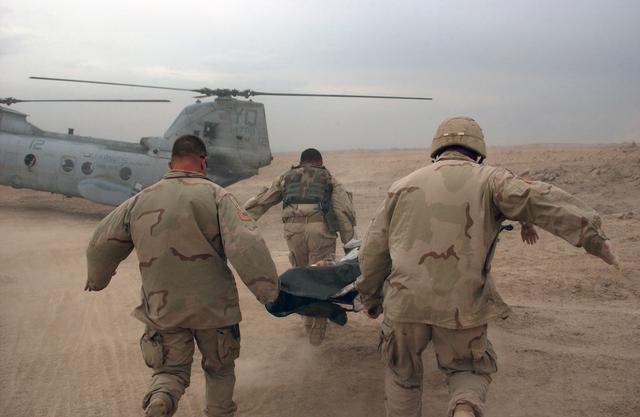
US Army soldiers assigned to 2-7 Cavalry, 2nd Brigade Combat Team (BCT),3rd battalion 1st Division, rush a wounded Soldier from Apache Troop to a waiting USMC CH-46E Sea Knight helicopter during operation in Fallujah, Iraq, during Operation IRAQI FREEDOM.
Photo by SFC Johan Charles Van Boers via Wikimedia Commons.
I’ve often said that, from what I can tell — and bearing in mind my entire military experience consists of a .500 record at Risk! — AINO‘s entire force philosophy amounts to “zero casualties, ever”.
Note that this was true even in the 20th century, when America was still America. “Stupendous casualties” by American standards would hardly rate “a spot of bother” by Soviet. Wiki lists the bloodiest American battle as Eisenborn Ridge (part of the Bulge), with approximately five thousand fatalities.
A Soviet commander who didn’t come home with at least five thousand KIA could probably expect to be court-martialed for cowardice.
That same Wiki article separates “battles” from “campaigns” for some reason. There’s an entire “methodology” section I’m not going to wade into, but even looking at “campaigns”, the bloodiest (by their definitions) is Normandy — 29,204 KIA. That’s an entire campaign, which might rate “a hard week’s fighting” by Soviet, German, or Japanese standards.
Please understand, Americans’ unwillingness to take casualties was greatly to their credit. You want to know about “meat assaults”, ask the Germans, Russians, or Japanese (or the British or French in WWI). George Patton might not have been the best American commander, but he was the most American commander — the whole point of battle is to make the other stupid bastard die for his country. I am 100% in favor of minimal losses, for everyone, everywhere.
But “minimal” does not mean “none”. People die in wars. People die training for wars. People die in the vicinity of the training for war, because it’s inherently risky. It doesn’t make one some kind of monster to call these “acceptable” losses; it makes one a realist. One could just as easily say — and with the same justification — that a certain number of car crash fatalities, or iatrogenic deaths, etc. are acceptable losses, because there’s no way to have “interstate commerce” and “modern medicine”, respectively, without them.
The Fistagon seemingly denies this. Forget human losses for a moment, and consider mere equipment. You read up on, say, Air Force fighter planes, and you’re forced to conclude that their operations assume that all planes will be fully operational at all times. Again, saying nothing of the pilots, just the airframes. The Navy seems to assume that all ships everywhere will not only be serviceable, but actually in service, at all times. Just recently, they shot off all their ammo at Houthi and the Blowfish … and seemingly had no idea what to do, because as Milestone D walked us through it, it’s impossible to rearm while underway.
Think about that for a second. How the fuck is that supposed to work in a real war? Can we just put the war on pause for a few months, so all our ships can head back to port to reload?
In fact, I’d go so far as to speculate that that’s the origin of the phrase “meat assault”. What The Media are calling a “meat assault” is simply what was known to a sane age as “an assault”. No qualifiers. You know, your basic attack — go take that hill, and if you take the hill, and if enough of the attacking force survives to hold it, that’s a win. People who absolutely should know better, though, don’t see it that way.
Since we’re here … I remember having conversations with some folks in College Town re: the Battle of Fallujah, while it was happening (technically the Second Battle of Fallujah). Now, obviously quite a few of my interlocutors were ideologically committed to the position that this was senseless butchery. And in the fullness of time, I too have come around to the position that the entire Operation Endless Occupation was senseless butchery. But leaving all that aside, the point I was trying to make was a simple one: Total US casualties were 95 killed, 560 wounded.
Every one of them a senseless crime, I now believe, but considering Fallujah strictly as a military operation, that’s amazing. House-to-house fighting in a heavily urban area, against a fanatically committed opponent who was willing, indeed eager, to use every dirty trick in the book … and US forces took 655 total casualties. That’s about as well as it can possibly be done. The Red Army probably lost 655 men on the train ride getting to Stalingrad. I wouldn’t be surprised at all to learn that 655 is the daily casualty figure across the entire front in Ukraine … hell, I wouldn’t be surprised to learn that there are lots of individual sectors in Ukraine taking those kinds of daily losses. 655 is pretty damn good …
… but I was called every dirty name they could think of for suggesting it. I was called dirty names by people who called themselves conservatives, who were such ostentatious “patriots” that they’d embarrass Toby Keith.
Fallujah was fought in 2004, a time that seems like the Blessed Land of Sanity compared to now. AINO simply won’t take casualties. The Pentagram won’t — lose a tank, and you lose your job. (In battle, obviously. If you abandon it to the Taliban, no problem. And of course if you lose an entire war, it’s medals and promotions for everyone). And because the high command won’t, the field commanders won’t either. And because they won’t … well, “desertion” is an ugly word, but let’s just say Tim Walz won’t be the only guy who suddenly needs to be elsewhere right before it’s time to ship out. And as for the guys actually shanghaied into whatever foreign fuckup … well, “mutiny” is an even uglier word, but does anyone want to bet against it?
The GTA job situation is dire, yet the government keeps allowing special permits to bring in foreign workers
I try not to moan about my work situation here on the blog … nobody comes here for that … but despite my decades of experience in my technical field, it’s been a very long time since I had an interview (I’m ashamed to admit how long), despite all the jobs I’ve applied for. I have several strikes against me, of course, in that I’m an older slightly disabled white male, but it’s not just about me: Canadian employers in the Greater Toronto Area are still getting special permits to bring in foreign workers despite the huge numbers of un- and under-employed Canadian citizens and permanent residents in the GTA:

With job fair lineups regularly snaking around blocks and experienced professionals unable to secure roles despite applying to hundreds of them, it’s safe to say the job market is pretty terrifying right now for anyone looking for any type of work in the Toronto area.
Population growth has been outpacing employment gains, pushing the city’s unemployment rate to a dismal 7.4 per cent earlier this year (compared to Canada’s 5.8 per cent). So, it’s no wonder that residents are concerned to find how many local businesses are outsourcing labour to foreign workers.
A user-created map shared to Reddit last week shows which employers in the GTA have applied to hire overseas personnel via Labour Market Impact Assessments from 2023 on, which are supposed to be used only when there is “a need for a foreign worker to fill the job [because] no Canadian worker or permanent resident is available to do the job.”
While it seems like the above would be a rare exception given the current work crisis, the map shows quite the opposite: a shocking number of firms trying to use LMIAs to hire thousands of staffers, from food service and retail workers to engineering technicians and administrative assistants.
The data used is from Canada’s Open Government Portal, the page explains, adding that “there have also been instances where employers have illegally sold their approved LMIA positions to workers.”
The post has tacked up thousands of upvotes and a robust discussion of hundreds of comments, almost all from people who are angry and confused about why so many places are actively trying to recruit — and in many cases, successfully recruiting — people from outside of the country when so many here are desperately seeking jobs.


