
World War Two
Published 12 Jun 2021It’s a week of starts and stops. The Battle of Sevastopol kicks into high gear, and the Battle of Gazala enters its third phase. And what is going on in the Pacific just one week after Midway?
(more…)
June 13, 2021
Sevastopol Must Fall! – WW2 – 146 – June 13, 1942
Comments Off on Sevastopol Must Fall! – WW2 – 146 – June 13, 1942
Wartime Changes: The Bren MkI Modified and Bren MkII
Forgotten Weapons
Published 3 Mar 2021http://www.patreon.com/ForgottenWeapons
https://www.floatplane.com/channel/Fo…
Cool Forgotten Weapons merch! http://shop.bbtv.com/collections/forg…
The British lost some 90% of their stock of Bren light machine guns in the disastrous Dunkirk evacuation, and in the following months rushed to rearm. Part of this program was a two-tiered simplification of the Bren design. First was a MkI Modified Bren (which was not marked any differently than the original MkI), and this was followed by a MkII design. These patterns simplified many of the machining operation required to produce the Bren, significantly reducing the number of required machining operations. The most visually distinctive elements of the MkII pattern were the omission of the stainless steel flash hider assembly and the replacement of the original dial rear sight with a simple ladder sight. In addition, changes were made to the buttstock, buttplate, receiver profile, gas block, and bipod. Both Enfield and Inglis would produce the simpler MkII Brens by the middle of the war. Despite the many changes made, the core operating components (bolt, bolt carrier, etc) were left unchanged, so they could still interchange between all patterns of the gun in service.
Contact:
Forgotten Weapons
6281 N. Oracle #36270
Tucson, AZ 85740

Comments Off on Wartime Changes: The Bren MkI Modified and Bren MkII
June 12, 2021
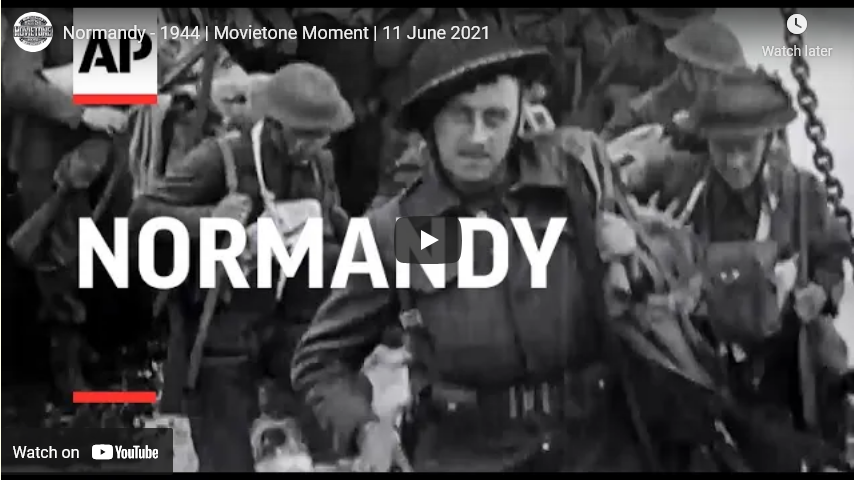
Normandy – 1944 | Movietone Moment | 11 June 2021
British Movietone
Published 11 Jun 2021On this day in 1944, five days after the D-Day landing, the allied forces converged in Normandy. Here is a British Movietone report covering the event.
More and more reinforcements and supplies arrive in Normandy each day. In the skies Allied air power continues to bomb and strafe the enemy. Captured German film shows Rommel and von Rundstedt visiting the vast concrete fortifications on the coast which were thought to be impassable. Mr Churchill arrived onboard HMS Kelvin and was greeted by General Montgomery as he came ashore.
Cut story – Dusk or dawn shot of destroyer with sun rising or sinking in background. Sunrise with armada in fore. Yanks board LCIs. Shots of LCTs. Beached equipment unloaded. GV of activity on beach. British troops of LTC. CU Tedder on bridge of ship. GS of Ramsay & Vian. Tedder, Ramsay & Vian walk along raft into camera. Elevated shot of activity on beach, very good. Troops build airstrip, bulldozers etc. at work. Plane takes off. Camera gun – shooting up trains, transport, & other targets, several large explosions. British pass through street, Frenchmen look on. AFU – British soldiers at look-out with field glasses. Troops (Canadian or British) run through fields & wooded country. Troops through street, French clap. Army transport passes through street, directed by soldier. Yanks march through streets. POW along roads, & over beach, wade out to LCT, one attempts to pull up sock while walking. Captured German reel GS of Rommel & Rundstedt. CU Rommel. SCU of coastal guns, & various shots of fortifications, pillboxes etc. Rommel & Rundstedt walk round inspecting same, look at double barrel coastal gun. SCU of barrel of guns, & various shots of Atlantic Wall (AFU British troops knock part of “Wall” down which they have captured). Eisenhower, Marshall & Arnold on bridge of ship. GV of destroyer Kelvin at sea – very good. CU Churchill in Trinity House uniform, wearing glasses. Churchill assists Brooke with “Mae West” life jackets. Both seated on deck Kelvin at sea. CU Churchill. Kelvin passes Nelson, Ramillies & other warships also large part of armada. Churchill transfers … ships, sailors cheer as he leaves. CU Churchill. CU Smuts both very good. Churchill, Smuts & Brooke in “Duck” [DUKW]. Churchill leans over side talks to Montgomery, Churchill alights from “Duck”. Shakes hands with Monty. The above four in group on beach, walk through crowds of soldiers. AFU – Monty stands on raised platform addresses troops (silent) Monty & Churchill through crowds. Churchill with Monty & climbs into Jeep. SEE STORY NUMBER 44914/2 & 44914/3 FOR CUTS
AP Has HD copy – HD ProRes 422 4:3 – 24fpsDisclaimer: British Movietone is an historical collection. Any views and expressions within either the video or metadata of the collection are reproduced for historical accuracy and do not represent the opinions or editorial policies of the Associated Press.
You can license this footage for commercial use through AP Archive – the story number bm44914
#Normandy #WWII #DDay
Find out more about AP Archive: http://www.aparchive.com/HowWeWork
Twitter: https://twitter.com/AP_Archive
Tumblr: https://aparchives.tumblr.com/
Instagram: https://www.instagram.com/APNews/
Comments Off on Normandy – 1944 | Movietone Moment | 11 June 2021
June 11, 2021
Is Finland an Ally of Nazi Germany? – Carl Gustaf Mannerheim – WW2 Biography Special
World War Two
Published 10 Jun 2021Carl Gustaf Mannerheim is a national hero after his service in everything from the Finnish Civil War to the Winter War. But did he plan a war of aggression with Nazi Germany against the Soviet Union? And if so, did Hitler and Stalin even give him any choice in the matter?
(more…)
Comments Off on Is Finland an Ally of Nazi Germany? – Carl Gustaf Mannerheim – WW2 Biography Special
June 10, 2021
QotD: “Defending” democracy using totalitarian methods
One of the peculiar phenomena of our time is the renegade Liberal. Over and above the familiar Marxist claim that “bourgeois liberty” is an illusion, there is now a widespread tendency to argue that one can only defend democracy by totalitarian methods. If one loves democracy, the argument runs, one must crush its enemies by no matter what means. And who are its enemies? It always appears that they are not only those who attack it openly and consciously, but those who “objectively” endanger it by spreading mistaken doctrines. In other words, defending democracy involves destroying all independence of thought. This argument was used, for instance, to justify the Russian purges. The most ardent Russophile hardly believed that all of the victims were guilty of all the things they were accused of: but by holding heretical opinions they “objectively” harmed the régime, and therefore it was quite right not only to massacre them but to discredit them by false accusations. The same argument was used to justify the quite conscious lying that went on in the leftwing press about the Trotskyists and other Republican minorities in the Spanish civil war. And it was used again as a reason for yelping against habeas corpus when Mosley was released in 1943.
These people don’t see that if you encourage totalitarian methods, the time may come when they will be used against you instead of for you. Make a habit of imprisoning Fascists without trial, and perhaps the process won’t stop at Fascists. Soon after the suppressed Daily Worker had been reinstated, I was lecturing to a workingmen’s college in South London. The audience were working-class and lower-middle class intellectuals — the same sort of audience that one used to meet at Left Book Club branches. The lecture had touched on the freedom of the press, and at the end, to my astonishment, several questioners stood up and asked me: Did I not think that the lifting of the ban on the Daily Worker was a great mistake? When asked why, they said that it was a paper of doubtful loyalty and ought not to be tolerated in war time. I found myself defending the Daily Worker, which has gone out of its way to libel me more than once. But where had these people learned this essentially totalitarian outlook? Pretty certainly they had learned it from the Communists themselves! Tolerance and decency are deeply rooted in England, but they are not indestructible, and they have to be kept alive partly by conscious effort. The result of preaching totalitarian doctrines is to weaken the instinct by means of which free peoples know what is or is not dangerous. The case of Mosley illustrates this. In 1940 it was perfectly right to intern Mosley, whether or not he had committed any technical crime. We were fighting for our lives and could not allow a possible quisling to go free. To keep him shut up, without trial, in 1943 was an outrage. The general failure to see this was a bad symptom, though it is true that the agitation against Mosley’s release was partly factitious and partly a rationalisation of other discontents. But how much of the present slide towards Fascist ways of thought is traceable to the “anti-Fascism” of the past ten years and the unscrupulousness it has entailed?
George Orwell, Unpublished Preface to Animal Farm, 1945.
Comments Off on QotD: “Defending” democracy using totalitarian methods
June 9, 2021
Do the Nazis Have Atomic Bombs? – WW2 – Spies & Ties 03 – Sam & Erwin part 2
World War Two
Published 8 Jun 2021All belligerents are working hard to develop a powerful nuclear super-weapon. The Americans wonder how far along the Germans are, and send in their spies.
(more…)
Comments Off on Do the Nazis Have Atomic Bombs? – WW2 – Spies & Ties 03 – Sam & Erwin part 2
Very Rare and Mostly Pointless: the Bren Fixed Line Sight
Forgotten Weapons
Published 25 Feb 2021http://www.patreon.com/ForgottenWeapons
https://www.floatplane.com/channel/Fo…
Cool Forgotten Weapons merch! http://shop.bbtv.com/collections/forg…
The very early production MkI Bren light machine guns were made with two dovetail brackets on the left side of the receiver. The rear one was for the standard rear sight, and the front one was to accommodate two types of optical sights. A mounting for the No.32 telescopic sight (the same one used on the No4(T) sniper rifle) was planned, but never produced. What was made in small numbers by the Plessey company was a “fixed line sight”. This was really more like a surveyor’s tool than a traditional sight, and it used the same optical element as the Vickers dial sight that was introduced alongside it in 1939. The purpose was to allow a tripod-mounted Bren to be set up with specific limits to its field of fire, and then for the gun to be removed, used on the bipod elsewhere, and returned to the tripod and confirm the field of fire, especially in the dark. This is a somewhat technically complex task, but not one that was actually needed very much for the Bren. As a result, production and use of the fixed line sights was very limited, and the sights are extremely rare today. The mounting bracket on the Bren receiver was rather quickly dropped from production as an unnecessary waste of machining time.
Contact:
Forgotten Weapons
6281 N. Oracle #36270
Tucson, AZ 85740

Comments Off on Very Rare and Mostly Pointless: the Bren Fixed Line Sight
June 8, 2021
Midway pt.2 – A New War? – WW2 – 145c – June 7, 1942
World War Two
Published 7 Jun 2021We left off last time with several burning behemoths. Watch today to see the action that follows, not just on the high seas, but also in Alaska. We also turn to Washington DC and Tokyo and follow the reaction to the Battle of Midway there. The Japanese one may surprise you.
(more…)
Comments Off on Midway pt.2 – A New War? – WW2 – 145c – June 7, 1942
June 7, 2021
Germany to Strike Strongest Fortress in the World – WW2 – 145b – June 6, 1942
World War Two
Published 6 Jun 2021Midway isn’t the only fight right now. Germany is trying to crack the mighty fortress of Sevastopol and take the whole Crimea. In North Africa, Rommel is routing the Allies, but in Malta the arrival of ever more fighter planes bodes well for the Allies.
(more…)
Comments Off on Germany to Strike Strongest Fortress in the World – WW2 – 145b – June 6, 1942
June 6, 2021
Midway, pt.1 – Clash of the Titans – 145a – June 5, 1942
World War Two
Published 5 Jun 2021The supposedly surprise Japanese operations against Midway Atoll and the Aleutian Islands kick-off, but they don’t know that Allied intelligence has cracked their codes. As the Japanese fleet advances in the Central Pacific and Japanese planes bomb Midway, the US Navy has a big surprise waiting for them.
(more…)
Comments Off on Midway, pt.1 – Clash of the Titans – 145a – June 5, 1942
Turning Point of History: D-Day Juno Beach
ch1201
Published 8 Nov 2014Examines Canada’s role on June 6th, 1944 and the advance through Normandy, France.

Comments Off on Turning Point of History: D-Day Juno Beach
June 5, 2021
Bren MkI: The Best Light Machine Gun of World War Two
Forgotten Weapons
Published 24 Feb 2021http://www.patreon.com/ForgottenWeapons
https://www.floatplane.com/channel/Fo…
Cool Forgotten Weapons merch! http://shop.bbtv.com/collections/forg…
In the years after World War One, the British military wanted a new machine gun, and they wanted it to replace both the Lewis and the Vickers. Through the 1920s the British would tinker with most of the light machine guns that became available, but it was not until the early 1930s that a serious formal trial was conducted. The initial trials found three particularly encouraging guns; the ZB-26, Madsen, and Vickers-Berthier. Over a series of followup testing, the Madsen and Vickers-Berthier were both eliminated, leaving the Czechoslovakian ZB as the final choice.
The British were extremely enthusiastic about the qualities of the ZB, and it is understandable why. The final .303 British version, the Bren, is widely regarded as the best magazine-fed light machine gun ever made. In its final preproduction trial, one of the prototype guns endured a 150,000-round trial without any real problems.
The design was licensed for British production as well as in the Dominions, and would be put into production at both Enfield in England and the John Inglis company in Canada. About 30,000 were produced before the Dunkirk disaster, which would lead to simplification of the design. But those changes are a subject for another video later…
Contact:
Forgotten Weapons
6281 N. Oracle #36270
Tucson, AZ 85740
From the comments:
Jeffrey Holdeman
5 hours ago
Ian- “this video is getting a little long already”Everyone else- “so what!”
Notable Discomfort
2 hours ago
Ian: “This video is a little long already.”
Everyone: “Baby doll, you take all the time you need, I’m in love with every second you take. Every minute you take to explain this rifle is a minute I get to spend with you and your comforting voice. Don’t never apologize. There’s nothing to be sorry about.FLIBFLAGGAFLUP
2 hours ago
The sheer amount of Victoria Cross citations that start with “he picked up a Bren gun” is stupendous, like a WW2 cheat code.

Comments Off on Bren MkI: The Best Light Machine Gun of World War Two
QotD: British wartime censorship
At this moment what is demanded by the prevailing orthodoxy is an uncritical admiration of Soviet Russia. Everyone knows this, nearly everyone acts on it. Any serious criticism of the Soviet régime, any disclosure of facts which the Soviet government would prefer to keep hidden, is next door to unprintable. And this nation-wide conspiracy to flatter our ally takes place, curiously enough, against a background of genuine intellectual tolerance. For though you are not allowed to criticise the Soviet government, at least you are reasonably free to criticise our own. Hardly anyone will print an attack on Stalin, but it is quite safe to attack Churchill, at any rate in books and periodicals. And throughout five years of war, during two or three of which we were fighting for national survival, countless books, pamphlets and articles advocating a compromise peace have been published without interference. More, they have been published without exciting much disapproval. So long as the prestige of the USSR is not involved, the principle of free speech has been reasonably well upheld. There are other forbidden topics, and I shall mention some of them presently, but the prevailing attitude towards the USSR is much the most serious symptom. It is, as it were, spontaneous, and is not due to the action of any pressure group.
George Orwell, Unpublished Preface to Animal Farm, 1945.
Comments Off on QotD: British wartime censorship
June 2, 2021
How Hitler Manipulated Germany into Committing Genocide – WW2 Special
World War Two
Published 1 Jun 2021In the wrong hands, propaganda is a powerful tool that can trick whole countries into supporting a dictator, go to war, or even commit genocide.
(more…)
Comments Off on How Hitler Manipulated Germany into Committing Genocide – WW2 Special
May 30, 2021
Rommel’s Desert Dash – The Whole Bloody Afrika Korps! – Gazala – WW2 – 144 – May 30, 1942
World War Two
Published 29 May 2021Erwin Rommel begins his surprise new offensive with “Rommel’s Moonlight Ride”, bringing all of his mighty mobile units to the fray in North Africa, while in the Pacific, dozens of warships and tens of thousands of men set sail from Japan — their mission? Attack the Aleutian Islands and Midway Island, but above all, destroy the US Pacific Fleet!
(more…)
Comments Off on Rommel’s Desert Dash – The Whole Bloody Afrika Korps! – Gazala – WW2 – 144 – May 30, 1942


