
World War Two
Published 26 Jun 2021Fall Blau, the huge Axis summer offensive in the Soviet Union, is supposed to being this, but is postponed to next. The smaller Operation Fridericus II does begin though, and what does Josef Stalin make of that and the intelligence he’s received? Meanwhile in North Africa, after the fall of Tobruk, the British 8th Army gets a leadership change, but Erwin Rommel is still on the move eastward into Egypt. Where will the Allies try to hold him? Half the world away, the Allies begin to establish a base at Milne Bay, New Guinea. It’s a start, a small one, but a start.
(more…)
June 27, 2021
Fall Blau Starts … or Does it? – WW2 – 148 – June 27, 1942
Comments Off on Fall Blau Starts … or Does it? – WW2 – 148 – June 27, 1942
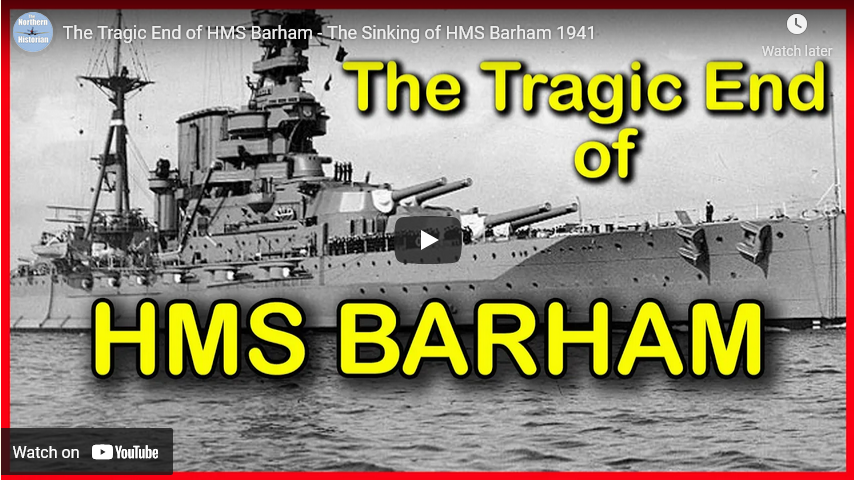
The Tragic End of HMS Barham – 25 November, 1941
The Northern Historian
Published 5 Mar 2021On the 25th of November 1941, the Royal Navy’s 1st Battle Squadron consisting of HMS Queen Elizabeth, HMS Valiant and HMS Barham along with eight destroyers were on a hunt in the central Mediterranean looking for Italian convoys.
Also on the hunt was a German U-Boat and their paths were on a collision course. A collision that would send HMS Barham to the floor of the Mediterranean Sea along with over 800 of her crew.HMS Barham had begun her service with the Royal Navy during World War 1 and played a role during the Battle of Jutland.
Following World War 1, HMS Barham had several refits and operated in the Atlantic Fleet and the Mediterranean Fleet during the inter-war years.
During World War 2, HMS Barham took part in the the Battle of Dakar before taking part in escort convoys in the Mediterranean.
In November of 1941, during an escort mission, HMS Barham was attacked by U Boat U-331 under the command of Hans-Diedrich von Tiesenhausen.
The attack caused a huge explosion in her magazine and rapidly sank, killing over 800 men.
Comments Off on The Tragic End of HMS Barham – 25 November, 1941
June 25, 2021
The Birth of the Manhattan Project – WW2 Special
World War Two
Published 24 Jun 2021When nuclear fission was discovered, scientists theorized it could be used in an atomic bomb. Thus, the American Army sets up one of the biggest research projects in history: The Manhattan Project.
(more…)
Comments Off on The Birth of the Manhattan Project – WW2 Special
June 23, 2021
The RAF and Luftwaffe Bombers of Western Europe – WW2 Special
World War Two
PUblished 22 Jun 2021What aircraft are being sent out by commanders like Hermann Göring and Arthur Harris to blitz and firebomb enemy cities? Watch the video to learn the specs of the Handley Page Halifax, Avro Lancaster, Junkers Ju-88, Dornier Do-17, Dornier Do-217, and Heinkel He-111 as they fly in their respective 1,000 Bomber Raids and Baedeker Blitz.
(more…)
Comments Off on The RAF and Luftwaffe Bombers of Western Europe – WW2 Special
Tank Chats #112 | Churchill Mk I and II | The Tank Museum
The Tank Museum
Published 4 Dec 2020Tank Museum Historian David Fletcher discusses the British Second World War Churchill Mark I, the very first Churchill, as well as its successor, the Mark II. This chat also covers the development of the A20 prototype and how this became the production Mark I variant. The Churchill displayed is actually a Mark II made to look like a Mark I, and is the oldest surviving Churchill in the UK.
(more…)
Comments Off on Tank Chats #112 | Churchill Mk I and II | The Tank Museum
QotD: Churchill’s support for Stalin
Churchill threw all of his support behind Stalin’s armies despite Stalin’s alliance with Hitler during the first 21 months of the war — the USSR having invaded the same number of countries as Nazi Germany (seven), having supplied the German Wehrmacht as it invaded France and the Low Countries, and having literally fueled the Luftwaffe as it bombed London in 1940.
This support was more than rhetorical. In a gesture of astonishing (and short-sighted) selflessness, Churchill responded to news of Nazi Germany’s invasion of the Soviet Union by sending Stalin 200 brand-new Hawker Hurricane pursuit planes which had been pledged to defend Singapore against Japanese attack. Churchill then “re-gifted” Stalin 200 Tomahawk fighters and 300 Douglas A-20 Havoc bombers from Britain’s own Lend-Lease consignments, and shipped Stalin 2,000 tonnes of processed aluminum for Soviet warplane factories, despite it being desperately needed at home.
Even more striking was Churchill’s decision to ship Stalin nearly 600 tanks, which helped tip the balance in the Battle of Moscow in December 1941. Churchill even agreed to strip Cairo command of hundreds more tanks in 1942, routing them to Stalin’s USSR via Iran to bail out the Red Army at Stalingrad, which left Egypt vulnerable to Rommel’s Afrika Korps.
Churchill doubled down on his pro-Soviet policies even in areas where Britain had her own clients, such as Yugoslavia. Despite hosting the Yugoslav exile government in London, by September 1943, Churchill abandoned that government’s commander on the ground and threw his full support behind Stalin’s man, Josip Broz (“Tito”). Bamboozled by a Soviet smear campaign against Colonel Draža Mihailovic, Churchill cut off Mihailovic’s Chetniks and shipped Tito more than 100 times more war materiel over the next nine months than Mihailovic had received in the previous two years.
Sean McMeekin, “Churchill’s enigma: the real riddle is why he cozied up to Stalin”, Spectator, 2021-03-21.
Comments Off on QotD: Churchill’s support for Stalin
June 22, 2021
QotD: The “Stringbag”, formally known as the Fairey Swordfish
There are three reasons for this feat. The first is that the British were early adaptors of night operations, and performed successful Swordfish strikes (such as the amazingly successful strike at the Port of Taranto which crippled or sank several major warships – becoming the Japanese model for Pearl Harbor), and successful night attacks at sea once the second innovation came in. This was the development of airborne radar, which was first operational on Swordfish operating on British carriers six months before Pearl Harbor. The British were to hold this unique ability to use radar for carrier aircraft operations for a couple of years before the Americans deployed similar concepts in 1943. They were to hold their unique advantage of night-time strikes also. (Both the Japanese and Americans lost many pilots over the next few years in strikes that failed to get home before dark!) So the Swordfish could soldier on under the cover of night, and continued to be useful as a strike aircraft long after its use in daytime had been demonstrated to be suicidal by the easy slaughter of those attempting to attack the Scharnhorst and Gneisenau during the Channel Dash in 1941.
The third, and unexpected reason, why the Swordfish was still in production at the end of the war, was that its unrivalled flying characteristics made it the only aircraft capable of surviving operations from small escort carriers operating in the Arctic Circle in bad weather. Whereas more modern, higher speed aircraft, like the Hurricane, Wildcat and Avenger could work from escort carriers in calmer seas, none of those would even consider operations under the sort of conditions that a Swordfish could easily manage. So the venerable old bus continued to serve successfully purely in an anti-submarine role until the final days of the war. This was not because there weren’t many better aircraft available, but simply because no other aircraft available could do the job as well. An example of a World War Two aircraft still having a (slightly reduced) role, long after being technically obsolete — see the many inadequate fighters that lived on as very successful night fighters. (Though the fact that “modern” B-52s are scheduled to still be operational 80 or 90 years after their initial deployment shows that new roles are always possible for reliable old aircraft, even when their technology is fifty years out of date.)
Nigel Davies, “Comparing naval aircraft of World War II”, rethinking history, 2010-12-20.
Comments Off on QotD: The “Stringbag”, formally known as the Fairey Swordfish
June 21, 2021
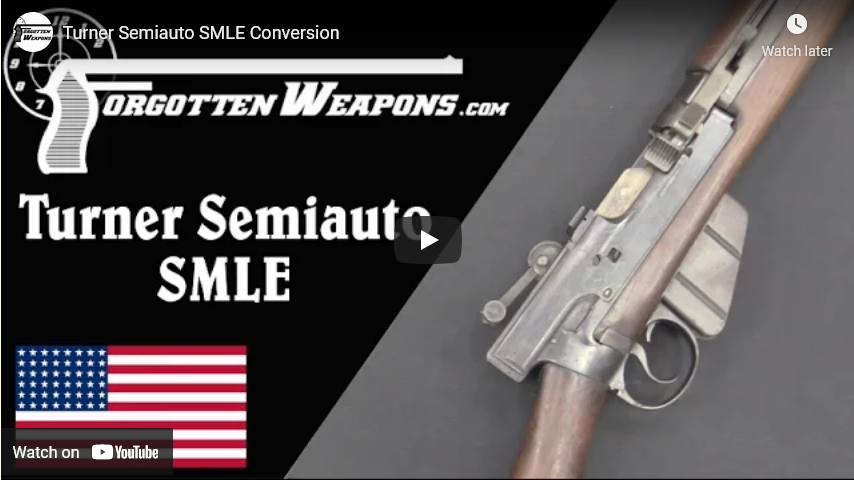
Turner Semiauto SMLE Conversion
Forgotten Weapons
Published 12 Nov 2016Cool Forgotten Weapons Merch! http://shop.bbtv.com/collections/forg…
Russell Turner was a Pennsylvania gunsmith and inventor who developed this semiautomatic conversion of an SMLE bolt action rifle circa 1940. It was intended for trial and potential sale to the Canadian military, as it would allow them to retrofit existing rifles into semiautomatic configuration and still use existing supplies of .303 British ammunition. Rather than try to devise a reliable system to rotate the original Enfield bolt, Turner replaced the bolt entirely, using instead a side-tilting design much like what he used in his M1 Carbine trials rifle for the US military. This was coupled with a long stroke gas piston and a hammer firing trigger mechanism.
Reportedly the rifle was tested by Canadian authorities, and performed quite well, with the adjustable gas system allowing it to function reliably even in temperatures of 25 below zero (where the Garand, tested alongside, experienced problems). However, Turner’s rifle was deemed too complex for military adoption.
That decision against the rifle was probably the right one for Canada, although Turner’s conversion is one of the better semi auto bolt acton conversions I have handled. It was remarkably non-awkward — that may not sound like much to crow about, but it sets a pretty high standard for this type of rifle.
Comments Off on Turner Semiauto SMLE Conversion
June 20, 2021
Tobruk: A second siege? – WW2 – 147 – June 20, 1942
World War Two
Published 19 Jun 2021Two convoys head from opposite ends of the Mediterranean to supply Malta, hoping to run interference for each other, and the Battle of Sevastopol continues as the Axis slowly wear down the Soviet defenders, but the big news is Erwin Rommel’s continued advances in North Africa, defeating the 8th Army again and again. Can the Allies hold Tobruk? Will they even try? Watch and find out.
(more…)
Comments Off on Tobruk: A second siege? – WW2 – 147 – June 20, 1942
June 19, 2021
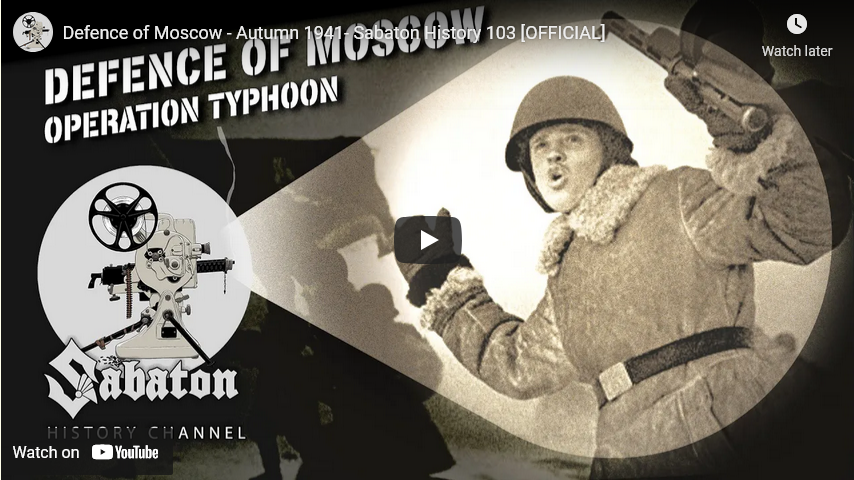
“Defence of Moscow” – Autumn 1941- Sabaton History 103
Sabaton History
Published 17 Jun 2021While it is legendary, there is a lot of confusion and a lot of myths about Operation Typhoon, the German drive on Moscow in the fall of 1941, and Operation Barbarossa, the invasion of the Soviet Union that summer. Today I talk about the first 5.5 months of Barbarossa, and then Joakim and I discuss covers and covers of covers.
Support Sabaton History on Patreon: https://www.patreon.com/sabatonhistory
Listen to “Defence Of Moscow”: https://music.sabaton.net/DefenceOfMo…
Watch the Official Music Video of “Defence Of Moscow” here: https://www.youtube.com/watch?v=i7K4v…
Listen to Sabaton on Spotify: http://smarturl.it/SabatonSpotify
Official Sabaton Merchandise Shop: http://bit.ly/SabatonOfficialShopHosted by: Indy Neidell
Written by: Markus Linke and Indy Neidell
Directed by: Astrid Deinhard and Wieke Kapteijns
Produced by: Pär Sundström, Astrid Deinhard and Spartacus Olsson
Creative Producer: Maria Kyhle
Executive Producers: Pär Sundström, Joakim Brodén, Tomas Sunmo, Indy Neidell, Astrid Deinhard, and Spartacus Olsson
Community Manager: Maria Kyhle
Post-Production Director: Wieke Kapteijns
Editor: Karolina Dołęga
Sound Editor: Marek Kaminski
Maps by: Eastory – https://www.youtube.com/c/eastory
Archive: Reuters/Screenocean – https://www.screenocean.comColorizations by:
– Mikołaj Uchmann
– Julius Jääskeläinen – https://www.facebook.com/JJcolorization/Sources:
– National Archives Nara
– Narodowe Archiwum Cyfrowe NARA
– Bundesarchiv
– New York Public Library
– Train tracks icon by Danishicon from the Noun Project
– Picture of singer Loona courtesy of Sandstein https://commons.wikimedia.org/wiki/Ca…
– Imperial War Museums: HU 75543, PST 4712
– Australian War MemorialAll music by: Sabaton
RADIO TAPOK – Битва за Москву (В стиле Sabaton / ИзиРок / – Defence Of Moscow)An OnLion Entertainment GmbH and Raging Beaver Publishing AB co-Production.
© Raging Beaver Publishing AB, 2021 – all rights reserved.
Comments Off on “Defence of Moscow” – Autumn 1941- Sabaton History 103
June 18, 2021
Heydrich, Architect of the Holocaust, Dies – WAH 036 – June 1942, Pt. 1
World War Two
Published 17 Jun 2021Reinhard Heydrich is fighting for his life, as the hunt of his assassins continues. Meanwhile, news of the Nazi atrocities starts to reach the Allied countries.
(more…)
Comments Off on Heydrich, Architect of the Holocaust, Dies – WAH 036 – June 1942, Pt. 1
June 17, 2021
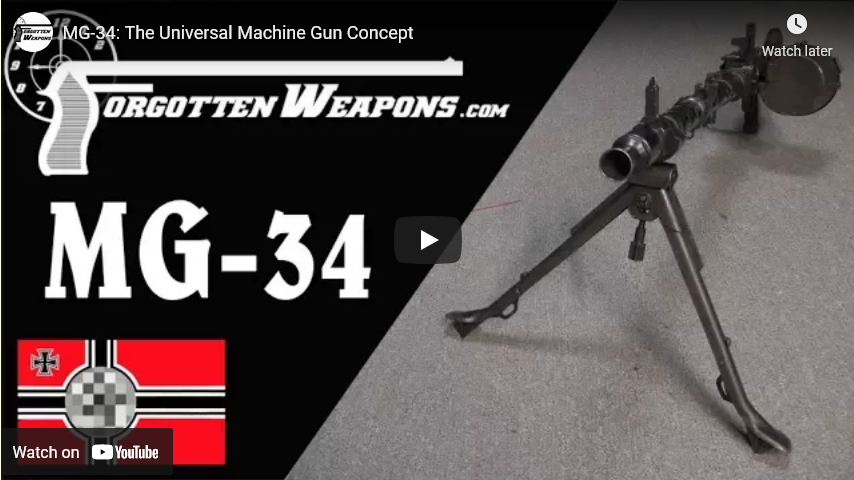
MG-34: The Universal Machine Gun Concept
Forgotten Weapons
Published 7 Oct 2017The MG34 was the first German implementation of the universal machine gun concept — and really the first such fielded by any army. The idea was to have a single weapon which could be used as a light machine gun, heavy machine gun, vehicle gun, fortification gun, and antiaircraft gun. The MG34 was designed to be light enough for use as an LMG, to have a high enough rate of fire to serve as an antiaircraft gun, to be compact and flexible enough for use in vehicles and fortifications, and to be mounted on a complex and advanced tripod for use as a heavy machine gun.
Mechanically, the MG34 is a recoil operated gun using a rotating bolt for locking. It is chambered for 8mm Mauser, and feeds from 50-round belt segments with a clever and unique quick-change barrel mechanism. The early versions were fitted with adjustable rate reducers in the grips allowing firing from 400 to 900 rounds per minute, and also had an option for a top cover which would fit a 75-round double drum magazine. Both of these features were rather quickly discarded, however, in the interest of more efficient production. However, the gun fulfilled its universal role remarkably well.
The MG34 was considered a state secret when first developed, and despite entering production in 1936 it would not be formally adopted until 1939 — by which time 50,000 or so had already been manufactured. It would comprise about 47% of the machine guns in German service when the Wehrmacht invaded Poland, but would be fully standardized by March of 1941. It was replaced by the MG42 later in the war, as that weapon was both faster and cheaper to produce and also required substantially less of the high-grade steel alloys that Germany had limited supplies of. However, it would continue to be produced through the war, particularly for vehicle mounts.
http://www.patreon.com/ForgottenWeapons
Cool Forgotten Weapons merch! http://shop.bbtv.com/collections/forg…
If you enjoy Forgotten Weapons, check out its sister channel, InRangeTV! http://www.youtube.com/InRangeTVShow
Comments Off on MG-34: The Universal Machine Gun Concept
June 16, 2021
By Sea, By Land – A Global History of the Marines – WW2 Special
World War Two
Published 15 Jun 2021Naval infantrymen have long been a feature of warfare. In the build-up to 1939, they took on new functions and tactics. The Royal Marines, the US Marine Corps, Black Death, Kaiheidan, and more are ready for all-out amphibious warfare in the Pacific Theatre and beyond.
(more…)
Comments Off on By Sea, By Land – A Global History of the Marines – WW2 Special
Tank Chats #111 | Sherman M4A1 (76) W | The Tank Museum
The Tank Museum
Published 20 Nov 2020Join The Tank Museum’s Historian David Fletcher as he discusses the Sherman M4A1 (76) W, a late war variant of the Sherman M4A1 which was introduced into service in the summer of 1944. The M4A1 (76) W still had a cast hull, but improved frontal armour, a more powerful version of the Continental radial engine and was up-gunned from the original M4A1, with a 76mm gun.
(more…)
Comments Off on Tank Chats #111 | Sherman M4A1 (76) W | The Tank Museum
June 14, 2021
QotD: Obsolescent carrier aircraft in the Pacific war
The next most obsolete was the Japanese Aichi D3A “Val” dive-bomber (266mph, 3 x 7.7 mg, 1 x 500lb and 2 x 60lb bombs, 970 mile range) which had also entered service in the mid 30’s. It was a fixed landing gear dive-bomber modeled on the famous Junkers Ju87 (183mph, 1 x 7.7mm mg, 1,000lb bomb load, 621 mile range), and was just as good a dive bomber … if there was no opposition. Unlike the Ju87 (and like the [British Blackburn] Skua) the Val also had the ability to defend itself as a second-rate fighter once the bombs had been dropped. Still, the Val relied for success on clear skies, and achieved excellent results under those conditions at Ceylon (cruisers Devonshire and Cornwall and unarmed old carrier Hermes) and Coral Sea (carrier Lexington). Under even moderate air pressure at Trincomalee and Midway the performance fell off markedly, and later in the war the phrase that comes to mind is “Great Marianas Turkey Shoot”. Nonetheless they had to soldier on because the replacement aircraft was too fast for the smaller carriers that were to become the majority of the Japanese carrier fleet after Midway.
Nigel Davies, “Comparing naval aircraft of World War II”, rethinking history, 2010-12-20.
Comments Off on QotD: Obsolescent carrier aircraft in the Pacific war


