
Forgotten Weapons
Published 20 Jun 2015The Palmer was the first bolt action firearm adopted by the US military — it was a single-shot rimfire carbine patented in 1863 and sold to the US cavalry in 1865. The guns were ordered during the Civil War, but were not delivered until just after the end of fighting, and thus never saw actual combat service. The design is very reminiscent of the later Ward-Burton rifle, using the same style of interrupted-thread locking lugs. The Palmer, however, has a separate hammer which must be cocked independently of the bolt operation.
March 14, 2026
Palmer Cavalry Carbine
Comments Off on Palmer Cavalry Carbine
March 11, 2026
Foldy-Glock: The Full Conceal M3D (History and Shooting)
Forgotten Weapons
Published 18 Oct 2025Full Conceal was a company that designed a folding Glock. The intent was to create a pistol that could be easily, discreetly, and safely carried in a pocket but still offer the handing and capability of a full size service pistol. They did this by cutting off the grip of a Glock 19 (M3D) or Glock 43 (M3S) and rebuilding it with a hinged trigger guard. An extended magazine could be then carried parallel to the barrel, folded up to render the trigger safe and giving it the profile of a big cell phone instead of pistol.
The M3D and M3S were shown as prototypes at SHOT 2017 and began shipping in early 2018. In October 2020 the company filed for bankruptcy and in June 2021 its assets were sold at auction. The problem was that the guns were simply too expensive for their target market. The company tried to reduce costs by developing their own slides and frame instead of using commercial Glocks, but this was too little too late to save them financially.
(more…)
Comments Off on Foldy-Glock: The Full Conceal M3D (History and Shooting)
March 9, 2026
The FIRST Tank Battle – Villers-Bretonneux, 1918: Mark IV v A7V
The Tank Museum and Queensland Museum
Published 14 Nov 2025By spring 1918, the British Mark IV tank has been in service for almost a year. It had proved itself during the Battle of Cambrai – the males attacking concrete emplacements, and the females fending off the infantry. But the Mark IV has never been tested against another tank …
The German A7V hasn’t served on the battlefield very long. While it has mobility and stability issues, it does have thicker armour than the British tanks – and is more heavily armed. On paper, this looks like it will be a close call.
Villers-Bretonneux is the first time in history that a tank fought another tank. It’s a day that would change the face of warfare forever.
00:00 | Introduction
00:50 | The Mark IV
02:57 | The A7V
05:30 | The Battle of Villers-Bretonneux
06:44 | Mark IV vs A7V
09:09 | Who won?
(more…)
Comments Off on The FIRST Tank Battle – Villers-Bretonneux, 1918: Mark IV v A7V
March 7, 2026
ASh-78: Albania Makes the Worst AK
Forgotten Weapons
Published 11 Oct 2025Albanian AKs are both pretty scarce to find outside Albania, and also a bit unusual in the AK field. Where most countries followed Russian AK development, Albania instead patterned theirs on the Chinese Type 56. China had Russian assistance in producing the original milled-receiver AK, but the milled AKM came after the Sino-Soviet split and so China had to create their own stamped receiver design independently. We see those features in the Albanian ASh-78, in elements like the offset front trunnion rivet, gas vent holes, stock and grip style, single trigger guard rivets, and lack of a rate reducing mechanism in the FCG.
In 1960 China began providing military aid to Albania. The first rifle production there was a version of the SKS, which are made into the early 1970s. In 1974 the Albanian state arsenal began setting up AK production with Chinese help as well. Relations between the two countries broke down shortly thereafter, and by the time production began in 1978 the Albanians were working entirely independently. They added an underfolding model (the ASh-82) in 1982, and production continued past the end of the Cold War. Total production numbers are not known, as military information was pretty tightly controlled.
(more…)
Comments Off on ASh-78: Albania Makes the Worst AK
March 6, 2026
How Not to Build a Plane – TSR2 vs F-111
HardThrasher
Published 5 Mar 2026In the late Cold War, Britain and the United States tried to build the ultimate low-level supersonic strike aircraft. The result was two of the most ambitious aviation programmes ever attempted: the BAC TSR-2 and the General Dynamics F-111 Aardvark. Both aircraft were designed to solve the same terrifying problem. Soviet surface-to-air missiles had made high-altitude bombing almost suicidal. The next generation of bombers would have to fly low and fast, automatically following the terrain, navigating using primitive onboard computers, and delivering nuclear or conventional weapons deep inside enemy territory. In theory, these aircraft would be revolutionary.
In practice … things went wrong.
The TSR2 programme became one of the most controversial cancellations in British aviation history. Plagued by spiralling costs, technical ambition far beyond the computers of the era, and a labyrinth of government bureaucracy, the aircraft was cancelled in 1965 after only a handful of test flights. Meanwhile the American F-111 survived the same technological challenges and political battles — but only just. Development disasters, crashes, exploding engines, and staggering cost overruns nearly killed the programme multiple times before the aircraft finally entered service.
In this video we explore:
• Why the TSR-2 was so technologically ambitious
• How terrain-following radar and early flight computers nearly broke both projects
• The political battles inside Whitehall and Washington
• Why the F-111 Aardvark survived when TSR2 did not
• And what these aircraft reveal about Cold War military technology and procurement
The TSR2 and F-111 weren’t just aircraft. They were early attempts at something closer to a flying computer, built decades before modern electronics made such systems reliable. And that ambition nearly destroyed both programmes.
(more…)
Comments Off on How Not to Build a Plane – TSR2 vs F-111
The latest CF-188 upgrade program, Hornet Extension Project, HEP
Polyus
Published 10 Nov 2025The CF-18s are getting old. Designed in the 70s, they were introduced into Canadian service in 1982, so they’re basically as old as me and yet they’re still flying on the front line. Of course they’re not the same planes today that they were back in 1982. They’ve gone through some changes along the way.
This video is intended to be an overview of the most recent upgrade program to the CF-188 Hornet, called the Hornet Extension Project. And yes that’s its official name but everyone calls it the CF-18, including me.
0:00 Introduction
1:37 Capability Gap
2:30 HEP-1
3:05 HEP-2
4:36 Conclusion
(more…)
Comments Off on The latest CF-188 upgrade program, Hornet Extension Project, HEP
March 5, 2026
“Britain’s ‘Scrap Iron Armada'” | Tonight (1962)
BBC Archive
Published 10 Nov 2025“A ship that’s built to withstand shell fire is no pushover in the breaker’s yard.”
Alan Whicker reports on the fate of obsolete naval warships, which are lying in bays around the country waiting to be scrapped or sold. Among this “scrap iron armada” is the Leviathan (R97) — a mammoth £6 million aircraft carrier — that has never sailed. It was abandoned, approximately 80 percent complete, in 1946 after the war ended.
Clip taken from Tonight, originally broadcast on BBC Television, 19 March, 1962.
Comments Off on “Britain’s ‘Scrap Iron Armada'” | Tonight (1962)
March 1, 2026
QotD: Even when you know the gun isn’t loaded … it might be loaded
You want to know why I’m a little OCD when it comes to chamber checks on firearms? Allow me to share a story:
At the first gun shop at which I worked, which was also a pawn shop, we had a relationship with a pawn shop owner down in the city. Every few months, he’d drive out to see us with a briefcase containing a few old Colt Police Positives and Smith .38/.32 Terriers and Browning Vest Pockets and suchlike and we would swap him a big box of Lorcins and Hi-Points and Jennings and cash to make up the difference.
One time he came up, the sticking point in the negotiations was a PPK, an early Interarms-marked stainless example. Initially he was thinking about keeping it. Then he wanted too much for it. Then he relented and we added it to our side of the pile.
He handed the Walther to me, and I locked the slide back and checked the chamber, and passed it to a coworker over at the computer. She printed a trigger tag out for it and handed it, slide still locked back, to one of the other salespeople, who put it in the showcase.
Then our buddy the pawn shop owner crawfished. I sighed and pulled the gun from the showcase, removed the trigger tag, and laid it on the counter between him and my boss. About the time pawn shop guy was leaving, I was walking out of the store to cross the street and get lunch for everybody.
When I came back, there was the PPK, sitting on the counter by the computer. “Arthur changed his mind again?” I asked, and was told that, indeed, he had sat in his car for a moment and then came back in and threw the Walther in on the deal at the last minute. Sweet! I still had the trigger tag handy, so I put it back on the gun and passed it to the salesman who put it back in the showcase with one hand while eating his hamburger with the other.
I wandered off to a far corner of the showroom where I could eat my burger in peace, back turned to the sales floor, when *KA-BAM!*
A customer is standing there with the PPK in his hand and an appalled look on his face, smoke wisping theatrically from the barrel and a divot in the linoleum at his feet containing a flattened Winchester Silvertip.
That’s right, Arthur had loaded the PPK back up in his car, and then brought it back in to add to the trade, and not one person who handled it from the time I picked it up and put the trigger tag on it to the time the customer made the loud noise had bothered to inspect the chamber because, hey, we had already done that when he brought it in the first time, right?
Lesson learned: I don’t care if I set the gun down and just look away for a second; that gun gets checked again when I pick it up. Period. Unless it has been in my field of vision the whole time, I don’t know what might have happened to it while I wasn’t paying attention.
Tamara Keel, “Formative experiences …”, view from the porch, 2011-08-16.
Comments Off on QotD: Even when you know the gun isn’t loaded … it might be loaded
February 28, 2026
QotD: The “Balance of Terror” in the missile age
This also meant that a devastating nuclear “first strike” could now be delivered before an opponent would know it was coming, or at least on extremely short notice. A nuclear power could no longer count on having enough warning to get its nuclear weapons off before the enemy’s nuclear strike had arrived. Bernard Brodie grappled with these problems in Strategy in the Missile Age (1959) but let’s focus on a different theorist, Albert Wohlstetter, also with the RAND Corporation, who wrote The Delicate Balance of Terror (1958) the year prior.
Wohlstetter argued that deterrence was not assured, but was in fact fragile: any development which allowed one party to break the other’s nuclear strike capability (e.g. the ability to deliver your strike so powerfully that the enemy’s retaliation was impossible) would encourage that power to strike in the window of vulnerability. Wohstetter, writing in the post-Sputnik shock, saw the likelihood that the USSR’s momentary advantage in missile technology would create such a moment of vulnerability for the United States.
Like Brodie, Wohlstetter concluded that the only way to avoid being the victim of a nuclear first strike (that having the enemy hit you with their nukes) was being able to credibly deliver a second strike. This is an important distinction that is often misunderstood; there is a tendency to read these theorists (Dr. Strangelove does this to a degree and influences public perception on this point) as planning for a “winnable” nuclear war (and some did, just not these fellows here), but indeed the point is quite the opposite: they assume nuclear war is fundamentally unwinnable and to be avoided, but that the only way to avoid it successfully is through deterrence and deterrence can only be maintained if the second strike (that is, your retaliation after your opponent’s nuclear weapons have already gone off) can be assured. Consequently, planning for nuclear war is the only way to avoid nuclear war – a point we’ll come back to.
Wohlstetter identifies six hurdles that must be overcome in order to provide a durable, credible second strike system – and remember, it is the perception of the system, not its reality that matters (though reality may be the best way to create perception). Such systems need to be stable in peacetime (and Wohlstetter notes that stability is both in the sense of being able to work in the event after a period of peace, but also such that they do not cause unintended escalation; he thus warns against, for instance, just keeping lots of nuclear-armed bombers in the air all of the time), they must be able to survive the enemy’s initial nuclear strikes, it must be possible to decide to retaliate and communicate that to the units with the nuclear weapons, then they must be able to reach enemy territory, then they have to penetrate enemy defenses, and finally they have to be powerful enough to guarantee that whatever fraction do penetrate those defenses are powerful enough to inflict irrecoverable damage.
You can think of these hurdles as a series of filters. You start a conflict with a certain number of systems and then each hurdle filters some of them out. Some may not work in the event, some may be destroyed by the enemy attack, some may be out of communication, some may be intercepted by enemy defenses. You need enough at the end to do so much damage that it would never be worth it to sustain such damage.
This is the logic behind the otherwise preposterously large nuclear arsenals of the United States and the Russian Federation (inherited from the USSR). In order to sustain your nuclear deterrent, you need more weapons than you would need in the event because you are planning for scenarios in which some large number of weapons are lost in the enemy’s first strike. At the same time, as you overbuild nuclear weapons to counter this, you both look more like you are planning a first strike and your opponent has to estimate that a larger portion of their nuclear arsenal may be destroyed in that (theoretical) first strike, which means they too need more missiles.
What I want to note about this logic is that it neatly explains why nuclear disarmament is so hard: nuclear weapons are, in a deterrence scenario, both necessary and useless. Necessary, because your nuclear arsenal is the only thing which can deter an enemy with nuclear weapons, but that very deterrence renders the weapons useless in the sense that you are trying to avoid any scenario in which you use them. If one side unilaterally disarmed, nuclear weapons would suddenly become useful – if only one side has them, well, they are the “absolute” weapon, able to make up for essentially any deficiency in conventional strength – and once useful, they would be used. Humanity has never once developed a useful weapon they would not use in extremis; and war is the land of in extremis.
Thus the absurd-sounding conclusion to fairly solid chain of logic: to avoid the use of nuclear weapons, you have to build so many nuclear weapons that it is impossible for a nuclear-armed opponent to destroy them all in a first strike, ensuring your second-strike lands. You build extra missiles for the purpose of not having to fire them.
(I should note here that these concerns were not the only things driving the US and USSR’s buildup of nuclear weapons. Often politics and a lack of clear information contributed as well. In the 1960s, US fears of a “missile gap” – which were unfounded and which many of the politicians pushing them knew were unfounded – were used to push for more investment in the US’s nuclear arsenal despite the United States already having at that time a stronger position in terms of nuclear weapons. In the 1970s and 1980s, the push for the development of precision guidance systems – partly driven by inter-agency rivalry in the USA and not designed to make a first strike possible – played a role in the massive Soviet nuclear buildup in that period; the USSR feared that precision systems might be designed for a “counter-force” first strike (that is a first strike targeting Soviet nuclear weapons themselves) and so built up to try to have enough missiles to ensure survivable second strike capability. This buildup, driven by concerns beyond even deterrence did lead to absurdities: when the SIOP (“Single Integrated Operational Plan”) for a nuclear war was assessed by General George Lee Butler in 1991, he declared it, “the single most absurd and irresponsible document I had ever reviewed in my life”. Having more warheads than targets had lead to the assignment of absurd amounts of nuclear firepower on increasingly trivial targets.)
All of this theory eventually filtered into American policy making in the form of “mutually assured destruction” (initially phrased as “assured destruction” by Secretary of Defense Robert McNamara in 1964). The idea here was, as we have laid out, that US nuclear forces would be designed to withstand a first nuclear strike still able to launch a retaliatory second strike of such scale that the attacker would be utterly destroyed; by doing so it was hoped that one would avoid nuclear war in general. Because different kinds of systems would have different survivability capabilities, it also led to procurement focused on a nuclear “triad” with nuclear systems split between land-based ICBMs in hardened silos, forward-deployed long-range bombers operating from bases in Europe and nuclear-armed missiles launched from submarines which could lurk off an enemy coast undetected. The idea here is that with a triad it would be impossible for an enemy to assure themselves that they could neutralize all of these systems, which assures the second strike, which assures the destruction, which deters the nuclear war you don’t want to have in the first place.
It is worth noting that while the United States and the USSR both developed such a nuclear triad, other nuclear powers have often seen this sort of secure, absolute second-strike capability as not being essential to create deterrence. The People’s Republic of China, for instance, has generally focused their resources on a fewer number of systems, confident that even with a smaller number of bombs, the risk of any of them striking an enemy city (typically an American city) would be enough to deter an enemy. As I’ve heard it phrased informally by one western observer, a strategy of, “one bomb and we’ll be sure to get it to L.A.” though of course that requires more than one bomb and one doubts the PRC phrases their doctrine so glibly (note that China is, in theory committed to developing a triad, they just haven’t bothered to actually really do so).
Bret Devereaux, “Collections: Nuclear Deterrence 101”, A Collection of Unmitigated Pedantry, 2022-03-11.
Comments Off on QotD: The “Balance of Terror” in the missile age
February 25, 2026
Bommarito: America’s First Toggle-Locked Battle Rifle
Forgotten Weapons
Published 1 Oct 2025Designed by Giuseppe Bommarito, this was one of the many independent rifle designs submitted to the US War Department in the 1910s hoping for military adoption. It is a short recoil operated, toggle-locked system chambered for .30-06 and using detachable 20-round magazines. It was tested (without much success) at Springfield and remained in development until 1918.
See a more complete article including original disassembly photos here:
https://www.forgottenweapons.com/m1-g…Thanks to the Springfield Armory National Historic Site for giving me access to this truly unique specimen from their reference collection to film for you! Don’t miss the chance to visit the museum there if you have a day free in Springfield, Massachusetts:
https://www.nps.gov/spar/index.htm
(more…)
Comments Off on Bommarito: America’s First Toggle-Locked Battle Rifle
February 23, 2026
QotD: Faith, Hope, and Charity defended Malta
France has collapsed, Hitler is eating Europe alive, and Mussolini doesn’t want to miss out. He wants birthday cake without bringing a present.
Poor show
So he looks at a map and asks the Italian Air Force:
“Who can we bomb that’s really close?”
Answer: Malta, 49 miles away.
The Italians begin their great wartime contribution by flying at 14,000 feet and dropping bombs with the accuracy of a man throwing darts after fourteen pints. Half land in the sea, a few hit fields.
But accuracy wasn’t the point. They just wanted to show Berlin they were “in the war”.
For the Maltese, who had never seen modern bombing, even bad Italian bombing was terrifying.
And unfortunately for them, this was only the warm-up act.
Maynard’s Defence: Faith, Hope and Charity
Air Commodore Foster Maynard is given the job of defending Malta with basically nothing.
He had been promised four fighter squadrons.
Zero have arrived. Typical early war British brilliance.
His only aircraft were some slow, ancient Fairey Swordfish.
Great for torpedoing ships, hopeless for intercepting bombers.
These were the famous “Stringbags”. We will hear from them later on.
Then like an archaeologist opening a cursed tomb the British discover 18 Gloster Gladiators in crates on the island. They were meant for HMS Glorious and HMS Eagle.
What followed was peak British wartime admin:
- Maynard asks the Navy to release some Gladiators.
- He gets permission.
- The ground crew assemble several.
- THEN the Navy says “No actually, stop, pack them back up.”
- THEN the decision gets reversed again.
- So they unpack them, reassemble them … again.
After all this faffing, three Gladiators emerge ready to fight.
Next problem: no fighter pilots.
Big problem I feel, anyway …
Maynard asks for volunteers. Eight bomber men step forward, either heroic or mildly insane.
Problem solved.
A journalist on the island, Harry Kirk, watching these three lonely biplanes scramble day after day, nicknames them Faith, Hope and Charity after his mother’s brooch.
The names stick. The legend begins.
On 21 June 1940 Pilot Officer George Burges shoots down a Savoia-Marchetti bomber over Valletta, the island’s first air victory.
The Maltese take it as a sign from God.
(It wasn’t, but let them have the moment.)
“MALTA: PART 1, Foreboding”, WWII Matters, 2025-11-17.
Comments Off on QotD: Faith, Hope, and Charity defended Malta
February 22, 2026
An Interesting Silenced Bulgarian Makarov
Forgotten Weapons
Published 29 Sept 2025Today we are taking a look at an interesting silenced Bulgarian Makarov with a mechanism added to lock the slide. This sort of feature is usually thought of as a sneaky way to avoid ejecting brass and leaving it behind, but it actually serves a much more practical purpose. One of the loudest elements of a suppressed pistol firing subsonic ammunition is actually the noise of pressurized gas escaping when the empty case is extracted and then the slide chambering a new round. A slide lock eliminates these sources of noise by preventing the slide from opening. While this is not a factory-made variant of the Makarov, it is an interesting mechanism that I thought worth covering.
(more…)
Comments Off on An Interesting Silenced Bulgarian Makarov
February 20, 2026
The Canadian Patrol Submarine Project
The Royal Canadian Navy is planning to replace its four current conventional submarines, the British-built Victoria class with a dozen new conventional submarines from either South Korea or Germany (a joint German-Norwegian design). Michael J. Lalonde, a former Canadian intelligence officer, goes through the requirements for the new submarines, the two contending designs’ strengths and weaknesses, and makes his own recommendation for the RCN’s next submarine class:
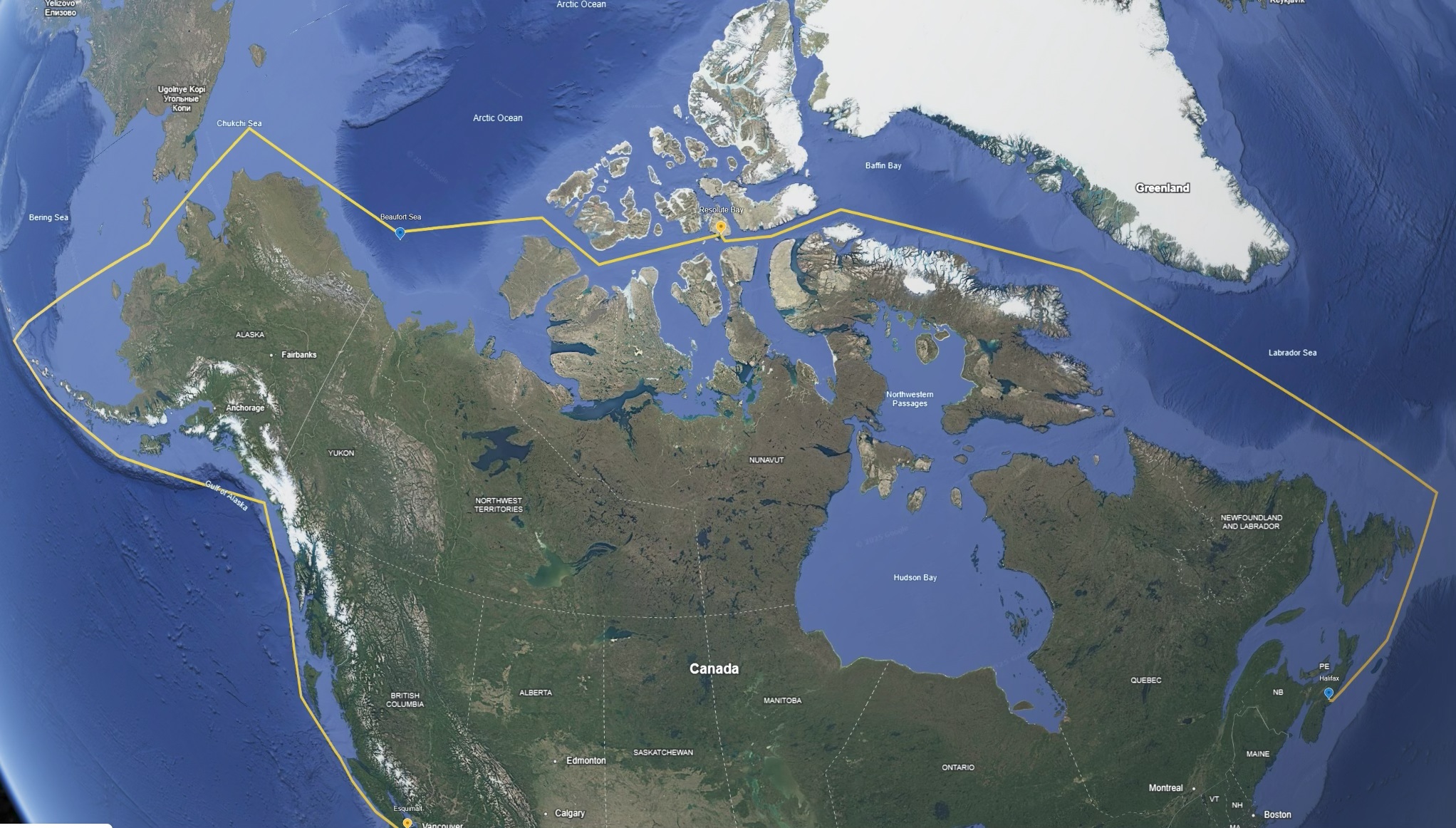
Rough transit routes to Canada’s Arctic from Esquimalt BC and Halifax NS
The first step is to assess what the Government of Canada wants out of its new submarine fleet and what capabilities it will need to achieve its objectives. I’m starting here because there is a common misconception that Canada needs submarines exclusively for Arctic patrol and surveillance, which is false. While it’s true that Arctic sovereignty and security are quite rightfully a preoccupation for the government, patrolling Canada’s Arctic is not the only capability Canada needs out of its new fleet. However, it is the most common argument in favour of a submarine fleet since Arctic sovereignty remains popular within Liberal and Conservative circles alike, along with mainstream media.
Unfortunately, this narrative forces a lopsided conversation about the role these new boats will be expected to play over the coming decades. In addition to Arctic operations, these subs will be expected to deploy far into the North Atlantic with NATO and push across the Pacific to support the Indo-Pacific Strategy. Ottawa’s own defence policy update ties submarine recapitalization to contributions with allies in both theatres.
This implies a blue-water capability, which means these conventionally powered submarines must be able to deploy and fight in the open ocean, far from home ports and daily logistics, for extended periods. This requires long range and endurance for transoceanic transits, sustained submerged persistence through air independent propulsion (AIP) and high-capacity batteries to minimize snorkelling, and habitability and maintenance margins that keep the crew and systems effective past the 30- to 60-day mark. Simply put, the new boats must be able to cross an ocean, remain covert and lethal on station, and deliver effects.
The government further stipulated specific capabilities that the new submarines must have in one of its press releases stating “Through the Canadian Patrol Submarine Project (CPSP), Canada will acquire a larger, modernized submarine fleet to enable the Royal Canadian Navy to covertly detect and deter maritime threats, control our maritime approaches, project power and striking capability further from our shores, and project a persistent deterrent on all three coasts.”
What caught my attention here is the ability to project power and striking capability further from our shores. Power projection is synonymous with a blue-water capability; however, a striking capability, which I take to mean a land strike capability, is not typical for a conventionally powered SSK, which are typically armed only with torpedoes to take out other submarines or surface vessels.
To sum up, Canada’s new subs must be able to:
- Patrol the Arctic with under-ice capability year-round
- Deploy with NATO in the North Atlantic and support Canada’s commitment to the Indo-Pacific Strategy – A blue-water capability
- Remain submerged for three weeks or more at a time
- Covertly detect and deter maritime threats
- Control Canada’s maritime approaches
- A range of 7000 + nautical miles
- Project power far from home ports
- Anti-surface and subsurface warfare
- Land-attack capability via cruise and/or non-nuclear ballistic missiles
- Insert Tier-1 special operators on coastal infiltration missions
- Conduct intelligence, surveillance, and reconnaissance in Canadian maritime approaches and abroad.
With that out of the way, let’s look at what each submarine can do.
He outlines the two competing designs and how they could meet the RCN’s needs and then plumps for the South Korean KSS-III for its stronger case for meeting those needs in the wider ocean environments than the German/Norwegian Type 212CD:
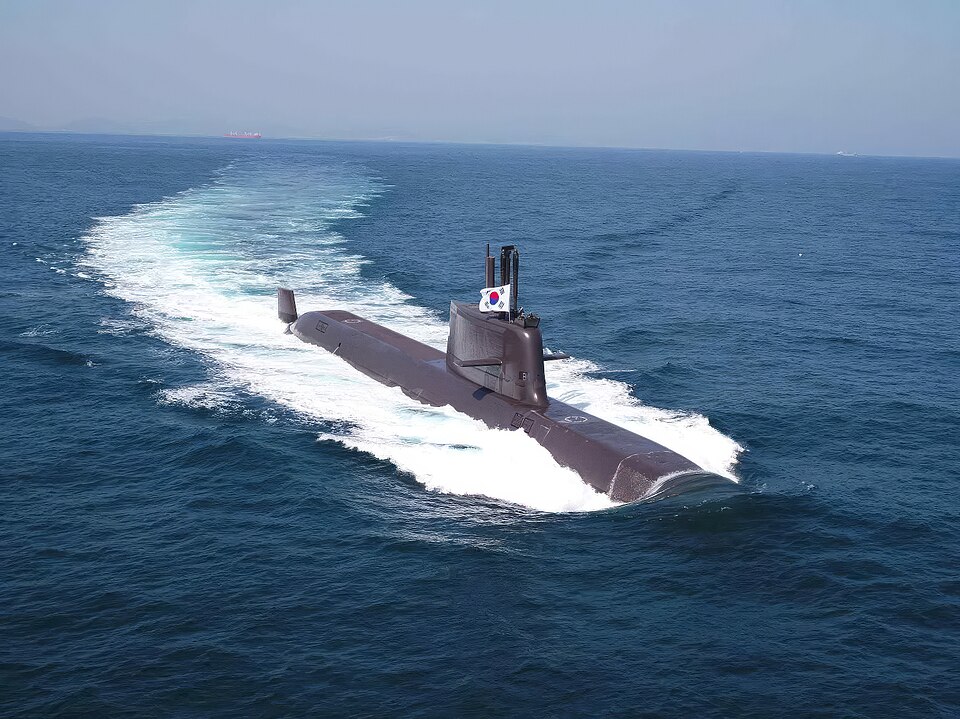
ROKS Shin Chae-ho, a KSS-III submarine at sea on 4 April, 2024.
Photo from the Defense Acquisition Program Administration (DAPA) via Wikimedia Commons.
The KSS-III is the only conventional submarine that can meet all of Canada’s requirements. It combines the blue-water reach and endurance demanded by transoceanic tasking with a vertical launch system that enables credible land-attack and complex anti-surface strike options, supported by lithium-ion batteries that lengthen quiet submerged persistence and improve sortie tempo on distant stations. Its larger hull and higher automation provide the habitability and crew margin needed for 30 to 60 day deployments from Halifax and Esquimalt to the North Atlantic, the Indo-Pacific, and the Arctic ice edge, while remaining within the conventional, non-nuclear profile Canada has set. The design’s modern combat system and sensor suite can be integrated with Canadian and allied command, control, and targeting architectures, and the bilateral sustainment framework required with South Korea can be structured by contract to include full technical data access, in-country training pipelines, and an industrial workshare that anchors through-life support domestically. The delivery cadence proposed for a 2026 award would shorten Canada’s reliance on the Victoria class and reduce associated sustainment exposure during transition, while an initial Canadian order of up to twelve boats would give Ottawa a controlling voice over configuration management, growth paths, and export-variant standards for the life of the class.
Comments Off on The Canadian Patrol Submarine Project
February 16, 2026
M1918A2 MOR: How to Make a Non-NFA BAR
Forgotten Weapons
Published 24 Sept 2025Prior to 1986, Group Industries imported BAR parts kits and then manufactured and registered full-auto receivers for them. This produced transferrable guns which were subject to NFA registration and the $200 transfer tax — which was a much more significant sum at that time than it is today. Some of the potential customers were people (like reenactors) who wanted guns that looked and handled like real BARs but were not regulated by the NFA. To satisfy this subgroup of customers, Group designed a receiver which neither had nor could be adapted to have a gas piston, rendering the gun manually operated. It would fire from an open bolt, but had to be manually recocked after each shot. This was not legally a machine gun, and he made 68 of them.
When the Hughes Amendment to the FOPA passed in 1986, manufacture of new transferrable machine guns ceased, and Group Industries went out of business. Its assets were sold off, including a number of parts kits and unbuilt M.O.R. receivers. One of the buyers was Ohio Ordnance Works (then called Collector’s Corner). They got ten receivers and after selling them, decided to develop a semiautomatic BAR for that same non-NFA BAR market. That gun ended up being the M1918A3, which is still available from them today.
(more…)
Comments Off on M1918A2 MOR: How to Make a Non-NFA BAR
February 13, 2026
Hovea M44: Husqvarna Makes a Submachine Gun
Forgotten Weapons
Published 22 Sept 2025The Hovea M44 was tested by the Danish and Swedish militaries in 1945, competing against the Carl Gustaf M45. It was designed and produced by Husqvarna (yes, the chainsaw company) and just 10 of them were made for testing. It was designed around the Suomi quad-stack magazine, which was also originally a Swedish design. Sweden chose the Carl Gustaf, but Denmark preferred the Hovea — but with a couple modifications. Specifically, they wanted the grip and stock from the Carl Gustaf, and that ended up becoming the Hovea M49 which was adopted into Danish service.
Hovea M49 video: • Denmark’s Post-WW2 SMG: the Hovea m/49
(more…)
Comments Off on Hovea M44: Husqvarna Makes a Submachine Gun


