
HardThrasher
Published 9 Apr 2024How did one man, Rolf Engels, go from student, to victim, to head of the SS Rocket Weapons programme reporting directly to Himmler? How did the Nazi state work, and how did a man like Rocket Rolf navigate the game of snakes and ladders and somehow come out on top?
(more…)
February 12, 2026
Inside the Nazi State: One Man’s Descent Into Darkness
Comments Off on Inside the Nazi State: One Man’s Descent Into Darkness
February 10, 2026
FAMAS G1: Simplified for Export
Forgotten Weapons
Published 17 Sept 2025The FAMAS G1 was developed as a lower-cost option for FAMAS export sales. The original F1 model had been offered for international sale, but it attracted little interest largely because of its high price. In response, GIAT created the G1 with many of the extra features left optional. This allowed them to reduce the price by up to 40%. Specific feature reductions included:
- Omitting the bipod legs
- Omitting the grenade launching sights and barrel fittings
- Omitting the night sights
- Omitting the burst fire mechanism
- Replacing the trigger guard with a molded whole-hand trigger guard
The mechanism stayed the same, and all of the omitted features could be included as options. This still failed to generate any export sales, in part because GIAT came under ownership of FN, and FN’s competing assault rifle options were more profitable than the FAMAS.
The G1 did contribute elements like the whole-hand trigger guard to the mid-1990s G2 model adopted by the French Navy, however.
(more…)
Comments Off on FAMAS G1: Simplified for Export
February 9, 2026
Keeping Up with the Pattons
The Tank Museum
Published 10 Oct 2025M46, M47, M48 and M60. They saw action in Korea, Vietnam, The Gulf and held the line in the Cold War. For almost 40 years the US produced a succession of good tanks — but they never seemed to be good enough for the top brass.
Time after time, designers sought a perfection that seemed to lay out of reach until the arrival of the step-changing M1 Abrams.
Up till then, you have what can be called “The Patton” family: a series of closely related tanks that are only intended to be temporary until the next big thing arrived …
This is the story of the “Patton” family of tanks; tanks that the US tried and failed to replace time after time, yet which despite this ended up becoming the armoured backbone of the Free World during the Cold War.
In this film, Tank Museum Historian, James Donaldson, walks us through the progression of US tanks from the M26 Pershing right up to the M1 Abrams. Commonly known as The Patton Family, this group of tanks were good… but never quite good enough. Always meant to be a stopgap, the Pattons persisted where their prospective replacements failed, leading them to become the vehicles that endured the Cold War around the globe.
00:00 | Introduction
00:58 | From Pershing to Patton
03:50 | Replacing the M46
06:25 | A Third Patton
10:01 | Yet Another Stopgap
12:44 | Irreplaceable?
(more…)
Comments Off on Keeping Up with the Pattons
February 7, 2026
S.R.E.M.: Britain’s Experimental WW2 Bullpup Sniper
Forgotten Weapons
Published 15 Sept 2025The Sniper Rifle Experimental Model (S.R.E.M.) was designed by the “Czech Section” of small arms designers who had taken refuge in the UK to escape German occupation of Czechoslovakia. The intention was to develop a scoped sniper rifle that could be fired and cycled without disturbing the shooter’s sight picture. The idea that the designers came up with was to use the pistol grip as a moving charging handle, similar to the Czech BESA machine gun already in British service.
In 1944, the Essex Engineering Works in the UK got a contract to make 22 sample S.R.E.M.s, although only 2 were actually made. Really, the whole concept was a bit of a red herring, as the recoil from 8mm Mauser (this was made in 8mm, expected the post-war the UK would be adopting it or another modern rimless round to replace the .303) would disturb the sight picture regardless of the mechanism used to cycle the action. The project was cancelled in 1945, and this example is the only known survivor today.
(more…)
Comments Off on S.R.E.M.: Britain’s Experimental WW2 Bullpup Sniper
February 6, 2026
Dresden Part 2 – Firestorm Dresden: Three Days In Hell!
HardThrasher
Published 5 Feb 2026In “Firestorm Dresden: 3 Days in Hell”*, we’ll unpack the bombing and subsequent firestorm in February 1945. We’ll look at how first the RAF night raids and then the US 8th Air Force daylight attacks unfolded, the damage they did and the horrific impact on the ground. We’ll look at how the aftermath shaped the myths and understanding surrounding the raid, and the fate of Arthur Harris and those who’d planned the raid.
* Proof once more, as if it were needed, how shit AI is — I have, apparently, to put the title of the video into the first words in the description to attract Google’s attention … I am so sorry to brutalise the English language like this.
[NR: Part one was posted here on January 22nd, should you want to watch it first.]
00:00 – 02:22 – Opening
02:26 – 06:20 – The weather
06:20 – 16:12 – The attack
16:18 – 25:17 – Horror on the ground
25:22 – 29:26 – USAAF Attacks
29:30 – 34:30 – Dealing with the bodies
34:34 – 44:59 – Reaction in the west
45:03 – 48:06 – The Soviet view
48:10 – 54:27 – Summing up and close
(more…)
Comments Off on Dresden Part 2 – Firestorm Dresden: Three Days In Hell!
February 5, 2026
On The Line with Vice-Admiral Angus Topshee, commander of the Royal Canadian Navy
The Line
Published 3 February, 2025Today on On The Line, Matt Gurney is joined by Vice-Admiral Angus Topshee, commander of the Royal Canadian Navy, for an extended, wide-ranging conversation recorded in the library of the Royal Canadian Military Institute in downtown Toronto. The discussion ranges across geopolitics, the state of the world, the state of Canada’s navy, what’s going right for the fleet, and what still needs to improve.
First, a correction from your host. During the conversation, Matt incorrectly stated at several points that Canada intends to procure 15 new submarines. Admiral Topshee was too kind to interrupt him during the recording, but the correct number is 12. That mistake was entirely Matt’s, and he regrets the error.
With that out of the way, the conversation spans the globe. Admiral Topshee discusses what’s happening in Europe with Russia and Ukraine, and in the Pacific, where growing Chinese power and influence is challenging long-held assumptions about global security. There’s also extensive discussion of the Arctic, why it matters, and what is changing there. Procurement comes up as well — shipyards, new ships for the fleet, and what it will actually cost to deliver on plans that now enjoy broad political support.
They also spend time on what Canada itself needs to sustain a much larger navy and armed forces. Do we have enough bases? Enough reservists? Are people being enrolled into the navy quickly enough? And how, realistically, could Canada expand its forces rapidly in a time of war?
It’s a long, free-ranging conversation about geopolitics, the evolution of warfare, and the future of the Royal Canadian Navy. Check it out today on On The Line. And special thanks to the Royal Canadian Military Institute for hosting this recording of the podcast. For more like this, visit ReadTheLine.ca, and as always, like and subscribe.
0:00 Intro
0:26 Vice-Admiral Angus Topshee
54:16 Outro#OnTheLine #RoyalCanadianNavy #AngusTopshee #CanadianForces #Geopolitics #ArcticSecurity #NavalPower #CanadaDefence #MattGurney
Comments Off on On The Line with Vice-Admiral Angus Topshee, commander of the Royal Canadian Navy
February 4, 2026
French Trials FN CAL: Adding Rifle Grenade Capability
Forgotten Weapons
Published 10 Sept 2025In the 1970s when the French Army was looking for a new rifle 5.56mm, they tested a number of foreign rifles alongside development the FAMAS at St Etienne. These included the HK33, the M16, and the FN CAL — and today we are looking at the FN CAL. It already had a four-position selector switch (safe/semi/full/burst), fulfilling one of the French Army requirements. But it did not have sufficient grenade launching capability, and so several examples were modified for trials with unique rifle grenade launching hardware.
Ultimately the HK33 was the best performing rifle, but it was not seen as a politically acceptable option and the FAMAS was chosen instead. I have not seen the trials reports to understand specifically why the FN CAL was unsuccessful, but we know that it was unsuccessful in many other trials, and FN dropped it for the distinct FNC design instead before long.
Full FN CAL teardown: • FN CAL: Short-Lived Predecessor to the FNC
HK33F Video: • Roller Delay in France: The H&K 33F (Trial…Many thanks to the IRCGN (Institut de Recherche Criminelle de la Gendarmerie Nationale) for allowing me access to film these trials prototypes for you!
(more…)
Comments Off on French Trials FN CAL: Adding Rifle Grenade Capability
January 30, 2026
Japanese Last-Ditch Pole Spear Bayonet
Forgotten Weapons
Published 8 Sept 2025Japanese bayonets followed the same trend of simplification as Arisaka rifles towards the end of World War Two, culminating in what is today called the “pole bayonet”. Abandoning even the fittings to mount to a rifle, these bayonets were intended to be lashed to a pole to create a spear. The Japanese government did not have the military forces to repulse an American invasion of the home islands, and was actively planning to sacrifice millions of Japanese civilians in a hopeless defense, literally having them charge American machine guns with spears. Some of this was done on outer island battles, like Saipan and Okinawa but the scale in Japan itself would have been unimaginable. It was the nuclear bombs on Hiroshima and Nagasaki that led to a Japanese surrender and prevented this from becoming a reality.
(more…)
Comments Off on Japanese Last-Ditch Pole Spear Bayonet
January 29, 2026
QotD: Nitpicking the Roman army in Gladiator (2000)
We pick up in an improbably mud-soaked clearing with a title card informing us that we’re in “Germania”, which is correct in a very broad sense that this is the Second Marcomannic War and the enemies here are the Marcomanni and Quadi, who are Germani (Germanic-language speakers), but the army here isn’t operating out of the Roman provinces of Germania (superior and inferior) which are on the Rhine, but rather on the Danube, from the provinces of Noricum and Pannonia (Superior). But in the sense that we’re in Germania magna, the greater zone of Germanic cultural influence, sure, fine.
In the process of Maximus riding up, the failure of negotiations and Maximus riding to join his cavalry, we get something of an overview of the Roman army and its position and both are wrong. Let’s start with the soldiers: we see a very clear distinction between two kinds of soldiers, the mail-clad auxilia, all archers, and the legionaries wearing the lorica segmentata and there appear to be about the same number of both groups. And here is where we first see the clear influence of the Column of Trajan (and to an unfortunately lesser degree, the far more appropriate Column of Marcus Aurelius) on the depiction, because this use of armor to distinctly signal the Roman citizen legionaries and non-citizen auxilia is straight from the Column of Trajan, completed probably around 113 and commemorating Trajan’s two Dacian Wars (101-102, 105-106).
What this sequence gets correct is that the Roman army was divided into those two groups, they were roughly equal in number (by this period, the auxilia probably modestly outnumber the legions in total manpower)1 and Trajan’s Column does use that visual signifier to distinguish them. This component is the crux of the verisimilitude that leads people to trust the rest of this sequence.
The problems start almost immediately from there. Roman auxilia were far more varied than what we see here in terms of equipment and tactics and only very few of them were archers. So let’s break down Roman auxiliary contingents. With all due caveats about the limits of our evidence, infantry auxilia outnumber cavalry by about 2:1 in attested auxilia units (auxilia were grouped into cavalry alae and infantry cohortes, generally of 480 men (sometimes around 800), but unlike for legionary citizen-infantry, these cohorts were not grouped into larger legions).2 So we ought to expect about a third of our auxilia to be cavalry, which is important because the cavalry detachments of Roman legions were very small (and mostly for scouting and messenger duties). Auxilia cavalry ranged in equipment and could include horse archers and even ultra-heavy cataphract cavalry, but most were mailed shock cavalry, equipped quite a lot like how Gallic or Germanic warrior-aristocrats or Roman legionary cavalry would be.
Of the remainder, the most common kind of infantry auxilia by far seem to have been heavy infantry, fighting in fairly heavy armor. These fellows get depicted in Roman artwork generally in mail armor, with flat oval shields (as opposed to the curved, rectangular imperial-period Roman scutum), spears and swords. These fellows, totally absent in this sequence are all over the Column of Trajan, with their flat oval shields being frequently seen (although one must distinguish them from Dacians who carry the same shield; the auxilia stick out for their mail and helmets). A bit less than 10% of auxilia units are attested as cohortes sagittariorum (“cohort of archers”). We also know the Romans used slingers within the auxilia, but as far as we can tell, not in specialized units; they may have been brigaded in with other auxilia cohorts. In either case, they appear in fairly small numbers. Finally, we also see on things like the Column of Trajan Roman allied or auxiliary units that are substantially lighter infantry: on the Column of Trajan, these are local troops shown wielding large clubs and stripped to the waist, presumably representing troops local to the Danube region, fighting in local (unarmored, with heavy two-handed weapons) style.
So whereas the army we see is a nearly even split between legionary heavy infantry and auxilia archers (with a small amount of legionary cavalry waiting for Maximus to show up to lead them), in practice a typical Roman field army would have far fewer archers, indeed around ten times fewer: not almost 50% of the force, but in fact probably a bit less than 5% of the force (since they’re less than 10% of the auxilia who would make up around half of a Roman field army). Meanwhile we’re simply missing the – by far – two most common sorts of auxilia cohorts, those of heavy infantry or heavy cavalry. This mangling of the structure of a Roman army is going to have implications when we get to Maximus’ overall plan for the battle as well.
Meanwhile, the legionary infantry are also much too uniform, literally. This is easily the most pardonable error, because what has happened here is that director Ridley Scott has copied the Column of Trajan but far too uncritically. After all, the Column of Trajan is not a photograph and thus has space for the artists producing it to take liberties, particularly in the name of imperial ideology and propaganda. In this case, showing large numbers of identically equipped soldiers, often moving in unified formation, serves the same rhetorical purpose in antiquity as it does today, suggesting an impressive, inhumanly uniformed and disciplined source. Moreover, the segmented Roman body armor, which we call the lorica segmentata (we don’t know what the Romans called it), was very distinctive to the legions, as it was the one armor that it seems like the auxilia probably (the evidence here can be tricky) didn’t share. And keeping the legions distinct from the auxilia also matters, as the legionary soldiers are higher status citizens who thus get “higher billing” in the imagery, as it were, than the auxilia. So showing all of the legions equipped neatly with this armor makes them seem distinct, impressive and uniform.
In short, it served Trajan’s image (and thus the artists aim) to suggest that all of his legions wore this armor.
Archaeology tells us quite clearly it was not so. Indeed, the lorica segmentata, so iconic because of its use in this way on the Column of Trajan, was probably the least common of the three major types of Roman legionary body armor in this period. The most common armor of the Roman legions was almost certainly still – as it had been in the Late Republic – mail, exactly the same as we see the auxilia wearing. We find fragments of Roman mail in legionary sites in all corners of the Empire and it remained common everywhere. To head off a standard question: no, it does not seem that the Romans ever got the idea to layer other defenses over mail, so when it was worn, it was the “primary” armor (worn over a padded textile defense called a subarmalis, but not under any other armor).3 We also see mail represented in Roman artwork, including on very high status soldiers, like senior centurions.
The next most common armor was probably scale armor, which we find very frequently in the East (that is, on the frontier with the Parthians/Sassanids) and often enough (if less frequently) in the West (that is, the Rhine/Danube frontier). We also know that some auxilia units wore this armor too and we see quite a bit of scale armor – wholly absent in this sequence – on the Column of – wait for it – Marcus Aurelius (completed c. 193). That’s the column that commemorates this war. Contemporary with this fictional battle. But it is less famous and somewhat less well-preserved than 70-years-earlier Column of Trajan, which they pretty evidently used quite a bit more of.
The lorica segmentata shows up the least often and – to my knowledge – effectively exclusively in the west on the Rhine/Danube frontier, where it is still probably not the most common (although it may have been more common than scale on that frontier). So what we ought to see in this army are legionaries who are marked out by their large scuta (the big Roman shield, by this period distinctly rectangular and also (as in the republic) curved), but in a range of mail, scale and lorica segmentata (with mail and segmentata being the most common, because we are on the Danube frontier, but scale hardly rare), along with auxilia divided into specialist cohorts (480 man units) each with different sets of armor and weapons: a few missile cohorts (archers, slingers), a lot more heavy infantry cohorts with spears and long shields, some lighter troops, and so on. The auxilia ought to be wearing basically every armor under the sun except for the lorica segmentata (which to my knowledge we’ve only ever found in sites associated with the legions).
Finally, these units are backed up by a whole load of catapults. We see two kinds, dual-arm arrow-throwing machines (which most folks would casually call ballistae) and single-armed pot-throwing machines (which most folks would casually call catapults), all of them in stationary mounts. Now on the one hand, “the Romans use lots of torsion-based catapults as artillery” is a true statement about the Roman army of this period, but on the other hand once again beyond that basic idea, most of this is wrong. Once again there’s an issue of verisimilitude here: the appearance of strange catapults and the true fact that the Romans used a lot of unusual catapults is likely to lead the viewer to assume some research has been done here and thus that these are the right catapults. For the most part, they are not.
We can start with the easy one, the larger single-armed pot-throwers. These are onagers, a late-Roman simplified single-arm torsion catapult, named for their fearsome “kick” (like an ass, an onager). These are popular favorites for Roman artillery, for instance showing up in both Rome: Total War and Total War: Rome II (both of which have main campaigns set during the Late Republic). There’s only one problem, which is that Gladiator (much less the even earlier Total War games) is set substantially too early for an onager to appear. Our first attestation of the onager is in Ammianus Marcellinus, writing in the last two decades of the 300s AD about the events of 353-378 (his work was broader than this, but only the back end survives). Vegetius, writing roughly contemporary with Ammianus also mentions them. But before the late fourth century, we don’t have any evidence for this design and it doesn’t show up on the Columns of Trajan or Marcus. So this isn’t just a little bit too early for these catapults but, given the evidence we have, around 150 years too early, the equivalent of having a line of M1 Abrams show up in a film about the Battle of Gettysburg.
What we do have are a number of twin-armed bolt or arrow-throwing machines and the Romans certainly had those, though what we see doesn’t match up well with what the Romans used. What we see is a single size of fairly large arrow-throwing engines, aimed upward to fire in fairly high arcs and built with large metal cases containing the torsion springs (generally made of hair or sinew, tightly coiled up; it is the coiling of these springs which stores the energy of the machine).
These two-armed torsion catapults came in a wide range of sizes and could be designed to throw either arrows/bolts or stones (the latter carved into spheres of rather precise caliber for specific machines). And we ought to see a pretty wide range of sizes here, from massive one-talent engines, which threw a 1 talent (26kg) stone and stood about three times the height of a man, to much smaller anti-personnel weapons (scorpiones) that were more like a “crew served” weapon than a large artillery piece. By Trajan’s time, the Romans had even taken to mounting these smaller crew-served engines on mule-drawn carts (called carroballistae) to allow them to be rapidly repositioned, something like early modern “horse artillery” (they were not meant to fire on the move; when we see them on Trajan’s Column, at least one of the operators is usually standing on the ground outside of the cart to winch the machine). These smaller machines, which would have made up the bulk of those deployed in a field battle, seem mostly absent in the sequence.
The result of all of this is that the Roman army presented in the opening moments of Gladiator manages to strike a remarkably unhappy balance: having just enough of the appearance of accuracy to decisively influence two decades of subsequent depictions of the Roman army without actually being particularly correct about anything beyond a very surface level. But subsequent pop-culture (again, I think Rome: Total War played a significant role here) would codify this vision of the Roman army – fire-throwing onagers, lots of auxilia archers, legionary rather than auxiliary cavalry, uniform use of the lorica segmentata – as the dominant model for quite some time.
But the army isn’t the only thing that’s wrong.
Bret Devereaux, “Collections: Nitpicking Gladiator’s Iconic Opening Battle, Part I”, A Collection of Unmitigated Pedantry, 2025-06-06.
- See figures in P. Holder, Auxiliary Deployment in the Reign of Hadrian (2003).
- There’s some complexity here because some infantry auxilia cohorts had small attached cavalry contingents too.
- I suppose I should note that is an odd exception for a type of very fine armor sometimes called lorica plumata (“feathered armor”) by modern writers where metal scales were mounted on mail armor (typically with extremely fine, small rings), rather than on a textile backing. This armor type seems to have been rare and must have been very expensive.
Comments Off on QotD: Nitpicking the Roman army in Gladiator (2000)
January 28, 2026
The Best Operational Briefcase: American 180 & Laser Sight
Forgotten Weapons
Published 5 Sept 2025The “American 180 Security Briefcase” is the best execution of the operational briefcase concept that I have yet seen. The idea is simple; hide a submachine gun inside an ordinary looking briefcase so that it can be carried in the open by VIP security without arousing attention. Sometimes this is done strictly for stowage (see the Uzi coming out of a Secret Service briefcase during the attempted Reagan assassination) and sometimes it is designed to fire from within the case (see the H&K MP5 operational case). This one is meant for firing.
Unlike virtually all other such cases, this one includes a sight, a helium-neon laser. That allows the gun to be actually aimed — what an idea! The firing mechanism is also well thought out, with a manual safety switch that powers the laser and firing solenoid, then a constant-pressure switch for the laser and a pressure pad for the gun. I don’t know who made this, but it was a commercially available product … and a very cool one at that!
(more…)
Comments Off on The Best Operational Briefcase: American 180 & Laser Sight
January 24, 2026
Potato Digger at War: Marlin Model 1917 Machine Gun
Forgotten Weapons
Published 27 Aug 2025John Browning’s first machine gun design was a gas operated system that used a swinging lever instead of a linear piston. He presented the first prototype to Colt in 1890, and it went into production in 1895. The US Navy bought a couple hundred, but the Army opted not to adopt it (much to Colt’s surprise). It was offered for sale internationally, but didn’t become very popular until World War One broke out.
By this time, Colt had improved it a bit with a finned detachable barrel, and they started getting orders for thousands of the guns from Belgium, Russia, Canada, Britain, and elsewhere. Unable to keep up with demand, they licensed the design to the Marlin company. Marlin made a few additional improvements (pistol grip attachment, sights, and access door for clearing malfunctions) and made several thousand for allied nations as well as 2,500 fort he US Army to use as training guns in 1917. They further improved the design by changing it to a linear gas piston, and sold some 38,000 to the US military for aircraft use.
3D animation of the Colt 1895 mechanism from vbbsmyt: • Browning 1895 ‘Potato digger’
Marlin 7MG Aircraft Gun: • Marlin 7MG aka Model 1917 Aircraft Machine…
(more…)
Comments Off on Potato Digger at War: Marlin Model 1917 Machine Gun
January 23, 2026
Canadian schizophrenia: “Resist US aggression!” but also “Disarm law-abiding civilians!”
Returning to a topic I’ve been mocking all week on the socials, in The Line, Matt Gurney gently suggests to the Canadian government that it’s just not reasonable to expect Canadian civilians to wage some kind of fierce guerilla war against a feared American invasion while actively disarming Canadians who legally own guns:

A lot has happened, is the thing. A lot is still happening. And it all seems to be happening faster.
But it’s still worth slowing things down just a little bit when the news stories arrive in particularly baffling sequences. Consider just two you may have seen this week: Canada is thinking about fighting an insurgency in case the Americans invade us, and Canada is also working hard to disarm its civilian population. Can I just interject here a moment and suggest that these goals are at odds? That this might be a stupid way of doing things? That the Canadian federal right hand would be shocked and appalled to discover what the left hand was doing?
Let’s take a minute and set up the insurgency thing. It comes from an article published this week in The Globe and Mail. Canadian soldiers are not frantically digging trenches quite yet. The overall consensus is that a U.S. invasion of Canada is unlikely. But clearly, the current trajectory of U.S. geopolitics has shifted the prospect from “batshit crazy” to “it would be weird but we should probably think about it”. So the military is thinking about it — it’s now a contingency being considered, just like the military plans for natural disasters or less bizarre military scenarios, like a war requiring a mobilization or an attack by a terror group or hostile nation on Canadian soil.
And what is the military thinking? Allow me to quote from the Globe:
The two senior government officials said military planners are modelling a U.S. invasion from the south, expecting American forces to overcome Canada’s strategic positions on land and at sea within a week and possibly as quickly as two days.
Canada does not have the number of military personnel or the sophisticated equipment needed to fend off a conventional American attack, they said. So, the military envisions unconventional warfare in which small groups of irregular military or armed civilians would resort to ambushes, sabotage, drone warfare or hit-and-run tactics.
One of the officials said the model includes tactics used by the Afghan mujahedeen in their hit-and-run attacks on Russian soldiers during the 1979-1989 Soviet-Afghan War. These were the same tactics employed by the Taliban in their 20-year war against the U.S. and allied forces that included Canada. Many of the 158 Canadian soldiers killed in Afghanistan from 2001 to 2014 were struck by improvised explosive devices or IEDs.
Mmm. This yogurt is tasty.
Let me say three things here: first, I can confirm some of the Globe‘s reporting via my own sources. I know for a fact that members of the Canadian Armed Forces are talking, in a very conceptual, high-level way, about what an insurgency against an invader could and would look like in Canada. I do not know of any serious plans or preparations. But discussions? Absolutely. Second, the plan above, in very vague terms, is probably about correct, in terms of how the Canadian population could resist an invader. The actual shooting war would be over almost immediately — the U.S.’s military advantage would be overwhelming. I think two days is optimistic, frankly. I’m not sure it would take much more than two hours to smash any meaningful military resistance.
So, longer term insurgency against a larger and more advanced force would be the only real option, and in that kind of fight, we’d have some real advantages. We’d be a tougher nut to crack, in many ways, than either Iraq or Afghanistan.
But only if we don’t hobble ourselves first. And this brings us to the third point I’d like to make: did you notice the part about “armed civilians”? Because I sure did.
Civilians, sometimes augmented by experienced military personnel in technical and leadership roles, are always the backbone of an insurgency. They have to be. Insurgencies are hit-and-run affairs, and you can’t do that if you’re driving a tank back to a base. In order to be effective, the population must be armed, or somehow have the means to arm itself. Not to be cute, but the resistance being armed is a necessary precondition for a successful armed resistance.
And we are disarming ourselves.
For the record, Canada and the US have historically had plans to defend against one another even at times we’ve otherwise been very peaceful and friendly. About a year ago, Big Serge suggested updates to the old US “War Plan Red” scenario invasion of Canada:
The country’s political and economic center of gravity is the urban corridor from Toronto to Montreal, but a significant share of the Canadian Army is dispersed, with large garrisons in Quebec, Halifax, and the western provinces. Only handful of brigades are garrisoned in the critical theater.
Manifest Destiny, 2025? Big Serge’s updated map for the old US War Plan Red for a military invasion of Canada.
The war will be won quickly and decisively, without massive destruction of Canadian cities, if American forces can establish blocking positions to isolate the urban corridor from peripheral Canadian garrisons. In this maneuver scheme, we utilize highly mobile elements including 1st Cavalry Division and airborne forces to block the highways into Toronto, while an eastern screening group isolates the urban centers from reinforcements scrambling in from Quebec.
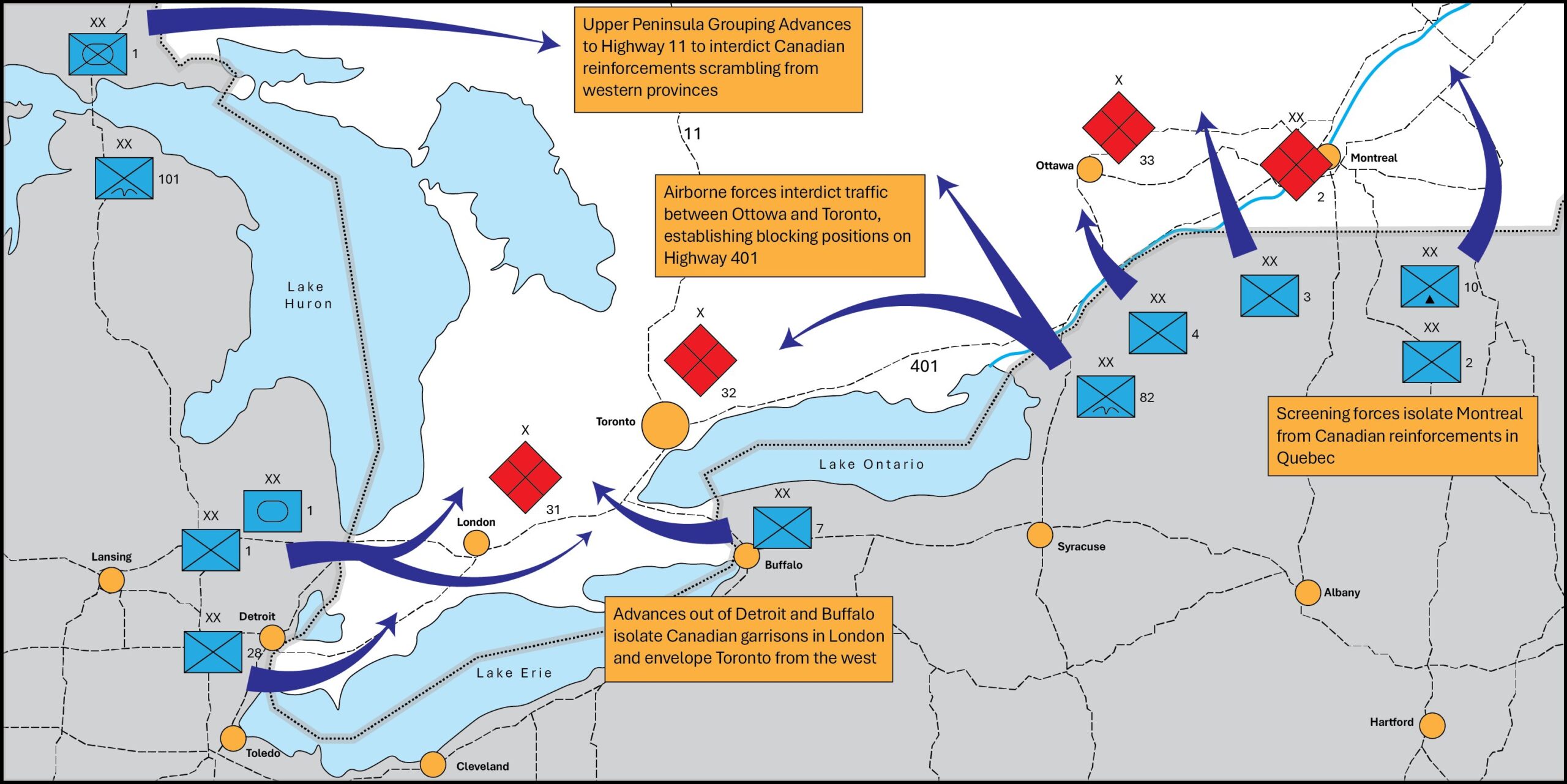
Proving my near-Nostradamus-level ability to foresee the future, I remarked that “As to why Trump would want to invade a frozen failed state on the brink of bankruptcy, even Big Serge doesn’t have an answer”. Now, of course, the biggest risk to US security would come from Canadian “snowbirds” in Florida, Texas, and Arizona, who may be prone to driving their motor homes or golf carts to attack ICE and US Border Patrol facilities before the Bingo games start at 8.
January 22, 2026
Dresden Part 1 – Targets, Tangents & Genocide
HardThrasher
Published 20 Jan 2026Was Dresden a war crime or a late-war military decision made in cold blood? The firebombing of Dresden (13–14 Feb 1945) remains one of the most infamous episodes of the WW2 history: a firestorm, a shattered city, and a death toll that still sparks argument today.
But most of what “everyone knows” about Dresden is wrong. In Part 1 of this two-part series, you and I will dig into the real reasons Dresden became a target. We also ask the uncomfortable questions: Was Dresden an “innocent” city? How Nazi was it? And what does Dresden reveal about the logic — and limits — of strategic bombing? And because this is my video and I’ll do as I damn well please, we’ll also do a quick overview of nearly 1,000 years of history, because why not. Thus in this you will also get the Northern Crusades, a discussion of pottery, a smattering of Central European history and long discussion of how the Nazis subverted power and used it to abuse people whilst being wildly incompetent at the basics
00:00 – Start
04:39 – Part 1 – A Brief History of Everything in Central Europe
17:36 – Rise of the Nazis and the Nuremberg Laws
30:25 – Military and Industrial Dresden
34:03 – Failure to Prepare for War
40:37 – How did it become a target?
52:37 – Survivor’s Club
(more…)
January 21, 2026
We’ll resist the Yankee hordes with our … um, strongly worded tweets?
A brilliant example of the general case of progressives never taking into account the impact of their own pet schemes is the Canadian Armed Forces including “armed civil resistance” as part of their contingency planning for an American invasion … at the same time that the Canadian government is moving heaven and earth to disarm as many Canadians as possible:
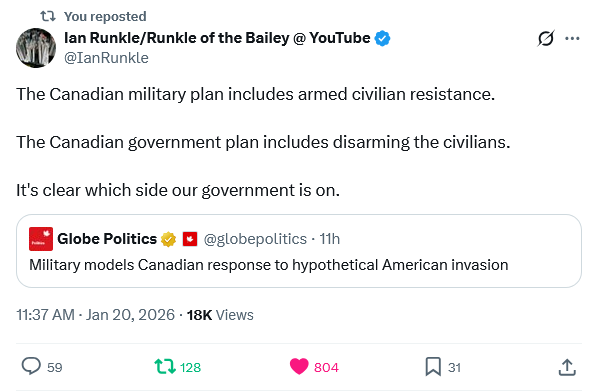
Jason James writes:
Canadian military planners have modeled a potential US invasion from the south.
Their plan?
An armed civilian resistance.
I’m not sure if they’ve checked in with the Liberal government yet, but they’ve outlawed most “assault style” weapons (meaning anything that could actually be used to mount such a resistance).
And depending on where the US invades, they might have a difficult time finding civilians who actually own anything beyond kitchen knives.
Furthermore, anyone who does own hunting rifles or the few legal “assault style” weapons would be more inclined to fight on the side of the Americans than defend a socialist wasteland that sold their future to China.
So what’s the plan then? Mobilize the Mexican cartels and Chinese organized crime gangs who actually have some fire power? Form a militia of IRGC operatives and Indian drug gangs to fight American special forces?
I highly doubt any of them would be interested in walking into certain death for a country they have no allegiance to.
So I guess we’re down to a handful of lesbians and communists armed with broom handles defending Vancouver and Toronto from the greatest military power the world has ever known.
Good luck with that, comrades.
No disrespect to James, but the weapons the federal government are trying to confiscate are not “weapons of war” or “assault weapons” — they are mostly semi-automatic guns that look vaguely like military weapons. The feds offered to send all confiscated weapons to Ukraine as they fight a desperate war of defence against the Russian invaders and need anything they can get. And Ukraine refused the offer because these weapons would not be useful in combat. But the basis for confiscating them in the first place is that they’re all dangerous military weapons.
This is likely what would happen if such an invasion materialized:
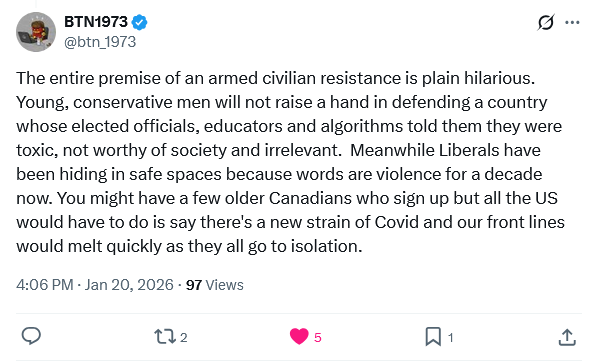
Of course, you can always depend on Not the Bee to provide a tasteful selection of topical memes.
Soviet World War Two 50mm Light Mortars (RM-39 & RM-40)
Forgotten Weapons
Published 25 Aug 2025The Soviet Union decided to adopt a 50mm light mortar in 1937 as a company-level armament. The first such weapon they used was the RM-38, introduced in 1938. It was a complex design, with a gas venting system to adjust range (200m – 800m), a bipod specifically set to either 45 or 75 degrees, and a recoil buffering system. This was clearly too complex, and it was replaced by the RM-39 the next year. This remained a well-made mortar, but now had a freely adjustable bipod. However it quickly proved too complex and expensive and it was in turn replaced by the RM-40.
The RM-40 is a much more efficient (aka, cheap) design. It used simple stamped bipod legs and a heavy stamped baseplate. It still uses adjustable gas venting to set range and retains a simplified recoil buffer, but it is a much more quickly produced weapon. A 1941 model of completely different design did replace it though, and by 1943 the Soviet Union moved to 82mm mortars for better effectiveness.
The Soviet mortars were generally well liked by German troops who captured them, as they were significantly longer ranged than the German 50mm mortar. They were also captured in large numbers by the Finns, who used them as well but found them underpowered. In 1960 some 1,268 Soviet 50mm mortars of all models were sold by the Finnish Defense Forces to Interarms to be imported into the US. Some were registered and sold as Destructive Devices and some were deactivated and sold as dummies.
(more…)
Comments Off on Soviet World War Two 50mm Light Mortars (RM-39 & RM-40)


