Quotulatiousness

August 1, 2025

The sad saga of the CH-148 Cyclone helicopters in Canadian service

Filed under: Cancon, Government, History, Military, Weapons — Tags: , , , — Nicholas @ 03:00

In the National Post, Tom Lawson and Gaëlle Rivard Piché argue for the Canadian government to learn from long and bitter past experiences while they “reconsider” the F-35 purchase for the RCAF … specifically the mind-numbing and depressing saga of obtaining helicopters for the Canadian Armed Forces. First, a quick recap of the helicopter story from a post back in 2012:

Pre-delivery Sikorsky CH-148 Cyclone helicopter, 4 April, 2012.
Photo by Gerry Metzler via Wikimedia Commons.

  • In 1963, the CH-124 Sea King helicopter (a variant of the US Navy S-61 model) entered service with the Royal Canadian Navy.
  • In 1983, the [Pierre] Trudeau government started a process to replace the Sea Kings. That process never got far enough for a replacement helicopter to be ordered.
  • In 1985, the Mulroney government started a new process to find a replacement for the Sea Kings.
  • In 1992, the Mulroney government placed an order for 50 EH-101 Cormorant helicopters (for both naval and search-and-rescue operations).
  • In 1993, the Campbell government reduced the order from 50 to 43, theoretically saving $1.4B.
  • In 1993, the new Chrétien government cancelled the “Cadillac” helicopters as being far too expensive and started a new process to identify the right helicopters to buy. The government had to pay nearly $500 million in cancellation penalties.
  • In 1998, having split the plan into separate orders for naval and SAR helicopters, the government ended up buying 15 Cormorant SAR helicopters anyway — and the per-unit prices had risen in the intervening time.
  • In 2004, the Martin government placed an order with Sikorsky for 28 CH-148 Cyclone helicopters to be delivered starting in 2008 (after very carefully arranging the specifications to exclude the Cormorant from the competition).
  • Now, in 2012, we may still have another five years to wait for the delivery of the Cyclones.

A few data points in addition to that list:

  • In 2009, the government granted Sikorsky two more years to begin deliveries … and waived the penalty fees for late delivery.
  • In 2011, the government announced it would impose late delivery fines on Sikorsky.
  • In 2012, Sikorsky announced the delay of the first batch of “interim” helicopters until 2013.
  • In 2015, the first six helicopters were delivered so RCAF crews could begin training, with two more later in the year.
  • In 2018, the first operational deployment of a Cyclone had the helicopter embarked on HMCS Ville de Quebec as part of Operation Reassurance.
  • In 2021, 19 of the 23 helicopters delivered were taken out of service for cracks in the tail assemblies.
  • In January 2025, the 27th helicopter was delivered to the RCAF.

Based on this lengthy and expensive process, Lawson and Piché write:

In 1992, the Progressive Conservative government signed a $4.8-billion contract with a European consortium to replace the aging Sea King helicopters deployed aboard Royal Canadian Navy (RCN) ships. For purely political reasons, when the Liberals came to power the following year, they cancelled the deal — incurring $500 million in termination penalties — and set out to find a more politically acceptable solution. That search dragged on for over a decade, culminating in a 2004 contract with Sikorsky to procure 28 CH-148 Cyclone helicopters.

What the government failed to realize — or chose to overlook — was that Sikorsky was not offering a ready-made military platform. Instead, it proposed to adapt its civilian S-92 model into a maritime helicopter fit for military use, with the hope of replicating the global success of its venerable Sea King.

But developmental issues plagued the project from the outset. The original delivery schedule of 2009 slipped repeatedly, prompting then-minister of national defence Peter MacKay to call the procurement “the worst in the history of Canada”. By 2014, the program was on the brink of cancellation. Only a tense meeting between senior ministers and Sikorsky’s president salvaged the deal, leading to a revised agreement that saw the Cyclone finally enter operational service in 2018.

Yet the challenges did not end there. The Cyclone has consistently posted poor serviceability rates. A crash that cost the lives of six Canadian Armed Forces members in early 2020 was linked to inadequate documentation and flawed software. More recently, the fleet has again been largely grounded — this time due to a shortage of spare parts. The Commander of the RCN has voiced public frustration over the shortage of deployable helicopters, even threatening to replace them with drones if necessary.

To be fair, Sikorsky is not solely to blame. It offered an attractive idea: a modern fly-by-wire maritime helicopter based on a successful civilian platform. The government accepted, underestimating the complexity of the transformation. The key lesson here — one that directly applies to the current fighter jet debate — is that there is enormous risk in buying aircraft, like the Cyclone, that exist in limited numbers worldwide.

The best path forward with the Cyclone may now be to phase out the fleet and absorb the sunk costs. A more reliable option could be the MH-60 Seahawk, also made by Sikorsky. Unlike the Cyclone, the Seahawk is a proven design, with nearly 1,000 units in active service with the U.S., Australian and some NATO navies. While it would be politically awkward to cancel a Sikorsky platform only to purchase another from the same manufacturer, pragmatism must prevail. Perhaps a deal could be struck to return the Cyclones for parts, recouping some value through the civilian S-92 supply chain.

July 31, 2025

Stamm-Zeller 1902: A Swiss Straight-Pull Converted to Semiauto

Filed under: Europe, History, Military, Weapons — Tags: , , , , — Nicholas @ 02:00

Forgotten Weapons
Published 8 Mar 2025

Today’s rifle was designed by a Swiss inventor named Hans Stamm while working for the Zeller et Cie company in Appenzell Switzerland. The company originally made embroidering machinery, but turned to military rifle parts subcontracting to bring in additional revenue in the early 1890s. Stamm had shown a good aptitude and interest for this work, and when the company decided to lean into the small arms business he was put in charge of its new weapons division.

There, Stamm spent several years developing a self-loading rifle for the Swiss military. It was not something specifically requested by the government, but rather an opportunistic risk by the company. Stamm’s resulting gun, the Model 1902, was expensive to produce, but quite elegant in design. It is a long-stroke gas pistol system with a rotating bolt, which was made from the ground up but could easily be adapted as a conversion of existing straight-pull bolt action rifles like the Swiss G96.

Unfortunately, the Swiss military declined the rifle, and Zeller was unable to find any other interested clients among the European states. By 1906, tired of dumping money into what is clearly a losing proposition, Zeller shuts down its weapons division. Stamm leaves the company, but he is not done with small arms design — we will see several more of his designs in future videos!

Many thanks to the Swiss Shooting Museum in Bern for giving me access to this visually one of a kind rifle to film for you! The museum is free to the public, and definitely worth visiting if you are in Bern — although it is closed for renovation until autumn 2025: https://www.schuetzenmuseum.ch/en/
(more…)

July 27, 2025

Shooting a .276 Pedersen PB Rifle

Filed under: History, Military, USA, Weapons — Tags: , , , , — Nicholas @ 02:00

Forgotten Weapons
Published 11 Aug 2015

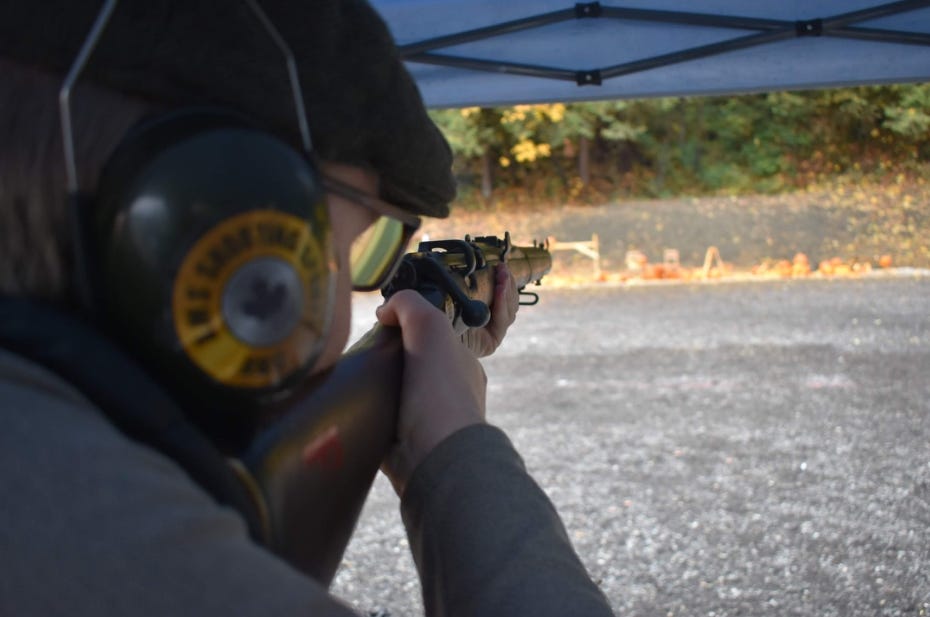
Thanks to Alex C. at TheFirearmBlog, I recently had an opportunity to do some shooting with a .276 caliber Vickers-Pedersen model PB rifle. This was one of the very first rifles Vickers built when they thought the Pedersen would be adopted by the US military and could be further marketed worldwide — after only about 16 PB rifles they made some changes and started making the improved PA model instead (the two main improvements being the use of a reversible clip and the addition of a mechanism to allow ejection of a partially-full clip).

Anyway, in addition to Alex and myself, we were joined by Nathaniel F (a TFB writer) and Patrick R (from the TFBTV video channel). Between us we put about 60 rounds of original 1920s wax-lubricated Frankfort Arsenal .276 Pedersen ammo through the rifle.

July 25, 2025

QotD: Evolved threat display mechanisms

Filed under: Government, History, Liberty, Quotations, Science, Weapons — Tags: , , , , — Nicholas @ 01:00

Every single bird and mammal I can think of, even some reptiles and fish, will exhibit something that ethologists call “threat display” whenever it feels menaced. Dogs and cats, horses and cattle, geese and pigs all engage in what amounts to a form of violence reducing behavior, growling, snarling, puffing up with poison spines, spitting, and assuming various combative postures that tell an enemy, a rival, or a predator, “Better back off, or you’re gonna get hurt”. I even had a cuddly big pet rabbit once, who would snort, bare his teeth, and charge you with his big front claws if he didn’t like the cut of your jib.

Animals, especially predators, are all pretty good at risk assessment. I’m absolutely certain, as an enthusiastic student of evolution, that dinosaurs had different kinds of threat display mechanisms, too. Maybe even trilobites. They do their thing and they stay alive.

On the other hand, just suppose you’re walking down a badly-lit sidewalk in any town or city in this or practically any other country, when you’re suddenly approached by half a dozen tough-looking young punks. They could be a murderous gang of thugs out to “make their bones” or just the local hockey team. But if you pull out your 6 1/2 inch nickel-plated Smith & Wesson Model 29 .44 Magnum, and simply hold it down beside your leg, you could be arrested for “brandishing” and your attractive, shiny, valuable weapon stolen from you by sticky-fingered cops.

When it comes to threat display — which could save your life as well as the lives of those who make you feel uneasy — you don’t have the rights of a lowly blow-fish. The insanity of ignorant government pencil-necks forbidding four billion year old violence-reducing behavior cannot be overstated.

L. Neil Smith, “Maybe Even Trilobites”, Libertarian Enterprise, 2018-10-14.

July 24, 2025

Glock 18 & 18C Machine Pistols: How Do They Work?

Filed under: Europe, History, Weapons — Tags: , , , , , — Nicholas @ 02:00

Forgotten Weapons
Published 3 Mar 2025

After the success of the Glock 17 in Austrian military trials, the company chose two specific markets to target for expansion. One was competition shooters, for whom the Glock 17L was released. The other was the international law enforcement and military market, for whom they decided to make a machine pistol — the Glock 18. The 18 was released in 1986, a model identical to the 17 except for the addition of a rotary selector switch on the slide.

In response to complaints about the controllability of the Glock 18, the 18C (Compensated) was released in 1996. This was a new model which added four barrel ports and a lightened slide to the 18. Neither has ever been really successful simply because machine pistols are by their very nature not very practical.

The question we are going to look at today is how the Glock 18 system works. As one would expect from Glock, it is a quite simply mechanical change to the semiauto lockwork.
(more…)

July 16, 2025

German Sten Copy: MP-3008, aka Gerät Neumünster

Filed under: Britain, Germany, History, Military, Weapons, WW2 — Tags: , , , — Nicholas @ 02:00

Forgotten Weapons
Published 4 Feb 2016

The MP 3008, aka Gerät Neumünster, was one of two German efforts to copy the British Sten gun. The first was the Gerät Potsdam (“gerät” meaning device or project; basically project code name), which was a direct copy of the Sten distinguishable only by a marking details and a few differences in manufacturing processes. While 10,000 of those were being manufactured by Mauser, R&D engineer Ludwig Vorgrimmler was simplifying the Sten design even farther, resulting in the MP-3008.

This simplified design did away with the Sten’s barrel shroud, and used a vertical magazine well instead of the Sten’s distinctive horizontal mounting. These were the significant changes, although there was also a sling loop placed on the front of the magazine well and a few minor simplifications to the fire control parts. Unlike the Potsdam, significant variation can be found in the MP-3008 in the details of stock and grip design.

In a masterpiece of insane optimism, German official placed an order for literally a million MP-3008 submachine guns, which of course was completely insane. Manufacture was undertaken at a wide scattering of small shops, with guns being assembled by larger manufacturers from supplied parts. The total made is not known, but is probably in the range of 3000-5000. Some are marked with manufacturing codes from recognized factories, some with codes unknown, and some have no marking at all. This particular example is dewat made by “TJK” — an unknown factory.

July 13, 2025

Tiger II: What was the point?

Filed under: Germany, History, Military, Weapons, WW2 — Tags: , , , — Nicholas @ 04:00

The folks at the Tank Museum at Bovington put together a video comparing the Tiger II to the earlier Tiger I and the typical allied tanks they faced on the battlefield. On the social media site formerly known as Twitter, historian Jonathan Ware posted a long thread about both the topics the Tank Museum’s video raised and where he feels they should have added more context:

And here’s the Tank Museum’s video itself:

FEATURING FOOTAGE OF TIGER I AND TIGER II RUNNING TOGETHER AT TANKFEST 2025 – with thanks to Musée des Blindés and World of Tanks.

It’s absurdly large, heavy, expensive, and difficult to build. So, you have to ask; what is the point of Tiger II when you already have the biggest, toughest and meanest beast on the block – Tiger I.

Whilst the Tiger I has maintained a legendary status since its appearance on the battlefield, there were many aspects of this tank’s design that were pretty much dead ends. The turret couldn’t be resized to fit a more powerful gun. And adding extra weight in the form of armour would put a huge amount of strain on the internal mechanics. So, a new tank was needed to ensure the German’s could maintain their edge against Allied armour.

Enter the Tiger II, otherwise known as the King Tiger. Heavily armed, the Tiger II could take on any Allied tanks that it faced, with its KwK 43 able to penetrate the frontal armour of a Sherman at 1,800m. Its thick sloped armour was incredibly dependable, and no Allied tank commander would willingly engage a Tiger II in a head-to-head fight.

The Tiger II’s battlefield presence came at a significant cost. A single Tiger II could take up to 400,000 hours to build at a price of RM 321,500 – up to 100,000 more hours than a Tiger I, and over twice the cost of a Panther. A while the Allies were churning out tanks that were “good enough”, the Germans were committed to quality and ensuring their tanks would always have the edge against enemy armour.

The Tiger II has often been described as a tactical success for its battlefield prowess, but a strategic failure for being so resource-hungry, expensive and relatively low in number. Given their cost, it forces us to question whether the German war machine should have dropped Tigers altogether in favour producing tanks that were cheaper and easier to build

00:00 | Introduction
00:55 | Durchbruchswagen
06:15 | Tiger I vs Tiger II
12:52 | The Numbers Game
17:34 | Was Tiger II a Success?

This video features archive footage courtesy of British Pathé.

In this film, Chris Copson breaks down the differences between two legendary tanks – the Tiger I and Tiger II. Whilst Tiger I was an impressive tank, certain areas of its design were an evolutionary dead-end. Its boxy turret couldn’t be enlarged to fit a bigger gun, and the hull couldn’t be up armoured without adding stress to the drive train. So, Tiger II ordered in 1943, including even thicker, sloped armour and a much more destructive gun. With mixed success on the battlefield, difficulties in maintaining its complex mechanics and reliance on dwindling supply lines, the Tiger II ended up being a tactic success, but a strategic failure.

Want to learn more about the Tiger I and Tiger II? Here are some of the sources we used to make this film:

Panzer Tracts No.23 – Panzer Production from 1933 to 1945 by Thomas Jentz and Hilary Doyle, 2011
Germany’s Tiger Tanks, DW to Tiger I: Design, Production and Modifications by Thomas Jentz and Hilary Doyle, 2000
Germany’s Tiger Tanks, VK45.02 to Tiger II: Design, Production and Modifications by Thomas Jentz and Hilary Doyle, 1997
Encyclopedia of German Tanks of World War Two, Revised Edition by Peter Chamberlain and Hilary Doyle, 1993
Tigerfibel. English translation by The Tank Museum, 2022
Panther and its Variants by Walter Spielberger, 1978
Armored Champion: The Top Tanks of World War II by Steven Zaloga, 2015
www.tankarchives.com
www.forum.axishistory.com
www.achtungpanzer.com
www.feldgrau.net

Q&A: Finland and Finnish Small Arms (From Berdan to New Sako AR)

Forgotten Weapons
Published 19 Feb 2025

Today’s Q&A is brought to you by the fine folks at Patreon!

I figured that Finland would be a good subject for this month’s Q&A, as I am visiting the country to shoot Finnish Brutality this month. In fact, this video was filmed during the trip (the match took place last weekend, and its video coverage will be coming soon!).

00:39 – Development of the Suomi and PPSh-41 submachine guns
03:24 – Oldest guns used in Finnish Independence War
04:40 – Biggest strength and weakness of the Suomi
06:43 – Soviet use of captured Suomis?
08:52 – Finnish Maxim guns
11:41 – Finnish alcohol
17:05 – Finnish small arms that could have been globally popular but weren’t?
20:04 – Benefits of a small invaded country using the same weapons as its invader?
23:07 – Favorite and least favorite Finnish customs?
25:57 – Finnish Mosin Nagant book by Matt DiRisio
27:26 – Sisu movie
28:28 – Are the Finns masters of improving other peoples’ guns?
30:08 – Pre-independence Finnish arms production
31:47 – Shower beer or sauna beer?
32:20 – Why so few RK95 rifles made, and RK95 vs RK62M?
35:35 – Swedish Mausers in Finland
37:54 – Commercial Sako rifles before and after Beretta bought Sako
39:19 – Finnish gun laws, specifically CCW
40:58 – Interlude: Finnish Brutality 2025 match update w/ Jari Laine
42:24 – Did Finland improve the PKM and SVD like they did the AK and Mosin?
44:57 – 7.62x54R vs 7.62x53R
47:56 – Thoughts on new Sako AR for Swedish and Finnish militaries
(more…)

July 10, 2025

Was Matilda II the BEST Tank of WWII?

Filed under: Australia, Britain, History, Military, Pacific, Russia, Weapons, WW2 — Tags: , , , , — Nicholas @ 02:00

The Tank Museum
Published 21 Feb 2025

Forget the Sherman, forget the Panther, forget the T-34 … Should Matilda II be considered the best tank of WWII? 

Emerging from the request for a new and improved infantry tank, Matilda II debuted on the battlefield in France. The heroic actions of Matilda crews at Arras stopped Blitzkrieg in its tracks and allowed the British army to be evacuated from the beaches of Dunkirk.

The Matilda’s fighting peak was during the North Africa campaign, where the 2pdr gun was more than a match for any of the Italian armour it came up against. Despite some mechanical issues, the performance of Matilda II at this time would earn her the title “Queen of the Desert”. Once the Germans arrived in North Africa, Matilda started to become obsolete but remained useful as a testbed for experimental equipment that would eventually be used on D-Day.

Matilda II saw service in all theatres of the Second World War. Around 900 tanks were deployed by the Soviets in 1942, filling the gap as the Red Army increased its roster of T-34s. Matilda made great contributions to campaigns in the Pacific – its small and solid profile making it ideal for jungle bashing. The Australians made effective use of the Matilda, creating variants including a mortar launcher and a flamethrower.

Some say that if it wasn’t for Matilda II we would be speaking German right now. Watch this video to find out why …

00:00 | Introduction
00:36 | Heroics at Arras
03:29 | It Takes Two
06:00 | Matilda II – Inside and Out
13:03 | Queen of the Desert
18:14 | Soviet Service on The Eastern Front
19:49 | The Pacific – Welcome to the Jungle… 
(more…)

July 9, 2025

WF-54: The Swiss FG-42 Scaled up to 7.5×55

Filed under: Europe, History, Military, Weapons — Tags: , , , , , — Nicholas @ 02:00

Forgotten Weapons
Published 19 Aug 2024

After World War Two the Swiss needed a new self-loading military rifle to replace their K-31 bolt actions. Two major design tracks followed; one being a roller-delayed system based on the G3 at SIG and the other being a derivative of the German FG-42 at Waffenfabrik Bern. Bern, under the direction of Adolph Furrer, had been experimenting with intermediate cartridges since the 1920s, and they used this as a basis to develop an improved FG-42 using an intermediate cartridge (7.5x38mm). The program began in 1951 and went through about a half dozen major iterations until it ultimately lost to the SIG program (which produced the Stgw-57).

Today we are looking at one of the later steps in the Bern program, the WF-54. By this point the intermediate cartridge had been discarded in favor of using the standard Swiss GP11 (7.5x55mm). The overall design was a bit simplified as well. The Bern program would continue for two more years after this rifle before ultimately losing out to the SIG 510 for Swiss military adoption.
(more…)

July 6, 2025

Steyr-Solothurn S2-200: the Austrian MG30 and Hungarian 31M

Forgotten Weapons
Published 23 Sept 2024

The S2-200 was developed by Louis Stange at the Rheinmetall company in Germany in the late 1920s. Because Germany was not allowed to be doing this sort of arms development at the time, Rheinmetall bought a controlling stake in the Swiss firm Solothurn AG, to make the product deniably Swiss. The gun itself is recoil operated, with a rotating locking collar connecting the bolt and barrel, rather like the Hotchkiss Portative. It was a design that had some early influence on the German MG34, although the German military declined to adopt it. Instead, it was taken into service in 8x56mm by both Austria (as the MG30) and Hungary (as the 31M). A third purchaser was El Salvador, which purchased 47 examples in 7x57mm caliber.

After the anschluss in 1938, the Austrian guns were integrated into the Wehrmacht, where they were primarily used by mountain troops. Hungary did later make a version in 7.92x57mm, designated the 43M.
(more…)

July 4, 2025

Another military procurement cock-up … this time it’s the C-19 rifles of the Canadian Rangers

Filed under: Bureaucracy, Cancon, Military, Weapons — Tags: , , , , , — Nicholas @ 03:00

The Canadian Rangers, one of the least-known parts of the Canadian Armed Forces, are a mainly Inuit reserve force operating in the Canadian north. They’d been equipped with WW2-era Lee Enfield rifles since the 1940s and the weapons were getting too old to perform the task so the CAF’s procurement folks settled on a Finnish rifle manufactured under license by Colt Canada. The Rangers, operating primarily as small patrols or as individuals, didn’t need the high firepower of a modern infantry rifle and the harsh climate they work in meant that a bolt-action rifle was desired. Bolt-action rifles are not new technology, so you’d think the CAF procurement would have been pretty straightforward, but no, they managed to miss something critical in the specifications they issued for the contract. And because the rifles met the published specifications, it’s on the CAF rather than the manufacturer to make sure that the weapons are safe to operate by the Canadian Rangers:

A Canadian Ranger handles the military’s new C-19 rifle. Shortly after the rifles were sent to Ranger units, red dye from the stocks started appearing on the hands of the soldiers when the weapons were exposed to wet conditions. (Credit: Canadian Armed Forces)

Canadian Rangers who use their new rifles in the rain are finding their hands covered in red dye because the stocks on the weapons can’t handle moisture, according to newly released military records.

The problem was discovered in May 2018 as the new C-19 rifles were initially being distributed to Canadian Ranger units as part of a $32.8-million contract with Colt Canada. The .308 C-19, which is equipped with a red stock, replaced the Lee Enfield .303 rifle that had been used by Canadian Rangers since 1947.

Under the contract, the new rifles were required to withstand extremely cold temperatures in the Arctic as well as moderate-to-high humidity in the coastal and forested regions of the country.

“Obviously from a health and safety perspective having dye released onto the skin is not a good situation,” Arthur Hall, who is with the Department of National Defence’s small arms program, noted in a May 9, 2018 email regarding the C-19.

Further complaints continued to come in from Ranger units who also found the stocks were cracking.

“The issue is that when exposed to moisture the red dye in the stock will run, and will discolour the hands of the user,” Luke Foster of the Directorate of Soldier Systems Program Management, pointed out in a July 3, 2018 email. “This is also an indication that the stocks are not properly protected from the elements.”

One report from an officer assigned to the Rangers noted he took his new rifle outside in the rain for only five minutes before returning indoors. Once back inside he noticed the weapon was dripping red dye. “I held the weapon for approximately 5-10 mins and it stated to stain my hand,” Captain T.M. Collier wrote in a May 9, 2018 email.

The documents, acquired by the Ottawa Citizen, were released under the Access to Information Act.

Department of National Defence officials, however, say it will be up to taxpayers to cover the costs of replacing the stocks on the 6,800 new rifles. That cost is estimated to be up to $10 million.

July 3, 2025

Latvia’s Unique Charger-Loading Lee Enfield (CLLE) Cavalry Carbine

Filed under: Britain, Europe, History, Military, Weapons, WW2 — Tags: , , , , — Nicholas @ 02:00

Forgotten Weapons
Published 14 Feb 2025

During the Latvian War of Independence, the nationalist forces receiver a fair bit of support from the British, including some 20,000 P14 Enfield rifles. These were great for the Latvian infantry, but the Latvian cavalry wanted something shorter. So in the early 1920s, they ordered 2200-2350 (the numbers are unclear) carbines from BSA. These were assembled using old Lee Metford and Long Lee parts, 21 inch barrels, and modified with charger clip bridges per the British CLLE pattern.

These carbines remained in service until World War Two, as we know that replacement barrels were purchased from Tikkakoski in Finland in the late 1930s — and this example has one of those Tikka barrels installed. During the Soviet occupation of Latvia, the Latvian Army did not fight, and many of these carbines appear to have been put into reserve service with the Red Army (some appearing to have been retrofitted with Mosin-style sling slots). Others disappeared into the forest with anti-Soviet partisans, and very few survived after the war.
(more…)

June 30, 2025

Small Arms History of the Falkland Islands Defense Force

Forgotten Weapons
Published 12 Feb 2025

Various militias existed on the Falkland Islands since its earliest settlement, but the Falkland Islands Defense Force of today traces its roots to the 1892 Falkland Islands Volunteer Corps. This force was equipped with Martini Henry rifles. With the outbreak of World War One, the Falklands were a strategically important naval station, and the FIDF grew significantly in size and was fitted out with more modern arms. They expanded again in World War Two, with Lee Enfield rifles, Sten MkV SMGs, and Bren, Lewis’s and Vickers machine guns. Eventually in 1972 the force modernized, acquiring British L1A1 SLR rifles, L2A3 Sterling SMGs, and GPMGs (FALs and FN MAGs) and updating its Bren guns to 7.62mm. These were the standard arms at hand during the Argentine invasion in 1982, although the FIDF was not really an active participant in the resistance to the invasion. In fact, the British Marine party on the island was in the middle of being replaced when the invasion happened and twice the normal number of Marines were present. They armed themselves with most of the FIDF SLRs, leaving the FIDF with mostly just SMLE rifles.

After the war, the FIDF was reconstituted. It kept its SLRs until the early 1990s when they were replaced with 5.56mm rifles. Instead of adopted the British L85A1, the FIDF opted to purchase Steyr AUGs. The intention was to replace the GPMG with the heavy-barreled AUG, but this did not work out in practice. Instead, the GPMGs remained in service and the heavy-barreled AUGs were converted to standard rifles. In the post-war years the FIDF also began to acquire more specialty arms, starting with a Parker-Hale M85, a couple of Steyr HS-50s, and ultimately a batch of LMT 7.62mm rifles. They remain a small but quite well-equipped for today, offering valuable reconnaissance and local knowledge to the British Army garrison should conflict break out again.

Many thanks to the FIDF for giving me access to their armory to dig out these arms to film for you!
(more…)

June 27, 2025

India’s FAL: The 1A1 Inch/Metric Hybrid

Filed under: Britain, Europe, India, Military, Weapons — Tags: , , , , — Nicholas @ 02:00

Forgotten Weapons
Published 5 Feb 2025

For political reasons, India decided to adopt the 7.62mm NATO cartridge when it needed to replace its No1 MkIII SMLE bolt action rifles with a modern self-loader. They chose the FN FAL as the rifle to adopt, but wanted a license to produce it domestically at the Ishapore rifle factory. FN insisted on the Indians buying Belgian tools as part of the agreement, which India was unwilling to do. So instead, Ishapore used the samples it had of both British L1A1 and Belgian FAL rifles to produce its own reverse-engineered drawings.

The resulting plans use a mixture of British (“inch”) and Belgian (“metric”) parts, and are not interchangeable with either standard pattern. As a result, the Indian 1A1 rifle is a clone of the FAL that is not actually parts compatible with the FAL. That did not prevent Ishapore from producing hundreds of thousands of them, with production apparently ending only in 2012.

Thanks to Sellier & Bellot for giving me access to this 1A1 example to film for you!
(more…)

« Newer PostsOlder Posts »

Powered by WordPress