
Stern’s “intellectual Luddites” wrote a whole lot of supercharged, Sturm und Drang hooey about “national souls” and “blood spirits” and whatnot, but even their most Romantic fantasies about the Aryan Übermenschen of yore paled in comparison to stuff like “Critical Race Theory”. Heinrich Himmler may have been the spiritual heir of Stern’s “intellectual Luddites”, but even he, playing with his live-action Castle Wolfenstein playset while the world burned, was a paragon of reason compared to people like Robin DeAngelo. Himmler thought “Nordic” runes were spiritual conduits to the mythic past, but our modern Elites believe, quite literally, in magic.
Magic dirt: There’s something about the Rio Grande, or the Ellis Island ferry, such that crossing it transforms 70-IQ campesinos into bourgie app developers. Magic shapes: Mold plastic into something that looks like a Glock, and anyone who sees it will be compelled to start shooting people. And of course the granddaddy of them all, magic words: Race, sex, these are all “social constructions”, such that a persyn who says xzhey are a woman really IS a woman, physiology be damned. Within the space of a generation, the same people who were smugly slapping Darwin fish on the bumpers of their Subaru Outbacks have declared the very basics of biology rank heresy.
Everyone knows that Karl Marx called religion “the opium of the masses”. It’s a fun quote, but it wasn’t particularly effective rhetoric back in the 19th century, since drug addiction wasn’t really a thing back then.1 Far more effective was David Hume’s description — “sick men’s dreams” — but even that paled in comparison to the 19th century’s go-to tactic: Implied infancy. If religious belief developed naturally, in a predictable pattern — and who could deny it, having read the formidable logic of E.B. Tylor? — then anyone who still clung to his belief in a Magic Sky Fairy must belong, despite his physical presence here in this best of all possible worlds, to Mankind’s intellectual infancy. Of course we’re not saying that the religion of Aquinas and Galileo, of Newton and Boyle, was all piffle … but come now, old sock, you must admit that the Thirty Nine Articles can only be understood “in a non-natural sense”, as Cardinal Newman (of all people!) put it. Are we not, in the face of all-triumphing science, all Robert Elsmere? Surely no one as obviously intelligent as yourself could possibly still …
Marx had that other quote that fits this situation much better, the one about “second time as farce”. Our Postmodern Elite, the I-Fucking-Love-Science crowd, has gone way past intellectual Luddism. They’re digital infants, chanting their hosannas to magic dirt, watching the same cartoon play out over and over again in Minnesota, in Chicago, soon enough in a neighborhood near you (infants love repetition). Tantrums, nom noms, and whee! A shiny!!
Such are the fruits of rationalism.
Severian, “Digital Infants”, Rotten Chestnuts, 2021-04-16.
1. Despite the easy availability of all kinds of highly addictive shit like opium and cocaine. Ponder that in the dark watches of the night, if you ever feel like giving yourself insomnia.
January 15, 2024
QotD: Beyond mere superstition, moderns believe in literal magic
January 14, 2024
Soviet and American Massive Attacks – Week 281 – January 13, 1945
World War Two
Published 13 Jan 2024In the East, the Soviets launch a massive series of new offensives. In the West, Monty holds an ill-judged press conference about the Battle of the Bulge. Operation Nordwind, the German offensive in Alsace, continues. In Hungary, there’s house to house fighting as the Red Army besieges Budapest. In Asia, the Allies wrestle with the Kamikazes, begin their landings on Luzon, and advance in Burma.
00:54 Intro
01:12 Recap
01:22 Montgomery’s Press Conference
05:53 Operation Nordwind
07:07 The battle for Hungary
09:38 The huge Soviet offensive begins!
12:22 American landings on Luzon
15:29 Anti-Kamikaze tactics
18:11 Slim’s advance in Burma
21:11 Conclusion
(more…)
January 13, 2024
Troubled by Rob Henderson
Stephanos Bibas reviews Rob Henderson’s autobiography Troubled: A Memoir of Foster Care, Family, and Social Class for the University of Chicago Law Review:
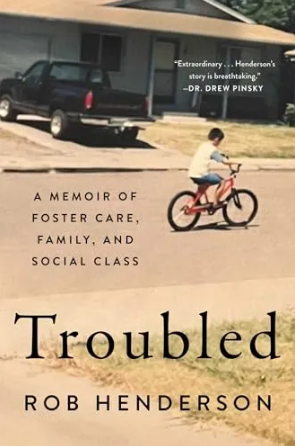
Life at the bottom is troubled. Charles Dickens, Victor Hugo, and many others have long shown us that. To understand criminal justice, education, and family law, we lawyers typically look to social scientists, and their external expertise does teach us much. But we often neglect lived experience. Occasionally, we should toggle from the dry regressions and clinical detachment of social science to the internal perspective and expertise of those who live through family breakup, foster care, disrupted schooling, drugs, and crime. And that is what Rob Henderson’s breakout memoir, Troubled, gives us: a window on troubled youth.1
Henderson, a brilliant young psychologist, illumines how harmful childhood instability is by reflecting on his own experience. He never knew his father, was abandoned by his drug-addicted mother, and bounced around foster care. After squandering much of his early education and drowning his rage in alcohol, drugs, fights, and vandalism, he managed to make his way through the Air Force to Yale and now Cambridge. But few of his friends escaped the wounds from their childhoods; many wound up unemployed, in prison, or dead. His eye is as keen as his intellect, recalling and reporting how adults in his life kept abandoning him and his fellow foster children and how they in turn acted out. As an outsider to the elites who dominate the Ivies, he also turns his critical eye on the groupthink and victimhood culture that is strongest among the most privileged. And building on literary historian Paul Fussell’s work, Henderson develops his own critique of the shibboleths that educated American elites use to set themselves—ourselves—apart while ignoring the harm to the rest of society.2
Henderson has much to teach us lawyers and legal scholars. He shows us how much we miss by focusing public policy on educational attainment and cost-benefit analysis, overlooking what is priceless: love and emotional attachment. The most important things in life can’t be quantified; at best, outcomes are mere proxies for them. We are more than our résumés! His account undermines our persistent habit of viewing humans as fully informed rational actors — a habit that makes much more sense in corporate law than in criminal law and the like. He showcases how poorly used adult autonomy harms children, leading to broken homes, drug addiction, numbness, and rage.
Lastly, Henderson critiques “luxury beliefs”, the term he coins for sociological opinions that are popular only among those who need not worry about their own survival. These beliefs are status signals to the educated elite who are not harmed by the fallout from any cultural shifts they might cause. But these beliefs corrode the social structures that children need to develop. (He could do more to develop the causal nexus to social harm, but his claims are still powerful.)
In short, Henderson’s memoir powerfully challenges prevalent views of education, family policy, and class. It shows how we hyperfocus on educational outcomes and other quantifiable goals at the expense of softer emotional goods. And it does it all in a plainspoken, understated voice that illustrates his points from his own lived experience and that of his buddies. Many will disagree with Henderson’s conclusions, of course, but scholars should grapple with his challenge.
Part I of this Review summarizes Henderson’s long journey from foster care to Yale. Part II canvasses his argument that adult instability breeds chaotic childhoods, leaving neglected kids to raise themselves in Hobbesian competition, impulsive indulgence, or reckless rage. Part III then develops Henderson’s signature concept of luxury beliefs and how nonjudgmentalism backfires on those at the bottom. Though one can quibble with some of his causal claims, his thrust is compelling. Finally, Part IV considers how Henderson’s account suggests reorienting some criminal justice, education, and family law reforms toward children’s need for stable structures to guide them.
1. Rob Henderson, Troubled: A Memoir of Foster Care, Family, and Social Class (forthcoming 2024) (on file with publisher). All further citations to this work are by page number in parentheticals in the text.
2. See generally Paul Fussell, Class: A Guide Through the American Status System (1983).
January 12, 2024
“… normal people no longer trust experts to any great degree”
Theophilus Chilton explains why the imprimatur of “the experts” is a rapidly diminishing value:
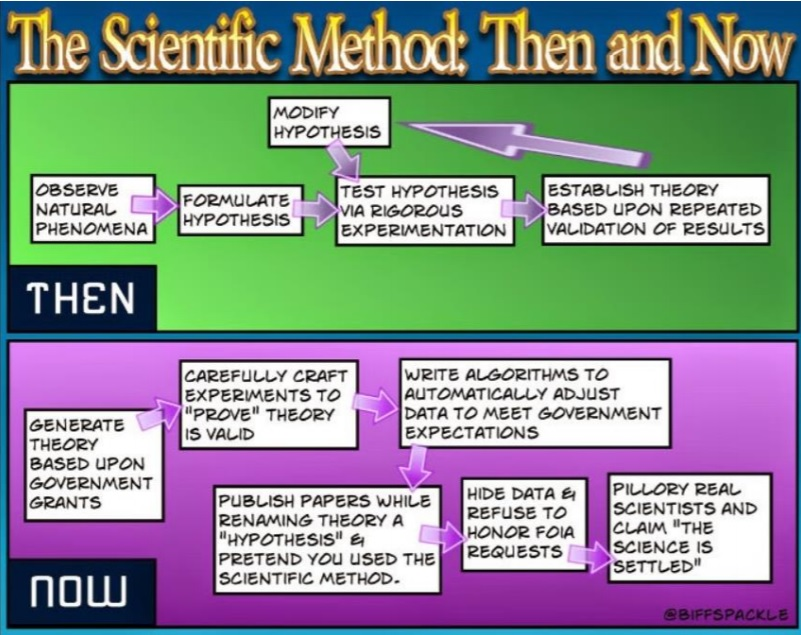
One explanation for the rise of midwittery and academic mediocrity in America directly connects to the “everybody should go to college” mantra that has become a common platitude. During the period of America’s rise to world superpower, going to college was reserved for a small minority of higher IQ Americans who attended under a relatively meritocratic regime. The quality of these graduates, however, was quite high and these were the “White men with slide rules” who built Hoover Dam, put a man on the moon, and could keep Boeing passenger jets from losing their doors halfway through a flight. As the bar has been lowered and the ranks of Gender and Queer Studies programs have been filled, the quality of college students has declined precipitously. One recent study shows that the average IQ of college students has dropped to the point where it is basically on par with the average for the general population as a whole.
Another area where this comes into play is with the replication crisis in science. For those who haven’t heard, the results from an increasingly large number of scientific studies, including many that have been used to have a direct impact on our lives, cannot be reproduced by other workers in the relevant fields. Obviously, this is a problem because being able to replicate other scientists’ results is sort of central to that whole scientific method thing. If you can’t do this, then your results really aren’t any more “scientific” than your Aunt Gertie’s internet searches.
As with other areas of increasing sociotechnical incompetency, some of this is diversity-driven. But not wholly so, by any means. Indeed, I’d say that most of it is due to the simple fact that bad science will always be unable to be consistently replicated. Much of this is because of bad experimental design and other technical matters like that. The rest is due to bad experimental design, etc., caused by overarching ideological drivers that operate on flawed assumptions that create bad experimentation and which lead to things like cherry-picking data to give results that the scientists (or, more often, those funding them) want to publish. After all, “science” carries a lot of moral and intellectual authority in the modern world, and that authority is what is really being purchased.
It’s no secret that Big Science is agenda-driven and definitely reflects Regime priorities. So whenever you see “New study shows the genetic origins of homosexuality” or “Latest data indicates trooning your kid improves their health by 768%,” that’s what is going on. REAL science is not on display. And don’t even get started on global warming, with its preselected, computer-generated “data” sets that have little reflection on actual, observable natural phenomena.
“Butbutbutbut this is all peer-reviewed!! 97% of scientists agree!!” The latter assertion is usually dubious, at best. The former, on the other hand, is irrelevant. Peer-reviewing has stopped being a useful measure for weeding out spurious theories and results and is now merely a way to put a Regime stamp of approval on desired result. But that’s okay because the “we love science” crowd flat out ignores data that contradict their presuppositions anywise, meaning they go from doing science to doing ideology (e.g. rejecting human biodiversity, etc.). This sort of thing was what drove the idiotic responses to COVID-19 a few years ago, and is what is still inducing midwits to gum up the works with outdated “science” that they’re not smart enough to move past.
If you want a succinct definition of “scientism,” it might be this – A belief system in which science is accorded intellectual abilities far beyond what the scientific method is capable of by people whose intellectual abilities are far below being able to understand what the scientific method even is.
January 11, 2024
Art Deco Architecture
Prof. Lynne Porter
Published 22 Apr 2021Lecture for Fairfield University class called “What We Leave Behind: the History of Fashion & Decor”.
QotD: Slavery in the United States
Everyone hated the idea of being a slave but few had any qualms about enslaving others. Slavery was just not an issue, not even among intellectuals, much less among political leaders, until the 18th century – and then it was an issue only in Western civilization. Among those who turned against slavery in the 18th century were George Washington, Thomas Jefferson, Patrick Henry and other American leaders. You could research all of the 18th century Africa or Asia or the Middle East without finding any comparable rejection of slavery there. But who is singled out for scathing criticism today? American leaders of the 18th century.
Deciding that slavery was wrong was much easier than deciding what to do with millions of people from another continent, of another race, and without any historical preparation for living as free citizens in a society like that of the United States, where they were 20 percent of the population.
It is clear from the private correspondence of Washington, Jefferson, and many others that their moral rejection of slavery was unambiguous, but the practical question of what to do now had them baffled. That would remain so for more than half a century.
In 1862, a ship carrying slaves from Africa to Cuba, in violation of a ban on the international slave trade, was captured on the high seas by the U.S. Navy. The crew were imprisoned and the captain was hanged in the United States – despite the fact that slavery itself was still legal at the time in Africa, Cuba, and in the United States. What does this tell us? That enslaving people was considered an abomination. But what to do with millions of people who were already enslaved was not equally clear.
That question was finally answered by a war in which one life was lost [620,000 Civil War casualties] for every six people freed [3.9 million]. Maybe that was the only answer. But don’t pretend today that it was an easy answer – or that those who grappled with the dilemma in the 18th century were some special villains when most leaders and most people around the world saw nothing wrong with slavery.
Incidentally, the September 2003 issue of National Geographic had an article about the millions of people still enslaved around the world right now. But where is the moral indignation about that?
Thomas Sowell, The Thomas Sowell Reader, 2011.
January 10, 2024
The unexpected rise in “Unknown Cause”
Mark Steyn rounds up some interesting details on that long-forgotten-by-the-media pandemic and corresponding heavy-handed government interventions that made things so much worse:

The obvious problem with appeals to authority, at least for anyone more sentient than an earthworm, is that across the western world the last four years have been one giant appeal to authority – and the result of mortgaging the entirety of human existence to the expert class is the rubble all around. Just for starters:
US scientists held secret talks with Covid ‘Batwoman’ amid drive to make coronaviruses more deadly
You don’t say! When would that have been? Oh:
…just before pandemic
Well, there’s a surprise!
A new cache of documents, obtained by Freedom of Information campaigners and seen by The Mail on Sunday, reveal the extent to which the controversial work at the Wuhan Institute of Virology was supported, and often funded, by America.
You got that right. Wuhan is the virological equivalent of a CIA black site in Pakistan: it’s where the Deep State goes to do the stuff it can’t do in suburban Virginia.
So how’s that working out for the planet? Way back in 2022, The Mark Steyn Show reported that “Unknown Cause” was now the leading cause of death in Alberta. According to the somewhat lethargic lads at Statistics Canada, taking eighteen month to catch up with yours truly, that same year it was the fourth leading cause of death across the entire country. “Unknown Cause” is rampaging from Nunavut igloos to the Hamas branch office in Montreal: Between 2019 and 2022, it was up almost five hundred per cent.
Does “Unknown Cause” have an awareness-raising ribbon like Aids or breast cancer? Are there any celebs who’d like to headline a gala fundraiser or do an all-star pop anthem?
Apparently not. Gee, it’s almost as if taking too great an interest in “Unknown Cause” can lead to a bad case of cancer of the career. Nevertheless, the official StatsCan numbers are, to put it at its mildest, odd. By the end of 2022, Canada was one of the most jabbed nations on earth, with a Covid vaccination rate of ninety-one per cent, the highest in the G7, by some distance (UK and US both at eighty per cent).
And yet, if these government numbers are to be believed, something very strange happened. In the most jabbed member of the G7, Covid deaths went up. As The Western Standard‘s Joseph Fournier noticed, while almost nobody else did, Covid deaths per annum across the Deathbed Dominion shot up 25 per cent from the days of curfews, and arrests for playing open-air hockey:
2020 15,890
2021 14,466
2022 19,716
So, in Jabba Jabba Central, more people died of Covid in the most recent annual round-up than at the height of the pandemic. In fact, on those numbers, Canada has yet to reach “the height of the pandemic”. Here’s another striking feature – again, direct from Statistics Canada:
During the first year of the pandemic, older Canadians (65 years of age and older) accounted for 94.1% of COVID-19 deaths, while those aged 45 to 64 years accounted for 5.3%. In 2021, while the number of COVID-19 deaths among individuals aged 65 years and older (82.0%) remained high, the proportion of deaths among those aged 45 to 64 years nearly tripled to 15.5%.
So, in the most vaxxed nation of the G7, middle-aged persons account for three times the proportion of Covid deaths than they did at “the height of the pandemic”.
Like I said: odd.
Canadian life expectancy? Down. Oh, just by four months or so. But that’s three times the size of last year’s drop.
Excess mortality? Indeed: In 2019 the age-standardised death rate was 830.5 per 100,000 people. In 2022 it was 972.5. As I’ve pointed out a gazillion times on telly, that’s the opposite of what’s meant to happen post-pandemic: After the Spanish Flu, the mortality rate fell because people who would otherwise have died in 1924 had already died in 1919. That phenomenon is visible in Eastern Europe, but nowhere in the Dominion of Death.
Last year I mentioned en passant to my friend Naomi Wolf that the Covid vaccines were beginning to remind me of the scandals of her old chum Bill Clinton: one such can do a politician in, but, if you have (as Slick Willy did) a multitude of ’em, who can follow it all? If Pfizer, Moderna and AstraZeneca just caused, say, myocarditis, maybe people would find it easier to focus on. Instead, it causes myocarditis in men and infertility in women and, if you manage to dodge the latter, the mRNA shows up in newborn babies; it brings on Guillain–Barré syndrome and Ramsay Hunt syndrome and lightning-speed turbo-cancers. Alternatively, you could get a dose of the SADS and drop dead on stage or on the footie pitch, or at home watching the telly. It’s a lot to keep track of.
Or maybe, as in Alberta, you just die of … whatever. And nobody cares to find out.
January 9, 2024
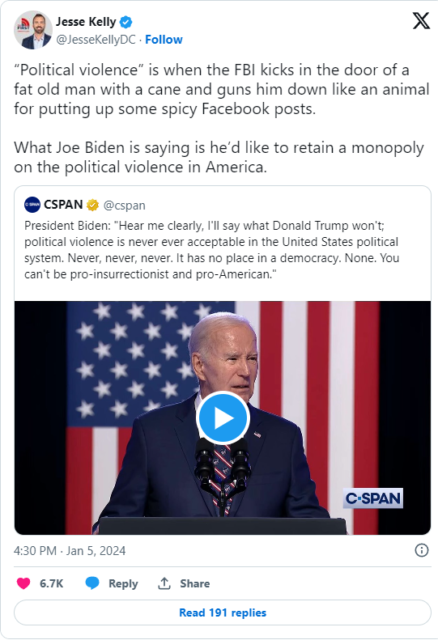
“[P]olitical violence is never ever acceptable in the United States political system”
Mark Steyn gets the message:
~I’m glad to see I wasn’t the only one who got a mordant laugh out of this line in Joe Biden’s Feast of the Insurrection sermon:
So “political violence is never ever acceptable in the United States political system. Never, never, never. It has no place in a democracy. None.”
An odd thing to say about a “political system” in which Lieutenant Michael Byrd was able to kill Ashli Babbitt in cold blood as his Capitol Police colleagues were able to do likewise to another defenceless woman, Mariam Carey. I would hope to be wrong, but I would be surprised if America gets through this year without more “political violence” — because one side seems to be fomenting it as a pretext for intensifying what Mr Kelly calls their “monopoly” on it.
That monopoly is part of a broader problem in the United States: the abolition of equality before the law. If you can avoid getting dispatched as swiftly as Ms Babbitt, you will nevertheless have what remains of your life ruined by detention without trial, solitary confinement, double-digit years of prison with no possibility of parole … Americans have gotten the message. Do you recall, after the Canadian truckers’ heroic Covid protests inspired the world, there was talk of a similar American Freedom Convoy?
Oh, you don’t remember? Me neither. That’s because it all fizzled out, as its proponents figured that the dirty stinkin’ rotten corrupt US Department of Justice would just treat it as January 6th on wheels.
~Of course, it didn’t work out too great for the Canadian truckers, either: Frozen bank accounts, protracted prosecution … Small potatoes by US DOJ standards, and Lieutenant Byrd wasn’t around to shoot them dead, but it has certainly been fierce and targeted by Canadian standards. Why? Because in Ottawa the “traffic disruption impacted residents’ lives in many ways”.
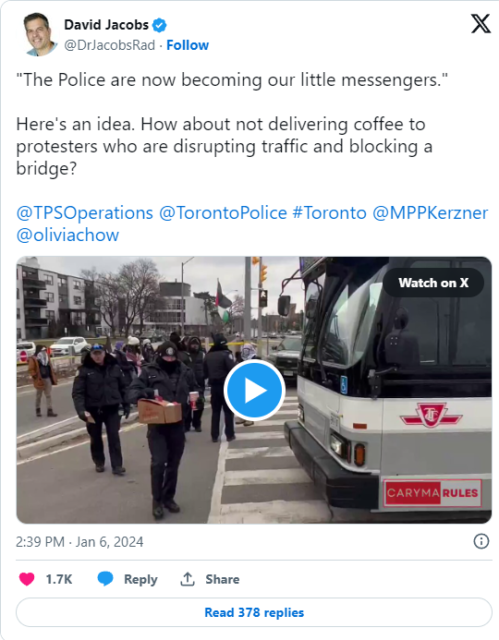
On the other hand, “pro-Palestinian” groups are currently disrupting traffic in Toronto. For over a week they’ve shut down the Avenue Road bridge over the 401. Why?
Well, it’s a key artery into Toronto’s and Canada’s most Jewish neighbourhood. But, relax: they’re not anti-Jew, they’re just anti-Zionist. After all, many of these Jews in Armour Heights and Bathurst Manor are out every night bombing Gaza daycare centres. It’s part of the same expansive definition of “pro-Palestinian” that has seen International Delicatessen Foods attacked because it has the same acronym as the Israeli Defence Force. But don’t worry, they’re not anti-Semites, just acro-Semites. If I were the famous Japanese tea master Takeno Jōō, I would hire additional security. But fortunately he died in 1555 …
Yet, as I said, it all comes down to equality before the law. The Canadian truckers handed out coffee and doughnuts to locals and are still in the dock two years on. Whereas on the blockaded Avenue Road overpass the Toronto Police deliver coffee and doughnuts to the pro-Hamas lads:
Roll up the Jews to win! In the old days, the German coppers pleaded that they were just obeying orders, but, as Kate MacMillan points out, the Toronto constables are just taking orders. Did you hear the way that fellow put it? “The police are now becoming our little messengers.”
January 8, 2024
Vivek Ramaswamy versus the HR team
Chris Bray finds the humour in Vivek Ramaswamy’s most recent viral video moment:
I’m not sure which part of the employee handbook he violated, but Vivek Ramaswamy was obviously called into a conference with HR.
“Mr. Ramaswamy, security will now escort you to your desk to collect your personal belongings.”
Federal debt has now passed $34 trillion, is well over 100% of GDP, and is on track to top $40 trillion in maybe two years. What are we going to do about that? We’re going to spend over a trillion dollars a year in the foreseeable future to cover the interest on that debt. Worth noticing?
The United States fought the Taliban for twenty years, accomplished nothing, and then let them take all of Afghanistan instead of just the half they controlled when we invaded. How did that happen? How did we spend thousands of lives and trillions of dollars on literally nothing? We trained and funded the Afghan National Army, which then turned out to not actually exist at the very first moment it was expected to function without us. Should we work to understand that failure? Should we maybe ask where the money went?
And so on. Pick your own top ten things that need to be discussed and examined. Covid policy, the emerging disaster of learning loss from school closures, the failure and increasingly obvious danger of the mRNA injections, our long history of remarkably unwise foreign interventions, the Frankenstein’s monster of our corporate-state merger and revolving door regulatory capture, the ideological rigidity of academic culture, whatever. There are crushingly obvious and disturbingly consequential failures all over our recent national record.
So our presidential candidates are facing persistent and aggressive questioning about … their willingness to denounce white supremacy. Is racism bad? Is racism bad? Is racism bad? Will you denounce it? Will you denounce it? Will you denounce it, denounce it, denounce it?

January 7, 2024
1945 Begins! – WW2 – Week 280 – January 6, 1945
World War Two
Published 6 Jan 2024The Germans launch a new offensive, Operation Nordwind, in Alsace, even as their offensive in the Ardennes is stalled. The Allies in the west don’t just have to fight these, they are also having serious issues amongst themselves in High Command that threaten their unity. The siege of Budapest is in full swing and is a hard, fought, bloody battle, and the Soviets and the Americans have big plans for new offensives soon to kick off in Eastern Europe and the Philippines (respectively).
00:00 INTRO
01:20 The Siege of Budapest
04:51 German defense plans in the East
06:38 Montgomery versus Eisenhower
08:32 Eisenhower versus the French
10:35 New German Offensive in Alsace
13:49 Monty’s plans for the press
15:04 The Battle of the Bulge
17:45 Preparations for the Luzon Landings
20:56 Notes to end the week
21:51 Summary and conclusion
(more…)
Every Type of Railcar Explained in 15 Minutes
Practical Engineering
Published 19 Sept 2023How many of these cars have you spotted before?
Trains are one of the most fascinating engineered systems in the world, and they’re out there, right in the open for anyone to have a look! Once you start paying attention, it’s pretty satisfying to look for all the different types of railcars that show up on the tracks.
(more…)
QotD: The US Army between 1945 and 1950
The trouble is, different men live by different myths.
There are men who would have a society pointed wholly to fighting and resistance to Communism, and this would be a very different society from the one Americans now enjoy. It might succeed on the battlefield, but its other failures can be predicted.
But the infantry battlefield also cannot be remade to the order of the prevailing midcentury opinion of American sociologists.
The recommendations of the so-called Doolittle Board of 1945-1946, which destroyed so much of the will — if not the actual power — of the military traditionalists, and left them bitter, and confused as to how to act, was based on experience in World War II. In that war, as in all others, millions of civilians were fitted arbitrarily into a military pattern already centuries old. It had once fitted Western society; it now coincided with American customs and thinking no longer.
What the Doolittle Board tried to do, in small measure, was to bring the professional Army back into the new society. What it could not do, in 1946, was to gauge the future.
By 1947 the United States Army had returned, in large measure, to the pattern it had known prior to 1939. The new teen-agers who now joined it were much the same stripe of men who had joined in the old days. They were not intellectuals, they were not completely fired with patriotism, or motivated by the draft; nor was an aroused public, eager to win a war, breathing down their necks.
A great many of them signed up for three squares and a sack.
Over several thousand years of history, man has found a way to make soldiers out of this kind of man, as he comes, basically unformed, to the colors. It is a way with great stresses and great strains. It cannot be said it is wholly good. Regimentation is not good, completely, for any man.
But no successful army has been able to avoid it. It is an unpleasant necessity, seemingly likely to go on forever, as long as men fight in fields and mud.
One thing should be made clear.
The Army could have fought World War III, just as it could have fought World War II, under the new rules. During 1941-1945 the average age of the United States soldier was in the late twenties, and the ranks were seasoned with maturity from every rank of life, as well as intelligence.
In World War III, or any war with national emotional support, this would have again been true. Soldiers would have brought their motivation with them, firmed by understanding and maturity.
The Army could have fought World War III in 1950, but it could not fight Korea.
T.R. Fehrenbach, This Kind of War: A Study in Unpreparedness, 1963.
January 5, 2024
The value of college degrees
Ted Gioia isn’t a college dropout, but he’s seen enough to realize that given how his career has gone, he might well have saved himself a lot of time and money by not going to university in the first place:
I spent almost a decade and huge sums of money — much of it borrowed in the form of student loans — to earn multiple degrees from elite institutions.
But I don’t have a degree in music — the field that became my vocation. And I never took a single course or lesson in jazz (my specialty) during my entire life.
I wasn’t a dropout, not even close. But it’s sobering to consider my life in retrospect, and see how much it relied on what I taught myself outside of the classroom. So I now have a very different view of college than I did back when I was a student.
My more mature view is as follows:
(1) A college degree is more about signaling your worth than about learning.
This is hardly a brilliant insight — many are now saying this. But when you’ve lived it yourself, it changes your perspective on everything.[…]
(2) College provides inspiring role models — but they also exist in other settings.
I was blessed with a small number of teachers and mentors who taught me by example — and most of this happened at high school and college. There is no substitute for seeing greatness in the flesh at close hand.But this can happen outside of college — my wife, for example, had those experiences working as a dancer and choreographer in New York. She learned more from her mentor Erick Hawkins than from any college professor.
[…]
(3) Dropping out is a real option with genuine upside, but it’s not for everybody.
Let me put it as simply as possible: Many successes are dropouts, but few dropouts are successes.I would advise against abandoning your education for simple reasons of avoidance — because classes are a hassle, tests are a bummer, etc. But if you have a genuine vision of your life and the skills to achieve it, college is purely optional. And perhaps even hazardous.
(4) As the college experience becomes more expensive and close-minded, the appeal of alternatives increases exponentially.
At what price does college become a bad deal? I don’t have an answer to that, but we must be close to a tipping point.If I tried to replicate my formal education today, it would cost ten times as much. I would have student loans as large as the national debt of a mid-sized country. That’s just ridiculous.
But this kind of irrational endpoint results when a bloated bureaucracy increases tuition at more than the inflation rate every year — and continues doing so for a half century. The people running our major universities think they can get away with this because customers want impressive diplomas, and can be squeezed to an infinite degree.
But infinity doesn’t actually exist in human affairs. And unsustainable trends eventually prove just that, namely that they are unsustainable.
(5) The smartest people will increasingly bypass the system.
I can’t emphasize this enough. My advice to young people today is very different from what I would have said just 5 years ago.I now tell them to find ways to work outside of bureaucratic legacy institutions.
[…]
(6) Dropouts really do change society.
As someone who invested so much time and money in big-ticket credentials, that’s painful to admit. But I’ve seen too much to ignore the facts. I now grasp that people who are genuine visionaries know at an early stage that they can teach themselves, think for themselves, and manage themselves. Those are more valuable skills than any degree.So maybe I didn’t drop out like my friend’s buddy at Harvard, back in the mid-1970s. But I wouldn’t laugh at the idea nowadays, the way I did back then. And if I had everything to do over again, I might drop out myself.
Qatar’s Aggies
In The Free Press, Eli Lake discusses the deal between Texas A&M and the Qatari government that gives the Qatar Foundation — run by the Qatari royal family — full ownership of any intellectual property developed at the Qatari campus of the university:

Texas A&M’s Nuclear Engineering and Science Center in College Station, Texas.
Photo via Texas A&M
What does Qatar get for its investment in U.S. universities? The answer may surprise you. In addition to the prestige and the influence of affiliating one’s national philanthropy with elite schools, Qatar is also accumulating the kind of technical research that was once the prize of American universities.
Consider Texas A&M University, one of the best places in the country to study nuclear engineering. Last month, The Free Press obtained exclusive access to a copy of the latest contract between Texas A&M and the Qatar Foundation that shows all of the intellectual property developed at the university’s campus in Doha belongs to the Qatar Foundation, a national philanthropy owned by the country’s royal family.
“The Qatar Foundation shall own the entire right, title, and interest in all Technology and Intellectual Property developed at (Texas A&M University Qatar) or under the auspices of its Research Program, other than those developed by non-TAMUQ employees and without financial support from the Qatar Foundation or any of its affiliates,” says the contract, dated May 25, 2021.
This kind of arrangement is common for large research universities in America. But TAMUQ is not your ordinary university. It is entirely funded by the Qatar Foundation. Kelly Brown, a spokeswoman for Texas A&M, told me that Qatar “pays for all faculty and staff salaries” as well as the physical campus, labs and equipment, housing, transportation, and travel allowances for professors.
It’s no small matter. The intellectual property generated by Texas A&M University in Qatar, or TAMUQ, includes highly sensitive research in a variety of fields ranging from computer science to bioengineering. Last year, TAMUQ inked an agreement to develop projects with a subsidiary of Barzan Holdings, Qatar’s largest arms manufacturer.
Andre Conradie, the CEO of the joint venture between Barzan and Germany’s Rheinmetall, said at the time, “This partnership will encourage the development of technological and operational capabilities to enhance military protection.”
As one of the country’s premier schools in nuclear engineering, Texas A&M has access to two nuclear reactors in Texas not affiliated with the U.S. government. In December, the National Nuclear Security Administration renewed a contract for the university, along with the University of California and Battelle Memorial Institute, to manage the Los Alamos National Laboratory, which involves oversight of teams who design and maintain nuclear weapons for the U.S. government.
Pacific Theater USMC-Modified Johnson M1941 Rifle
Forgotten Weapons
Published 25 Aug 2023Johnson M1941 rifles were used in limited numbers by the US Marine Corps in the Pacific theater of World War Two, but they were used — and generally well liked. Interestingly, there was a fairly common field modification done by the Marines, and that was to cut off the front sight wings, and sometimes cut the rear aperture into a deep V-notch or a flat U-notch style. This particular ex-Marine rifle shows both of these modifications.
(more…)


