
If you have always believed that everyone should play by the same rules and be judged by the same standards, that would have gotten you labeled a radical 50 years ago, a liberal 25 years ago and a racist today.
Thomas Sowell, “A Few Assorted Thoughts About Sex, Lies And Human Race”, Sun Sentinel, 1998-11-28.
June 17, 2018
QotD: “Progress”
Comments Off on QotD: “Progress”
June 15, 2018
Looking at US farm subsidy claims
On Twitter, Chris Auld, an economics professor at the University of Victoria explains why Canadian journalists should stop using the $22 billion figure for US farm subsidies to justify Canada’s unjustifiable supply management regime:
It's been widely reported that the U.S. subsidizes dairy farms $22B per year, or 71% of revenues. Which seems… large. That figure comes from a report paid for by the Dairy Farmers of Canada by a small consulting firm. (https://t.co/2v4xkOZRBU). 1/5 pic.twitter.com/chMnPeRMZx
— Chris Auld (@Chris_Auld) June 12, 2018
If we follow their source to pg 111 of the cited USDA document, we find what they're counting as the $225B of "agricultural subsidies" includes absolutely everything in the USDA's budget! More than half goes to SNAP ("food stamps") and other anti-poverty programs. 2/5 pic.twitter.com/tPhR3Qtb6d
— Chris Auld (@Chris_Auld) June 12, 2018
And much of the remainder, including programs like food safety, the forest service, and research, are not agricultural subsidies, either. See pages 210-211 here: https://t.co/BBmjD41AWZ 3/5
— Chris Auld (@Chris_Auld) June 12, 2018
Some of what's left is subsidies, but the report just takes 10.54% of the total as allocated to dairy since that's the percentage of dairy in U.S. agriculture. What most people would think of as actual "dairy subsidies," direct or indirect payments to dairy farmers, 4/5
— Chris Auld (@Chris_Auld) June 12, 2018
are a trivial fraction of the staggering sums claimed in this report. And if we calculated Canadian "dairy subsidies" in the same silly manner, we'd wind up with similarly vast sums. This figure is rubbish and journalists in particular should stop repeating it. 5/5 pic.twitter.com/Hg0M3vpOuB
— Chris Auld (@Chris_Auld) June 12, 2018
Comments Off on Looking at US farm subsidy claims
June 13, 2018
Imagine … a tariff-free world
Danny Chabino on what he calls “Trump’s G7 Surprise”:
In what I consider a brilliant move on the part of Trump and his team, instead of initially discussing what tariffs he would increase if x,y and z didn’t happen or if whichever nation wouldn’t reduce tariffs on whatever industry, he simply raised the simple question of why don’t we just not have tariffs at all? It’s brilliant in the sense that it not only shut down all the anticipated arguments, but also placed the world’s leaders in a position of having to awkwardly defend the very idea of tariffs (and subsidies), and they knew they couldn’t really do that. It highlighted the true intentions of the world’s leaders as representatives of the authoritarian nature of almost every existing government in the world today.
Now, please don’t misunderstand this article as me beaming with a Trump glow. In fact, Trump knew full well no one would take him up on such an offer. I do believe if they had he would have followed through, but his next moves will be ones that I believe are the wrong ones. He will seek to raise tariffs, which has always done more harm to the nation raising the tariffs than it has done good that nation. Trump will do just as he has threatened and hurt his own country;’s economy with new tariffs.
What I do enjoy, though, is that all of the world’s major leaders had to essentially admit that they don’t want their people and their economies to be better off. At least not on their own. They want their people and economies to be dependent upon their leadership and their governments. While everyone at the summit knew that the greatest of outcomes would be for all the world’s most powerful nations to exercise free trade, and that this would benefit the entire world in great proportions, that really wasn’t their aim. Their aim was to gain greater power. What an incredible admission!
When given a golden opportunity to end tariffs and increase freedom and prosperity for most citizens of the world, the world’s leaders instead chose to cling hard to their own designs. The world’s leaders know full well that tariffs hurt their own citizens, but they don’t care. Tariffs have never served the function of creating market efficiency, and they have never helped protect a nation’s economy. Instead, they have always been a means for governments to exercise control over huge parts of their own economies, and where there is control, there is power. Politicians and world leaders seek power. It’s like their drug of choice, and they can never get enough of it.
Comments Off on Imagine … a tariff-free world
June 12, 2018
G7 minus one
Justin Raimondo on the well-shared image of Angela Merkel and her associates apparently trying to browbeat Donald Trump at the G-7 meeting (this version from Raimondo’s article):
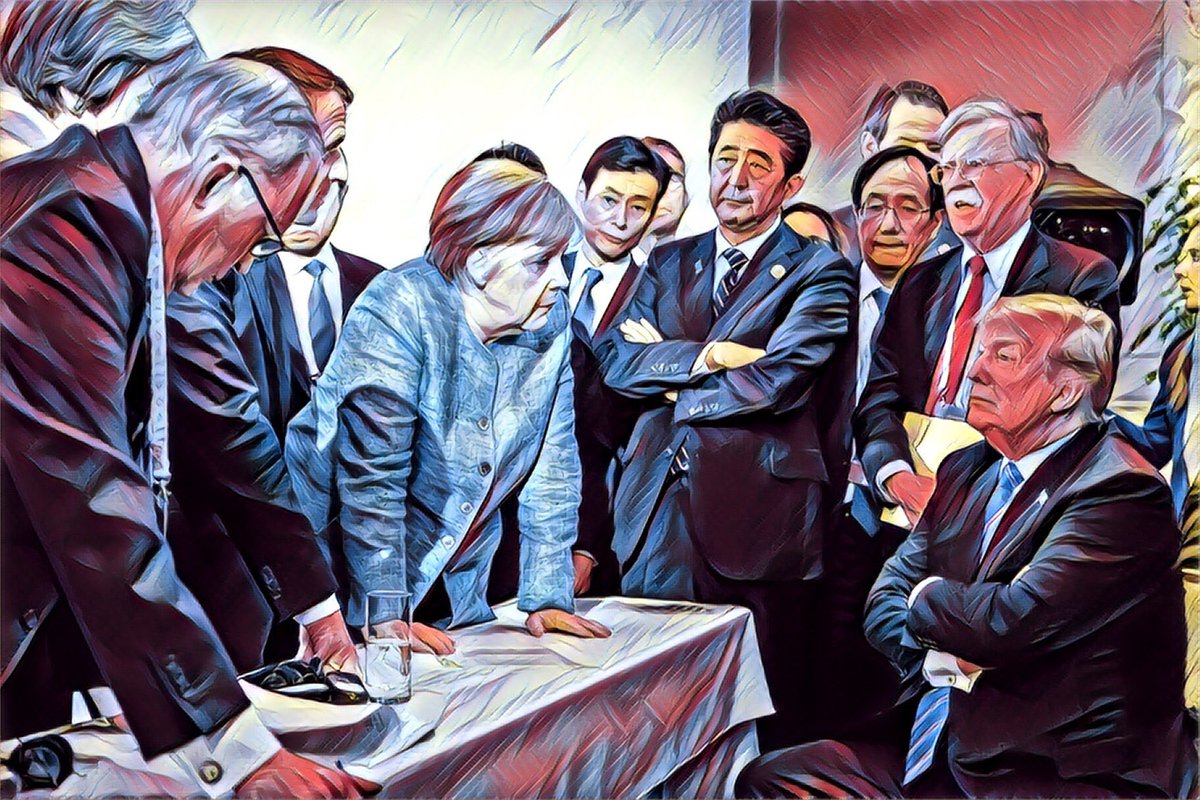
All the Very Serious People are tweeting and retweeting this “iconic” photo of Trump surrounded by the Euro-weenies, with Angela Merkel seeming to lecture the President while the rest of our faithless “allies” look on. It’s “America Alone” – the visual representation of the internationalist worldview: Trump’s policy of “America First” is “isolating” us, and, according to clueless leftists like Michael Moore, Merkel is now the “leader” of the “free world.”
This last is good news indeed, for if Merkel is the new leader of the “free world” then the stationing of 35,000 US troops in Germany – at a cost of billions annually – is no longer required and we can bring them home. This also means Germany, rather than the US, will be sending troops all over the world to fight “terrorism” – a move that is sure to cause consternation in certain regions with a history of German intervention, but hey, somebody has to do it!
The political class is screaming bloody murder over Trump’s performance at the G-7 meeting in Canada, where he reportedly spent most of the time detailing how much the US was paying for the defense of our vaunted “allies,” not to mention the high tariffs imposed on American goods. He then proposed a “free trade zone” in which member countries would drop all tariffs, subsidies, and other barriers to trade: the “allies” didn’t like that much, either. Nor did the alleged advocates of free trade here in the US give him any credit for ostensibly coming around to their point of view. Which reminds me of something Murray Rothbard said about this issue: “If authentic free trade ever looms on the policy horizon, there’ll be one sure way to tell. The government/media/big-business complex will oppose it tooth and nail.”
Of course the Euro-weenies don’t want real free trade: after all, they practically invented protectionism. What they want is a free ride, at Uncle Sam’s expense, and the reason they hate Trump is because they know the freebies are over. However, what really got the Usual Suspects frothing at the mouth was Trump’s insistence that Russia be readmitted to the G-8:
“I think it would be good for the world, I think it would be good for Russia, I think it would be good for the United States, I think it would be good for all of the countries in the G-7. I think having Russia back in would be a positive thing. We’re looking to have peace in the world. We’re not looking to play games.”
The “experts” went crazy when he said this: our “allies” are being insulted, they wailed, while our “enemies” are being “appeased.” It’s sedition! Russia! Russia! Russia!
Eric Boehm says that the White House’s justification for imposing tariffs on national security grounds may have been undermined through Trump’s tweets hitting back after what he clearly felt was Justin Trudeau’s hissy fit (although Trudeau didn’t exactly break new ground or say anything radically different in his comments):
The Trump administration has spent months trying to construct a rather flimsy argument that steel and aluminum imports from Canada and other close American allies constitute a national security threat. More than a handy way to drum up public support for trade barriers, the “national security” claim is a crucial bit of the legal rationale for letting the president impose tariffs on those goods without congressional approval.
Then, as he was departing this past weekend’s G7 summit, Trump took to Twitter to air some grievences with Canadian Prime Minister Justin Trudeau. In doing so, the president may have significantly kneecapped that legal argument.
PM Justin Trudeau of Canada acted so meek and mild during our @G7 meetings only to give a news conference after I left saying that, “US Tariffs were kind of insulting” and he “will not be pushed around.” Very dishonest & weak. Our Tariffs are in response to his of 270% on dairy!
— Donald J. Trump (@realDonaldTrump) June 9, 2018
The last sentence of Trump’s tweet is the one that really matters.
The White House slapped a 25 percent tariff on imported steel and a 10 percent tariff on imported aluminum by invoking Section 232 of the Trade Expansion Act of 1962, which gives the president legal authority to impose tariffs without congressional approval when it’s for the sake of national security. That line of argument, outlined by Commerce Secretary Wilbur Ross in a February report, says that America needs aluminum and steel to make weapons of war, and that protecting the domestic steel and aluminum industries is the only way to ensure the country will be able to defend itself if attacked.
That is pretty weak, as I (and others) have written before. But as long as Trump makes that claim — no matter how strained the logic might be — the law seems to be on his side. Invoke “national security” and the president can do what he wants with trade.
Except now Trump seems to have admitted that it’s not about national security at all. His tweet plainly states that “our Tariffs [sic] are in response to his of 270% on dairy!”
Chris Selley points out that up until this eruption, Canadian politicians were still carrying on as if nothing was really at stake (especially Conservative leader Andrew Scheer, who re-swore his allegiance to ultra-protectionist supply management at all costs, and damn actual free trade):
So utterly obsessed are Canadian politicians by the small differences between them that federal Conservative leader Andrew Scheer recently demanded Prime Minister Justin Trudeau explain what he meant when he suggested Canada might be “flexible” on the issue of supply management in the dairy industry, in the face of new demands from Washington. It’s preposterous: you can’t fit a processed cheese slice between the three major party’s total devotion to the dairy cartel.
Trudeau needs to explain what he meant when he said he was open to "flexibility" on that file when negotiating with the US, and what concessions he offered to them from Canada's dairy industry. https://t.co/GeCA4irhAY (2/2)
— Andrew Scheer (@AndrewScheer) June 8, 2018
Because, as we all know, what unites Canadians from coast-to-coast is our universally shared determination to pay significantly higher prices for dairy products, to ensure that Quebec farmers are not overly bothered by pesky competition from uppity foreigners who don’t even speak Joual…
Comments Off on G7 minus one
QotD: How to create and perpetuate an apartheid state
The usual way to remove inferior races from public spaces is to price them out. Municipal and regional governments are the guiding hand, through their planning departments. The “gentrification” process is done overtly through tight by-laws, licencing, and commercial regulation, all arranged on the Clintonian principle of “pay to play.” This makes the respectable zones too expensive for the lesser breeds, and assists in the development of their underclass-consciousness.
On the other side, more subtly at first, it is done by such as public housing projects, which remove the poor to a greater distance from respectable neighbourhoods, and confine them in camps, where their criminality and poor table manners can be offensive only to themselves. They become, by increments, wards of the state — and may be easily manipulated to provide voting blocks for the “progressive” parties, on whom they now depend for their rent, food stamps, and modest cash doles.
Compulsory attendance in state schools seals the bargain, by which the young of the underclass species are indoctrinated and trained to know their place in the social and political order. They can see that they are victims of “discrimination”; their resentments can be shaped in the interest of the governing liberal elites, and directed instead at people who have no idea what they are yammering and rioting about.
Who do not see that the poor have been “unpersoned.” And that, having little to lose, they are now playing the unpersonable part.
The superior races principally benefit from this system of apartheid, in which the unwashed are kept out of view, except through the selective camera angles of the media voyeurs. Without this isolation, the liberals’ smugness would be hard to maintain, and their commitment to various hygienic and environmental causes would suffer. They, for their part, are taught in their much better appointed government schools that the welfare-state redistribution of income exists to promote “equality”; when in fact it exists to promote the division of society into manageable cells, walled both visibly and invisibly to prevent the respective inmates from mixing and meeting. Now, even if they see, they cannot smell each other.
David Warren, “The common man”, Essays in Idleness, 2016-08-29.
Comments Off on QotD: How to create and perpetuate an apartheid state
June 11, 2018
Jay Currie says it’s time to light the Bat Signal for … Brian Mulroney?
I find it hard to believe that things have gotten to the point that anyone, let alone Jay Currie, is looking to former PM Brian Mulroney to pull Justin’s chestnuts out of the Trumpian fire:
In Canada, more specifically Ontario, the destruction of the auto industry would be a full scale, all hands on deck, disaster. Realistically, the auto sector is Ontario’s largest private sector employer and the largest manufacturing sector. Being priced out of the US market would kill tens of thousands of well-paid jobs.
Trump has taken the measure of Trudeau and his tiny, annoying, Minister of External Affairs, Chrystia Freeland and concluded they are featherweights. Which means that Canada is potentially screwed because Trump has no faith in our leadership. You don’t call people dishonest publicly if you plan to do business with them.
It is unlikely that Trudeau will be aware of just how badly he has failed for a few days. The Canadian media are heavily invested in a narrative which has Justin standing up to the big, bad, Trump. Trudeau’s tone-deaf advisors are, no doubt, revelling in the fact they got lots of “gender” language into the communique.
It will take a few days for the more sober side of the media to realize what peril Trudeau has put us in. And a few more for the geniuses in the PMO to figure out that Trump is not playing the same game as they are.
When they do figure it out the question will arise, “What the fuck do we do now?”
As I am quite sure Butz and his posse read this blog I have a simple suggestion.
Normally, I would have suggested they get in touch with Simon Reisman who negotiated both the Auto-Pact and NAFTA. Alas, Reisman is dead.
Second best by a long shot? Brian Mulroney. A man I have next to no time for but who a) managed to get Canadians onboard for NAFTA, b) was a quite successful Canadian Prime Minister, c) is wired into both Trump World and broad swaths of corporate America.
If Trudeau could get Mulroney to do it Mulroney would be going into the US with a serious, well thought out, everything on the table, pitch. Likely starting with first principles – no tariffs, no subsidies, no non-tariff barriers. Be prepared to dump dairy and end transhipment of Chinese steel. And pitch it to the Trump people as the template for the deals which could be made with the EU, Japan, India and so on. (China is a whole other thing.)
The key point here is that Canada has to move, and move quickly, away from the finger-wagging politics of gender inclusion and climate change to a hard-nosed business approach to getting the best deal we can with an America which is now willing to put its own interests first.
Comments Off on Jay Currie says it’s time to light the Bat Signal for … Brian Mulroney?
L. Neil Smith on the Koch brothers and the libertarian movement
In the latest issue of the Libertarian Enterprise, L. Neil Smith discusses his experiences working with the Koch brothers:
It says here that David Koch is retiring. In case you don’t know, he is the younger of two oil billionaire brothers associated with the libertarian movement who bankrolled the Cato Institute, and whom “progressives” love to hate, automatically blaming them for what little they don’t blame Donald Trump for.
Genuine libertarians and conservatives don’t like them much, either, for a variety of reasons. My own first is that I served on the 1977 Libertarian Party National Platform Committee with Charlie, David’s older brother and found him to be a timid, unimaginative soul, more concerned with credibility and respectability than with truth or principle. At the time, the think-tank he and his brother created was attempting to turn the LP into a wholly-owned subsidiary (David ran in 1980 for Vice President with Ed Clark), and I didn’t like that, either.
The Koch brothers are also open-borderists, siding with establishment Republicans like that smirk-weasel Paul Ryan who want an imported servant-class they can abuse. I’ve changed my mind on that issue for good and sufficient reasons, and they ought to be good and sufficient for the Koch Brothers, too, if they were really libertarians. American culture is unique and wonderful; I do not want to see it changed or destroyed as the cultures of Sweden and England are being, by uncontrolled mass immigration. Letting a lot of Third Worlders into the United States of America is like letting a lot of Californians into Colorado. Pretty soon it’ll be just like the mess they made and left behind.
We have a saying here: “Don’t Californicate Colorado”.
David is retiring, it says here, due to an extremely long bout with prostate cancer. It does not say what his prognosis is. My own father, whom I miss every day, fought prostate cancer for six ghastly years and died. I’m sorry David has it now; I would not wish that fate on anybody.
But the reason I’m writing this is to speak the truth, to a great big pile of money, if not to power. The Kochs don’t have power because they don’t have a clue how to spend money politically, and, among other counter-productive follies, they threw their dough away with all four hands, supporting a think-tank incapable of reaching the people by the millions the way Donald Trump has. I have never known anyone who read a paper produced by the Cato Institute or listened to a lecture given by one of their wonks — except other wonks.
June 10, 2018
Why the Canadian media (and the Laurentian Elite) misjudge Trump
Ted Campbell provides a thumbnail sketch of Donald Trump and suggests why the Canadian establishment finds him so hard to understand (and to work with):
In the view of Professors Bradbury and Leuprecht Canada and all of the US’ competitors are falling into Trump’s trap and the WTO ~ and global fair trade ~ will be the chief victim because, from President Trump’s perspective it is better that we all sink into poverty as long as the US remains top dog.
OK, what do we actually know about Donald Trump? What drives his policy choices?
I’m going to engage in a bit of ‘pop psychology’ and very personal speculation to try to clarify my own thoughts about President Trump as he prepares to meet, in just a few hours, with the G7 in Canada.
Is he stupid? No, not really … perhaps not “well read” as, say, most presidents from George Washington and Thomas Jefferson through to George H.W. Bush and Barack Obama were, but he’s not a stupid man. Is he intellectually lazy? I believe so … I think that explains why he is reported to dislike sitting through briefings and so on; he seems to want to follow his own instincts and cut through all the details, especially those which might not support his instinctive preferred course of action.
Is he a racist? The available evidence says “No,” he’s not. Is he Islamophobic? Not likely, I think. Is he a white supremacist? Not that, either, in my view, but it may be closer to his ‘basic instincts.’ He is, I suspect, something a kin to the Nativists who sprung up in mid 19th century America. He is, I believe, suspicious of everyone who is not a born and bred American. It not a racist or religious thing, it is simple nationalism of a rather narrow and nasty sort.
I think he is also, or wishes to be, an isolationist; I suspect he actively detests the World Trade Organization, the United Nations, the World Court, the International Monetary Fund, the Organization of American States, NATO and, possibly, even bilateral even NORAD because he sees each as an attempt by foreigners to entangle America and tie its hands. He is said to be less opposed to bilateral deals in which the US is, inevitably, the major partner but dislikes multi-lateral deals wherein American can be outnumbered and outvoted by others. he seems not to care who the “others” are … foreigners are foreigners, none are friends.
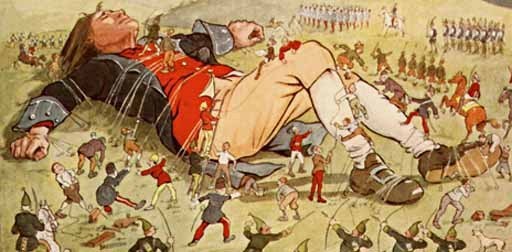
He is, as I have said before, an instinctive man; he makes up his mind quickly ~ although he may change it, by a full 180°, in hours or days ~ based on the evidence he wants to hear and believe, and I suspect that his instinctive reaction to the world is the America is like a modern day, national Gulliver, marooned in a hostile, greedy world and tied down by agreements and treaties and institutions created by little people …
… and then forced to abide by the little peoples’ rules.
[…]
His view of “winning,” it seems to me, owes more to Conan the Barbarian than to Adam Smith or Andrew Carnegie. Thus, I think Time has it about right … he wants to be an absolute monarch.
In fact, I think he shares Prime Minister Justin Trudeau’s “admiration” for China’s “basic dictatorship, which “allows them to turn their economy around on a dime.” Since I don’t think he, Trump, or Trudeau for that matter, knows much about economics I can only conclude that he admires Xi Jinping’s ability to exercise dictatorial power and throw his perceived enemies in jail on a whim.
That, I suspect, is President Trump’s “basic instinct:” he wants to be the absolute monarch of whatever enterprise with which he happens to be involved ~ property development, repeated bankruptcy proceedings, reality TV shows and now the US presidency. I’m guessing that we might have Donald Trump in the White House until 2020 … his view of America in the world, as Gulliver, is shared by many millions of his fellow citizens and the US Democrats seem, at best, incoherent in policy terms.
Comments Off on Why the Canadian media (and the Laurentian Elite) misjudge Trump
QotD: Typing with a foreign accent
To sound generally foreign, omit elisions and contractions normally used by native speakers. Type “I do not think I have the time” rather than “I don’t think I have time”.
To sound German, put commas in places that do not correspond to speech pauses in English. “I do not know, how he could have believed that.”
To sound Russian, omit definite or indefinite articles. “No, you cannot have cheeseburger.”
To sound like a speaker of Hindi or Urdu or one of the related languages, emit wordy run-on sentences that begin with “Esteemed sir”, like: “Esteemed sir, I would be grateful if you could direct me towards a good book on Python because I am attempting to learn programming.”
Understand, none of these errors actually interferes with comprehension. I’ve found that these second-language speakers are often more worried about the quality of their English than they need to be.
Eric S. Raymond, “How to Type with a Foreign Accent”, Armed and Dangerous, 2009-06-12.
Comments Off on QotD: Typing with a foreign accent
June 8, 2018
The Battle of Belleau Wood Begins I THE GREAT WAR Week 202
The Great War
Published on 7 Jun 2018The German Army is still threatening Paris and the situation for the Allies looks dire. Reluctantly, General Pershing agrees to put some of the American troops into action at Belleau Wood and Château-Thierry.
Comments Off on The Battle of Belleau Wood Begins I THE GREAT WAR Week 202
June 7, 2018
Trade war with Canada justified because the White House was torched in the War of 1812
Maybe it was intended as a joke, but what else was Trump supposed to say when Trudeau actually asked what actual security threat Canada poses to the United States?
During a phone call with Canadian Prime Minister Justin Trudeau last weekend, President Donald Trump reportedly justified his decision to impose tariffs on Canadian steel and aluminum by invoking … the burning of the White House by British troops during the War of 1812.
At least, that’s what CNN is reporting this afternoon. Here’s how they put it, citing information from “sources familiar with the call: “Trudeau pressed Trump on how he could justify the tariffs as a ‘national security’ issue. In response, Trump quipped to Trudeau, ‘Didn’t you guys burn down the White House?'”
That is, presumably, a reference to the War of 1812, during which British troops invaded Washington, D.C., and set fire to the White House. Despite the war’s name, the burning of the White House actually occurred in 1814. And it wasn’t carried out by Canadians because, well, Canada did not become an independent nation until 1867 — or 53 years after the White House burned.
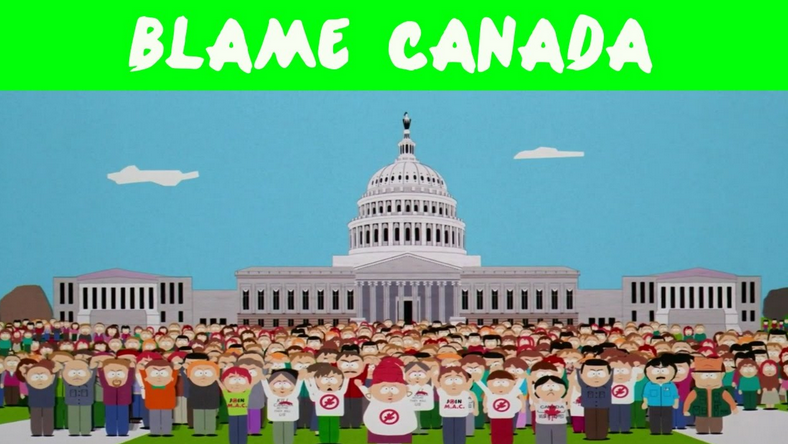
But, sure, whatever. The War of 1812 makes Canada a national security threat in the year 2018, despite our having been allies for the last century, sharing the world’s longest unpatrolled border, and exchanging more than $620 billion in goods last year. The rationales for war with Canada in Canadian Bacon and South Park: Bigger, Longer & Uncut are more grounded in reality.
Comments Off on Trade war with Canada justified because the White House was torched in the War of 1812
Faith Moore explains how to avoid sexually objectifying women
It’s apparently very simple and straightforward, once you double-check the feminist cheat sheet:
Apparently feminism has become so confusing that even feminists don’t know what’s feminist anymore. But Everyday feminists apparently do — and they’ve provided us with a handy cheat sheet so we don’t accidentally objectify someone who was trying to be empowered, or empower someone who was trying to be objectified.
The way to tell the difference, according to Everyday Feminism, is to figure out who has the power. “If the person being ‘looked at,’ or sexualized, has the power in the situation, then they are sexually empowered.” Here’s an example: “if someone puts on ‘sexy’ clothing and goes out in public or takes a selfie and shares it, they have the power because they chose themselves to put on those clothes.”
Oh, okay, I get it. So, if a woman chooses to put on “sexy” clothes and go out in public then all the catcalls and inappropriate comments and unwanted marriage proposals are empowering because she chose to put on those clothes. Oh, and also if she takes a “sexy” selfie and posts it on Instagram, all the comments about how she’s a “slut” and a “whore” and should “put her clothes on” are also empowering because she chose to share that photo. (I’m learning so much!)
But wait! Apparently beauty standards “compel” some people to wear sexy clothing “because they believe that they won’t be beautiful” otherwise. And there are even some people who feel they must not wear sexy clothing “because they are shamed if they do.”
So even if you think you put on those clothes of your own free will, it’s possible that society was actually hiding in your closet handing you things to put on (which is creepy) and that’s why you dressed all sexy (or not sexy). Which means that even though you thought you were empowered, it turns out you’re actually being objectified. And if you choose not to dress in the way you wanted to dress because society tells you that society was telling you it was wrong, then you’re empowered because you’re doing what someone else told you not to do about what someone else told you to do. (This makes total sense. I’m such a good feminist!)
But what about people who don’t dress “sexy”? Don’t worry, they can be objectified too. “Even a person who is ‘modestly’ dressed can objectified if the ‘looking’ person makes a non-sexual situation sexual without the ‘looked at’ person’s consent.” Oh good, for a minute there I thought “modestly dressed” people were being excluded from objectification and was worried because I know exclusion is wrong and we shouldn’t do it. Phew! Glad that even people who don’t want to be objectified still can be.
Comments Off on Faith Moore explains how to avoid sexually objectifying women
June 6, 2018
D-Day – I: The Great Crusade – Extra History
Extra Credits
Published on 6 Jun 2017D-Day: June 6, 1944, the day when Allied forces stormed the beaches of Normandy to retake France from the Germans. They hoped to take the Germans by surprise, and their decision to brave rough weather to make their landings certainly accomplished that, but despite these small advantages, the American forces at Utah and Omaha Beach had to overcome monumental challenges to establish a successful beachhead.
Comments Off on D-Day – I: The Great Crusade – Extra History
QotD: When the “Right Stuff” becomes “old school”
Consider the popular conception of firefighters: brave, selfless, strong enough to haul an incapacitated person from a burning building.
A few years ago, at a conference, I learned that many women were failing to qualify as firefighters, because they were coming up short on the strength test. What was so interesting, though, was that in practice, it turns out that one of the most important skills a firefighter needs is not so much the strength to drag an unconscious person from a building, but, far more commonly, the ability to coax someone who’s in danger and is terrified to come with them. Apparently, many women turn out to be far more persuasive than men – highlighting the importance of selection based on real-world skills, rather than legacy stereotypes.
Space flight offers another striking example of this phenomenon. In the context of a recent Tech Tonics podcast interview with Dorit Donoviel, director of the Biomedical Innovations Laboratory at the Center for Space Medicine at Baylor College of Medicine, I had told Dr. Donoviel about my lifelong interest in astronomy and space, about launching Estes rockets and my love of the National Air and Space Museum and above all, about my affection for the heroism captured in the movie The Right Stuff, an all-time favorite.
In response, she laughed, and told me how “old school” that thinking was. When the space program started out, she explained, there was an exceptional degree of risk involved, and astronauts tended to be selected from the ranks of fighter pilots – because, in her words, they had “the skill sets and the cojones.” But today, she said, things are different – in large measure because the “space program is a lot safer than it used to be.”
Consequently, Donoviel explained, “Today what we’re looking for is less of the sort of alpha-male pilots, and more of the sort of scientists and engineers, geologists and earth scientists, folks who can work together in a cohesive manner in a team.”
Moreover, she added, the astronaut of the future needs to be able to endure long periods of boredom and the prolonged lack of stimulation – in many ways, the opposite of high-adrenaline “seat-of-the-pants flying” that in some ways characterized the early astronaut missions.
In space travel, as in firefighting, our notion of what constitutes the right skill set has evolved appreciably.
David Shaywitz, “Evolving Notions Of The Right Stuff — In Spaceflight And In Medicine”, Forbes, 2016-09-20.
Comments Off on QotD: When the “Right Stuff” becomes “old school”


