
… one fascinating thread about the Depression era in American food is the hunger, the poverty, the disruption to American households. But even at the height of the Depression, when a quarter of the workforce was unemployed, most people were not on relief, and most were not suffering malnutrition. Those people were, however, seeing some pretty remarkable transformation in how they produced, purchased and consumed food.
- The tractor. Between 1930 and 1940, despite the fact that credit had dried up and farms were failing left and right, tractors became the majority of the horsepower available on American farms. Tractor technology itself improved during the decade, but the most remarkable advance was simply the number of draft animals who were replaced. This had far-reaching effects on American farms: It meant that more land could be put into cash crops or pasturage for food animals (because an enormous amount of available land had previously been needed simply to grow food to feed the draft animals). It increased the amount that a farmer could produce. It also meant that farmers were more exposed to market forces; you cannot grow diesel fuel on a spare field, and two amorous tractors do not make a new tractor every spring. And the capital required to buy a tractor favored larger farms, one of the first steps along the road to modern agribusiness.
- The supermarket. The grocery store as we now know it — with open shelves where the customers gather their own goods — is a relatively recent innovation. A&P, generally regarded as the first modern grocery chain, entered the 1930s well-positioned to benefit from the Depression, because it had financed expansion out of retained earnings rather than debt. Its ability to offer low prices through bulk purchasing, low labor costs and good logistics helped it to grow even as other stores were failing. Naturally this triggered a backlash, culminating in some rather exciting legislative battles in Congress, and a law, the Robinson-Patman Act, that is still on the books today.
- Commodity markets. Like stock exchanges, commodity markets — where things got a little hairy when farm prices collapsed — got a big new regulatory bill in the mid-1930s, the Commodity Futures Act. Even if you don’t care about commodity exchanges — and you should! — it’s worth knowing that there’s always something crazy going on when people are trading commodities.
- Farm policy. The New Deal programs designed to deal with the crisis in American agriculture had vast and enduring effects on the nation’s food supply, changing how people farmed, what they grew and how they got paid for it.
- Frozen food. Don’t sniff. Yes, frozen vegetables are not as good as vegetables picked at the peak of freshness and taken straight to your table from the garden or farmer’s market. This is the wrong comparison. What frozen vegetables and fish replaced was the usually inferior alternatives like canning, drying or salt-preserving, because most people could not afford to get fresh produce from a hothouse or a farm thousands of miles away. When General Foods debuted the Birds Eye line, it became possible for people to have tasty vegetables out of season or out of region at a reasonable price.
- The refrigerator. There were other technologies that made inroads during the decade thanks to falling prices, improving design and rural electrification. The waffle iron and the toaster, among others, probably deserve at least a glancing mention, as does the electric range. But indisputable pride of place goes to the refrigerator, which had penetrated 20 percent of American homes by 1932, and 50 percent by 1938. That bears a second look: In the depths of the Great Depression, people are purchasing a major expensive appliance, which suggests just how great refrigerators are. The early models were primitive, but still represented an order-of-magnitude improvement over the icebox, which couldn’t maintain an even temperature, couldn’t freeze anything, and had to have its drain periodically scrubbed with a wire brush to get rid of the disgusting accumulation of green slime. The refrigerator was complementary to other developments, like the supermarket and the frozen food case, allowing less frequent marketing and a wider variety of temperature-sensitive foods.
- Nutrition science. This almost always gets attention in histories of the era; most of that attention is not very nice. Yes, the concoctions that home economists came up with look awful to the modern eye. (I, for one, never want to find out what “cornstarch pudding” tastes like.) Yes, they got a bunch of stuff wrong. Yes, they were a little overintoxicated with idea of scientifically managing every aspect of human life, leaving no room for small matters such as, erm, flavor. But they were also coming out of an era when people frequently died of food-borne illness, or were permanently debilitated by vitamin deficiencies. And modern writers give far too little credit to the constraints that home economists were working under. Until the 1960s, just making sure you had enough calories on the table was a major part of the American household budget. Limited food supply chains did not offer the rich array of exotic ingredients we now take for granted, and cooking was something that every woman had to do a lot of, even if she had no interest or skill for the task. Providing calories with limited means (and limited cooks) took precedence over learning how to concoct the perfect pot-au-feu. The innovators who tackled these challenges did some harm, but they also did a fair amount of good, and they deserve better than the amused condescension they usually get.
- Convenience foods. Obviously, the development of convenience foods was not limited to the 1930s. We got powdered gelatin, which is to my mind the first major convenience food, in the late 19th century; cake mixes, invented in the 1930s, properly belong to the 1940s as a mass phenomenon. But the 1930s had some notable contributions: Jiffy Biscuit Mix and Bisquick, refrigerator rolls, dry soup mix, and of course, that notorious old standby, Campbell’s cream of mushroom soup. For good or for ill, these things transformed American cookery.
We often think of these developments narrowly: A tractor can plow a few more furrows, a refrigerator lets you keep food a little longer, a biscuit mix lets you have bread on the table 30 percent faster. But these sorts of changes are not just shifts in degree, but changes in kind. The tractor changed not just how fast a farmer could work, but the kinds of work he could do; the supermarket and the frozen pea and the refrigerator worked in concert to revolutionize what a housewife could do, how she could do it, and therefore, what other things she could do with the time and energy she had freed up.
And all of these things, working in concert, made radical alterations to the kind and amount of food that we put into our mouths. The Great Depression left a lot of lasting legacies on the American landscape. But the most ubiquitous, and perhaps least noticed, is the way we eat.
Megan McArdle, “The Depression Was Great for the American Kitchen”, Bloomberg View, 2016-09-23.
June 28, 2018
QotD: Some positive aspects of the Great Depression
June 27, 2018
QotD: Male homosexuality in ancient and modern times
Most educated people in the U.S. and Europe have a default model or construction of homosexual behavior which I will call “romantic homosexuality”. Romantic homosexuality is homoeroticism between equals; men or women of roughly the same age and social position, with the relationship having affective elements similar to the emotional range in heterosexual relationships (from one-night stand through lifetime marriage).
[…]
Over and over again, the pattern of male homosexual behavior in pre-modern sources is overwhelmingly one of pederasty and domination sex. And not just in pre-modern sources but in most of the present-day world as well. […] We may further note that there are, broadly speaking, two contending models of “normal” — acceptable or semi-acceptable male homosexual behavior — observable in human cultures. In one model, that of the modern West, romantic homosexuality is relatively tolerated, while pederasty and domination sex are considered far more deviant. I’ll call this the homophilic construction. It’s what most of my readers accept as normal.
But in the other, older model, pederasty and domination sex are considered more “normal” than romantic homosexuality. In cultures with this model, the “top” in an episode of pederasty or domination sex is not necessarily considered homosexual or deviant at all; any stigma attaches to the passive partner. Romantic homosexuality is considered far more perverse, because it feminizes both partners. I think of this as the “classical” construction of homosexuality, as it describes the attitudes of ancient Rome – but it persists in cultures as near to our own as South America and the Mediterranean littoral.
It’s the classical construction that is the rule in human cultures. The homophilic one is the exception; in fact, I am not able to identify any culture which held to it until after the Industrial Revolution in Europe. And not all of Europe has acquired it yet. Even in the English-speaking countries, where the homophilic construction is most entrenched, the connotations of sexual insults and threats in our language still reflect the older model.
To put it another way, the male homosexuals of the last two centuries in our culture have engaged in a massive reinvention of homosexuality that is still underway. Specifically the male homosexuals; lesbians began the game with romantic homosexuality as their dominant mode. I have not identified any culture in which it was considered more normal for lesbians to have sex with prepubescent girls or with dominated inferiors.
[…]
This analysis raises two interesting questions. The first one is about the past: what changed? That is, how did the homophilic construction replace the classical one, where it did? I’m only speculating here, but I think the proximate cause may have been the sentimentalization of family life around the turn of the 19th century in Europe, which in turn was enabled by a sharp fall in infant mortality rates. Both processes started earlier and moved faster in England and the Anglosphere than they did elsewhere.
The other interesting question is whether this reinvention is sustainable in the longer term. If my analysis is correct, modern homosexuals are bucking a pretty strong biological headwind. How strong can be judged by a chilling little statistic I picked up years ago from a how-to manual written by homosexual SM practitioners for newbies, er, learning the ropes; it noted that, adjusted for population size, male homosexuals murder each other at a rate 26 times that of the general population.
That suggests to me that a tendency for male homosexuals to drift into the darker corners of domination sex is still wired in beneath the modern homophilic construction. It might take actual genetic engineering, of a kind we don’t yet have, to fix that wiring. Until then, I wish them luck. Because (and here I make the first and only value claim in this essay) whatever one’s opinion of homophilic homosexuals might be, the behaviors associated with the pederastic/dominating classical style are entangled with abuse and degradation in a way that can only be described as evil. Modern homosexuals deserve praise for their attempt to get shut of them.
Eric S. Raymond, “Reinventing Homosexuality”, Armed and Dangerous, 2009-06-17.
June 26, 2018
Henry Johnson And The Harlem Hellfighters I WHO DID WHAT IN WW1?
The Great War
Published on 25 Jun 2018The 369th Infantry Regiment from Harlem, New York was an all-black unit that served on the Western Front. But not under American command, but loaned tot he French Army.
QotD: Writing essays in school
To find their way in American life, high-schoolers need to be able to speak English, to read, to listen to and respect other people’s opinions, to have a command of the basic elements of courtesy and, to a lesser extent, to write. (They do not need to know how to write a thesis sentence. More injury is done to high-school essays by the imposition of the thesis-sentence requirement than by any other means. The trick, kids are sometimes told, is to begin with a word like “although.” No.)
Nicholson Baker, “Fortress of Tedium: What I Learned as a Substitute Teacher”, New York Times Magazine, 2016-09-07.
June 25, 2018
Differences between the United States and the “idealized” United States of Europe
Tim Worstall, in the Continental Telegraph:
There are those who think – urge, wish for perhaps – the European Union is or should become the United States of Europe. Lots of central bureaucratic control, the nation states left as just the remnants of once independent countries like the US states are these days. In some ways the two systems are very much the same already. No US state has any control at all over trade across its own border. Nor does any EU one. Trade is an issue solely the competence of the central organisations, respectively Washington DC and Brussels. Equally, both systems use this central control of trade and trade only to expand that central control.
In the US there was a case that Federal control of trade meant that the Feds got to decide who could grow wheat where and when. The usual sort of planning idiocy led to the Feds telling farmers who could grow how much and when. One farmer claimed he was only growing for his own consumption and this shouldn’t be limited. The centre (the Supreme Court) disagreed, the crux being that if he didn’t grow for his own consumption he would buy, this affected inter-state commerce, he had to obey the Feds. The EU takes this a step further. The Single Market rules are nominally about trade. Anything legal to be buying and selling in one place is such in all is a reasonable explanation of the nub of the matter. Sure, exceptions and all that. But this then smuggles into all law that continental (Roman Law really) idea that what is legal to do is something that the legislation defines. Instead of that Common Law idea that legislation, the law even, defines what it is illegal to do all other things being legal.
Once this is accepted then of course the next step is that there must be regulation of all things so as to tell people what it is legal to do. In this manner all sorts of things get smuggled in. Vacuum cleaner motors must be limited to a certain size or power. Because those whose lives are unfortunate enough that they’ve time to spare to be concerned about legislation on such matters note that they can be and thus incorporate their trivialities into legislation. The extent of this reach is larger than you think. The underlying legal, not political, justification for recycling targets is that some countries – Holland, where digging a hole gains nothing but wet boots – don’t have space for landfill. This would put them at a disadvantage if other countries do have the space, therefore all must recycle.
Giving the centre power always, but always, means an extension of the centre’s power. The two systems aren’t so different then.
June 23, 2018
Word of the day – Kakistocracy
Ann Althouse does the etymological heavy lifting:
“Kakistocracy” — based on the Greek for “worst” + “rule” — means ” The government of a state by the worst citizens”(OED).
1829 T. L. Peacock Misfortunes Elphin vi. 93 Our agrestic kakistocracy now castigates the heinous sins which were then committed with impunity [“Agrestic” = rural, rough and uncouth.]
1876 J. R. Lowell Lett. II. vii. 179 Is ours a government of the people, by the people, for the people, or a Kakistocracy rather, for the benefit of knaves at the cost of fools?I see that Salon got to the OED and deployed that word and those quotes before Trump was even sworn in: “Degeneration nation: “It takes a village of idiots to raise a kakistocracy like Donald Trump’s/Donald Trump’s government will be ‘for the benefit of knaves at the cost of fools’” (December 17, 2016):
As Amro Ali explains in a piece calling for a revival of the term “kakistrocracy” [sic] “In a world where stupidity penetrates multiple levels of government, policies and personalities; it is strange that the term coined to best describe it has actually ended up in the endangered and forgotten words books.”…
Forbes contributor Michael Lewitt reminds us that “kakistocracy” should be used to describe a state or government run by the most unscrupulous or unsuitable people: “Corrupt, dishonest and incompetent politicians, regulators and bureaucrats were put in charge by self-absorbed, selfish and ignorant citizens.” He goes on to acknowledge that we are probably not the first society to consider our leaders as part of a kakistocracy….
The word kakistocracy comes to us from Greek. Kakistos means “worst,” which is superlative of kakos — “bad” — and if it sounds like shit, that’s because it is.
That link on “if it sounds like shit” goes to an etymology dictionary entry for “kakistocracy”:
…. from Greek kakistos “worst,” superlative of kakos “bad” (which perhaps is related to PIE root *kakka- “to defecate”) + –cracy.
In that view, the real “shithole country.” When will the U.N. give us credit for having the most nerve and confidence to criticize those we elect and continually threaten to oust?
June 22, 2018
What the well-dressed politician shouldn’t be wearing
Ann Althouse reacts to a New York Times article on what clothes “say” about the wearer:
I clicked on that title because I thought it was going to say that it’s a mistake for female candidates to wear pants (in any form) rather than a skirt/dress (of some kind). But the article lumped skirted suits and pantsuits together.
To my eye, women in pants look less dressed up than a man in a standard business suit, and I don’t think women should put themselves at that disadvantage, especially since pantsuits look sloppier on a woman’s body than a business suit on a man’s body.
I don’t mean to insult women by saying that, but women’s bodies are (generally) shaped differently than men’s and women’s pants are (generally) fitted differently from men’s suit pants. Men’s suit pants do not hug the legs or crotch, so they completely deflect attention away from the lower body. Men’s suits bring us right up to the shoulders — the idealized shoulders — and and then, via shirt and tie, aim us straight at the face.
Women’s pantsuits are more fitted in the leg and use color in a way that draws the eye downward, and they often do things with the jacket — such as making it very long — to cover up what’s happening down there in the legs. But then the jacket is distracting.
In the 2016 campaign, Hillary Clinton’s jackets were flat-out weird, with perplexing patch pockets. In fact, I don’t like Vanessa Friedman’s reference to the “Elizabeth Warren/Hillary Clinton/Kirsten Gillibrand mold,” because Warren and Gillibrand wear very low-key things and Hillary Clinton launched into clothes that we struggled to understand, that got compared to loungewear or sci-fi costumery.
I don’t really know what the best answer is. It depends on the individual. But you’re asking to be trusted with responsibility, not to be enjoyed as a pop star or fashion maven. You don’t want to look as though you’re seeking power for purpose of expressing your individuality.
A Brief History of the Jeep
KnowledgeHub
Published on 30 May 2018Jeeps are the original military vehicle that everybody loved so much, it became a civilian. So whats the history of these? Do you care? I mean you clicked on this video bub.
June 20, 2018
QotD: Changing cultural views
The way to deal with institutionalized discrimination is to disprove it. THAT is the way to change things, too. Over time, if people of x group who are assumed to be lazy and stupid prove they are excellent and high achievers, the culture changes to [accommodate] the new fact.
Is it fair to have to work against expectation? Well, there you have me cupcake. It certainly ISN’T fair. You know what else isn’t fair? Being born mortal, in a body that starts falling apart at around 40. If you were expecting fair, you were born in the wrong world. In this world we don’t have fair or ideal. We have what works, and what doesn’t.
Working really hard to show prejudice is wrong WORKS. It takes a few generations and is unfair as hell to the people who do it, but overtime the culture changes. At least if it’s a healthy culture that doesn’t kill you just for being different.
What doesn’t work is whining about how men don’t get out of your way when you’re walking (what are you? The Roman emperor? I’m sure if you play chicken they WILL get out of the way, unless they too are in a novel-writing funk. Which is when I’ve walked into people, male and female both.)
And if you go around saying bullshit like we live in a white supremacist society, you’re just going to cause me to laugh till my head falls off. Because I’ve been in one white supremacist society and guess what they didn’t have: lawsuits for discrimination; set asides for minorities; etc. In fact their laws de facto discriminated against people based on their skin color.
Running into the occasional asshole (look, I tan, and younger son tans much more than I. If you think we don’t run into assholes on a regular basis you’re nuts) who thinks you’re inferior, or tells you to go back to Mexico/Africa/the desert, is not a supremacist society. It’s a DIVERSE society, where people are allowed to think any damn crazy thing they want to. Some people in a diverse society WILL be assholes. It’s not a crime, as such. And some assholes obsess on race, or sex, or sexual orientation. Don’t make no difference which or how. They’re just ASSHOLES.
The thing to do with assholes is not to embrace them to your chest as a precious that proves you can’t get ahead because everyone is against you. It’s to go “oh, asshole” and move on.
That is ultimately the point. Sure there are micro and macro aggressions in society. They exist for everyone, yes, including white males (because some are ugly, and some are poor, and some are overweight and none of them is perfect and someone will find a reason to pick on them too.) It’s part of living in the world and not in paradise.
The diversity you claim to love comes with the ability to be many different varieties of asshole.
Sarah Hoyt, “A Very Diverse Cake”, According to Hoyt, 2016-08-31.
June 19, 2018
Flying Aircraft Carriers – Reversed Bullets I OUT OF THE TRENCHES
The Great War
Published on 18 Jun 2018
Detroit’s Michigan Central Station purchased by Ford
In Trains News Wire, Kevin P. Keefe rounds up the news from last week about the purchase of Detroit’s imposing former Michigan Central Station:
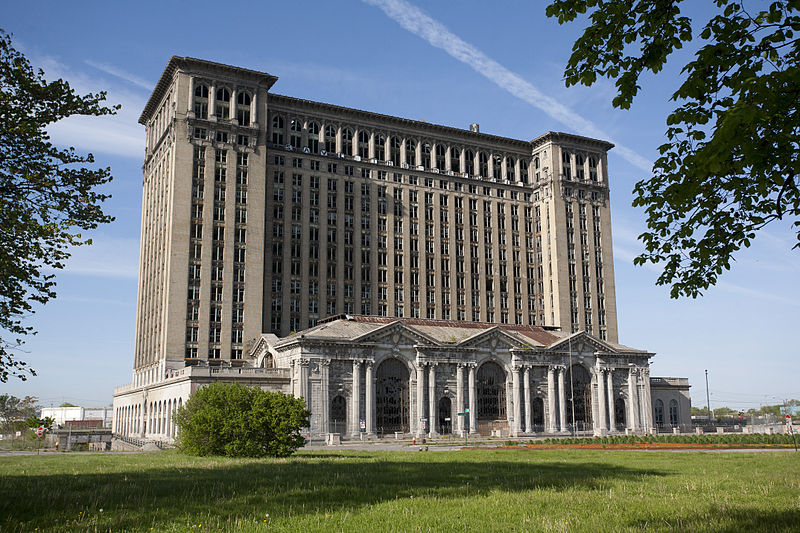
The abandoned Michigan Central Train Station, as seen from Roosevelt Park in Detroit.
Photo by Albert Duce, via Wikimedia Commons
The news this week that the Ford Motor Co. has purchased Detroit’s crumbling but historic Michigan Central Station indicates a happy ending for one of America’s most notoriously neglected big-city train stations.
Ford purchased the building from the Manuel Moroun family, billionaire owners of a trucking and logistics empire, which includes the Ambassador Bridge linking Detroit with Windsor, Canada. A purchase price for the station has not been disclosed.
A Ford spokesman said the company would announce detailed plans for the site at a June 19 press conference and open house. It is presumed the project will include renovation of the passenger terminal and its 18-story office building. At a press conference Monday, Matthew Moroun, heir to the Moroun fortune, said Ford’s “blue oval will adorn the building.”
[…]
In Michigan Central Station, Ford is acquiring one of railroading’s great architectural monuments. Two firms designed the 1913 station: St. Paul, Minn.-based Reed & Stem, of New York’s Grand Central Terminal fame; and New York-based Warren & Wetmore, known for such hotels as the Biltmore and Ritz-Carlton in Manhattan.
When the station opened, the Michigan Central was already a subsidiary of the New York Central, but a proud and independent one. With its 19th century roots in Boston’s financial aristocracy, the Michigan Central wanted to build monuments of its own. In a sprawling two-part series in the August and September 1978 issues of Trains Magazine, authors Garnet R. Cousins and Paul Maximuke called it “the proud symbol of a mighty railroad.”
The station was also unusual by virtue of its connection to the Detroit River Tunnel Co., which carried the Michigan Central main line beneath the Detroit River just a mile east of the station, linking the railroad with its Canada Southern affiliate. The tunnel opened in October 1910. The long grade necessary for the tunnel necessitated Michigan Central Station’s location more than a mile west of downtown Detroit at the corner of Vernor Highway and Michigan Avenue.
In its heyday, Michigan Central Station was as vital as any in the Midwest. In 1929, the station saw more than 90 arrivals and departures each day. Ultimately the depot could boast a number of famous NYC trains, including the Mercury, Wolverine, and, at the top, the daily Twilight Limited, originally an all-Pullman parlor-car train to Chicago. The station thrived through the postwar streamliner era.
QotD: Homophobia and racism in the USA and in Europe
Outside the very privileged top of society, feminism doesn’t get the traction it gets in the US ANYWHERE ELSE IN THE WORLD. Not even in England. In fact every other country in the world is far more “ist” than the US, because being “ist” (racist, sexist and homophobic[ist for completism]) is the way things are done. I find it mildly amusing whenever gay friends think that the US is worse than Europe “because of all the religious stuff.” Uh. No. The US is more tolerant than Europe because we’re richer and more vast and we can ignore that which annoys us more easily. In Europe they live in each other’s pockets on what is for us tight resources. They have no “give” and cohesion and conformity is enforced, which means if you stick out, you get it. Not publicly and certainly not if you’re a tourist, but if you live there among the people you’ll find you don’t need to hunt for microaggressions.
And before people from Europe say it isn’t so — you don’t know. Anymore than Americans do who’ve never lived there as locals. You don’t know how much LESS of the racism and sexism and homophobia there is in the US than in your area. Hint, what you see in our movies and read in our papers is the greatest bullshit around. Those PRACTICALLY don’t exist in the US, for any functional purpose. I mean, sure, people might think women are inferior, or might hate gays, but unlike the internet sites colonized by the alt.right (and how many of those are Russian agent accounts no one knows) people expressing such feelings (actual hostility not imaginary micro-aggressions) are likely to be laughed at or mocked. Not so in Europe.
And then there’s the more tan areas of Europe, and what we’ll term the first world minus a quarter.
I’m not ragging on my birthplace. It has some admirable qualities. But if you think that it is more tolerant or laid back than the US you haven’t lived there. Sexism is internalized at such a level people don’t see it. They give lip service to women having jobs, etc, but those women still have to be “good housewives” no matter what their job is. Men still get the choice seats in cars (be fair, they are so tiny most men have to sit up front to fit, but it has become internalized, too), men still take pride of place without a thoughts. No, not everywhere, not in every family. BUT at a cultural level, it exists at a point that feminists here would have a heart attack. Again no time to look for micro aggressions, you’re too busy working through the macro ones.
But here is the thing that these people forget: They’re not AGGRESSIONS. They’re just culture. When a man as a matter of course takes the best seat, he’s not making a comment on YOU. Hell, he’s not making a comment at all. He’s just doing something so deeply ingrained that he didn’t think about it. If you think that’s enough to make it so that you can’t succeed or that you need to run around saying you live in a patriarchal or male-supremacist society, let me tell you, cupcake, you wouldn’t have succeeded anyway.
Sarah Hoyt, “A Very Diverse Cake”, According to Hoyt, 2016-08-31.
June 18, 2018
The Only German Submarine Attack On US Shore in WW1 I OUT OF THE ETHER
The Great War
Published on 16 Jun 2018Paul Hodos’ Book about U-Kreuzer: https://amzn.to/2JzXkIY
After a long time, we are back with our format Out Of The Ether and this week we tell you about the only time Germany directly attacked US mainland with a submarine.
June 17, 2018
Conrad Black – Trump’s not bluffing
In the National Post (but linked from his personal website), Conrad Black warns of the danger of assuming that Trump is just blustering on his trade threats:
Justin Trudeau struck just the right Canadian note of our gentle nature but refusal “to be pushed around,” and he predictably will reap the short-term reward for standing up for the country opposite the ideal American bogeyman, the blustering billionaire president who has been a Garry Trudeau caricature of the Ugly American for 25 years. (It is a very incomplete picture, like most caricatures, but it works for Trump and he often cultivates it.) The boycotts of American goods and holidays will be a bonus to Canada economically and the anti-Trump American media will be along within two weeks to lionize doughty Canada like “Gallant little Belgium” in 1914 and “Plucky Israel” in 1947, and it will strengthen Canada’s always fragile self-regard opposite the United States.
On the other hand, Trump isn’t just a blowhard; all his career he has known how to go for the jugular and his reference to 270-per-cent Canadian tariffs on butter is a valid complaint that threatens to tear the scab off this egregious payoff to the comparatively small number of Quebec dairy farmers who mainly profit from it. The same issue was hammered hard by Martha Hall Findlay when she ran for the federal Liberal leadership in 2013 and by Maxime Bernier when he ran narrowly behind Andrew Scheer for the Conservative federal leadership last year. The issue died down after their unsuccessful campaigns, but if Donald Trump is incited to hammer that theme, he will roil the domestic Canadian political waters and English-French relations in the country generally.
Presumably our trade negotiators will not become so intoxicated by the prime minister’s peppy talk and spontaneous popular boycotts of the U.S. that they forget the correlation of forces. An aroused American administration could do serious damage to Canada’s standard of living, and it could be a tempting tactic to expedite more important negotiations with Mexico and the principal Asian and European powers. The United States is now enjoying three times as great a rate of economic growth as Canada (4.8 to 1.5 per cent), has lower tax rates, 11 times as great an economy, and more unfilled jobs than unemployed people.
Behind the peeling façades of Norman Rockwell and Walt Disney, the United States is a monster, and not always an amiable monster. If Canadians are blinded by their visceral dislike of Donald Trump, as the antithesis of Canadian criteria for likeable public figures, they will be exposed to the ruthless pursuit of the national interest that in his own career propelled him from technical insolvency to immense wealth and celebrity and then, against all odds, to control of a great political party and to the headship of the most powerful country in the world. If these talks blow up, the U.S. doesn’t have to settle for WTO rules; it can impose outright protectionist measures. Justin Trudeau has been agile, and the country has responded admirably. But Canadian policy-makers must understand that they are playing for almost mortal stakes with potentially dangerous protagonists who have no sense of fair play and no interest in what Canada thinks of them.


