
We are now — in the Me Decade — seeing the upward roll (and not yet the crest, by any means) of the third great religious wave in American history, one that historians will very likely term the Third Great Awakening. Like the others it has begun in a flood of ecstasy, achieved through LSD and other psychedelics, orgy, dancing (the New Sufi and the Hare Krishna), meditation, and psychic frenzy (the marathon encounter). This third wave has built up from more diverse and exotic sources than the first two, from therapeutic movements as well as overtly religious movements, from hippies and students of “psi phenomena” and Flying Saucerites as well as charismatic Christians. But other than that, what will historians say about it?
The historian Perry Miller credited the First Great Awakening with helping to pave the way for the American Revolution through its assault on the colonies’ religious establishment and, thereby, on British colonial authority generally. The sociologist Thomas O’Dea credited the Second Great Awakening with creating the atmosphere of Christian asceticism (known as “bleak” on the East Coast) that swept through the Midwest and the West during the nineteenth century and helped make it possible to build communities in the face of great hardship. And the Third Great Awakening? Journalists (historians have not yet tackled the subject) have shown a morbid tendency to regard the various movements in this wave as “fascist.” The hippie movement was often attacked as “fascist” in the late 1960s. Over the past several years a barrage of articles has attacked Scientology, the est movement, and “the Moonies” (followers of the Reverend Sun Myung Moon) along the same lines.
Frankly, this tells us nothing except that journalists bring the same conventional Grim Slide concepts to every subject. The word fascism derives from the old Roman symbol of power and authority, the fasces, a bundle of sticks bound together by thongs (with an ax head protruding from one end). One by one the sticks would be easy to break. Bound together they are invincible Fascist ideology called for binding all classes, all levels, all elements of an entire nation together into a single organization with a single will.
The various movements of the current religious wave attempt very nearly the opposite. They begin with … “Let’s talk about Me.” They begin with the most delicious look inward; with considerable narcissism, in short. When the believers bind together into religions, it is always with a sense of splitting off from the rest of society. We, the enlightened (lit by the sparks at the apexes of our souls), hereby separate ourselves from the lost souls around us. Like all religions before them, they proselytize — but always on promising the opposite of nationalism: a City of Light that is above it all. There is no ecumenical spirit within this Third Great Awakening. If anything, there is a spirit of schism. The contempt the various seers have for one another is breathtaking. One has only to ask, say, Oscar Ichazo of Arica about Carlos Castaneda or Werner Erhard of est to learn that Castaneda is a fake and Erhard is a shallow sloganeer. It’s exhilarating! — to watch the faithful split off from one another to seek ever more perfect and refined crucibles in which to fan the Divine spark … and to talk about Me.
Whatever the Third Great Awakening amounts to, for better or for worse, will have to do with this unprecedented post-World War II American development: the luxury, enjoyed by so many millions of middling folk, of dwelling upon the self. At first glance, Shirley Polykoff’s slogan — “If I’ve only one life, let me live it as a blonde!” — seems like merely another example of a superficial and irritating rhetorical trope (antanaclasis) that now happens to be fashionable among advertising copywriters. But in fact the notion of “If I’ve only one life” challenges one of those assumptions of society that are so deep-rooted and ancient, they have no name — they are simply lived by. In this case: man’s age-old belief in serial immortality.
Tom Wolfe, “The ‘Me’ Decade and the Third Great Awakening”, New York Magazine, 1976-08-23.
July 29, 2018
QotD: The third Great Awakening
July 28, 2018
Pellagra – A Medical Mystery – Extra History
Extra Credits
Published on 26 Jul 2018Pellagra can cause depression, dementia, and diarrhea, eventually leading to death. Dr. Joseph Goldberger was put on the case to crack it.
July 27, 2018
“Tariffs are the classic example of government interventions with concentrated benefits and dispersed costs”
Robert Higgs on what he describes its supporters as “waging the trade war to end all trade wars”:
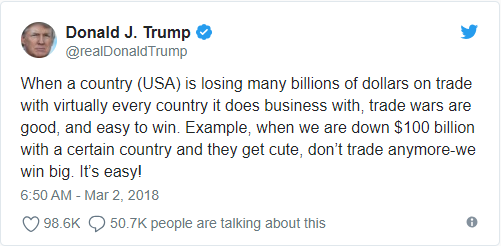
… even as Trump spouts venerable fallacies to justify and seek support for his destructive trade policies and related ad hoc actions, he and his supporters have sometimes offered a strange defense of their tactics: they purport to be seeking, at the end of the game, universal free trade, a world in which all countries have abandoned tariffs, quotas, subsidies, and other government intrusions in international exchange. In Wilsonian terms, they claim to be waging the trade war to end all trade wars. The idea is that by raising U.S. tariffs, they will induce other governments to lower and ultimately eliminate their own.
Of course, this rationale may be nothing more than wily claptrap, tossed out as a rhetorical bone to Republicans who favor freer trade. The administration’s actions to date certainly give no indication that it is aiming at global free trade. On the contrary. So the Wilsonian gambit may consist of nothing but hot air.
But if Trump and his trade advisers actually take this tactic seriously, they are deluding themselves.
First, and surely obviously, U.S. tariff increases will not induce other governments to lower their own, but to raise them, as the EU, China, Mexico, Canada, and other trading partners have already demonstrated. That’s why it’s called a trade war — because the “enemy” shoots back. History has shown repeatedly, most notably in the early 1930s, in the wake of the Smoot-Hawley Tariff Act of 1930, that such trade wars only spiral downward, choking off more and more trade, despoiling the international division of labor in accordance with comparative advantage, and thereby diminishing real income in all the trading countries.
Second, the prospect of the U.S. government’s ever abandoning tariffs is slim to none. Tariffs are the classic example of government interventions with concentrated benefits and dispersed costs. This character makes them attract great support from protected special interests and little opposition from the general public — including other producers — when they are enacted or extended. They are easy for politicians to put in place and diabolically difficult for anyone to eliminate. Although the costs are great — much greater than the benefits for the economy as a whole — hardly anyone’s costs are great enough to justify mounting a potent political attack on the tariffs.
People who get tariffs put in place to protect them in the first place are well positioned to marshal strong opposition to any political attempt to eliminate these taxes on consumers who buy from competing, foreign suppliers. Consumers rarely know anything about why foreign goods are priced as they are, and producers, in general, are usually not affected enough by tariffs on imported raw materials and components to justify well-funded politicking against them.
Urban Combat – Room Breaching & Clearing – US Army (2011)
Military History Visualized
Published on 10 Mar 2017This video gives a brief overview on room breaching and clearing techniques based on the US Army Field Manual FM 3-06.11 from June 2011.
Military History Visualized provides a series of short narrative and visual presentations like documentaries based on academic literature or sometimes primary sources. Videos are intended as introduction to military history, but also contain a lot of details for history buffs. Since the aim is to keep the episodes short and comprehensive some details are often cut.
» SOURCES «
Headquarters, Department of the Army: ATTP 3-06.11 (FM 3-06.11) – Combined Arms Operations in Urban Terrain (June 2011)
Headquarters, Department of the Army: FM 3-21.8 – The Infantry Rifle Platoon and Squad (March 2007)
July 26, 2018
The Trump tariffs are working exactly as designed
That is, they’re becoming a drag on the economy and will take away a lot of the economic activity that was stimulated by the tax cuts enacted earlier. Warren Meyer says that it’s time that congress reclaimed the tariff powers it has outsourced to the executive branch over the years:
I Know Congress Hates To Challenge A President of Its Own Party, But…
…Congress simply has to pare back the tariff authority it has delegated the President. It is simply insane that Trump can just unilaterally impose 20% tariffs on foreign automobiles, a $200 billion new tax on US consumers.
It is appalling to see Trump following the usual blue model of economic regulation, imposing one intervention after another, each meant to fix the unintended consequences of the last intervention. Steel tariffs increased costs to domestic auto makers, so Trump proposes tariffs on foreign autos. When tariffs result (inevitably) in counter-tariffs on US agricultural exports, Trump proposes more agricultural subsidies. People (not me) lament gridlock in government and want more fluid lawmaking — well here it is. And it sucks. It is mindless and reactive and emotional and totally ignorant of economics.
These tariffs, when combined with earlier actions, will result in tax increases on consumers that swamp the tax cuts Trump and the Republicans were so proud of last year.
Jon Gabriel on the most recent “fix” for one of those unintended consequences:
A few months back, President Trump declared that “trade wars are good, and easy to win.” Now, just as nearly every economist on the left and right predicted, Americans are being hurt.
The White House slapped tariffs on imported steel and aluminum. China retaliated with planned tariffs on soybeans, meats and various agricultural products. Mexico, Canada and the European Union also struck back at farm goods and other U.S. exports.
A smart leader would notice his mistake and end the destructive policy. Instead, Trump declared that “tariffs are the greatest” and created a multibillion-dollar federal program to mitigate a small part of the mess he created.
Since Agriculture Secretary Sonny Perdue estimated $11 billion in damage to the industry, he announced a $12 billion payoff to make up the difference.
The administration used emergency executive powers created during the Great Depression; that way Congress wouldn’t get to weigh in.
“This is obviously a short-term solution that will give President Trump time to work on a long-term trade policy and deal to benefit agriculture as well as all sectors of the American economy,” Perdue told reporters.
It’s certainly short-term, but hardly a solution. Trade deals and networks are disrupted, farmers can’t plan for the future, and non-agricultural industries are still losing money. Not to mention all the American consumers watching prices rise on all sorts of household goods.
But red states have a lot of farmers and the midterms are just three months away. Maybe borrowing a few billion dollars will hide enough economic pain to convince voters to keep Republicans in power for two more years.
July 24, 2018
Ayn Rand and the Hollywood blacklist
In the August/September issue of Reason, Jesse Walker discusses the role Ayn Rand played in the House Committee on Un-American Activities’ anti-Communist hearings on Tinseltown’s great and good:
Ayn Rand was a blacklist truther. The novelist and screenwriter had been a friendly witness during the House Committee on Un-American Activities’ 1947 hearings on Hollywood subversion — the probe that prompted the studios to announce that they would not hire Communists. But when she was asked about her testimony two decades later, she claimed that the blacklist was a myth.
“I do not know of any red blacklisted in Hollywood,” Rand told a Boston audience in 1967.
“I do know, if the newspaper stories can be trusted, that many of those ‘blacklisted’ people … were working in Hollywood thereafter under assumed names.” The real victims, she insisted, were the hearings’ friendly witnesses. “You talk about the blacklisting of reds. I don’t know of one leftist who has suffered for his views, and conversely, I don’t know of one pro-capitalist who in one form or another did not have to suffer for his views.”
This was misleading, to put it mildly. The blacklist really did exist. It was an organized effort to remove people from the movie industry for their political opinions, and the federal government played a major role in launching it. Anyone who cares about free expression should object to that sort of censorship by proxy, both as it manifested itself in the early days of the Cold War and as it threatens to re-emerge in social media today.
Yes, some of the more talented blacklisted writers continued to find work under assumed names or behind fronts. Dalton Trumbo knew how to write a movie that audiences would pay to see, and so Trumbo’s screenplays remained in demand. But others didn’t do studio work for a long time or left the industry altogether. (Blacklistee Alvah Bessie wound up taking a job as stage manager in a San Francisco nightclub and writing novels on the side.) And even folks like Trumbo found themselves getting paid a lot less. The blacklist eventually dissolved, but that took years. It is simply untrue that no Communists, real or alleged, lost work because of it.
On the other hand, it is true that some of the friendly witnesses of ’47 fared pretty badly. Rand mentioned a few examples at that Boston speech, among them Morrie Ryskind, who worked for those other Marxes when he scripted three Marx Brothers movies. “In Hollywood, he was getting $3,000 a week, which at the time was top money for writers,” she said. But “he has not worked as a writer one day since appearing as a friendly witness.” In Show Trial (Columbia University Press), his engrossing new book about those hearings, the Brandeis historian Thomas Doherty lists several examples of his own, from Jack Moffitt, who stopped getting hired to write motion pictures and fell back on reviewing movies for The Hollywood Reporter, to Fred Niblo Jr., who wound up leaving Hollywood to write religious films for television and documentaries for the State Department. In risk-averse Hollywood, anyone who stuck his head out might lose work for his trouble, especially if he came from the low end of the industry’s totem pole.
But this should not be equated, Doherty writes, “with the state-coerced, institutionally enforced blacklist of Communists, fellow travelers, and stubborn liberals.” That was a more fearsome and intrusive beast.
A Farewell to Arms – Ernest Hemingway I WHO DID WHAT IN WW1?
The Great War
Published on 23 Jul 2018He is regarded as one of the greatest writers of the 20th century, but before that, he was an ambulance driver on the Italian Front in the Great War and also took part in the Spanish Civil War and World War Two.
The Amazing Life of Ulysses S. Grant
PragerU
Published on 2 Jul 2018No American led a more eventful life than Ulysses S. Grant, the 18th President of the United States and the Union Army’s most celebrated general. Garry Adelman, director of history and education at the Civil War Trust, tells Grant’s amazing story in this inspiring video.
Donate today to PragerU! http://l.prageru.com/2eB2p0hThis video was made in partnership with the American Battlefield Trust. Learn more about the Civil War and America’s Battlefields at: https://goo.gl/mmJMPk
July 23, 2018
1918 Flu Pandemic – Order More Coffins – Extra History – #3
Extra Credits
Published on 21 Jul 2018Dr. Welch, Dr. Avery, Dr. Park, and Dr. Williams are on the hunt now to correctly identify this new pathogen and make a vaccine. But public officials are in denial. In Philadelphia, the mayor and his health officials are telling the press that the outbreak is nearly over. They continue doing so, day after day, as the death toll mounts and hospital wards fill.
July 22, 2018
Trump and Putin … with all this smoke, there has to be a smoking gun, right?
Colby Cosh pours cold water on the still-smouldering hopes of the “smoking gun” enthusiasts:
If the president can be found guilty of “Treason, Bribery, or other High Crimes and Misdemeanors” that is another thing, but that would require courtroom-worthy evidence of action, as opposed to indications of presidential doctrine or feeling or even strong hints of compromised personal interest. Trump did behave in Helsinki like someone who is beholden to Russia, or who is anxious for a rapprochement with Putin’s state. Yet he was, and this could not have come as a surprise, quick to try reversing himself later — emphasizing how tough he has been with Russia and how tough he is prepared to continue to be. Grrr!
Since I’m not on a diet of television news, I tend to interpret this as Trumpian “leadership” technique. They are the actions of someone who is convinced that anything can be accomplished by means of erratic emotional style and business-literature verbal tactics. These include cheap personal praise for negotiating opponents, which has become a perfectly foreseeable theme of Trump as a diplomat. (The tactical corollary is that very popular or highly esteemed people are especially vulnerable to outbursts of surprise criticism, and that has been a feature of Trump, too.)
It does not really cost the United States anything for Trump to praise Putin as skilled and strong (as a tyrant, he has been effective at maintaining domestic moral legitimacy, even if judged by the cost in shed blood) or to portray Kim Jong Un as a young man coping with terrible responsibilities. (Trump’s distaste for NATO is more dangerous as rhetoric, but did the other member nations forget for a while that political legitimacy within the United States is a prerequisite for the organization’s existence? If in the long run we devote a little more attention to the necessary housekeeping, Trump may have done the world a service.)
[…] The midterm congressional elections will be held with a long-forgotten fact re-emerging in the American popular consciousness: that much of the president’s power to set foreign policy and foul up trade is actually the property of Congress, and could be reclaimed after a century of careless delegation.
Perhaps some Americans are beginning to consider that it does not matter most whether you are with the good guys in the Trump/anti-Trump drama. Which is not to say you do not want to be one of the good guys. But the opportunity for American millennials, considered as a generation on the cusp of electoral dominance, is not just to kick Trump out, but to renovate the presidency so that the republic can survive having an unsuitable or even compromised person as president. Everybody got that? Are we good? Eyes on the ball, people.
Austro-Hungarian Artillery – Choctaw Code Talkers I OUT OF THE TRENCHES
The Great War
Published on 21 Jul 2018
Debunking the “King Cotton” school of history
In the current issue of Reason, Dierdre McCloskey discusses the claim that America became rich only or primarily due to exploitation of slave labour in the south:
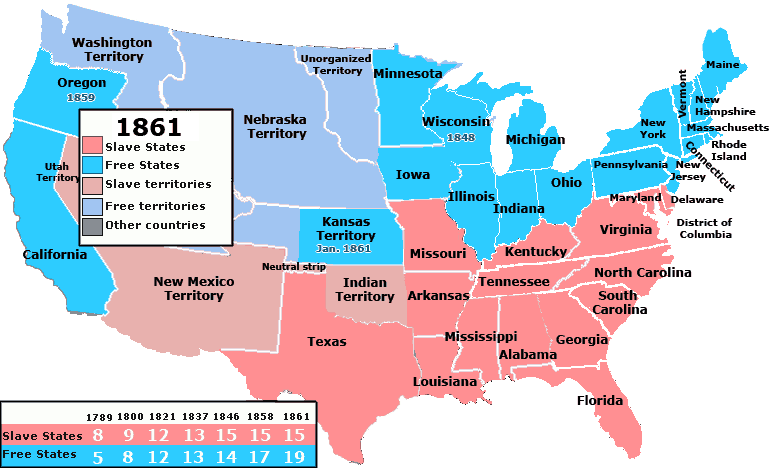
Map showing which areas of the United States did and did not allow slavery between January 1861 to February 4 1861. On February 4 1861, the Confederate States of America was created. Territories and states which had not specifically banned slavery are colored red/pink.
Map by Golbez, via Wikimedia Commons.
In his second inaugural, Abraham Lincoln declared that “if God wills that [the Civil War] continue until all the wealth piled by the bondsman’s 250 years of unrequited toil shall be sunk…as was said 3,000 years ago, so still it must be said, ‘the judgments of the Lord are true and righteous altogether.'”
It is a noble sentiment. Yet the economic idea implied — that exploitation made us rich — is mistaken. Slavery made a few Southerners rich; a few Northerners, too. But it was ingenuity and innovation that enriched Americans generally, including at last the descendants of the slaves.
It’s hard to dispel the idea embedded in Lincoln’s poetry. TeachUSHistory.org assumes “that northern finance made the Cotton Kingdom possible” because “northern factories required that cotton.” The idea underlies recent books of a new King Cotton school of history: Walter Johnson’s River of Dark Dreams (Harvard University Press), Sven Beckert’s Empire of Cotton: A Global History (Knopf), and Edward Baptist’s The Half Has Never Been Told: Slavery and the Making of American Capitalism (Basic Books).
The rise of capitalism depended, the King Cottoners claim, on the making of cotton cloth in Manchester, England, and Manchester, New Hampshire. The raw cotton, they say, could come only from the South. The growing of cotton, in turn, is said to have depended on slavery. The conclusion — just as our good friends on the left have been saying all these years — is that capitalism was conceived in sin, the sin of slavery.
Yet each step in the logic of the King Cotton historians is mistaken. The enrichment of the modern world did not depend on cotton textiles. Cotton mills, true, were pioneers of some industrial techniques, techniques applied to wool and linen as well. And many other techniques, in iron making and engineering and mining and farming, had nothing to do with cotton. Britain in 1790 and the U.S. in 1860 were not nation-sized cotton mills.
Nor is it true that if a supply chain is interrupted there are no possible substitutes. Such is the theory behind strategic bombing, as of the Ho Chi Minh trail. Yet only in the short run is it “necessary” for a good to come from a particular region by a particular route. A missing link can be replaced, as in fact it was during the blockade of raw cotton from the South during the war. British and other European manufacturers turned to Egypt to provide some of what the South could not.
July 21, 2018
John Coltrane: My Favourite Things – Sachal Jazz and Wynton Marsalis
Hassan Khan
Published on Apr 30, 2015The original was regarded to have transcended from the West to the East and this tribute absolutely manages to do so! What a tribute and proof that when the East and West compliment rather than compete, there is no limit to what we can achieve! #Makejazznotwar! Sachal Includes Baqir Abbas (flute, bansuri), Nijat Ali (conductor), Ustad Ballu Khan (tabla), Nafees Ahmed (sitar), Asad Ali (guitar), Najaf Ali (dholak), Rafiq Ahmed (dholak)
H/T to Open Culture for the link.
July 20, 2018
2nd Battle Of The Marne – Turning Point On The Western Front I THE GREAT WAR Week 208
The Great War
Published on 19 Jul 2018The German Army launches an diversionary attack from the Rheims-Soisson salient and increases the pressure on Paris. But the Allies knew about the attack and for the first time, they effectively counter the German Stormtrooper tactics and even counter-attack along the line.


