
The Great War
Published on 19 Jul 2018The German Army launches an diversionary attack from the Rheims-Soisson salient and increases the pressure on Paris. But the Allies knew about the attack and for the first time, they effectively counter the German Stormtrooper tactics and even counter-attack along the line.
July 20, 2018
2nd Battle Of The Marne – Turning Point On The Western Front I THE GREAT WAR Week 208
Comments Off on 2nd Battle Of The Marne – Turning Point On The Western Front I THE GREAT WAR Week 208
July 19, 2018
Crony capitalists of the military-industrial complex
Matthew D. Mitchell comments on some of the problems with government contractors and their all-too-cosy relationship with the government officials who hand out the public’s funds:
… as economist Luigi Zingales explains in his book, A Capitalism for the People, governments contracting with private interests has its own set of risks:
The problem with many public-private partnerships is best captured by a comment that George Bernard Shaw once made to a beautiful ballerina. She had proposed that they have a child together so that the child could possess his brain and her beauty; Shaw replied that he feared the child would have her brain and his beauty. Similarly, public-private partnerships often wind up with the social goals of the private sector and the efficiency of the public one. In these partnerships, Republican and Democratic politicians and businesspeople frequently cooperate toward just one goal: their own profit.
When President Dwight Eisenhower warned against the “unwarranted influence” of the “military-industrial complex,” he was concerned that certain firms selling to the government might obtain untoward privilege, twisting public resources to serve private ends. It is telling that one of those contractors, Lockheed Aircraft, would become the first company to be bailed out by Congress in 1971.
For many observers, the George W. Bush administration’s “no-bid” contracts to Halliburton and Blackwater appeared to exemplify the sort of deals that Eisenhower had warned of. It is true that federal regulations explicitly permit contracts without open bidding in certain circumstances, such as when only one firm is capable of providing a certain service or when there is an unusual or compelling emergency. In any case, a report issued by the bipartisan Commission on Wartime Contracting in 2011 estimated that contractor fraud and abuse during operations in Afghanistan and Iraq cost taxpayers an estimated $31 to $60 billion. This includes, but is not limited to:
requirements that were excessive when established and/or not adjusted in a timely fashion; poor performance by contractors that required costly rework; ill-conceived projects that did not fit the cultural, political, and economic mores of the society they were meant to serve; security and other costs that were not anticipated due to lack of proper planning; questionable and unsupported payments to contractors that take years to reconcile; ineffective government oversight; and losses through lack of competition.
Governments may also award contracts to perform a service that has more to do with serving a parochial interest than with providing a benefit to the paying public. For example, Congress may order the Pentagon to procure more tanks even though the Pentagon itself says the tanks aren’t needed. Paying General Dynamics hundreds of millions of dollars to produce unneeded tanks in order to protect jobs in particular congressional districts may be an abuse even if the underlying process by which the contract was awarded is legitimate.
Comments Off on Crony capitalists of the military-industrial complex
July 18, 2018
Isaac Asimov – Master of Science – Extra Sci Fi – #1
Extra Credits
Published on 17 Jul 2018Isaac Asimov didn’t have a birthday. Nobody knew the exact date of his birth, so he picked one for himself at a young age — and that choice, quite possibly, was what gave us one of his best creative periods.
Comments Off on Isaac Asimov – Master of Science – Extra Sci Fi – #1
An Israeli milestone is reached
Barbara Kay in the National Post:
The announcement was not unexpected.
On the contrary, for those who follow the subject, it was long anticipated. But the words themselves, spoken by Israel’s Immigration Minister, Sofa Landver, still carried emotional force: “Israeli Jews now constitute the largest Jewish community in the world.”
Until now, the U.S., with its many millions of Jews, has been the most Jewish country in the world. For context, in 1948, when Israel achieved official nationhood, only 600,000 of the world’s 11.5 million Jews lived there (5.2 per cent of world Jewry). By 1967, Israel’s Jewish population was 2.4 million (almost 20 per cent), and in 2012, 5.9 million (43 per cent).
The exact numbers are disputed according to methodology and definition of Jewishness. Landver puts the Israeli number at 6.6 million, the U.S. figure at 5.7 million, while Pew has the U.S. number at 7.7 million Jews identifying as Jewish at some level, which includes 2.4 million people with “Jewish background,” but no affiliation or practice.
However one calculates who is or is not Jewish for census purposes, everyone agrees the trend is to a diminishing Jewish presence in America (secularization, intermarriage, low birthrate) and an escalating Jewish presence in Israel. So whether it’s this week or next year, the population dies are cast, and will, according to Hebrew University’s Sergio DellaPergolo, an expert on Jewish demographics, reflect a demographic reality not experienced by the Jewish people since 586 BCE.
In the age-old question: is this good or bad for the Jews?
It’s good in the sense that, since Israel is the Jewish homeland with Jews the only extant indigenous people who consider it sacred space, this is a return to an original norm. Twenty years ago, it was estimated that 98 per cent of Jews no longer reside in the place in which at least one grandparent was born. Perhaps it is a few percentage points fewer today. Still, such numbers speak to a rather lachrymose history of dispersion and insecurity, in which the dream of Zion restored has been both a comfort in adversity and motivation for endurance.
Once the dream came true (at a cost of two-thirds of European Jews’ deaths, numbers still not made up), it makes sense that Jews should gather in the one place where they know they will be unconditionally welcome. A steady stream of European Jews — notably from France, where the state has proved unequal to the task of quelling or reliably containing Muslim anti-Semitism — will continue to swell the ranks of highly cultured and well-educated Jews who can fairly seamlessly and productively integrate into Israeli society.

Comments Off on An Israeli milestone is reached
July 17, 2018
Juul threat
John Tierney on the good news/bad news in the most recent smoking statistics in the United States:
Tobacco-company stocks have plunged this year — along with cigarette sales — because of a wonderful trend: the percentage of people smoking has fallen to a historic low. For the first time, the smoking rate in America has dropped below 15 percent for adults and 8 percent for high school students. But instead of celebrating this trend, public-health activists are working hard to reverse it.
They’ve renewed their campaign against the vaping industry and singled out Juul Labs, the maker of an e-cigarette so effective at weaning smokers from their habit that Wall Street analysts are calling it an existential threat to tobacco companies. In just a few years, Juul has taken over more than half the e-cigarette market thanks to its innovative device, which uses replaceable snap-on pods containing a novel liquid called nicotine salt. Because the Juul’s aerosol vapor delivers nicotine more quickly than other vaping devices, it feels more like a tobacco cigarette, so it appeals to smokers who want nicotine’s benefits (of which there are many) without the toxins and carcinogens in tobacco smoke.
It clearly seems to be the most effective technology ever developed for getting smokers to quit, and there’s no question that it’s far safer than tobacco cigarettes. But activists are so determined to prohibit any use of nicotine that they’re calling Juul a “massive public-health disaster” and have persuaded journalists, Democratic politicians, and federal officials to combat the “Juuling epidemic” among teenagers.
The press has been scaring the public with tales of high schools filled with nicotine fiends desperately puffing on Juuls, but the latest federal survey, released last month, tells a different story. The vaping rate last year among high-school students, a little less than 12 percent, was actually four percentage points lower than in 2015, when Juul was a new product with miniscule sales. As Juul sales soared over the next two years, the number of high-school vapers declined by more than a quarter, and the number of middle-school vapers declined by more than a third — hardly the signs of an epidemic.
Comments Off on Juul threat
QotD: The incentive problem for universities
Incentives matter. This is a fundamental tenet of economics: People respond to their incentives. If something in a market seems to be going wrong, it’s because the incentives have gotten screwed up.
Looking at the market for education, it’s hard not to think that there’s something wrong with the incentives. Tuition keeps going up and so does debt. The percentage of people who are not paying off that debt — either because they are in default, deferment, or an income-based repayment program — is staggering. Naturally, a lot of folks would like to get the government in there to start tweaking those incentives until the market stops being so crazy.
One issue involves the incentives that schools have to ensure that their graduates get value out of their degrees. At the moment, a school can enroll you in practically any program, and the government will lend you money for tuition and living expenses, whether or not that degree is likely to produce the means to repay the loan. Since schools are often in a better position to know the economic value of their degrees than naive potential students, that twists the incentives. Eventually, the student will pay, either with money or trashed credit. If the loan defaults, taxpayers will pay too. The school has the most information about the transaction and yet it has the least at stake. No wonder we have such high tuition, so many dubious degree programs and such a troubling rate of default.
Megan McArdle, “Don’t Make Colleges Pay for Student-Loan Defaults”, Bloomberg View, 2016-09-07.
Comments Off on QotD: The incentive problem for universities
July 16, 2018
Deconstructing Zinn’s People’s History of the United States
Alex Usher took to the Twitters to explain why you shouldn’t bother reading Howard Zinn’s ?popular? history book:
Finished Howard Zinn's "People's History of the United States". I do not understand how this came to be thought of as a classic because it's a terrible work of history.
— Alex Usher (@AlexUsherHESA) July 14, 2018
Rather than slowing down your page loading speed, here’s the rest of that Twitter thread as a screen grab:

Comments Off on Deconstructing Zinn’s People’s History of the United States
July 15, 2018
1918 Flu Pandemic – Trench Fever – Extra History – #2
Extra Credits
Published on 14 Jul 2018The flu arrived in France. It found a pleasant home in the crowded wartime trenches, much to the dismay of the Allies who tried to keep the flu a secret. When it made its way to Madrid, not subject to wartime censorship, it picked up the nickname “Spanish flu.”
Comments Off on 1918 Flu Pandemic – Trench Fever – Extra History – #2
QotD: “Temporary” government programs
Obamacare will not collapse imminently — or maybe not even ever. But that is not because it is “working” as a public policy. Countries around the world have carried the husk of their far more socialized health-care systems for generations. Rent control, the minimum wage, and countless other economically ridiculous policies endure because they satisfy the political needs of politicians, bureaucrats, and a whole phylum of remora-like rent-seekers. That’s why Milton Friedman said, “Nothing is so permanent as a temporary government program.” He should know, given how it was basically his idea to implement tax-withholding from paychecks as a wartime measure.
You might say that these programs also help real people too. And that is true. But wealth distribution efforts always help someone. And those someones become vested interests who demand perpetuation of the status quo. If the federal government implemented a program to give every left-handed person in the country $20,000 a year free and clear (no doubt to compensate for the fact that such people are witches), you can be sure the Left Handed Association of America would work assiduously to protect their entitlement.
Jonah Goldberg, “The Consequences of Overpromising on Obamacare”, National Review, 2016-10-08.
Comments Off on QotD: “Temporary” government programs
July 14, 2018
Trump’s tariffs are working
Tim Worstall explains that the recent US price hikes in washing machines is exactly what the Trump administration wanted:
The part of import tariffs that all too many fail to understand is that it is consumers being “protected” by them who actually pay them. That is, import tariffs on foreign goods entering the United States are paid by those inside the United States. Or, as we can also put it, Trump’s tariffs are making Americans poorer. This isn’t a known to be desired effect of economic policy.
However, it’s important to note that the real burden doesn’t come from the rise in price of the imports. It’s what the domestic producers do to us all in the absence of that foreign competition which is important:
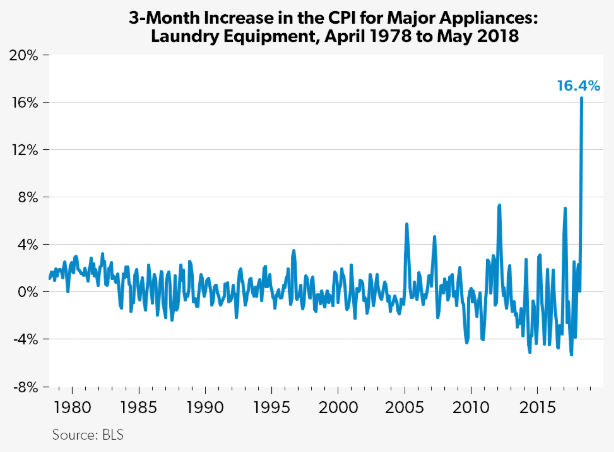
The clear and obvious effect of import tariffs – Credit, BLS, via Mark Perry and AEI, by permission
If you’re unfortunate enough to be shopping for a new washing machine, you can thank the Trump tariffs on imported washing machines, washing machine parts, steel and aluminum for the largest three-month price increase — 16.4% from February to May this year — in the 40-year history of the BLS series for Major Appliances: Laundry Equipment that started in January 1978 (see chart above). In the May CPI report (see Table 2), the one-month increase in the CPI for Laundry Equipment of 7.4% in May followed a 9.6% increase in April, and in both months was the largest monthly price increase of any of the 300 individual CPI categories or sub-categories. For the month of May, the 7.4% increase in the washing machine series was twice the increase of the next highest increase of 3.7% for educational books and supplies (mostly college textbooks).
What’s worse than this price rise is that this is planned. This is the desired outcome from the people who imposed these taxes.
Comments Off on Trump’s tariffs are working
July 13, 2018
QotD: Decline of the mainstream media
What happened to that instinct to go find the story that the “powers that be” wanted buried? Yeah, I know how the Internet has slashed into the paid-advertising model that supported “objective” daily newspapers. But don’t you think the ongoing loss of audience and credibility of the “legacy media” might also have something to do with the fact their little drones now all recite the “Leftist line” in unison — never challenge any of the sacred cows?
That what remains of the American and European “news media” would become captive to the screeching Collectivist/Globalist Left was predictable. First our colleges and now even the government youth propaganda camps (“public high schools”) have been captive to unionized Leftists pushing a thinly disguised Marxist agenda — Franz Fanon, Noam Chomsky and the like — for 45 years now. Public schools which quite purposely turn out graduates who are just barely literate enough to follow their marching orders, by the way, with most of a troublemaker’s innate sense of curiosity long since ground out of them.
(Real research is such a grind. We SO much more prefer the classes where we get good grades for just shouting our opinions about racism and oppression and stuff. And now we even get a free field trip to the state Capitol to shout it out for gun control! … even though we wouldn’t know a muzzle brake from a stripper clip, and couldn’t tell you who wrote the Bill of Rights or why he (or they) believed a citizenry armed with military-grade weapons is somehow “necessary to the security of a free state.” … Or even where that phrase appears.)
With the exception of a few pretty network news readers with great hair, no one ever went into journalism for the money. The sense since Woodward and Bernstein took down Richard Nixon was that journalists had a mission to take down greedy white “deplorable” politicians (and if we can’t find any, we’ll invent some. “If you’re for enforcing the existing immigration laws like every other nation on earth, you’re a racist!”)
The problem is not just a political “leaning.” The problem is that today’s crop of journalists are so incurious it never occurs to them to notice that their assignment editors are taking orders from owners and publishers who are on the same globalist/mind-control team as virtually all of those bought-and-paid-for politicians they’re supposed to be “exposing.” The big corporate guys don’t really care which politicians get taken down, since they’ve bought the “D”s AND the “R”s — they own Chuck Schumer and Nancy Pelosi AND Mitch McConnell and Lindsey Graham and Trey Gowdy. It’s Kabuki, it’s a Punch-and-Judy show to make people feel they’ve got a real choice.
Vin Suprynowicz, “On Reporters Who Ask No (Unapproved) Questions”, Libertarian Enterprise, 2018-06-03.
Comments Off on QotD: Decline of the mainstream media
July 12, 2018
“And that is how the Flat Century dies. Upstairs, downstairs isn’t just our past, it’s our future”
ESR looks in his crystal ball and finds a much less egalitarian future lurking just ahead of us:
I think we all better hope we get germ-line genetic engineering and really effective nootropics real soon now. Because I think I have seen what the future looks like without these technologies, and it sucks.
A hundred years ago, 1918, marked the approximate end of the period when even middle-class families in the U.S. and Great Britain routinely had servants. During the inter-war years availability of domestic servants became an acute problem further and further up the SES scale, nearly highlighted by the National Council on Household Employment’s 1928 report on the problem. The institution of the servant class was in collapse; would-be masters were priced out of the market by rising wages for factory jobs and wider working opportunities for women (notably as typists).
But there was a supply-side factor as well; potential hires were unwilling to be servants and have masters – increasingly reluctant to be in service even when such jobs were still the best return they could get on their labor. The economic collapse of personal service coincided with an increasing rejection of the social stratification that had gone with it. Society as a whole became flatter and much more meritocratic.
There are unwelcome but powerful reasons to expect that this trend has already begun to reverse.
[…]
But now it’s 2018. Poverty cultures are reaching down to unprecedented levels of self-degradation; indicators of this are out-of-wedlock births, rates of drug abuse, and levels of interpersonal violence and suicide. Even as American society as a whole is getting steadily richer, more peaceful and less crime-ridden, its lowest SES tiers are going to hell in a handbasket. And not just the usual urban minority suspects, either, but poor whites as well; this is the burden of books like Charles Murray’s Coming Apart. J. D. Vance’s Hillbilly Elegy, and the opioid-abuse statistics.
It’s hard not to look at this and not see the prophecies of The Bell Curve, a quarter century ago, coming hideously true. We have assorted ourselves into increasing cognitive inequality by class. and the poor are paying an ever heavier price for this. Furthermore, the natural outcome of the process is average IQ and other class differentiating abilities abilities are on their way to becoming genetically locked in.
The last jaw of the trap is the implosion of jobs for unskilled and semi-skilled labor. Retail, a traditional entry ramp into the workforce, has been badly hit by e-commerce, and that’s going to get worse. Fast-food chains are automating as fast as political morons pass “living wage” laws; that’s going to have an especially hard impact on minorities.
But we ain’t seen nothing yet; there’s a huge disruption coming when driverless cars and trucks wipe out an entire tier of the economy related to commercial transport. That’s 1 in 15 workers in the U.S., overwhelmingly from lower SES tiers. What are they going to do in the brave new world? What are their increasingly genetically disadvantaged children going to do?
Here’s where we jump into science fiction, because the only answer I can see is: become servants. And that is how the Flat Century dies. Upstairs, downstairs isn’t just our past, it’s our future. Because in a world where production of goods and routinized service is increasingly dominated by robots and AI, the social role of servant as a person who takes orders will increasingly be the only thing that an unskilled person has left to offer above the economic level of digging ditches or picking fruit.
Comments Off on “And that is how the Flat Century dies. Upstairs, downstairs isn’t just our past, it’s our future”
Great Blunders of WWII: Japan’s Mistakes at Midway
Anthony Coleman
Published on 3 Nov 2016From the History Channel DVD series “Great Blunders of WWII”
Comments Off on Great Blunders of WWII: Japan’s Mistakes at Midway
QotD: Bloomberg Syndrome
It is a human trait to focus on cheap lofty rhetoric rather than costly earthy reality. It is a bureaucratic characteristic to rail against the trifling misdemeanor rather than address the often-dangerous felony. And it is political habit to mask one’s own failures by lecturing others on their supposed shortcomings. Ambitious elected officials often manage to do all three.
The result in these hard times is that our elected sheriffs, mayors and governors are loudly weighing in on national and global challenges that are quite often out of their own jurisdiction, while ignoring or failing to solve the very problems that they were elected to address.
Quite simply, the next time your elected local or state official holds a press conference about global warming, the Middle East or the national political climate, expect to experience poor county law enforcement, bad municipal services or regional insolvency.
Victor Davis Hanson, “The Bloomberg Syndrome”, Private Papers, 2011-01-24.
Comments Off on QotD: Bloomberg Syndrome
July 11, 2018
The Golden Age of Science Fiction – Modernity Begins – Extra Sci Fi
Extra Credits
Published on 10 Jul 2018The golden age of science fiction represents a very flawed but fascinating American view of the future; authors Arthur C. Clarke, Isaac Asimov, and Robert Heinlein were all influential to this time period.
Comments Off on The Golden Age of Science Fiction – Modernity Begins – Extra Sci Fi


