
In 2010, the psychologists Alex Haslam and Craig Knight set up an experiment in which participants were asked to perform simple administrative tasks in a variety of office spaces. They tested four different office layouts. One was stripped down: bare desk, swivel chair, pencil, paper, nothing else. The second layout was softened with pot plants and almost abstract floral images. Workers enjoyed this layout more than the minimalist one and got more and better work done there.
The third and fourth layouts were superficially similar, yet produced dramatically different outcomes. In each, workers were invited to use the same plants and pictures to decorate the space before they started work, if they wished. But in one of them, the experimenter came in after the subject had finished decorating, and then rearranged it all. The physical difference was trivial, but the impact on productivity and job satisfaction was dramatic. When workers were empowered to shape their own space, they did more and better work and felt far more content. When workers were deliberately disempowered, their work suffered and, of course, they hated it. “I wanted to hit you,” one participant later admitted.
It wasn’t the environment itself that was stressful or distracting — it was the lack of control.
Yet there is a long, dismal tradition of disempowering workers. In the 1960s, the designer Robert Propst worked with the Herman Miller company to produce “The Action Office”, a stylish system of open-plan office furniture that allowed workers to sit, stand, move around and configure the space as they wished.
Propst then watched in horror as his ideas were corrupted into cheap modular dividers, and then to cubicle farms or, as Propst described them, “barren, rathole places”. Managers had squeezed the style and the space out of the action office, but above all they had squeezed the ability of workers to make choices about the place where they spent much of their waking lives.
Tim Harford, “What Le Corbusier got right about office space”, Tim Harford, 2022-04-07.
July 19, 2022
QotD: The soul-less, dehumanizing “cube farm” (aka, “veal pens”)
July 18, 2022
General Patton Orders War Crimes – WAH 069 – July 17, 1943
World War Two
Published 17 Jul 2022This week, we see a contrast in the way different civilians behave within occupied Ukraine, Patton orders war crimes, and Jewish resistance give up one of their own fighters.
(more…)
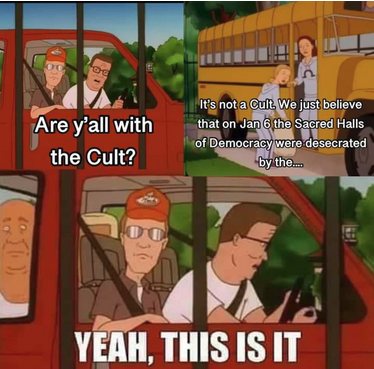
“Sophisticated liberals” yawning in synchrony
Ed West linked to this Jacob Siegel post about the tactical use of the “yawn” response to deflect and avoid discussion of topics “sophisticated liberals” want to avoid:
An American who wants to understand how political change occurs in their country must study what I’ve come to think of as the “yawning” habit of sophisticated liberals.
The yawn is an avoidance tactic that feigns moral and intellectual superiority while exhibiting dullness and cowardice. It is deployed when some flagrantly abnormal thing is occurring, which the sophisticated liberal is too sophisticated to defend outright — since to do so would expose them to potential mockery and loss of status — but too cowardly to condemn, since that would risk placing them on the wrong side of Progress.
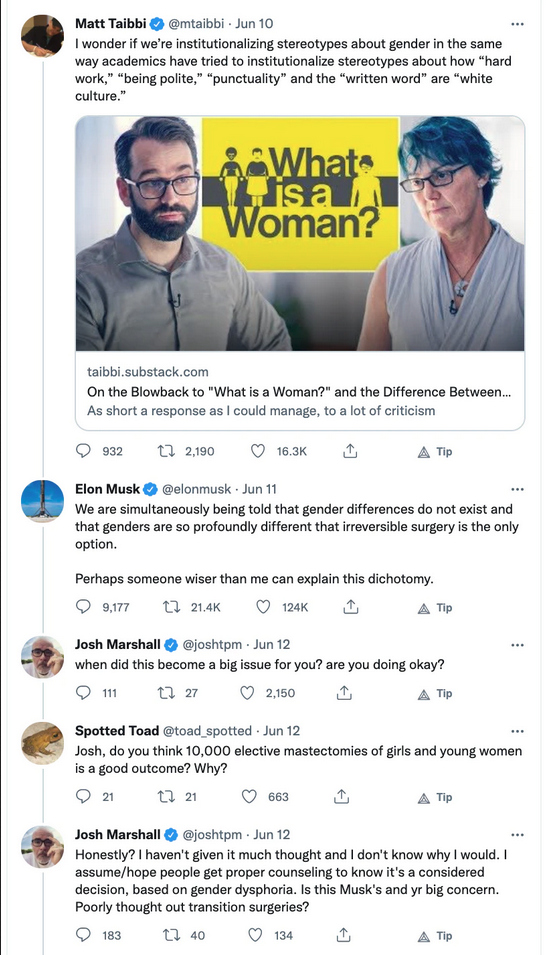
Here we can observe the liberal pundit Josh Marshall, yawning as loud as he can in response to questions about the precepts of gender ideology.
Marshall has not given much thought to why thousands of people, including adolescents, have suddenly decided to alter their bodies in irreversible ways. He’s not just incurious, he’s bragging about it. Only right-wing, extremist Putin lovers (of course, Marshall was a Russiagate conspiracist) would possibly care about an historically unprecedented, institutionally directed revolt against sexual dimorphism. A 2018 study by the British government found that the number of minors being referred for gender treatments, including hormone injections, increased by more than 4,000% in a single decade … How uninteresting. Yawn. The World Professional Association for Transgender Health just lowered the minimum age for children to receive puberty blockers or undergo transition surgery from 16 to 14. Double yawn.
“I’d like to know why you care,” the conservative pundit Matt Walsh is asked repeatedly in his new agitprop documentary What Is a Woman? The academics and other gender experts whom Walsh interviews clearly view this as an effective response to his line of questioning. It tells you something about the moral and intellectual vitality of contemporary liberalism that they simply assume that the people whose opinions they care about would agree there’s something very suspicious and déclassé about insisting on a definition of woman.
July 17, 2022
Who Let the Dogs Out?! – The Invasion of Sicily – WW2 – 203 – July 16, 1943
World War Two
Published 16 Jul 2022The Allies have begun their fight to take back Western Europe with Operation Husky. That’s not the only news though. They are also trying to extend their foothold in the Solomons, and Germany and the USSR continue smashing into one another at Kursk.
(more…)
July 16, 2022
Declarations of faith in the Church of Scientism
Chris Bray points out the hard-to-miss similarities between traditional religious beliefs and the modern beliefs of the congregations of the Church of Scientism:
Christian churches tend the bust out the HE IS RISEN banner on Easter Sunday, and here’s a version of the central declaration of faith from another religion, the Church of Scientism:
“We stand by science, so we stand by the vaccine.” These hang from every lamppost on the sizeable campus of a major research hospital in Los Angeles, an identical recitation of faith that appears before the eyes of the medical pilgrim every thirty steps or so. You can chant it in a rhythm, if you’re so inclined, as ye performest thine Stations of the Vaccine. The true penitent will park on Robertson, to walk past the maximum number of signs, but mark ye the parking restrictions, for the ways of Los Angeles parking enforcement are cruel, and many are they who suffer the penalties.
If this isn’t a declaration of a faith, then what is it? The call and response, the this-therefore-this:
Priest: Because of science, we save lives every day.
Congregation: We stand by science, so we stand by the vaccines.
You can hear the chanting in your head, can’t you? The repetition, the delivery of a mantra in a form that allows you to perceive it, and perceive it, and perceive it, and perceive it yet again before ye makest thine turn onto San Vicente. When you say it often and identically, it wears grooves; it patterns the dailiness of life with the avenues of belief. It’s Benedictine Scientism.
Or, you know, not. My bet is that most people never notice these signs, or never notice them twice, but the choice to make them and to display them is compellingly bizarre and creepy. I wish I could have witnessed the meeting of medical administrators that led to that choice, because I’m fairly confident that it played like a Paddy Chayefsky movie IRL.
I’ve been reminded over and over this week how important Substack has become. This absolute must read post from el gato malo discusses the complete implosion of popular trust in the mRNA injections, from the sharp decline in booster uptake to the “that parrot is dead” numbers regarding mRNA uptake in children under the age of five. Flatly, people aren’t taking this shit anymore, and they’re for damn sure not having it injected into their children.

Anti-Tank Chats #4 Bazooka | The Tank Museum
The Tank Museum
Published 18 Mar 2022Join Stuart Wheeler for an Anti-Tank Chat and discover the US military’s development of the Bazooka anti-tank weapon.
(more…)
July 15, 2022
Forget George Washington, Woodrow Wilson, and FDR – studying the presidency of Jimmy Carter is suddenly more relevant
One of the readers of Scott Alexander’s Astral Codex Ten has contributed a review of The Outlier: The Unfinished Presidency of Jimmy Carter by Kai Bird. This is one of perhaps a dozen or so anonymous reviews that Scott publishes every year with the readers voting for the best review and the names of the contributors withheld until after the voting is finished:
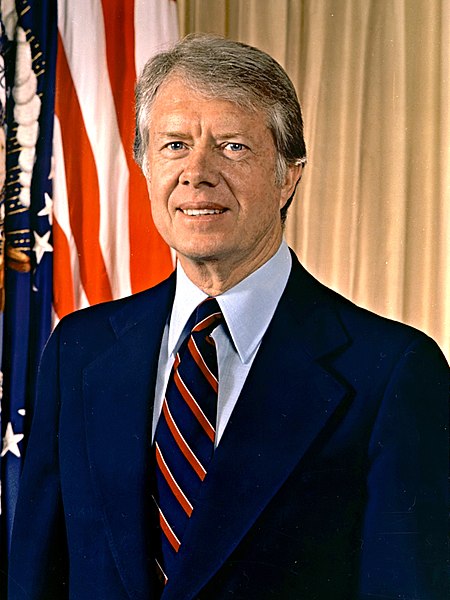
President James Earl “Jimmy” Carter.
Official portrait via Wikimedia Commons.
Like most people under 70, I was more aware of Carter’s post-presidency role as America’s kindly old grandfather, pottering around holding his wife’s hand and building Houses for Humanity. I mostly knew that he liked to wear sweaters, that he owned a peanut farm, and that he lost to Ronald Reagan.
But I wondered what, if any, hidden depths lay within the peanut farmer. Also, I wanted to enter this contest, and I didn’t want to pick a book that I thought a bunch of other people might also review. So I turned to The Outlier: The Unfinished Presidency of Jimmy Carter, by Kai Bird. Like Carter, this book seems to have been largely forgotten. It won a Pulitzer, but I had never heard of it until I googled “best book about Jimmy Carter”. It seems to have gotten a lot less attention than similar recent biographies about Grant, Roosevelt, and Truman, and it’s hard to imagine it ever becoming a TV show or a musical.
Carter was born in 1924 in Plains, Georgia, which, as you can tell from the name “Plains”, is very dull. His father was a successful farmer, which made his family wealthy by local standards. Almost every other Plains resident during Carter’s childhood was an impoverished African-American, many of whom worked on the Carter farm, a fact that is often cited as the answer to the central mystery of Carter’s childhood: how he grew up white in the Depression-era South without becoming a huge racist. It probably doesn’t tell the whole story, though, as his siblings came out just about as racist as you’d expect.
Carter attends the Naval Academy and eventually becomes a lieutenant on a nuclear submarine. At one point, he participates in a cleanup mission in which he is lowered directly into the core of an active nuclear reactor, thus causing him to develop superpowers that he will later use to win the presidency. Perhaps because of this experience — but, more likely, because he realizes that his deep-seated religious beliefs make him a poor fit for a career in an organization designed to wage war — he quits the Navy at 29 and returns home to Plains. “God did not intend for me to kill”, he says, which would have been an awesome catchphrase had those superpowers actually been real.
Searching for a new career, Carter runs for State Senate, loses due to voter fraud, then challenges the results and wins by 15 votes in a new election. A few years later, he runs for governor, and loses for real this time, to avowed segregationist (and man with a truly awesome name) Lester Maddox. Having never experienced failure in any way before, Carter is plunged into a profound spiritual crisis by this loss. Today, we would probably just say he was depressed. But as a religious Christian in the Deep South in 1966, you don’t “get depressed”, you have a spiritual crisis.
In 1970 Carter runs for governor again. This time, however, he decides to do whatever it takes to win. He runs a sleazy campaign that flies in the face of his modern-day reputation as kindly and honest. His campaign strategy has two core planks: 1) pretend to be a racist to appeal to the masses, and 2) avoid taking a stand on any other issue. Carter describes himself nonsensically as a “conservative progressive” and avoids commenting on the Vietnam War or the civil rights movement. He’s so good at pretending to be racist that the white supremacist White Citizens Council endorses him. He even wins the endorsement of his old opponent, outgoing Governor Maddox, who’s term-limited from running again. As far as anyone can tell, Carter never expresses any second thoughts about his disingenuous behavior during the campaign. Having passed through his spiritual crisis, he’s now guided by an unshakeable faith in his own goodness — a faith that justifies a victory by any means necessary.
The “fake racist” strategy works. Carter trounces his opponent, a wealthy businessman named Carl Sanders who he caricatures as “Cuff Links Carl” — when he’s not busy falsely accusing him of corruption, or hypocritically bashing him for his support of Martin Luther King. In January 1971, Carter is sworn in as the 76th Governor of Georgia.
Just a few minutes into his inaugural speech, Carter drops the pretenses of his campaign and executes on one of the most dramatic about-faces in modern-day political history when he declares that “the era of racial discrimination in Georgia is over”. The crowd gasps audibly, and outgoing Governor Maddox denounces Carter as a liar before the inauguration is even over. But Carter doesn’t care. He’s governor now, and he’s going to do what he wants.
QotD: Modern and historical multiculturalism
Yet over the last 20 years we have deprecated “unity” and championed “diversity”. Americans are being urged by popular culture, universities, schools and government to emphasize their innate differences rather than their common similarities.
Sometimes the strained effort turns comical. Some hyphenate or add accents or foreign pronunciations to their names. Others fabricate phony ethnic pedigrees in hopes of gaining an edge in job-seeking or admissions.
The common theme is to be anything other than just normal Americans for whom race, gender and ethnicity are incidental rather than essential to their character.
But unchecked tribalism historically leads to nihilism. Meritocracy is abandoned as bureaucrats select their own rather than the best-qualified. A Tower of Babel chaos ensues as the common language is replaced by myriad local tongues, in the fashion of fifth century imperial Rome. Class differences are subordinated to tribal animosities. Almost every contentious issue is distilled into racial or ethnic victims and victimizers.
History always offers guidance to the eventual end game when people are unwilling to give up their chauvinism. Vicious tribal war can break out as in contemporary Syria. The nation can fragment into ethnic enclaves as seen in the Balkans. Or factions can stake out regional no-go zones of power as we seen in Iraq and Libya.
In sum, the present identity-politics divisiveness is not a sustainable model for a multiracial nation, and it will soon reach its natural limits one way or another. On a number of fronts, if Americans do not address these growing crises, history will. And it won’t be pretty.
Victor Davis Hanson, “Things That Can’t Go on Forever Simply Don’t”, PJ Media, 2019-04-17.
July 13, 2022
Joe Biden’s age and health can suddenly be discussed in the New York Times
In the free-to-cheapskates portion of Matt Taibbi’s TK News article on “The New Kremlinology”, he discusses the sudden change of policy for the New York Times regarding Joe Biden’s physical and cognitive condition:

After reading his formal remarks from the teleprompter, Joe Biden walks away from reporters without answering questions, August 2021.
On Monday, the New York Times ran a story pegged to a new poll, showing Joe Biden dragging a sub-Trumpish 33% approval rating into the midterms. The language was grave:
Widespread concerns about the economy and inflation have helped turn the national mood decidedly dark, both on Mr. Biden and the trajectory of the nation… a pervasive sense of pessimism that spans every corner of the country …
The article followed another from the weekend, “At 79, Biden Is Testing the Boundaries of Age and the Presidency”. That piece, about Biden’s age — code for “cognitive decline” — was full of doom as well:
Mr. Biden looks older than just a few years ago, a political liability that cannot be solved by traditional White House stratagems like staff shake-ups … Some aides quietly watch out for him. He often shuffles when he walks, and aides worry he will trip on a wire. He stumbles over words during public events, and they hold their breath to see if he makes it to the end without a gaffe.
Biden’s descent was obvious six years ago. Following the candidate in places like Nevada, Iowa, and New Hampshire, I listened to traveling press joke about his general lack of awareness and discuss new precautions his aides seemed to be taking to prevent him engaging audience members at events. Biden at the time was earning negative headlines for doing things like jamming a forefinger into the sternum of a black activist named Tracye Redd in Waterloo, Iowa, one of several such incidents just on that trip.
My former editor at Rolling Stone John Hendrickson, a genial, patient person whom I like a great deal, insisted from afar that Biden’s problems were due to continuing difficulties with a childhood stutter, something John had also overcome. He went on to write a piece for the Atlantic called “Joe Biden’s Stutter, and Mine” that became a viral phenomenon, abetting a common explanation for Biden’s stump behavior: he was dealing with a disability. The Times added op-eds from heroes like airline pilot Captain “Sully” Sullenberger with titles like, “Like Joe Biden, I Once Stuttered, Too. I Dare You to Mock Me”.
But I’d covered a much sharper Biden in 2008 and felt that even if the drain of overcoming a stutter had some effect, the problems were cognitive, not speech-related. He struggled to remember where he was and veered constantly into inappropriateness, challenging people physically, telling crazy-ass stories, and angering instantly. He’d move to inch-close face range of undecideds like Cedar Rapids resident Jaimee Warbasse and grab her hand (“we’re talking minutes”, she said) before saying, “If I haven’t swayed you today, then I can’t.” I called the mental health professionals who were all too happy to diagnose Donald Trump from afar for a story about the effort to remove Trump under the 25th amendment, and all declined to discuss Biden even off the record for “ethical” reasons.
This week, all that changed. Add stories like “Biden Promised to Stay Above the Fray, but Democrats Want a Fighter” and Michelle Goldberg’s “Joe Biden is Too Old to Be President Again”, and what we’ve got is a newspaper that catches real history spasmodically and often years late, but has the accuracy of an atomic clock when it comes to recording the shifting attitudes of elite opinion.
Creating an American Homo Sovieticus
Chris Bray has had to visit a large urban hospital frequently in the last little while and he’s noticed just how readily some people have adapted to the pandemic world situation:

A large urban hospital (not the one Chris is talking about here).
Photo via Wikimedia Commons.
Observers of the Soviet Union noted the presence of Homo Sovieticus, the species adapted to the culture: “a double-thinking, suspicious and fearful conformist with no morality”. It seems fairly clear that the Blue Zones are birthing a version of this creature, well accustomed to a life centered on compliance rituals and the production of the Required Documents™.
But Soviet subjects usually found a layered response to the compliance culture, with backdoor deals and systems of baksheesh. Factories and offices evolved a set of people who learned the skills of a fixer, greasing supply chains and easing problems with a little something for your family. I just happen to have a couple of extra cartons of cigarettes, friend, and about that delayed shipment of ball bearings …
So one of the things that’s interesting about Large Urban Hospital, where the rules are the rules and I’m sorry, sir, that’s our policy, is that the rules aren’t entirely the rules, and the luck of the personnel draw sets your course. I already know the helpful front desk check-in staff — Hi, welcome back! — and I already know which one scowls at the computer, and asks if you’re sure you cleared your visit in advance, and says she’s going to need to make a few phone calls to check on your paperwork, and I need to see those test results again (she says, pulling on her scowling at documents glasses). Checking in at the lobby desk can take thirty seconds, or it can take ten minutes; it can be miserable and hostile, or it can be relatively pleasant and human. But in both cases, the person behind the computer, and the people who put them there and provide them with the systems that govern their work, believe that the work is standardized, and everyone at the check-in desk is enforcing the rules.
We have literally insane systems of ritual behavior, but within those systems we have people who are still people, and people who have very much embraced the compliance behaviors. There are dehumanizing institutions, and holy shit are there people who like it.
July 12, 2022
Kursk, When Titans Clash – 202 – July 9, 1943
World War Two
Published 10 Jul 2022Adolf Hitler launches his huge summer offensive in the USSR, Operation Citadel, known as the Battle of Kursk. Men in the millions clash. The Allies’ New Georgia campaign continues in the Solomons, both on land and with fighting at sea this week, and the preliminary actions begin for the Allied invasion of Sicily, scheduled to go off tomorrow.
(more…)
July 11, 2022
Well, we were overdue for another “Great Awakening”, but this time it’s woke
In the Neo-Ciceronian Times, Theophilus Chilton outlines why it’s more sensible to regard today’s progressives as devout cultists rather than persuaded political activists:
You may not have been aware of it, but a religious revival has been sweeping America for the past few years. However, rather than the old-time religion of Christian piety, it’s a new religion with new idols and a new direction. Yet, not entirely new — it’s the latest phase in an evolving revolutionary belief system that has consciously set itself against every aspect of traditional American culture and society. Whereas earlier progressivism made an effort to appear to integrate itself into earlier American paradigms even as it was acting to overturn them, the current religion of Woke Progressivism has completely excised itself from any pretension of respect for previous Americanism.
Some on the Right balk at the terminology of referring to woke progressivism as a “religion”. After all, hasn’t the modern Left been characterised by a rejection of religion? By an increasingly overt atheism that not only denies traditional religion, but actively subverts and mocks? Yet, unlike European modes of leftism that have remained more within the boundaries of orthodox Marxism-Leninism, official atheism has never been able to gain more than a toehold in the United States. The American temperament is a religious one and therefore requires some object of piety towards which it is directed.
For the Left, this new object of piety was channeled into cultural Marxism, a form of New Leftism that has successfully managed to take over nearly every institution — government, corporate, cultural — in this country. It did so by providing a more comprehensive program, one that was as much cultural subversion and replacement as it was “traditional” economic leftism, than older forms of socialism. This new leftism, which in its full floruit is the woke progressivism we see today, provides a totalising replacement ideology that seeks to sweep away everything that came before it.
But is this new belief system a religion? I believe that it definitely can be thought of as one, since it displays all the typical sociological patterns found in religions as they have been found throughout history, plus a few that are typical of cult groups as they’re observed today.
To begin, woke progressivism has a precisely defined and systematically enforced body of doctrines which are to be believed, not rationalised. The fluidity of gender, the naturalness of homosexuality, the evil of whiteness — all of these and much more are to be received by simple faith. But these aren’t randomly chosen. They have overarching doctrinal bases that fit within the larger progressive ideological agenda. Put together, these constitute an interlocking body of progressive doctrine that provides a comprehensive ideology to its followers.
Yet at the same time, woke progressivism does have a means of receiving new revelation and new interpretation via its own body of canonical authorities who then pass on this doctrine to the larger body of the woke “church”. This is done primarily through means of the narrative-shaping performed by major media outlets working in conjunction with elements within government, NGOs, and academia (the complex of which is what neoreactionaries often refer to as “the Cathedral”). Indeed, that process has been at work for decades — e.g. it is how the Afrocentrism of the 1980s went from being an odd, laughable academic quirk to being received doctrine which naysaying can cause you to lose your job. Have you ever noticed how when some new element of the progressive narrative hits, whether it’s a fundamental element of ideology or simply how to think about some current news event, that progressives seem to adopt it all at once?
There’s a reason for that. Once a change or addition is decided, the doctrine is swiftly promulgated to all of the local parishes and becomes a received and accepted part of the faith.
July 10, 2022
Seven easy steps to fix military procurement
CDR Salamander wrote these for the US military, so some of them are far out-of-scale for tiddlers like the Canadian Armed Forces, but the spirit is still valid and relevant:
1. No weapon system presently under production will be allowed to stop production until its replacement is under production itself.
2. Acknowledge we have lied to ourselves for decades actual magazine requirements in war (use “new” lessons from the Russo-Ukraine War for the tender to save face — whatever works) — and accelerate/restart production of everything from ASW weapons to strike weapons of all types.
3. Acknowledge that we do not have enough weapons — specifically anti-air and land attack — on our warships. Every war proves this and recent experience tells us this.
4. If I take away your access to satellite VOX & DATA and you cannot navigate and fight, you are not a wartime asset and your funding sent somewhere useful.
5. Accelerate capacity for repair away from fleet concentration areas, preferably afloat. Maximize production of sealift and begin the process to replace the C-5M.
6. If your combat unit does not have organic, robust unmanned ISR under the command of your unit’s commander, you are worthless in the war to come and you will have such a capability by FY25 or you will be disestablished.
7. Pass the Salamander Bill: no General of Flag Officer shall, for a period no less than 5-yrs from retirement date, receive compensation of any kind or anything of value from any publicly or privately held company that does business with the federal government, nor shall they serve in any non-paid positions with same.
Yes, #7 is important. If you have not realized why in 2022, you are part of the problem.
July 8, 2022
The Missing Rings • The Story Of The 1969 Minnesota Vikings
Randy Fast
Published 28 May 2016I know that this video has already been posted on YouTube, but for those of you that have never seen it, here’s a great documentary by NFL Films on the 1969 Minnesota Vikings season. I was only seven at the time, and professional football wasn’t quite yet on my radar, but for hardcore Vikings fans, the finale of this season must have been a pretty hard pill to swallow. Anyway, I hope YouTube/NFL Films allows me to keep this video posted, so until then…

July 6, 2022
“The Great Charter of the Liberties” was signed on June 15, 1215 at Runnymede
Ed West on the connections between England’s Magna Carta and the American system (at least before the “Imperial Presidency” and the modern administrative state overwhelmed the Republic’s traditional division of powers):
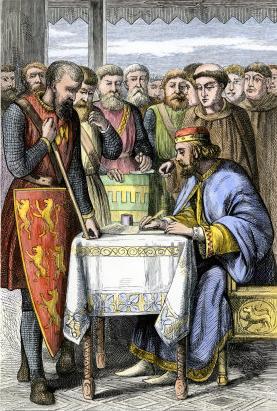
King John signs Magna Carta on June 15, 1215 at Runnymede; coloured wood engraving, 19th century.
Original artist unknown, held by the Granger Collection, New York. Image via Wikimedia Commons.
England does not really go in for national monuments, and when it does they are often eccentric. There is no great shrine to Alfred the Great, for example, the great founder of our nation, but we do have, right in the middle of London, a large marble memorial to the animals that gave their lives in the fight against fascism. And Runnymede, which you could say is the birthplace of English liberty, would be a deserted lay-by were it not for the Americans.
Beside the Thames, some 10 miles outside London’s western suburbs, this place “between Windsor and Staines”, as it is called in the original document, is a rather subdued spot, with the sound of constant traffic close by. Once there you might not know it was such a momentous place were it not for an enclosure with a small Romanesque circus, paid for by the American Association of Lawyers in 1957.
American lawyers are possibly not the most beloved group on earth, but it would be an awful world without them, and for that we must thank the men who on June 15, 1215 forced the king of England to agree to a document, “The Great Charter of the Liberties”.
Although John went back on the agreement almost immediately, and the country fell into civil war, by the end of the century Magna Carta had been written into English law; today, 800 years later, it is considered the most important legal document in history. As the great 18th-century statesman William Pitt the Elder put it, Magna Carta is “the Bible of the English Constitution”.
It was also, perhaps more importantly to the world, a huge influence on the United States. That is why today the doors to America’s Supreme Court feature eight panels showing great moments in legal history, one with an angry-looking King John facing a baron in 1215.
Magna Carta failed as a peace treaty, but after John’s death in 1216 the charter was reissued the following year, an act of desperation by the guardians of the new boy king Henry III. In 1300 his son Edward I reconfirmed the Charter when there was further discontent among the aristocracy; the monarch may have been lying to everyone in doing so, but he at least helped establish the precedent that kings were supposed to pretend to be bound by rules.
From then on Parliament often reaffirmed Magna Carta to the monarch, with 40 such announcements by 1400. Clause 39 heavily influenced the so-called “six statutes” of Edward III, which declared, among other things, that “no man, of whatever estate or condition he may be … could be dispossessed, imprisoned, or executed without due process of law”, the first time that phrase was used.
Magna Carta was last issued in 1423 and then barely referenced in the later 15th or 16th centuries, with the country going through periods of dynastic fighting followed by Tudor despotism and religious conflict. By Elizabeth I’s time, Magna Carta was so little cared about that Shakespeare’s play King John didn’t even mention it.


