
J.J. McCullough
Published 2 Apr 2022The story of chips is the story of America.
(more…)
July 28, 2022
The History of American Chip Flavors
Comments Off on The History of American Chip Flavors
July 27, 2022
Baghdad Biden speaks
Chris Bray recounts the story of a local government attempting and — for a while — succeeding with the Baghdad Bob blanket denial strategy:

In the Deep Blue suburban town where I live, our city government has been stumbling through a series of crises. For a couple of years, employees fled from City Hall like the building was on fire, and nowhere was the crisis more acute than in the finance department — where we had five directors in a little over two years, and lost most of the other staff, including one who sued the city over her departure. There was a year when we couldn’t pass a budget, because the budget proposal was such a shambles, and a discussion at a meeting of an advisory commission in which a commissioner asked one of the many finance directors if the numbers in the city’s bank accounts matched the numbers in the city ledger. (Try to guess the answer.)
Recently, an ad hoc committee of local citizens — all finance professionals — wrote a report on the period of crisis, and presented our city council with a recommendation that they hire someone to do a forensic audit of the city’s accounting during those years. The council scheduled the report as a “receive and file” item, placing it on a 28-item agenda as, you’ll never guess, item #28. Then, in a brief discussion that began after midnight, they said that the report was nonsense and hearsay. The end.
So, yes, there was no financial crisis in our city during the years when we had five finance directors, when “permanent” finance directors left after a few months, when we lost most of the finance department staff, when we couldn’t pass a budget, and when we had no idea how much money we were actually supposed to have in the bank. Our city council says so. “These are not the ‘droids you are looking for.”
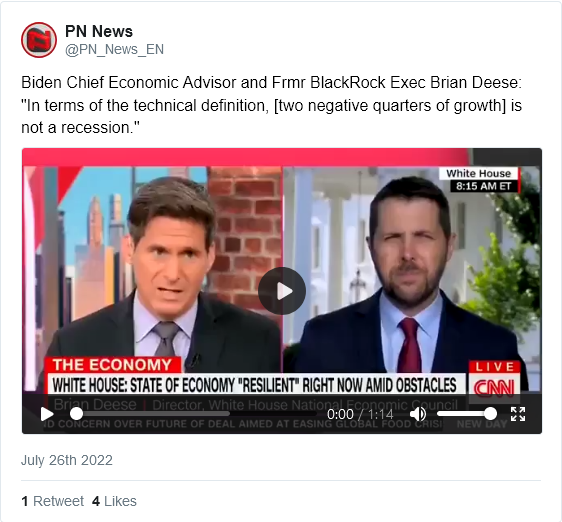
Meanwhile, we’re not in a recession, or even facing the risk of a recession, because that’s not Joe Biden’s view, and because the technical definition of a recession is very complicated.
Also, the inflation of 2021 was transitory. Zipped right by! Also, Joe Biden has a plan to shut down the virus.
The war in Ukraine is SHUT UP SHUT UP SHUT UP, the economy is SHUT UP SHUT UP SHUT UP, the continuing Covid-19 “emergency” is SHUT UP SHUT UP SHUT UP, and the mRNA injections are REALLY REALLY SHUT UP. Actually, the way experts measure this is really complicated, and technically …
Comments Off on Baghdad Biden speaks
QotD: Sex and the young Zoomer
I bring this up because we seem to have entered one of those moments, not infrequent in American history, when the keepers of our culture have decided sex should be taboo. The word itself is now indecent and unmentionable: We’re supposed to say “gender”. But gender pertains to linguistics, not biology. In Spanish, for example, the moon is feminine in gender: la luna. The sun is masculine: el sol. This sets up all kinds of interesting possibilities during sunrise and sunset, but that’s not the point here. The point is that some moralistic souls think you can somehow detach the sex act from sexuality. But why?
Apparently, many in the zoomer generation find sex scary. I get that. When I was 13 and contemplated the mechanics of the thing, I pretty much became reconciled to a life of despondent celibacy. But at what point was our culture handed over to clueless 13-year-old kids? The zoomers mate later, less and with fewer reproductive consequences than their parents and grandparents. They get triggered by 50 Shades of Grey and suffer a permanent headache from climate change. I mean, can anyone conjure up a romantic vision of Greta Thunberg?
There’s also the idea that sex is fluid — that one can be born into a biological “gender” then pick among dozens of other flavors, like scoops at the gelato store. But weren’t we told, not so long ago, that being gay was a matter of genetic destiny? Evidently, everyone else is free to choose. You can be transgender, of course, and cisgender, which I think is what I am. But there are 70 more buckets to pick from, such as abimegender, aerogender, cassgender — even cloudgender, which means one’s gender “cannot be comprehended or understood due to depersonalization and derealization disorder”.
If you believe there are 72 sexes, you’re overthinking. You’re also likely to be online 22 hours a day and paddling toward a digitally reinforced narcissism. “You may say you’re cassgender. Fine. Big deal. But I am cloudgender and can’t be fully comprehended or understood!” That’s the stuff of social media. It feels like millions are listening to your magnificently baroque sexual identity, even if you’re only talking to yourself.
Martin Gurri, “Get the Kids Out of the Room — We’re Going To Talk About Sex”, Discourse, 2022-04-25.
Comments Off on QotD: Sex and the young Zoomer
July 26, 2022
What’s worse than having a nepotistic elite running the country? Having an incompetent nepotistic elite running the country
Kurt Schlichter isn’t a fan of the kakistocratic “elite” running most of the western world at the moment:

The things we took for granted decades ago are uncertain, and there’s always an excuse — inevitably one that blames us. Like the new take on air conditioners, which is that they are an extravagance we should learn to live without. What the hell? Why?
And don’t get me started on the bizarre insistence of the resetters that we all need to give up beef and start eating bugs. I have a better idea. How about we eat ribeyes and burgers like Americans instead of crickets and locust like Third World famine victims?
A proper ruling class would see the problems and move to solve them, because the proper relationship between the ruling class and the rest of us is that the ruling class provides prosperity and security and the rest of us let them skim some cream off the top. If they were doing a decent job, their riches and luxuries would not bother us much; but when they have failed yet still expect full pay and benefits anyway, that grates. It is unsustainable.
So why doesn’t the ruling class try to get America moving again instead of telling us that we should settle for less and less? For one thing, because our ruling class is not competent. Joe Biden is, in a way, the perfect president for the resetters — stupid and getting seniler, corrupt, yet absolutely sure of his own genius despite literally no basis for that self-regard. Look, the solutions are there. Want to fix crime? Do what Giuliani did in New York City in the nineties. Want energy independence? Do what Trump did in 2016. Want the economy roaring? Do what Reagan and Trump did. These tactics are not secrets, yet they seem to be too hard for our elite to pull off. Our reset revolt will be to embrace someone who can.
Of course, the incompetence issue assumes that our elite wants to succeed in doing what elites should do. Does it really? Does it really want us prosperous, secure and free? Oh, the elite wants to succeed for itself, and it sure has. The elite is richer than ever. And it intends to stay that way even after you are reset to “Peasant” mode. The elite won’t be taking public transportation among the hobos like you. They will be safe behind armed guards while you are disarmed and victimized — defend yourself at your peril! And they will keep eating steak tartar while you slurp up beetle paste. Yum yum, proles!
The ruling caste has no intention of you living like a civilized citizen. No, you are their sacrifice, to Gaia, the angry weather goddess or whatever other pagan idol that empty void inside them worships. Your pain is the point. Remember, bullies love the raw exercise of power. Making you miserable is a manifestation of their urge to dominate and crush. That’s the genesis of those seemingly insane moves around the world like Sri Lanka giving up fertilizer or agricultural powerhouse Holland evicting farmers. But these moves — including the destruction of our own energy industry — only seem insane if you refuse to accept their ultimate goal. They want to hurt you. Your pain is a feature, not a bug — which will be your next meal if they get their way.
Comments Off on What’s worse than having a nepotistic elite running the country? Having an incompetent nepotistic elite running the country
Flying Failures – Christmas Bullet (The Worst Plane Ever Built)
Ruairidh MacVeigh
Published 25 Dec 2020Merry Christmas everyone! 😀
To coincide with this most special of holidays, in this episode of Flying Failures we will be examining the dubious history of the Christmas Bullet, a divisive little plane that could either be seen as the brainchild of a man whose ambition outweighed his abilities, or perhaps one of the greatest cons in aviation history, a con that left two planes destroyed, two test pilots dead, and the US taxpayer several million dollars out of pocket.
(more…)
Comments Off on Flying Failures – Christmas Bullet (The Worst Plane Ever Built)
July 25, 2022
Political memes: threat or menace?
In Quillette, Christopher J. Ferguson considers the social dangers of sharing political memes:

Modern politics has always been replete with issues about which people feel passionate, sometimes aggressively so. But the culture wars currently raging in the US, Canada, and across much of the industrialized West seem to be particularly fraught. In my 50-plus years, I have never seen so much anger and hostility among citizens of otherwise stable countries. Some of these people will participate in protests or engage in civil disobedience, but many more will employ the political meme to express their discontent. Given how widespread the phenomenon has become, it’s worth asking whether political memes actually advance advocacy goals and our knowledge of important issues, or if they simply feed an unconstructive cycle of anger, misinformation, and polarization.
The term “meme” was coined by Richard Dawkins, who used it to describe units of culture, socially transmitted and imitated across generations in ways synonymous with genes — adaptive ideas survive, while maladaptive ideas perish. But in the social media age, the word usually refers to “an image, video, piece of text, etc., that is copied and spread rapidly by Internet users often with slight variations”. The subset of memes that focus on politics are generally designed to boil complex issues down to a digestible combination of emotive image and sloganeering text that flatters those who agree with its message and provokes those who do not.
Most academics who study memes agree that they are poisonous to healthy public discourse (“toxic” is a word that crops up a lot, even in the scholarly literature). One scholar bluntly called them “one of the main vehicles for misinformation”, and they tend to distort reality in several ways. By their very nature, they leave no room for nuance or complexity, and so they are frequently misleading; they tend to lean heavily on scornful condescension and moral sanctimony (usually, the intended takeaway is that anyone who agrees with the point of view being — inaccurately — mocked is an imbecile); they make copious use of ad hominem attacks, straw man fallacies, and motte-and-bailey arguments; they intentionally catastrophize, generalize, personalize, and encourage dichotomous thinking; and they are aggressive and sometimes dehumanizing. They are, in other words, methods of Internet communication that display all the symptoms of a borderline personality type of mental disorder. Of course, it’s possible to construct a meme that is short yet still thoughtful and sophisticated, but these are few and far between.
The best evidence we have today is incomplete and limited, but it suggests that political memes have a net negative effect on society. If the idea is to persuade or advance practical advocacy goals, then there is little evidence that they work. To the contrary, they may be counterproductive — the evidence we do have suggests that they contribute to political polarization, distort issues in the name of political expediency, and provoke indignation, hatred, and intolerance (on both sides of the political spectrum). Yes, the available evidence is fragmentary and would certainly benefit from better and more open science designs. However, it accords with larger observations about social media and political polarization. Perhaps new and better research will reveal that alarm about the negative effects of memes is simply another moral panic comparable to those that arose around video games or smoking in movies. But since memes add almost nothing to public discourse that would offset the risks, it’s probably worth hesitating before sharing them.
I save the odd meme that wanders through my various social media sites that I find amusing or (occasionally) effective, and memes as described in this article certainly do seem to be far more common than they were even a few years ago. A few selections below the fold, just because:
July 24, 2022
After a Victory at Kursk, The Soviets Attack Everywhere – WW2 – 204 – July 23, 1943
World War Two
Published 23 Jul 2022The Allied invasion of Italy powers on and puts the future of a key axis power at play. In the USSR, the Soviets have learnt to deal with German offensives, as the Wehrmacht struggles to make a dent.
(more…)
Comments Off on After a Victory at Kursk, The Soviets Attack Everywhere – WW2 – 204 – July 23, 1943
Stoner 63A Automatic Rifle – The Original Modular Weapon
Forgotten Weapons
Published 17 Mar 2018The Stoner 63 was a remarkably advanced and clever modular firearm designed by Eugene Stoner (along with Bob Fremont and Jim Sullivan) after he left Armalite. This was tested by DARPA and the US Marine Corps in 1963, and showed significant potential — enough that the US Navy SEALs adopted it and kept it in service into the 1980s. It was a fantastic balance of weight and controllability, offering a belt-fed 5.56mm platform at less than half the weight of the M60. The other fundamental characteristic of the Stoner 63 was modularity. It was built around a single universal receiver component which could be configured into a multitude of different configurations, from carbine to medium machine gun. Today we have one of the rarer configurations, an Automatic Rifle type. In addition, today’s rifle is actually a Stoner 63A, the improved version introduced in 1966 to resolve some of the problems that had been found in the original.
Ultimately, the Stoner system was able to achieve its remarkably light weight by sacrificing durability. The weapon was engineered extremely well and was not a danger to itself (like, for example, the FG-42), but it was prone to damage when mishandled by the average grunt. This would limit its application to elite units like the SEALs, who were willing to devote the necessary care to the maintenance and operation of the guns in exchange for the excellent handling characteristics it offered.
(more…)
Comments Off on Stoner 63A Automatic Rifle – The Original Modular Weapon
July 23, 2022
Tank Chat #152 | Swiss Centurion | The Tank Museum
The Tank Museum
Published 25 Mar 2022
(more…)
Comments Off on Tank Chat #152 | Swiss Centurion | The Tank Museum
QotD: “The New Journalism” and “narrative journalism”
This is the news cycle in a nutshell. There is very little news. It has been at least a generation since the major news outlets in America have done reporting. Most of it is just stenography. The “journalist” copies what a government spokesbot has sent to them and dresses it up with some commentary. Then there are the narratives that are designed to give the public a way to repeat the official truth that sounds convincing to them and their acquaintances.
The source of this is the “new journalism” that emerged in the 1960’s. The late British reporter Chris Munnion chronicled this in his book Banana Sunday. He spent most of his life covering Africa for the Telegraph. In the 1960’s he noticed Americans showing up with pre-written narratives. They would seek out quotes and pictures to fill out the story they had prepared for the trip. Even if the facts contradicted the narrative, they stuck with the narrative because that was the new journalism.
Narrative journalism is just accepted these days. The “news” has always been a form of passive-aggressive political activism so its evolution into story telling on behalf of powerful interests seems natural. When you think of the New York Times, Washington Post and Wall Street Journal as propaganda arms of their respective clients in the managerial elite, it all makes sense. Instead of the Ministry of Truth we have the mainstream media “speaking truth to power”.
That last bit gets mocked by normal people on this side of the great divide because they have woken up to the reality of this age. As if often the case, however, there is a kernel of truth locked in this media fabrication. The people inside these disinformation operations genuinely fear the public. When they say “speak truth to power” they mean broadcast their truth to you in the hopes that you will buy it. Modern mass media is mostly a defensive weapon of the elites.
The Z Man, “The Lying Liars”, The Z Blog, 2022-04-20.
Comments Off on QotD: “The New Journalism” and “narrative journalism”
July 22, 2022
Sexual liberation to sexual revolution to … today’s sexual desert
Chris Bray thinks that the sexual revolution “missed a turn, somewhere out in the desert”:
The discussion of what we didn’t mean to do is becoming an interesting one:
After decades of sexual liberation — Mattachine, Stonewall, Loving v. Virginia, Griswold v. Connecticut, Second Wave feminism and the Sexual Revolution, Lawrence v. Texas, Obergefell v. Hodges, and whatever else I’m missing in there (and I’m not sure Roe belongs on the list, but maybe) — we somehow arrive at a moment in which we merge a sexualized display of childhood and a relentless media-driven commodification of sexuality with the very clear reality that nobody’s having any sex:
One of the most comprehensive sex studies to date — the National Survey of Sexual Health and Behavior — found evidence of declines in all types of partnered sexual activity in the U.S. Over the course of the study from 2009 to 2018, those surveyed reported declines in penile-vaginal intercourse, anal sex and partnered masturbation …
Over the last 22 years, Herbenick has co-authored several studies about our sexual activity. Her most recent research finds that all of us, regardless of age, are having less sex, with the most dramatic decline among teenagers.
At the start of the study in 2009, 79% of those ages 14 to 17, revealed they were not having sex. By 2018, that number rose to 89%.
Liberation stabbed pleasure in the heart; we emptied sex. Hypersexualization turns out to be desexualization. The unrelenting joylessness and death odor of contemporary sexual culture emerges from seventy years of growing openness and freedom. How?
There’s no way to fully cover a question of that scope in a single post — but I refer, as a start, to the earlier posts I wrote about the sexualization of childhood and the way Jim Jones used sex as a weapon. Breaking barriers and repressive anchors broke connections and reference points: Yes, some people were trapped in oppressive societal norms, and it’s not at all my view that all the sexual liberation in our past wasn’t really liberating. But we broke marriage to set people free, and whoops. Some people experienced bourgeois heteronormativity as a prison, and so set out to release everybody from their cages, which seem to have not been cages for a whole lot of people. Congratulations, we’ve freed you from being part of a family.

Comments Off on Sexual liberation to sexual revolution to … today’s sexual desert
July 21, 2022
Hidden flaws in vintage wooden planes
Rex Krueger
Published 20 Jul 2022Find the problems that can make wooden planes unusable. Find them BEFORE you buy.
(more…)
Comments Off on Hidden flaws in vintage wooden planes
July 20, 2022
The Myth of Rosie the Riveter – On the Homefront 016
World War Two
Published 19 Jul 2022With American men going off to fight the war, there are concerns about a labor shortage. Enter Rosie the Riveter. The women who answered the “We Can Do It” call and entered the factories. But did she really exist?
(more…)
Comments Off on The Myth of Rosie the Riveter – On the Homefront 016
Apparently “Crisis-Pregnancy Centers” prey exclusively on young people who menstruate!
Chris Bray reveals some of the shocking information a new investigation has turned up about so-called “Crisis-Pregnancy Centers” in the United States:
A quick illustration of the Red-Blue Chasm, the immensity of which can now only be estimated using theories borrowed from astrophysics.
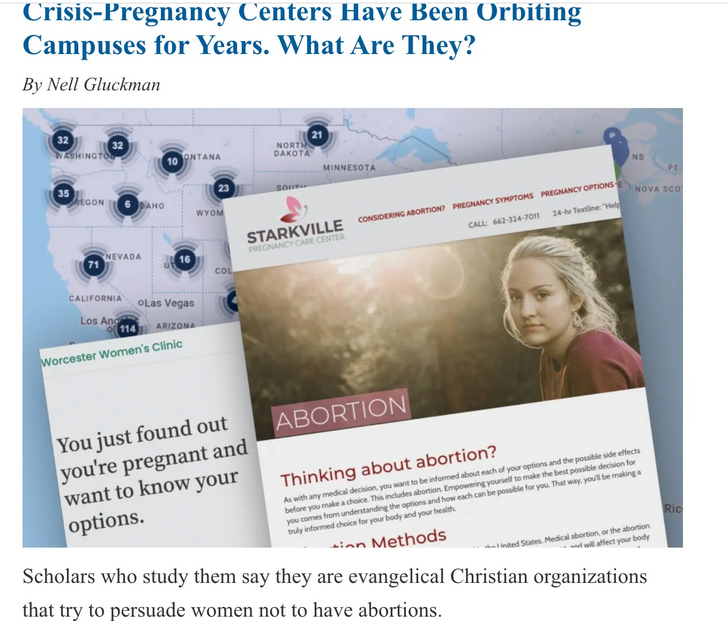
An email message this morning from The Chronicle of Higher Education offers a deep investigative dive into an obscure topic — in a message that barely fit on my screen, so the screenshot is cut off a bit at the top:
Figured that out, did they? Coming soon: “Pizza shops orbit college campuses. Scholars have determined that they offer a bread-like disc strewn with red liquid and white-colored molten coverings”.
The investigation of pregnancy centers proceeds on the kind of dark foreboding that a television show conveys with poor lighting and a low vibration on the soundtrack. Since the reporter didn’t manage to get a single pregnancy center advocate or volunteer on the record, despite sending some email messages, the whole investigation takes all criticism entirely at face value, uncontested and unexamined. That leads to framing like this:
Some centers target college students. Andrea Swartzendruber, an epidemiologist at the University of Georgia, analyzed the centers’ locations in Georgia and found that they were disproportionately clustered around the state’s colleges and high schools when compared with other health clinics. Swartzendruber and her colleague Danielle Lambert have mapped the locations of more than 2,500 crisis-pregnancy centers across the United States.
Yes, friends, I’m afraid this is the actual dark truth: Pregnancy centers target young women. They don’t target eight year-old boys or the elderly at all! nOw Do YoU SeE tHe hIddEn aGenDa!?!?!?!? THERE’S NOT A SINGLE CRISIS-PREGNANCY CENTER INSIDE A SINGLE RETIREMENT COMMUNITY!!!!!
Anyway, scholars were able to determine this, using sophisticated geospatial analysis.
The story also includes shock-quotes from an actual college student, Hana, who went to a crisis pregnancy center, like this one: “She kept referring to my pregnancy as a baby.”
And then, presumably, they invaded Poland.
Comments Off on Apparently “Crisis-Pregnancy Centers” prey exclusively on young people who menstruate!
July 19, 2022
How dating apps have changed the dating world
Rob Henderson on the changes dating sites have accelerated in the dating community:

“In the United States, 35 percent of Tinder users are college students ages 18 to 24 … ‘I’ve heard a joke on campus that goes something like this: ‘First base is hooking up, second base is talking, third base is going on a date and fourth base is dating’.“ (source).
I am just old enough to remember what the dating scene was like before the rise of Tinder and other dating/hook-up apps. It has changed a lot.
2012 was another world in many ways.
The situation has changed for everyone on the dating market. Even those who don’t use these apps. This is because even for the people who don’t use the apps, they still live in an environment where others use them. Over time, those who don’t use apps must adapt to the preferences and behavior of those who use them. Not the other way around.
One example of how the scene has changed. I have a friend from college. A good-looking guy. He showed me how many women he has matched with: More than 21,000. Twenty-one thousand. Tinder actually identified him as a valuable user early on, and gave him free perks and upgrades. They lifted his radius restrictions. This allowed him to match with even more women. I have another friend. Doesn’t have the best pictures on his profile. But not a bad looking guy. Over roughly the same period of time as my other friend, he has matched with seven women.
Some findings on dating apps:
- 18 to 25 percent of Tinder users are in a committed relationship.
- Women aged 23 to 27 are twice as likely to swipe right (“liked”) on a man with a master’s degree compared with a bachelor’s degree.
- Men swipe right (“liked”) on 62 percent of the women’s profiles they see; women swipe right (“liked”) on only 4.5 percent of the men’s profiles they see.
- Half of men who use dating apps while in a committed relationship reported having sex with another person they met on a dating app. All women who used dating apps while in a committed relationship reported having sex with another person they met on a dating app.
- 30 percent of men who use Tinder are married.
- In terms of attractiveness, the bottom 80% of men are competing for the bottom 22% of women and the top 78% of women are competing for the top 20% of men.
One way dating apps might be changing the dating scene. People used to have to go out to meet people. And it was costly to lose a relationship partner, in part because of the process involved in meeting someone new. Today, people know that a new partner is a few swipes away. Partners might be more replaceable. If things start deteriorating with their current partner, some can pull out a goldmine in their pocket.
There may be some sexual stratification going on as well. My two friends are examples of the above finding that being slightly more attractive as a man leads to far more matches.
Comments Off on How dating apps have changed the dating world


