
Much has been written about Rachel Jeantel, routinely described as the prosecution’s “star witness” in the George Zimmerman trial, almost as if she were some sort of new-generation civil-rights icon. Jeantel has been variously praised by liberals for her street smarts, and lamented by conservatives as emblematic of the tragic detours of the Great Society. Both agree that in some sense she is a victim of the social forces that for decades now have been forging an underclass.
Perhaps — but from her testimony and her post-trial interviews for hire, we learned that Ms. Jeantel was confident and savvy about using electronic media while at the same time apparently illiterate, given that she could not read “cursive.” Yet whose fault is it that she preferred to post obscenities rather than scroll over to a book? Jeantel’s worldview appears anti-liberal to the core. She admitted that her original testimony under oath was not fully accurate: Trayvon Martin, we now learn, wanted to “whoop ass” and so threw the first blow against Zimmerman. Yet Jeantel did not say that at the trial; she was quite willing to see the defendant convicted on false testimony.
Jeantel was unapologetic about her use of “retarded” as a putdown, her preposterous homophobic accusations that George Zimmerman could have been some sort of crazed gay rapist, and her casual use of slurs like “bitch,” “nigga,” and “crazy ass cracker.” True, Jeantel is impoverished and no doubt “underserved” by a host of government agencies entrusted with providing support to the less well off. Yet by both past American and present global standards, she is not victimized in the sense of suffering hunger, unaddressed health problems, or lack of access to technology.
In today’s topsy-turvy world, we are to emphasize the untruth that Ms. Jeantel is poor in the Dickensian sense, while ignoring the truth that her matter-of-fact worldview is by contemporary liberal benchmarks homophobic, racist, and misogynistic — and entirely contrary to the race-blind meritocracy that a much poorer, much more heroic generation of civil-rights leaders once sacrificed for.
From 1619 to 1865, African-Americans in a large region of North America were enslaved. For the century following the Civil War, they were deprived in the South of civil rights that were supposed to be accorded citizens of the United States, and elsewhere were often subjected to insidious racism. In the last half-century, a vast private effort has sought to change the American psyche while a vast public one has used government resources to attempt to redress racist legacies. These are elemental issues of good and evil that are at the heart of the human experience and must continue to be addressed — but not in the manner of our era of psychodramatic trivialization.
Victor Davis Hanson, “Our Postmodern Angst”, National Review, 2013-08-13
August 14, 2013
QotD: Our Postmodern Angst
August 1, 2013
QotD: Banksy and the lumpenintelligentsia
Better still is Banksy’s satirical picture, this one on a wall in London’s Essex Road, of two small children pledging allegiance, with hand on heart, to a Tesco plastic bag on a flagpole — actually an electric cable — being run up like a flag by a third child. Tesco is Britain’s largest supermarket chain, and its plastic bags, white with blue stripes and red lettering, litter the countryside, often flapping from trees or disfiguring hedgerows.
Of course, Banksy, as a spoiled child of a consumer society in which real shortage is unthinkable, has all the unexamined anticapitalist prejudices of the lumpenintelligentsia to whom he appeals. But it would be wrong to dismiss the satire of this image out of hand. Tesco, after all, issues a “loyalty card” called a Clubcard; every customer is asked at the checkout, now sometimes by machine, whether he has such a card. The card’s name implies that shopping repeatedly in the stores of one giant corporation rather than in those of another, in the hope of a small price rebate, constitutes membership in a club. You don’t have to be anticapitalist to think that such an idea debases the concept of human clubbability. (In the same way, the word “solidarity” is degraded in France by its association with the payment of high taxes extracted from citizens by force of law.) It is no new thought — but not therefore a false one — that at the heart of consumer society is often a spiritual vacuum, at least for many people. They fill the vacuum with meaningless gestures, such as loyalty to brands almost indistinguishable from one another. I have known murder committed over brands of footwear. Banksy’s image captures, both succinctly and wittily, the vacuum and what fills it.
You also don’t have to be anticapitalist to acknowledge that the power of corporations like Tesco is not altogether benign. The small and beautiful town in which I live when I am in England illustrates this. When my next-door neighbor decided to restore and redecorate his house, which dated from 1709, the local council’s conservation department demanded that the new lead flashing on his roof, invisible from the street, be stamped with a design of bees, presumably because it had been so stamped at some time in history. Certainly conservation is important and cannot be left entirely to individuals. But why was my neighbor bullied in this fashion when Tesco was permitted to open a store not 100 yards away with a frontage completely out of keeping with the town — an eyesore that affects the town’s aesthetic fabric infinitely more than the absence of bees on my neighbor’s invisible lead does? The great majority of British towns have been ruined aesthetically in a similar way, their main streets becoming dispiritingly uniform and ugly, no doubt through some combination of corporate power, bribery, and administrative incompetence. Bullying people like my neighbor is perhaps the officials’ overcompensation for their cowardice or dishonesty in the face of corporations. Banksy’s image therefore has some satirical depth to it.
Banksy’s attitude toward authority and property rights is the standard hostility of the lumpenintelligentsia. Here he is particularly hypocritical because, while maintaining that pose of hostility, he employs lawyers, owns private companies, and is reputed to be highly authoritarian in his dealings with his associates. Inside every rebel, goes the saying, there’s a dictator trying to get out.
Theodore Dalrymple, “The Discriminating Philistine: Banksy’s wit and talent don’t excuse his vandalism and juvenility”, City Journal, 2013-06
July 18, 2013
QotD: It does, however, answer the question “can an orgy be tedious?”
We open to an orgy in a god’s sex cave.
No. Really.
Tannhauser, a bard in the Germanic middle ages, is the boy-toy of Venus, eternal goddess of hot sex that you thought would be totally worth all her baggage but in the long run isn’t. Remember the wisdom of the bros: even if he or she is literally an unearthly gorgeous sex god, somewhere there is someone who is sick of putting up with his or her bullshit.
Tannhauser and Venus are shacked up at Venus’ place, which with typical German lyricism is called “Venusburg.” Tannhauser and Venus are lounging in bed. They’re watching a dance/orgy/cage match among Naiads, Sirens, the Three Graces, fauns, satyrs, nymphs, Baccchantes, and cupids. No, really. I could quote the libretto I just linked, but even the description of this is abusively long. Wagner could have just said “enter the entire Monster Manual, which humps.”
That’s the ballet. There’s no dialogue, and it’s not Wagner’s best music, though it’s not terrible. It does, however, answer the question “can an orgy be tedious?”
Ken White, “Popehat Goes To The Opera: Tannhauser”, Popehat, 2013-07-17
July 17, 2013
QotD: The war on general-purpose computing
As we wait for dessert, I ask him about his recent speeches at technology conferences discussing the “war on general purpose computing”. He runs through the argument with practised fluency. Computers are by nature general-purpose machines. It’s impossible to make a computer that does all the kinds of things we want computers to do yet is somehow disabled from making copies of copyrighted material, or viewing child pornography, or sending instructions to a 3D printer to produce a gun.
“Oh my God, that’s good,” says Doctorow after his first mouthful of crumble. My peanut butter shortbread is fantastic too, if absurdly calorific. We are interrupted only by another waiter dropping a tray of glasses.
He continues with the argument. The impossibility of making limited-purpose computers won’t stop governments or corporations trying to put on the locks, or changing laws to try to make those locks effective. But the only way these limits can possibly work is subterfuge: computers therefore tend to contain concealed software that spies on what their users are trying to do. Such software is inevitably open to abuse and has often been abused in the past.
Digital rights management systems intended to prevent copying have been hijacked by virus-writers. In one notorious case, the Federal Trade Commission acted against seven computer rental companies and the software company that supplied them, alleging that the rental companies could activate hidden software to grab passwords, bank account details and even switch on the webcam to take photos of what the FTC coyly calls “intimate activities at home”. As computers surround us — in our cars, our homes, our pacemakers — Doctorow is determined to make people realise what’s at stake.
Tim Harford, “Cory Doctorow has Lunch with the FT“, TimHarford.com (originally published at the Financial Times), 2013-07-15
July 16, 2013
QotD: American justice
The defining characteristic of English law is its distribution of power between prosecutor, judge, and jury. This delicate balance has been utterly corrupted in the United States to the point where today at the federal level there is a conviction rate of over 90 percent — which would impress Mubarak and the House of Saud, if not quite, yet, Kim Jong Un. American prosecutors have an unhealthy and disreputable addiction to what I called, at the conclusion of the trial of my old boss Conrad Black six years ago, “countless counts.” In Conrad’s case, he was charged originally with 17 crimes, three of which were dropped by the opening of the trial and another halfway through, leaving 13 for the jury, nine of which they found the defendant not guilty of, bringing it down to four, one of which the Supreme Court ruled unconstitutional and the remaining three of which they vacated, only to have two of them reinstated by the lower appeals court. In other words, the prosecution lost 88 percent of the case, but the 12 percent they won was enough to destroy Conrad Black’s life.
Multiple charges tend, through sheer weight of numbers, to favor a result in which the jury convict on some and acquit on others and then tell themselves that they’ve reached a “moderate” “compromise” as befits the reasonable persons they assuredly are. It is, of course, not reasonable. Indeed, the notion of a “compromise” between conviction and acquittal is a dagger at the heart of justice. It’s the repugnant “plea bargain” in reverse, but this time to bargain with the jury: Okay, we threw the book at him and it went nowhere, so why don’t we all agree to settle? In Sanford, the state’s second closing “argument” to the strange, shrunken semi-jury of strikingly unrepresentative peers — facts, shmacts, who really knows? vote with your hearts — brilliantly dispenses with the need for a “case” at all.
Mark Steyn, “A Dagger at the Heart of Justice”, National Review, 2013-07-15
July 12, 2013
QotD: Canada as mirror-America
Have you heard about this place called Canada? It’s like some weird parallel America where they never had a revolution. There’s some other differences too: It’s colder, for instance, and they call their Seattle “Vancouver.” Also, they keep their Louisiana in the north instead of the south, and every now and then it threatens to leave. Apparently, if you change just a few little variables like that, history comes out differently: You get socialized medicine, and a lot of signs and stuff are in French, and instead of Saturday Night Live there was a show called SCTV which was funnier but didn’t last as long.
Legend has it that if you journey to the far, far north, you can pass through a portal to this alternate America. Unless you live in Alaska, in which case I gather you have to drive west. (*)
(* Or maybe east. The legends are cloudy.)
Jesse Walker, “Canada Repeals Restriction on Online ‘Hate Speech'”, Hit and Run, 2013-07-11
July 3, 2013
QotD: Militarization of the police
The days of the peace officer are long gone, replaced by the militarized police warrior wearing uniforms making them indistinguishable from military personnel. Once something is defined as a “war” everyone becomes a “warrior.” Balko offers solutions ranging from ending the war on drugs, to halting mission creep so agencies such as the Department of Education and the FDA don’t have their own SWAT teams, to enacting transparency requirements so that all raids are reported and statistics kept, to community policing, and finally to one of the toughest solutions: changing police culture.
Police culture has gone from knocking on someone’s door to ask him to come to the station house, to knocking on a door to drag him to the station house, to a full SWAT raid on a home.
Two quotes from the HBO television series The Wire apply quite appropriately to this situation:
“This drug thing, this ain’t police work. Soldiering and police, they ain’t the same thing.”
“You call something a war and pretty soon everyone’s gonna’ be running around acting like warriors. They’re gonna’ be running around on a damn crusade, storming corners, slapping on cuffs and racking up body counts. And when you’re at war you need an enemy. And pretty soon damn near everybody on every corner’s your enemy. And soon the neighborhood you’re supposed to be policing, that’s just occupied territory.”
Detective John J. Baeza, NYPD (ret.), posted review of Radley Balko’s Rise of the Warrior Cop at Amazon.com, 2013-07-01
June 29, 2013
QotD: Orwell on nationalism and the world state
What is the use of pointing out that a World State is desirable? What matters is that not one of the five great military powers would think of submitting to such a thing. All sensible men for decades past have been substantially in agreement with what Mr. Wells says; but the sensible men have no power and, in too many cases, no disposition to sacrifice themselves. Hitler is a criminal lunatic, and Hitler has an army of millions of men, aeroplanes in thousands, tanks in tens of thousands. For his sake a great nation has been willing to overwork itself for six years and then to fight for two years more, whereas for the common-sense, essentially hedonistic world-view which Mr. Wells puts forward, hardly a human creature is willing to shed a pint of blood. Before you can even talk of world reconstruction, or even of peace, you have got to eliminate Hitler, which means bringing into being a dynamic not necessarily the same as that of the Nazis, but probably quite as unacceptable to ‘enlightened’ and hedonistic people. What has kept England on its feet during the past year? In part, no doubt, some vague idea about a better future, but chiefly the atavistic emotion of patriotism, the ingrained feeling of the English-speaking peoples that they are superior to foreigners. For the last twenty years the main object of English left-wing intellectuals has been to break this feeling down, and if they had succeeded, we might be watching the S.S. men patrolling the London streets at this moment. Similarly, why are the Russians fighting like tigers against the German invasion? In part, perhaps, for some half-remembered ideal of Utopian Socialism, but chiefly in defence of Holy Russia (the ‘sacred soil of the Fatherland’, etc. etc.), which Stalin has revived in an only slightly altered from. The energy that actually shapes the world springs from emotions — racial pride, leader-worship, religious belief, love of war — which liberal intellectuals mechanically write off as anachronisms, and which they have usually destroyed so completely in themselves as to have lost all power of action.
[. . .]
Mr. Wells, like Dickens, belongs to the non-military middle class. The thunder of guns, the jingle of spurs, the catch in the throat when the old flag goes by, leave him manifestly cold. He has an invincible hatred of the fighting, hunting, swashbuckling side of life, symbolised in all his early books by a violent propaganda against horses. The principal villain of his Outline of History is the military adventurer, Napoleon. If one looks through nearly any book that he has written in the last forty years one finds the same idea constantly recurring: the supposed antithesis between the man of science who is working towards a planned World State and the reactionary who is trying to restore a disorderly past. In novels, Utopias, essays, films, pamphlets, the antithesis crops up, always more or less the same. On the one side science, order, progress, internationalism, aeroplanes, steel, concrete, hygiene: on the other side war, nationalism, religion, monarchy, peasants, Greek professors, poets, horses. History as he sees it is a series of victories won by the scientific man over the romantic man. Now, he is probably right in assuming that a ‘reasonable,’ planned form of society, with scientists rather than witch-doctors in control, will prevail sooner or later, but that is a different matter from assuming that it is just round the corner. There survives somewhere or other an interesting controversy which took place between Wells and Churchill at the time of the Russian Revolution. Wells accuses Churchill of not really believing his own propaganda about the Bolsheviks being monsters dripping with blood, etc., but of merely fearing that they were going to introduce an era of common sense and scientific control, in which flag-wavers like Churchill himself would have no place. Churchill’s estimate of the Bolsheviks, however, was nearer the mark than Wells’s. The early Bolsheviks may have been angels or demons, according as one chooses to regard them, but at any rate they were not sensible men. They were not introducing a Wellsian Utopia but a Rule of the Saints, which like the English Rule of the Saints, was a military despotism enlivened by witchcraft trials. The same misconception reappears in an inverted form in Wells’s attitude to the Nazis. Hitler is all the war-lords and witch-doctors in history rolled into one. Therefore, argues Wells, he is an absurdity, a ghost from the past, a creature doomed to disappear almost immediately. But unfortunately the equation of science with common sense does not really hold good. The aeroplane, which was looked forward to as a civilising influence but in practice has hardly been used except for dropping bombs, is the symbol of that fact. Modern Germany is far more scientific than England, and far more barbarous. Much of what Wells has imagined and worked for is physically there in Nazi Germany. The order, the planning, the State encouragement of science, the steel, the concrete, the aeroplanes, are all there, but all in the service of ideas appropriate to the Stone Age. Science is fighting on the side of superstition. But obviously it is impossible for Wells to accept this. It would contradict the world-view on which his own works are based. The war-lords and the witch-doctors must fail, the common-sense World State, as seen by a nineteenth-century Liberal whose heart does not leap at the sound of bugles, must triumph. Treachery and defeatism apart, Hitler cannot be a danger. That he should finally win would be an impossible reversal of history, like a Jacobite restoration.
George Orwell, “Wells, Hitler and the World State”, Horizon, 1941.
June 28, 2013
June 19, 2013
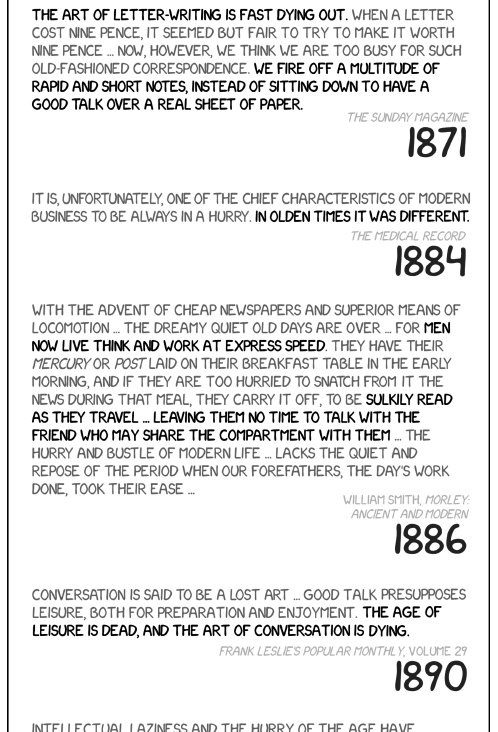
Nostalgia for an imaginary better past
I love this:
June 17, 2013
QotD: Demands for less US control over the internet will get much more insistent
Writing about the new Internet nationalism, I talked about the ITU meeting in Dubai last fall, and the attempt of some countries to wrest control of the Internet from the US. That movement just got a huge PR boost. Now, when countries like Russia and Iran say the US is simply too untrustworthy to manage the Internet, no one will be able to argue.
We can’t fight for Internet freedom around the world, then turn around and destroy it back home. Even if we don’t see the contradiction, the rest of the world does.
Bruce Schneier, “Blowback from the NSA Surveillance”, Schneier on Security, 2013-06-17
June 14, 2013
QotD: Tax avoidance
The claim that tax avoidance is immoral is an attack on the very notion of private property. It is, as it were, to say that all money belongs to society collectively, and “we” have an intention as to how much you get to use yourself and how much goes to the state, and if you avoid tax you end up using more of society’s collective money than it intended for you to use. Tax avoidance then becomes a kind of theft. But if my property is fundamentally mine, a tax is an impost, a legal requirement for me to surrender some of my property. Provided I do that, I have behaved perfectly properly. If the overall consequence is that I do not pay what would be regarded as a fair tax contribution, either tax law should be modified, or I could be persuaded that I had a moral duty to make an additional free-will tax contribution.
Andrew Lilico, “Companies have a moral duty to pay no more tax than legally required”, The Telegraph, 2013-06-14
June 9, 2013
QotD: Whistleblowers
The U.S. government is on a secrecy binge. It overclassifies more information than ever. And we learn, again and again, that our government regularly classifies things not because they need to be secret, but because their release would be embarrassing.
Knowing how the government spies on us is important. Not only because so much of it is illegal — or, to be as charitable as possible, based on novel interpretations of the law — but because we have a right to know. Democracy requires an informed citizenry in order to function properly, and transparency and accountability are essential parts of that. That means knowing what our government is doing to us, in our name. That means knowing that the government is operating within the constraints of the law. Otherwise, we’re living in a police state.
We need whistle-blowers.
Leaking information without getting caught is difficult. It’s almost impossible to maintain privacy in the Internet Age. The WikiLeaks platform seems to have been secure — Bradley Manning was caught not because of a technological flaw, but because someone he trusted betrayed him — but the U.S. government seems to have successfully destroyed it as a platform. None of the spin-offs have risen to become viable yet. The New Yorker recently unveiled its Strongbox platform for leaking material, which is still new but looks good. This link contains the best advice on how to leak information to the press via phone, email, or the post office. The National Whistleblowers Center has a page on national-security whistle-blowers and their rights.
Bruce Schneier, “What We Don’t Know About Spying on Citizens: Scarier Than What We Know”, The Atlantic, 2013-06-06
June 6, 2013
QotD: The CBC is “nothing but a zombie, slowly sucking up a dwindling fund of goodwill and nostalgia”
As Postmedia and other newspaper empires pull paywalls down over their digital incarnations, CBC minions on Twitter have been caught crowing about their “no paywall” status, purchased by the taxpayer at the sensational bargain price of $1.2 billion a year.
It may be hard for readers to feel bad for the cartelizing Paywall Gang, but it is surely a tactical error for the CBC to call attention to its incredibly expensive “free” nature. The Broadcasting Act says the Corporation shall operate “radio and television” services; it doesn’t say anything about a website, much less a website that functions as a telegraphic gazette. Of course, times change and new media paradigms develop and blah blah blah, but the distinction here is crucial: The original pretext for the creation of the CBC was the limited, theoretically public nature of broadcast spectrum. To the degree that the CBC is now just one digital content provider among many, with a hypothetized mandate that puts it in a position to compete with newspapers, it can rightly be privatized, or destroyed, or handed over to its own employees, in order to unburden the public treasury.
Polls always demonstrate high levels of purported political support for the CBC. The public subsidy to the CBC is a forced transfer of wealth from people who don’t like it to people who do, and the “dos,” unsurprisingly, like the set-up just fine. In the U.S., donor-funded, non-profit “public” radio is equally adored by fans; the only difference is that they’re asked to chip in for their preferred electronic smarm or go without. No social or economic arguments against privatization of the CBC are possible. It’s nothing but a zombie, slowly sucking up a dwindling fund of goodwill and nostalgia. Mr. Dressup is dead, folks.
Colby Cosh, “Why the CBC has outlived its usefulness”, Maclean’s, 2013-06-06
June 2, 2013
QotD: Reign of the Gay Magical Elves
Was I the only gay man of a certain demo who experienced a flicker of annoyance in the way the media treated Jason Collins as some kind of baby panda who needed to be honored and praised and consoled and — yes — infantilized by his coming out on the cover of Sports Illustrated? Within the tyrannical homophobia of the sports world, that any man would come out as gay (let alone a black man) is not only an LGBT triumph but also a triumph for pranksters everywhere who thrilled to the idea that what should be considered just another neutral fact that is nobody’s business was instead a shock heard around the world, one that added another jolt of transparency to an increasingly transparent planet. It was an undeniable moment and also extremely cool. Jason Collins is the future. But the subsequent fawning over Collins simply stating he is gay still seemed to me, as another gay man, like a new kind of victimization. (George Stephanopoulos interviewed him so tenderly, it was as if he was talking to a six-year-old boy.) In another five years hopefully this won’t matter, but for now we’re trapped in the times we live in. The reign of The Gay Man as Magical Elf, who whenever he comes out appears before us as some kind of saintly E.T. whose sole purpose is to be put in the position of reminding us only about Tolerance and Our Own Prejudices and To Feel Good About Ourselves and to be a symbol instead of just being a gay dude, is — lamentably — still in media play.
The Gay Man as Magical Elf has been such a tricky part of gay self-patronization in the media that you would by now expect the chill members of the LGBT community to respond with cool indifference. The Sweet and Sexually Unthreatening and Super-Successful Gay is supposed to be destined to transform The Hets into noble gay-loving protectors — as long as the gay in question isn’t messy or sexual or difficult. The straight and gay sanctimoniousness that says everyone gay needs to be canonized when coming out still makes some of us who are already out feel like we’re on the sidelines. I’m all for coming out on one’s own terms, but heralding it as the most important news story of the week feels to me, as a gay man, well, kind of alienating. We are apart because of what we supposedly represent because of … our … boring … sexuality — oh man, do we have to go through this again? And it’s all about the upbeat press release, the kind of smiling mask assuring us everything is awesome. God help the gay man who comes out and doesn’t want to represent, who doesn’t want to teach, who doesn’t feel like part of the homogenized gay culture and rejects it. Where’s the gay dude who makes crude jokes about other gays in the media (as straight dudes do of each other constantly) or express their hopelessness in seeing Modern Family being rewarded for its depiction of gays, a show where a heterosexual plays the most simpering ka-ween on TV and Wins. Emmys. For. It? Why isn’t the gay dude I have always known and the gay dude I have always wanted to be not front and center in the media culture now? But being “real” and “human” (i.e. flawed) is not necessarily what The Gay Gatekeepers want straight culture to see.
Bret Easton Ellis, “In the Reign of the Gay Magical Elves”, Out Magazine, 2013-05-13


