Quotulatiousness

June 14, 2024

When propaganda wins over historical facts, Ontario public schools edition

To someone of my generation (late boomer/early GenX), the history of the Residential School system was taught, at least superficially, in middle school. Along with the early settlement of what is now Canada by the French and later the English (with a very brief nod to the Vikings, of course), we got a cursory introduction to the relationships among the European settlers and explorers and the various First Nations groups they encountered. It wasn’t in great depth — what is taught in great depth in middle school? — but we got a rough outline. In my case, details about the Residential School system came more from a “young adult” novel about a young First Nations student running away from his school and trying to find his way back to his home and family. My best friend in school had First Nations ancestry, so I felt a strong desire to understand the book and the system and culture portrayed in it.
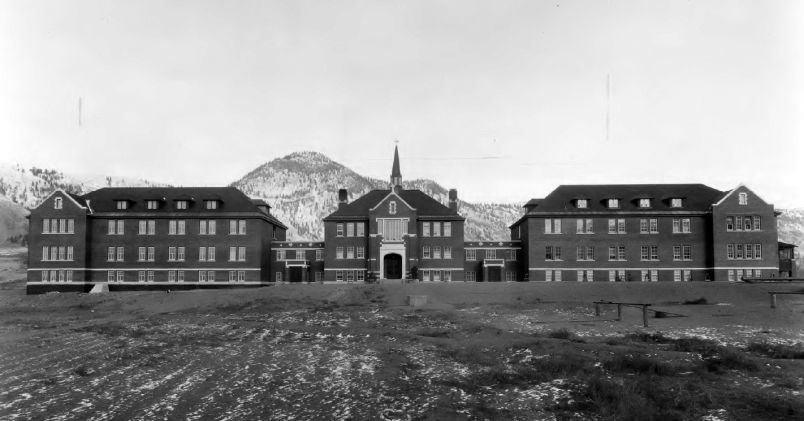
Kamloops Indian Residential School, 1930.
Photo from Archives Deschâtelets-NDC, Richelieu via Wikimedia Commons.

If, in the early 1970s, the Ontario school system taught at least a bit about the history of the First Nations peoples, how is it possible that they stopped doing so and my son’s generation were utterly blindsided by the sensationalist treatment of the students at a particular Residential School in British Columbia? And as a result, were far more credulous and willing to believe the worst that the “anticolonialist” propagandists could come up with.

Igor Stravinsky” is a teacher in the Ontario school system who writes under a pseudonym for fairly obvious reasons, as he’s not a believer in the modern narrative about the history of First Nations children in the Residential School system:

This will be my last instalment of this series. I have attempted to shed light on the poor quality of information students are receiving in Ontario schools with regard to Indigenous history and current issues. It is important to note that this is being done intentionally. It is to the advantage of the leaders of the Indigenous Grievance Industry to characterise Canada and the pre-Canadian colonies of this land as genocidal oppressors, and our politicians have exploited this situation for crass political gain. This was perhaps epitomised by Prime Minister Justin Trudeau’s photo op of himself holding a teddy bear in the proximity of a soil disturbance in a field at the site of a former residential school in Cowessess First Nation, Saskatchewan on Tuesday, July 6, 2021:

Prime Minister Justin Trudeau holding a teddy bear in Cowessess First Nation, Saskatchewan.
July 6, 2021.

Are there actually human remains there? If so, of whom? Is this evidence of any kind of foul play? These are questions he was not about to bother to ask. Why would he, when such a golden opportunity to score political points presented itself?

We now know all this murdered Indigenous children stuff was a big hoax but don’t hold your breath waiting for Trudeau to issue an apology for staining the international reputation of Canada and triggering a knee-jerk vote by our Parliament declaring Canada a genocidal state and adopting the The United Nations Declaration on the Rights of Indigenous People (more on that below). Undoing all this damage will be a herculean task.

Just as students are fed simplistic, misleading, and false information about the past with regard to Indigenous people (the focus being the Indian Residential Schools) they are being presented with the point of view that human rights violations against the Indigenous people are ongoing, and are the reason for the poor quality of life in which such a disproportionate number of Indigenous people find themselves.

The claim of generational trauma

On Apr. 27, 2010, speaking as chair of the Truth and Reconciliation Commission and for the people of Canada, Sinclair told the Ninth Session of the United Nations Permanent Forum on Indigenous Issues: “For roughly seven generations nearly every Indigenous child in Canada was sent to a residential school. They were taken from their families, tribes and communities, and forced to live in those institutions of assimilation.”

This lie is promoted in the schools. It is the foundation of the generational trauma claim but in fact, during the IRS era, perhaps 30% of Status Indians (you can cut that figure in half if you include all people who identify as Indigenous) ever attended, and for an average of 4.5 years.

Even if it were true that most Indigenous people who attended the IRS suffered trauma, there is no evidence or logical reason to believe that trauma could be transferred down the generations. If generational trauma is a thing, why have the descendants of the victims of the holocaust been doing so well?

If there is generational trauma, the culprit is alcohol. Alcohol abuse has been a major problem in Indigenous communities since first contact but rarely comes up these days, certainly not in schools. Fetal Alcohol Syndrome (FAS), which occurs when a mother consumes alcohol during pregnancy, is also a major problem and the children born with it suffer from mental and emotional challenges throughout their lives. It impacts their social life, education and work. Girls who suffer from the condition all too often end up drinking during pregnancy themselves and the cycle continues.

June 13, 2024

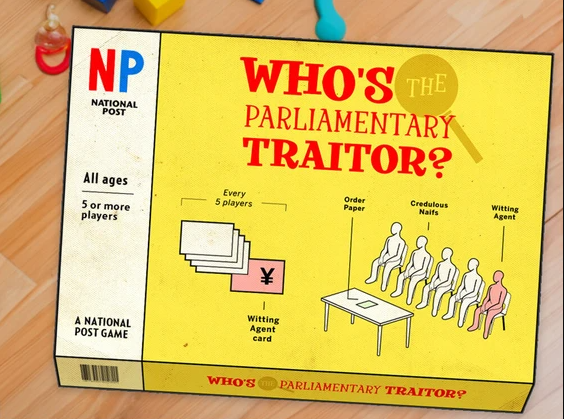
Fun new family game – Who’s the Parliamentary Traitor?

Filed under: Cancon, Gaming, Government, Humour, Politics — Tags: , , , , , — Nicholas @ 05:00

In the National Post, Tristin Hopper presents the rulebook for an exciting new family game literally “ripped from the headlines” – Who’s the Parliamentary Traitor?

“To simulate what it’s like to go to work in a national parliament secretly housing foreign agents, the National Post presents a tongue-in-cheek instruction manual to play this group game: Who’s the Parliamentary Traitor?
Photo by Brice Hall”

WHAT YOU NEED TO PLAY:

  • One large writing surface, such as a chalkboard, whiteboard or flip chart (THE ORDER PAPER)
  • 20-70 note cards
  • A timer

SETTING UP PLAY:
Gather at least five of your closest friends and have them sit in a line facing the ORDER PAPER. They will be divided into two categories: The WITTING AGENTS and the CREDULOUS NAIFS.

To choose who among them will be the WITTING AGENTS, prepare a stack of IDENTITY CARDS equal to the number of players. On every fifth card, mark the symbol for the Chinese yuan (¥). In the case of five players, mark a single card, for 10 players, mark two, etc.

Shuffle the IDENTITY CARDS and distribute them among the players. Anyone receiving a “¥” is now a WITTING AGENT.

Set aside another stack of note cards to serve as MANDATE LETTERS. The text for each card is below. Shuffle the MANDATE LETTERS and place them face down.

RULES OF THE GAME:
Each round begins with a CANADA IS NOT BROKEN phase in which all players close their eyes, put their thumbs in their ears and bury their face for two minutes (the elapsed time to be marked with a timer). During this phase, the WITTING AGENTS open their eyes, stride over to the ORDER PAPER and write down a piece of binding public policy that damages Canada to the advantage of a hostile government (suggestions below).

Once this act of treachery is done, the WITTING AGENTS return to their seats will pretend to wake up alongside them as if nothing happened.

Now begins the CONCERNED FOLLOW-UP phase. First, players must pull a MANDATE LETTER card that will determine conditions of discussion. Now, the parliamentarians must decide who among them is the foreign cat’s paw who has defaced their ORDER PAPER with disloyal policy. Uncomfortable questions are asked, accusations are made, and at the end of the round the players vote on who among them will be ejected as a traitor.

Only after the accused traitor is exiled will they show their IDENTITY CARD, revealing whether the accusations have been true, or whether they have been unjustly maligned.

Ejected players are then exiled to THE SENATE, a separated area of chairs where they are served port, ginger ale and black liquorice. They continue to participate in the CANADA IS NOT BROKEN and the CONCERNED FOLLOW-UP phases, but they no longer have a vote.

June 12, 2024

“Treason never prospers” … except in Canadian politics, apparently

Filed under: Cancon, Government, Media, Politics — Tags: , , , , , — Nicholas @ 05:00

Justin Trudeau and his unindicted co-conspirators in Canada’s federal parliament don’t think the names of Members of Parliament who have been acting as enablers or actual agents of foreign powers — that is, possible traitors — should be made public. The National Security and Intelligence Committee of Parliamentarians (NSICOP) Even the least cynical may be forgiven for thinking that this isn’t what a mature country would do in similar circumstances:

The cover of the NSICOP special report on foreign interference (PDF here)

… MPs have an obligation to protect the institution that is the House of Commons. Every MP is required as a condition of taking their seats, to swear the following oath: “I, [name], do swear that I will be faithful and bear true allegiance to His Majesty King Charles the Third, King of Canada, his heirs and successors. So help me God.”

The violation of that oath, or the suspected violation of that oath, is absolutely arguably contempt against the House of Commons. We don’t have a ton of precedent for that, because MPs who have been alleged to have collaborated, even unwittingly, with a foreign power in the past usually have the good sense to resign. But MPs should absolutely be allowed to pass judgment on the actions of their colleagues, with the express intent of expelling from the House any members who have transgressed against their oath to King and Country. This isn’t just their duty, it is a duty that they are uniquely positioned and obligated to perform. Until we know exactly which parliamentarians we’re talking about, a spectre hangs over all 400-plus of them. That very much compromises the public’s opinion of Parliament and has a demonstrable impact on their ability to do their jobs as parliamentarians.

Once upon a time, children, ministers of the Crown would offer their resignations for mistakes made by members of the civil service in the ministry for which he or she held responsibility, never mind mistakes of their own. In modern times, of course, it’s rare to find a minister resigning voluntarily until the RCMP is literally knocking on the door, and sometimes not even then.

Second, we are a large and multicultural country. MPs are expected to represent members of any diaspora community which may exist in their constituency. If you’re a Tibetan or Uyghur activist, how can you be represented by an MP who’s demonstrated a willingness to collaborate with the government of the People’s Republic of China? If you’re an Iranian democracy and reform activist, how can you be represented by an MP who has close ties to Iran’s diplomatic and intelligence operation?

The answer, of course, is that you can’t be. The government has a greater responsibility to the democratic rights of those Canadians than it does to protecting the identity of any single unscrupulous or otherwise compromised parliamentarian. With every day that passes, Ottawa looks more like it has an interest in partisan butt-covering than it does in maintaining the long-term faith that democracy requires for our institutions to survive.

A good Member of Parliament recognizes the responsibility to the constituents — whether they voted for that particular MP or not — and would keep that responsibility as faithfully as possible. On that reckoning, we have fewer good MPs than we should have … and if the intelligence turns out to be fully supported upon full investigation, there should be a lot of open seats to run by-elections for (even if no formal charges of treason are ever laid).

Finally, I accept that intelligence is not evidence. I also accept, as noted in the Globe by Philippe Lagassé and Stephanie Carvin, that we must be cautious to not compromise intelligence sources and methods, or compromise ongoing investigations. Parliamentarians should not replace the criminal justice system or undercut our defence, but they what they are capable of doing, and indeed are required to do because no one else can do it for them, is broadly defining what the acceptable behaviour for parliamentarians should be. If an MP or a senator has engaged with a foreign power’s diplomatic or security services and they do not believe they have crossed the line for what we deem to be acceptable behaviour, they will be more than welcome to go on Power and Politics, or take to social media, or show up at what I’m sure will be many committee hearings, and make their case.

It is not a hardship to ask them do so. They are not being hard done by. The question here is not whether what they’ve done is criminal. It wasn’t criminal when Bev Oda billed the taxpayers for her juice. It wasn’t criminal when Bill Morneau forgot to leave a cabinet meeting where a decision was made that was a perceived conflict of interest. But both of those parliamentarians were forced to accept that their behaviour had failed the people they were sworn to represent. They resigned.

And the idea that orange juice crosses the line, but aiding a foreign intelligence service — even “semi-wittingly” — does not, will fail to pass the smell test with a very large number of Canadians. And that is entirely correct. The public is well ahead of the politicians on understanding this.

Public trust in politicians has been ebbing for quite some time and was fading even before the pandemic exposed so many of them as would-be dictators, poltroons, and idiots. There is no deep reservoir of respect for politicians that can be drawn on at this point. Swift action is the only thing that Parliament can do and by “swift”, I don’t mean setting up a Royal Commission with a multi-year remit to bury the issue until after the next federal election.

June 11, 2024

EUquake 2024

Filed under: Europe, France, Germany, Italy, Media, Politics — Tags: , , , , , — Nicholas @ 04:00

Although the European elites have managed to move as much as they can out of the reach of democratic institutions, they still have to allow the illusion that the few things ordinary people can vote for still kinda, sorta matter. Ordinary people seem to have noticed this:

“I cannot act as if nothing has happened”, said a weary, dejected Emmanuel Macron, in an unplanned address to his nation last night. The French president, bruised by an unprecedented showing for the right-wing populist National Rally (RN) on Sunday’s European Parliament elections, immediately dissolved the French parliament and announced snap legislative elections. The first round will take place in just three weeks’ time.

When Macron was elected president in 2017, he promised the French people that they will “no longer have a single reason to vote for the extremes”. Pro-EU centrists hailed his apparent defeat of nationalist, populist forces. Seven years later, RN is on course to achieve its best-ever result in an EU election. Marine Le Pen’s party is projected to win double the vote share of the president’s liberal, centrist Renaissance group. Clearly, the French feel that they have more reasons than ever to revolt against the mainstream.

The French are not alone in this. The hard-right Alternative for Germany (AfD), despite two of its leading MEP candidates being dogged by major scandals, came second behind the centre-right CDU. Crucially, it beat all three of the parties in Germany’s governing coalition. The Social Democrats (SPD), led by chancellor Olaf Scholz, suffered its worst result of any nationwide election since the 1940s. According to one pollster, around a million people who supported the left-leaning parties in the “traffic light” coalition have since defected to the AfD. Pressure is now mounting on Scholz to call his own snap election. In Italy, meanwhile, Giorgia Meloni and her Brothers of Italy topped the European polls, exceeding the vote share that swept her into power in 2022’s national elections. Populist, right-wing and hard-right parties, therefore, came in first or second place in all three of the major EU nations.

Even Belgium, at the epicentre of the EU empire, has been struck by the populist earthquake. Prime minister Alexander de Croo announced his resignation last night as his party was beaten to below 10 per cent in Sunday’s federal parliamentary elections and to around five per cent in the European elections – squeezed by Flemish separatist parties. Hard-right parties also came first in Austria and second in the Netherlands.

While Macron has been forced to react to the scale of his defeat, acknowledging euphemistically that these elections were “not a good result for the parties that defend Europe”, others in the Brussels oligarchy have tried to bury their heads in the sand. On Sunday evening, European Commission president Ursula von der Leyen declared – delusionally – that “the centre is holding”.

She is right in one, very narrow, sense. The centre-left Progressive Alliance of Socialists and Democrats (S&D), the centre-right European People’s Party (EPP) and the liberal Renew group have likely gained enough seats between them for business as usual to resume in the European Parliament. The two groupings to their right – the European Conservatives and Reformists (ECR) and Identity and Democracy (ID) – have not made enough gains, even when combined, to start throwing their weight around in Brussels. Von der Leyen’s own position as Commission president is likely secure, not least because her EPP is the single largest grouping in parliament. The new populist MEPs will likely be shut out of key decisions, including the vetting of new EU commissioners. The EU has never allowed the democratic wishes of the public to intrude on its affairs before, so it is unlikely to start now.

But Brussels cannot hide from reality forever. These elections clearly show that the EU and its boosters are failing to contain the public’s anger. European elites have pulled every trick in the book to try to put the brakes on the populist surge, seemingly to little avail.

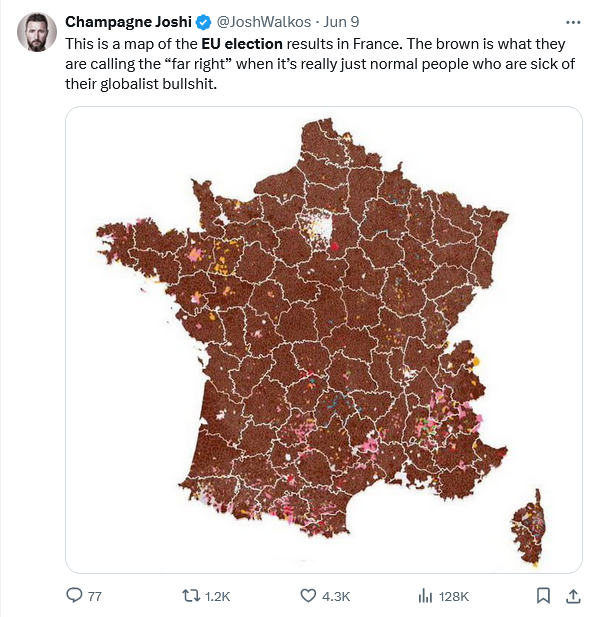
How bad was the rejection of the kakistocrats in France? This bad:

Mark Steyn on Nigel Farage

This is from his Friday round-up post at SteynOnline:

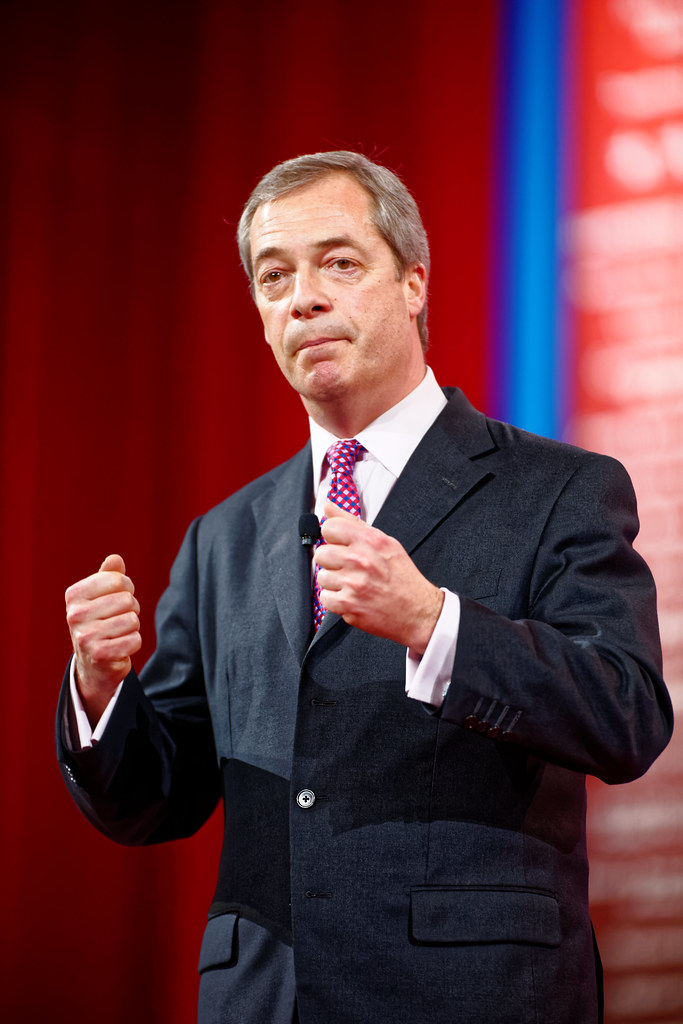
“Nigel Farage” by Michael Vadon is licensed under CC BY-SA 2.0 .

Demography is relentless. Douglas Murray notes that the BBC is always warning that the “far right” is “on the march“, but in the west it is demographic transformation that is truly on the march, quietly and unreported, picking up pace every month. By comparison, the wretched Sunak/Starmer dinner-theatre of the UK election campaign is completely irrelevant to Britain’s future. So I am glad to see that Nigel Farage has had a change of heart and opted to join the battle. Back in 2016, in the days after the Brexit vote, I said he was the most consequential figure in UK politics since Mrs Thatcher. Which was true. Alas, people most Britons have never heard of then set about subverting Brexit, and very effectively.

So here we are eight years later, with half-a-million Anglo-Celts abandoning the UK each year and a million Pushtun warlords and Sudanese clitoridectomists and Albanian sex-traffickers taking their place. Demography is relentless, and the hour is late.

Over a decade ago — in fact, closer to two, as I estimate it — Nigel Farage said to me that the first thing you have to do when you found a new political party on the right is to accept the burden of being its only member — at least for a while. Because the first 10,000 people who want to join are neo-Nazis and skinheads and the like. It was a clever insight, and he spread it around. So I had it told back to me many times over the years by populist politicians from all over the Continent, Danes and Dutch, Swedes and Spaniards alike.

Nigel took his gatekeeping seriously — and not just on the domestic front, “distancing” himself from Tommy Robinson and Tommy-associated issues such as Islam and the industrial-scale sex-slavery of thousands of English girls. As Gavin Mortimer reminds us, a decade ago Farage also rejected any Euro-collaboration with Marine Le Pen because her party had “anti-Semitism and general prejudice in its DNA“. Geert Wilders (for whose fine book I am proud to have written the introduction) was furious with Farage and attempted to broker a rapprochement. Nigel was having none of it.

So here we are a decade later:

    * in the Netherlands, Wilders is currently the most powerful politician, leading the most popular party, and has helped move the electorate significantly;

    * in France, Mme Le Pen’s party will, in just two days’ time, win the European elections. She is the de facto leader of the opposition, and her caucus in the National Assembly is the largest and most effective opponent to Macron. She has also helped move the electorate significantly;

    * in the United Kingdom, by contrast, voters are about to elect a left-wing government led by a fellow, Sir Vics Starmer, who thinks men can have a cervix.

I think Nigel over-gatekept.

He has been very good at founding personal vehicles (Ukip, the Brexit Party) that deflate like punctured soufflés when he steps down as leader. Yes, he was very watchable in the jungle on “I’m a Celebrity — Get Me Out of Here”, and, in my GB News days, he certainly handed me a bigger audience at 8pm than any of his guest-hosts. But, as that station’s currently Farageless ratings reveal, you can’t build a sustained movement on one man. Nigel’s advice was clever twenty years ago. Wilders, LePen, Meloni et al were wise to recognise its limitations.

So I’m pleased Farage changed his mind on this election. He should change his mind on the over-gatekeeping, too.

Time and demography march on.

June 10, 2024

South Africa’s “Rainbow Nation” falters

Filed under: Africa, Economics, Government, History, Media, Politics — Tags: , , , , , — Nicholas @ 05:00

Niccolo Soldo’s weekly roundup included a lengthy section on the recent election results in South Africa and what they might mean for the nation’s short- and medium-term stability:

Being a teen, the issue of South African Apartheid didn’t really fit all that well within the overarching Cold War paradigm. Unlike most other global issues, this one didn’t break down cleanly between the “freedom-loving West” and the “dictatorial, oppressive communist bloc”, as the push to dismantle the regime came from western liberals who were in agreement with the reds.

This slight bit of complexity did not faze most people, as Apartheid was seen as a relic of an older world, one to be consigned to the proverbial dustbin of history. It’s elimination did fit well enough into the Post-Berlin Wall world, one in which freedom and democracy were to reign supreme. This was more than enough reason for almost all people to cheer the release of Nelson Mandela and applaud South Africa’s embrace of western liberal democracy.

In the early 1990s, men once again dared to flirt with utopian ideas, and South Africa’s “Rainbow Nation” was to be its centrepiece: out with authoritarianism, racism, ethnocentrism, etc., and in with multiracialism, multiethnicity, democracy and individual liberty. We could all leave the past where it belonged (in the past) and live in peace and harmony, as democracy would defend it, secure it, and preserve it. South Africa would lead the way, and would in fact teach us westerners how it is to be done.

Oddly enough, South Africa quickly fell off of the radar of mainstream media in the West when it failed to live up to these lofty goals. Rather than living up to the hype of being the “Rainbow Nation”, it instead was quickly mired in the politics of corruption and race, showing itself to be all too human, just like the rest of us. South Africa had failed to immediately resolve its inherent internal tensions, whether they be racial, economic, ethnic, or ideological, and by extension it had failed to deliver its promise to western liberals. “Out of sight, out of mind” became the best practice, replacing the utopianism of the first half of the 1990s.

Granted, a lot of grace was given to South Africa by western media so long as Nelson Mandela remained in office (and even after that), but the failures were plainly evident to see: an explosion in crime and in corruption were its most obvious characteristics, ones that could not be brushed under the carpet. The African National Congress (ANC), the party that would deliver the promise of the Rainbow Nation, was instead shown to be little more than a powerful engine of corruption and patronage. Luckily for the ANC, it was fueled in large part by the legacy of Mandela and the goodwill that he had accumulated over the years while he sat in prison.

The post-Mandela era has not been kind to the ANC (nor to South Africa as a whole), as the party could no longer hide behind his fading legacy, and could no longer cash in on the goodwill that came from it. It could “put up”, and would it not “shut up”. The ANC over time became a lumbering beast, too big to slay, but too slow to destroy its opposition when compared to its nimble youth.

What has the party delivered in its three decades of power? It did help dismantle Apartheid, but it did not deliver economic prosperity and opportunity to all. Instead, it simply swapped out elites where it could, preferring to keep the new ones in house. An inability to tame crime and to keep the national power grid running has turned the country into a bit of a joke, especially when it is lumped into the BRICS group alongside Brazil, Russia, India, and China. Despite its abundance of natural wealth, South Africa has been economically mismanaged.

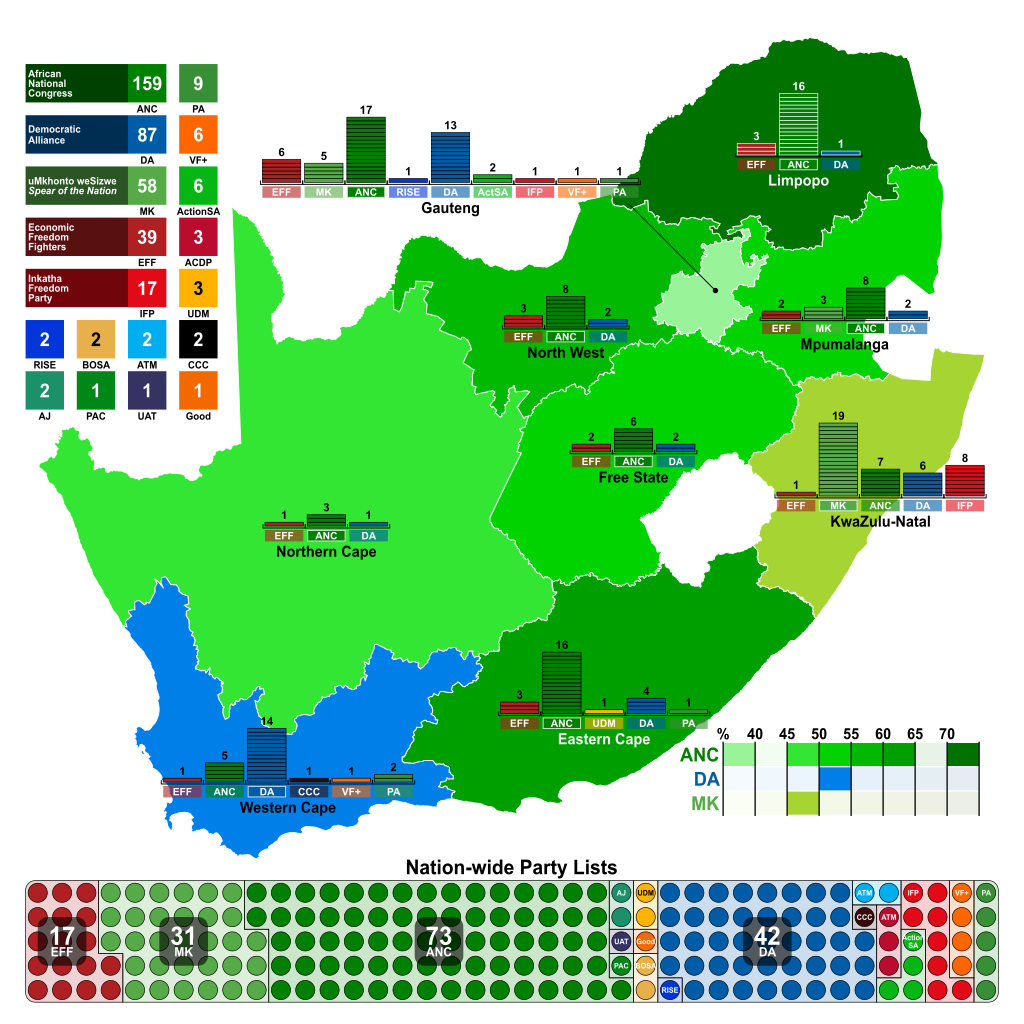
South Africa is an important country to watch for the simple reason that there is so much tinder lying around, ready to be set ablaze. Luckily for South Africans, dire projections of widespread civil strife have not come to pass. Unluckily for South Africans, their national trajectory is headed in the wrong direction. Last week’s national elections saw the ANC lose their parliamentary majority for the first time ever, and the only way to read the results is to conclude that no matter how one may feel about this very corrupt party, it is an ominous sign.

Elite contempt for democracy is fuelling anti-immigration “far right” sentiment in the west

Even for people who are generally happy with robust immigration, the numbers being recorded (or, more likely, under-recorded) in Canada, the United States and Europe are far too high to pretend that the new arrivals will quickly integrate into their new countries, and they are generally not being encouraged to do so anyway. Complaints to the people who have enabled these massive inflows — at best — are waved off or ignored, but often are seized upon as examples of hateful far-right xenophobia to be punished and suppressed:

Not so long ago, as many of us reeled from the political earthquakes of Brexit and Trump, it seemed sensible for responsible mainstream political parties to adopt tighter immigration control to keep the populist right at bay. Mass migration in Europe had led to a far-right resurgence; in the US and UK, Trump and the Johnson-era Tories seemed to grasp this and moved to co-opt the anti-immigrant fervor. Democracy was working to accommodate a shift in the public mood.

Or so it seemed. Nearly a decade later, something else has happened: an immigration explosion. In response to a volatile public mood, Western elites actually intensified their policy of importing millions of people from the developing world to replace their insufficiently diverse and declining domestic populations.

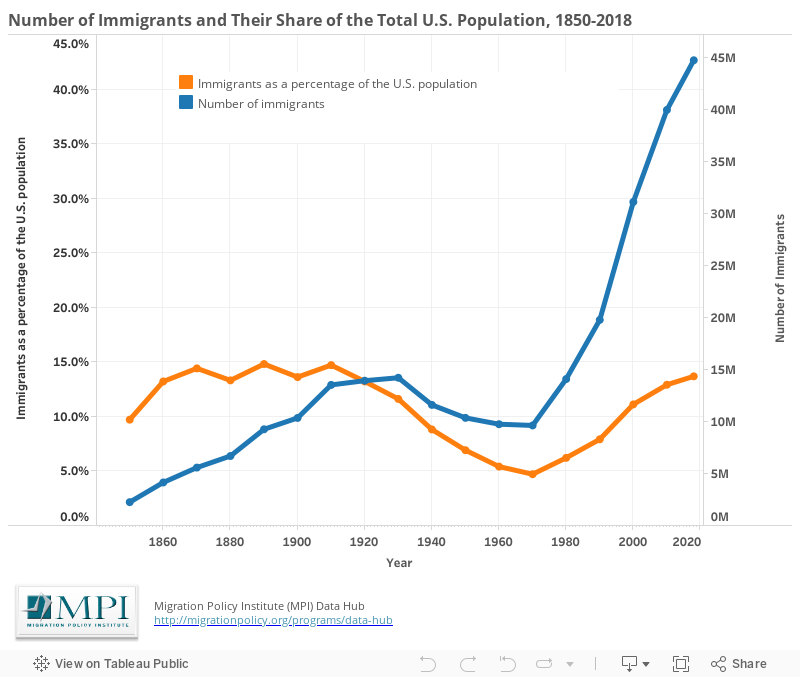
The recent figures from the US, UK and Canada are mind-blowing. The graphs all look like a hockey stick, with a massive spike in the last three years alone. Under Trump, the average number of illegal crossings a year was around 500,000; under Biden, that has quadrupled to two million a year — from a much more diverse group, from Africa, China and India. To add insult to injury, Biden has also all but shut down immigration enforcement in the interior; and abused his parole power to usher in nearly 1.3 million illegal migrants in 2023 alone. The number of undetained illegal migrants living in the US has thereby ballooned under Biden: from 3.7 million in 2021 to 6.2 million in 2023, according to ICE. If a fraction of those millions turns up for asylum hearings, I’ll be gob-smacked.

Canada has seen something similar. For much of the 21st century, Canada had around 200,000 to 300,000 immigrants a year; but in the last two years, this has nearly doubled. In Britain, the same story. In 2015, the year before Brexit, net migration (the numbers of people immigrating minus the number emigrating) was 329,000; in the last two years, it has more than doubled to over 700,000. And whereas most immigration before Brexit was from the EU, today, immigrants from the developing world outnumber European immigrants by almost 10 to 1. For those Brits who voted for Brexit to lower the number of foreigners in the country, it’s been surreal.

If you want to understand why Biden keeps trailing in the swing states, why the Tories are about to be wiped out in a historic collapse, and why Trudeau is at all-time low in approval at 28 percent, this seems to me to be key. As the public tried to express a desire to slow down the pace of demographic change, elites in London, Ottawa, and Washington chose to massively accelerate it. It’s as if they saw the rise in the popularity of the far right and said to themselves: well now, how can we really get it to take off?

This week, CNN ran a poll on Biden and immigration. Here’s what they found: in May 2020, only one percent of Americans put immigration as their top concern — in 15th place among issues; in May 2024, 18 percent put it first. In 2020, Biden edged Trump by one percent on who was best to tackle the border crisis; four years later, Trump is ahead on the issue by 27 points. As a coup de grâce, CNN also found that foreign-born Americans preferred Trump to Biden on immigration by 47 to 44 percent. Turns out that this immigrant’s worries are widely shared by my fellow new Americans.

Biden, of course, is now desperately scrambling to salvage something from this disaster. This week, he contradicted himself by saying he has the unilateral capacity as president to shut down the border, and attempted to blame the GOP for the problem. Yes, the GOP was unhelpful and cynically political earlier this year — but that won’t muddy the waters for most voters who have been conscious for the past three years. But I am grateful nonetheless to hear the president echo what the Dish has been saying for years now, and for which I was routinely called a racist:

    To protect America as a land that welcomes immigrants, we must first secure the border and secure it now. The simple truth is there is a worldwide migrant crisis, and if the United States doesn’t secure our border, there is no limit to the number of people who may try to come here, because there is no better place on the planet than the United States of America.

Now that didn’t hurt, did it? But why did he keep telling us there was no crisis for the last three and a half years? And why would anyone trust a re-elected Biden to enact this if he had a Congressional majority? I sure don’t.

Even under Biden’s “crackdown”, he is still prepared to admit at least 1.75 million illegal immigrants a year! Last week, Chuck Schumer declared that the ultimate goal was to legalize every single illegal immigrant — because Americans are not having enough children. Without open borders, of course, our economy wouldn’t look so good: in the last year, according to the Bureau of Labor Statistics, foreign-born workers gained 600,000 new jobs, while native-born Americans lost 300,000. But don’t you dare mention the “Great Replacement Theory“!

June 9, 2024

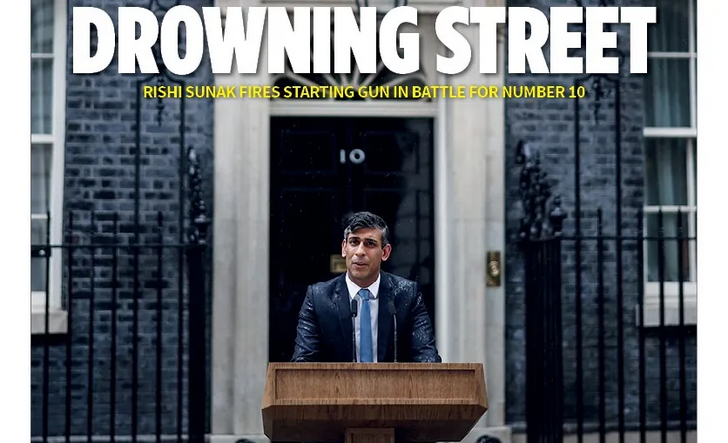
Rishi Sunak “promised to run Britain like a start-up. On that account, he has delivered. Over one-third of start-ups crash and burn within two years.”

Filed under: Britain, Media, Politics — Tags: , , , , , , , — Nicholas @ 05:00

Christopher Gage pokes a bit of goodnatured fun at British Prime Minister Rishi Sunak’s awful start to his re-election campaign:

This week on the campaign trail might just enter the political history books. Rishi Sunak, the man who themed his cheese-melting campaign on national pride and security, slipped off home early from the D-Day commemorations in France.

World leaders gathered at the event on Thursday to honour the eightieth anniversary of the Normandy landings. You know, the one attended by a dwindling platoon of demigod veterans in what might be the final year graced by their presence. To riot in understatement, this Irish goodbye was inadvisable. Sunak might as well have fed Dame Judi Dench to a ravenous gang of XL bullies.

Our prime minister is one of life’s thoroughbred winners. From one of the most exclusive schools in the country, Sunak went on to Oxford and then to Stanford university. Cultured in our meritocratic petri-dish, Sunak has never failed a thing in his 44 years. Until now.

Twenty-odd points behind Sir Keir Starmer’s Labour, Sunak is on course to finish third in a two-horse race.

It gets worse. This week, Nigel Farage announced he would stand for election as the Reform Party candidate in Clacton. That Essex seat is the living, breathing symbol of pissed-off, left-behind, white-working-class, fucking furious Great Britain.

The polls have broken Tory brains. Clamped around the Conservative Party’s noodle neck is Reform’s roid-head paws. The right-wing upstarts trail the Tories by just two points. And that was before Sunak committed the social equivalent of tarmacking over the Princess Diana memorial garden on Mothering Sunday.


Sunak is a one-colour pie chart of hubris. After losing the Tory leadership election to the ludicrous Liz Truss, Sunak got handed the top job by knowing the right string-pullers.

Breathless commentary from back then christened Sunak as a Silicon Valley start-up guru, furnishing the boy wonder with LinkedIn adjectives such as “brilliant” and “dynamic”.

Sunak parrots the pediculous babble beloved of that skulk of Babbitts. With blue-sky thinking, and by sticking to core competencies, Sunak has a plan to deliver. He promised to run Britain like a start-up. On that account, he has delivered. Over one-third of start-ups crash and burn within two years.

What went wrong? Sunak’s indulgent reboots have crashed his operating system. Not so long ago, he was an anti-woke culture warrior reeling off tiresome jibes about trans people. Then came spartan Sunak, trusted centurion of the Telegraph comment section.

Too late. For the best part of two years, Sunak has circulated in meme-form around this teetering island, his existence a boundless source of second-hand embarrassment and ridicule.

With each reboot, Sunak sunk further. Ordinary people have a radar for bullshit. They don’t see such shapeshifting as necessary brand correction to meet market demands. They see duplicity and serpentine salesmanship bordering on fraud. In the plain English of my council-estate youth: Sunak is full of shit.

With his wings smeared in beeswax, Rishi Sunak is Icarus. And Nigel Farage is the sun.


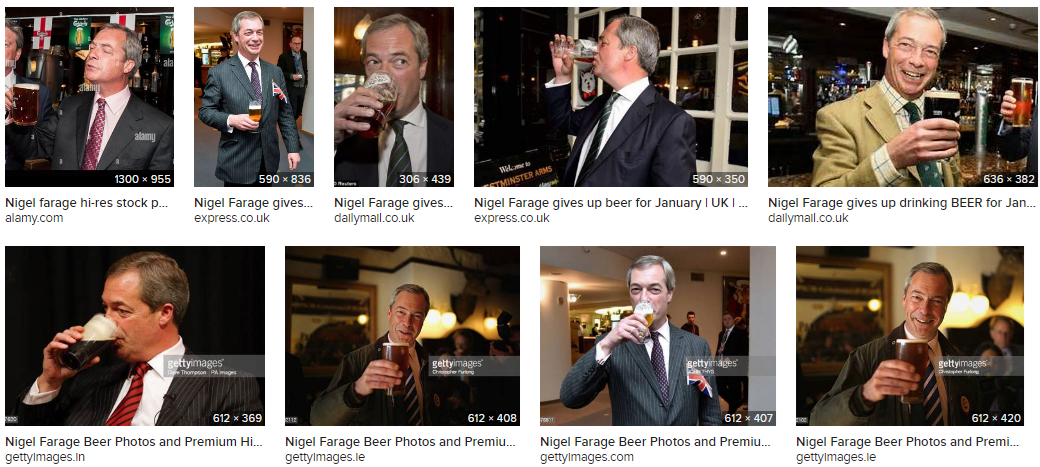
Farage is more than the sun. Farage is Wetherspoon Man.


A quick image search for “Nigel Farage beer” provides lots of evidence for “Wetherspoon Man”

During his visit to Clacton, Farage fittingly visited a Wetherspoon pub. For the unfamiliar, Wetherspoon pubs owe their undeniable success to their reliability and recognition. Wherever you may be in Britain, you know what you’ll get in one of Wetherspoons’ 800-odd cavernous boozers: A decent burger, chips, and a pint for half an hour on the minimum wage, alongside cheap, cheap booze.

Critics scoff. But they’ll never find a Wetherspoon empty at any time of day or on any day of the week.

Farage announced his plans and doubled the Reform vote in Clacton. His appeal relies on the Wetherspoon model. Farage is the same wherever he may be and to whomever he may talk. Dressed like a hobbyist gamekeeper, he sinks pints, smokes fags, and cracks jokes. “Nigel” says what a sizeable swathe of left-behind Britain thinks and wants to hear.

His many detractors don’t get it. How can a privately educated former metals trader claim to speak for the people? For the same reason that populist parties are lapping at the walls of power across Europe: their erstwhile champions are too busy peacocking their pronouns in their Twitter bios.

June 8, 2024

Eco-terrorism – it’s all over Canada

Filed under: Cancon, Environment, Media, Politics — Tags: , , , , , , , — Nicholas @ 03:00

Elizabeth Nickson on the strong likelihood of any given wildfire in Canada being not just man-made but deliberately set for political reasons:

“Forest fire” by Ervins Strauhmanis is licensed under CC BY 2.0 .

A Google Earth satellite video is making the rounds on twitter. it shows the moment an arc of fires began in northern Quebec, the smoke rising. It looks like people calculated the prevailing winds so that the smoke would blow south. Then connected via sat phone, they lit them. It’s another psy-op from our gracious overlords. We aren’t afraid enough, despite every nasty limiting idiotic play they have visited upon us in the last four years. Monkey Pox failed, more plague warnings were greeted by a shrug. But this one, the world bursting into flame? Be very very afraid.

Justin Trudeau lost no time in announcing that the fires were from “climate change” and the carbon tax, which is impoverishing everyone not in government or on lush pensions, is just the beginning of the restrictions he must institute or we are all gonna die.

The stupidity and cruelty of this is almost unimaginable. But fires have worked over and over again to terrify people into quiescence. The rumours that they were deliberate were the stuff of fantasy until people started getting arrested. Alberta shows that almost 60 percent of fires in that province are human caused. And in Canada, as of today, we have arrested dozens. They will be released, their bails paid by a high-priced lawyer because most of them act as agents of the hyper-rich, paid through a cascade of environmental NGOs. The richest people among us are burning the forests in order to force compliance.

When I moved back to the country 20 years ago, the movement adopted me because I was writing for the Globe and Mail and Harper’s Magazine. I interviewed hundreds of local activists, the ones who, with the inspiration of RFK, Jr. had shut down the biggest industrial forest in the world in an action called “The War of the Woods“. They were mostly ordinary people, socialists and scientists of one stripe or another and deeply profoundly committed to saving the earth. The fact that they had eliminated the principal source of funding for health care and education — forestry — their own in fact, went right over their heads. It didn’t matter. “Climate Change” was an existential threat and those trees must stand to suck up “carbon”, or CO2, as it used to be known.

I met Denis Hayes too, the founder of Earth Day, head of the Bullitt Foundation in Seattle, founded by the heiresses to Weyerhaeuser. He excitedly told me how he created the storm of protest that led to Bill Clinton shutting down the western forests of the U.S., during the same period that Clinton was giving away American manufacturing to China. The result was devastation in forested communities from northern California to the Canadian border. Hayes, a tall, attractive Ivy Leaguer married to a woman whose father won a Nobel in chemistry, slithers through every institution. When I hung out with him, his target was Bill Gates’ climate initiatives and clearly, he has succeeded.

His “work” turned the forests into a tinderbox. Today, the 9th of June, 2023, a full thirty years too late, the Wall Street Journal editorial board finally acknowledges that sustainable forestry management may be the principal cause of the forests burning down. Holly Fretwell, a fellow at the Property and Environment Research Center, and professor at Montana State, gives, in this book, a thoroughgoing analysis of how wrong-headed and destructive “green” has been in the forests. Also this book by me, and a follow-up policy paper, also by me. These were not popular opinions, but they were, in fact, right. It is not “climate change” burning down the forests, it is government in the hands of brutal greens, in pursuit of an impossible goal.

June 7, 2024

Nigel Farage’s challenge to the Conservatives

Ed West perhaps goes a bit far in comparing Nigel Farage and his Reform UK to Lenin’s Bolsheviks in the October Revolution, but he’s not wrong about what the rise of Farage’s party might mean to the already dim re-election hopes of Rishi Sunak’s bedraggled clown posse:

“Nigel Farage” by Michael Vadon is licensed under CC BY-SA 2.0 .

I imagine that the last remaining serotonin emptied from the bodies of the Tory election team when they heard that Nigel Farage was to return as leader of the Reform Party and stand at Clacton.

The likelihood is that Farage will win that seat, and the reception he received was certainly electric. And Clacton is not even among Reform’s top 20 targets, according to Matt Goodwin.

It’s possible that the party could overtake the Tories in some polls, although I doubt that they will beat them on election day. That is certainly Farage’s aim, and as he said on Monday: “I genuinely believe we can get more votes in this election than the Conservative Party. They are on the verge of total collapse … I’ve done it before. I’ll do it again. I will surprise everybody.”

Contrary to the jokes about Farage failing to get elected, or the criticism that he is a “serial loser“, he is arguably the most successful politician of the past decade. He built up a minuscule party of ‘fruitcakes and gadflies’ to win two successive European elections. He made Brexit happen, and then stood his candidates down in a number of seats to ensure the Leave alliance remained united in 2019, securing Boris Johnson a victory.

For which he didn’t get the thanks he felt was due, something he alluded to at Monday’s press conference. From what I understand the Tory establishment treated him with a snooty disdain which many an outsider has experienced with the British upper class. And for those making the old point that Farage’s private school background bars him from being a true outsider, that’s not how high society works. Populist movements claiming to represent the downtrodden or disenfranchised have invariably been led by people from highly educated or privileged backgrounds, whether of the Left or Right.

Farage’s targeted constituency certainly fits that bill. Clacton is the town that Matthew Parris called “Britain on crutches” in a piece warning the Tories not to desert their traditional middle-class voters. But the problem for the party is that, through a combination of authoritarian vibes and very liberal policies, they have managed to lose both. Rather than making moderate, soothing sounds while using the British executive’s immense power to shape the country around their will, they have done the exact opposite.

The Government’s disastrous polling figures are not some great mystery. Conservatives don’t tend to have the same emotional attachment to their party as the Labour family does. They vote Tory because they want them to do three things: cut immigration, put more criminals away, and lower taxes. It’s nothing more complicated than that, and they’ve failed on all three.

It is obviously the former that has provoked the most bitterness towards the party. I’m a great believer in Stephen Davies’s analysis of alignment in politics, and the central issue in British politics is immigration, multiculturalism and diversity. Labour are unquestionably on one side of this issue; the Tories are broadly pro-multiculturalism and, while issuing soundbites critical of high immigration, have raised it to record levels. If both main parties are seen to be on one side, something else will fill that gap in the market. Political parties are amoral bodies seeking voting coalitions, and the side which is most united in aligning its core groups around primary and secondary issues will win.

June 5, 2024

QotD: Mental health at “Flyover State”

As y’all undoubtedly know, mental illness is something of a badge of honor in the ivory tower. Screw HIPAA; most people in academia are willing, indeed eager, to tell you all about their mental problems. The students mostly do it to get out of classwork, of course — the minute you get the letter from Student Services, you can go ahead and start filing the “incomplete” paperwork with the registrar — but grad students and professors collect DSM diagnoses and SSRI prescriptions like the Japanese collect Pokemon and used panties.

Given that, and given how lunatic professors’ actual beliefs are, there’s pretty much nothing you can’t get away with saying in the ivory tower if you play your cards right. In much the same way Jon Stewart rode his “clown nose on / clown nose off” act to adulation from the smart set, you can say whatever you want if you keep it ambiguously crazy. (You know how it goes — if you agree with Stewart, he’s doing straight political commentary; but if you disagree with him to the point where he might lose sponsors, c’mon man, he’s just a tv comedian).

I’ll give you an example. Back in 2008, during the Democratic primaries, it was all the rage on campus to be anti-Obama. You’ll just have to trust me on that, I guess, but if you believed my previous “inside the ivory gulag” posts, I’m sure you’ll understand why that fad existed — everyone’s playing the “more radical than thou” game, and what’s more radical than being against the black guy, because his positions are such weak sauce Liberal boilerplate? The real People’s Candidate back then was Dennis Kucinich, and if normal people remember anything about him, it’s that he was more than a little Fox Mulder-y on the question of extraterrestrial life.

Anyway, whenever anyone asked me who I was voting for, I’d give Obama both barrels, always from the most extreme conservative position … but when I noticed the SJW I was talking to had finally cottoned to that, I ended with something like “And what’s worst is that unlike some candidates, Obama refuses to take the saucer people menace seriously!!”

Severian, “Friday Mailbag”, Rotten Chestnuts, 2021-06-04.

June 4, 2024

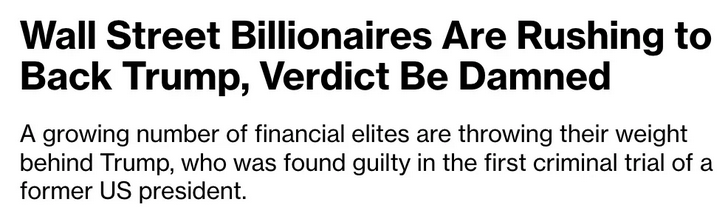
How Wall Street billionaires are reacting to the verdict against Trump

Filed under: Business, Law, Media, Politics, USA — Tags: , , , , — Nicholas @ 05:00

Under normal circumstances, you might think that Trump would find doors closed to him among the big-money folks on Wall Street after his trial ended with 34 guilty verdicts … yet the opposite is reported to be happening and his campaign is being inundated with big financial donations:

My quite strong suspicion is that Leticia James and Alvin Bragg have caused alarm by targeting business records and real estate valuations in corporate borrowing, things that everyone shares in finance, insurance, and real estate, for criminalization and destructive litigation. My bet is that capital is turning hard against lawfare, seeking to disincentivize and punish an attack on the basics of corporate business. People in business are horrified by a flamethrower of a prosecution over old business records.

So Bloomberg’s interpretation is that Wall Street is standing with Trump despite the verdict, but my bet is that Wall Street, Silicon Valley, and other business interests are turning against Democrats because of the verdict — because Democratic prosecutors in New York (and especially Manhattan), America’s financial capital, are doing things like turning seven year-old business record misdemeanors into a long list of Frankenstein felonies.

That interpretation makes capital’s support for Trump self-interested rather than morally outraged, though not over Bloomberg’s explanation of lower taxes, as people who keep business records turn against the party that bizarrely overcriminalizes the handling of business records when the target becomes politically unfashionable. If capital turns against the Democratic Party — if the ATM machine stops spitting out campaign funding — the moment becomes pretty significant, and Alvin Bragg becomes the dog who caught the car.

Assassination-to-order, or war by other means

Filed under: Politics, Russia, USA — Tags: , , , , , — Nicholas @ 04:00

I was not well-informed about the goings-on within Vladimir Putin’s Russia even before the Russo-Ukrainian war went into high gear and disrupted all information from that part of the world and I hear much but trust nothing I’ve been hearing since then. kulak, on the other hand, seems to have paid much closer attention to Russian internal affairs, including one particular political assassination:

On August 20, 2022, 29 year old Daria Dugina was killed in a car bombing on the outskirts of Moscow. The bomb, it was widely agreed, had been intended for her father the famed/infamous Russian philosopher Alexander Dugin (whose works are now shockingly hard to get in English and appears on my “Real Banned Books List“), and while there were lots of deflections and denials, it was fairly widely agreed the plot had been carried out with US and UK backing by Ukrainian-aligned insurgents and agents within Russia.

Indeed many US aligned “Journalists”, “Open Source Intelligence” types, Bellingcat-associated influencers, and other CIA-aligned carve outs openly CELEBRATED the death of Daria, since she had been involved in Putin-aligned political youth organizing.

Of course, the fact political volunteers and door knockers have NEVER been considered legitimate military targets, nor the fact the real target was a PHILOSOPHER and everything he had ever done would have been perfectly legal to do even within the United States under the auspices of the first amendment … that somehow never occurred to these commentators. Nor the wider US intellectual class, and somehow neither did the natural logical conclusion.

Russia is by and large NOT run by its political organizers and academics. You could probably kill 1000 Russian university professors and it wouldn’t unbalance the Russian state too extraordinarily. Russia is run by a combination of old Soviet secret policemen, gangsters, and crooked/”reformed” oligarchs all attempting to reorganize themselves into a somewhat respectable upper-class, with a blend of impressive and farcical results.

Before he was killed in an internal power struggle the former head of Wagner PMC Yevgeny Prigozhin embodied this, turning from a St. Petersburg gangster, to a prisoner, to a (definitely money laundering) caterer for the presidential palace, to the head of a PMC mercenary company. Every prominent person in Russia has a career like this Right down to Putin going from a KGB officer, to a gangster/political fixer, to president … Every elite member of Russian society is basically leading a life ripped right from Grand Theft Auto IV, complete with the eternal struggles of trying to “go legit” and formalize everything as a normal upper-class elite, to being dragged back into gangsterism or even Soviet power struggles by their complex past.

Put simply the actual Russian Elite are not people very intimidated by assassination. They’ve all known people to be killed in power struggles, espionage, and criminal altercations, and are used to the anxiety that death might wait for them around the corner. And the US and Ukraine lashing out at academics who might be intimidated doesn’t really affect them.

However, if the Russian state did the logical tit-for-tat escalation and responded in kind … that would shake America to its knees. America actually IS run by its academics, political organizers, and bureaucrats. And almost none of the people with power have a gangster or KGB agent’s stoic familiarity with death and danger.

Killing a Russian Academics daughter did very little to the Russian state… It’d be a very different story for Russia’s armed agents to do the same in America and kill Chelsea Clinton, daughter of current Columbia professor Hillary Clinton.

It’s be a very different story if Russia assassinated Brookings senior fellow Robert Kagan, husband of former under-secretary of state Victoria Nuland. Or any number of Harvard, Stanford, Yale or Princeton political philosophers or International Relations commentators, or members of their family.

One can imagine the headlines if John Hopkins and RAND fellow Francis Fukuyama was so killed:


“It is the end of Fukuyama”
History


And again remember, though the various income streams of the US elite may resemble embezzlement, protection rackets, and money laundering … these aren’t gangsters. These are complacent, highly agreeable, shockingly unoriginal and cowardly … academics and bureaucrats.

Indeed one can imagine Putin weighing the risk of such a reprisal and then deciding against it, not out of ethical concerns, but because the American ruling class is too unpredictable and prone to womanly hysterias.

Indeed amongst the few senior American and Ukrainian officials who knew of the attack beforehand you can imagine them salivating that Putin might respond in kind and the subsequent freakout might commit the US to joining the war (one of the few scenarios where Ukraine could possible survive against their overwhelming odds).

June 3, 2024

Decoding Nigel Farage’s “hidden agenda” … that isn’t actually hidden at all

Filed under: Britain, Cancon, Media, Politics — Tags: , , , , — Nicholas @ 04:00

I’ve been theorizing that the reason Nigel Farage didn’t plunge immediately into the British election campaign was that he was expecting Rishi Sunak to do his very best Kim Campbell impersonation and utterly destroy the Conservatives as a viable political party. It turns out that that’s pretty much exactly what he’s doing:

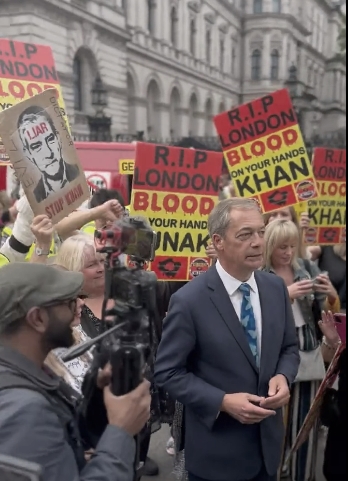
Nigel Farage at the ULEZ protests in London, 30 August 2023.
Image from JoNova.

The biggest question of all, however, is what Farage wants to do after polling day. For months now, a growing band of Conservative MPs have been agitating openly for him to be admitted to the party; even Rishi Sunak now says he “respects” him.

Close friends of Farage believe his real plan is to wait for the Tories to implode, and in the aftermath arrive as a saviour in waiting. “He doesn’t want to be the person who puts the bullet in the back of their heads, why be seen to alienate Conservative voters?” said one, while a second, a senior Tory, said: “Our party needs to be able to come back with people like Nigel, where we basically go back to be that authentic Thatcherite party — his natural home.”

[Reform UK leader Richard] Tice says he wants to destroy and replace the Conservative Party, but when asked if he feels the same, Farage says: “I certainly don’t have any trust for them or any love for them”. So does he want to change it? “I want to reshape the centre-right, whatever that means.”

Asked directly if his friends are right and he wants to join the Tories, he adds: “Why do you think I called it Reform? Because of what happened in Canada — the 1992-93 precedent in Canada, where Reform comes from the outside, because the Canadian Conservatives had become social democrats like our mob here. It took them time, it took them two elections, they became the biggest party on the centre-right. They then absorbed what was left of the Conservative Party into them and rebranded.”

I suggest this sounds a lot like he’s floating a merger. “More like a takeover, dear boy,” he replies, grinning like a Cheshire Cat.

The “mass graves” moral panic at three

Filed under: Books, Cancon, History, Media, Politics — Tags: , , , , — Nicholas @ 03:00

In the National Post, Father Raymond J. de Souza notes the almost un-noticed third anniversary of the dramatic announcement and ensuing moral panic over claims that hundreds of unmarked graves had been discovered at the site of a former Residential School in Kamloops, BC:

This past week marked the third anniversary of the dramatic announcement that 215 “unmarked graves” had been discovered near a former residential school in Kamloops. It was a global news story which had a significant impact in Canada. It was also a great media malpractice.

Many things were reported then that were not only not true, but had not even been claimed to be true by anyone. Recall the monstrously misleading headlines about mass murder and mass graves? For example, from the Toronto Star on 28 May 2021: “The Remains of 215 Children Have Been Found”.

Not true. No one ever claimed that remains had been found. Many people assumed that the “unmarked graves” held children, but the ground-penetrating radar employed cannot reveal if a body is in the soil, let alone whether it is a child or adult.

Tales of mass murder and mass graves produced a massive moral panic. Marches were held, symbolic children’s shoes were assembled, churches were burned and vandalized, hundreds of millions were committed to investigating further mass graves, the prime minister ordered flags at every embassy abroad and federal building at home to be lowered for nearly six months, a new federal holiday was instituted, the Catholic Church issued (another) apology and Pope Francis came to visit.

How can it now be that the anniversary of something so globally momentous passed so quietly this week?

It’s because the great media malpractice has been answered by journalists, a broader category in the digital world, who provided the effective response. It’s an inspiring David and Goliath tale of how courageous, good journalism beat out conforming, bad journalism.

We can take some pride here at the National Post, for on the first anniversary we published the remarkable reporting of Terry Glavin, who demonstrated exactly how media malpractice had produced a moral panic.

But aside from that, the work was carried out by writers — academics, reporters, amateur researchers and dogged citizens — outside of the legacy media. The story unfolded in C2C Journal, Dorchester Review, True North, Western Standard, the Frontier Centre for Public Policy and Quillette.

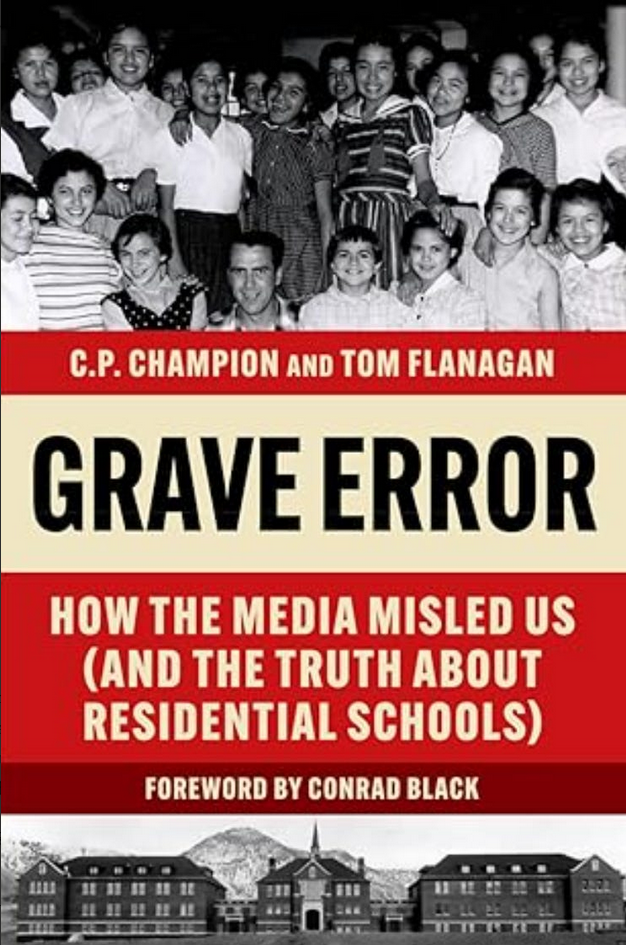
Last December, a single volume collecting much of this work was published: Grave Error: How the media misled us (and the truth about residential schools), edited by Christian Champion, founder and publisher of the Dorchester Review, and the well known academic and political player, Tom Flanagan, professor emeritus at the University of Calgary.

Those outlets which had perpetrated the original malpractice took a pass. The legacy media ignored the book, and Canada’s major book retailers did not sell it.

« Newer PostsOlder Posts »

Powered by WordPress