Quotulatiousness

November 19, 2021

Viewing-with-alarm … from afar

Filed under: Britain, Media, Politics, USA — Tags: , , , , , — Nicholas @ 05:00

In Spiked, Simon Evans explains why he finds British commentary on US hot-button issues like guns and race to be frequently uninformed but remarkably certain of itself:

What many Brits believe every American carries in their pickup trucks or on their persons, probably.

As a Brit, there are few things less edifying, nor more unintentionally hilarious, than an American newspaper reporting on any very English scandal. A breach of some obscure royal protocol, perhaps, or an aspect of parliamentary procedure, often involving Black Rod, which despite the capital B, the Washington Post will have to explain, is not a racial epithet, or an ill-advised tribute act.

A personal favourite is when a provincial dietary preference has caught the New York Times‘ eye, having unexpectedly “caught on” nationwide. It is an innocent enough pleasure, watching Americans trying to distinguish black pudding from haggis, or indeed gravy from “chippy sauce”. Like watching the Dutch discuss the morality of bullfighting, or Korea debate a proposed rule change in top flight Buzkashi.

Yet put the sneaker on the other foot and watch British commentators angrily contend the moral and legal thrust of a case in which an American is on trial for using lethal force with a firearm, and we suffer something very like Gell-Mann Amnesia by proxy. We forget how important a little local knowledge might be, and our seasoned, tolerant, bemused respect for tradition and culture and specialist knowledge are gone within moments. Watching the Kyle Rittenhouse case approach a verdict, British commentators are a-froth with indignation at the palpable miscarriages of justice seemingly running unchecked only five short hours away across the globe. My God, he had a gun ! What more is there to say? And – do I have this right? – he crossed state lines ! The man’s a monster.

Not since the proroguing of parliament two years ago have so many people become acquainted so quickly with something so arcane as the crossing of state lines with intent to do mischief. Putting aside the fact that the weapon itself did not cross this fabled demarcation, what is striking is the evident lack of enthusiasm for certain other state lines, such as the one somewhat further to America’s south, or indeed the one etched around the British Isles, that currently seem to get crossed on a pretty frequent basis, with who knows what intent? Drawing attention to those lines is clearly racist.

It was GB Shaw who first made the observation that GB’s shores were separated from the US’s by an ocean of incomprehension, concealed by our sharing a common language.

Rather like urban Canadians, most British readers and viewers tend to agree with the opinions expressed in US mainstream media based largely in urban coastal areas:

So, we don’t get the full spectrum argument. Instead, we gratefully share the apparent horror and shame of the coastal elite, with their tertiary education and their teeth that meet in the middle, when confronted with their inland, inbred in-laws. We deplore the multi-decade epidemic of what seems, if you read the Washington Post and the NYT, to be the largely white, Wild West assassination culture that 2A concedes. Bullets sprayed around schools. Shopping malls, synagogues and mosques running with blood. A death toll out of all control. Murder, cold-blooded and cruel – and largely in the service of a bigotry, as often as not a racial bigotry, as old as the Appalachians hills.

This is, to put it as mildly as one can without choking, not quite the whole story. Do your own due diligence, it isn’t hard. The editors of the NYT can’t stop you acquainting yourself with the FBI crime statistics, and they put some of the more notorious outbreaks of flying lead into useful perspective.

But generally, we instead swallow like sugary cough syrup (believing it good for us, no matter how delicious it also is) the narrative that guns are largely in the hands and lovingly tended racks of homicidal white supremacists, paranoid death-spiral redneck survivalists, and a police force that is barely superior in discipline, racial enlightenment or legitimacy to a rounded-up posse of ad hoc lynch-happy vigilantes.

QotD: People who are interested in history versus “academic” historians

Filed under: Education, History, Politics, Quotations, USA — Tags: , , , , , — Nicholas @ 01:00

One of many reasons I never went anywhere in my career as an academic historian is that I actually like history. I find it interesting. That’s because I find people interesting, and history is, above all, the study of people and how they be.

Your average academic historian lives entirely in xzheyr own head. They hate and fear people. They have no interest in how people actually are, only in how they should be. Thus, academic history quickly devolves into the worst kind of Social Justice Mad Lib, a never-ending, ever more frantic search for ever more obscure terms to complete the equation: “Despite [barbarities], the [micro-group] were actually only doing it because they were oppressed by the Pale Penis People, because [reasons].”

For example:

This is one of those things that’s true even if it’s not true, because Clown World, but I actually looked this guy up and yeah, he’s real — he’s a “Professor of Practice in Media and Activism at Harvard University”, which is exactly what it sounds like: basically, a tenured pest, who makes very nice bank making students protest shit for class credit. The “new book” referenced in the screenshot isn’t on Amazon yet, so maybe that’s not real, but again, Clown World — even if it’s not real, it’s real, because that’s exactly the kind of thing academic historians do. You probably remember it well from your own college days, if you were in college at any time between about 1985 through 1995, the heyday of “everyone you’ve ever heard of was secretly gay!” pseudo-scholarship.

Severian, “On Boredom”, Rotten Chestnuts, 2021-08-17.

November 15, 2021

“That is what I like about you Canadians … you are so ready to admit fault. It is a fine, if dangerous, national characteristic. You are all ashamed.”

Filed under: Cancon, History, Media, Politics — Tags: , , , , , — Nicholas @ 05:00

John E. MacKinnon on the world’s first admittedly genocidal, terminally apologetic, “post-national” state … the entity that used to be known as the Dominion of Canada:

During one broadcast, [late CBC Radio host Peter] Gzowski recalled an incident that had occurred at the annual invitational golf tournament he hosted to benefit adult literacy programs across Canada. As one participant, standing next to Gzowski, leaned thoughtfully on his club, another drove a golf cart over his toes. Although it was unclear from the telling whether the cart-driver was American, the first golfer was obviously Canadian, since, shifting gingerly from foot to aching foot, he could only plead, “sorry”. Gzowski shared this anecdote with evident delight, since it struck him as so endearingly, because emblematically, Canadian.

But Gzowski’s soaring contentment with this view of his country and countrymen was no less emblematic. To Canadian nationalists of Gzowski’s era and ilk, the representative Canadian is no hewer of wood or carrier of water, no builder of bridges, roads and railways, no stormer of barricades or keeper of the peace, but a hobbled guest on a verdant fairway, eagerly apologizing for the pleasure of having his toes crushed. “That is what I like about you Canadians,” says Dr. Gunilla Dahl-Soot in Robertson Davies’s novel The Lyre of Orpheus, “you are so ready to admit fault. It is a fine, if dangerous, national characteristic. You are all ashamed.”

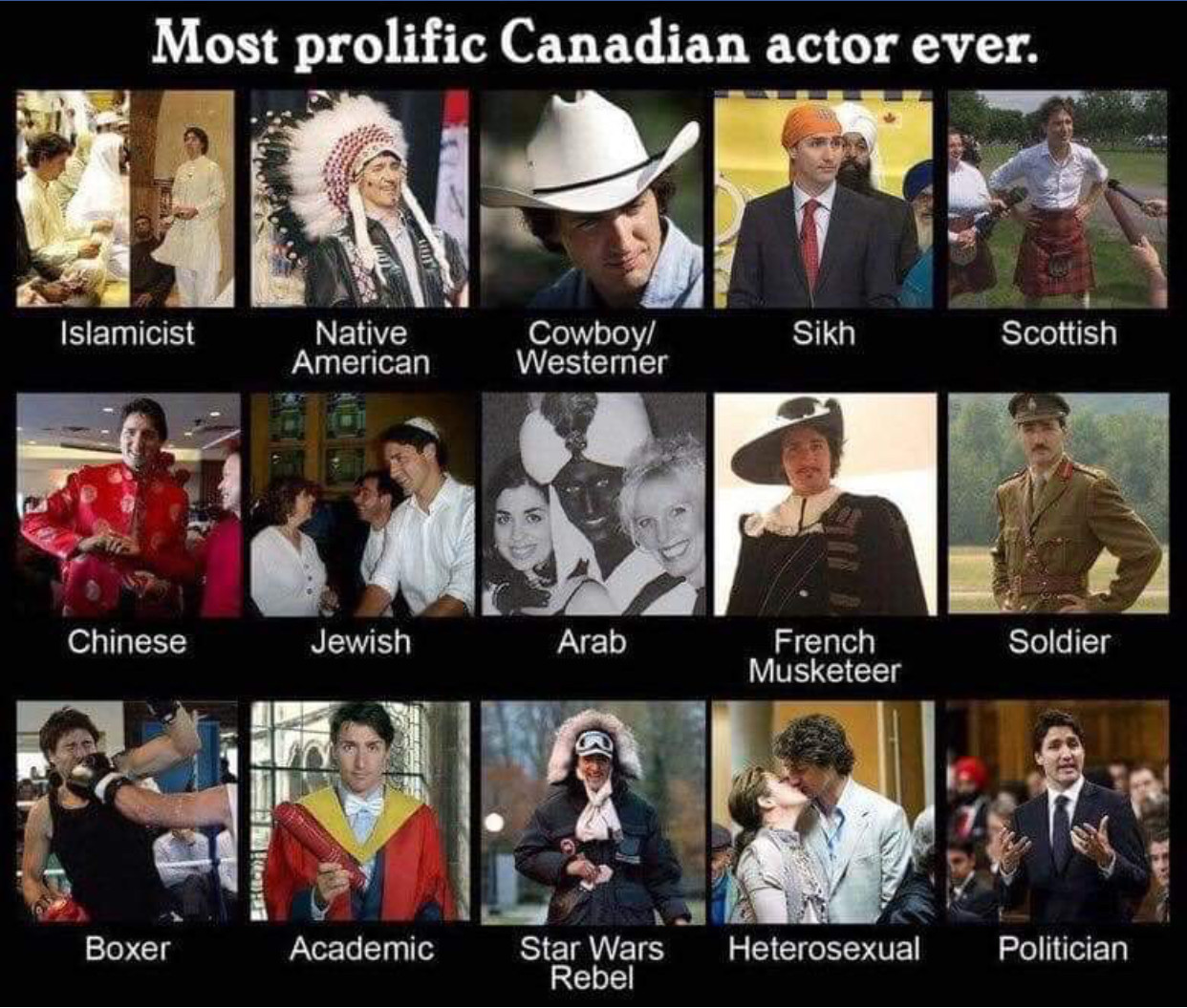
Over the past 200 years, notes Hungarian-born Canadian writer George Jonas, “we have been misled by science. Medicine became our hubris. Having learned to fix appendices, we thought we could fix history.” Today, in Canada, there is no clearer manifestation of this urge to renovate and repair the past than the vogue for apology. And no one has struck this posture of national self-abasement with quite the alacrity of Prime Minister Justin Trudeau. Just months after taking office, he apologized for the Komagata Maru incident in 1914, in which a ship carrying Sikhs, Muslims, and Hindus was sent back to Calcutta, where 20 died in a riot. In 2017, he apologized to Indigenous residential-school survivors in Newfoundland and Labrador, and, just days later, to LGBT Canadians for decades of “state-sponsored, systemic oppression.” A year later, he apologized for the execution, in 1864, of six Tsilhqot’in chiefs over a road-building dispute, and for a government refusal, in June, 1939, to allow into the port of Halifax the MS St. Louis, an ocean liner carrying more than 900 Jews fleeing Nazi Germany. In March, 2019, he apologized for the inhumane manner in which Inuit in northern Canada were treated for tuberculosis in the mid-20th century. Two months later, he exonerated Chief Poundmaker of the Poundmaker Cree, apologizing for the Chief’s conviction for treason more than 130 years before. Still at it in the spring of 2021, Trudeau issued a formal apology in the House of Commons for the internment of Italian-Canadians during the Second World War, even though many, it was subsequently revealed, were indeed hardcore fascists, loyal to an enemy in a time of war. Two weeks later, he lowered the Canadian flag for five months to mark the discovery of the remains of Indigenous children who died at residential schools.

In the midst of this flurry of breathy performances, the BBC asked, with more than a touch of arch obviousness, whether the Canadian Prime Minister might not perhaps apologize too much. And yet, in Trudeau, we simply have the apotheosis of that habit of abject contrition celebrated by Gzowskian nationalists. Under his government, it has become fashionable, even necessary, to apologize, not just for egregious historical episodes or policies, but for the existence of Canada itself. In an interview with the New York Times, Trudeau witlessly described the country that had so favoured him through a lifetime of privilege as “post-national”, suggesting that Canada as we know it had somehow served its purpose, extended itself beyond any warrantable use. And recently, not to be outpaced by more current styles of denunciation, he described Canada, “in all our institutions,” as “built around a system of colonialism, of discrimination, of systemic racism.” When China, responding to criticism of its brutal treatment of Muslim Uyghurs, lashed out at Canada for committing “genocide” against its own Indigenous population and subjecting Asian-Canadians to “systemic racism”, Canada’s political class was in no position to quibble — as its prime minister had already muttered his agreement to the claim that he presided over a genocide state.

This note of cringing repentance now echoes in the pronouncements of all of our institutions. No matter how admired our country may remain internationally, no matter how ardently people around the world long to immigrate here for a chance at a better life, our presumptive leaders are eager to scorn Canada as a meagre and regrettable conceit. That the confessional mode they favour has become so prevalent confirms what Christopher Lasch long ago diagnosed as the strain of narcissism that courses through contemporary culture, lending ready appeal to all such facile gestures of self-reproach. There is, indeed, no cagier career move for any Canadian academic, journalist, bureaucrat, or politician these days than to repudiate Canada, and with feeling.

November 14, 2021

The Media — declining to report the news and instead depleting the strategic reserve of Narrativium

Filed under: Business, Government, Media, Politics, USA — Tags: , , , , , — Nicholas @ 05:00

This week’s excerpt from Andrew Sullivan’s Weekly Dish explores the many, many ways that the mainstream media have been actively abandoning any semblance of informing their audience and instead now concentrate almost exclusively on propagandizing them:

The news is a perilous business. It’s perilous because the first draft of history is almost always somewhat wrong, and needs a second draft, and a third, and so on, over time, until the historian can investigate with more perspective and calm. The job of journalists is to do as best they can, day by day, and respond swiftly when they screw up, correct the record, and move forward. I’ve learned this the hard way, not least in the combination of credulousness and trauma I harbored in the wake of 9/11.

But when the sources of news keep getting things wrong, and all the errors lie in the exact same direction, and they are reluctant to acknowledge error, we have a problem. If you look back at the last few years, the record of errors, small and large, about major stories, is hard to deny. It’s as if the more Donald Trump accused the MSM of being “fake news” the more assiduously they tried to prove him right.

You know the situation is bad when Andrew Sullivan references Donald Trump without a sneer!

We found out this week, for example, that a key figure in the emergence of the Steele Dossier, Igor Danchenko, has been indicted for lying to the FBI. He is also charged with asking a Clinton crony, Charles Dolan Jr: “Any thought, rumor, allegation. I am working on a related project against Trump.”

The evidence from another key source for the dossier, Sergei Millian — touted across all media, including the Washington Post — has also been exposed as potentially fake. What has the Post done? As their own indispensable Erik Wemple notes, instead of a clear retraction, the Post has just added editors’ notes to previous stories, removed sections and a video, and altered headlines retroactively. This is a bizarre way of correcting the record: “No such case comes immediately or specifically to mind, at least no historical case that stirred lasting controversy,” said W. Joseph Campbell, a professor and journalism historian at American University.

This doesn’t mean that Trump wasn’t eager for Russian help. But Trump was right, in the end, about the dodgy dossier; he was right about the duped FBI’s original overreach; and the mass media — Rachel Maddow chief among them — were wrong. And yet the dossier dominated the headlines for three years, and the “corrections” have a fraction of the audience of the errors. Maddow gets promoted. And the man who first published it, Ben Smith, was made the media columnist for the NYT.

Think of the other narratives the MSM pushed in recent years that have collapsed. They viciously defamed the Covington boys. They authoritatively told us that bounties had been placed on US soldiers in Afghanistan by Putin — and Trump’s denials only made them more certain. They told us that the lab-leak theory of Covid was a conspiracy theory with no evidence behind it at all. (The NYT actually had the story of the leak theory, by Donald McNeil, killed it, and then fired McNeil, their best Covid reporter, after some schoolgirls complained he wasn’t woke.) Wrong. Wrong. Wrong.

The MSM took the ludicrous story of Jussie Smollett seriously because it fit their nutty “white supremacy” narrative. They told us that a woman was brutally gang-raped at UVA (invented), that the Pulse mass shooting was driven by homophobia (untrue) and that the Atlanta spa shooter was motivated by anti-Asian bias (no known evidence for that at all). For good measure, they followed up with story after story about white supremacists targeting Asian-Americans, in a new wave of “hate”, even as the assaults were disproportionately by African Americans and the mentally ill.

As Greenwald noted, the NYT “published an emotionally gut-wrenching but complete fiction that never had any evidence — that Officer Sicknick’s skull was savagely bashed in with a fire extinguisher by a pro-Trump mob until he died.” The media told us that an alleged transgender exposure in the Wi Spa in Los Angeles was an anti-trans hoax (also untrue). They told us that the emails recovered on Hunter Biden’s laptop were Russian disinformation. They did this just before an election and used that claim to stymie the story on social media. But they were not Russian disinformation. They were a valid if minor news story the media consciously kept from its audience for partisan purposes.

November 13, 2021

QotD: Boris Johnson as Billy Bunter, the “Fat Owl of the Remove”

Filed under: Books, Britain, Humour, Politics, Quotations — Tags: , , — Nicholas @ 01:00

One can only suspect some insidious intent – or trolling, if one wishes to call it by its proper name – when the Scottish police force had to rename the operation designed to protect Boris Johnson in his current visit to the country. It now rejoices in the unexceptional title of “Operation Aeration”, but until it attracted adverse publicity, its original name was “Operation Bunter”.

Although a spokesman for the Scottish police said, with tongue so far in cheek that it was astonishing they could speak, “Operational names are auto-generated by computer and can be changed if they are deemed to be inappropriate”, the comparison between the Prime Minister and Frank Richards’ legendary creation Billy Bunter, the “Fat Owl of the Remove” is a far from flattering one.

In Richards’ stories, Bunter is a gluttonous, lazy, dishonest and academically negligible student at Greyfriars School in Kent, forever attempting to obtain loans from his fellow schoolboys on the promise that a non-existent postal order is going to arrive from his wealthy relatives at “Bunter Court”. It is made clear that, for all his fantasies of wealth and success, Bunter’s home is in fact the considerably more modest “Bunter Villa”, which possesses merely one maid and one cook. Richards therefore invites his readers to condemn Bunter as an arriviste to the English public school system, amongst his many other sins. He is repulsive in appearance, significantly overweight, perpetually dirty and often given to thoughtless instances of racism and xenophobia. And his famous catchphrases – “I say, you fellows!” and, when he is being beaten, kicked or otherwise abused, “yarooh!” – are irritating, rather than witty or charming.

Needless to say, the books that featured him as their lead character were hugely successful for decades, but now, in our more censorious and self-aware image, have fallen into obscurity. None of them are currently in print, and the last time that any of the novels were reissued was in the early Nineties. When the news story about Operation Bunter broke, many papers had to explain exactly who the character was, and why the allusion was apposite. While the milder likes of Jennings and William continue to be much loved by parents and grandparents of a certain generation, Bunter and his fellow denizens of Greyfriars have found themselves condemned to a kind of literary Siberia, and show few signs of coming in from this particular cold. Is there any hope that some literary-minded minister will intervene and aid the Fat Owl’s rehabilitation? Or are the books simply too outrageous and un-PC for our contemporary tastes?

Alexander Larman, “Boris Bunter”, The Critic, 2021-08-09.

November 12, 2021

One Pretendian’s “cultural Munchausen syndrome”

In Thursday’s NP Platformed newsletter, Colby Cosh updates us on the story of Carrie Bourassa, who had effortlessly surfed to high profile, well-remunerated positions at the University of Saskatchewan and with the federal government largely on the basis of her claimed First Nations background:

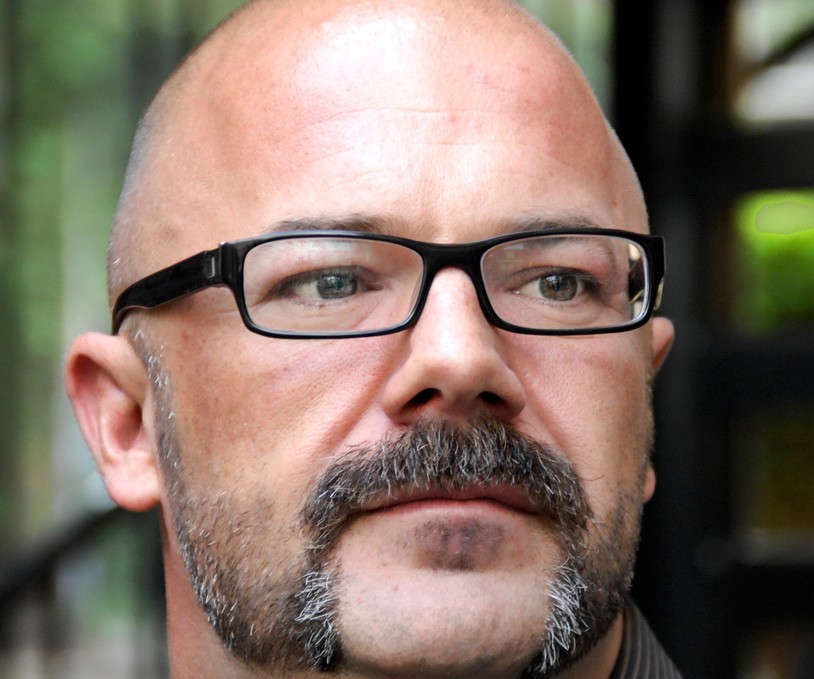
Carrie Bourassa with media.
Lead photo in Geoff Leo’s article for the CBC – https://www.cbc.ca/newsinteractives/features/carrie-bourassa-indigenous

Newspapers have a slightly nasty characteristic: it’s easy for them to get pre-emptively mad when institutions are a little slow to do the right thing, and it’s also easy for them to forget to give credit when those institutions get around to it.

So let’s acknowledge that the federal government and the University of Saskatchewan are dealing — as best they can, almost certainly — with their shared Carrie Bourassa problem.

Two weeks ago, CBC News investigative reporter Geoff Leo published an astonishing tour de force. His feature article established, beyond almost any doubt, that Bourassa, a high-profile Indigenous scholar who told and published countless stories of racist treatment and childhood adversity, is actually a fabulist from a wealthy white family. The Institute of Indigenous Peoples’ Health soon put Bourassa, its scientific director, on unpaid leave. The U of S suspended her with pay, probably having no better immediate alternative.

[…]

Since Prof. Bourassa was put on ice in her lucrative Aboriginal-health jobs, Indigenous folk have been labouring to explain in the press what was wrong with her concoction and aggressive peddling of a fake Métis upbringing on the mean streets of Regina. Drew Hayden Taylor’s Globe and Mail op-ed about Bourassa’s “cultural Munchausen syndrome” is instructive and funny, but we hope it is all right to tell Aboriginal-Canadians that no white settler with a lick of sense would consider Bourassa’s tapestry of falsehoods to be harmless “fibs”. This may be a self-serving observation, but her confabulations about her personal history wouldn’t be consistent with the standards of a newspaper, let alone those of a university.

About a year ago, the Saskatchewan Health Research Foundation gave Bourassa an award (not her first) and published a capsule summary of her career. If you read it, you will notice how she was, from time to time, offered career advancement out of the blue by Indigenous supporters who had been taken in by her stories. Even a white grad student living on ramen in a basement apartment might be a little ticked about this. The University of Saskatchewan’s original claim that Prof. Bourassa hadn’t benefited from claiming Aboriginal ancestry is pathetic hokum: Bourassa tellingly accused her own sister of “looking for … a way to make some money” by accepting Indigenous scholarship funds during her PhD studies.

And it probably occurred to the USask brass sometime between the two press releases that an investigative reporter like Leo, in taking on a topic, always looks a couple articles ahead. Bourassa, for example, claims to have suffered from tuberculosis in her late 20s — a useful credential, unfortunately, for someone studying the field of Indigenous health. It’s useful because the disease has been nearly eliminated among non-Indigenous Canadians: the incidence rate for First Nations is 40 times higher, and the cases tend to be concentrated in remote northern Indigenous communities. Even if we overlook Bourassa’s propensity for creative autobiography … well, if she contracted TB, she was certainly very unlucky.

More on the populist success of Hungary’s Victor Orbán

Filed under: Economics, Europe, History, Politics — Tags: , , , , — Nicholas @ 03:00

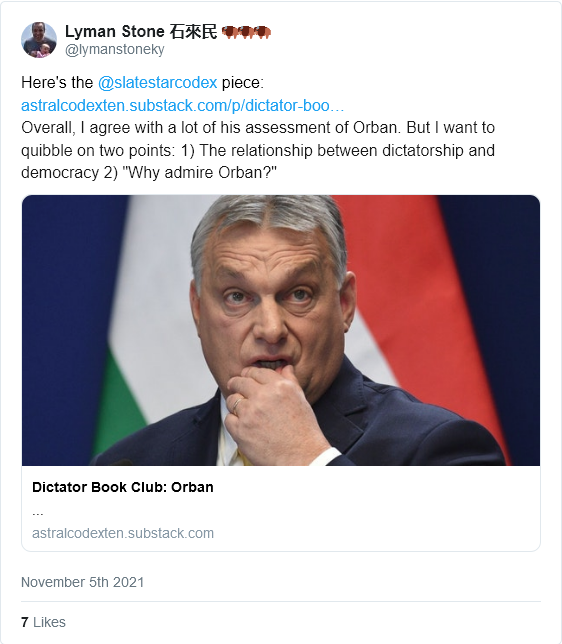
Last week, Scott Alexander looked at a couple of recent biographies of Hungarian politician Victor Orban (linked here). He got some quite interesting responses from his readers, including a long Twitter thread from Lyman Stone, which he’s converted into plain text for ease of reading:

I won’t make you read it all in tweet format. He continues:

1) Dictatorship and democracy. The arguments about Orban cheating in elections might be totally true. I dunno. But that’s sort of irrelevant. Neutral opinion polls nobody disputes show he would have gotten 2/3 under almost any system.

His crude poll share was about 60% before the 2010 election, but given the threshold effects, he’d likely have ended up at a supermajority under almost any system. And as @slatestarcodex [says], a lot of the initiatives that the EU most despises under Orban are initiatives that *everyone agrees* have supermajority public support among Hungarian voters.

Moreover, I agree with @slatestarcodex that if public opinion turned in Hungary, Orban would probably turn on a dime too. The dude loves power. But that should inform our read of what’s going on in Hungary. *Hungarians wanted* a right-nationalist authoritarian leader, *and so they voted for one*, and the electorate has *wanted* recurrent intensifications of that regime. So is it a dictatorship? Or is it a democracy?

This gets at the problem with “democracy” as a concept. Hungary is undeniably Democratic: there is widespread public support for the regime, which is selected by elections, the results of which are a decent approximation of trustworthy and neutral opinion polls. But I think it’s still possibly reasonable to call Orban a dictator. He wields enormous *personal* power, there are few checks on his power, and he uses power to create a *personal* clique of supporters to perpetuate that power and enfeeble the competition.

But this is the point: Democracy and dictatorship aren’t opposites. In fact, they are natural companions! So much so that before the 20th century, “democracy” was often used *literally as a synonym* for “authoritarian and demagogic rule”! Orban is a great example of why the word “democracy” came into ill repute in the past: because it was widely understood that “the people” (often pejoratively “the mob”) will often vote for a strongman to stomp his boot on the face of disliked others. That’s not so much a disagreement with @slatestarcodex as just a comment where I think the modern western liberal mindset obscures understanding the phenomenon of populist leadership.

2) Why admire Orban? Here I think @slatestarcodex misses some important stuff, perhaps because his biographies miss it. Yes, Orban was incompetent in the 90s. So were MOST immediate post-Soviet leaders! And while Orban may have been corrupt, you can compare the personal wealth of the Fidesz clique to the cliques that looted Russia or Ukraine and realize that Hungary got a better class of corrupt leaders than much of eastern Europe. Moreover, Hungary actually had competitive elections with changes of power and leaders who *respected* those results! Maybe they were dirty but, like, it happened! This wasn’t universally true!

So why might Hungarians admire a dissident-cum-parliamentarian who competed for their votes and when defeated responded democratically by adapting to try to win the next election? Because … duh?

But it’s not just that. The big factor that’s absent in all these culturalist accounts of Hungarian politics is … the economy. Hungary went from below-average unemployment rate for its region under Orban 1 to way above-average under the socialists to again below-average under Orban 2.

This is extremely important. A part of Orban’s appeal is that, whether by coincidence or art, he has managed to preside over periods where Hungary’s economic performance was better than a lot of its neighbors, and often fairly obviously so. That is, supporting irredentist nationalism in the form of Orban hasn’t imposed costs on Hungarians: they aren’t like facing sanctions or something or enduring deep economic hardship to stand by their dictator. He’s delivered (comparatively) good times!

So when you have a leader who 1) seems marginally-less-corrupt than regional peers, 2) delivers marginally-better-results than regional peers, and 3) adopts policies that are widely popular … that leader will be popular! Duh!

Update: Fixed broken link.

November 10, 2021

The organizational priorities of Canadian universities make for interesting reading

Filed under: Bureaucracy, Cancon, Education, Politics — Tags: , , , , — Nicholas @ 05:00

In Quillette, Jonathan Kay examines the 89-page agenda from a Universities Canada meeting, comparing the issues most people would identify as likely being of high urgency for a gathering of Canadian university administrators with the actual issues the organization considers urgent and important:

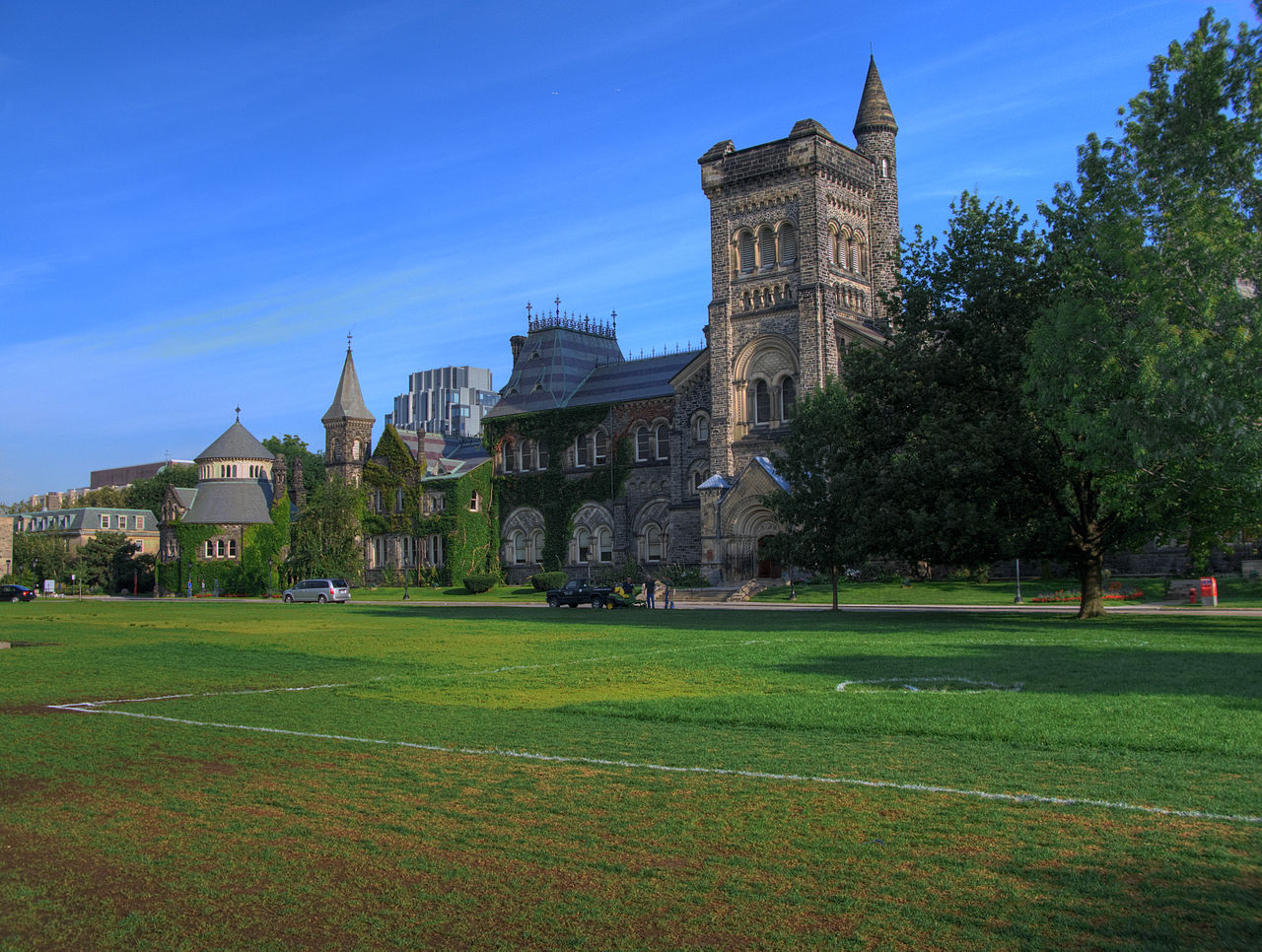
University College, University of Toronto, 31 July, 2008.
Photo by “SurlyDuff” via Wikimedia Commons.

Last week, 53 top Canadian academic administrators convened in Ottawa for a biannual membership meeting of Universities Canada, a group dedicated to “providing university presidents with a unified voice for higher education.” The 89-page meeting agenda, which was leaked to me after the event, makes for an interesting read.

The pandemic has been a challenging period for Canadian universities, as the adoption of virtual classrooms has caused some families to wonder whether the traditional bricks-and-mortar education model is worth the price. Many Canadian schools are financially dependent on foreign students, an income source that’s now in flux thanks to COVID. In April, Laurentian University in Ontario declared itself insolvent, cut dozens of programs, and laid off about 100 professors — an unprecedented development.

And yet none of these issues is listed on the October 27th Universities Canada meeting agenda. Laurentian University isn’t mentioned at all, in fact. And the only substantive reference to the COVID pandemic consists of an aside to the effect that “women are disproportionately being impacted negatively during the pandemic”. Instead, all of the agenda’s main action items are dedicated to social justice.

The first item updates attendees on Universities Canada’s multi-year effort to draft a statement on “Social Impact Principles”. A subsequent action item details the “Scarborough National Charter”, a document aimed at “mov[ing] from rhetoric to meaningful concrete action to address anti-Black racism and to promote Black inclusion.” There’s also a related item titled “Equity, Diversity, and Inclusion,” under which members were asked, by formal motion, to affirm their commitment to an affirmative-action doctrine known as “Inclusive Excellence”.

Later in the document, there appears an action item relating to “Principles of Indigenous Education”, detailing the by-now year-and-a-half-long consultation process aimed at renewing Universities Canada’s original Indigenous Education manifesto (which itself was announced with much fanfare in 2015 after a year of work). Among the proposed editing refinements are that language be added “recognizing [the] intersectionality of Indigenous identities”; and that a new preamble be added “acknowledging that Universities Canada and its member universities are located on Indigenous lands across Turtle Island.” The final version, it’s predicted, will be ready by April 2022.

But the agenda’s real centrepiece is a 46-page standalone report commissioned by Universities Canada, called Building a Race-Conscious Institution: A Guide and Toolkit for University Leaders Enacting Anti-Racist Organizational Change.

The report’s main theme is that university leaders must decisively reject the idea of “colour-blindness” (which the author asserts should properly be termed “colour evasion”) in favour of becoming “race-conscious individuals” who “explicitly reflect on their ethno-racial identity and group membership.” The author also exhorts university presidents to “actively examine their personally mediated racial biases, consider their individual experiences with respect to racism, and acknowledge their relative race-related marginalization or privilege in the larger society.” To persist in colour evasion, the author warns, is to erect “discursive barriers to antiracist organizational change.”

And colour evasion is just one of 10 listed “dominant ideologies and pervasive narratives [that] undermine efforts to counteract racism.” Among the other “barriers” listed by the author are “equal opportunity”, “tradition”, and “tolerance”. The report also contains tangents on “white fragility”, “allyship”, and the “ethics of care” prescribed by “critical feminist and antiracist scholars” — as well as instructions regarding the use of certain words and phrases. For instance: “Representation gaps among students, scholars, and staff in higher education are not ‘achievement’ gaps, but rather ‘opportunity’ gaps.”

When the police get posh – “The ruling class needs a woke paramilitary vanguard for when the people revolt”

Filed under: Britain, Environment, Law, Liberty, Politics — Tags: , , , , , , — Nicholas @ 03:00

In The Critic, Harry Miller decries the comfortable middle- and upper-middle-class wokesters who can posture and protest and cause mass disruptions to the workers and lower-middle-class with impunity, because on the very few occasions they are brought to court, the judiciary demonstrate that their hearts are with the posh protest movements, not with the people:

Of course, there is a risk when elected leaders burn up the air miles to feast with the Bacchanalian elite, whilst simultaneously preaching that climate armageddon will only be avoided if the hoi polloi ditch their cars and, once a week, take the peasant wagon to Lidl. When “let them eat cake” becomes “let them eat insects and plant based mash”, there is a heightened risk that the working class will take to the streets to sing “One Day More” with a spare rib in one hand a pitchfork in the other. And it is the working class which poses the threat as the middle class can afford to make a virtue of its suffering. Trading in the Discovery Sport for a hybrid Mini Countryman and a bag full of social bragging rights is substantially different from having to choose between putting on the heating and a week on the beer in Faliraki.

In anticipation of the backlash the government has turned a blind eye to the politicisation of the police and is now recruiting exclusively from the middle class. Why else do you suppose a career in the police is now only open to those with a degree? The ruling class needs a woke paramilitary vanguard, well versed in the etiquette of uncritical obedience, for when the people revolt.

When the police embrace a political cause, there is no expression of support that is too extreme. Humberside Police endorsed a lunatic with connections to organised crime who once told Julie Burchill, a writer of Jewish heritage, that Hitler had the right idea. And the national lead on Hate Crime, Paul Giannasi OBE, recently introduced the concept of laudable hate, provided it serves middle class preoccupations such as gender identity or preserving the tundra.

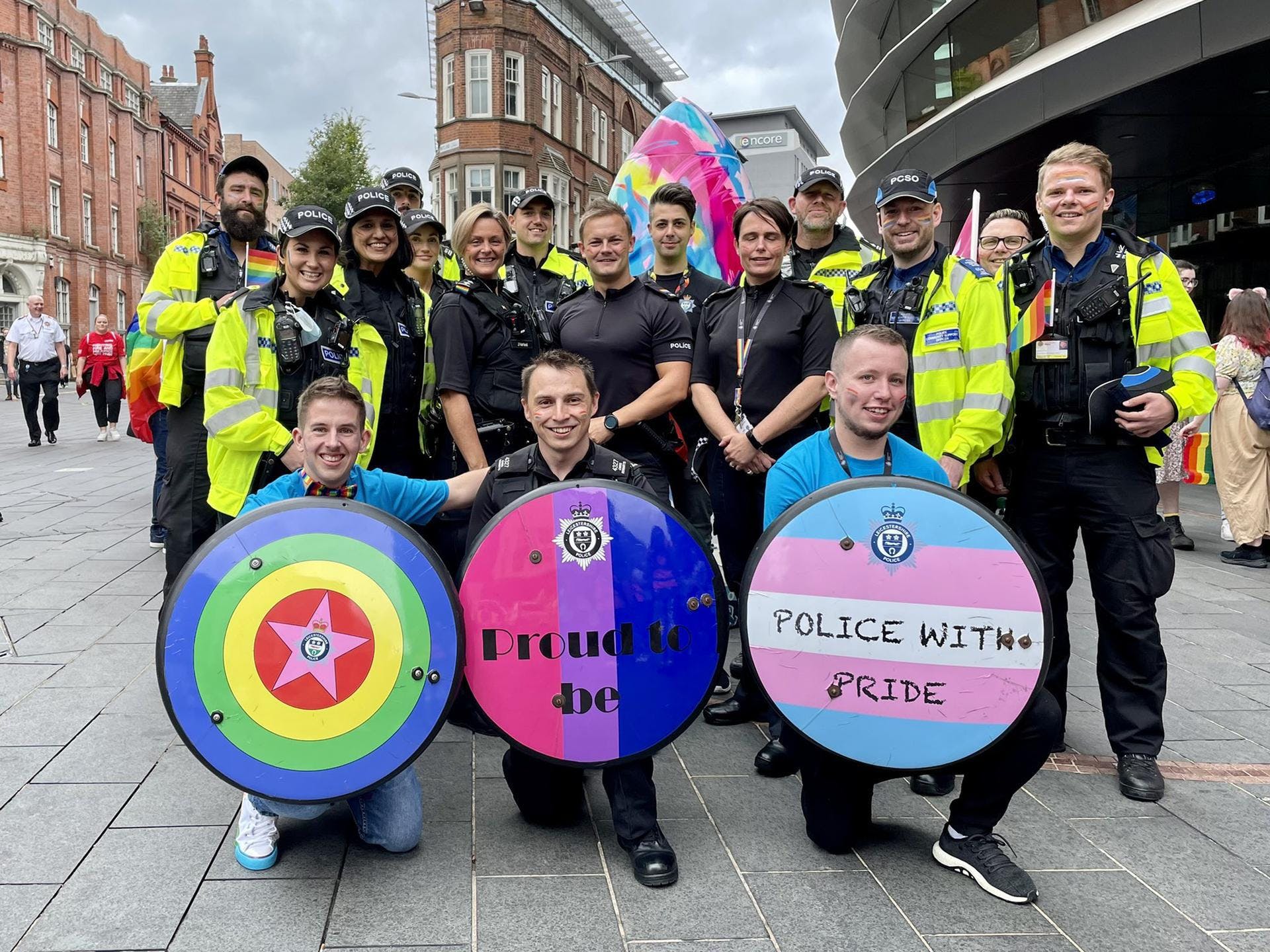
And then there is the obscene spectacle of politically sponsored riot shields being paraded by the police through the streets of Leicester. We are meant to swallow the lie that this is a benign display of support for a marginalised community when, in reality, it is an emblematic reminder to the working class to Remember The Battle Of Orgreave. On the 18th of June, 1984, ordinary working people lent their support to the picketing miners and were met with a baton charge, preceded by the pounding of riot shields, in scenes reminiscent of Zulu. Lest they forget.

Photo from The Critic

The crimes of the woke middle class, where they are prosecuted at all, come with the safety net of a judiciary that is also in on the racket. When six XR zealots found themselves in the dock for progressing the cause of Greta Thunberg by taking hammers to the glass frontage of Shell’s London Headquarters, Judge Gregory Perrin advised that their actions had no defence at law. Nevertheless, he offered gratitude for the care and diligence taken by the jury when it returned a not-guilty verdict. Last week, three activists were found guilty of criminal damage for graffitiing “Lies, lies, lies” on the Westminster Office of the Global Warming Policy Foundation in response to its sin of climate scepticism. Before being slammed with peppercorn fines, the criminals — Clare, Jessica and Rupert — were praised by the bench for their openness and honesty. It is yet to be seen whether similar leeway will be afforded to working class criminals who, in pursuit of Net Zero, begin half inching insulation from Travis Perkins.

November 6, 2021

Canadian flag shenanigans still not resolved, kinda

Filed under: Cancon, Government, History, Politics — Tags: , , — Nicholas @ 05:00

For non-Canadian readers (which last time I bothered to check were the absolute majority of readers), it’s perhaps not clear why flying of the Canadian national flag is an ongoing issue here in the dysfunctional Dominion. In short, Prime Minister Trudeau ordered the flag to be flown at half-staff at federal government and military sites after the publicization of unmarked graves of First Nations children who died during their stay at various residential schools across the country. (I must note that this wasn’t actually unknown beforehand … it just got enough media attention that PM Look-at-my-socks Photo-op decided it was a good idea to ostentatiously pretend that this was previously unknown and (to some) provided further evidence of the “ongoing genocide” of Canada’s problematic relations with First Nations people. The flag-lowering was ordered in May and no end date was specified to the observance. Like ritualistic “land acknowledgements” this did absolutely nothing to actually improve the living conditions of any members of First Nations bands, but was balm to the soul of virtue-signallers across the country. In Friday’s NP Platformed newsletter, Colby Cosh updates us on the state of play:

This morning the Assembly of First Nations (AFN) made its much-anticipated move in the chess game that has developed over the display of the Canadian flag on federal government buildings. As you will recall, the flags on all these buildings, including those abroad, were lowered to half-mast in May, when unmarked graves were discovered on the site of a former residential school in Kamloops, B.C., and have stayed there ever since. The prime minister said then that, although the lowering of the flags is his exclusive responsibility, he wouldn’t allow them to be flown normally again until “Indigenous communities and leadership” agreed that they could go back up.

Was this elliptical, confounding phrase intended to refer to the AFN? We wondered at the time who was capable of giving the necessary permission, if not the AFN: it appears, quite naturally, to have accepted the position, which is bound to be controversial if made explicit, that it is the exclusive political instrument for Indigenous communities.

In any case the AFN announced its solution to the stalemate this morning. Its executive committee, after consulting with elders, suggests raising the Maple Leaf on Sunday alongside an orange “Every Child Matters” banner. Both flags would go to half-mast on Monday, Nov. 8, this being Indigenous Veterans Day. The flags then go back up, and the Canadian one comes down again on Nov. 11, according to the usual tradition. From then on, both flags fly until “all of our children are recovered, named and symbolically or physically returned to their homelands with proper ceremony.”

There are Canadians who have no use for a national flag; some, no doubt, dream of carrying national self-abnegation to the point of having a fully transparent flag. But even these progressives would have to admit that it is hard to imagine a sequence of events allowing some future prime minister and some future AFN executive to get together and say, “Great job, everybody, the orange one can come down now.” This is a proposed permanent adoption of two national flags (and who is to say it won’t catch on among private citizens?). Yet it could still be argued that the AFN is letting the prime minister off the hook lightly, in exchange for a symbolic political victory of its own.

With the approach of Remembrance Day, the flag flying at half-mast was becoming a symbol, not of Canadian remorse, but of one politician’s daft impulsiveness and inability to act with even the immediate future in mind. As much as some approved of the original gesture, the prime minister should never have been allowed to treat the flag as personal property or as a subject for political negotiation.

In what other country would this be contemplated? Where else could a head of government do something like this without being warned or grimaced at or, outside the pages of the National Post, castigated very much? Indeed, how was this particular power of jerking the flag up and down on government buildings ever assigned to a prime minister in the first place? It is a little anomalous that this file doesn’t belong to the Governor General, who wrangles other flag-like symbols like medals and heraldry.

Choose your college roommates well

Filed under: Books, Europe, History, Politics — Tags: , , , , , — Nicholas @ 03:00

Scott Alexander on the unlikely rise of Victor Orbán:

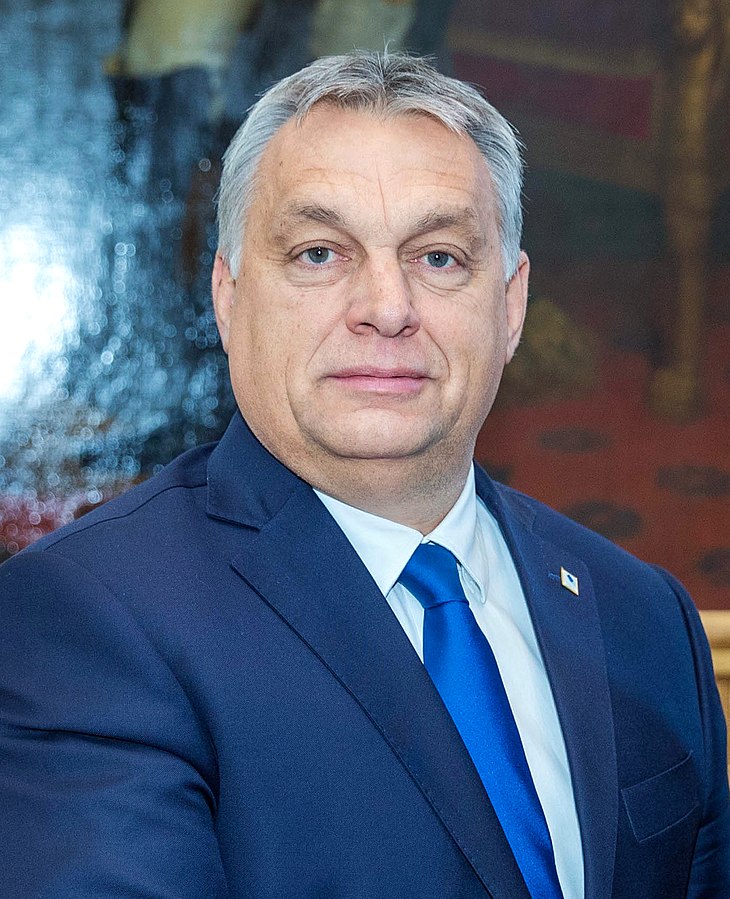
Viktor Orbán at the European People’s Party Summit in Brussels, December 2018.
Wikimedia Commons.

Some are born great. Some achieve greatness. And some are Victor Orbán’s college roommates.

Orbán: Europe’s New Strongman and Orbánland, my two sources for this installment of our Dictator Book Club, tell the story of a man who spent the last eleven years taking over Hungary and distributing it to guys he knew in college. Janos Ader, President of Hungary. Laszlo Kover, Speaker of the National Assembly. Joszef Szajer, drafter of the Hungarian constitution. All of them have something in common: they were Viktor Orbán’s college chums. Gabor Fodor, former Minister of Education, and Lajos Simicska, former media baron, were both literally his roommates. The rank order of how rich and powerful you are in today’s Hungary, and the rank order of how close you sat to Viktor Orbán in the cafeteria of Istvan Bibo College, are more similar than anyone has a right to expect.

Our story begins on March 30 1988, when young Viktor Orbán founded an extra-curricular society at his college called The Alliance Of Young Democrats (Hungarian abbreviation: FiDeSz). Thirty-seven students met in a college common room and agreed to start a youth organization. Orbán’s two roommates were there, along with a couple of other guys they knew. Orbán gave the pitch: the Soviet Union was crumbling. A potential post-Soviet Hungary would need fresh blood, new politicians who could navigate the democratic environment. They could get in on the ground floor.

It must have seemed kind of far-fetched. Orbán was a hick from the very furthest reaches of Hicksville, the “tiny, wretched village of Alcsutdoboz”. He grew up so poor that he would later describe “what an unforgettable experience it had been for him as a fifteen-year-old to use a bathroom for the first time, and to have warm water simply by turning on a tap”. He was neither exceptionally bright nor exceptionally charismatic.

Still, there was something about him. To call it “a competitive streak” would be an understatement. He loved fighting. The dirtier, the better. He had been kicked out of school after school for violent behavior as a child. As a teen, he’d gone into football, and despite having little natural talent he’d worked his way up to the semi-professional leagues through sheer practice and determination. During his mandatory military service, he’d beaten up one of his commanding officers. Throughout his life, people would keep underestimating how long, how dirty, and how intensely he was willing to fight for something he wanted. In the proverb “never mud-wrestle a pig, you’ll both get dirty but the pig will like it”, the pig is Viktor Orbán.

Those thirty-six college friends must have seen something in him. They gave him his loyalty, and he gave them their marching orders. The predicted Soviet collapse arrived faster than anybody expected, and after some really fast networking (“did you know I represent the youth, who are the future of this country?”) Orban got invited to give a speech at a big ceremony marking the successful revolution, and he knocked it out of the park.

He spoke about freedom, and democracy, and the popular will. He spoke against the older generation, and the need for a rupture with the crumbling traditions of the past. And also, he spoke against the Russian troops remaining in the country — the only speaker brave enough to say what everyone else was thinking. The voters liked what they heard: in Hungary’s first free election, he and several of his college friends were elected to Parliament on the Fidesz ticket.

Unfortunately, he wasn’t a very good liberal MP.

Separated from his pomp and platform, he was just a 27 year old kid without a lot of political experience. There was a glut of liberal democrats in Hungary — the country had just had a successful liberal democratic revolution — and Orbán and Fidesz couldn’t differentiate themselves from the rest of the market. Most liberal democrats wanted cosmopolitan intellectual types; Orbán — despite his herculean efforts to lose the accent and develop some class — was still just a hick from Hicksville. During the next election, Fidesz did embarrassingly badly.

So Viktor Orbán got everyone from his liberal democratic party together and asked — what if, instead of being liberal democrats, we were all far-right nationalists?

Wait, what?

QotD: Michael Bellesisles

… I offered a very limited defense of the History Biz. It’s not just that they’re rabid Leftists, I said. I mean, yeah, they are, no denying that, but outright “writing the conclusion before you even start asking the question”-type fraud, Michael Bellesisles-type fraud, is a lot rarer than you probably think.

Bellesisles, you might recall, is the guy whose revolutionary revisionist thesis was that the Founders weren’t really all that enthusiastic about guns, and didn’t own that many, and that whole 2nd Amendment thing was just an afterthought. Yeah, right. That one was written conclusion first, and since no remotely objective look at the evidence could ever possibly support it, he resorted to making lots of “evidence” up. But the reaction of the rest of the profession was interesting: They lauded Bellesisles to the skies. He won the Bancroft Prize for his work, which is the biggest one you can get in American history. Now, I’m sure you’re saying “of course they praised him, he was telling them exactly what they wanted to hear!”, and you’re right …

… but only to a point. Because eggheads are — as you might imagine — the pettiest, most envious bunch of little bitches this side of a junior high cheerleading squad, there’s no piece of research so meticulous, no conclusion so solid, that someone isn’t going to tear into it in one of the professional journals, for base personal reasons if no other. Lest you think I’m kidding, I personally know of a woman at a big league school whose husband was seduced, and her marriage ruined, by an open, obnoxious lesbian colleague, all because she, the hetero, had dared to question some of the lesbian’s work at a conference in their mutual field.

That’s the level of pettiness we’re dealing with here. And I can’t say for absolute certain that Bellesisles received no criticism whatsoever; he doesn’t work in my field, so even though I was certain that Arming America was bullshit of the purest ray serene, it wasn’t my problem, professionally speaking. But whatever, point is, in my fairly well-informed opinion, merely “telling them what they want to hear” doesn’t account for the entire profession ignoring the huge, blinking, neon red flags surrounding Arming America. Rather, I suggest it’s more of a Pauline Kael thing.

I actually kinda pity Kael — much like John Montagu, the 4th Earl of Sandwich, she was a fairly big wheel back in her day, but if she’s known at all now, it’s for something entirely peripheral to her life’s work. In Kael’s case, it’s her declaration that it was impossible for Richard Nixon to have won in 1972, since “nobody I know voted for him” (it was one of the biggest blowouts in American electoral history). The Arming America thing is, I think, like that — nobody in academia owns a gun, or knows anyone who owns a gun, or knows anyone who knows anyone who owns a gun. So, yeah, they know all the scary statistics about how there are sixty gorillion more guns than people in America, but all of that iron belongs to the Dirt People, far away over the horizon. They’d never in a million years even be in the same zip code as someone who thinks Arming America was absurd on its face. Hence, it never occurred to them to question it.

It helped that Bellesisles was telling them what they wanted to hear, no doubt, but the main reason nobody challenged it was that they lacked the cognitive toolkit to even consider the possibility he might be wrong.

Severian, “Are They Trying to Lose?”, Rotten Chestnuts, 2021-07-15.

November 5, 2021

“There is nothing to debate anymore. The climate catastrophe is coming. Now is the time for action”

Filed under: Environment, Media, Politics, Science — Tags: , , , — Nicholas @ 05:00

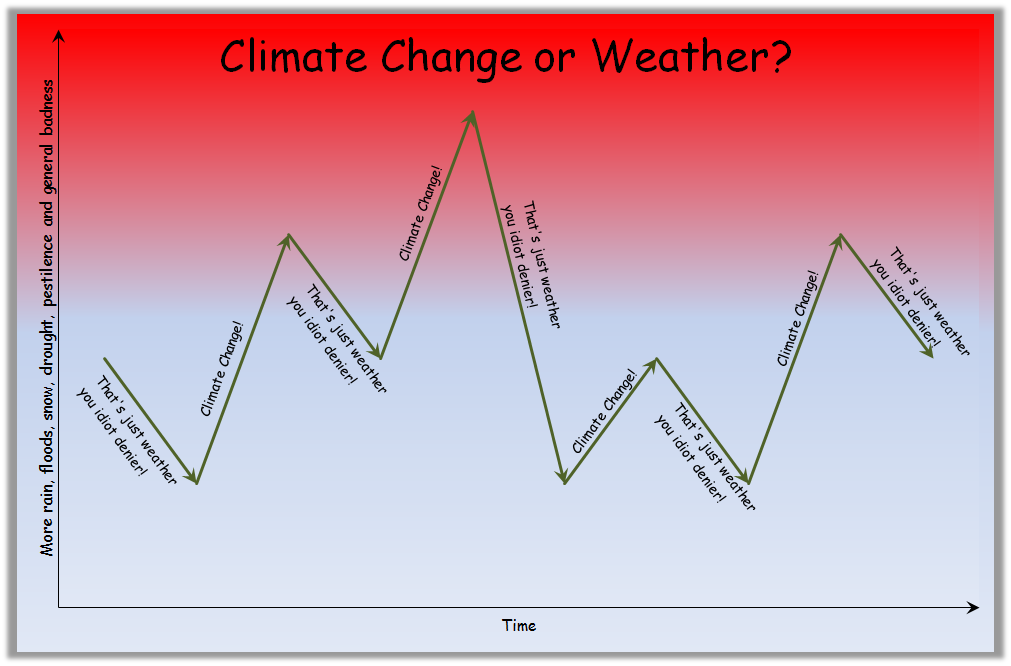
Unlike all the other (dozens? scores? hundreds?) times since the 1970s we’ve been warned about imminent climatological disaster unless we gave up on industrial civilization, heating our homes, and all the other white supremacist, racist, colonialist, transphobic, etc., exploitations we have been enjoying up to now, we’re finally out of time and we must act NOW:

COP26 is an extravaganza of ideological conformity. From the 30,000 delegates and heads of state sequestered in the “blue zone” to the NGOs, academics and green businesses exhibiting in the public “green zone”, the message is the same. There is nothing to debate anymore. The climate catastrophe is coming. Now is the time for action.

Similar sentiments abound outside COP26, where the protesters are gathered. There the likes of young eco-millenarian Greta Thunberg also claim that the end is nigh, that the time for debate is over. Or as the Swedish teenager herself put it during a protest on Sunday, there’s no need for any more of this “blah, blah, blah”.

This is essentially what all those in and around COP26 are saying. That, in effect, there is nothing to debate anymore. And so, over the next few days, Western-led policymakers, angrily cheered on by protesters, will try to decide our futures for the next few decades. They will regulate, restrict and limit. And they will be able to do so without dissent or debate.

How have we got here? How have we ended up at a point where debating climate change has become nigh-on impossible? The answer lies principally in the use and abuse of the authority of science. The standard justification for shutting down those challenging the alarmist climate-change narrative amounts, effectively, to saying “the science has spoken”.

This was clear in the run-up to COP26, when Mark Lynas, a long-time environmentalist campaigner and now a visiting fellow at Cornell University, published a widely reported-on study asserting that the scientific consensus that humans are altering the climate is now agreed upon by 99.9 per cent of scientists. That’s how certain The Science now is. Not just 97 to 98 per cent certain, as it used to be, but 99.9 per cent certain. “It is really case closed”, said Lynas. “There is nobody of significance in the scientific community who doubts human-caused climate change.”

“Case closed.” No “doubts” and no appeal. These are revealing words. Climate change has long since ceased to be an issue to be addressed, or a set of challenges to be overcome. It is now the revealed truth, the God-like judgement around which we must organise the entirety of societal life. To question this truth is tantamount to apostasy. Hence Lynas calls for any remaining heretics to be censored, urging Facebook and Twitter “to look at their algorithms and policies” to root out “climate misinformation”.

Indeed, those daring to question any aspect of the alarmist narrative are now routinely dismissed not as heretics, but as “deniers” – a term which morally equates those who question, say, certain decarbonisation policies with anti-Semites who deny that the Holocaust happened.

November 4, 2021

QotD: The “Righteousness Fallacy”, California style

… the righteousness fallacy, which Barry Brownstein noted is rampant in modern politics and a key driver of democratic socialism.

The Righteousness Fallacy (also known as the fallacy of good intentions) is described by author Dr. Bo Bennett as the idea that one is correct because their intentions are pure.

It recently occurred to me that California is a perfect example of this fallacy. Consider these three facts about the Golden State:

  1. California spends about $98.5 billion annually on welfare — the most in the US — but has the highest poverty rate in America.
  2. California has the highest income tax rate in the US, at 13.3 percent, but the fourth greatest income inequality of the 50 states.
  3. California has one of the most regulated housing markets in America, yet it has the highest homeless population in American and ranks 49th (per capita) in housing supply.

That politicians would persist with harmful policies should come as little surprise. The Nobel Prize-winning economist Milton Friedman once observed the uncanny proclivity of politicians “to judge policies and programs by their intentions rather than their results”.

In his book Capitalism and Freedom, Friedman described the danger of such thinking.

    [The threat comes] from men of good intentions and good will who wish to reform us. Impatient with the slowness of persuasion and example to achieve the great social changes they envision, they’re anxious to use the power of the state to achieve their ends and confident in their ability to do so. Yet … Concentrated power is not rendered harmless by the good intentions of those who create it.

Jon Miltimore, “Data Show California Is a Living Example of the Good Intentions Fallacy”, Foundation for Economic Education, 2019-01-09.

November 2, 2021

Election day in Virginia

Filed under: Education, Government, Politics, USA — Tags: , , , , — Nicholas @ 03:00

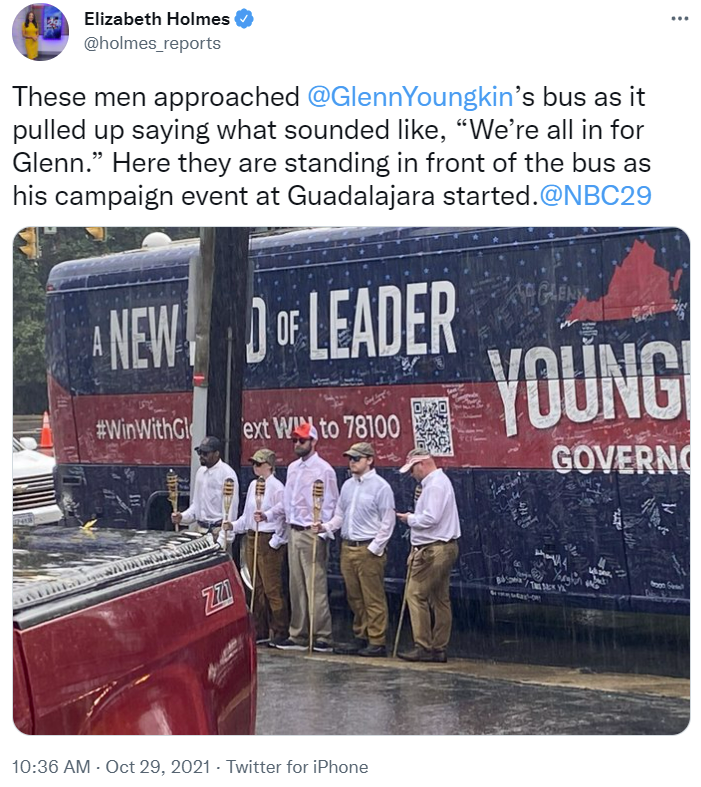
Mark Steyn writing about the Tuesday state elections being held in Virginia, which certainly seemed to become much more competitive as larger concerns about the school system energized a lot of parents, and a Republican-in-name-only group plays dirty tricks on the Republican candidate for governor:

“Republican” group trolls Republican candidate in the Virginia election campaign, October 2021.

Tuesday is what less evolved societies than Virginia still quaintly call “Election Day”. The Democrat candidate, the unlovely Clinton bagman Terry McAuliffe, claims that “we are substantially leading on the early vote”. In the fullness of time he will also be substantially leading on the late vote, if he isn’t already.

That leaves the votes on Voting Day up for grabs. The Republican candidate, Mr Youngkin, is a squish of no fixed beliefs who will govern as Mitt did in Massachusetts or Pataki did in New York. But he has been handed a winning issue that he would probably not have chosen save for public outrage — the state of Virginia schools in an age of “critical race theory” and trans-mania. It’s bigger even than an education issue: The left is so boundlessly ambitious that it is abolishing biological sex, and if it gets away with it will leave an awful mountain of human wreckage in its wake, bigger even than its other innovations.

Every Virginian should vote on Tuesday — because Youngkin’s campaign is a classic example of Milton Friedman’s dictum: in politics you don’t wait for the right people to do the right thing, you create the conditions whereby the wrong people are forced to do the right thing. That is what parents at school-board meetings have been doing, and they deserve to be rewarded for it.

Virginia is a state where a rapist gets transferred to another school because he/she belongs to a protected class, rapes again, and, when you protest the anal rape of your daughter by a known rapist, you’re the guy who gets thrown to the ground and arrested. Whether one finds the foregoing objectionable shouldn’t really be a Republican/Democrat thing, but such is the moral depravity of the cultural heights that Dems are all in on the convicted sodomizer and only squaresville low-status GOP candidates can muster even pro forma objections. So in 21st-century Virginia insouciance about schoolgirl anal rape is now a partisan thing.

Of course, it remains to be seen whether the state’s election system is sufficiently honest to reflect fairly that public outrage. If at, say, 10pm on Tuesday night Youngkin is narrowly ahead but you wake up on Wednesday morn to find McAuliffe has been the beneficiary of all the 3am votes, well, Republicans will be forgiven for suspecting that “fortifying” the “two-party system” into something rather more streamlined is here to stay.

I say that as an immigrant who never feels more foreign than on America’s hideously chaotic yet oddly purposeful election nights. But then in Northern Virginia a quarter of the population is now foreign-born, and half of those arrived in the last twenty years. That’s a remarkable statistic for a so-called “Old Dominion”. Demography is destiny, and in an ever more tightly circumscribed public discourse there are decreasing opportunities even to raise the topic.

« Newer PostsOlder Posts »

Powered by WordPress