Quotulatiousness

December 30, 2022

The continued relevance of Orwell’s “Politics and the English Language”

Filed under: Books, Britain, History, Politics — Tags: , , , , — Nicholas @ 03:00

In Quillette, George Case praises Orwell’s 1946 essay “Politics and the English Language” (which was one of the first essays that convinced me that Orwell was one of the greatest writers of the 20th century), and shows how it still has relevance today:
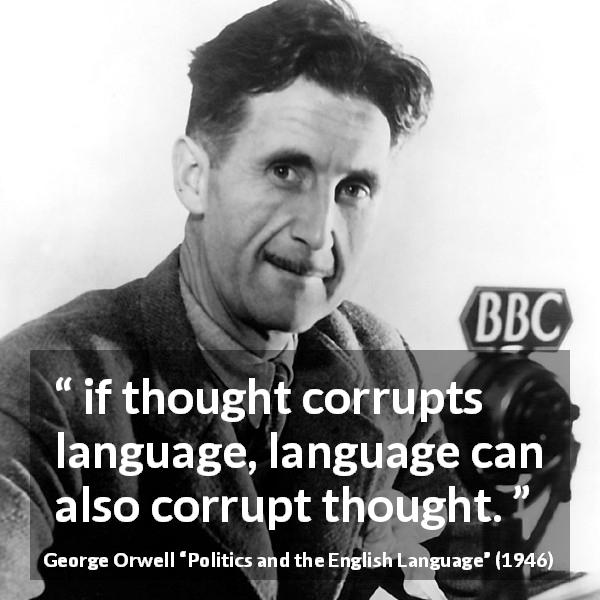
George Orwell’s “Politics and the English Language” is widely considered one of the greatest and most influential essays ever written. First published in Britain’s Horizon in 1946, it has since been widely anthologized and is always included in any collection of the writer’s essential nonfiction. In the decades since its appearance, the article has been quoted by many commentators who invoke Orwell’s literary and moral stature in support of its continued relevance. But perhaps the language of today’s politics warrants some fresh criticisms that even the author of Nineteen Eighty-Four and Animal Farm could not have conceived.

“Politics and the English Language” addressed the jargon, double-talk, and what we would now call “spin” that had already distorted the discourse of the mid-20th century. “In our time,” Orwell argued, “political speech and writing are largely the defence of the indefensible. … Thus political language has to consist largely of euphemism, question-begging and sheer cloudy vagueness. … Political language — and with variations this is true of all political parties, from Conservatives to Anarchists — is designed to make lies sound truthful and murder respectable, and to give an appearance of solidity to pure wind.” Those are the sentences most cited whenever a modern leader or talking head hides behind terms like “restructuring” (for layoffs), “visiting a site” (for bombing), or “alternative facts” (for falsehoods). In his essay, Orwell also cut through the careless, mechanical prose of academics and journalists who fall back on clichés — “all prefabricated phrases, needless repetitions, and humbug and vagueness generally”.

These objections still hold up almost 80 years later, but historic changes in taste and technology mean that they apply to a new set of unexamined truisms and slogans regularly invoked less in oratory or print than through televised soundbites, online memes, and social media: the errors of reason and rhetoric identified in “Politics and the English Language” can be seen in familiar examples of empty platitudes, stretched metaphors, and meaningless cant which few who post, share, like, and retweet have seriously parsed. Consider how the following lexicon from 2023 is distinguished by the same question-begging, humbug, and sheer cloudy vagueness exposed by George Orwell in 1946.

[…]

Climate, [mis- and dis-]information, popular knowledge, genocide, land claims, sexual assault, and racism are all serious topics, but politicizing them with hyperbole turns them into trite catchphrases. The language cited here is largely employed as a stylistic template by the outlets who relay it — in the same way that individual publications will adhere to uniform guidelines of punctuation and capitalization, so too must they now follow directives to always write rape culture, stolen land, misinformation, or climate emergency in place of anything more neutral or accurate. Sometimes, as with cultural genocide or systemic racism, the purpose appears to be in how the diction of a few extra syllables imparts gravity to the premise being conveyed, as if a gigantic whale is a bigger animal than a whale, or a horrific murder is a worse crime than a murder.

Elsewhere, the words strive to alter the parameters of an issue so that its actual or perceived significance is amplified a little longer. “Drunk driving” will always be a danger if the legal limits of motorists’ alcohol levels are periodically lowered; likewise, relations between the sexes and a chaotic range of public opinion will always be problematic if they can be recast as rape culture, hate, or disinformation. This lingo typifies the parroted lines and reflexive responses of political communication in the 21st century.

In “Politics and the English Language”, George Orwell’s concluding lesson was not just that parroted lines and reflexive responses were aesthetically bad, or that they revealed professional incompetence in whoever crafted them, but that they served to suppress thinking. “The invasion of one’s mind by ready-made phrases … can only be prevented if one is constantly on guard against them, and every such phrase anaesthetizes a portion of one’s brain”, he wrote. He is still right: glib, shallow expression reflects, and will only perpetuate, glib, shallow thought, achieving no more than to give an appearance of solidity to pure wind.

December 28, 2022

The Twitter Files – “How does anyone run a business under these conditions?”

Chris Bray on the sheer magnitude of government(s) meddling in Twitter’s business (even though, yes, Twitter’s management was totally on-board politically with most or all of this meddling):

[…] Twitter has been constantly flooded with requests from at least dozens of separate federal entities, all of them needy and pushy and consuming the company’s time and energy: CENTCOM wants a meeting this week and CDC wants a meeting this week and NIH wants a meeting this week and the FBI wants a meeting this week and the White House wants a meeting this week and DHS wants a meeting this week and DOD wants a meeting this week even though CENTCOM already has one, and several members of Congress have some concerns they want the senior team to address this week, and …

Now: Twitter is a global platform. I would bet a kidney that there’s a Twitter Files equivalent for the Ottawa Police Department during the Freedom Convoy, and an RCMP file, and a Trudeau government file, and that Chrystia Freeland had some thoughts to share about some tweets she didn’t like. I would bet the other kidney that Twitter has equivalent files, in dozens of languages, from multiple government agencies in Iran and New Zealand and Australia and the Netherlands and the UK and Brazil and on and on an on.

As for my third kidney — just go with it, and we’ll clean up the biological metaphors later — state and local governments also expect Twitter to act on their content concerns and complaints about disinformation, which means fifty governors and attorneys general and state directors of public health and state police commanders picking up the phone, and 3,243 sheriffs and district attorneys and public health directors expecting to be able to reach out to their partners at Twitter, and close to 20,000 mayors and police chiefs, and thousands of state legislators and tens of thousands of city councilmembers, and on and on and on. “You tell this Jack Dorsey that I’m the damn mayor pro tem here in Glendale, and I want my concerns to be dealt with.”

And so, if we accept the premise that governments have special rights to demand content moderation, if the staff director of a legislative committee in the Arkansas state legislature and a sheriff in Maryland and the flag officers at all the MACOMS and Jen Psaki’s deputy assistant and a member of a county board of supervisors in Oregon and the chief of staff to the governor of Rhode Island, being Very Important People, all expect to by God get a direct meeting with Twitter executives because @buttchug623 is saying some things that they do not like at all, and oh by the way the prime minister of the Democratic Republic of the Congo is holding on line 6 and he’s pissed and when can you pencil in a half-hour with Turkmenistan’s finance minister, then how much does it cost to manage all of those relationships?

The regulatory affairs staffing buries the business — you can’t pay for that much face time with that many self-important officials. We need to schedule the senior management team for a meeting with the White House this week, ’cause they don’t like Alex Berenson. How does anyone run a business under these conditions? “Before you cook that cheeseburger for order number seven, the deputy assistant secretary for sustainable agriculture would like to share some thoughts on the environmental trajectory of industrial protein cultivation. And about that milkshake …”

In addition to the free speech problem and the pathologies of gleichschaltung, the Twitter files are about the way government without boundaries consumes resources from every entity it touches.

Twitter’s path to bankruptcy runs through the premise that every government official who doesn’t like a tweet deserves a meeting.

December 23, 2022

Never, ever be the first to stop clapping

Filed under: Europe, Media, Politics, USA — Tags: , , , — Nicholas @ 05:00

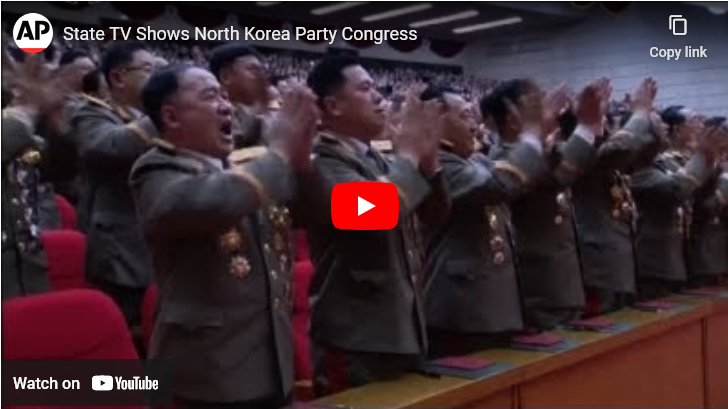
Chris Bray on the echoes of Soviet-era mandatory celebrations expected of US elected politicians during a speech by Comrade Stalin to the Politburo state visit by the President of Ukraine:

I hesitate to say any of this, because it’s December 22 and none of us should be thinking about the grotesqueries of the political and media classes, but it’s been a busy week for them. I started writing here a little more than a year ago, and have argued since the beginning that our notional leadership classes have developed a set of ritual behaviors that are entirely severed from any form of reality you’ll ever see in your own daily life. (Dana Loesch: “You can’t run a country you’ve never been to.”)

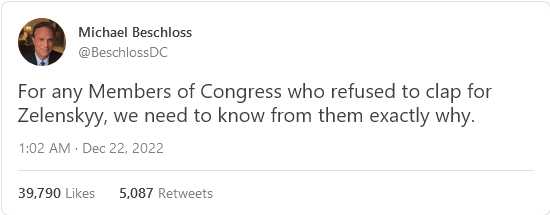
And so here’s one of the least subtle court eunuchs with a message about ritual obedience:

I wish I could replicate the awkward burst of nervous laughter that came out of me at the moment that I saw this message. The policing of performative applause in a formal political setting is so obviously a theme of totalitarian societies that … well, that Chief Eunuch Michael Beschloss can be counted on to not notice what he’s just done. I didn’t get a harumph outta that guy, he said, from deep inside a cloud of obtuse self-regard.

“They insist on inflicting on us such bloated theater & they seem not to know how false it all appears.” The Ukrainian president made it all the way to the Capitol in his combat fatigues, doncha know, and was greeted with a rapturous standing ovation by members of Congress, seen here in this actual footage:

Are there any normal human beings who don’t taste bile when they see this performance? And, Thomas Massie and Rand Paul aside, are there any normal human beings left inside the Beltway?

“Squee! Squee! Squee!” they explained, shaking their pom poms in a dignified ritual of state.

QotD: Wokeness as a lifestyle

Filed under: Media, Politics, Quotations, USA — Tags: , , , , , , — Nicholas @ 01:00

The quick and dirty version is: Since the goddamn Boomers will never, ever retire — they’ll keep patting themselves on the back for Sticking It to the Man until they’re lowered into their tie-dyed, patchouli-reeking coffins, even though they’re all hedge fund managers and live in McMansions — the subsequent generations had to find a new area in which to compete for social status. Thus lifestyle striving for Gen X, and persona striving for the Millennials.

For Gen X, think of my personal candidate for “everything that’s wrong with the 90s, all in one place,” the 1994 movie Reality Bites. Don’t rent it unless you’re current on your blood pressure meds. It’s four of the 1990s’ most insufferable people (Winona Ryder, Ethan Hawke, Ben Stiller, Janeane Garofalo) quipping about being slackers. Well, except Stiller (also the director), who plays the grasping, uptight, sold-his-soul-to-The-Man yuppie foil to the other three. Stiller is the Gen Xer who chose to compete in the oversaturated career arena; he’s cartoonishly evil. The rest of them hang out in coffee houses, polishing their image. They’re lifestyle competitors.

For Millennials, and whatever we’re calling the upcoming generation (“The Lobotomized Snowflake Posse” is my suggestion, brevity be damned), well, just look at social media. Even lounging-around-Starbucks lifestyle competition is out of reach for people who went $100K in the hole for a Gender Studies degree. The only currency they’ve got is effort — hey, didn’t Karl Marx say something about that? — so Twitter becomes their full time job. Xzhe with the most followers wins.

Severian, “Why So #Woke?”, Rotten Chestnuts, 2020-01-07.

December 22, 2022

The Emulsified High-Fat Offal Tube | Yes, Minister: 1984 Christmas Special | BBC Comedy Greats

Filed under: Britain, Bureaucracy, Humour, Media, Politics — Tags: , , , — Nicholas @ 02:00

BBC Comedy Greats
Published 26 Jul 2021

Bernard (Derek Fowlds) walks Jim Hacker (Paul Eddington) through the red-tape of signing his Christmas cards, but Jim Hacker is more concerned with worrying plans from Brussels to rename the British sausage.
(more…)

December 19, 2022

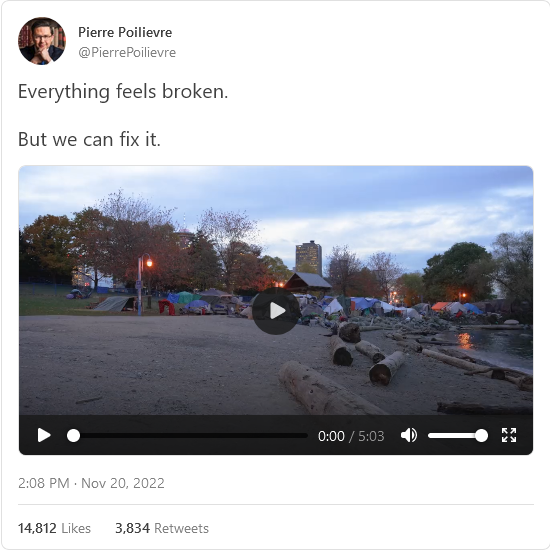
“[T]he major promoter of the ‘Canada is broken’ thesis over the past few years has been … Justin Trudeau”

Filed under: Cancon, Media, Politics — Tags: , , , — Nicholas @ 05:00

In the free-to-cheapskates exerpt from this week’s Dispatch from The Line, they set up the possible lines of attack for the next federal election:

What was more interesting to us this week were the comments made by Prime Minister Justin Trudeau to thousands of Liberals at a large in-person Christmas party. As one does at any good Christmas party, the PM took the chance to, uh, savage his rivals. To wit: “Canada is not broken … Mr. Poilievre might choose to undermine our democracy by amplifying conspiracy theories. He might decide to run away from journalists when they ask him tough questions. That’s how he brands himself. That’s his choice. But, when he says that Canada is broken, that’s where we draw the line.” (Full video of the speech is available via CTV News).

The PM was responding, of course, to a recent line of attack favoured by the Conservatives: that Canada is broken, and we need the Conservatives to fix it.

There are three comments we’ll make in response to this.

The first is strictly an analysis: Trudeau is staking out some interesting rhetorical ground. We aren’t sure this will be the ground on which the next campaign is fought over — God only knows what’ll happen between now and whenever we are next headed to the polls. But if this is the subject of our next “ballot question”, well, that’s just fascinating. “Sunny Ways” vs. “Everything Is Broken and It’s Your Fault.”

How fun! Both men would be able to make an honest pitch for their case. As we’ve written before, the Liberals seem exhausted and spent. They’ve accumulated baggage since their first smiley-faced win back in 2015, and the country has been thoroughly battered by events since then. That suggests that Poilievre, who is at his best when on the attack, could mop the floor with Trudeau.

That said, we don’t take that outcome as a given. First, Trudeau is a damned good politician, better than the Conservatives still give him credit for, and though we are starting to wonder if Trudeau is past the point of no return, we will never count him out. We also think that if the Conservatives make “Things are terrible” the centrepiece of their next campaign, may find that Canadians recoil. Canadian pride is a fragile, brittle thing, and while many of us may feel like things are bad, it’s not clear to us that Poilievre saying so won’t rub a lot of voters the wrong way.

But we honestly don’t know. That’s why it’s fascinating.

The second point is a bit of a reminder: It is worth noting that the major promoter of the “Canada is broken” thesis over the past few years has been … Justin Trudeau. We don’t think we — your Line editors, the media, Canadians in general — should let him take such casual re-occupation of the “Sunny Ways” position, since he’s spent the last five years absolutely dumping on Canada, its history (genocide), its symbols (the flag), and its institutions (the military, amongst others). No one has done more to proclaim Canada broken than Justin Trudeau. Is he now claiming that he’s fixed all the problems he’s spent the last half decade making political hay over?

We mean … the guy won’t even fix his house.

The third point is our own view: of course Canada is broken. And Trudeau has done nothing to fix it.

Now, we have to define our terms here. “Broken” isn’t “destroyed”. We don’t think we’re descending into some kind of post-apocalyptic wasteland. It remains undeniably true that Canada is, in global terms, a nice place to live. Safe. Lots of food. No one is firing missiles at us. Sweet! But, like, gosh, folks. Look around. If the PM really wants to assert that Canada isn’t broken, we’ll agree insofar as it’s not so broken that the average person fears starvation and violent death. Sure. But that average person also probably can’t get a passport, or a family doctor, or timely care in an emergency room, or a house in a big city where the jobs are clustering, or Tylenol for their kids.

“Both sides have their crazy folks … But usually, they’re on the semi-fringe”

Filed under: Media, Politics, USA — Tags: , , , — Nicholas @ 03:00

Tom Knighton on the increasing difficulty of taking some people seriously:

There are some people who are completely unhinged. We all know this and have seen it ourselves throughout our lives. This is especially true if you spend much time in the political space.

Both sides have their crazy folks. They exist in the realm of conspiracy theories, rationalizations, and fearmongering with absolutely no basis in reality.

But usually, they’re on the semi-fringe.

Or, at least, they used to be.

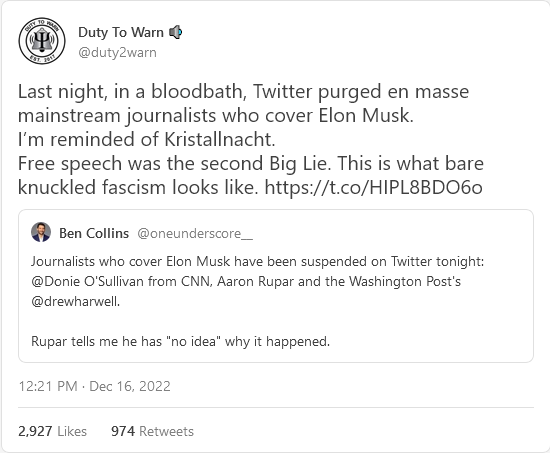
However, I came across this tweet from an account with over 400,000 followers and reportedly run by a group of mental health professionals, and if this isn’t the height of unhinged, I don’t know what is.

Now look, I know that the official reason these journalists were suspended was because of doxxing, but I don’t know just how valid that is. I didn’t see their tweets so I can’t say.

I do know that they caught a seven-day suspension, so they’ll all be back.

But for these jackwagons to claim it reminds them of Kristallnacht

At least 91 Jews were murdered during Kristallnacht. Some experts say the actual death toll should be higher due to post-arrest maltreatment with at least one saying over 630 people died as a result of Kristallnacht.

I looked to see if this was a parody account, but it doesn’t look like it, which means these dipsticks are serious.

And that’s terrifying.

See, if they’re mental health professionals, then it means at least some in our mental health system are crazier than most trying to get help in the first place. This is beyond deranged.

And yet, it’s unlikely that those more than 400,000 followers are hate followers. They’re people who actually like what these people say and take it seriously. That’s downright terrifying.

QotD: When reality fails to follow the model, ditch reality

Alexander wept, for he saw there were no more worlds to conquer …

I get that, man. On some fundamental level. But that makes me a generally unhappy guy. So it is, so it has always been.

For whatever reason, the Leftist is able to externalize that. If there are no more worlds to conquer, well, that’s the world’s fault. I remember hanging out with some of the Political Science goofs at Flyover State. For whatever reason, they rank pretty high for Poli Sci — their department developed some measure of whatzit to better analyze the doodad, you know how it goes, the Karl Roves and James Carvilles of the world all use it.

Anyway, this was 2004, when George W. Bush won his reelection campaign against Kerry. Exactly zero of the Flyover State Poli Sci goofs predicted that. They were all certain that Kerry was cruising to victory. When I pointed out that this seems to be a BIG flaw in their precious model — the election wasn’t even particularly close — their response was instructive: It wasn’t the model’s fault. Rather, it’s that the American public chose to throw a temper tantrum.

That’s seriously what they went with. There’s the actual, observed behavior of 70 million people; and there’s your model; and when the one contradicts the other, the only possible explanation is: All those people are idiots.

(One of those grad students I was talking to ended up doing something “unofficial” yet fairly important for the Hillary Clinton campaign in 2016; if I’d known that, I could’ve called it for Trump at the very start of election and made a fortune on prop bets).

It’s probably genetic for them, too. Which is either hopeful or depressing, depending, but I think it answers the question: Why does society end up being ruled by Very Clever Boys? They just can’t do anything else. They can’t internalize; they have game the system. Have to. A society that wants to survive must find a system for them to game, somewhere far isolated from the real affairs of people.

Severian, “Me vs. The World”, Founding Questions, 2022-09-14.

December 18, 2022

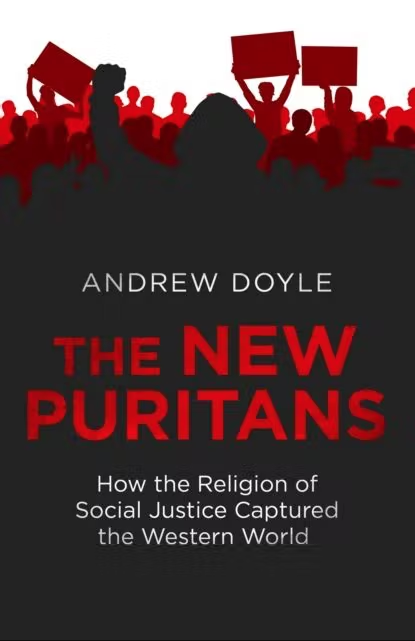
Christopher Snowden reviews Andrew Doyle’s The New Puritans

Filed under: Books, Britain, Education, Media, Politics — Tags: , , , , , — Nicholas @ 03:00

In The Critic, Christopher Snowden praises Doyle’s recent book:

How wrong I was. As Andrew Doyle shows in The New Puritans, it took only a few years for Critical Social Justice to infect the corporate world, government agencies and the media. Most worryingly for a system of thought that favours “lived experience” over objective truth, it became pervasive in higher and lower education.

Doyle had been warning about this for years and kept the receipts. He has a long list of examples of institutional idiocy and persecution to show that there is more to concerns about the “woke brigade” than a right-wing panic over a handful of crazies.

So divorced from reality is Critical Social Justice, that unintentional humour often arises: the CEO of Stonewall accusing lesbians who refuse to date trans women of “sexual racism”; activists becoming uncomfortable with the phrase “trigger warning” because it invokes guns; an American professor of education asserting that “on many levels, mathematics itself operates as whiteness” (how many levels?).

[…]

Those of us who will never be intimately acquainted with the Frankfurt School owe a debt to Doyle for calmly dissecting the anti-liberal worldview. Doyle himself is a left-wing homosexual who is often portrayed as a Nazi on social media for defending free speech and mocking the “entitled demands and infantile tantrums” of the woke mob.

Borrowing a phrase from Isaiah Berlin, he argues that we are living through a “Counter-Enlightenment” led by “conformists with pretensions of radicalism”. The woke ideology is not a natural extension of left-liberalism, he says, nor of political correctness. It is something far more sinister, regressive and authoritarian. In its Year Zero approach to knowledge and history, it is almost nihilistic.

Academically rigorous but never pretentious, The New Puritans is virtually unimprovable as an analysis of this chilling social phenomenon. It begins and ends with the Salem witch trials of 1692–93, when two vindictive children sent 20 people to their deaths on the basis of nothing more than “spectral evidence” (AKA “lived experience”). The mania ended as quickly as it began when the adults in the room simply stopped believing them.

Doyle believes the current madness will end the same way if we can return to critical thinking and put a stop to ad hominem attacks. Good luck with that. Most of the people he is writing about would sooner burn this book than read it.

December 17, 2022

Canada’s consciously anemic foreign and military policies

In The Line, Matt Gurney explains why Canada consistently fails to “punch above their weight” in foreign and military matters and that it’s not at all accidental:

Canadian politicians have an inputs problem. Maybe that’s actually the wrong way to describe it — the problem is with the outputs. But it’s the inputs they love talking about.

If that all sounds a little vague, maybe this sounds familiar: “Hey there, citizen. Alarmed about Troubling Issue X? Well, don’t worry. We’re pledging $300 million over the next six years to Troubling Issue X. Oh, and Annoying Irritant Y? We’re announcing a task force to report back on that.”

Does Troubling Issue X get solved? Does Annoying Irritant Y get less annoying and irritating? Eh. We probably don’t collect enough stats to even know. The purpose of the announcement isn’t to solve the problem. It’s to announce something and hope people stop paying attention.

Canadian politicians — especially the current federal government — are notorious for announcing the same “new thing” in as many ways and in as many different contexts as they can. They get several hundred dollars of positive press coverage for every actual dollar spent on whatever the announced spending is supposed to be devoted toward. If they can recycle announcements from months past into a new set of announcements, you’re pretty much guaranteed they’ll do it. Announcing spending is, one must assume, what gets people to cast their votes for the party announcing the spending.

A lot of what looks like policy failure in Canadian foreign and military affairs only looks like a failure when you forget that accomplishing something wasn’t the point. Being photographed and videotaped saying you’ll accomplish something was the point. And the announcement itself accomplishes that!

This was true even before the Trudeau government started handing out bushel baskets of money to various Canadian newspapers, TV networks, magazines, and other legacy media entities. What was once merely praise is now bought sychophancy from the (literally) paid media.

On the military side of things, the Canadian Armed Forces are an organization the government grudgingly funds, but only enough to look good for the self-same media:

It’s not that Canada accomplishes nothing on the world stage. We accomplish things. Sometimes we even play an outsized role — Canada did, for instance, perform well and above expectations in Kandahar. The odd exception aside, though, when it comes to foreign policy generally and especially with defence policy, successive Canadian governments have set a very clear target: we will do, technically, more than nothing. We won’t often do much more than that. But we’ll do enough to not get kicked out of the club of allied nations.

Why do we want to be in the club? Not because we feel any sense of duty or obligation to lead and take on any real burden. But because being in the club makes us safer, and it would, after all, be embarrassing to get kicked out.

It’s important to remember that Canada is, by any standard, a rich country. We could be an actual force for good and stability on the world stage if we wanted to. We could build a bigger fleet and patrol more places, more often — we’d be welcome! We could have a bigger army and lead more peacekeeping missions, or contribute more to NATO. A bigger air force, likewise, could contribute more to our allies, especially in Europe in these unsettled times. In a parallel universe where we did these things, we’d then be able to say with a straight face that the purpose of Canada’s navy was contributing to the safety and security of the seas, the purpose of our army was to assist allies and provide peacekeepers to help end international crises, and the purpose of our air force was to project power and bring support to threatened allies.

In the world we actually live in, though, the purpose of the navy is to technically have a navy that technically does things, the purpose of the army is to technically have an army that technically does things, and the purpose of the air force … you see where this is going, right?

Our navy does things! It shows up places, and patrols areas. But only as much as necessary to technically tick that box. The army is in much the same condition; with a growing number of domestic commitments sapping its strength and budget, even its ability to assist with disasters at home is largely maxed out, but we send a few hundred soldiers here and there, thereby allowing ourselves to proclaim that we’ve … sent soldiers somewhere. The air force, as was just reported this week, can’t even really do even that much this year. The exhausted force is skipping the very modest — a half-dozen fighter jets — annual mission to Europe. The air force is just too burnt out to sustain even that tiny mission.

This is a big and growing problem. Canada, again, is rich enough to make a difference in global security affairs, if we chose to make different choices with how we spend our money. We have made the opposite choice. We field just enough of a military to be able to make just enough difference to avoid being accused of being total deadbeats, and no more.

Can it fight? Eh, maybe a bit. Can it make a difference? Depends how you define “difference”, I guess. Does it make the world and our allies safer? In a way? Can it keep Canadians safe at home? Sort of.

This isn’t a failure of our policy. This is our policy. We show up with as little as possible for as brief a time as possible, but gosh, do we ever talk about the showing up. 

December 16, 2022

“To hear Musk tell it, his motivation is obvious: It’s about saving the world”

Filed under: Business, Media, Politics, USA — Tags: , , , , — Nicholas @ 05:00

Bari Weiss at The Free Press (formerly known as Common Sense) on what went on in preparing to reveal the “Twitter files” and what Elon Musk is hoping to accomplish with Twitter:

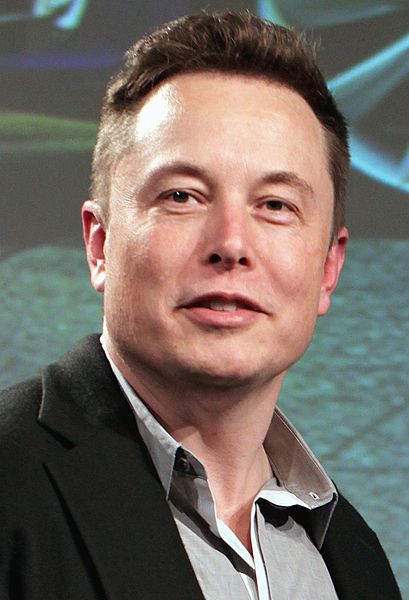
Elon Musk at the 2015 Tesla Motors annual meeting.
Photo by Steve Jurvetson via Wikimedia Commons.

“I’m not going to spend $44 billion to reinstate a satire blog”, Musk said about the Babylon Bee, which had been banned from Twitter in March 2022. “I did it because I was worried about the future of civilization”, he told us late one night. 

As far as Musk sees things, “birth rates are plummeting, the thought police are gaining power, and even having an opinion is enough to be shunned. We are trending in a bad direction.”

He says he wants to transform Twitter from a social media platform distrusted and despised by at least half the country into one widely trusted by most Americans. To have it fulfill its highest mission: that of a digital town square where all ideas can be heard, and the best will win out. 

“If there is one information source that breaks ranks, then I think it ultimately forces others not to have the same narrative”, he said. “If even one organization competes hard for the truth, others will have to follow.” 

To win back that trust, Musk figured it would require being honest about what had, until very recently, been going on at the company he had just bought: the suppression of disfavored users; the curtailing of certain political views; the censorship of stories like the Hunter Biden laptop; and the extent to which the government had tried to influence such decisions.

“We have a goal here, which is to clear the decks of any prior wrongdoing and move forward with a clean slate”, Musk said in one of many conversations that took place over the course of a week. “I’m sleeping at Twitter HQ for a reason. This is a code-red situation.” (He put it even more forcefully on Twitter, where he said that the company was a “crime scene”.) And so he has been sleeping there on-and-off, claiming a sofa. His 2-year-old son, named X, was almost always nearby. 

Musk, who is a South African native, analogized the work of cleaning-house at Twitter several times to a kind of Truth and Reconciliation Commission. But what looks to some like truth and reconciliation can look to others like revenge.

At one point after midnight, as Musk showed off a closet of swag, including t-shirts left by the previous crew that said “Stay Woke”, he joked: “The barbarians have crashed through the gates and are pillaging the merch!”

Remember: After Musk made his offer to buy Twitter in April, he tried to get out of it in July, arguing that the company had not been honest about the percentage of fake users and bots on the site. But the company sued to force the deal, and he went ahead with it. 

Musk estimates that he paid at least twice what it was worth but that he had to “chew down this hairball” — which is to say, he had to buy Twitter. 

The price tag isn’t his only grievance. There’s also the fact that the company, to hear him tell it, wasn’t really a functioning company at all.

When Musk took over, he said, he found Twitter in disarray. Employees had unlimited vacation time and permanent work from home. The company had stopped doing performance reviews altogether, according to a long-time Twitter employee. “As long as Twitter could just keep its head above water and be roughly cash-flow break-even, then that’s all that they cared about”, Musk said. 

Musk calls the Twitter he purchased a “non-profit”. Twitter, as it existed, wasn’t pursuing net earnings but “social influence”, he said. “This was fundamentally an activist organization”. 

Since he took the helm at Twitter, he has fired 80 percent of the staff. He has insisted that those not prepared to be “extremely hardcore” and work “long hours at high intensity” show themselves out. Several engineers I spoke to had been working 18-hour days for the past month. They looked like it.

“It’s like if an aircraft was going in one direction and then suddenly pulled a U-turn and hit the afterburners in the other direction. That’s what happened to Twitter”, Musk said, making a vroom noise and laughing. 

December 14, 2022

Point – “Society cannot be so radically changed”

Filed under: Health, Media, Politics, USA — Tags: , , , , , , — Nicholas @ 05:00

Counterpoint – Western culture since 1960:

“The Pill” by starbooze is licensed under CC BY-ND 2.0 .

The discussion of the causes of the problem is clear enough, whereas the discussion of possible solutions leaves much to be desired.

It seems to me rational to say that if the loss of family life was caused by the pill leading to abortion leading to the normalization of fornication, which in turn leads to ten percent of high-status males being sought by sixty percent of females, which in turn incentivizes fornication — because any woman unwilling to play the unpayed whore on the first date will be quickly replaced by one more willing — and if this in turn leads to a anti-child culture where the normal expectations and social support for mothers with children is lost, that therefore the solution is not to have maternal women try harder and made more sacrifices than the grandmothers were asked to make.

The solution is to normalize monogamy, which is impossible as long as contraception is not seen as the grave moral evil it is. Hence the solution, as soon as the culture atmosphere permits it, is to illegalize contraception.

After 1930 Lambeth Conference, the Anglicans spoke of contraception as permissible. The resolution, which passed 193 to 67 with 47 abstentions, is said to be the first instance where any responsible authority – not simply in Christendom but in any culture – had publicly supported, in any way at all, the use of artificial contraception.

Many other denominations followed suit and caved in on this issue.

The Roman Catholic Church teaches, and maintains, that contraception, in addition to being imprudent and damaging to the woman’s long-interests best interests, is a sin.

This is an ancient teaching which reaches back to the First Century. See, for example, the teaching manual of the Apostles, the Didache reads: “You shall not practice birth control, you shall not murder a child by abortion, nor kill what is begotten”. — Many scholars translate this as “practice sorcery” or “use potions” because the Greek word “pharmakon” (from which we get our word for pharmaceutical) sometimes has that meaning. However, it also means to use medicines, potions, or poisons, and the term was also used to refer to contraceptive measure, as it does here.

This is a core Christian teaching, and always has been.

The medical knowledge that chemical contraception, aka “the pill”, meddles with female hormones and induces depression and other mental disorders apparently is an insufficient motivator to reverse this poisonous addiction by the whole society.

Does returning to a society that respects women, follows wisdom, and disapproves of sex desecrated to mere recreation, and forbids our womenfolk to be degraded to harlots, seem impossible? Look around you. The sexual grooming of gradeschoolers and the surgical mutilation of their genitals due to sexual neurosis is a direct result of the sexual revolution, as is the abomination and absurdity of Orwellian gay marriage.

It may not be as impossible to convince the public that the alternative of happy marriages is so much less desirable than the hell of sexual self-mutilation, pornography, and perversion seen around us. It is not as if the Left will be satisfied with castration and mastectomy performed on children, once this is normalized. They will move on to the next thing, and after that, the next.

There is no final level. Hell is bottomless.

PayPal channels its inner Justin Trudeau

Filed under: Business, Cancon, Politics, USA — Tags: , , , , — Nicholas @ 03:00

Canada’s current Prime Minister found a neat work-around to punish peaceful protestors and their small-scale financial backers by getting Canada’s chartered banks to freeze their bank accounts and credit cards. He didn’t bother getting a law or even an Order-in-Council to do this. He merely had the Finance Minister have a friendly chat with the banks’ CEOs and it was a done deal at least for a few hundreds or thousands of Canadians. PayPal clearly admires Justin Trudeau’s forthright moves to crush dissent and — being a financial institution itself — has been doing similar things to wrongthinking individuals and organizations who (used to) use PayPal’s services:

If you’re one of the lucky ones and your account has just been suspended, you can go to customer service, explain your situation and hope that someone gets back to you. If you’ve been banned, you’ll need an attorney to file a subpoena for the internal PayPal documents — simply to learn why you’ve been banned. (Good luck getting unbanned.)

These are entrepreneurs, writers, academics, activists — the very same people PayPal, whose mission is “democratizing financial services”, was meant to empower. 

PayPal won’t say how many of them it has suspended or banned. In June 2021, the Electronic Frontier Foundation and other civil-liberties groups wrote a letter to PayPal and Venmo, calling on them to open up. So far, they have not, said Aaron Terr, director of public advocacy at the Foundation for Individual Rights and Expression.

The people who founded PayPal — the so-called PayPal Mafia — include Peter Thiel, Elon Musk, David Sacks and Max Levchin. All are champions of free speech. All have expressed shock and dismay at what is happening to the company they created. Several founders agreed to talk with The Free Press for this article.

“If the online forms of your money are frozen, that’s like destroying people economically, limiting their ability to exercise their political voice”, Thiel told me. “There’s something about destroying people economically that seems like a far more totalitarian thing.” [Justin Trudeau smiles]

When they launched PayPal, in December 1998, the founders imagined themselves connecting people to the global economy by sidestepping the hefty fees charged by credit-card companies and the inflationary policies of poorly run governments. Early PayPal users had Palm Pilots, and they would beam money from their devices to anyone with an email address. It was especially popular among eBay users. 

“PayPal will give citizens worldwide more direct control over their currencies than they ever had before”, Thiel said at a company meeting, in late 1999. “It will be nearly impossible for corrupt governments to steal wealth from their people through their old means, because if they try the people will switch to dollars or pounds or yen, in effect, dumping the worthless local currency for something more secure.”

Since those early heady days, PayPal has amassed 429 million active accounts. Fifty-eight percent of Americans use PayPal, and in 2021, there were 19.3 billion PayPal transactions. It now has a market valuation of $84 billion. 

But the company that was meant to liberate countless individuals is becoming something else.

Increasingly, it is becoming a police officer. It is deciding what is right and wrong, who gets to be heard, who is silenced. It is locking out of the financial system those people or brands that have slipped outside the parameters of acceptable discourse, those who threaten the consensus of the gatekeepers. The consensus is hard to articulate; it is an ideology lacking clearly defined ideological contours. But the tenets of that consensus are unmistakable: the new progressive politics around race and gender are a force for good, the Covid lockdown was just, the war in Ukraine is noble, and an unfettered exchange of ideas and opinions is an unacceptable threat to all of the above. 

A cynic might say that the original idea, “democratizing financial services”, has been implemented with a capital “D” which makes it all make sense in an American political context.

December 13, 2022

Well, the modern Weimarites were getting overdue for another putsch

Filed under: Germany, Government, Politics, Weapons — Tags: , , , — Nicholas @ 05:00

Apparently, we just missed having a new German Reich last week, due to the lack of a few key ingredients, including mass support, weapons, good planning, and competent coup leaders … or maybe the German government just over-reacted to a non-existential threat:

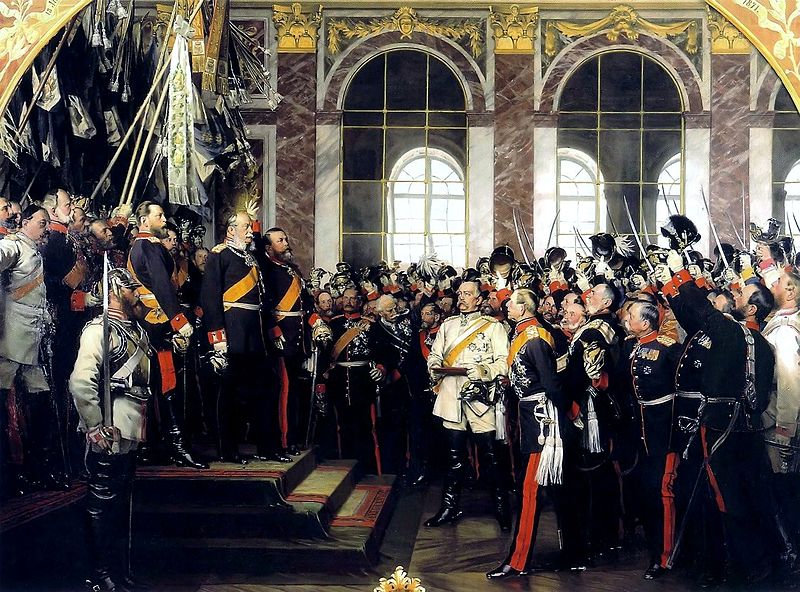
The proclamation of Prussian king Wilhelm I as German Emperor at Versailles, by Anton von Werner. The first two versions were destroyed in the Second World War. This version was commissioned by the Prussian royal family for chancellor Bismarck’s 70th birthday.

The German state oversaw one of its largest anti-terror operations in its modern history last week. Approximately 3,000 police officers arrested 54 suspects in raids carried out on Wednesday morning. Those arrested were members of the Reichsbürger – one of the oddest and most obnoxious movements to have emerged in Germany in recent years. It is alleged that those arrested were conspiring to overthrow the state and install a shadow government headed by an obscure German nobleman.

German chancellor Olaf Scholz was clearly pleased with himself after the raid. He hailed it as an example of Germany’s “defensive democracy” (wehrhafte Demokratie) in action. This refers to the modern German state’s willingness to curtail certain democratic freedoms to protect itself from the far right.

The Reichsbürger are deeply reactionary, anti-democratic and conspiratorial. They claim that the old German Reich, which collapsed at the end of the First World War, was never legally abolished and that modern-day Germany is therefore an illegal construct. They believe Germany’s democracy is a sham, which conceals a secret deep state pulling the strings behind the scenes. In its place, the Reichsbürger want to recreate the Germany of the late 19th century, which includes reinstalling a Kaiser as ruler.

The fact that such a bizarre movement has been growing in size – from around 19,000 supporters in 2019 to an alleged 23,000 in 2022, according to the police – shows us that something is clearly going wrong in Germany. The Reichsbürger have not been growing in a political vacuum. Indeed, they have grown partly as a response to the German government’s authoritarian handling of the Covid pandemic. The Reichsbürger’s black, white and red flags (the colour of the flag of the old pre-1918 German Reich) could often be seen at anti-lockdown demonstrations. This made it all too easy for the pro-lockdown lobby to present any opposition to Covid restrictions as the product of far-right conspiracy theorists.

The Reichsbürger have also been violent at times. During a raid on a Reichsbürger building in 2016, three police officers were injured and one was killed. Earlier this year, one member ran over and seriously injured a policeman with his car. They also have members with military skills. Some of those arrested last week were former German soldiers, including a member of an elite military unit (the KSK).

Yet it is important not to exaggerate the threat the Reichsbürger pose to the German state. Which is what the government deliberately seems to be doing. Interior minister Nancy Faeser spoke of the alleged plotters as a “terrorist threat”, despite the fact those arrested looked more like confused pensioners than hardened insurgents. Indeed, the alleged head of the conspiracy, a 71-year-old member of a largely unknown former noble family, is called “Prince Reuss” (or Prince Henry XIII). A relative of the prince told reporters that, while the “prince” does have nutty ideas and is bitter about his loss of social status, it is hard to imagine him as the ringleader of a conspiracy. At the time of writing, there is also no trace of the huge cache of military hardware that was alleged to be somewhere on the prince’s estate – although some swords, rifles and crossbows have been found.

Unacceptable Views trailer

Filed under: Cancon, Government, Health, Media, Politics — Tags: , , , — Nicholas @ 04:00

Donna Laframboise:

Unacceptable Views is a fantastic new documentary film about the Freedom Convoy protest. All 100 minutes of it can be watched for free on Rumble here. Sharp, marvelous footage. Great interviews with truckers who went to Ottawa.

One of my favourite scenes occurs around the 19:20-minute mark. A Polish immigrant talks about being arrested as a teenager in Poland during the 1981 freedom protests in that country. She looks into the camera and says:

    I’m so proud that the young generation finally have balls and they stand up for the freedom …

The next gentleman who appears on screen, a Sikh, denies witnessing any misogyny, racism, anger, or violence in Ottawa. Instead, he describes the protest as “heaven on Earth, the energy was supreme”.

(more…)

« Newer PostsOlder Posts »

Powered by WordPress