
Rex’s Hangar
Published 21 Sept 2022Today we’re taking a look at the remarkable Brodie Launch System. This device could be used on land or aboard ships, and it was designed to provide accessibility for light aircraft in extremely remote locations during WW2.
(more…)
March 15, 2023
An Aircraft Carrier Without A Deck? | The Remarkable Brodie Landing System
Comments Off on An Aircraft Carrier Without A Deck? | The Remarkable Brodie Landing System
March 12, 2023
Zhukov hits the Ground Running – WW2 – Week 237 – March 11, 1944
World War Two
Published 11 Mar 2023The Soviets launch not one, not two, but three offensives in Ukraine this week, designed to destroy the entire southern wing of the German forces. The Japanese counterattack against the Americans on Bougainville finally begins after months of preparations, but there are more Japanese attacks elsewhere that get going: the operation to invade India.
(more…)
Comments Off on Zhukov hits the Ground Running – WW2 – Week 237 – March 11, 1944
March 11, 2023
Why Japan Surrendered in WW2: Stalin or the Bomb?
Real Time History
Published 10 Mar 2023
It’s common wisdom that the nuclear bombs dropped over Hiroshima and Nagasaki caused the Japanese surrender at the end of the 2nd World War. However, there has been a fierce historical debate if this narrative omits the role of the Soviet invasion of Manchuria in August 1945 — or if this invasion was actually the main cause for the surrender.
(more…)
Comments Off on Why Japan Surrendered in WW2: Stalin or the Bomb?
March 8, 2023
First to the Fight: The Marines’ Reising M50 SMG
Forgotten Weapons
Published 4 Nov 2022Eugene Reising developed a .45 ACP submachine gun in the late 1930s that was basically the opposite of the Thompson — it was light and handy, fired from a closed bolt with a delayed blowback action, and was inexpensive to produce. Reising contracted with Harrington & Richardson to produce the gun, and when it entered the market in early 1940 it found immediate interest from the USMC. Looking initially to equip the Marine Paratroop Regiment (Paramarines), the Corps wanted a gun that was light and compact. The Reising M55 with its folding stock was certainly those things and since the Thompson was essentially unavailable anyway (all production was going to the Army and foreign contracts), the Corps adopted the Reising with initial purchases of both the M50 and M55 in January and February of 1942.
What we are looking at today is an early production M50. It is blued with 29 barrel fins and the early style of sights, stock screw, trigger guard, magazine release, stock (the lacquer coating and sling swivels having been added by a previous owner), and firing pin. Later production guns would be improved and strengthened in various ways, but the Reising would never quite meet the needs of frontline combat troops, much to the displeasure of the Marines who first used them in the Pacific theater. Lacking interchangeable parts and susceptible to fouling and malfunctions, the Reisings were quickly replaced by other arms — some Johnson M1941 rifles, some M1 and M1A1 carbines, and various other guns. Rotated back to duties like ship boarding parties, guards, and military police, the Reising served very well. They were indeed handy and accurate guns, just not built for the extreme rigors of Pacific beach assaults and jungle foxholes.
(more…)
Comments Off on First to the Fight: The Marines’ Reising M50 SMG
March 5, 2023
MacArthur and Nimitz Go Head-to-Head – Week 236 – March 4, 1944
World War Two
Published 4 Mar 2023The American attacks against the Admiralty Islands are successful, but this causes real tensions between commanders Douglas MacArthur and Chester Nimitz. Much of this week is taken up by planning and meetings on both sides — Adolf Hitler plans the occupation of Hungary, Josef Stalin plans new offensives in Ukraine, and the Allies plan to reconfigure their whole front in Italy. It’s all the prelude to an explosion of action.
(more…)
Comments Off on MacArthur and Nimitz Go Head-to-Head – Week 236 – March 4, 1944
February 26, 2023
Tojo Takes Control – Week 235 – February 25, 1944
World War Two
Published 25 Feb 2023Now that the Americans have seized the Marshall Islands, they can bypass the Japanese base at Truk. This impels Prime Minister Hideki Tojo to shake up both army and navy command, and he even takes personal control over the Japanese Army. On the Anzio Front, Lucian Truscott replaces John Lucas as Allied Commander. In the field, the Allies win a big victory in Burma, and in Ukraine, the Soviets are still on the move.
(more…)
Comments Off on Tojo Takes Control – Week 235 – February 25, 1944
February 19, 2023
The Destruction of Monte Cassino – Week 234 – February 18, 1944
World War Two
Published 18 Feb 2023The Allies bomb the monastery atop Monte Cassino in Italy, but just to the Northwest it’s the Germans attacking them at Anzio this week. In the Soviet Union, the Axis break out of the Korsun Pocket, but at great cost, and in the Pacific comes a major Allied raid on the Japanese base at Truk and landings on Eniwetok Atoll.
(more…)
Comments Off on The Destruction of Monte Cassino – Week 234 – February 18, 1944
February 17, 2023
America’s War on Japanese Shipping – WW2 Special Documentary
World War Two
Published 15 Feb 2023We’ve covered in great depth the Battle of the Atlantic and the war by and against German U-Boats, but what about the other side of the world? Why has the war on Japanese shipping been so much quieter? There are several very specific reasons for that, which we look at today.
(more…)
Comments Off on America’s War on Japanese Shipping – WW2 Special Documentary
February 14, 2023
China’s awkward actions on the world stage do not charm the neighbours
CDR Salamander explains why the BRIC (Brazil-Russia-India-China) “coalition” is as unlikely to occur in the real world as any other opium pipe-dream:
Yes, the USA and Canada had our Balloons of February, but in the last year or so, what has China been doing to seem like a pleasant alternative to the United States to the rest of the world?
Her largest neighbor? They get sticks:
The root cause is an ill-defined, 3,440km (2,100-mile)-long disputed border.
Rivers, lakes and snowcaps along the frontier mean the line can shift, bringing soldiers face to face at many points, sparking a confrontation.
The two nations are also competing to build infrastructure along the border, which is also known as the Line of Actual Control. India’s construction of a new road to a high-altitude air base is seen as one of the main triggers for a deadly 2020 clash with Chinese troops.
How bad is the situation?
Despite military-level talks, tensions continue. In December 2022 troops clashed for the first time in more than a year.
It happened near the Tawang sector of Arunachal Pradesh state, the eastern tip of India. Some soldiers suffered minor injuries.
De-escalation work has taken place since a major clash in June 2020. The Galwan Valley battle — fought with sticks and clubs, not guns — was the first fatal confrontation between the two sides since 1975.
At least 20 Indian and four Chinese soldiers died.
Another face-off in January 2021 left troops on both sides injured. It took place near India’s Sikkim state, between Bhutan and Nepal.
The “I” and “C” in the B.R.I.C. are not going to be close friends, ever — one of the reasons I roll my eyes at those who propose the BRIC nations as some kind of power block — something only slightly sillier than the Cold War “Non Aligned Movement.”
With the “B” being the basket case Brazil (always the nation of the future, and always will be), and the “R” being Russia, I mean, child please.
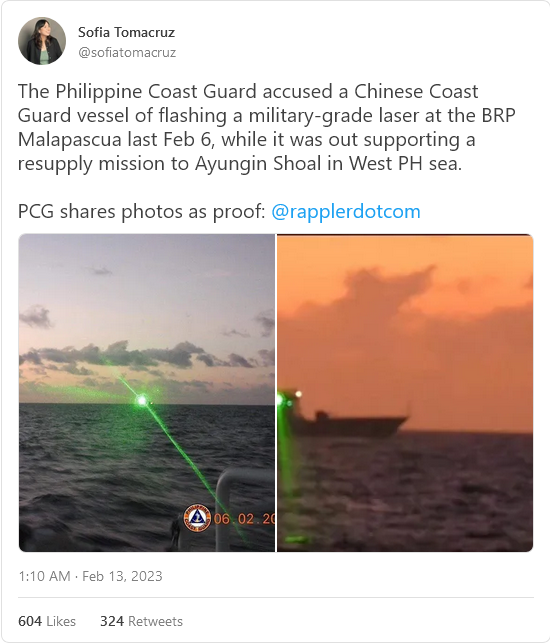
Another nation that if the PRC was just slightly more subtle and less arrogant they might have a chance to make things more difficult for the USA-Japan-Australia defense concerns is The Philippines. They had a window in the last couple of decades, but … if they’re doing this;
The PRC Wolf Warrior Lack of Charm Campaign perhaps may play well internally — and that may be all they care about — but there was a window not long ago that the PRC was playing smart on the world stage — making significant impact in Australia and having the USA happy to let them set up Confucius Institutes at our major universities, etc … but the last decade or so they somehow decided to play a different game.
Comments Off on China’s awkward actions on the world stage do not charm the neighbours
February 10, 2023
When “Taffy 3” kicked the ass of the pride of the Imperial Japanese Navy
Chris Bray isn’t a milblogger, but I thought his summary of the Battle of Leyte Gulf was pretty darned good:
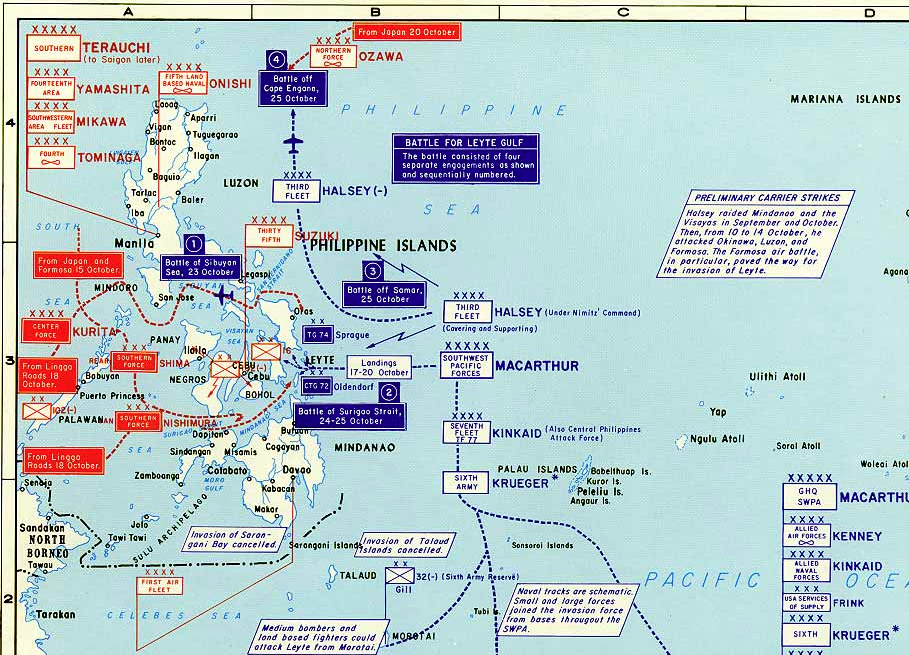
In October of 1944, US troops landing on Leyte Island in the Philippines were menaced from the sea by an enormous Japanese naval fleet that was divided into three separate attack forces.
Detail of the West Point Military Atlas: World War II: Asia-Pacific Invasion of Leyte, October 1944 map.
https://www.westpoint.edu/sites/default/files/inline-images/academics/academic_departments/history/WWII%20Asia/ww2%2520asia%2520map%252029.jpgSummarizing aggressively, the American ground forces were protected against an attack from the sea by the US Navy’s Third Fleet, commanded by Bull Halsey. But Halsey suddenly wasn’t there anymore, taking the bait of a decoy attack force [of de-planed Japanese carriers] and chasing it out into the sea. The Third Fleet’s departure uncovered Leyte Gulf, and the largest of the Japanese attack forces sailed in. Disaster became likely.
There were two American naval task forces in the path of the Japanese attack force, Taffy 2 and Taffy 3, but neither were meant for serious naval combat. They were supporting forces, designed to help the troops on the ground: a few escort carriers, a few lightly armed destroyer escorts, a very few destroyers. Aircraft on the American escort carriers were armed with 100-pound bombs to provide close air support to the infantry. The Japanese First Task Force had four battleships, eight cruisers, and eleven destroyers. One of the Japanese battleships was the Yamato, armed with 18-inch guns. The Japanese attack force sailed directly into contact with Taffy 3, which didn’t realize they were about to face the main Japanese attack force until they were already within range of its guns.
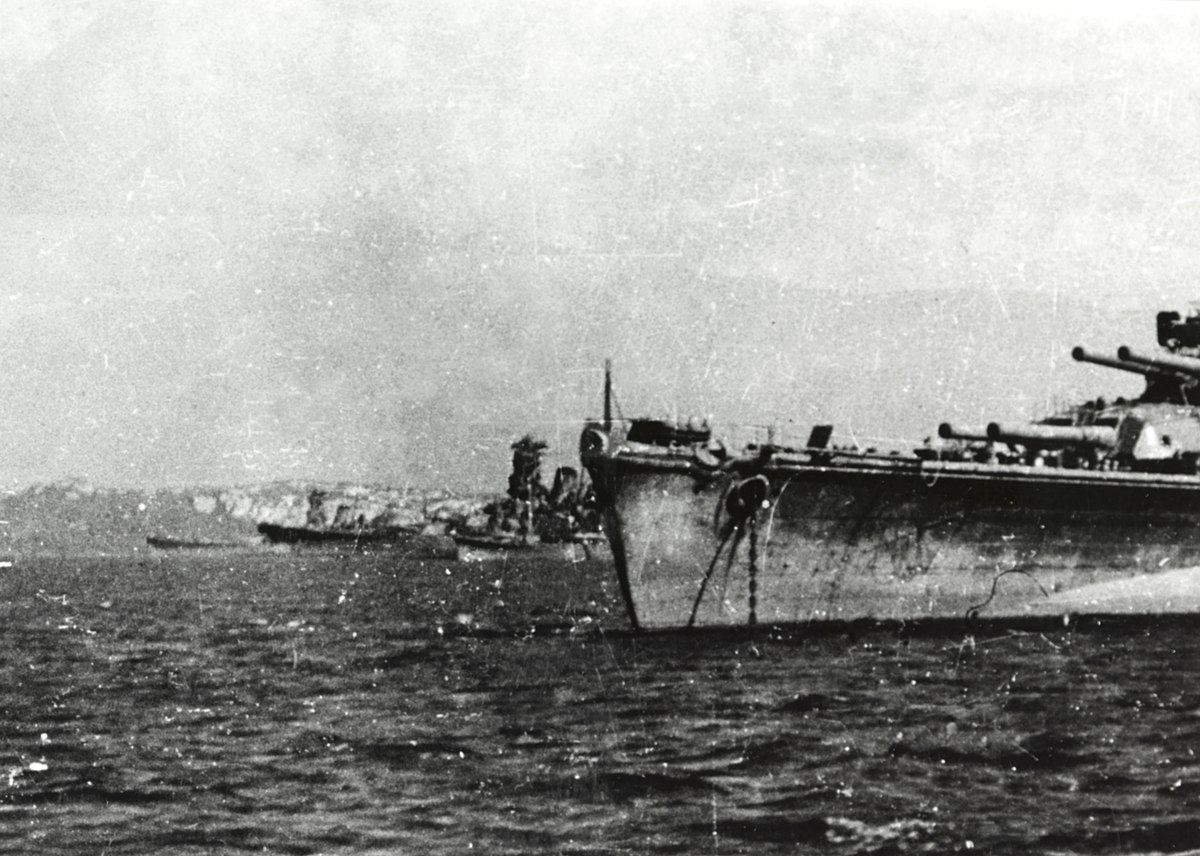
Imperial Japanese Navy ships at anchor in Brunei, Borneo shortly before the Battle of Leyte Gulf. Left to right, Musashi, Yamato, an unidentified cruiser, and Nagato.
Photo by Kazutoshi Hando from the US Naval History and Heritage Command collection.The commander of Taffy 3, Rear Admiral Clifton Sprague, saw immediately that his task force couldn’t survive the engagement, so he tried to salvage what he could: He ordered his destroyers and destroyer escorts to attack, to cover the hoped-for withdrawal of the escort carriers. The resulting battle is one of the best-known in naval history — and one of the least plausible, because Taffy 3 kicked the everloving shit out of that much larger Japanese attack force, compelling the Japanese to withdraw in the panicked belief that they’d sailed into the bulk of Halsey’s Third Fleet.
If you haven’t read [the late] James Hornfischer’s magnificent book about the battle, The Last Stand of the Tin Can Sailors, you should read it. The details are far beyond anything that could be summarized in a single short piece. But the battle was won by a remarkable combination of disciplined obedience, independent audacity, and a paradoxically disciplined disobedience — by men aggressively refusing to obey orders that threatened their cause.
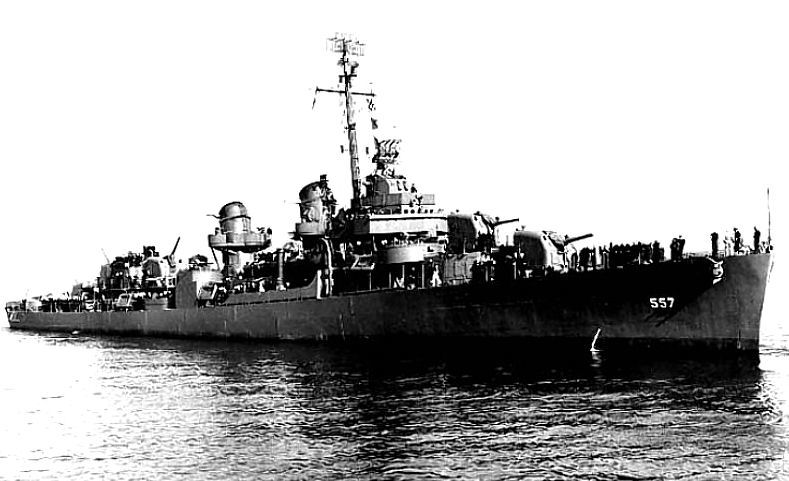
The Fletcher-class destroyer USS Johnston (DD-557), sunk in the Battle off Samar, 25 October, 1944.
US Navy photo with enhancement work by Wild Surmise via Wikimedia Commons.The battle began with one of the US Navy’s most famous moments. Before Sprague had time to order anyone to do anything, the captain of the Johnston, one of Taffy 3’s few destroyers, turned to attack the Japanese fleet. We have confused and contradictory accounts of the orders given by Cmdr. Ernest Evans, because the man who gave them, and most of the men who heard them, died soon afterward, but he is supposed to have said something like this:
1.) We’re under the guns of a much larger Japanese fleet.
2.) Survival is not to be expected.
3.) Hard left rudder, all ahead flank.
We’re all going to die; attack. The Johnston sank, and Evans died, but his first torpedo run blew the bow off a Japanese cruiser — setting the tone of the fight.
Comments Off on When “Taffy 3” kicked the ass of the pride of the Imperial Japanese Navy
February 5, 2023
Leningrad: NO STEP BACK! – Week 232 – February 4, 1944
World War Two
Published 4 Feb 2023The Allies begin a new operation in the Pacific this week: assaulting the Marshall Islands. They also make big attacks from their beachhead in Italy at Anzio, but these are called off after only a few days in the face of heavy enemy resistance. However, in the USSR there are several successes against the Axis, as they are pushed back both in the far north and the far south of the front, and still surrounded near Korsun.
(more…)
Comments Off on Leningrad: NO STEP BACK! – Week 232 – February 4, 1944
January 29, 2023
Anzio Begins – Allies Already Pinned Down – Week 231 – January 28, 1944
World War Two
Published 28 Jan 2023Some big news is the Allies amphibious offensive to hit the Germans behind their lines at Anzio in Italy, some other big news is that after nearly two and a half years, the Soviets have broken the siege of Leningrad and their twin northern offensives keep pushing back the enemy. Yet more big news is that the Soviets have managed to surround and cut off over 50,000 Axis troops near Korsun. This is one big week of action!
(more…)
Comments Off on Anzio Begins – Allies Already Pinned Down – Week 231 – January 28, 1944
January 23, 2023
Monte Cassino, the Battle Begins – Ep 230 – January 21, 1944
World War Two
Published 21 Jan 2023The Allies have reached the linchpin of the German defenses in Italy, but a first attack proves disastrous. It does, though, divert troops from where they soon plan to make landings behind enemy lines. Meanwhile in the USSR, the huge Soviet offensive in the north makes great gains against the stunned Axis forces.
(more…)
Comments Off on Monte Cassino, the Battle Begins – Ep 230 – January 21, 1944
January 15, 2023
Time to Liberate Leningrad! – Ep 229 – January 14, 1944
World War Two
Published 14 Jan 2023Three Soviet Fronts launch major offensives to try and finally free Leningrad, under siege for nearly two and a half years now. The Soviets are, in fact, making attacks along most of the Eastern Front. In the South Pacific, the Allies step up their aerial assault to wreck Rabaul’s air power, thus neutralizing it as a base.
(more…)
Comments Off on Time to Liberate Leningrad! – Ep 229 – January 14, 1944
January 1, 2023
Canadians Take Little Stalingrad – WW2 – 227 – December 31, 1943
World War Two
Published 31 Dec 20221943 reaches its end with no end in sight for the war. In Italy, the Canadians take Ortona after bloody close fighting, the US Marines advance on New Britain, and a new Soviet offensive makes huge gains in the USSR. This isn’t enough for the Allies, though, who have a big shake up in their European Command to help prepare for future attacks.
(more…)
Comments Off on Canadians Take Little Stalingrad – WW2 – 227 – December 31, 1943


