Forgotten Weapons
Published 24 Dec 2022After (formally) joining World War Two in the wake of Pearl Harbor, the United States endured a series of defeats at the hands of the Japanese. The Philippines garrison fell, Wake Island fell, Guam fell. British possessions in Southeast Asia teetered and fell as well — the campaign was not going well for the Allies.
The first American offensive of the war would come on August 7th, 1942 with the landing of the 1st and 5th Marines at Red Beach on Guadalcanal. Part of a multi-prong assault (the nearby Japanese bases on Tulagi and Gavutu/Tanambogo were also captured at the same time), the attack on Guadalcanal was made to secure the airstrip under Japanese construction there. If the island became an operational Japanese air base, Allied supply shipping to Australia would come under threat, and this could imperil the whole area of operations.
Fortunately for the Marines, US intelligence massively overestimated the Japanese force on Guadalcanal. It was in fact only a few hundred infantry, leading a work force of about 3,000 laborers (mostly Koreans). They thought the US landings were just a small raid, and dispersed into the jungle to wait for the US departure. Instead, the Marines were there to take the airfield and hold it. They were not, however, very well prepared. The Navy suffered a massive defeat in the waters off Guadalcanal the very next night, and would pull out of the area August 9th, leaving the Marines with dangerously low supplies of food, ammunition, and other essentials.
(more…)
April 18, 2023
Guadalcanal’s Red Beach Landing: America’s First Offensive in WW2
April 14, 2023
QotD: The three great strategic sins
The first sin is the sin of of not having a strategy in the first place, what we might call “emotive” strategy. As Clausewitz notes, policy (again, note above how what we’re calling strategy is closest to policy in Clausewitz’ sense) is “subject to reason alone” whereas the “primordial violence, hatred and enmity” is provided for in another part of the trinity (“will” or “passion”). To replace policy with passion is to invert their proper relationship and court destruction.
The second sin is the elevation of operational concerns over strategic ones, the usurpation of strategy with operations, which we have discussed before. This is, by the by, also an error in managing the relationship of the trinity, allowing the general’s role in managing friction to usurp the state’s role in managing politics.
Perhaps the greatest example of this is the Japanese attack on Pearl Harbor; an operational consideration (the destruction of the US Pacific Fleet) and even the tactics necessary to achieve that operational objective, were elevated above the strategic consideration of “should Japan, in the midst of an endless, probably unwinnable war against a third-rate power (the Republic of China) also go to war with a first-rate power (the United States) in order to free up oil-supplies for the first war”. Hara Tadaichi’s pithy summary is always worth quoting, “We won a great tactical victory at Pearl Harbor and thereby lost the war.”
How does this error happen? It tends to come from two main sources. First, it usually occurs most dramatically in military systems where the military leadership – which has been trained for operations and tactics, not strategy, which you will recall is the province of kings, ministers and presidents – usurps the leadership of the state. Second, it tends to occur when those military leaders – influenced by their operational training – take the operational conditions of their planning as assumed constants. “What do we do if we go to war with the United States” becomes “What do we do when we go to war with the United States” which elides out the strategic question “should we go to war with the United States?” entirely – and catastrophically, as for Imperial Japan, the answer to that unasked question of should we do this was clearly Oh my, NO.
(Bibliography note: It would hardly be fitting for me to declare these errors common and not provide examples. Two of the best case-studies I have read in this kind of strategic-thinking-failure-as-organizational-culture-failure are I. Hull, Absolute Destruction: Military Culture and the Practices of War in Imperial Germany (2005) and Parshall and Tully, Shattered Sword: The Untold Story of the Battle of Midway (2005). Also worth checking out, Daddis, “Chasing the Austerlitz Ideal: The Enduring Quest for Decisive Battle” in Armed Forces Journal (2006): 38-41. The same themes naturally come up in Daddis, Withdrawal: Reassessing America’s Final Years in Vietnam (2017)).
The third and final sin is easy to understand: a failure to update the strategy as conditions change. Quite often this happens in conjunction with the second sin, as once those operational concerns take over the place of strategy, it becomes difficult for leaders to consider new strategy as opposed to simply new operations in the pursuit of strategic goals which are often already lost beyond all retrieval. But this can happen without a subordination failure, due to sunk-costs and the different incentives faced by the state and its leaders. The classic example being functionally every major power in the First World War: by 1915 or 1916, it ought to have been obvious that no gains made as a result of the war could possibly be worth its continuance. Yet it was continued, both because having lost so much it seemed wrong to give up without “victory” and also because, for the politicians who had initially supported the war, to admit it was a useless waste was political suicide.
Bret Devereaux, “Collections: The Battle of Helm’s Deep, Part VIII: The Mind of Saruman”, A Collection of Unmitigated Pedantry, 2020-06-19.
April 3, 2023
Goodbye Manstein… Hello Model – WW2 – Week 240 – April 1, 1944
World War Two
Published 1 Apr 2023As the Allies prepare to close in on Germany from all fronts, a shake up of the German military leadership can only achieve so much…
(more…)
March 26, 2023
Germany Invades Hungary – WW2 – Week 239 – March 25, 1944
World War Two
Published 25 Mar 2023Germany occupies Hungary this week to prevent any possible Hungarian defection from the war, the Soviets continue pushing back the Axis in Ukraine, pressing them ever more toward Romania, the Japanese advance on Imphal and Kohima continues, but Allied attacks in Italy and Japanese ones on Bougainville come to their ends.
(more…)
March 25, 2023
Beria’s Reward for Ethnic Cleansing – War Against Humanity 100
World War Two
Published 23 Mar 2023Authoritarian regimes on both sides, in the Soviet Union, Nazi Germany, and Imperialist Japan the terror is once again escalating. The bombing war from both sides see continued death of civilians, while Harris of the RAF, Spaatz of the USAAF, and Supreme Allied Commander Eisenhower are getting into a fight about how the bombers should be used for the upcoming D-Day.
(more…)
March 22, 2023
A 60 Minutes show on the US Navy that wasn’t a hit piece?
CDR Salamander is pleased at the way the CBS team for 60 Minutes presented their US Navy coverage in a recent show:
A regular topic of conversation here […] is the lack of discussion in the public space about the importance of a strong Navy to our republic’s economic and military security. Sure, inside our salons, slack channels, and email threads we talk to each other a lot, but we seem to have a hard time getting our message out to the general public.
Sunday night’s 60 Minutes was an exception to the rule. There is a lot of credit to go around here. First of all, you have to give credit to the 60 Minutes team fronted by Norah O’Donnell and lead producers Keith Sharman and Roxanne Feitel. This two-segment effort was not just on a topic we all are interested in, it was just plain good journalism.
Sure, I have a nit to pic here and there, but that is just my nature. Perfect? No … but it is one of the best bits of solid, down the middle journalism about our Navy and its challenges I have seen from a major network for a long time.
If you missed it, CBS has published the video and transcript that I’m going to pull some bits from below for conversation.
The second segment was more meatier than the first, but the first is important. It isn’t just where Big Navy got a chance to make a run at media capture with the “C-2 to the Big Deck at sea” show that we all love, but it will introduce many people to someone who is very good at his job and representing the Navy, Admiral Samuel Paparo, USN.
He gets your attention early by, even though clearly well prepared and sticking to scripted talking points and marketing pitches here and there of questionable utility, he also spoke in blunt terms in a way we don’t hear enough in venues such as this:
Admiral Samuel Paparo commands the U.S. Pacific Fleet, whose 200 ships and 150,000 sailors and civilians make up 60% of the entire U.S. Navy. We met him last month on the aircraft carrier USS Nimitz deployed near the U.S. territory of Guam, southeast of Taiwan and the People’s Republic of China, or PRC.
Norah O’Donnell: You’ve been operating as a naval officer for 40 years. How has operating in the Western Pacific changed?
Admiral Samuel Paparo: In the early 2000s the PRC Navy mustered about 37 vessels. Today, they’re mustering 350 vessels.
…
60 Minutes has spent months talking to current and former naval officers, military strategists and politicians about the state of the U.S. Navy. One common thread in our reporting is unease, both about the size of the U.S. fleet and its readiness to fight. The Navy’s ships are being retired faster than they’re getting replaced, while the navy of the People’s Republic of China or PRC, grows larger and more lethal by the year. We asked the commander of the U.S. Pacific Fleet, Admiral Samuel Paparo, about this on our visit to the USS Nimitz, the oldest aircraft carrier in the Navy.
Admiral Samuel Paparo: We call it the Decade of Concern. We’ve seen a tenfold increase in the size of the PRC Navy.
Norah O’Donnell: Technically speaking, the Chinese now have the largest navy in the world, in terms of number of ships, correct?
Admiral Samuel Paparo: Yes. Yes.
Norah O’Donnell: Do the numbers matter?
Admiral Samuel Paparo: Yes. As the saying goes, “Quantity has a quality all its own.”
This is exactly how the answer needs to be delivered. No squish, no excessive spin — acknowledge the reality of where we are.
More of this from more senior leaders.
There was some subtlety as well. When he first said this, about 10-seconds later I decided to rewind to listen to it again.
Norah O’Donnell: And if China invades Taiwan, what will the U.S. Navy do?
Admiral Samuel Paparo: It’s a decision of the president of the United States and a decision of the Congress. It’s our duty to be ready for that. But the bulk of the United States Navy will be deployed rapidly to the Western Pacific to come to the aid of Taiwan if the order comes to aid Taiwan in thwarting that invasion.
Norah O’Donnell: Is the U.S. Navy ready?
Admiral Samuel Paparo: We’re ready, yes. I’ll never admit to being ready enough.
Did you catch that? He can’t say, “We’re not ready” as if the call comes, we can and will execute what we are tasked … and initially will be ready to do what we can with the reduced numbers we have … but everyone knows there is a huge asterisk next to “ready”.
We don’t have enough escort ships. We don’t have enough VLS tubes. We don’t have a large enough airwing with long enough legs. We don’t have enough reliable and robust tanking. We don’t have much of a bench … so, we are “ready” – but not even close to being “ready enough”. A subtle distinction with not so subtle implications.
We also need to give a nod to our Navy for not having only the 4-stars talk to CBS. LCDR David Ash, USN got some good face time with the camera, and his fellow LCDR Matthew Carlton, USN blessed us with his superb deployment stash.
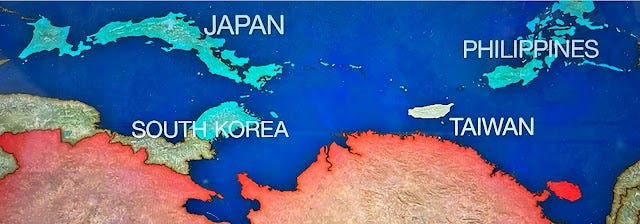
60 Minutes‘ graphics department also gets credit for the video that the pic at the top of this post is a screen capture of.
Add “PLARF” to you handy list of military acronyms for future reference:
There was another point where Admiral Paparo put a marker down that someone can pick up and run with … hey, I think I’ll do that now;
Norah O’Donnell: How much do you worry about the PLA Rocket Force?
Admiral Samuel Paparo: I worry. You know, I — I’d be a fool to not worry about it. Of course I worry about the PLA Rocket Force. And of course I work every single day to develop the tactics and the techniques and the procedures to counter it, and to continue to develop the systems that can also defend– against them.
Norah O’Donnell: About how far are we from mainland China?
Admiral Samuel Paparo: Fifteen hundred nautical miles.
Norah O’Donnell: They can hit us.
Admiral Samuel Paparo: Yes they can. If they’ve got the targeting in place, they could hit this aircraft carrier. If I don’t want to be hit, there’s something I can do about it.
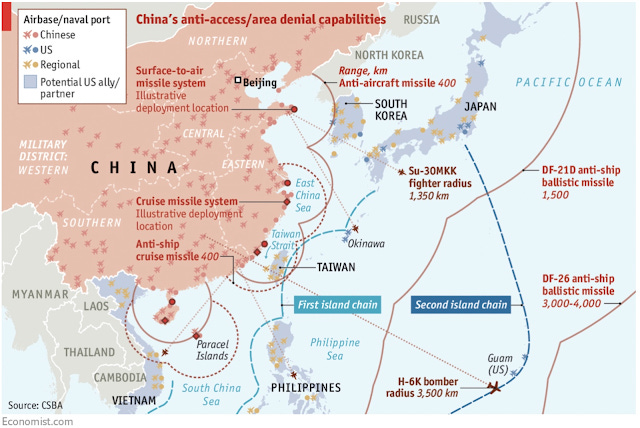
Ahhhhh, yes. Time to bring back one of my favorite graphics.
Draw a 1,500nm circle from the PLARF launch sites and look at what land based airfields, bases, depots and facilities of all sorts are located under that threat. They cannot move. A navy and sea based facilities can.
Undersold point, but Paparo is leaving it there for you to run with.
March 19, 2023
The Japanese Invade India! – WW2 – Week 238 – March 18, 1944
World War Two
Published 18 Mar 2023Operation U-Go, Renya Mutaguchi’s invasion of India, is in full swing this week, as his men aim at Imphal and Kohima; three Soviets Fronts batter their way through the Axis positions all over Ukraine; and there is a huge Allied bombing campaign at Cassino in Italy, which mistakenly kills a lot of Allied soldiers. That’s one busy week.
(more…)
March 15, 2023
An Aircraft Carrier Without A Deck? | The Remarkable Brodie Landing System
Rex’s Hangar
Published 21 Sept 2022Today we’re taking a look at the remarkable Brodie Launch System. This device could be used on land or aboard ships, and it was designed to provide accessibility for light aircraft in extremely remote locations during WW2.
(more…)
March 12, 2023
Zhukov hits the Ground Running – WW2 – Week 237 – March 11, 1944
World War Two
Published 11 Mar 2023The Soviets launch not one, not two, but three offensives in Ukraine this week, designed to destroy the entire southern wing of the German forces. The Japanese counterattack against the Americans on Bougainville finally begins after months of preparations, but there are more Japanese attacks elsewhere that get going: the operation to invade India.
(more…)
March 11, 2023
Why Japan Surrendered in WW2: Stalin or the Bomb?
Real Time History
Published 10 Mar 2023
It’s common wisdom that the nuclear bombs dropped over Hiroshima and Nagasaki caused the Japanese surrender at the end of the 2nd World War. However, there has been a fierce historical debate if this narrative omits the role of the Soviet invasion of Manchuria in August 1945 — or if this invasion was actually the main cause for the surrender.
(more…)
March 8, 2023
First to the Fight: The Marines’ Reising M50 SMG
Forgotten Weapons
Published 4 Nov 2022Eugene Reising developed a .45 ACP submachine gun in the late 1930s that was basically the opposite of the Thompson — it was light and handy, fired from a closed bolt with a delayed blowback action, and was inexpensive to produce. Reising contracted with Harrington & Richardson to produce the gun, and when it entered the market in early 1940 it found immediate interest from the USMC. Looking initially to equip the Marine Paratroop Regiment (Paramarines), the Corps wanted a gun that was light and compact. The Reising M55 with its folding stock was certainly those things and since the Thompson was essentially unavailable anyway (all production was going to the Army and foreign contracts), the Corps adopted the Reising with initial purchases of both the M50 and M55 in January and February of 1942.
What we are looking at today is an early production M50. It is blued with 29 barrel fins and the early style of sights, stock screw, trigger guard, magazine release, stock (the lacquer coating and sling swivels having been added by a previous owner), and firing pin. Later production guns would be improved and strengthened in various ways, but the Reising would never quite meet the needs of frontline combat troops, much to the displeasure of the Marines who first used them in the Pacific theater. Lacking interchangeable parts and susceptible to fouling and malfunctions, the Reisings were quickly replaced by other arms — some Johnson M1941 rifles, some M1 and M1A1 carbines, and various other guns. Rotated back to duties like ship boarding parties, guards, and military police, the Reising served very well. They were indeed handy and accurate guns, just not built for the extreme rigors of Pacific beach assaults and jungle foxholes.
(more…)
March 5, 2023
MacArthur and Nimitz Go Head-to-Head – Week 236 – March 4, 1944
World War Two
Published 4 Mar 2023The American attacks against the Admiralty Islands are successful, but this causes real tensions between commanders Douglas MacArthur and Chester Nimitz. Much of this week is taken up by planning and meetings on both sides — Adolf Hitler plans the occupation of Hungary, Josef Stalin plans new offensives in Ukraine, and the Allies plan to reconfigure their whole front in Italy. It’s all the prelude to an explosion of action.
(more…)
February 26, 2023
Tojo Takes Control – Week 235 – February 25, 1944
World War Two
Published 25 Feb 2023Now that the Americans have seized the Marshall Islands, they can bypass the Japanese base at Truk. This impels Prime Minister Hideki Tojo to shake up both army and navy command, and he even takes personal control over the Japanese Army. On the Anzio Front, Lucian Truscott replaces John Lucas as Allied Commander. In the field, the Allies win a big victory in Burma, and in Ukraine, the Soviets are still on the move.
(more…)
February 19, 2023
The Destruction of Monte Cassino – Week 234 – February 18, 1944
World War Two
Published 18 Feb 2023The Allies bomb the monastery atop Monte Cassino in Italy, but just to the Northwest it’s the Germans attacking them at Anzio this week. In the Soviet Union, the Axis break out of the Korsun Pocket, but at great cost, and in the Pacific comes a major Allied raid on the Japanese base at Truk and landings on Eniwetok Atoll.
(more…)
February 17, 2023
America’s War on Japanese Shipping – WW2 Special Documentary
World War Two
Published 15 Feb 2023We’ve covered in great depth the Battle of the Atlantic and the war by and against German U-Boats, but what about the other side of the world? Why has the war on Japanese shipping been so much quieter? There are several very specific reasons for that, which we look at today.
(more…)