
World War Two
Published 9 Sep 2023This week the USSR invades Bulgaria … who’ve also declared war on Germany, and who are still at war with the US and Britain, so Bulgaria is briefly technically at war with all four at once. Finland signs a ceasefire, the Germans are pulling out of Greece, the Warsaw and Slovak Uprisings continue, Belgium is mostly liberated, and across the world, the Japanese enter Guangxi, and there are American plans to liberate the Philippines.
(more…)
September 10, 2023
Bulgaria at War with Everyone – WW2 – Week 263 – September 9, 1944
Comments Off on Bulgaria at War with Everyone – WW2 – Week 263 – September 9, 1944
September 8, 2023
Johnson M1941 rifle
Forgotten Weapons
Published 8 Dec 2013Melvin Johnson was a gun designer who felt that the M1 Garand rifle had several significant flaws — so he developed his own semiauto .30-06 rifle to supplement the M1. His thought was that if problems arose with the M1 in combat, production of his rifle could provide a continuing supply of arms while problems with the M1 were worked out. The rifle he designed was a short-recoil system with a multi-lug rotating bolt (which was the direct ancestor of the AR bolt design). When the Johnson rifle was tested formally alongside the M1, the two were found to be pretty much evenly matched — which led the Army to dismiss the Johnson. If it wasn’t a significant improvement over the Garand, Ordnance didn’t see the use in siphoning off resources to produce a second rifle.
The Johnson had some interesting features — primarily its magazine design. It used a fixed 10-round rotary magazine, which could be fed by 5-round standard stripper clips or loose individual cartridges. It could also be topped up without interfering with the rifle’s action, unlike the M1. On the other hand, it was not well suited to using a bayonet, since the extra weight on the barrel was liable to cause reliability problems (since the recoil action has to be balanced for a specific reciprocating mass). Johnson thought bayonets were mostly useless, but the Army used the issue as a rationale to dismiss the Johnson from consideration.
However, Johnson was able to make sales of the rifle to the Dutch government, which was in urgent need of arms for the East Indies colonies. This is where the M1941 designation came from — it was the Dutch model name. Only a few of the 30,000 manufactured rifles were delivered before the Japanese overran the Dutch islands, rendering the rest of the shipment moot.
At this point, Johnson was also working to interest the newly-formed Marine Paratroop battalions in a light machine gun version of his rifle. The Paramarines needed an LMG which could be broken down for jumping, light enough for a single man to effectively carry, and quick to reassemble upon landing. The Johnson LMG met these requirements extremely well, and was adopted for the purpose. The Paramarines were being issued Reising folding-stock submachine guns in addition to the Johnson LMGs, and they found the Reisings less than desirable. Someone noticed that thousands of M1941 Johnson rifles (which could also have their barrel quickly and easily removed for compact storage) were effectively sitting abandoned on the docks, and the Para Marines liberated more than a few of them. These rifles were never officially on the US Army books, but they were used on Bougainville and a few other small islands.
Comments Off on Johnson M1941 rifle
August 22, 2023
QotD: Megafauna extinction
Another marker to put down about the extinction of the varied megafauna. A lot of which went extinct just as human beings – or varied ancestors of – turned up in the same area. The usual bit being that we eated it.
There is, sadly enough, a common misconception about our ancestors. Nature loving, that Rousseauesque fantasy of just drinking the clear water, munching on the acorns that fall unbidden. That humans don’t thrive on acorns matters not a whit to those who share this fantasy of an Elysian past. The truth being that humans – and proto- – were the most vicious beasts out there. That’s why we survived to thrive. It’s not just modern day humans who would scale down a cliff to throttle babbie seabirds for the pot after all.
So too with the bargain bucket meal on legs just found:
Half-tonne birds may have roamed Europe at same time as humans
They roamed, we eated, they roamed no more. As with the arrival of the Maori in New Zealand and the exit of moas. The American horse disappearing about the same time Amerinds made it past the ice barriers into British Columbia and points south. Dodos and sailing ships and on and on around the globe. The major factor in megafauna going extinct being humans turning up to eat them.
Tim Worstall, “Crimea Fried Ostrich – And Then We Eated It”, Continental Telegraph, 2019-06-27.
Comments Off on QotD: Megafauna extinction
August 13, 2023
Panzer Revenge in Normandy – WW2 – Week 259 – August 12, 1944 (CENSORED)
World War Two
Published 12 Aug 2023The Germans launch a counter-attack to sabotage the Allied positions in France. In the Baltics the Soviet advances grind to a halt, but the Soviets are busy making plans to invade Romania in the south. Meanwhile in the center the Warsaw Uprising continues. Across the world the siege of Hengyang comes to its end with a Japanese victory, but the Battle for Guam ends with a Japanese loss.
[Promoted from the comments]: An increasingly persistent challenge for us at TimeGhost is that a growing number of our videos are being age restricted. While this was always the case with War Against Humanity, it’s started affecting this weekly series now too. This most recent video was restricted before it was even publicly published. As such we made the difficult decision to publish a censored version instead this week.
Why is it such a big issue? Well it doesn’t only limit the access to educational content for young people, but also to adult audiences. Age restricted videos have a barrier to viewing that ranges from territory to territory, with some countries requiring viewers not only to have a YouTube account, but to link it with their credit card. Even if an account belongs to a verified adult, it’s still less likely to be recommended an age restricted video.
Our core mission at TimeGhost is making the lessons of our past free and accessible to people around the world. While it’s challenging, especially with the new obstacles from YouTube, it’s still possible thanks to everyone in the TimeGhost Army who backs these videos. To all of you that signed up, or who watch regularly, thank you for joining us on this mission.
Comments Off on Panzer Revenge in Normandy – WW2 – Week 259 – August 12, 1944 (CENSORED)
August 9, 2023
America Plans to Incinerate Japan – War Against Humanity 107
World War Two
Published 8 Aug 2023The Allied Strategic bombing campaign has claimed hundreds of thousands of civilian lives across Europe and has made little real impact on the Axis war machine. Even so, the United States is determined to extend the campaign to Japan. Until now, the vast distances of the Asia-Pacific theatre have protected the imperial enemy. That all changes when the USAAF unleashes the Superfortress.
(more…)
Comments Off on America Plans to Incinerate Japan – War Against Humanity 107
August 6, 2023
The Warsaw Uprising Begins! – WW2 – Week 258 – August 5, 1944
World War Two
Published 5 Aug 2023As the Red Army closes in on Warsaw, the Polish Home Army in the city rises up against the German forces. Up in the north the Red Army takes Kaunas. The Allies take Florence in Italy this week, well, half of it, and in France break out of Normandy and into Brittany. The Allies also finally take Myitkyina in Burma after many weeks of siege, and in the Marianas take Tinian and nearly finish taking Guam. And in Finland the President resigns, which could have serious implications for Finland remaining in the war.
(more…)
Comments Off on The Warsaw Uprising Begins! – WW2 – Week 258 – August 5, 1944
July 30, 2023
Bradley Unleashes His Cobra – WW2 – Week 257 – July 29, 1944
World War Two
Published 29 Jul 2023Operation Cobra is the drop that finally opens the floodgates and the Allies make a breakthrough in Normandy; up in the Baltics the Soviets take Shaulyai, Dvinsk, and finally Narva, though their big prize this week is Lvov further south. This happens during the Poles’ Lvov Uprising, which ends badly for the Poles. Things also go badly for the Japanese on Guam, though, as their assault this week devastates their own troops.
(more…)
Comments Off on Bradley Unleashes His Cobra – WW2 – Week 257 – July 29, 1944
July 23, 2023
Sayonara Tojo – WW2 – Week 256 – July 22, 1944
World War Two
Published 22 Jul 2023This week, Adolf Hitler is blown up and Hideki Tojo steps down. In the Pacific, the Americans land on Guam and prepare for hard fighting. In France, the Americans take Saint-Lô and British and German armored forces clash around Caen. In the East, the Red Army enters Latvia, tears a gap in Army Group North, and reaches the gates of Lvov.
(more…)
Comments Off on Sayonara Tojo – WW2 – Week 256 – July 22, 1944
July 18, 2023
Seaplanes? How 1940s. No, we’re seeking to “leverage emerging technologies” instead
CDR Salamander wonders about a modern need for military sea rescue capability that the US Navy filled with flying boats and seaplanes during the Second World War, then supplemented with helicopters during Korea and Vietnam. For ocean search-and-rescue in a combat environment in the present or near future, what are the USN’s plans?
I will be the first person to admit that good, well-meaning, and informed people can disagree with seaplanes in general or the US-2 specifically, but they have to engage the conversation. Directly argue the requirement or offer realistic alternatives.
This does neither. If anything is demonstrates the narrowness of thought and fragility of substance used in opposition.
What an patronizingly toxic stew that answer is. I highly doubt Lung typed out that answer himself, so my commentary below is not directed at him personally, but … and it is what comes after the “but” that counts — but at the three-digit J or N code that extruded that from the random acquisitions professional statement subroutine from ChatGPT.
Let’s give that answer a full Fisking;
- “The Indo-Pacific operational environment has evolved significantly since World War II”:
Let me check my WWII Pacific chart, my Vietnam War era globe, and GoogleEarth … and … no. The geography has not changed. The distances have not changed. The requirement of thousands of years to take and hold territory or eliminate your enemy from access to it has not changed. All the little islands, regardless of what Al Gore and John Kerry say, are still there. As we are seeing in the Russo-Ukrainian War, a million PPT slides saying so does not change the fundamentals of war.
Sentence one is invalid.
- “The employment of seaplanes today would not meet the operational demands and current threat scenario.”
Is there an operational demand for us to rescue downed airmen and to be able to reach remote islands without airfields? Yes. Does your “current threat scenario” run from Northern Japan through to Darwin, Australia? Yes.
Sentence two is invalid.
- “However, we support the continuous development of new and innovative solutions that may provide solutions to logistical challenges.”
So, you define “new” as something that only exists on PPT slides? By “continuous development” you mean never matures as a design that goes into production. By “innovative” you mean high on technology risk. Undefined program risk. Unknown design risk. No known production line or remote estimate to IOC, much less FOC when we know that the next decade is the time of most danger of the next Great Pacific War.
Sentence three is irresponsible and professionally embarrassing given the history of transformational wunderwaffe this century.
- “As an example, DARPA’s Liberty Lifter X-Plane seeks to leverage emerging technologies that may demonstrate seaborn strategic and tactical lift capabilities.”
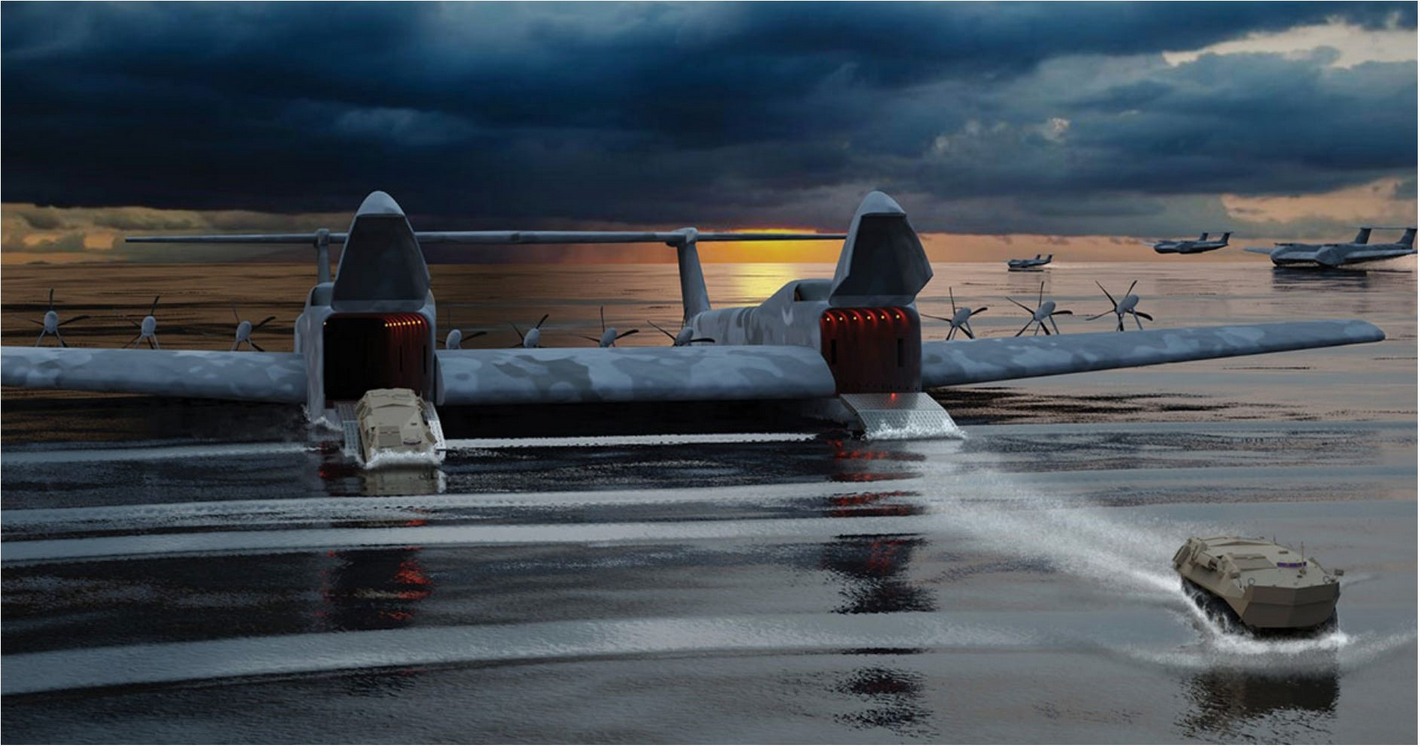
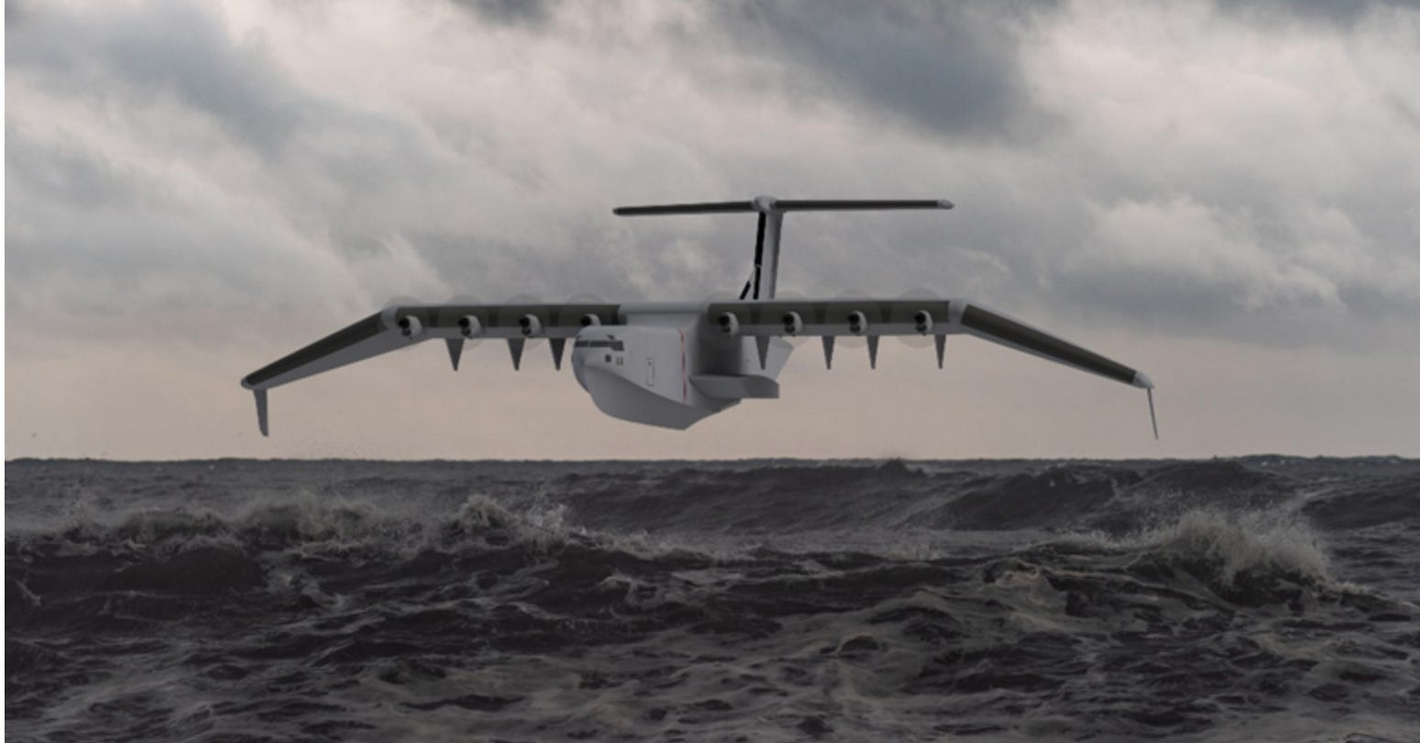
Well, goodness, we will have to micro-Fisk this gaslighting horror show of a sentence. To start with, they are talking about either this from General Atomics;
… that could only be used on a very few select beaches under ideal weather in a completely permissive environment and could only be used for one specific mission and nowhere any possible hostile aircraft or ground forces. Also looks like we’d need a whole new engine and a small town’s worth of engine mechanics to maintain the maintenance schedule on those engines.
Then we have this offspring of an accidental mating of the Spruce Goose with the Caspian Sea Monster idea from Aurora Flight Sciences;
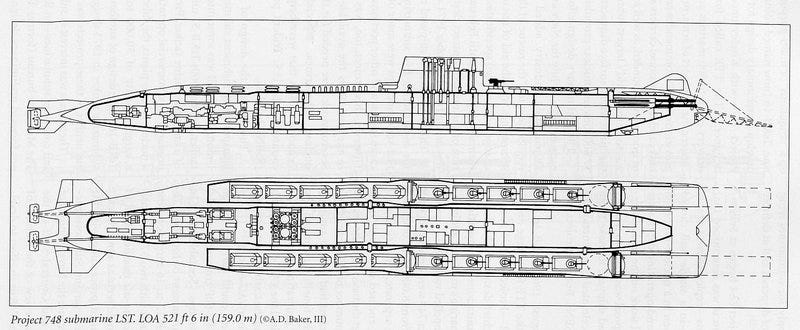
I give the odds of either one of those taking to the air prior to 2035, if ever, on par with a return of the submarine LST of Cold War fame (deck gun not included).
Let’s get back to the wording of that dog’s breakfast of a final sentence. Feel slimy reading it? You should;
- “seeks to leverage” — that is just a way of saying, “hope in magic beans.” Gobbledegook.
- “emerging technologies” — oh, you mean something that hasn’t left the computer, white board, or PPT slide.
- “that may demonstrate” — so, even if our magic beans managed to fuse unobtainium with Amrita, we’re not really sure if the strip mining of strange blue creatures’s holy sites and drilling holes in the soft pallet of whale-like thing will result in something of use.
- “strategic and tactical lift capabilities” — I’m sorry, an eight or ten-engined aircraft that any goober with a 1960s-era iron-sighted RPG-7 could target at maximum range is going do anything “tactical” — especially at the expected price of those things and the resulting precious few that wind up displacing water. Oh, and you admit that it will only be used for cargo, so it can’t do the full range of possible missions the US-2 can … just cargo. On just a few beaches that are fully surveyed ahead of time. At the right tide. In the right weather. In a 100% safe and permissive environment.
- The final sentence is a caricature.
Rep. Austin Scott (R-GA) should feel at least mildly insulted by this reply. It was a serious question given a canned answer that, slightly modified, could have been provided at any time in the last quarter century by the lethargically complacent maintainers of the suboptimal habits of the mistakingly entitled acquisitions nomenklatura
Comments Off on Seaplanes? How 1940s. No, we’re seeking to “leverage emerging technologies” instead
July 16, 2023
Mass Suicide on Saipan – WW2 – Week 255 – July 15, 1944
World War Two
Published 15 Jul 2023Japanese troops and civilians commit mass suicide rather than surrender to the Americans in the Marianas; in Normandy, Caen has finally fallen to the Allies though the fight for St. Lo is not over; the Soviet offensives in the north take Vilnius and the fighting continues up in Finland, but the big eastern front news is the mighty new Soviet offensive in Western Ukraine. (more…)
Comments Off on Mass Suicide on Saipan – WW2 – Week 255 – July 15, 1944
July 2, 2023
Allies Liberate Cherbourg – WW2 – Week 253 – July 1, 1944
World War Two
Published 1 Jul 2023Several weeks after the invasion of Normandy began, the Allies finally take a port city there, though the actual harbor has been destroyed. On Saipan the Americans have the advantage, in Finland, the Soviets do, but the big news is the Soviet destruction of huge chunks of German Army Group Center, demolishing entire Army Corps, and surrounding tens of thousands of the enemy.
(more…)
Comments Off on Allies Liberate Cherbourg – WW2 – Week 253 – July 1, 1944
June 25, 2023
The Greatest Pincer Movement in Military History – WW2 – Week 252 – June 24, 1944
World War Two
Published 24 Jun 2023The Red Army surges forward in Operation Bagration, a mighty new offensive to destroy German Army Group Centre. Fighting continues in Normandy, Italy, and Finland. The United States Navy tears the heart out of the Imperial Japanese Navy in the Philippine Sea even as the Imperial Japanese Army has success in China. The British and Indian armies lift the siege of Kohima.
(more…)
Comments Off on The Greatest Pincer Movement in Military History – WW2 – Week 252 – June 24, 1944
June 18, 2023
Titanic Clash Looms In Pacific – WW2 – Week 251 – June 17, 1944
World War Two
Published 17 Jun 2023Japanese and American navies are heading for a showdown in the Philippine Sea, even as American forces land on Saipan in the Marianas in force. The Japanese have Changsha under siege in China, the Allies advance in both Normandy and Italy, the Soviets advance in Finland, and the massive Soviet summer operation is coming together and will begin in a matter of days.
(more…)
Comments Off on Titanic Clash Looms In Pacific – WW2 – Week 251 – June 17, 1944
May 28, 2023
Breakout from Anzio! – WW2 – Week 248 – May 27, 1944
World War Two
Published 27 May 2023After four months, the Allies breakout from their bridgehead at Anzio and meet with the advancing troops heading north after the fall of Monte Cassino last week. The Japanese begin phase two of their big operation in China, and both the Soviets and the Western Allies continue making plans for their massive June offensives to squeeze the Axis from both sides of Europe.
(more…)
Comments Off on Breakout from Anzio! – WW2 – Week 248 – May 27, 1944
May 21, 2023
The Fall of Monte Cassino – WW2 – Week 247 – May 20, 1944
World War Two
Published 20 May 2023In Italy, the Allies finally overcome Monte Cassino and break through the Gustav Line; in Burma Merrill’s Marauders surprise the Japanese and take Myitkyina Airfield; in China, it’s the Japanese who are playing offense, as Operation Ichi Go and the siege of Luoyang continue. That’s the field action, but there’s big planning behind the scenes for major June offensives going on by both the Western Allies and the Soviets.
(more…)
Comments Off on The Fall of Monte Cassino – WW2 – Week 247 – May 20, 1944


