Quotulatiousness

October 10, 2010

Electronic solution to the cost of rifle training

Filed under: Military, Technology, USA — Tags: , — Nicholas @ 11:33

Strategypage reports on an indoor shooting simulator:

The U.S. Marine Corps has saved over half a billion dollars in the last four years, by using indoor electronic firing ranges. IMST (Indoor Simulated Marksmanship Trainer) has cost over $200 million, but the savings in ammo, wear on weapons, and running outdoor ranges were much larger. Nearly 200,000 marines have undergone marksmanship training using IMST. Unlike the similar U.S. Army EST system, IMST is wireless. A special magazine contains gas that provides a realistic recoil and a wireless radio device connects the weapon to the targets displayed on the screen and records how accurate the electronic rounds were fired.

Devices like IMST and EST have boosted the shooting skills of troops, while reducing costs. This gives American riflemen a big battlefield advantage. In most armies, the troops rarely fire their rifles. Ammo is too expensive (given the meager military budget). When there is combat, the troops are issued bullets, which they fire very inaccurately. Against a better trained foe, this leads to quick defeat. Happens all the time. But now cash strapped armies can train their troops to be effective marksmen without spending a lot of money, by using simulators.

Sure beats the “simulation technology” we used in my militia days: we ran around yelling “Bang!” to simulate firing the bullets the military budget couldn’t afford to provide us with. Ah, the joys of Trudeau-era military experience.

October 8, 2010

Does SDSR stand for Slashing Damage to Strategic Resources?

Filed under: Britain, Military, Politics — Tags: , , , — Nicholas @ 13:22

Well, no, it stands for Strategic Defence and Security Review, which is what the British government is conducting right now. Lewis Page (who is a former naval officer, BTW) is still hoping that the Admirals can manage to save the core components of the Royal Navy from the budget cutters:

The Telegraph reports on the matter today, quoting unnamed insider sources at the heart of the ongoing Strategic Defence and Security Review (SDSR, the new government’s name for the savage cuts that will be necessary to sort out the UK defence budget crisis).

According to the paper’s informants, the navy has proposed cutting its fleet of “escort” warships (submarine-hunting frigates and air-defence destroyers) from the current 23 down to 12 — a couple more than we here on the Reg naval desk suggested under We Want Two. We didn’t think that the navy could preserve its vital amphibious-landing capability without cutting the tremendously costly — and largely useless — escort fleet a little further. It seems that we were on the money, as reportedly the two-carrier, 12-escort plan calls for “all amphibious craft” to be dispensed with.

If the paper’s sources are correct, some version of the escort-slashing, carrier-saving plan will go ahead. Reportedly the ministers of the National Security Council, meeting yesterday, “stopped short of a formal decision”, but “insiders now believe both ships will be built”.

Getting the two carriers through the first skirmish in the budget battle is a good start, but the ships are cheap compared to the proposed aircraft to equip them. The F-35B supersonic VTOL/STOL aircraft will cost a lot more than the ships they’ll be based on.

Although it makes for a fairly cheap carrier, the F-35Bs would be horrifyingly expensive, particularly if bought in time to equip the ships as they are completed. Not only is the F-35B the world’s first ever supersonic stealth jumpjet, it is currently suffering severe delays in flight testing: for quite some few years, until the production line gets into gear and economies of scale kick in, it will be very pricey to buy. It will also be comparatively expensive to own and operate, as perhaps the most or second-most complicated jet in the world today. Worse still, the need to carry a lift fan, swivelling exhaust nozzle and multiple lids and doors to cover these things when not in use means that the F-35B jumpjet will not be as good a combat plane as the F-35A and F-35C versions (runway and catapult respectively).

If we dare to assume that the hulls will be built, then a quick budget fix would be to omit the F-35B and install catapults on the carriers to allow them to use cheaper tail-hook aircraft (the F-18 or perhaps the F-35C). That’ll chop a few billion off the total cost of the package, and the only fly in the ointment is that the carriers are gas-turbine, not steam or nuclear-powered. That means depending on the not-yet-in-service electromagnetic catapult designed for the USS Gerald Ford, the next big American carrier.

The US Navy is committed to the electromagnetic catapult working, or they’ll have to pay a lot of money to re-engineer the Ford to use older technology and accept a multi-year delay in commissioning the ship. The US Navy could buy the entire Royal Navy out of petty cash, so it’s not a huge risk to depend on them getting the bugs worked out of the new mechanism in time.

The Telegraph thinks that the plan will be to convert HMS Prince of Wales, the second carrier, to an amphibious assault ship. Page thinks this is a bad idea on multiple counts:

The Telegraph‘s sources think that this is on the cards, saying that “ministers have discussed reconfiguring the first new carrier as a helicopter platform that would also carry Royal Marine commandos. The carrier would then ultimately replace the existing helicopter ship, HMS Ocean“.

This is a foolish plan, however. HMS Ocean is new: she doesn’t need replacing. Furthermore, having only one proper carrier is much, much worse than having two, almost as bad as having none: an enemy need only wait until the sole proper carrier is in a planned refit before becoming aggressive, happy in the knowledge that the UK can’t even rattle its sabre effectively in response. (One of the main ways that the USA resolves or responds to tense situations around the world day to day or week to week is to move its carriers about.)

In effect, the amphib downgrade plan sacrifices a hugely important and powerful carrier — gives up the critical one-carrier-always-up capability — and throws away the perfectly good HMS Ocean, which was actually quite cheap to have anyway (she cost less than a typical escort and her crew is no larger). The only upside here is that one or two more frigates or destroyers are preserved, a largely meaningless gain: the more so as there would now be fewer capital ships actually requiring escorts.

The problem with any kind of military spending is that you’re trying to make provision for the unforeseen future contingency. The last time the British government was on the verge of scrapping the aircraft carriers, Argentina kindly kicked up a ruckus that required military action — which would not have been possible without the carriers.

This time around, there’s no likely trouble spot to flare up and force the government to reconsider (unless we can prod Argentina to do us a favour again . . .)

October 6, 2010

British forces facing imminent cuts

Filed under: Britain, Economics, Military — Tags: , , , , , — Nicholas @ 12:15

Lewis Page makes what I think is the correct call for the British government’s National Security Council to keep the Royal Navy’s carrier program and gut the RAF deep bomber fleet and the army’s heavy combat arm:

Thus it is a good bet that the first of the two new carriers for the Royal Navy will go ahead. The second may be downgraded to serve as an amphibious-warfare ship full of troops and helicopters rather than combat aircraft, or it might be cancelled altogether — which means British shipbuilding would be kept alive by bringing forward plans for a new generation of navy frigates.

The RAF and even the Army will be offering up massive cuts of their own — it is expected that the entire Tornado deep-bomber fleet will be retired years early, and the current Cold War style armoured-warfare juggernaut of tanks, mobile artillery and infantry fighting vehicles is set for a major trim back — so there is only one way that the government can preserve a two-carrier navy.

A navy with pretensions to independent action requires aircraft carriers. Plural. A single carrier isn’t enough, and places too much of your naval “capital” in a single hull. Two is the minimum (and three would be even better): you can, with care, always have at least one carrier fully worked-up and ready to deploy.

Even if the RN gets both carriers through the NSC flensing mill, they still face other cuts:

That one way is to finally cut the Royal Navy’s force of frigates and destroyers — collectively known as “escorts”, as their primary role is to protect and defend major warships — down to numbers suitable for actually escorting our biggest ships. For the past many decades, for reasons of history and jobs for the boys, the RN has actually maintained far more escorts than it needs to escort major units such as carriers and amphibious task groups.

Realistically, a combat carrier can actually protect herself using aircraft far more effectively than her escorts can: but it is reasonable to say that sending a carrier out to a major war alone, when just one bomb or missile or torpedo could eliminate Britain’s reach into a given theatre — perhaps cutting off air cover, supplies, even the chance of evacuation for our troops ashore — is a gutsy call.

Reducing the number of frigates and destroyers would make a lot of sense (except if you’ve “spent your whole life in an effort to be a frigate captain”). A bigger-ticket item than the carriers themselves is the required aircraft to equip the ships. Current plans are for the role to be given to the ultra-expensive F-35B. Politics aside, it would make brilliant economic and military sense to replace those techno-wonders with slightly less capable F-18s:

Really we need a maximum total escort fleet of say 10, as compared to the Navy’s current lineup of 23. Savings just in running costs over the next decade would add up to at least £11bn. Then we can save at least another billion-odd in acquisition costs by not buying the last two Type 45s and their dubious missile systems. All this is far and away more than enough to ensure that the second carrier is built, and to give the two ships catapult launch. This in turn would permit the purchase of much cheaper and more powerful aircraft for them, easing the problems caused for the MoD budget by the rising costs and delays facing the F-35B supersonic stealth jumpjet (currently grounded following the discovery of technical snags during flight testing).

And why would I, a former ground-pounder, be so enthusiastic about aircraft carriers? Because the British experience has been that the RN has been there for the army when needed:

It hasn’t been often that British troops have needed fighter cover since World War II, but when they’ve needed it they’ve really, really needed it. Just ask the Welsh Guards, chopped to pieces by Argentine jets at Bluff Cove. When there has actually been any fighter cover for British troops in combat since World War II, it has come from the navy, not the RAF. Every time a British fighter has shot down an enemy aircraft since 1945, it took off from a ship to do so. Even back during WWII, lack of carrier air killed a lot of sailors and soldiers — and the presence of it saved many more.

October 5, 2010

Let me read that again

Filed under: Britain, France, Military — Tags: , — Nicholas @ 13:01

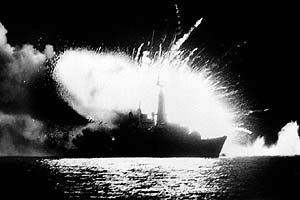
The Royal Navy has had some of their new Type 45 destroyers in service for a while, but they’ve only just gotten around to arming them?

The Royal Navy’s new £1bn+ Type 45 destroyers, which have been in service for several years (the first is already on her second captain), have finally achieved a successful firing of their primary armament.

The Ministry of Defence (MoD) announced yesterday that HMS Dauntless, second of the class, has made the first firing from a Type 45 of the French-made Aster missiles with which the ships are armed. All previous trial shoots were carried out using a test barge at French facilities in the Mediterranean.

Well, at least they’re getting closer to being armed and equipped as they were originally supposed to be:

Each of the six Type 45s will now cost the taxpayer £1.1bn and counting. At the moment the only weapons they can use operationally are their basic 4.5-inch “Kryten” gun turrets and light 30mm autocannon, principally useful for bombarding undefended foreshore targets or shooting up pirate dhows and the like. This is armament barely above the gunboat level.

The big attraction to the (very expensive) PAAMS/Sea Viper missile system is its claimed ability to shoot down the latest generation of Russian supersonic anti-ship missiles . . . oh, and that it wasn’t the cheaper (and proven) American AEGIS system.

As it is, we will pay at least double and get none of these things. Our Type 45s will have no serious ability to strike targets ashore, and we will continue to have no capabilities against ballistic missiles. Most glaringly of all, the Type 45 will have no weapon other than its guns with which to fight enemy ships — Sea Viper has no surface-to-surface mode.

You might feel that preservation of British high-tech jobs in some way justifies such horrific overspending for such lamentable amounts of capability, but in fact the relatively few Brit workers concerned have now mostly been fired anyway.

We can’t poke too much fun at the Royal Navy over the jobs issue: most major purchases for the Canadian Forces are driven more by “spin-offs” and regional employment concerns than either cost or military efficacy.

I did like The Register‘s cheeky graphic:

October 4, 2010

Winning the media war

Filed under: Asia, Media, Military — Tags: , , , , — Nicholas @ 12:03

Strategypage reports on the ongoing struggle by both the Taliban and the NATO/US forces to influence media coverage, both inside Afghanistan and in the outside world:

In Afghanistan, the Taliban have been very successful with the media, mainly because they give the media what they want, or an offer they can’t refuse. The Taliban know that the media loves stories where the underdog prevails, or where the powers-that-be screw up. Put out the right kind of disinformation, and the media will take it and run it as the truth. Or at least something that could, might or ought to be true somewhere.

The Taliban media people know what the Western and regional media want, and this is provided. For example, the Taliban have invented the idea that Western troops are causing most of the civilian deaths in the Taliban effort to regain control of Afghanistan. But the truth, which is published but not emphasized much, is that most of the civilians are killed by the Taliban, and the Western troops have been killing fewer and fewer civilians, even at the risk of more Western casualties. The Taliban regularly use civilians as human shields. Again, the media mentions that, but it’s something for the back pages. The headlines stress what the Taliban wants, mainly that they are winning, even when they are losing.

For a backwards, almost medieval group, the Taliban (or their non-Afghani advisors) have developed a talent for manipulating the international media coverage:

But you don’t have to bribe or threaten Western media. Just package your lies in an acceptable manner, and your message will be delivered. The Taliban are smart enough to constantly recast their press releases to suit the perceived needs of Western and regional media. All they have to do is note what stories editors are running, and work up new stuff with a Taliban angle. Thus while corruption has been an Afghan cultural problem for centuries, the Western media will swallow whole a Taliban press release suggesting that the Taliban are less corrupt (they aren’t) and this more attractive to the average Afghan (not according to opinion polls, or reports from American troops who deal with local Afghans every day.) But in the Western media, you survive by pushing what will sell, not what is actually happening.

October 3, 2010

Pakistan’s self-harming border closure

Filed under: Asia, Economics, Military, Railways — Tags: , , , — Nicholas @ 11:22

Strategypage shows why Pakistan is doing itself more harm than good on the Afghan border:

After a recent incident where U.S. helicopter gunships crossed into Pakistan, in hot pursuit of Islamic terrorists, and killed three Pakistani soldiers (and a lot more terrorists), Pakistan cut one of the two NATO supply routes that pass through Pakistan. Aside from the fact that the Pakistani soldiers fired on the NATO helicopters (which they often do, even when the choppers are on the Afghan side of the border), the U.S. didn’t have to remind the Pakistanis that such a gesture was self-defeating. The Pakistani government is heavily dependent on American economic and military aid, and more and more of the supplies for foreign troops in Pakistan is coming from non-Pakistani sources. This hurts Pakistani businesses that move, and often provide, the supplies.

At the moment, about half those supplies come through Pakistan. The Pakistanis only closed, for about a day, one of the two main routes. About 30 percent of the supplies come in via Central Asia railroads, and another comes from the Black Sea, via rail to the Afghan border. The remaining 20 percent comes in by air. But some of that may be shifted to the Central Asian route, which is much safer (from bandits, bad roads and the Taliban) than the Pakistan routes.

Pakistan may have helped create conditions that will actually improve the economies of several other countries:

Shipping supplies to Afghanistan via Russian and Central Asian railroads has advantages for the nations it passes through. Russia has an economic interest in this, as more traffic makes it financially attractive for Central Asian nations to invest in upgrading their rail connections to Afghanistan. Tajikistan, for example, is extending its railroad to the Afghan border by building another 145 kilometers of track. Afghanistan itself has no railroads, mainly because there is not enough economic activity in the country to make this worthwhile. Foreign donors have contributed billions of dollars since 2002 to build more paved roads in Afghanistan. Currently, there are 42,000 kilometers of roads there, but only a third are paved. There are few rivers, much less navigable ones, and no access to the sea. The place has long been a logistical nightmare. Most Afghans recognize that roads will make the country more prosperous, by making it economically feasible to export many commodities, and cheaper to bring in, and distribute, foreign goods. Naturally, the Taliban are opposed to all this road building, as it threatens the poverty and ancient customs that Islamic conservatives are so fond of.

September 30, 2010

Inter-service rivalry now compromising SAS training

Filed under: Britain, Bureaucracy, Military — Tags: , , , — Nicholas @ 07:50

Of all the various famous units the British have to boast of, surely the Special Air Service (SAS) is the top of the list. That status still doesn’t exempt the SAS from being a pawn in the ongoing battle between the Army and the RAF:

For five years now, the Royal Air Force (RAF), and the British Army have been feuding over the lack of aircraft for parachute training. The latest row involves Britain’s SAS (Special Air Service) commandos, who have been unable to train all their operators in complex parachuting techniques, because the RAF has been unable to provide transports to carry the SAS personnel into the air. This is considered a more serious matter than previous problems with not having enough transports to train members of the Parachute Regiment. The SAS threatens to send their operators to the United States for training, relying on long standing ties with their American counterparts (the U.S. Army Special Forces and SOCOM). This would be embarrassing for the RAF, and that would be the point.

This sort of feud has been going on for a long time. For example, four years ago it was revealed that the British Army had to decide between supplying its troops in Iraq and Afghanistan, and providing aircraft for its paratroopers to complete their training. As a result of this shortage, in 2005, only about 25 percent of paratroop trainees were able to make the required jumps, to become qualified parachutists. Back in 2003, 93 percent were able to successfully make their jumps. In addition to the morale boost, being a qualified paratrooper also gets you an extra $3,000 a year in bonus pay.

The RAF, rather like the US Air Force, has different priorities than the other services, and clearly doesn’t value their inter-operational harmony as highly as controlling the equipment and doctrine to support their own mission (as defined by air force commanders). This isn’t a new thing: it’s been going on since the first world war. It also shows a failure of leadership on the civilian side — the civilian bosses should be much more insistent on getting the overall mission done properly than in allowing these turf wars (cloud wars?) to interfere.

September 29, 2010

Transformer TX project initial funding awarded to AAI Corporation

Filed under: Military, Technology — Tags: , , , , — Nicholas @ 12:14

Remember the “Flying Jeep” proposal? It’s still being pursued, as the initial funding for a flying gyrocopter/SUV has been awarded by DARPA:

Transformer TX, as we have previously reported, is intended to produce a vehicle able to drive on the ground with similar performance to a Humvee or other offroad vehicle. It must also be able to take off vertically with 1,000lb of passengers and payload aboard and fly about at altitudes up to 10,000 feet at speeds equivalent to normal light aircraft.

Perhaps best of all, the Transformer TX is also intended to be fully automated, capable of flying itself with only the most basic guidance from its human operator — who would not, therefore, need to be a highly trained pilot.

Admittedly, I know almost nothing about flying, but this sounds like getting something for nothing (that is, aren’t there laws of physics against this?):

The SR/C idea is basically a winged, propellor-driven light aeroplane with a set of free-spinning autogyro rotors on top. It’s not a helicopter: the engine can’t drive the rotors in flight, and a sustained hover isn’t possible. Nonetheless, though, the CarterCopter can take off vertically as required by Transformer TX rules.

It does this by having weighted rotor tips, meaning that a lot of energy can be stored in the spinning blades (rather as in a flywheel). Sitting on the ground, a small engine-driven “pre-rotator” assembly can gradually spin the rotors up to high speed. The pre-rotator, pleasingly, doesn’t have to transmit a lot of power — thus it is lightweight, cheap and simple compared to a helicopter’s transmission. Nor is the engine required to deliver the massive grunt required to keep chopper blades spinning hard enough to support the aircraft.

Once the rotors are at takeoff speed, the pre-rotator is declutched, the prop engaged and the pitch of the rotors pulled in so that they start to bite air. As they slow down, the energy stored in their whirling weighted tips blasts air down through the disc and the aircraft leaps vertically into the air in a “jump takeoff”.

Sounds amazingly like pulling yourself into the air by your own bootstraps . . .

Still, I’d like to eventually get that flying car I was promised all those years ago.

September 27, 2010

EMALS back on track in time to save British carrier fleet?

Filed under: Britain, Military, Technology — Tags: , , , , , — Nicholas @ 08:54

As discussed earlier, the Royal Navy has been watching the US Navy’s ongoing EMALS project carefully, as it might provide a major cost-saving for the new carriers HMS Queen Elizabeth and HMS Prince of Wales. Recent testing shows the program appears to be back on track:

The US Navy’s plan to fit its next aircraft carrier with electromagnetic mass-driver catapults instead of steam launchers is reportedly on track, with shore trials using test weights a success. The progress of the Electromagnetic Aircraft Launch System (EMALS), the first of its kind, is of interest to the Royal Navy as it could offer a way to massively cut the money spent on the Service’s two new carriers — or, more accurately, to cut the money spent on their aeroplanes.

A statement issued last week by the US Naval Air Systems Command (NAVAIR) says that the EMALS test installation at Lakehurst, New Jersey is going through its planned programme without difficulty.

[. . .]

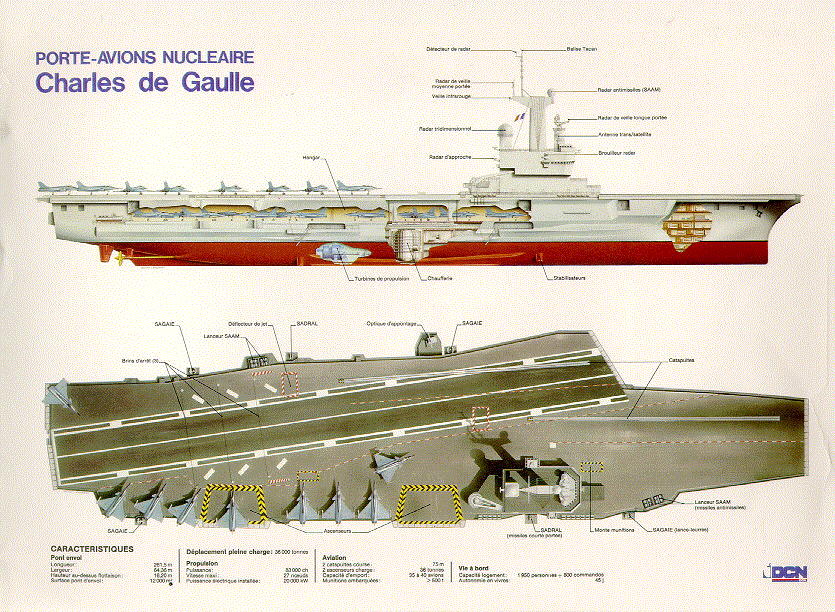
CVN 78, aka USS Gerald R Ford, is the next US Navy supercarrier, now under construction. It’s very important to the USN that EMALS works, as it is acknowledged that it’s now too late to change the Ford’s design and fit her with steam catapults like all other US (and French) carriers. If for some reason EMALS isn’t a success, the US will have bought the biggest and most expensive helicopter carrier ever.

Though the steam catapult is actually a British invention, Blighty’s present pocket-size carriers don’t have any catapults at all. Thus they can only launch helicopters and short-takeoff Harrier jumpjets.

The problem for Britain’s decision makers is that the current carrier design limits them to the ultra-expensive F-35B, which will be roughly twice the price of the ships themselves to provide sufficient aircraft to make the carriers fully operational. Being able to swap out the deluxe F-35B for cheap-as-dirt F-18E’s may be enough to save both carriers from the ongoing cost-slashing by the ministry.

September 17, 2010

Duelling camo patterns

Filed under: Military, USA — Tags: , , — Nicholas @ 09:38

A brief outline of the US Army’s quest to find better camouflage patterns for troops in the field:

While the MultiCam was an improvement on the older ACU pattern uniforms, the troops did not get new packs (which also use cano pattern cloth) at the same time they received the MultiCam uniforms. Thus when troops went off into the hills, the combination of MultiCam uniforms and ACU pattern packs do a lot to ruin the camouflage effect.

The U.S. military has been having a tough decade when it comes to camouflage uniforms. Since September 11, 2001, the U.S. Army has changed camouflage patterns for their combat uniforms twice. First it was the adoption of digital patterns, then the current move to MultiCam.

It was SOCOM (special operations command) troops who first had second thoughts about the older digital camo pattern. The digital camouflage pattern uses “pixels” (little square or round spots of color, like you will find on your computer monitor if you look very closely), instead of just splotches of different colors. Naturally, this was called “digital camouflage.” This pattern proved considerably more effective at hiding troops than older methods.

For example, in tests, it was found that soldiers wearing digital pattern uniforms were 50 percent more likely to escape detection by other troops, than if they were wearing standard green uniforms. What made the digital pattern work was the way the human brain processed information. The small “pixels” of color on the cloth makes the human brain see vegetation and terrain, not people. One could provide a more technical explanation, but the “brain processing” one pretty much says it all. Another advantage of the digital patterns is that they can also fool troops using night vision scopes. American troops are increasingly running up against opponents who have night optics, so wearing a camouflage pattern that looks like vegetation to someone with a night scope, is useful.

September 16, 2010

Army, RN, RAF, and Trident replacement: pick any three

Filed under: Britain, Military, Politics — Tags: , , , , , — Nicholas @ 10:03

The British coalition government has declared that they will retain the nuclear option (that is, buy replacements for their current Trident submarines), but still seem to think that you can take £20bn from the Defence budget (in addition to the 10-20% savings you’re already demanding be made) and still have three viable services. Perhaps it’s a strange form of new math:

The £20bn replacement of the UK’s Trident nuclear deterrent could be put off until after 2015, according to reports.

The BBC said ministers were considering delaying the planned 2014 date in an effort to reduce short-term costs and head off a pre-general election political row.

The Ministry of Defence (MoD) said no decisions had yet been taken on the future of the submarine-based missile system, which is currently the subject of a value-for-money review.

It has been formally excluded from the ongoing strategic defence and security review (SDSR) but the Treasury has made clear the under-pressure MoD budget will have to pay for it. An influential committee of MPs yesterday warned that that decision would have very significant consequences for future defence spending.

Just as the coalition took office, it was mentioned that the previous Labour government had committed to spend £37bn on various new weapon systems, but had not actually provided the funding to make those purchases. Add a Trident replacement bill on top of that and there is no way to successfully pay the bills out of the current military budget.

There are always economies that can be made in military spending: it’s not unreasonable to assume that savings of 10% can be found in any military force. 20% is pushing the envelope too much unless a scaling-back of commitment is also part of the reduction. 20% cuts, no reduction in tasks, and the Trident replacements (even if you reduce the fleet from four to three) can’t be done.

Update: Lewis Page thinks the Trident replacement is essential:

Proper new Trident, with submarine-launched ballistic nukes, is the right call for the UK. Its cost is tiny compared to UK government spending — just half of a single year’s Department for Work and Pensions budget would buy new Trident boats, arm them, crew them and cover their running costs for decades.

Compared to the MoD’s much smaller budget the costs look bigger, but they are still small — and ICBM submarines represent far and away the best value for money in the MoD. For perhaps £20bn to £30bn in acquisition costs you get an unstoppable, unfindable nuclear hammer capable of shattering a nation in an afternoon. When one reflects that we have spent the same money to get the Eurofighter — a wildly expensive and now rather oldfashioned pure air-to-air platform — new Trident looks like a steal.

One major reason that the Eurofighter is such poor value for money, of course, has been repeated delay so as to achieve short-term savings in the past. This is also true of nearly every other procurement project in the MoD: cumulatively, past politicians failing to grasp nettles are now costing us billions every year. It has to stop, and stop now — as a taxpayer, quite frankly I don’t see why I should pay still more billions down the road just to keep Mr Cameron in Downing Street and Mr Clegg in the Cabinet today.

September 14, 2010

When the bureaucracy strangles its young

Filed under: Bureaucracy, Military, USA — Tags: , , , — Nicholas @ 07:42

Noah Schactman uncovers the reason it takes a decade for the Pentagon to buy new weapons:

And you thought winning the Afghanistan war was tough. Try building the Army’s new armored vehicle. Or piecing together the Navy’s new network.

All of the complexity of the Afghan conflict — and all of the bureaucracy NATO used to manage the counterinsurgency effort — was summed up by a single spaghetti monster of a PowerPoint slide. “When we understand [it],” war commander Gen. Stanley McChrystal joked when he saw the slide, “we’ll have won the war.”

But that slide was child’s play compared to the three-foot wall chart the military uses to explain its gajillion-step process for developing, buying, and maintaining gear. The “Integrated Acquisitions Technology and Logistics Life Cycle Management” diagram is kind of a precis to the whole interminable progression, from “decompose concept functional definition into component concepts & assessment objective” to “execute support program that meets materiel readiness and operational support performance requirements and sustains system in most cost-effective manner.” Stare long enough, and you’ll start to see why it takes a decade for the Defense Department to buy a tanker plane, or why marines are still reading web pages with Internet Explorer 6.

The chart is put out by the Pentagon’s Defense Acquisitions University, where the Pentagon educates 180,000 people a year on its, um, unique process for purchasing equipment.

Full-sized horror of the slide at the link. If you think you can survive the insanity of it.

September 10, 2010

The bitter choices facing Britain’s new National Security Council

Filed under: Britain, Military — Tags: , , , , , , — Nicholas @ 09:40

The new National Security Council will have its first meeting next week. It’s expected to report on Britain’s defence priorities next month. For any kind of government body, that’s a breathtaking pace to set — and the decisions to be taken will have a huge impact on Britain’s armed forces for decades to come.

Thanks to poor decision-making on new defence purchases, the current government has to cut spending by an estimated 10 to 20%. Each service has major new equipment already in the pipeline, which means cancellation won’t automatically mean monetary relief for the government. The RAF has their priority purchase of 40 more Typhoon aircraft (costing £2.8 billion). The RN is desperate to keep their two new aircraft carriers on schedule for 2016 and 2018 (costing £5.2 billion for the ships and a mind-bending £10 billion for the F-35B aircraft to load on to them). In addition, the nuclear option needs to be renewed or (saving £20 billion) scrapped.

The Economist anticipates the bulk of the cuts going to the RAF and the army:

The RAF looks certain to be hit hard. Douglas Barrie, of the International Institute for Strategic Studies, reckons that the air force will shrink dramatically, losing perhaps 200 jets through the early retirement of Tornadoes and Harriers and a scaling back of the plan for a 160-strong Typhoon fleet. Attack helicopters and unmanned drones will increasingly be used to support ground operations instead. The order for F-35 jets, which are to be shared between the navy and the air force, looks certain to be more than halved to around 60, saving more than £5 billion in purchase costs and at least as much in maintenance.

Theoretically, one or both of the navy’s aircraft carriers could be cancelled. That would drastically reduce Britain’s expeditionary capability; but the advanced state of construction, the amount of money already spent and the 10,000 or so jobs at stake make it unlikely. Ditching just one of them is impractical, since two are needed if one is to be continuously available for operations. Despite some excitable recent talk of sharing a carrier with France, the difficulty of agreeing what to do with such a shared vessel make that idea unworkable. Dr Fox has ruled it out, though he is exploring other areas of co-operation.

[. . .]

And despite Afghanistan, the army will not escape entirely. A growing emphasis on special forces in ground warfare, combined with rising scepticism about the future utility of heavy armour should allow two or three battalions of infantry to be eliminated, the mothballing of most of the army’s main battle tanks and thus big savings in manpower and logistical support. A smaller army — comprising perhaps 95,000 soldiers rather than the current 107,000 — would also make it possible to repatriate most of the roughly 19,000 British troops still stationed in Germany without building new bases or housing.

Can anyone adequately explain why Britain still has nearly 20,000 troops in Germany at this late date? What possible strategic value are they, sitting in the middle of Europe?

September 7, 2010

A different kind of “outreach”

Filed under: Asia, Military, Religion — Tags: , , , — Nicholas @ 07:42

Looks like Terry Jones and his Dove World Outreach Center got exactly the level of attention he was looking for:

The top U.S. commander in Afghanistan said the planned burning of Qurans on Sept. 11 by a small Florida church could put the lives of American troops in danger and damage the war effort.

Gen. David Petraeus said the Taliban would exploit the demonstration for propaganda purposes, drumming up anger toward the U.S. and making it harder for allied troops to carry out their mission of protecting Afghan civilians.

“It could endanger troops and it could endanger the overall effort,” Gen. Petraeus said in an interview. “It is precisely the kind of action the Taliban uses and could cause significant problems. Not just here, but everywhere in the world we are engaged with the Islamic community.”

Over at Fark.com, they have a highly appropriate term for people like Mr. Jones: they call them “attention whores”. Seems to fit.

On the other hand, wouldn’t an appropriate counter-protest involve a small mosque in Kabul burning some Christian bibles? I wonder why nobody’s doing that instead of the mass protests being threatened? It should probably be noted that this church has fifty members: hardly the mainstream of American religious belief.

September 6, 2010

The start of the Blitz, 1940

Filed under: Britain, Germany, History, Military, WW2 — Tags: , — Nicholas @ 09:44

September, 1940: the start of the Blitz:

The London Blitz started quietly. Less than 100 incidents reported by the London Fire Brigade up to 5pm on September 7, 1940. Only a few weeks after the British victory in the Battle of Britain, what came then must have been a terrible shock for Londoners. You can read the original Guardian archive report of the night here.

At 5.30pm, some 348 German bombers escorted by 617 fighters pounded London until 6.00pm. Guided by the flames, a second group attacked with more incendiary bombs two hours later, lasting into the next day.

Note, that link to the Guardian archive is a bit badly behaved: it resized my browser window.

Update: Rare colour footage of the Blitz.

« Newer PostsOlder Posts »

Powered by WordPress