
Published on 24 Oct 2015
Indy is sitting in the Chair of Madness again to answer your questions. And this time we are answering one big question that we get a lot: Why didn’t they learn anything from the American Civil War and its carnage?
October 26, 2015
Why Didn’t They Learn Anything From the American Civil War? I OUT OF THE TRENCHES
Comments Off on Why Didn’t They Learn Anything From the American Civil War? I OUT OF THE TRENCHES
Going price for a working Enigma machine – $365,000
Lester Haines reports on a recent record auction price for an Enigma machine:
A fully-functioning four-rotor M4 Enigma WW2 cipher machine has sold at auction for $365,000.
The German encryption device, as used by the U-Boat fleet and described as “one of the rarest of all the Enigma machines”, went under the hammer at Bonham’s in New York last night as part of the “Conflicts of the 20th Century” sale.
The M4 was adopted by the German Navy, the Kriegsmarine, in early 1942 following the capture of U-570 in August 1941*. Although the crew of U-570 had destroyed their three-rotor Enigma, the British found aboard written material which compromised the security of the machine.
The traffic to and from the replacement machines was dubbed “Shark” by codebreakers at Bletchley Park. Decryption proved troublesome, due in part to an initial lack of “cribs” (identified or suspected plaintext in an encrypted message) for the new device, but by December 1942, the British were regularly cracking M4 messages.
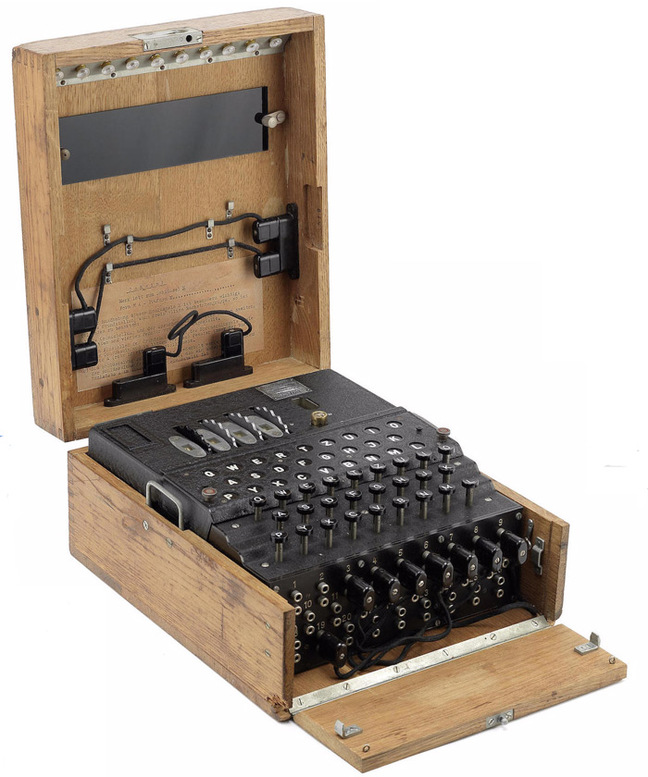
I recently read David O’Keefe’s One Day in August, which seems to explain the otherwise inexplicable launch of “Operation Jubilee”, the Dieppe raid … in his reading, the raid was actually a cover-up operation while British intelligence operatives tried to snatch one or more of the new Enigma machines (like the one shown above) without tipping off the Germans that that was the actual goal. Joel Ralph reviewed the book when it was released:
One Day in August, by David O’Keefe, takes a completely different approach to the Dieppe landing. With significant new evidence in hand, O’Keefe seeks to reframe the entire raid within the context of the secret naval intelligence war being fought against Nazi Germany.
On February 1, 1942, German U-boats operating in the Atlantic Ocean switched from using a three-rotor Enigma code machine to a new four-rotor machine. Britain’s Naval Intelligence Division, which had broken the three-rotor code and was regularly reading German coded messages, was suddenly left entirely in the dark as to the positions and intentions of enemy submarines. By the summer of 1942, the Battle of the Atlantic had reached a state of crisis and was threatening to cut off Britain from the resources needed to carry on with the war.
O’Keefe spends nearly two hundred pages documenting the secret war against Germany and the growth of the Naval Intelligence Division. What ties this to Dieppe and sparked O’Keefe’s research was the development of a unique naval intelligence commando unit tasked with retrieving vital code-breaking material. As O’Keefe’s research reveals, the origins of this unit were at Dieppe, on an almost suicidal mission to gather intelligence they hoped would crack the four-rotor Enigma machine.
O’Keefe has uncovered new documents and first-hand accounts that provide evidence for the existence of such a mission. But he takes it one step further and argues that these secret commandos were not simply along for the ride at Dieppe. Instead, he claims, the entire Dieppe raid was cover for their important task.
It’s easy to dismiss O’Keefe’s argument as too incredible (Zuehlke does so quickly in his brief conclusion [in his book Operation Jubilee, August 19, 1942]). But O’Keefe would argue that just about everything associated with combined operations defied conventional military logic, from Operation Ruthless, a planned but never executed James Bond-style mission, to the successful raid on the French port of St. Nazaire only months before Dieppe.
Clearly this commando operation was an important part of the Dieppe raid. But, while the circumstantial evidence is robust, there is no single clear document that directly lays out the Dieppe raid as cover for a secret “pinch by design” operation to steal German code books and Enigma material.
Comments Off on Going price for a working Enigma machine – $365,000
October 23, 2015
The Crime That Shook the World – The Execution of Edith Cavell I THE GREAT WAR Week 65
Published on 22 Oct 2015
Edith Cavell was a British nurse serving in a nursing school in occupied Belgium. She was executed by the Germans for treason and espionage in Brussels. Her death and the surrounding atrocity propaganda caused a public outcry all over the world. At the same time the First World War continued like never before. The Third Battle of the Isonzo didn’t bring a decision between Austria-Hungary and Italy, in Gallipoli the troops were slowly withdrawn and the the Champagne offensive of the French army was still in full swing.
Comments Off on The Crime That Shook the World – The Execution of Edith Cavell I THE GREAT WAR Week 65
October 20, 2015
The French Uniforms of World War 1 I THE GREAT WAR – Special
Published on 19 Oct 2015
We are starting a new irregular series about the various uniforms of the warring nations of World War 1. Starting with the French uniforms we are exploring everything from helmets to boots. The French were the first army to adapt a real military helmet with the M15. In the beginning of the war they were still wearing the traditional Kepi from Franco-Prussian War, however. Find out all about the French equipment in the trenches with Indy.
Comments Off on The French Uniforms of World War 1 I THE GREAT WAR – Special
QotD: A Roman army encampment
The camp of a Roman legion presented the appearance of a fortified city. As soon as the space was marked out, the pioneers carefully levelled the ground, and removed every impediment that might interrupt its perfect regularity. Its form was an exact quadrangle; and we may calculate, that a square of about seven hundred yards was sufficient for the encampment of twenty thousand Romans; though a similar number of our own troops would expose to the enemy a front of more than treble that extent. In the midst of the camp, the praetorium, or general’s quarters, rose above the others; the cavalry, the infantry, and the auxiliaries occupied their respective stations; the streets were broad and perfectly straight, and a vacant space of two hundred feet was left on all sides between the tents and the rampart. The rampart itself was usually twelve feet high, armed with a line of strong and intricate palisades, and defended by a ditch of twelve feet in depth as well as in breadth. This important labor was performed by the hands of the legionaries themselves; to whom the use of the spade and the pickaxe was no less familiar than that of the sword or pilum. Active valor may often be the present of nature; but such patient diligence can be the fruit only of habit and discipline.
Whenever the trumpet gave the signal of departure, the camp was almost instantly broke up, and the troops fell into their ranks without delay or confusion. Besides their arms, which the legionaries scarcely considered as an encumbrance, they were laden with their kitchen furniture, the instruments of fortification, and the provision of many days. Under this weight, which would oppress the delicacy of a modern soldier, they were trained by a regular step to advance, in about six hours, near twenty miles. On the appearance of an enemy, they threw aside their baggage, and by easy and rapid evolutions converted the column of march into an order of battle. The slingers and archers skirmished in the front; the auxiliaries formed the first line, and were seconded or sustained by the strength of the legions; the cavalry covered the flanks, and the military engines were placed in the rear.
Edward Gibbon, “Chapter I: The Extent Of The Empire In The Age Of The Antonines — Part III”, History of the Decline and Fall of the Roman Empire, 1782.
Comments Off on QotD: A Roman army encampment
October 18, 2015
Should we build “modern battleships”? The answer is probably “no”
The question, raised by Robert Farley at The National Interest is “Is it time to bring back the Battleships?”
Is it time to bring back the battleship?
For decades, naval architects have concentrated on building ships that, by the standards of the World Wars, are remarkably brittle. These ships can deal punishment at much greater ranges than their early 20th century counterparts, but they can’t take a hit. Is it time to reconsider this strategy, and once again build protected ships? This article examines how these trends came about, and what might change in the future.
The label “battleship” emerges from the older “ship of the line” formulation, in the sense that a navy’s largest ships participated in the “line of battle” formation that allowed them to bring their broadsides to bear on an opposing line. After the development of ironclad warships, the “battle ship” diverged from the armored cruiser based on expectations of usage; “battleships” were expected to fight enemy “battleships.” The modern battleship form settled around 1890, with the British Royal Sovereign class. These ships displaced about 15,000 tons, with two heavy guns each in turrets fore and aft, and steel armor. The rest of the navies of the world adopted these basic design parameters, which provided a ship that could both deal out and absorb punishment. The process of ensuring survivability was simplified, in these early battleships, by the predictability of the threat. The most likely vector of attack in the late 1890s came from large naval artillery carried by other ships, and consequently protective schemes could concentrate on that threat.
From the American perspective, even if through some collective congressional brain-fart the US Navy was compelled to build and deploy modern analogues to the classic battleship, what the hell would they be used for? China and Russia are not going to build opposing battleships, and it’s difficult to imagine anyone else on the planet who would have both the economic resources and the strategic desire to go toe-to-toe in Jutland fashion against the USN.
Comments Off on Should we build “modern battleships”? The answer is probably “no”
October 16, 2015
Learning Lessons From Loos – Bulgaria Enters The War I THE GREAT WAR – Week 64
Published on 15 Oct 2015
By the numbers the Battle of Loos was a defeat for the British Army but they learned valuable lessons for the future on the Western Front. The creeping artillery barrage is used for the first time successfully and it is apparent that assault tactics have to be rethought completely. On the Balkans, Bulgaria officially declares war on Serbia and joins the Central Powers Germany, Austria-Hungary and the Ottoman Empire. On the same day they invade Serbia which is now in real trouble.
Comments Off on Learning Lessons From Loos – Bulgaria Enters The War I THE GREAT WAR – Week 64
The rules of war, US edition
Tom Kratman read through the latest edition of the US government’s Law of War Manual, so you (probably) won’t have to:
I thought I was free of one thousand plus page books of the driest prose imaginable when I finished law school. Sadly, no such luck; the Department of Defense released, back in mid-June, its Law of War Manual, which is eleven hundred and seventy-six pages of painfully sere verbiage. Go ahead and divide the number of pages by the number of days since about 15 June, 2015. Yeah, that dry.
But, dry or not, it’s not that bad. Nothing that induces the legal LibLePRs (Liberals, Leftists, Progressives, and Reds) of ICOTESCAS (the International Community Of The Ever So Caring And Sensitive) to denounce it as something that “reads like it was written by Hitler’s Ministry of War,” could be all that bad.
[…]
The left’s grasp of law of war is tenuous at best, often mistaken and frequently fraudulent. For example, one of their usual charges, also much heard during the campaign in Iraq and especially at Fallujah, was that incendiary weapons are banned, per the Protocol on Prohibitions or Restrictions on the Use of Incendiary Weapons (Protocol III). The fraud there is that incendiary weapons are not banned there or anywhere. Their use under some circumstances is restricted or banned, but the weapons themselves, and their use for other purposes or other circumstances is perfectly legal.
That’s just one example of the fraud the left has perpetrated with regard to the manual. There are numerous others, too numerous to list here. I will limit my comment, therefore, to the observation that attacking a legitimate military target in proximity to a civilian or civilians is not quite the same thing as carte blanche to attacks civilians, qua civilians, generally. ICOTESCAS seems to harbor some confusion about this or to pretend to confusion to cover their fraud.
One aspect, in particular, that has the left up in arms about the manual is in its treatment of journalists. I suppose in their ideal world, camera teams from Al Jazeera should be able to do reconnaissance for groups of guerillas and terrorists, scot free. Too, one suspects, in the ideal lefty world, the presence of a journalist, even if he happens to be carrying ammunition for the other side, should protect all combatants around the “journalist,” lest the journalist’s expensive coif be mussed.
Sadly, for that set of values and outlooks, in the real world, once the soldiers realize that some “journalists” are helping the enemy, those journalists are going to be killed as quickly and conveniently as possible, as they should be. Aim true, boys, aim true.
The rules, as outlined in the manual, for journalists are actually pretty reasonable. To paraphrase:
- If you are a journalist and among the enemy, your presence will not protect them. Their presence will endanger you and the closer you are to them the more you will be in danger. We will neither aim expressly for you if we know where and who you are, nor avoid targeting places you might be, if we don’t know who and where you are, nor avoid targeting places where you are, if we know or suspect the enemy is there, too. You knew it was a risk when you undertook the profession.
- If you take part in hostilities, to include by providing reconnaissance or by spying, you will have lost your immunities as a civilian, but not gained the privilege of a combatant. We can kill you.
- If you act as a spy and we catch you, we can try you as a spy, give you a judge and jury who may not much care for you or your profession, then stand you against a wall and shoot you.
Comments Off on The rules of war, US edition
October 15, 2015
S.L.A. Marshall, Dave Grossman, and the “man is naturally peaceful” meme
The American military historian S.L.A. Marshall was perhaps best known for his book Men Against Fire: The Problem of Battle Command in Future War, where he argued that American military training was insufficient to overcome most men’s natural hesitation to take another human life, even in intense combat situations. Dave Grossman is a modern military author who draws much of his conclusions from the initial work of Marshall. Grossman’s case is presented in his book On Killing: The Psychological Cost of Learning to Kill in War and Society, which was reviewed by Robert Engen in an older issue of the Canadian Military Journal:
As a military historian, I am instinctively skeptical of any work or theory that claims to overturn all existing scholarship – indeed, overturn an entire academic discipline – in one fell swoop. In academic history, the field normally expands and evolves incrementally, based upon new research, rather than being completely overthrown periodically. While it is not impossible for such a revolution to take place and become accepted, extraordinary new research and evidence would need to be presented to back up these claims. Simply put, Grossman’s On Killing and its succeeding “killology” literature represent a potential revolution for military history, if his claims can stand up to scrutiny – especially the claim that throughout human history, most soldiers and people have been unable to kill one another.
I will be the first to acknowledge that Grossman has made positive contributions to the discipline. On Combat, in particular, contains wonderful insights on the physiology of combat that bear further study and incorporation within the discipline. However, Grossman’s current “killology” literature contains some serious problems, and there are some worrying flaws in the theories that are being preached as truth to the men and women of the Canadian Forces. Although much of Grossman’s work is credible, his proposed theories on the inability of human beings to kill one another, while optimistic, are not sufficiently reinforced to warrant uncritical acceptance. A reassessment of the value that this material holds for the Canadian military is necessary.
The evidence seems to indicate that, contrary to Grossman’s ideas, killing is a natural, if difficult, part of human behaviour, and that killology’s belief that soldiers and the population at large are only being able to kill as part of programmed behaviour (or as a symptom of mental illness) hinders our understanding of the actualities of warfare. A flawed understanding of how and why soldiers can kill is no more helpful to the study of military history than it is to practitioners of the military profession. More research in this area is required, and On Killing and On Combat should be treated as the starting points, rather than the culmination, of this process.
Comments Off on S.L.A. Marshall, Dave Grossman, and the “man is naturally peaceful” meme
October 14, 2015
Toyota’s ISIS problem
In The Diplomat, Franz-Stefan Gady looks at the problem for Toyota because their vehicles have become the favourites of ISIS and other terrorist groups:
The United States has launched an investigation to determine how the terror group ISIS was able to acquire a large number of Toyota pickup trucks and SUVs ABC News reported this week.
Japanese car manufacturer Toyota, the world’s second-largest auto maker, has pledged full cooperation with U.S. authorities and is “supporting” the inquiry led by the Terror Financing division of the U.S. Department of the Treasury.
“We briefed Treasury on Toyota’s supply chains in the Middle East and the procedures that Toyota has in place to protect supply chain integrity,” according to a D.C.-based spokesperson of Toyota. However, “it is impossible for Toyota to completely control indirect or illegal channels through which our vehicles could be misappropriated,” he added.
According to Toyota sales data, the number of Hilux and Land Cruisers sold tripled from 6,000 in Iraq in 2011 to 18,000 sold in 2013. However, sales dropped to 13,000 in 2014.
Toyota Hilux pickup trucks – a lightweight virtually indestructible vehicle – have been prominently featured in various ISIS propaganda videos and played an important role in ISIS’ conquests of large stretches of Iraqi territory last summer by acting as a force multiplier.
Armed with a .50 caliber machine gun the Hilux truck’s maneuverability provided insurgents quickly with close-range fire support during their attacks. Back in 2010, the counterinsurgency expert David Kilcullen referred to the Hilux as “a modern version of light cavalry. They move weapons into positions to fire, and can also shift people around very quickly, with a quick dismount.”
Full disclosure: I’m currently driving a ten-year-old Toyota pickup truck (a Tacoma, which I think is the North American version of the Hilux). My next vehicle is likely to be another Toyota pickup truck. They may not be technically indestructible, but I’ve been very impressed with the performance and durability of my particular vehicle.
Comments Off on Toyota’s ISIS problem
Canadian defence … a still-relevant view from ten years ago
Instapundit linked to a ten-year-old post at Albion’s Seedlings, and I noticed that the next post there is still pretty much dead-on in describing why Canada’s military is in the state we still see today. Spoiler: the post is titled “Was Canada Ever Serious? Militia and Military Since Confederation“:
Initial chapters [of Canadian Brass: The Making of a Professional Army 1860-1939 by Stephen Harris, 1988] consolidate the early periods of Canadian military history as the British military staff digested the new geopolitical realities demonstrated during the American Civil War. Canada was to be spun loose politically in 1867 but its foreign policy and defense were to remain a very strange hybrid well into the 20th century. The WW1 period in Canadian Brass is divided into pre-war, a Sam Hughes [Militia Minister] WW1 period, and a post-Hughes WW1 period. An interbellum period gets thorough coverage and then WW2 is broken out into separate Military Planning, and Training & Education chapters.
The rather shocking message of this book is that the Canadian military has been the constant butt of political interference during the last 150 years except for two brief periods: WW2 proper, and 1951-1964. During virtually all other periods of Canadian history, the permanent (professional) military forces have been starved of funds, denigrated in public by all and sundry, and then ignored completely during mobilization for wartime. The only time in Canadian history that professional pre-mobilization plans were actually used was WW2. In all other eras, professional plans were ignored and politicians turned to various militia cronies to assemble, train, lead, and transport Canadian troops.
[…]
The author suggests, therefore, that lack of professionalism in the organization of the military led to unnecessary political crises (specifically the split between Quebec and English-speaking Canada), and, in the case of the First World War, the needless slaughter of the initial Canadian divisions (because they were led by totally unqualified militia officers with political connections). The WW1 crisis created by Minister of Militia Sam Hughes was the result of a totally mythical and exaggerated memory of militia superiority in the War of 1812 and the Fenian raids of 1866, and careful news management out of the Boer War. Militia were held to be a superior in all ways to a professional force, moral and martial. Government money for militias (urban and especially rural) was a traditional source of political patronage in Canada, frustrating British military advisers and Governor-Generals for literally generations (and ruining many Brit careers in the process). Such patronage methodically starved the professional units in a nascent professional Canadian Army of training, equipment, facilities, pensions, wages and prestige. The result was a professional army that wasn’t and an oblivious overconfident citizen-soldier militia that was destined for a horrific introduction to modern war.
The casualty situation got so bad by the late fall of 1916 that Hughes was dismissed, and a new generation of Canadian officers (all political appointees but survivors of the savage Darwinian selection at the front) began to lead, and promote their junior officers out of the ranks. The impact on morale and military success from early 1917 to the end of the First World War were dramatic. Canadian reputations for combat effectiveness essentially came out of this period.
[…]
It’s clear, in retrospect, that Canadian politicians and the Canadian public have had a long-standing expectation that the British (and then the US) were going to bail them out in any serious military situation. As a result, the professional Canadian military was seen as simply another source of political largesse for the party in power. It never had to be effective, and post-1964, it actually was designed not to be used at all … unification of the three services (Army, Navy, Air Force), and endless UN peace-keeping missions were an effective way to strip combat effectiveness and combat equipment out of the Canadian military. Harris provides all the necessary context and information for that conclusion but is politic enough to avoid much further commentary.
He does writes an interesting epilogue that delicately skirts around those post-1939 issues … and avoids touching the “third rail” of military bilingualism introduced in the 60s, which further degraded esprit de corps and combat effectiveness. After all, Mr. Harris was essentially writing about his own Cold War employer at the time of publication (1988), and probably wanted to keep his job. Nonetheless, it’s pretty clear that the Liberal dismantlement of the conventional Canadian military (after tactical nukes appeared in Europe in the 60s) was yet another iteration of the political manipulation of the permanent military and a return of the good old days of “jobs for the boys.” The sorry state of today’s Canadian military (a small but excellent antiterrorist force [JTF2] to protect the elite in Ottawa, and a sprinkle of blue helmet cannon fodder without adequate air transport) is therefore very much part of a proud Canadian political tradition stretching back 135 years. It’s not a mistake. It’s on purpose.
Ten years on, we don’t do the UN peacekeeping stuff to any great extent, but even with a “pro-military” government in power for most of that time, the Canadian Armed Forces are still starved for resources and up-to-date equipment (and procurement is still seen as a way to spread government money around to “deserving” regions rather than a way of getting the best tools for the money). Thanks to our unique strategic situation, Canada can still be a military free-loader — and glories in it.
Comments Off on Canadian defence … a still-relevant view from ten years ago
October 13, 2015
Art From The Apocalypse – Otto Dix I WHO DID WHAT IN WW 1
Published on 12 Oct 2015
Otto Dix was a German artist known for his unforgiving depiction of the Great War and the society of Weimar Republic. His works in the series Der Krieg (The War) are among the most well known depictions of the horrors of war. Together with George Grosz and Max Beckmann, he is considered one of the most important artists of the Neue Sachlichkeit (New Objectivity).
Comments Off on Art From The Apocalypse – Otto Dix I WHO DID WHAT IN WW 1
October 11, 2015
How Was A Burial Truce organised? I OUT OF THE TRENCHES
Published on 10 Oct 2015
Indy is sitting in the Chair of Madness this time and to answer your questions. This time we are talking about Paul von Hindenburg and his legacy after World War 1 and about burial truces between the armies on the Western Front.
Comments Off on How Was A Burial Truce organised? I OUT OF THE TRENCHES
October 9, 2015
Serbia Is Invaded Once Again – The Entente Lands in Greece I THE GREAT WAR Week 63
Published on 8 Oct 2015
The Central Powers want to open a direct supply connection between Berlin and Constantinople. So, they start a new offensive on Serbia to defeat them once and for all. It’s an open secret that Serbia’s neighbour Bulgaria will soon join the war so the Serbians are in dire need of help. With no other option, the Entente lands troops in Salonika, Greece. The whole situation on the Balkans is spiraling out of control once more. Meanwhile the new offensives on the Western Front continue while the Eastern Front cools down.
Comments Off on Serbia Is Invaded Once Again – The Entente Lands in Greece I THE GREAT WAR Week 63
October 6, 2015
Bulgaria in World War 1 – The New Central Power I THE GREAT WAR – Special
Published on 5 Oct 2015
Thank you Plamen Ganev for helping with the research for this episode!
Bulgaria joined the ranks of the Central Powers in World War 1 in October 1915 and shortly after invaded neighbouring Serbia to support the German-Austro offensive on Belgrade. A lot of promises about territory were made towards Ferdinand I and especially the chance of getting back territories lost in the Balkan Wars was music to Bulgarian ears. Find out all about Bulgaria joining World War 1 in our special episode.
Comments Off on Bulgaria in World War 1 – The New Central Power I THE GREAT WAR – Special


