
The Great War
Published on 6 Jan 2018Check out The Tank Museum on Patreon: https://www.patreon.com/tankmuseum
Indy speaks to David Willey, curator of The Tank Museum in Bovington, about the Rolls Royce Armoured Car, one of the most iconic armoured cars of World War 1. From its early, improvised days on the Western Front to deployment in the far corners of the British Empire.
January 7, 2018
Inside the Rolls Royce Armoured Car I THE GREAT WAR Special
Comments Off on Inside the Rolls Royce Armoured Car I THE GREAT WAR Special
January 6, 2018
THE GREAT WAR and C&RSENAL Special Hangout – Russian Rifles and Pistols of WW1
The Great War
Streamed live 6 hours agoCheck out C&RSENAL: http://youtube.com/candrsenal
Ask questions here: https://www.reddit.com/r/TheGreatWarC…
Comments Off on THE GREAT WAR and C&RSENAL Special Hangout – Russian Rifles and Pistols of WW1
Caesar in Gaul: REVOLT! (54 to 53 B.C.E.)
Historia Civilis
Published on 21 Jun 2017
Comments Off on Caesar in Gaul: REVOLT! (54 to 53 B.C.E.)
January 5, 2018
Machinations In The British High Command I THE GREAT WAR Week 180
The Great War
Published on 4 Jan 20181918 starts with machinations in the British High Command since Prime Minister Lloyd George is holding back troops and generally would like to replace Sir Douglas Haig as commander.
Comments Off on Machinations In The British High Command I THE GREAT WAR Week 180
January 4, 2018
HMS Ocean to be sold to Brazil
In The Register, Gareth Corfield sums up reports on the disposition of the Royal Navy’s current flagship after a 20-year service life:
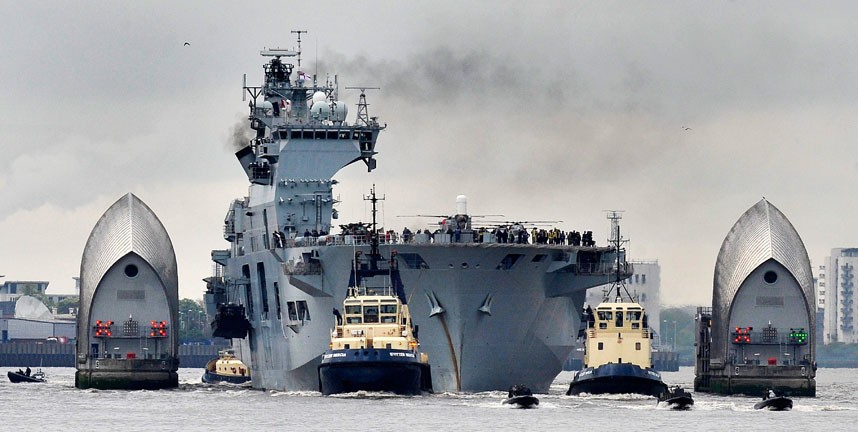
HMS Ocean at the Thames Barrier in 2012, being moved into position to support the Olympic Games in London.
The 22,000-tonne helicopter carrier, which returned from her last British deployment to the Caribbean just weeks ago, will be formally decommissioned from the RN in spring this year.
Although it was well known that Ocean was up for sale and that Brazil (as well as Turkey) were interested in buying the 20-year-old warship, confirmation of the deal and the purchase price were all “known unknowns” until now.
The news was broken by defence blog UK Defence Journal, citing a Brazilian journalist.
The Brazilian Navy’s end-of-year roundup statement, published on Christmas Eve 2017, also included the line: “Minister Raul Jungmann and the Brazilian Navy Commander Eduardo Bacellar Leal Ferreira took the opportunity to announce the purchase of the Royal Navy’s HMS Ocean multifunction vessel, valued at £84m sterling.”
A British Ministry of Defence spokesman told El Reg: “Discussions with Brazil over the long-planned sale of HMS Ocean are at an advanced stage, but no final decisions have been made. HMS Ocean has served admirably with us since 1998 and the revenue she generates will be reinvested in defence as we bolster our Royal Navy with two types of brand new frigates and two huge aircraft carriers.”
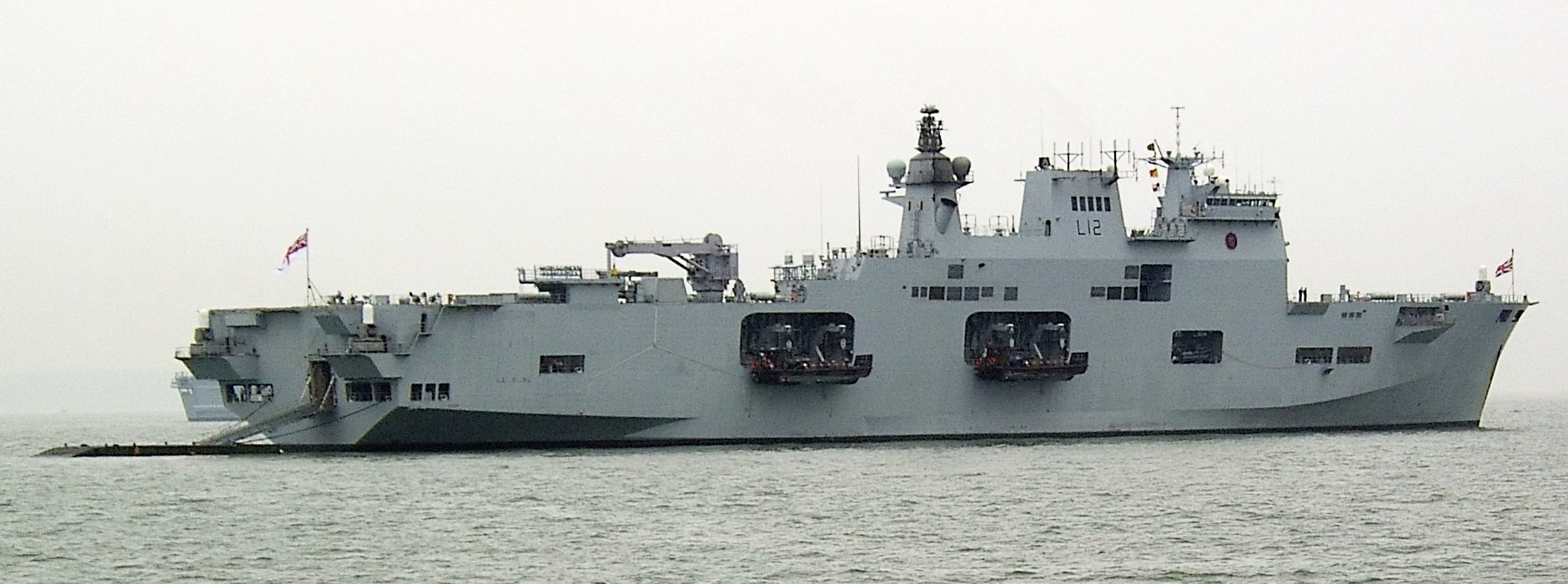
HMS Ocean at the 2005 International Fleet Review, showing Landing Craft on davits and Stern Ramp deployed.
Photo via Wikimedia.
At the Thin Pinstriped Line, Sir Humphrey explains why selling the ship now makes sense for the Royal Navy:
The big change to this requirement came in 2015, when the SDSR [Strategic Defence and Security Review]confirmed that the RN would keep both carriers in active service, and that neither would be CTOL [conventional take-off and landing]. Suddenly the RN found itself planning for a future where it would have two CVF available [the Queen Elizabeth class carriers], both of which would need to have manpower available to crew them. It also meant that the RN could make modifications to the ships to ensure that either of them could operate as an LPH [Landing Platform Helicopter] and carry helicopters and troops as well as a fixed wing airgroup.
This decision has had major ramifications for Ocean – suddenly the need for her to remain in service was gone. The LPH role that she would have done would now be filled by two newer and vastly more capable ships – the UK wasn’t losing capability but gaining it. In practical terms the RN actually would have more chance of an LPH being available without Ocean as CVF availability will be higher, both can role as an LPH (rather than CTOL which would not do this task) and with both platforms active, there is far less chance of the nightmare situation of both the CTOL carrier and the old LPH being stuck in refit at the same time.
From a capability perspective, the move to CVF makes a lot of sense. There are issues to be resolved (arguably the littoral manoeuvre capability offered by her landing craft, the vehicle issue and the question of what to do about afloat 1&2* command platforms and where to put them), but Ocean paying off is not going to remove the LPH capability from the UK toolkit.
The second problem has been that even if the RN wanted to run Ocean on, it has run out of manpower to do so. This year will see Queen Elizabeth at sea doing complex trials, drawing heavily on the Fleet Air Arm personnel to do so. As Prince of Wales (POW) stands up, more and more crew (usually very specialised engineers and the like) will be needed to bring her out of build. On the old plan this wouldn’t have been an issue – one would have gone straight into reserve. Now, the RN has to bring both carriers into service at roughly the same time (a helpful reminder of RN capability here is that it is the only navy in the world currently introducing two supercarriers into service at roughly the same time).
Ocean requires a lot of specialist crew who will be needed on QE and POW, and more importantly so will their reliefs. The manpower planners have not been working on the assumption of three carriers available and at sea (something the RN arguably has not done consistently for many years), and so the manpower structure is not designed to provide this. It could be changed, but would need many years to produce the right numbers of people in the right slots to deliver it without breaking manpower and causing retention challenges.
Comments Off on HMS Ocean to be sold to Brazil
January 2, 2018
The Defence of Baku – The Adventures of Dunsterforce Part 2 I THE GREAT WAR Special
The Great War
Published on 1 Jan 2018In part two of the Adventures of Dunsterforce, we follow the Hush Hush Army on their travels through the Caucasus. Picking up where we left off, the Dunsterforce leave Enzeli, clash with Jangalis en route, and head for Baku. They had to journey through territory controlled by warlords, cossacks and bolshevik soviets and when they arrived during the Siege of Baku, Dunsterville and his men meet the five dictators that make up the Centrocaspian Dictatorship.
Comments Off on The Defence of Baku – The Adventures of Dunsterforce Part 2 I THE GREAT WAR Special
December 31, 2017
The Sopwith Snipe – WW1 Pilot’s Gear I THE GREAT WAR Special
The Great War
Published on 30 Dec 2017Play Warthunder For Free:
https://warthunder.com/play4free?r=greatwarIndy takes a look at the Sopwith Snipe and meets Trevor who shows us the typical gear of a WW1 pilot.
Comments Off on The Sopwith Snipe – WW1 Pilot’s Gear I THE GREAT WAR Special
December 29, 2017
Ludendorff Plans for a Spring Offensive I THE GREAT WAR – Week 179
The Great War
Published on 28 Dec 2017This week, the peace negotiations are underway at Brest-Litovsk. Meanwhile, the German High Command begins to plan for a game-changing offensive in the spring. There’s action in Italy on the Piave Front, and the Ottomans try to recapture the Holy City.
Comments Off on Ludendorff Plans for a Spring Offensive I THE GREAT WAR – Week 179
December 28, 2017
How A Cargo Ship Helped Win WW2: The Liberty Ship Story
Mustard
Published on 14 Nov 2017During World War Two, hundreds of cargo ships raced across the Atlantic in an effort to keep Britain supplied. But these ships were being sunk by German U-boats, warships and aircraft. In 1940 alone, over a thousand allied ships were lost on their way to Britain.
The United States, while not yet at war, was playing a vital role in supplying Britain. But with ships being sunk daily, Britain and America desperately needed a way to keep all that material moving across the Atlantic. In response, 18 shipyards across the coastal United States mobilized to build thousands of large cargo ships known as Liberty Ships. They would be built even faster than the enemy could sink them. At one point the shipyards were building one large Liberty Ship every eight hours.
Two revolutionary changes in shipbuilding will make this enormous feat possible. The first is welding and the second is the use of a modular assembly process. By mid 1941, the sheer number Liberties out at sea, along with increasing armed escorts overwhelmed German forces. Advances in anti-submarine technologies also started stamping out the U-boat threat.
Today, there are only three Liberty Ships remaining of the 2,710 built that remind us of their enormous contribution to winning World War Two.
Comments Off on How A Cargo Ship Helped Win WW2: The Liberty Ship Story
December 27, 2017
The Second World War – Operation Dynamo completed, The Long March has started.
TimeGhost
Published on 20 Dec 2017Thank you all for your support so far! Every minute, every hour we move closer to launching The Second World War as the largest collaborative effort on YouTube ever, and you’re making it happen!
Launch WWII: https://www.kickstarter.com/projects/…
Join the TimeGhost Army Group: https://www.facebook.com/groups/TimeGhostArmy/
Audio: Winston Churchill’s speech to the House of Commons on 4 June 1940 after the completion of Operation Dynamo, the evacuation from Dunkirk.
Footage from Frank Capra’s “Why We Fight” series from 1942 and “The True Glory” from 1945, a documentary based on photography by combat camera men produced by the governments of Great Britain and The United Sates. Both courtesy of The National Archive, all right released.
Comments Off on The Second World War – Operation Dynamo completed, The Long March has started.
December 26, 2017
The Hush Hush Army – The Adventures of Dunsterforce Part 1 I THE GREAT WAR Special
The Great War
Published on 25 Dec 2017Dunsterforce Book: http://amzn.to/2BA5IRM
The Dunsterforce was a small British military mission under Colonel Dunsterville. Its goal was to prevent the spread of German influence in the South Caucasus and Caspian Sea. The soldiers soon find themselves in the complicated and violent post-revolutionary Caucasus where no one can really be trusted.
Comments Off on The Hush Hush Army – The Adventures of Dunsterforce Part 1 I THE GREAT WAR Special
December 25, 2017
Filling Trenches – General PoWs – Blindness I OUT OF THE TRENCHES
The Great War
Published on 23 Dec 2017Ask your questions: http://outofthetrenches.thegreatwar.tv
Comments Off on Filling Trenches – General PoWs – Blindness I OUT OF THE TRENCHES
December 24, 2017
Hilarious History: That Time Cadets at West Point Rioted Over Eggnog
Today I Found Out
Published on 6 Dec 2017In this video:
From the beginning, heavy drinking was fairly commonplace among the cadets at the United States Military Academy at West Point (founded in 1802). In an attempt to stem this in 1826, the academy’s strict superintendent and the “Father of West Point,” General Sylvanus Thayer, began a crackdown by prohibiting alcohol on campus. As Christmas approached and the cadets realized that the prohibition would put a damper on their traditional Christmas Eve festivities that included consumption of a fair amount of eggnog, a bold few began to plan away around the problem.
Want the text version?: http://www.todayifoundout.com/index.p…
Comments Off on Hilarious History: That Time Cadets at West Point Rioted Over Eggnog
December 23, 2017
The team behind “The Great War” to produce a Second World War video series
Perhaps the single question Indy Neidell and the team at “The Great War” channel have been asked most frequently was whether they were planning to do a similar kind of week-by-week history on the Second World War. They have finally committed to doing so, although it will be a much bigger effort than what they’ve been doing so far. Here’s the Kickstarter intro video:
The funding effort is going well, as the latest update indicates:
Comments Off on The team behind “The Great War” to produce a Second World War video series
December 22, 2017
The Armistice of Brest-Litovsk I THE GREAT WAR Week 178
The Great War
Published on 21 Dec 2017An armistice between Austria-Hungary, Germany and Russia is signed this week 100 years ago at Brest-Litovsk. And right away the Germans make their intentions clear that they want to dictate the terms for the following peace negotiations. Even Great Britain is exploring peace options but is there actually peace in Russia? After the Bolshevik Coup a Civil War is looming.
Comments Off on The Armistice of Brest-Litovsk I THE GREAT WAR Week 178


