Editor’s Note: This series was originally published by Alex Funk on the TimeGhostArmy forums (original URL – https://community.timeghost.tv/t/canada-and-the-battle-of-the-atlantic-part-5-edited/1453).
Sources:
- Far Distant Ships, Joseph Schull, ISBN 10 0773721606 (An official operational account published in 1950, somewhat sensationalist)
[Schull’s book was published in part because the funding for the official history team had been cut and they did not feel that the RCN’s contribution to the Battle of the Atlantic should have no official recognition. It is very much an artifact of its era, and needs to be read that way. A more balanced (and weighty) history didn’t appear until the publication of No Higher Purpose and A Blue Water Navy in 2002, parts 1 and 2 of the Official Operational History of the RCN in WW2, covering 1939-1943 and 1943-1945, respectively.]- North Atlantic Run: the Royal Canadian Navy and the battle for the convoys, Marc Milner, ISBN 10 0802025447 (Written in an attempt to give a more strategic view of Canada’s contribution than Schull’s work, published 1985)
- Reader’s Digest: The Canadians At War: Volumes 1 & 2 ISBN 10 0888501617 (A compilation of articles ranging from personal stories to overviews of Canadian involvement in a particular campaign. Contains excerpts from a number of more obscure Canadian books written after the war, published 1969)
- All photos used exist in the Public Domain and are from the National Archives of Canada, unless otherwise noted in the caption.
I have inserted occasional comments in [square brackets] and links to other sources that do not appear in the original posts. A few minor edits have also been made for clarity.
Earlier parts of this series:
Part 1 — Canada’s navy before WW2
Part 2 — The Admiralty takes control
Part 3 — The professionals and the amateurs
Part 4 — 1940: The fall of France, the battle begins, and the RCN dreams of expansion
Part 5 — The RCN’s desperate need for warships
Part 6 — New ships, new challenges
Part 8 — Expansion problems: not enough men for not enough ships
Part 9 — Early-to-mid 1941, The Rocky Isle in the Ocean
Part 10 — The Newfoundland Escort Force and the Canadian corvettes
Part 12 — Staff needed, training needed, and Commodore Murray’s thankless tasks
Mid-May 1941 saw the few Canadian ships that remained in England involved in a series of training exercises off the Northern Irish coast. Two of the four-stackers and three corvettes practiced ASW, wireless, and visual signalling, under the watchful eyes of British officers. The results were less than satisfactory. The situation was described by Marc Milner in North Atlantic Run as
… a complete lack of understanding of what was expected of divisions within individual ships (the ASDIC team, depth-charge crew, gunners, and so on) and of ships operating as a group. The British found the Canadians keen, intelligent, and willing to learn. But no one, from the Captains on down, had any concept of ASW, and this caused the British great concern. … Most disturbing was the British training officer’s criticism of the corvettes’ commanding officers. He reported that they showed a great lack of initiative and relied entirely on the senior officer for instructions. “No one would possibly question their courage or endurance at sea,” the RN officer wrote, “and they are fine seamen. Their lack of technical knowledge is their greatest difficulty and possibly due to their age they are slow to learn.” The RCNR commanders of Canada’s first corvettes may also have had an understandable reluctance to jump too quickly when asked to do so by a young RN officer. None the less, Captain (D), Greenock, who took exception to the above officer’s dim view of Canadian COs, concluded bluntly that the low state of efficiency reached by these ships was “attributable directly to inexperience and perhaps the age of their commanding officers.” Captain (D), Greenock, recommended that they be replaced as soon as possible by younger, more experienced RCN or RCNR officers with escort experience.
Captain (D), Greenock, compiled these remarks for his chain of command, and included uncomplimentary extracts from the original work-ups of the Canadian corvettes to illustrate just how inefficient they really were. Their wireless communications had passed muster, and “bearings and distances of contacts were passed among them continuously and accurately”. Signal communication “was at times hopeless, and at best was barely adequate.” At the RN’s escort work-up base at Tobermory, where Spikenard and Hepatica trained in May, drawing similar comments from the training staff there.
From the record, it appears unlikely that any of these RN officers knew that the ten Canadian corvettes had been manned only to transfer the ships to RN crews, and that many of the officers and ratings were intended for other roles after arrival in British waters. As mentioned in earlier parts, the crews were far from seasoned professionals, as James Lamb explains in The Corvette Navy:
Corvette crews were young; officers and men were mostly right out of high school, and anyone over thirty found himself nicknamed “Pappy” and the oldest man in the ship. Consequently, corvette people were all junior in rank and rate, most of their upper-deck crews being ordinary seamen and with leading seamen often carrying out the jobs normally assigned petty officers, and the engine rooms filled with youngsters right out of mechanical training school. Early in the war, a corvette would be commanded by a Naval Reserve (ex-merchant navy) lieutenant with a Volunteer Reserve lieutenant as executive officer or “Jimmy the One”, and two other officers — junior lieutenants or sublieutenants — as watch-keepers. The corvettes were cobbled together, half a dozen at a time, into escort groups, led by an old destroyer usually commanded by a lieutenant or lieutenant-commander of either the RCN or, especially in the early days, the RN.
When you first joined a ship in the corvette navy, you passed from one world into another. You left behind the Big Navy, where you had done your training, the shoreside navy with all its braid and bands and bumf, and you joined an outfit that was run along the lines of a small corner-store. For corvette types were “family”; you soon got to know the characters in your own ship, and in the others of the group. There were chummy ships, whose destinies seemed always to be bound up with yours, and there were rivals, usually commanded by officers senior to your own. Months would go by, grow into years; the shoreside navy became a memory, although there were always officers and men joining ship for a trip or two before going back ashore to the other world where they were busy building careers.
For most of us, the corvettes, the frigates, the Bangors and the old four-stackers and other obsolete destroyers of the escort fleet became home.
From the inside, the RCN’s corvette crews may have been like families afloat, but the stiffer and more formal RN viewed-with-alarm the amateurs they would be depending upon for significant numbers of the convoy escorts critical to British survival. You can probably see their point. Marc Milner continues:
Operational and training authorities in Britain were clearly appalled by what they saw, and Captain (D), Greenock’s memo was not intended for purely internal consumption. The RCN’s expansion had got off to a poor start, and the foundations of a legacy of inadequacy and ineptitude were laid. No amount of hard work or improvement would shake it for some time.
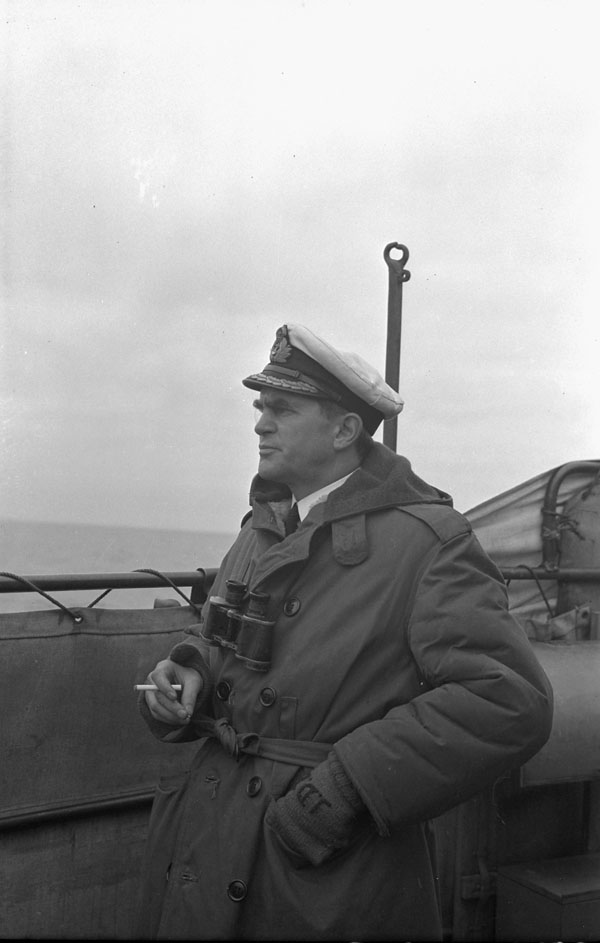
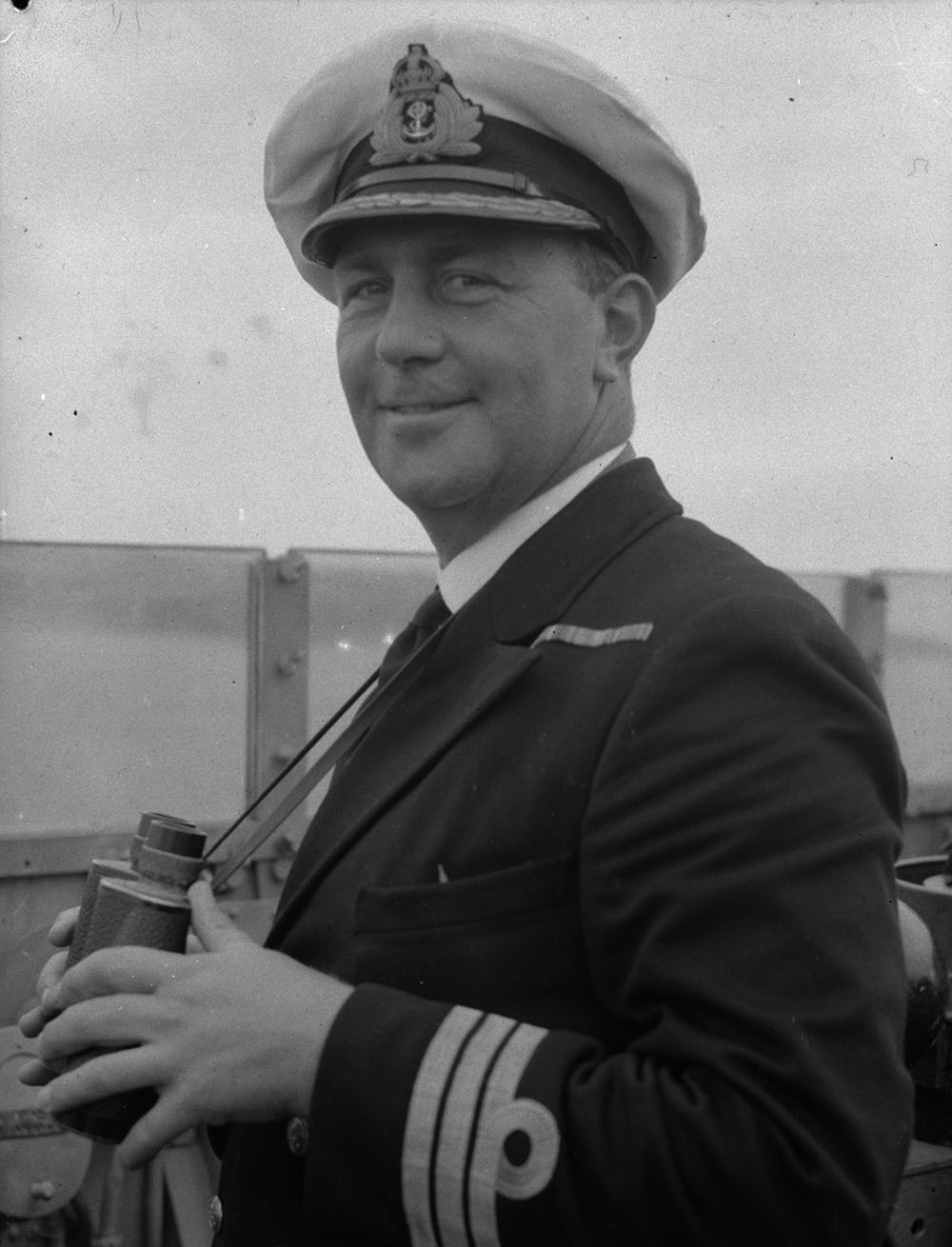
As the above report made its way through channels and the ships of the Fourth Escort Group sailed to join NEF, things moved apace in Newfoundland. Commodore Murray … arrived to assume the post of Commodore Commanding Newfoundland Escort Force (CCNF) on 15 June. Murray was a native Nova Scotian with deep roots in rural Pictou County. He attended the first class of the Royal Naval College of Canada in 1912 as a boy and went on to serve in various warships of both the RN and the RCN. His first notable appointment was to the wardroom of HMS Calcutta as a young sub-lieutenant when that ship commissioned from the builder’s yards in 1919. Calcutta‘s first commanding officer was then Captain Dudley Pound, a man who was instrumental — as First Sea Lord in 1941 — in having Murray posted to St John’s. Close links with the RN not only fostered personal connections; young Canadians also adopted many of the trappings of RN officers. Murray was not spared the effects of his long exposure to the traditions and habits of the parent service. Although he did not develop a British accent, it is unlikely that many Pictonians would have recognised him as one of their own in 1939. Yet Murray never lost his playful charm and his appreciation of his background. … This rapport carried on throughout the war; ironically, his concern for “his boys” has been cited as evidence that Murray was never capable of the type of dynamic command that his positions warranted. There is some truth in this. But few major naval commands during the Second World War were comparable to those of the RCN, where tact, diplomacy, and goodwill were essential to running an organization composed almost entirely of reservists. Murray was above all a competent and confident officer, an excellent ship handler, and an able administrator.
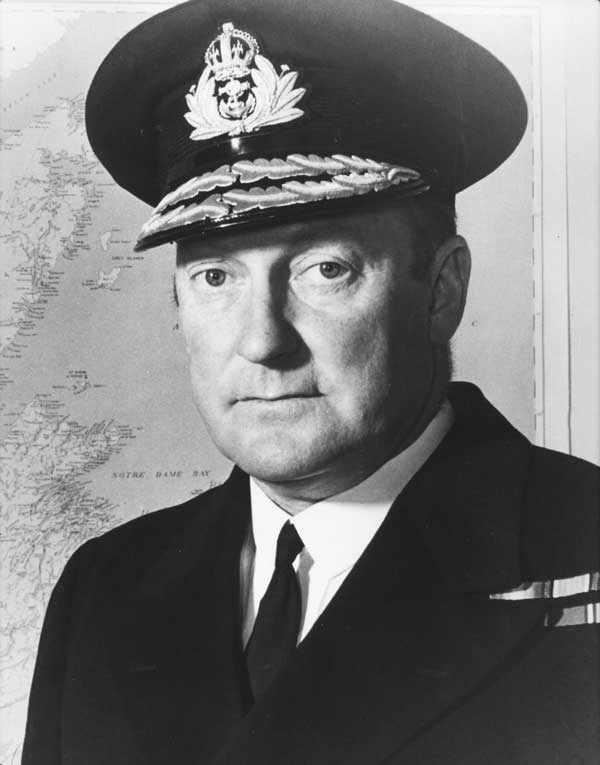
Rear Admiral Leonard W. Murray as Flag Officer, Newfoundland.
Photo via CFB Esquimalt Naval & Military Museum.
Murray’s task in Newfoundland was daunting. Not only were the facilities jury-rigged and totally inadequate; a whole administrative and support staff had to be assembled and adapted to conditions at St John’s. Perhaps because the very long-term existence of NEF — as distinct from the base itself — was an open question in the summer of 1941, the development of its staff was slow. Murray, as CCNF, was charged with overall command of naval operations off Newfoundland. But the initial staff at St John’s in May 1941 was wholly administrative, belonging to the port defence establishment. The first official record of HMCS Avalon, which appeared in the September 1941 Navy Lists, shows little more than Captain Schwerdt’s port-defence and naval-control-of-shipping staffs. Newfoundland Escort Force’s staff consisted of Murray, his chief of staff Commander R.E.S. Bidwell, RCN, and the commodore’s secretary. A more accurate indication of NEF’s supporting staff by mid-1941 was published in November. By then CCNF had added staff officers of Operations, Intelligence, and Signals and a secretary’s staff. These staffs provided the vital elements of naval operations: the processing and collecting of intelligence, handling of heavy signals traffic, and the organization and management of operational forces.
The actual administration of the escort forces themselves fell to a separate “Flotilla” staff under a “Captain (D[estroyers]).” Traditionally Captain (D) was a seagoing officer, responsible in all respects, including operational efficiency, for a flotilla of ten to twelve destroyers. Administratively the system was applicable to escort forces, but the small size of their ships and the small size of escort groups made it inappropriate for Captains (D) to go to sea. As a result the main staff of escort forces such as NEF remained ashore, while the actual seagoing duties of Captain (D) were passed to the less senior commanders of escort groups.
Captain (D) was crucial to the performance of his forces. Through a staff of specialists he monitored and was ultimately responsible for the efficacy of escort groups, individual ships, and the important warlike functions within each ship. In the early days of NEF the latter problems overwhelmed those of group coordination and the development of and adherence to a suitable tactical doctrine, for which Captain (D) was also responsible. Initially, much-needed specialists in all but a few traditional naval functions were unavailable. During 1941 Captain (D), Newfoundland, had only two specialist officers, one for gunnery and one for signals. A torpedo officer, whose duties included depth charges, was not added until 1942, while the key posts of A/S, radar, and engineering were not added until 1943. In an A/S escort force the delay in providing specialists to oversee the use of ASDIC, radar, and depth charges was serious. In the interim, St John’s-based escorts had to draw on the expertise of the base A/S and radar officers (both qualified RN officers), whose duties covered maintenance and supervision of port defences as well. Fortunately, these men found time to devote to NEF. … The RCN did what it could, but there were simply not enough qualified personnel to go around. The result was a serious deficiency in Captain (D)’s staff. In the context of a time when things were difficult all around, however, these weaknesses appear comparatively minor. Further, like the escorts themselves, Captain (D)’s initial shortfalls could be expected to diminish with time.
Theoretically at least, Captain (D) was also responsible for maintenance of existing equipment and modernization as new equipment became available. The limited facilities of St John’s made simple maintenance difficult enough, as the port was not capable of handling anything more than emergency repairs. Equipment was in very short supply, and even accommodation for extra staff was difficult or impossible to arrange. The Captain (D), Halifax, had an inspection staff for Additions and Alterations (A’s & A’s in naval parlance), so St John’s-based escorts had to turn to Halifax for anything that could not be done locally. There was nowhere within NEF’s normal operations area where new equipment could even be fitted, and a six-hundred mile trip to Halifax was hardly convenient in a changing tactical environment.
Organizationally and operationally, the NEF was a smaller version of the RN’s Western Approaches Command. The size and composition of escort groups was identical, and the NEF adopted the use of group numbers (14 through 25) following in sequence from those used by WA. NEF escort groups were more or less permanent in membership in order to foster teamwork, and as with RN groups, sailed under the command of their most senior officer (Senior Officer, Escort or SOE). This officer fulfilled the operational duties of a Captain (D) at sea.
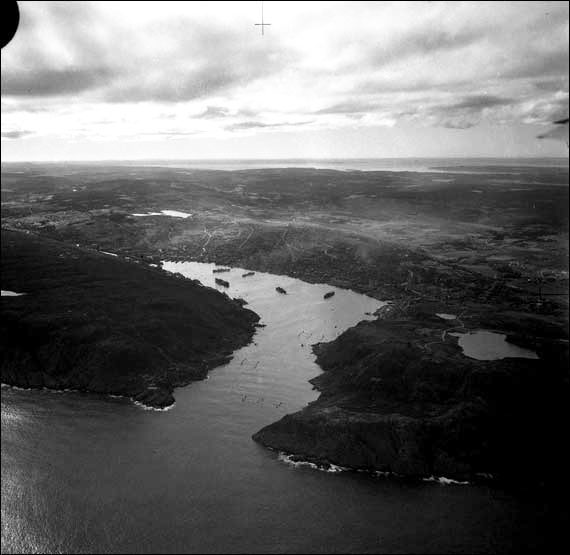
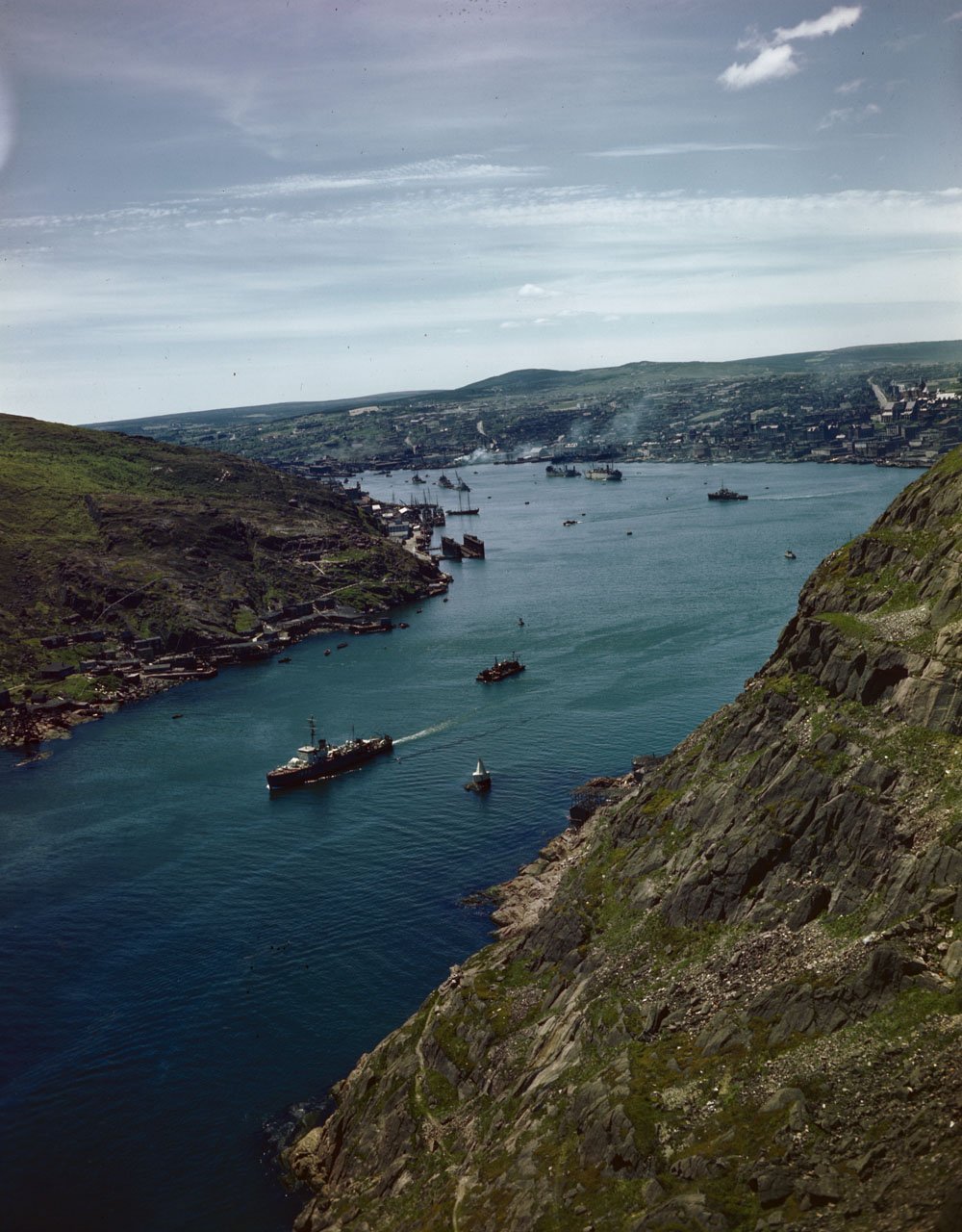
St. John’s harbour, circa 1942.
Photo from Heritage Newfoundland & Labrador (original from Library and Archives Canada MIKAN 4164991.)
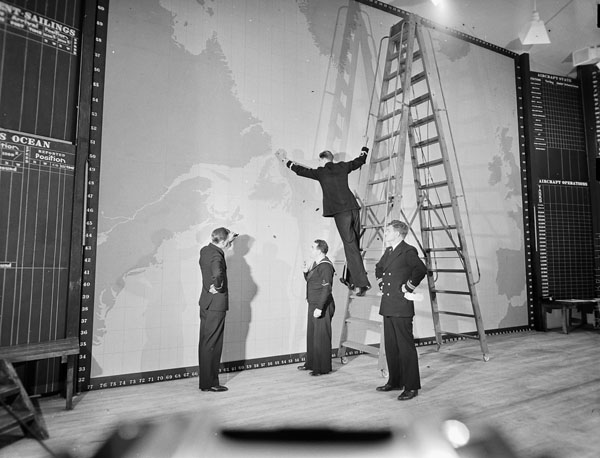
Detailing tasks, issuing sailing orders, and other related duties fell to CCNF’s operational staff. It provided the link between actual naval forces and the trade and convoy organizations. The control and management of shipping was part of the bureaucratic war. The Commonwealth navies, through their trade divisions and Naval-Control-of-Shipping (NCS) organizations, rationalized and systematized the movement of merchant ships, allowing them to be defended one of two ways. On the basis of intelligence and under the indirect cover of battle fleets, shipping was routed independently along “safe” routes. This form of protection (by far the most prevalent until 1943), was predicated upon existence of British, and later Anglo-American, command of the sea. It was an effective form of defence against the surface raiders, but it would never achieve true success against U-boats, particularly as their numbers grew. The second type of naval defence of shipping was the raison d’être for NEF.