
World War Two
Published 2 Sep 2021Citizens in Stalingrad face German bombs as Soviet officials refuse to evacuate. The German counter-insurgency effort increases, but people continue to resist against all odds. The Treblinka camp breaks down under the ambitions of its commandant, Irmfried Eberl.
(more…)
September 3, 2021
Why Don’t the French Resist? – WAH 041 – August 1942, pt. 2
Comments Off on Why Don’t the French Resist? – WAH 041 – August 1942, pt. 2
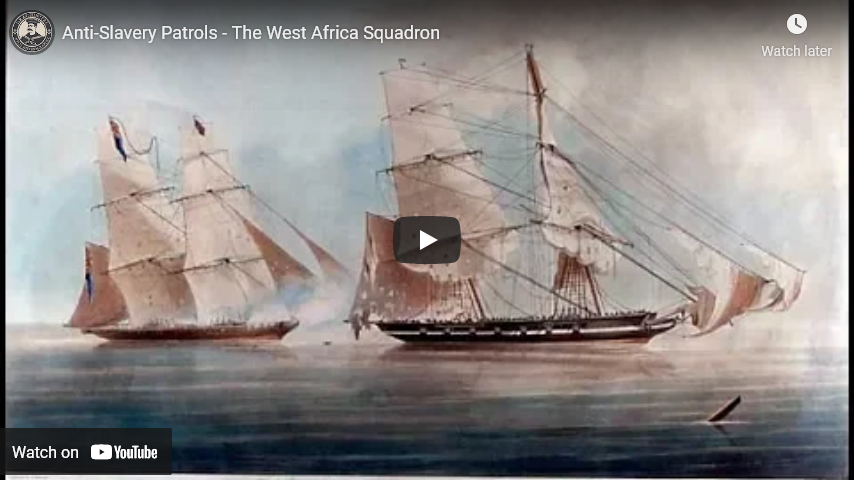
Anti-Slavery Patrols – The West Africa Squadron
Drachinifel
Published 1 Dec 2018Title says it all really, we look at something that was definitely worth doing, which really should have been done much sooner.
Comments Off on Anti-Slavery Patrols – The West Africa Squadron
September 2, 2021
Tank Chats #122 | Sherman 105 | The Tank Museum
The Tank Museum
Published 9 Apr 2021The Tank Museum’s Historian David Fletcher presents a Tank Chat on the only M4 variant of Sherman in The Tank Museum’s collection. This particular example is armed with the 105mm millimetre howitzer, designed for firing High Explosive in a close support role. Join David to find out more.
(more…)
Comments Off on Tank Chats #122 | Sherman 105 | The Tank Museum
September 1, 2021
1893 Lee-Metford Trials Carbine (One of Only 100 Made)
Forgotten Weapons
Published 17 May 2021http://www.patreon.com/ForgottenWeapons
https://www.floatplane.com/channel/Fo…
Cool Forgotten Weapons merch! http://shop.forgottenweapons.com
Once Lee-Metford rifle production was in place, the British began working on a carbine version of the same action for their cavalry. In 1893 a trial run of 100 carbines were made, and today we are looking at serial number 32 of that batch. These carbines are different in several ways from the ultimately adopted pattern. They had exposed muzzles like the Martini carbines, instead of the heavy snub-nose muzzle that would be adopted (similar to the muzzle of most early Mauser carbines). These trials carbines also had no safety, no sling attachments, and no barrel band. The did have the bent bolt handle of the final pattern (albeit not flattened down) and the short 6-round magazine.
Contact:
Forgotten Weapons
6281 N. Oracle 36270
Tucson, AZ 85740

Comments Off on 1893 Lee-Metford Trials Carbine (One of Only 100 Made)
August 30, 2021
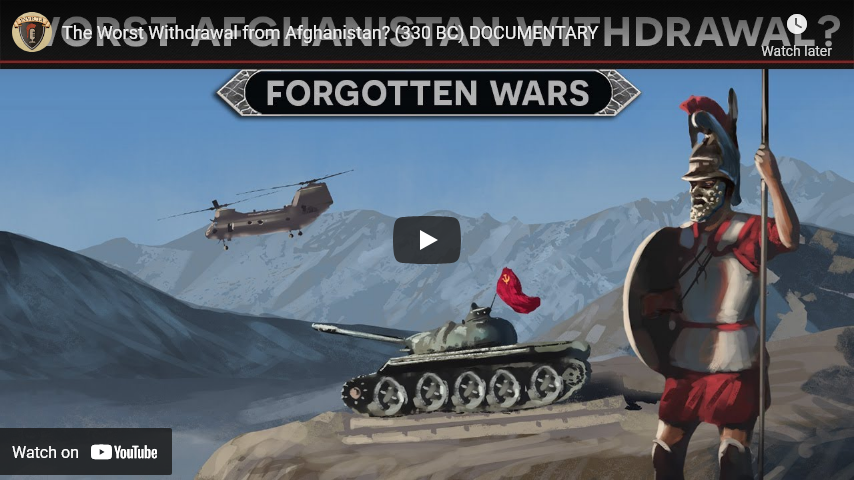
The Worst Withdrawal from Afghanistan? (330 BC)
Invicta
Published 28 Aug 2021Afghanistan has a long history of foreign invasions and withdrawals. Today we explore the first of these chapters with the campaigns of Alexander the Great. Signup for your FREE trial to Wondrium here: http://ow.ly/C3xs30rNLaU
As the last chapter of the US war in Afghanistan appears to draw to a close, the world watches armed and civilian forces alike conduct their final evacuations. However in these moments we hear echoes of the past. The history of the so-called “Graveyard of Empires” is filled with many chapters that tell of yet another major power that has been forced to withdraw after years of spilled blood and treasure. The most well-known instances have occurred in recent memory. However the pages of Afghan history go back thousands of years. Today I wanted to take a look at one of these first major military withdrawals that may just be the most FUBAR one on record; The evacuation of Alexander the Great’s Macedonian army from Afghanistan.
In order to contextualize this conflict we first begin with a quick overview of the history of Afghanistan. No country existed by that name or with those borders in antiquity and it was instead made up of a variety of tribal coalitions and minor kingdoms for much of its early history. However it would first see foreigners begin to claim its lands with the rise of the Median Empire and the succeeding Achaemenid Empire. The lands of modern Afghanistan would now be carved into a series of Satrapies such as Bactria, Gandara, Arakhosia, Drangaian, and Areia.
Following the Ionian Revolt and the Greco Persian Wars, the Kingdom of Macedon would rise to power and take on this ancestral conflict as a way to unify the Hellenic world behind its rule. Phillip II first began to plan and invasion of the Achaemenid Empire but it would be Alexander the Great who carried out this vision. He would campaign for several years through Anatolia, the Levant, Egypt, and Mesopotamia, consuming vast swaths of the enemy’s domains. However King Darius would escape to the east. Alexander initially pursued the Great King but when he was killed by his own Lieutenant, Bessus, Alexander set off against this traitor.
In this chase, Alexander the Great would be sucked into a multi-year war to subdue the eastern satrapies that made up modern Afghanistan. We cover the most significant events of this campaign, the establishment of occupying forces, and the eventual withdrawal of the army following the death of Alexander the Great. The ensuing settler revolt would make it (in my eyes) one of the most FUBAR Afghanistan withdrawals in history that would certainly be worthy of a Vice news documentary had it existed.
The Campaigns of Alexander the Great by Arrian
In the Footsteps of Alexander the Great by Michael Wood
Alexander the Great and Bactria: The Formation of a Greek Frontier in Central Asia by Frank Holt
The Greeks in Bactria and India by W. W. Tarn
On the revolt of the Greek settlers by DiodorusCredits:
Research: Invicta
Script: Invicta
Narration: Invicta
Artwork: Penta Limited#History
#Afghanistan
#Documentary
Comments Off on The Worst Withdrawal from Afghanistan? (330 BC)
Mark Steyn on chocolate soldiers, tutti-frutti generals, and the ice-cream commander-in-chief
When all that matters is not performance but performance art:
On the day that twelve US Marines and some 150 civilians were blown apart by suicide bombers, it was heartening to learn what real heroism is.
Until January 6th, the highlight of Michael Byrd’s “law-enforcement” career was leaving his loaded Glock in a congressional men’s room and paying no price. He “serves” with the grotesquely misnamed “Capitol Police”, which is not a police department but a praetorian guard – a personal security team for the praetors of Congress. Lieutenant Byrd shot and killed Ashli Babbitt, a 5’2″ unarmed woman, because “she was posing a threat to the US House of Representatives”.
All that has been known for months by anyone who wanted to know. The only real news in NBC’s Byrd exclusive was the level of his self-congratulation:
I believe I showed the utmost courage on January 6.
His interviewer, Lester Holt, did not respond: “Er, hang on, isn’t that the kind of thing you’re meant to leave for someone else to say about you?”
And did he have to say “utmost”? Even in as unutterably vulgar an age as ours, is even Michael Byrd incapable of imagining any “courage” greater than his own?
Ah, well, don’t over-think it; it’s just one of those phrases, half-remembered by Byrd from some Rose Garden medal ceremony he caught on TV: “utmost” goes with “courage” like “white” goes with “supremacist” and “domestic” goes with “terrorist”.
America is a land that tends to the utmost in all things. At the end of the nineteenth century, Bernard Shaw popularized the term “chocolate soldier” — the dashing hussar who is useless in battle but looks good in a uniform. We have the tutti-frutti generals: Thoroughly Modern Milley and his chums, whose diversity ribbons from shoulder to scrotum advertise their own utmostness even as they explain why everything going wrong merely demonstrates how everything is going right.
The tutti-frutti generals report to the ice-cream commander-in-chief melting all over the lectern every afternoon. His predecessor was on telly all day every day; Mr Biden was sold to head-in-the-sand Americans as the quiet-life guy who wouldn’t be in your face. Unfortunately, when your countrymen get blown up by government blunders, the citizenry expects him to be in their faces at least every now and then. Across the Atlantic, Boris and the EU chaps were on the screen responding to an all too predictable atrocity. But in the White House Joe Biden’s meds hadn’t yet kicked in — or, conversely, they’d shot him the juice too early and it had worn off. So, as has become familiar, the melting waffle cone was hours late in tottering across the room, squinting into the camera and reading with woozy and wooden defiance. This time he gave it the full Corn Pop:
To those who carried out this attack, as well as anyone who wishes America harm, know this: We will not forgive. We will not forget.
But Joe, a man who cannot reliably name his own Defense Secretary, has already forgotten.
Comments Off on Mark Steyn on chocolate soldiers, tutti-frutti generals, and the ice-cream commander-in-chief
August 29, 2021
Yamamoto: Midway Round Two? – World War Two – 157 – August 28, 1942
World War Two
Published 28 Aug 2021The Battle of the Eastern Solomons takes place this week — another carrier battle. As for the Germans, they’re advancing on Stalingrad, slowing down in the Caucasus, and Erwin Rommel is preparing to launch another assault in North Africa.
(more…)
Comments Off on Yamamoto: Midway Round Two? – World War Two – 157 – August 28, 1942
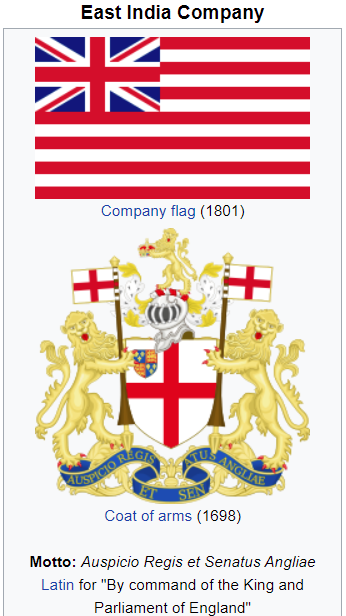
The competing English and Dutch East India companies
In his latest Age of Invention newsletter, Anton Howes considers the odd fact that although the Dutch were the last major seafaring power to extend to the East Indies, they quickly became the most powerful European traders and colonialists in the region:
By the mid-seventeenth century, although the trans-Atlantic trades were still almost entirely in the hands of the Spanish, the European trade to the Indian Ocean had come to be dominated by the Dutch — which is quite surprising, as they had arrived so late. The high-value exports of the Indian Ocean — particularly pepper — had anciently arrived via the Red Sea, the Persian Gulf, or overland, and then been bought up in Egypt or Syria by the Venetians and Genoese, who then sold them on to the rest of Europe. It was then the Portuguese who had supplanted that trade in the late fifteenth century by discovering the direct route to the Indian Ocean around the Cape of Good Hope. The Portuguese monopolised the new sea route around Africa for a century, almost totally undisturbed by other Europeans, entrenching their position by building forts — occasionally with the permission of local rulers, but often without.
The Portuguese seem to have spread the rumour in Europe that they had effectively conquered the entire region, presumably to dissuade others from even trying to break their monopoly. Even as late as the 1630s, when other nations were already regularly trading there, foreign writers took the time to mock such assertions. As the Welsh-born merchant Lewes Roberts put it, the Portuguese “brag of the conquest of the whole country, which they are in no more possibility entirely to conquer and possess, than the French were to subdue Spain when they possessed of the fort of Perpignan, or the English to be masters of France when they were only sovereigns of Calais.” Quite.
[…]
But for all their tardiness, the Dutch arrival in the Indian Ocean was dramatic. The English may have been the first to threaten the Portuguese monopoly, but in the whole of the 1590s they sent a mere two expeditions out east, and in 1600-10 sent only a further eight (seven by the newly-chartered East India Company (EIC), with a monopoly over English trade with the region, and another voyage licensed to break that monopoly in 1604 by the king, which unhelpfully spoiled the company’s relations with local rulers by turning pirate and plundering Indian and Chinese ships). What the English sent out over the course of twenty years, the Dutch exceeded in just five. Between just 1598 and 1603, after the successful return of de Houtman’s first voyage, they sent out a whopping thirteen fleets — and this despite their merchants not even pooling their efforts like the English had until the very end of that period, when in 1602 the various small and city-based Dutch companies were merged to form a single, national joint-stock monopoly, the Verenigde Oost-Indische Compagnie (VOC). The founding of the VOC accelerated the divergence. Between 1613 and 1622 the EIC sent out a paltry 82 ships compared to the VOC’s 201.
The sheer quantity of Dutch ships heading for the Indian Ocean meant that they were soon dominant amongst the European merchants there, capturing forts from the Portuguese, founding further bases of their own, and able to forcibly keep the English out — sometimes by attacking the English directly, other times by simply threatening any of their would-be trading partners. The steady stream of Dutch ships also allowed them to resupply and maintain their factors — the key infrastructure of long-distance commerce, as I explained in last week’s post for subscribers. They were able to have a presence, and project force, in a way that the English could not. By 1638, Lewes Roberts, despite often lauding England’s commercial achievements, and being an EIC official himself, had to concede that in the Indian Ocean “the English nation are the last and least”.
That English weakness was reflected in how EIC merchants had to comport themselves in the region so as to have any share in the trade at all. Despite the EIC’s later reputation for bloodthirsty rapaciousness, in the early seventeenth century they were highly reliant on good relations with the locals. Whereas the Dutch could often afford to use force and bear the repercussions, the English more or less only held on in the early days by ingratiating themselves with local rulers — often by finding common cause against the aggressive and domineering Dutch. The infrequently-supplied English factors were often heavily indebted to local merchants too, including the Indo-Portuguese — a group that they often married into, for access to social networks and support. As the historian David Veevers argues in a new overview of the early EIC (a relatively pricey academic book, but compellingly argued and juicy with detail), the English often went further than just friendliness or integration, subordinating themselves to local rulers too. Of the few early forts that the English managed to establish, for example, that at Madras in 1640 was only built because the local ruler encouraged it, treating the English there as his vassals.
Comments Off on The competing English and Dutch East India companies
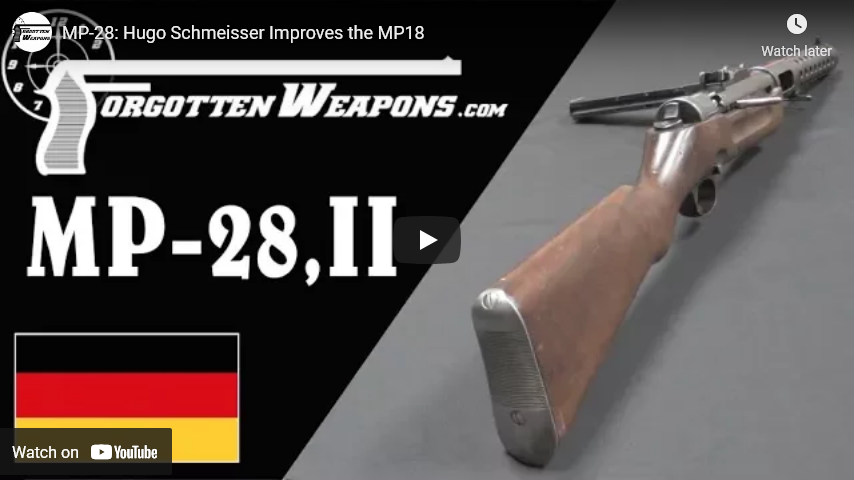
MP-28: Hugo Schmeisser Improves the MP18
Forgotten Weapons
Published 22 Aug 2017The MP28,II was Hugo Schmeisser’s improved take on the original World War One MP18,I design. It used a simple box magazine in place of the Luger drum magazines, and this magazine would form the basis for a long series of military SMG magazines. It was a double-stack, single feed design because Schmeisser thought this would prevent some malfunctions that were possible with double-feed magazines (and because Mauser probably had a patent on the double feed box magazine at the time). This magazine would be used in conversions of MP18 guns, and would also be the model for the MP-38/40 and subsequent British Sten gun magazines.
The MP28 also introduced a semiautomatic selector switch, where the MP18 had been a fully automatic-only design. It is the presence of this selector button over the trigger, along with a tangent sight instead of a simple flip-up notch that can be used to distinguish between an updated MP18 and an MP28.
While the MP28 was not formally adopted by the German military, it was used by police and SS units, as well as being adopted or copied by a wide selection of other nations, including Portugal, Spain, China, Japan, and Ethiopia.
http://www.patreon.com/ForgottenWeapons
Cool Forgotten Weapons merch! http://shop.bbtv.com/collections/forg…
If you enjoy Forgotten Weapons, check out its sister channel, InRangeTV! http://www.youtube.com/InRangeTVShow
Comments Off on MP-28: Hugo Schmeisser Improves the MP18
August 28, 2021
An Entire French Army Trapped in Metz During the Franco-Prussian War
realtimehistory
Published 26 Aug 2021Sign up for Curiosity Stream and get Nebula bundled in and SAVE 26%: https://curiositystream.com/realtimeh…
The French Army of the Rhine under Marshal Bazaine is trapped inside Metz — along with civilians and wounded over 250,000 people will need to be fed from the city’s dwindling supplies. Surrounding the city is a German Army that cannot force the Metz fortifications and opts for starving it into submission instead.
» THANK YOU TO OUR CO-PRODUCERS
John Ozment
James Darcangelo
Jacob Carter Landt
Thomas Brendan» OUR PODCAST
https://realtimehistory.net/podcast – interviews with historians and background info for the show.» LITERATURE
Arand, Tobias: 1870/71. Der Deutsch-Französische Krieg erzählt in Einzelschicksalen. Hamburg 2018Bourguinat, Nicolas/Vogt, Gilles: La guerre franco-allemande de 1870. Une histoire globale. Paris 2020
Gouttman, Alain: La grande défaite de 1870-1871. Paris 2015
Herre, Franz: Eugénie. Kaiserin der Franzosen. Stuttgart, München 2000
Milza, Pierre: L’année terrible. Paris 2009
Schikorsky, Isa (Hrsg.): “Wenn doch dies Elend ein Ende hätte”. Ein Briefwechsel aus dem Deutsch-Französischen Krieg 1870/71. Köln, Weimar, Wien 1999
» SOURCES
Bazaine, François-Achille: Episoden aus dem Kriege von 1870 und der Belagerung von Paris. Berlin 1884Bazaine, François-Achille: Feldzug des Rhein-Heeres vom 12. August bis 28. Oktober 1870. Leipzig 1872
Großer Generalstab (Hrsg.): Der Deutsch-Französische Krieg, 1870–71. Bd. 1–3. Berlin 1874 ff.
Historischer Verein der Höhen von Spicheren des 67. Kaiserlichen Linienregiments der Infaterie (Hrsg.): Das Kriegstagebuch von Clovis Hardy. Soldat im 63. Linienregiment. Deutsch-Französischer Krieg 1870/71. Vom Lager in Châlons bis nach Ansbach in Bayern. O.O. [Esvres] O.J. [2011]
Sternegg, Johann Khoss von: Schlachtenatlas des XIX. Jahrhunderts. Leipzig 1886
» OUR STORE
Website: https://realtimehistory.net»CREDITS
Presented by: Jesse Alexander
Written by: Cathérine Pfauth, Prof. Dr. Tobias Arand, Jesse Alexander
Director: Toni Steller & Florian Wittig
Director of Photography: Toni Steller
Sound: Above Zero
Editing: Toni Steller
Motion Design: Philipp Appelt
Mixing, Mastering & Sound Design: http://above-zero.com
Maps: Battlefield Design
Research by: Cathérine Pfauth, Prof. Dr. Tobias Arand
Fact checking: Cathérine Pfauth, Prof. Dr. Tobias ArandChannel Design: Battlefield Design
Contains licensed material by getty images
All rights reserved – Real Time History GmbH 2021
Comments Off on An Entire French Army Trapped in Metz During the Franco-Prussian War
The name “Afghanistan” is becoming a badge of shame for western politicians, and deservedly so
In The Line, Matt Gurney points out that while it was probably beyond the capabilities of the Canadian government to evacuate all Afghanis who had assisted Canadian efforts in that country, the actual efforts fell very far short of even “adequate”:
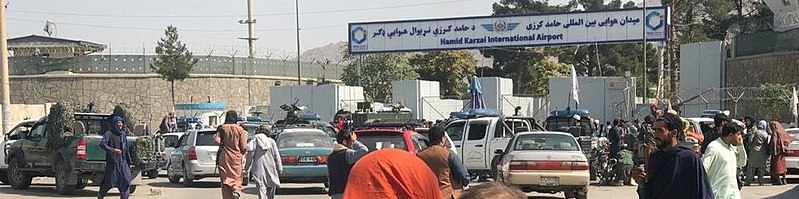
On the second day of the Taliban’s rule in Kabul, the front of Hamid Karzai International Airport was crowded with people trying to travel abroad, but were stopped by Taliban militants, 17 August, 2021.
Public domain image from VOA via Wikimedia Commons.
We have to cut through the fanatics on both sides and be very clear about this: the evacuation was always going to be messy. We were never going to get everyone out. But it is obvious that we did not get out as many people as we should have. It’s clear that we made major errors, including failing to work with veterans and aid groups on the ground; we did not lift bureaucratic hurdles quickly enough. We lost time dithering. That is our shameful failure.
It is not the Canadian government’s fault that our American allies decided to pull out of the conflict. Frankly, I still can’t entirely blame either the Trump or Biden administrations for that decision, although the execution of that decision has been catastrophic.
This was not a decision made in Ottawa, but in Washington, and for entirely American reasons. Further, the Liberals are not to blame for the U.S. government’s massive intelligence failure. We were caught totally flatfooted by the rapid and total collapse of the former Afghan government — what had been expected to take months took days. Canada, a member of both NATO and the Five Eyes, relies heavily on the intelligence gathered by our larger, more powerful ally. I do not fault Liberal party leader Justin Trudeau or his government for being caught unprepared.
So let’s dispense with that nonsense right away. In the big picture, there is not a whole hell of a lot Canadian governments could have done to avoid this crisis.
But we could’ve managed the crisis much better.
Over the last 10 days, we’ve had repeated reports of bottlenecks caused by over-restrictive paperwork requirements. We’ve seen other allies flying helicopters into Kabul to allow them to retrieve their people from sites around the city; Canada has helicopters and the ability to deploy them, but we didn’t follow suit.
Reports indicate that there was a gap of several days in any meaningful Canadian Armed Forces presence on the ground — and that gap set us back in terms of intelligence and planning. Canadian officials reportedly worried about the number of seatbelts on our transport planes even as other allies were loading their aircraft up with as many people as they could (we eventually began cramming evacuees into ours, as well). In several recent pieces here at The Line, Kevin Newman has described the struggle faced by those those trying to escape — people to whom we had had promised safe haven as their lives were now in peril due time they spent helping us during our missions in Afghanistan. There are numerous reports of our government telling these people to show up at gas stations and hotels — only to ghost them.
Facts beyond our control limited how effective we were ever going to be at getting people out, but we did not max out our effectiveness within those constraints. As a result, people will die who did not have to. The gap between the best-possible Canadian response and the actual Canadian response is a gap measured in lives.
I’m always happy to point the finger at Prime Minister Trudeau for his mistakes, but as Matt Gurney writes above, there was little that Trudeau could have done to avert the humanitarian disaster still unfolding around Kabul. The blame for deciding to pull out without adequate (or any) notice to allies or competent logistical and administrative planning lies with Joe Biden, as Conrad Black explains [this was written before the bomb attacks outside the airport in Kabul]:
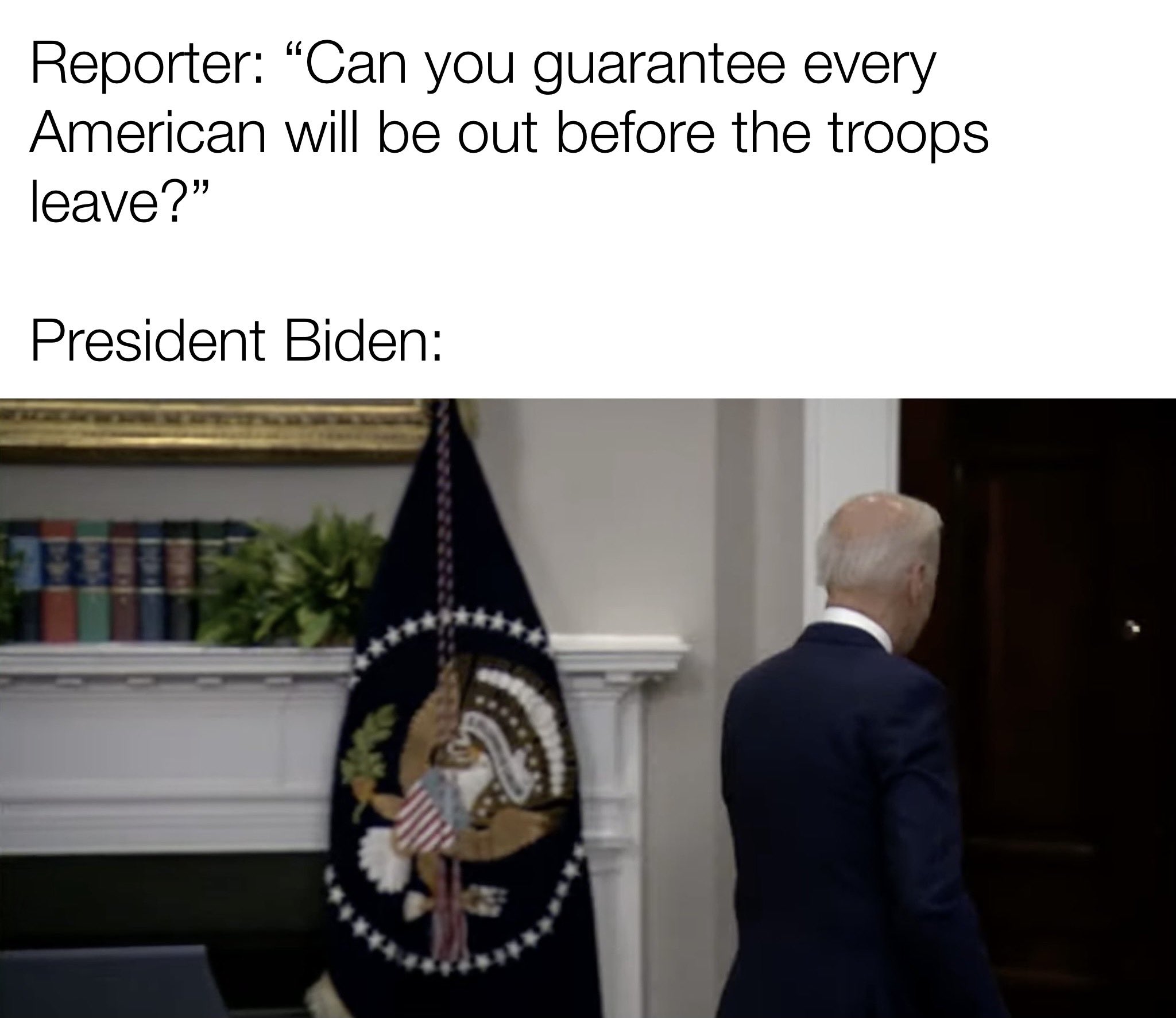
Biden, in his address last Monday, in his midweek interview with George Stephanopoulos, and in his address on Friday, uttered a series of egregious falsehoods that were quickly exposed. He said there was no expression of discontent from America’s allies. For the first time in history, references to an American president in the British Parliament were met with shouts of “shame”. When Thomas Tugendhat, the chairman of the House of Commons Foreign Relations Committee and a retired colonel who served with distinction in Afghanistan and was decorated by the U.S. 82nd Airborne Division for combat bravery, said that it was shameful for a commander-in-chief who has not served under his own colors to mock the sacrifice of men who have, all parties in the British House agreed. No American president has been so severely or — unfortunately — deservedly insulted.
No American, consuming only mainstream media narratives, would realize that there were three times as many allied forces from assorted NATO countries in Afghanistan as there were Americans, or that they were not consulted before the Americans abruptly departed and brought the roof down on all of them. The Western alliance, as former President Trump emphasized, has its problems. Most of the members were not pulling their weight. Germany, the strongest NATO country after the United States, has almost disarmed and has effectively made itself a Russian energy satellite through the Nord Stream 2 natural gas pipeline. But they did not deserve this.
After this horrifying fiasco, where the Americans scuttled and turned tail and left their European allies and Canada to fend for themselves, the NATO members have already indicated that they are in no mood to follow this administration anywhere. No one can blame them. Biden said on Friday that the United States was not sending armored vehicles to collect its citizens and bring them to Kabul airport as the British and French were doing because, he explained, Americans were not being stopped by Taliban checkpoints. Half an hour later, the inarticulate Pentagon spokesman John Kirby squarely contradicted his commander-in-chief, and the official explanation was changed to advise Americans not to try to reach the airport because of the danger.
Biden said the Afghans wouldn’t fight so they weren’t worth the risk of American lives; but 50,000 Afghan soldiers and scores of thousands of civilians have died in this war. No Americans ha[d] died in Afghanistan in 18 months (in stark contrast to the soaring crime rates in almost all American cities). As Tugendhat told the House of Commons, it is not for the commander-in-chief of this cowardly, shameful, and disastrous flight from American national responsibilities, who has never served in his own armed forces, to disparage those who have died in allied forces for a cause that he has abandoned and doomed.
The one potentially positive aspect of this horrible debacle has been the unarguable revelation that the president is not up to his job.
Comments Off on The name “Afghanistan” is becoming a badge of shame for western politicians, and deservedly so
Russo-Japanese War 1904-1905 – Battle of Tsushima
Kings and Generals
Published 16 Dec 2018In our new historical animated documentary, we will cover the Russo-Japanese War of 1904-1905 with a focus on the naval engagements at Tsushima, the Yellow Sea, and Port Arthur. This conflict between Russia and Japan was unique due to the heavy usage of the battleships and its results influenced the First and Second World Wars.
Support us on Patreon: http://www.patreon.com/KingsandGenerals or Paypal: http://paypal.me/kingsandgenerals
Check out our Merch Store: teespring.com/stores/kingsandgenerals
We are grateful to our patrons and youtube members, who made this video possible: https://drive.google.com/open?id=1Tff…
This video was narrated by Officially Devin (https://www.youtube.com/user/OfficiallyDevin)
✔ Merch store ► teespring.com/stores/kingsandgenerals
✔ Podcast ► Google Play: http://bit.ly/2QDF7y0 iTunes: https://apple.co/2QTuMNG
✔ Twitter ► https://twitter.com/KingsGenerals
✔ Instagram ► http://www.instagram.com/Kings_GeneralsSources:
Robert Forczyk – Russian Battleship vs Japanese Battleship
William Koenig – Epic Sea Battles
Левицкий – Русско-японская война 1904—1905
Сорокин – Оборона Порт-Артура. Русско-японская война 1904—1905Production Music courtesy of Epidemic Sound: http://www.epidemicsound.com
#Documentary #RussoJapaneseWar #KingsAndGenerals
Comments Off on Russo-Japanese War 1904-1905 – Battle of Tsushima
August 27, 2021
On Which Side is Brazil? – WW2 Special
World War Two
Published 26 Aug 2021Brazilian President, Getúlio Vargas, has led his country as dictator since the 1930s. He has embraced European fascist ideas and fostered close ties with Germany and Italy. Yet, he also maintains a close relationship with the United States. After skilfully playing both sides, he must now choose Axis or Allies.
(more…)
Comments Off on On Which Side is Brazil? – WW2 Special
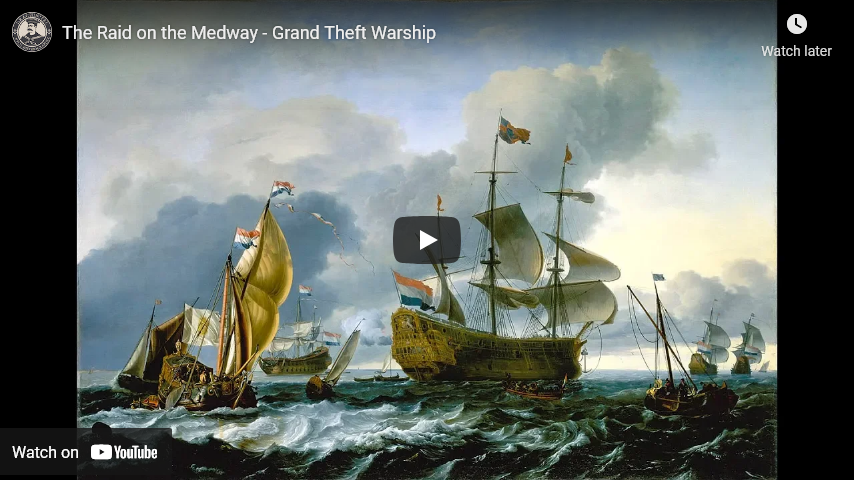
The Raid on the Medway – Grand Theft Warship
Drachinifel
Published 24 Apr 2019Today we look at the Dutch raid on the Medway in the 2nd Anglo-Dutch War and its after-effects.
Want to support the channel? – https://www.patreon.com/Drachinifel
Want to talk about ships? https://discord.gg/TYu88mt
Music – https://www.youtube.com/watch?v=jRQWZ…
Want to get some books? – www.amazon.co.uk/shop/drachinifel
Drydock Episodes in podcast format – https://soundcloud.com/user-21912004
From the comments:
lordmuntague
2 years ago
“On 14 December 1941 a Dutch minelayer named after Jan van Brakel, which was serving as a convoy escort on the UK eastern coast, accidentally hit the anchor buoy of one of the gate vessels which were protecting the entrance to the Medway during World War II. The commander reported this incident to the port authorities, signalling: “Van Brakel damaged boom defence Medway”. The instant reply was: “What, again?”From the RNSA Website.
Comments Off on The Raid on the Medway – Grand Theft Warship


