Quotulatiousness

April 25, 2021

The First SMLE Trials Rifles: Lessons From the Boer War

Filed under: Britain, History, Military, Weapons — Tags: , , , — Nicholas @ 02:00

Forgotten Weapons
Published 13 Jan 2021

http://www.patreon.com/ForgottenWeapons

https://www.floatplane.com/channel/Fo…

Cool Forgotten Weapons merch! http://shop.bbtv.com/collections/forg…

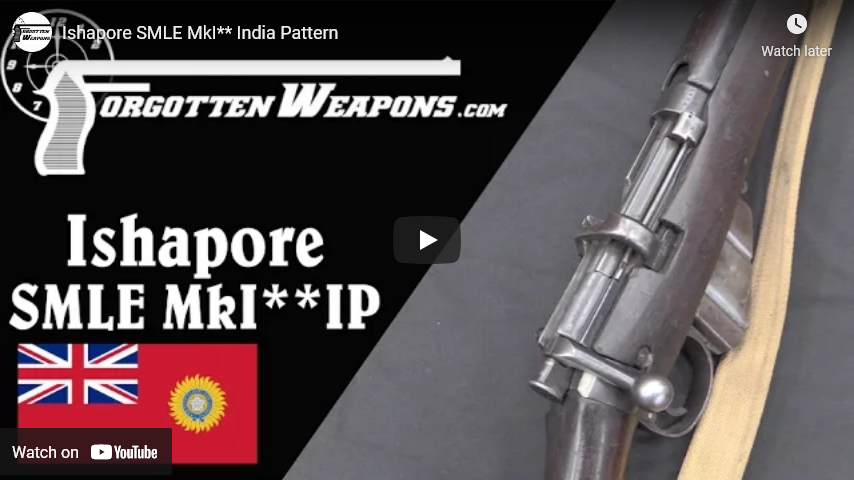
In the aftermath of the Boer War, the British military needed to address critical issues of practical marksmanship with its troops. The Long Lee rifles it had deployed to South Africa suffered significant problems in making real-world hits on the battlefield. In addition to investing in better musketry training, the military chose to radically change its rifles.

In place of the Lee rifles and carbines, a single short rifle pattern would be issued for all branches of service (cavalry, artillery, and infantry). A stripper clip loading system was introduced to speed reloading and a full-length handguard for improving bayonet handling and reducing sight mirage. A windage adjustable rear sight was mandated, and a stout full protective hood added around the front sight. A new nosecap design was implemented to put the weight of the bayonet onto the stock, and not on the barrel where it would impact the rifle’s zero.

Two different patterns of rear sight were considered. The A pattern design was a tangent type sight like a Mauser, pinned at the front. The B pattern used a ladder sight, pinned at the rear. Five hundred of each were made, and put through a rigorous set of remarkably practical field trials. The testing involved not just static shooting for accuracy, but also shooting against timed disappearing targets, camouflaged targets, and snap shooting. The trial winner was the A pattern design, and it went into mass production in 1904 as the Short, Magazine, Lee Enfield Mark I — the first SMLE.

As adopted a few minor changes were made from the trials rifles, most notably a change from a full front sight hood to a pair of stout protective wings, to allow more light onto the sight. In addition, the design was almost immediately updated to a MkI* pattern, with a stronger rear sling swivel, rounded corners on the receiver, and a storage trap added to the buttplate.

Contact:
Forgotten Weapons
6281 N. Oracle #36270
Tucson, AZ 85740

April 24, 2021

This Insane Helicopter Was The Largest Ever Built: The Mil V-12 Story

Filed under: History, Military, Russia, Technology, Weapons — Tags: , , , , — Nicholas @ 02:00

Mustard
Published 10 Sep 2020

Sign up for an annual CuriosityStream subscription and you’ll also get a free Nebula subscription (the new streaming platform built by creators) here: http://CuriosityStream.com/mustard

Research and writing in collaboration with Tomás Campos.

The Soviets built some of the largest and most technically advanced helicopters in the world. By 1957, the Mil Mi-6 had already emerged as the largest helicopter ever built, far out-sizing helicopters built in the west. But for the Soviet Union, the need to build a helicopter far larger than even the Mi-6, soon became a matter of national security.

By 1960, American U-2 spy planes conducting high altitude reconnaissance flights over the Soviet Union were beginning to uncover the location of the country’s Intercontinental Ballistic Missile (ICBM) sites. These first generation R-7 Semyorka ICBMs were being deployed throughout the Soviet Union as fast as possible, but their enormous size and weight meant they could only be delivered to launch sites using trains. The need to build rail lines to launch sites made the ICBM sites easy to spot in U.S. reconnaissance photos.

Keeping the missile sites hidden was a matter of national security. The Soviets devised a bold plan to airlift ICBMs into the vast and remote Soviet wilderness, thereby eliminating the need for rail lines or even roads. This would make it virtually impossible for spy planes to track down missile sites hidden in over twelve million square kilometres of forests. But to make the plan work, the Soviets would need to build a helicopter with at least twice the lifting power of the Mi-6.

Design studies for the new enormous helicopter began in 1959, with the Soviet Council of Ministers formally approving development in 1962. But development of such an ambitious helicopter would progress slowly, as various configurations (single rotor, tandem and transverse) were studied. Construction of testing-rigs, transmission systems and mock-ups began in 1963, and construction of the first prototype started in 1965. The new prototype would be designated as the Mil V-12 (with plans to designate the production version as Mil Mi-12). The first test flight in 1967 ended in failure as the V-12 crashed back to earth sustaining minor damage due to oscillations caused by control problems. A second test flight a year later proved the helicopter’s airworthiness.

The V-12 would go on to break numerous world records for lifting capacity, but its fate had already been sealed by a rapidly changing strategic situation. The introduction of spy satellites, and the development of new lighter and mobile ICBMs made hiding nuclear missiles strategically irrelevant.

In 1970, the Soviet Air Force refused to accept the V-12 into state acceptance trials, due to a lack of need. Although a second V-12 prototype would be constructed in 1972, there were simply too few scenarios that would require such a large and complex helicopter. In 1974 development of the V-12 was cancelled and the Mil Design Bureau shifted efforts to designing the Mil Mi-26, the largest helicopter to enter service.

Select footage courtesy the AP Archive:
AP Archive website: http://www.aparchive.com YouTube: https://www.youtube.com/c/aparchive and https://www.youtube.com/c/britishmovi…

Special thanks to Nick Arehart for helping clean up our audio:
https://twitter.com/airhrt_

Link to the Mustard Store:
teespring.com/stores/mustard-store

Music used in this production (reproduced under license):

Intro Song: “Space Cinematic”- https://www.pond5.com/royalty-free-mu…

Song 2: “Yet Another Chase” – https://www.epidemicsound.com/track/X…

Song 3: “The Board Is Set” – https://www.epidemicsound.com/track/g…

Song 4: “Grim March” – https://www.pond5.com/royalty-free-mu…

Song 5: “Like the Wind” – https://www.pond5.com/royalty-free-mu…

Song 6: “Synthwave Industrial Technology” – https://audiojungle.net/item/synthwav…

Thanks for watching!

April 23, 2021

Taiwan Under Occupation, Axis Solidarity, and U-Boats in the Med – WW2 – OOTF 022

Filed under: China, Europe, Germany, History, Japan, Military, WW2 — Tags: , , , , , — Nicholas @ 04:00

World War Two
Published 22 Apr 2021

Ever wonder what life was like in Taiwan during the Second World War? Or if German U-Boats were active in the Mediterranean? You can find out the answers in this episode of Out of the Foxholes!

Join us on Patreon: https://www.patreon.com/TimeGhostHistory
Or join The TimeGhost Army directly at: https://timeghost.tv

Follow WW2 day by day on Instagram @ww2_day_by_day – https://www.instagram.com/ww2_day_by_day
Between 2 Wars: https://www.youtube.com/playlist?list…
Source list: http://bit.ly/WW2sources

Hosted by: Indy Neidell
Written by: Ian Sowden, Lewis Braithwaite, Timothy Smith
Director: Astrid Deinhard
Producers: Astrid Deinhard and Spartacus Olsson
Executive Producers: Astrid Deinhard, Indy Neidell, Spartacus Olsson, Bodo Rittenauer
Creative Producer: Maria Kyhle
Post-Production Director: Wieke Kapteijns
Research by: Ian Sowden, Lewis Braithwaite, Timothy Smith
Edited by: Miki Cackowski
Sound design: Marek Kamiński
Map animations: Miki Cackowski and Eastory (https://www.youtube.com/c/eastory​)

Sources:
David Rumsey Map Collection, David Rumsey Map Center, Stanford Libraries
Chapman University Digital Commons

Soundtracks from the Epidemic Sound:
Yi Nantiro – “Watchman”
Max Anson – “Ancient Saga”
Skrya – “First Responders”

Archive by Screenocean/Reuters https://www.screenocean.com​.

A TimeGhost chronological documentary produced by OnLion Entertainment GmbH.

Treaties and War, The Washington Naval Conference

Filed under: Britain, France, History, Italy, Japan, Military, USA, Weapons — Tags: , , , , , — Nicholas @ 02:00

The History Guy: History Deserves to Be Remembered
Published 17 Aug 2017

The History Guy remembers the Washington Naval Conference, a watershed in diplomacy.

The episode discusses events and shows some artwork depicting warships, which some viewers may find disturbing. All events are described for educational purposes and are presented in historical context.

The History Guy uses images that are in the Public Domain. As photographs of actual events are often not available, I will sometimes use photographs of similar events or objects for illustration.

Patreon: https://www.patreon.com/TheHistoryGuy

The History Guy: Five Minutes of History is the place to find short snippets of forgotten history from five to fifteen minutes long. If you like history too, this is the channel for you.

Awesome The History Guy merchandise is available at:
teespring.com/stores/the-history-guy

The episode is intended for educational purposes. All events are presented in historical context.

#ushistory #thehistoryguy #militaryhistory

April 22, 2021

The Winter War

Filed under: Europe, History, Military, Russia, WW2 — Tags: , , , , — Nicholas @ 03:00

In Quillette, Sean McMeekin outlines the disaster of the first Soviet offensive against Finland in the opening battles of the 1939-40 Winter War:

While Finland, with a tiny population of scarcely 3.5 million, could hardly have threatened the Soviet colossus, it had fought fiercely for independence during the Russian Civil War, conquering Helsinki in April 1918 and dealing the Reds a series of painful blows. The Finnish White Guards — as the Bolsheviks referred to the forces then commanded by the redoubtable Gustaf Mannerheim — had also, Stalin remembered, worked with German troops and collaborated with the British Baltic fleet. Had Mannerheim’s connections with the Germans not been so strong, the British might have lent his Finnish guards more support in the critical days of fall 1919, when Petrograd nearly fell to the Whites. But this was small consolation to Stalin, who mostly remembered the humiliation of losing Finland and Finnish double-dealing with outside powers. The fear that Finland might once again invite in a power hostile to the USSR, whether Britain or Germany, was never far from Stalin’s mind.

When Molotov summoned a Finnish delegation to the Kremlin on October 12th, 1939, Stalin made a personal appearance to heighten the intimidation factor, and he handed the Finns a brutal ultimatum demanding, among other things, “that the frontier between Russia and Finland in the Karelian Isthmus region be moved westward to a point only 20 miles east of Viipuri, and that all existing fortifications on the Karelian Isthmus be destroyed.” Stalin made it clear that this was the price that Finland had to pay to avoid the fate of Poland.

Aggressive and insulting as the Soviet demands on Finland were, Stalin and Molotov fully expected them to be accepted. As the Ukrainian party boss and future general secretary Nikita Khrushchev later recalled, the mood in the Politburo at the time was that “all we had to do was raise our voice a little bit and the Finns would obey. If that didn’t work, we could fire one shot and the Finns would put up their hands and surrender.” Stalin ruled, after all, a heavily armed empire of more than 170 million that had been in a state of near-constant mobilization since early September. The Red Army had already deployed 21,000 modern tanks, while the tiny Finnish Army did not possess an anti-tank gun. The Finnish Air Force had maybe a dozen fighter planes, facing a Red Air armada of 15,000, with 10,362 brand-new warplanes built in 1939 alone. Finnish Army reserves still mostly drilled with wooden rifles dating to the 19th century. By contrast, the Red Army was, in late 1939, the largest in the world, the most mechanized, the most heavily armored, and the most lavishly armed, even if surely not — because of Stalin’s purges — the best led.

[…]

Just past dawn on November 30th, Stalin’s undeclared war against Finland began with a furious artillery barrage on all fronts, followed by the scream of warplanes overhead. The only difference between the bald acts of territorial aggression in Finland and Poland was that the Soviet blitzkrieg was less efficient. Soviet medium bombers — mostly SB-2s cautiously dropping one-ton payloads from heights of 3,000 feet or more — weren’t especially accurate. In Helsinki, Russian bombers failed to knock out a single docking bay, airfield runway, Finnish warplane, or oil tank (although one airport hangar was destroyed). A stray bomb hit the Soviet legation building. According to eyewitnesses, Red fighter pilots strafed Helsinki suburbs as well, “machine-gunning women and children who had fled their houses to the fields.” Similar scenes of horror were repeated in Viipuri (Vyborg), as well as in provincial towns such as Lahti, Enso, and Kotka.

Meretskov’s landward assault on the Karelian Isthmus fared poorly. During the interval between the border incident of November 26th and the Russian onslaught early on November 30th, Mannerheim had wisely evacuated most of the civilian population. A series of clever booby traps were set for the invaders, including “pipe mines” — steel tubes crammed with explosives buried in snowdrifts and set off by hidden trip wires. The most effective defense of all was the Molotov cocktail, first used in Spain but ingeniously updated by the Finns, who would fill liquor bottles with a blend of gasoline or kerosene, tar, and potassium chloride. In fits of derring-do, Finnish soldiers on skis would drop these into the turrets of advancing tanks, ram branches or crowbars into the tank treads, or slice holes in the ice to sink them. Despite boasts in the Russian high command that the campaign would be over in 12 days, by mid-December, most of the Soviet Seventh and Thirteenth Armies were still blundering along short of the Mannerheim Line. On December 17th, in fact, the Thirteenth Army actually went into reverse, retreating after bloody losses in a clash at Taipale. By then, even the tiny Finnish Air Force of old Dutch Fokker fighters had joined the rout, knocking down Soviet bombers — one Finnish ace took out six in four minutes — and doing wonders for the morale of the Finns below. Further north, the Soviet Ninth Army was nearly destroyed in a battle near a burned-out Suomussalmi on December 9th. One Finnish ski sniper, a farmer named Simo Häyhä, personally killed, according to (improbable) legend, more than 500 Russians[*]. Wounded Russians overwhelmed the hospitals of Leningrad. One overworked Soviet surgeon complained in early December that he was dealing with nearly 400 wounded Red Army soldiers every day.

* The story of Simo Häyhä was set to music by Sabaton in their song “White Death” on the Coat of Arms album. Indy Neidell discussed the history behind the music in a Sabaton History video in 2019.

Charger-Loading Lee Enfields: The CLLE MkI* and MkII

Filed under: Britain, History, Military, Weapons, WW1 — Tags: , , — Nicholas @ 02:00

Forgotten Weapons
Published 6 Jan 2020

http://www.patreon.com/ForgottenWeapons

https://www.floatplane.com/channel/Fo…

Cool Forgotten Weapons merch! http://shop.bbtv.com/collections/forg…

In our continuing series on the development of the British Lee Enfield rifles, we are looking at the CLLE conversions today. In 1907 the British adopted a new universal short rifle (the SMLE) that used charger (aka stripper) clips. Previous models of the Lee in British service had to be loaded one round at a time by hand. In order to make use of the hundreds of thousands of “Long Lee” (and Metford) rifles already manufactured, the British instituted a program to update them with charger guides. The began in 1908 and ran to 1914, although the majority were done in 1909 and 1910. In addition to removing the dust cover and fitting the charger guide, the front sight, rear sight, magazine, and volley sights were all updated. The new sights were windage-adjustable on both front and rear, and calibrated for Mk VI ammunition (although many were later updated again and re-re-calibrated for Mk VII ammunition).

These CLLE rifles would serve as second-line rifles in World War One and even through the end of World War Two.

Contact:
Forgotten Weapons
6281 N. Oracle #36270
Tucson, AZ 85740

QotD: Moderation in war

Filed under: Britain, History, Military, Quotations — Tags: , — Nicholas @ 01:00

[T]he essence of war is violence and moderation in war is imbecility.

Admiral of the Fleet Lord Fisher, 1913.

April 21, 2021

Tank Chats #104 | T-54 & T-55 | The Tank Museum

Filed under: History, Military, Russia, Weapons — Tags: , , , , — Nicholas @ 02:00

The Tank Museum
Published 14 Aug 2020

Here Curator David Willey discusses the T-54, and its successor the T-55, tanks which can source their roots back to the Second World War and are probably the most produced tanks of all time.

Support the work of The Tank Museum on Patreon: ► https://www.patreon.com/tankmuseum
Visit The Tank Museum SHOP & become a Friend: ► tankmuseumshop.org

Twitter: ► https://twitter.com/TankMuseum
Instagram: ► https://www.instagram.com/tankmuseum/
#tankmuseum #tanks

April 20, 2021

Why do the Queen Elizabeth-class carriers have twin islands?

Filed under: Britain, Military, Weapons — Tags: , , , — Nicholas @ 02:00

Not What You Think
Published 28 Dec 2020

There are at least five advantages to having two separate islands on the Royal Navy’s Queen Elizabeth-class aircraft carriers. But the main reason for such a design can only be found below the deck. Enjoy!

All the footage used in this video is under MOD license from Royal Navy Imagery archive. https://www.royalnavy.mod.uk/news-and…

REFERENCES:
https://ukdefencejournal.org.uk/why-d…
https://www.savetheroyalnavy.org/the-…

April 19, 2021

QotD: Logistics and training

Filed under: Military, Quotations — Tags: , , , — Nicholas @ 01:00

Logistics is more than just ensuring that the bullets and beans get sent forward to the infantry companies … it encompasses the whole business of manufacturing, stockpiling, shipping, handling and delivering everything the sailors, soldiers and air force members need, on time and to the right place. It is a complex science, and, when bombs are falling and bullets are whizzing about, a bit of an art, too. As I mentioned a couple of days ago, […] the administrative and logistics services are always “soft targets” for cuts when admirals and generals don’t want to cut their own pet components. The admirals and generals who always try to cut too much of the support “tail” before pulling a few teeth are always wrong.

When we consider logistics and training we should consider then both, together, as part of Support ~ with a capital S. Support also includes keeping facilities (barracks and training areas and workshops and supply depots) up to date.

Training is not just teaching selected skills; it involves planning on how many people will be needed, each with specific skill sets, to crew ships, to serve in regiments and battalions, to fly airplanes and to repair and maintain ships and tanks and trucks and aircraft over the long haul. Training also involves ensuring that teams know how to work together … training is how we prepare for war.

The capital S Support base […] must be properly staffed, properly funded (which means funding must be stable, over the years and decades) and properly organized and managed. Supporting our troops and fleets of ships, vehicles and aircraft requires a mix of civil and military people: some in uniform, some civil servants and some on contract from the private sector. There is no perfect model … most modern, Western states, including America, Australia, Britain, Canada, Denmark and so on, use a mix of military, civil service and contractor support service. each trying to get the right mix of operational effectiveness and economy. The key, as I mentioned above, is stability. The support system need to be properly staffed and funded year in and year out, decade after decade. Those elements ~ dockyards and depots and workshops and schools and agencies comprise the firm base upon which the nation’s war-fighting (combat) powers depend.

Ted Campbell, “My Plan (3)”, Ted Campbell’s Point of View, 2018-09-15.

April 18, 2021

America Strikes Back – Tokyo in Flames – WW2 -138 – April 18 1942

World War Two
Published 17 Apr 2021

The Doolittle Raid is just a little bombing raid over Tokyo that doesn’t do that much physical damage. It does, however, have big repercussions — partly in terms of future offensive plans for the Japanese fleet, and partly in terms of the thousands of Chinese lives taken in reprisals for allowing the US bombers to land in China. There is small scattered action on the Eastern Front, more Japanese advances in Burma, and a French VIP escapes captivity in Germany and heads for Switzerland and freedom.

Join us on Patreon: https://www.patreon.com/TimeGhostHistory
Or join The TimeGhost Army directly at: https://timeghost.tv

Follow WW2 day by day on Instagram @ww2_day_by_day – https://www.instagram.com/ww2_day_by_day
Between 2 Wars: https://www.youtube.com/playlist?list…
Source list: http://bit.ly/WW2sources

Written and Hosted by: Indy Neidell
Director: Astrid Deinhard
Producers: Astrid Deinhard and Spartacus Olsson
Executive Producers: Astrid Deinhard, Indy Neidell, Spartacus Olsson, Bodo Rittenauer
Creative Producer: Maria Kyhle
Post-Production Director: Wieke Kapteijns
Research by: Indy Neidell
Edited by: Iryna Dulka
Sound design: Marek Kamiński
Map animations: Eastory (https://www.youtube.com/c/eastory​)

Colorizations by:
– Mikołaj Uchman
– Norman Stewart – https://oldtimesincolor.blogspot.com/

Sources:
– Stan S. Katz
– IWM: IND 3595
– Image of ‘The Fortress of Königstein from the North-West’ by Bernardo Bellotto, © National Gallery of Art, Washington

Soundtracks from the Epidemic Sound:
– Rannar Sillard – “Easy Target”
– Howard Harper-Barnes – “London”
– Jo Wandrini – “Dragon King”
– Dream Cave – “The Beast”
– Reynard Seidel – “Rush of Blood”
– Wendel Scherer – “Out the Window”
– Brightarm Orchestra – “On the Edge of Change”
– Gunnar Johnsen – “Not Safe Yet”
– Johan Hynynen – “Dark Beginning”
– Philip Ayers – “Trapped in a Maze”

Archive by Screenocean/Reuters https://www.screenocean.com​.

A TimeGhost chronological documentary produced by OnLion Entertainment GmbH.

Boys Mk I Anti-Tank Rifle at the Range

Filed under: Britain, History, Military, Weapons, WW2 — Tags: , , , — Nicholas @ 02:00

Forgotten Weapons
Published 2 Jan 2021

http://www.patreon.com/ForgottenWeapons

https://www.floatplane.com/channel/Fo…

Cool Forgotten Weapons merch! http://shop.bbtv.com/collections/forg…

(Edit: Tungsten carbine is, of course *denser* than steel, not lighter. Sorry.)

I have done several previous videos on the Boys antitank rifle, but never actually fired one — until today! We’re out at the range with a MkI Boys and five rounds of its .55 Boys ammunition. So let’s see if it’s as painful to shoot as people say …

Contact:
Forgotten Weapons
6281 N. Oracle #36270
Tucson, AZ 85740

April 17, 2021

Can you build a Starter Set Model Kit using ONLY the included paints and glue?

Filed under: Military, Randomness, WW2 — Tags: , , — Nicholas @ 02:00

Model Minutes
Published 10 Dec 2020

Quite often I get asked if you can build a Starter Set Model Kit using ONLY the included paints and glue? Well, why not? What would it actually look like? I feel like there might be a bit of a CHALLENGE coming on …

Join me in this video as I build (and review) the Airfix Messerschmitt Bf109E-3 plastic model kit in 1/72 scale which comes as part of a starter set — with glue, paint and brush included. I will be building this kit with only these products to see how it turns out.

Unboxing review of this kit:
https://youtu.be/NWHsWtxot_c

Please consider pledging your support to help keep the channel growing from strength to strength. Find out what’s in-store and how to unlock additional perks here: https://www.patreon.com/modelminutes

If you like what I do, why not buy me a coffee over at http://ko-fi.com/modelminutes

Come join the live conversation over at Discord, chat to other modellers in real time! https://discord.gg/JP4tk2n

If you want to buy any of the kits I’ve built or recommend — take a look here (it helps support the channel):
https://www.amazon.co.uk/shop/modelmi…

Let’s get social!
https://twitter.com/ModelMinutes
https://www.instagram.com/modelminutes/

This video is intended for adult scale model enthusiasts.

Model Minutes holds no responsibility for any accidents, damage or injury that could occur as a result of attempting to replicate any steps depicted in this video.

All music used from the YouTube Audio Library.

#Airfix #Model #Modelkit #starterset #scale #bf109

From the comments:

Model Minutes
4 days ago
Before you leave a comment about thinning the paint or using extra tools/products, read this:

I don’t think a lot of people watching this one quite “got” what I was going for here. My aim (if it wasn’t clear) was to see how good I could make this model kit using only the included products and a knife. I gave myself really strict rules to follow in an attempt to get a “best case” model out of a “worst case” situation.

Many people seem to think that beginners would instantly know that they are supposed to thin their paints, sand the plastic, fill the gaps, use extra brushes … and if, as a beginner you knew that, then you were so fortunate!

But this video is for those of us (me included) who knew nothing about model building, had no one to help us and nothing to look to for reference. When I started, YouTube didn’t exist (the internet wasn’t really a thing for me growing up either) and if I wanted to read up about modelling it meant buying magazines and looking for the information.

My build in this video is a throwback to my early days, where I built what I wanted, how I wanted, and usually with only what I had, could borrow, recycle or afford with my small amount of pocket money.

Ultimately though, I think the point of this build and video has been missed by some.

It’s meant to be fun, a light and entertaining look at our hobby. After all, isn’t this hobby supposed to be fun anyway?

I’d also like to think that some beginners out there see this one and realise that you don’t have to build a model kit with all these extra things that so many youtubers use these days. Although it’s good to have aspirations I think it’s unrealistic and can put newcomers off. If my video encourages just one new person to start building, then that’s a success right? We should be encouraging new members to the hobby because it’s in our interest too! If you agree, send someone this video and encourage them to start!

TLDR: I made this video for entertainment. It’s not a tutorial. I added extra restrictions because otherwise it wouldn’t be a “challenge” — it would be a normal build video.

April 16, 2021

The Bataan Death March Begins – WAH 032 – April 1942, Pt. 1

Filed under: Britain, Europe, Germany, History, Japan, Military, Pacific, USA, WW2 — Tags: , , , , , , — Nicholas @ 04:00

World War Two
Published 15 Apr 2021

Malta and British cities are victim to German bombs, while the Japanese advance in Burma causes a refugee crisis. In the Philippines, 80,000 Allied POWs walk the Bataan Death March.

Join us on Patreon: https://www.patreon.com/TimeGhostHistory
Or join The TimeGhost Army directly at: https://timeghost.tv

Follow WW2 day by day on Instagram @ww2_day_by_day – https://www.instagram.com/ww2_day_by_day
Between 2 Wars: https://www.youtube.com/playlist?list…
Source list: http://bit.ly/WW2sources

Hosted by: Spartacus Olsson
Written by: Spartacus Olsson and Joram Appel
Director: Astrid Deinhard
Producers: Astrid Deinhard and Spartacus Olsson
Executive Producers: Astrid Deinhard, Indy Neidell, Spartacus Olsson, Bodo Rittenauer
Creative Producer: Maria Kyhle
Post-Production Director: Wieke Kapteijns
Research by: Joram Appel
Edited by: Miki Cackowski
Sound design: Marek Kamiński
Map animations: Miki Cackowski and Eastory (https://www.youtube.com/c/eastory​)

Colorizations by:
Mikołaj Uchman
Election1960 https://commons.wikimedia.org/wiki/Fi…​

Sources:
IWM C 4743, CL 2377
Bundesarchiv
From the Noun Project: Watchtower by Eliricon

Soundtracks from the Epidemic Sound:
Johan Hynynen – “Dark Beginning”
Fabien Tell – “Weapon of Choice”
Wendel Scherer – “Defeated”
Philip Ayers – “Trapped in a Maze”
Cobby Costa – “From the Past”
Cobby Costa – “Flight Path”
Wendel Scherer – “Growing Doubt”
Jon Bjork – “For the Many”

Archive by Screenocean/Reuters https://www.screenocean.com​.

A TimeGhost chronological documentary produced by OnLion Entertainment GmbH.

From the comments:

World War Two
3 days ago (edited)
Under our previous episode I told you about how YouTube has been age restricting these videos, effectively censoring them and turning the format into an echo chamber that doesn’t reach beyond the viewers who already know about it. As I explained we feel that it’s a great disservice to education and remembrance, and it has affected me deeply personally making me question why we do this. Two things happened:

1. You collectively gave us the most amazing reception and reminded us of how important the work we do is. I can’t thank you enough for the amazing comments, many of them where kind, supportive, and motivating far beyond what I feel we deserve. You lifted my spirits and brought me out of the slump I was in, cementing, and confirming that what we do matters. In the name of the entire team: thank you so much, it is an immense honor to have you all with us.

2. YouTube did not age restrict the video, and even cleared it for monetization, leading to that it once again reached a viewership like before the string of age restrictions we were struck with. We haven’t heard any explanation from YouTube and we won’t. Furthermore, I am painfully aware that these decisions depend completely on the whims of the individuals at Google who review the videos. We also know that these individuals are different for every video, so I fear that that this state of affairs will not remain. Already, this video was judged as “not suitable for all advertisers” and will therefore be recommended to viewers less often in YouTube’s system. Hence, although it pains us, and is against the principles we stand for, we have also prepared a version of this video with all images documenting the atrocities we expose blurred out – we can only hope that we don’t need it.

I’d like to end with an anecdote out of my motivation to create this series. Many, many moons ago, when I was in senior high at boarding school in Sweden, Elie Wiesel – author, chronicler of the Holocaust, and survivor of Auschwitz and Buchenwald came to our school. It was in 1986, the same year that he received the Nobel Peace Prize for his work, and if I remember correctly he had connected a lecture tour to his reception of the award.

In any case — I had the privilege of speaking to Mr. Wiesel in a small group. He explained something that has stayed with me ever since. To him, his experiences were not defeating, the entire Holocaust was not a defeat, not only had humanity been victorious in the end, but he and others had survived to tell the tale — which to him was a special kind of victory that came with the responsibility of sharing and educating.

Mr. Wiesel, a kind, warm hearted man, full of humor and life despite the horrors he had lived, passed five years ago. It is for him, for the other survivors of every ethnicity faced by any kind or terror, and for those who didn’t make it through that we do this — to celebrate their life and continue turning their suffering from defeat into victory by remembering even after they are gone.

Yours,
Spartacus

April 15, 2021

Eichmann in Budapest

Filed under: Europe, Germany, History, Military, WW2 — Tags: , , , — Nicholas @ 03:00

Alexander Faludy outlines the horrific “success” of Adolf Eichmann’s activities in Hungary in 1944:

SS-Obersturmbannführer Adolf Eichmann (1906–1962), head of Reichssicherheitshauptamt (RSHA, Reich Security Central Office) Department IV B4 (Jewish affairs), who organized the deportation of Jews to the Auschwitz concentration camp in German-occupied Poland during the Holocaust. Taken in or around 1942, this appears to have been Eichmann’s official RSHA ID photograph.
Photographer unknown, public domain image via Wikimedia Commons.

SS Obersturmbannführer (Lt. Col.) Adolf Eichmann, head of Reich Security Main Office IV.B.4 (Jewish Affairs), arrived at Budapest’s Keleti railway station together with 19 subordinates on 21 March 1944. Just 48 hours had passed since German troops had marched into the country, and a car was waiting to take Eichmann to the city’s Astoria Hotel close to the Pest riverbank. From these incongruously elegant surroundings Eichmann would commence the most feverous episode in the Final Solution of the Jewish question in Europe: the destruction of the Jews of Hungary, the only chapter in its history he was to supervise in person and in full.

For speed and scale the deportations went unmatched: 424,000 people were despatched by train in just 52 days, from 14 May to 9 July. In this fleeting window Hungarian Jews became the single largest group gassed at Auschwitz. The crematoria couldn’t cope with such “over-supply”, and Commandant Rudolf Höß ordered special fire pits dug — filling the camp with noxious smoke. According to Primo Levi, “there were weeks when only Hungarian was heard in Auschwitz”.

Physical annihilation was undergirded by Eichmann’s elaborate psychological strategy. Sophisticated Budapest Jews who might escape or resist were pacified by newspaper reports that only “ost Juden” from Hungary’s nether regions were being removed as “undesirables”. Many only saw through the lie, if at all, when deportations reached Budapest’s outer suburbs in early July — just before Admiral Miklós Horthy, Hungary’s Head of State, halted them under diplomatic pressure from the Western Allies and neutrals.

Throughout the deportations, and across Hungary’s length, Eichmann deluged Jews with ever more complex regulations covering the minutiae of daily life. These instilled a false sense of permanence which inhibited hiding or escape: “why would the authorities go to all this trouble if they were just going to get rid of us?”

Even as deportations rolled on, Eichmann conducted elaborate negotiations for fanciful “rescue schemes” including, but not limited to, the infamous “Blood for Trucks” project involving Rudolf Kastner — the proposed barter of one million Jewish lives for 10,000 Western motor vehicles for use on the Eastern front against the USSR. The aim, Eichmann later acknowledged, was not just to split Western powers from the Soviets, but also to distract Hungary’s Jewish leaders from counter-organising: keeping minds busy and hopes alive.

All the while Eichmann treated Jewish leaders in Budapest to flashes of menace. One day he promised them a return to normality “after the war”, the next he would snarl “Do you know who I am? I am a bloodhound!” With studied cruelty Eichmann arranged the ghettoisation of Hungary’s Jews to begin on Sunday, 16 April: the first day of Passover, 1944.

Eichmann did many things in Hungary; the one thing he did not do was simply “obey orders” — indeed over time he defied them with gathering frequency. That autumn as inevitable defeat became ever more apparent Eichmann, helped by local enthusiasts, intensified his efforts, instigating newly inventive means of eliminating Jews in Hungary and the Balkans through “death marches” and localised killing sprees. In doing so, Eichmann subverted instructions from Himmler who ordered cessation as part of a delusional plan to negotiate with the allies.

This “Eichmann in Budapest” should be recalled while contemplating the later Eichmann in Jerusalem.

« Newer PostsOlder Posts »

Powered by WordPress