Quotulatiousness

February 9, 2024

QotD: “Five, Four, Three, Two, One. Thunderbirds Are Go!”

Filed under: Britain, History, Media, Quotations — Tags: , , , , — Nicholas @ 01:00

To break the BBC’s monopoly on viewing, Independent Television had been founded by Act of Parliament in 1955 as a network of fifteen regional television franchises funded by advertising. Alerted by TV Times, on that September Thursday in 1965, the nation’s children (including Your Humble Scribe) settled down to watch a man with a mid-Atlantic accent as he counted down a series of weird spaceships and aircraft with the sequence, “Five, Four, Three, Two, One. Thunderbirds Are Go!”

Although there had been earlier offerings from the same stable, such as Supercar, Fireball XL5 and Stingray, and others which followed, it was Thunderbirds that gripped my generation and has never really let go. Set in the future, the genre devised by Gerry Anderson focused on the heroic exploits of secret but benevolent organisations operating from remote or hidden bases on land, in the sky or on the moon. Equipped with advanced technology, their missions were to protect civilisation from aggression, accident and sabotage, countering devious, often extra-terrestrial opponents. It was his brother’s service in the RAF that gave Anderson a life-long fascination with flying machines. Thunderbird Field at Glendale, Arizona, where his older brother learned to fly, provided a name for the series.

In his future worlds, planet Earth is generally united under a world president, in contrast to the traumas of the recently passed world war. Each programme featured life-like puppets, filmed in what Anderson dubbed “Supermarionation”. They were tributes to his brother. It was on 27 April 1944 that these future television series were really born. Flight Sergeant Lionel Anderson never got to pilot Stingray or Thunderbird One, or fly an Interceptor from Cloudbase, for during the early hours of that April Thursday, his twin-engined Mosquito was hit by flak on a night intruder raid and crashed near Deelen in Holland. Now he and his navigator, Sergeant Bert Hayward, lie in the corner of a cemetery in Arnhem, “Mourned by his devoted parents and brother Gerald”, as the Commonwealth War Grave headstone reads.

The war traumatised Gerry Anderson, whose Jewish grandparents had fled pogroms on the Polish–Russian frontier. He would complete his own national service in the RAF and experienced two more dramatic flying events. In 1948, he saw a Mosquito — his brother’s aircraft type — crash during an air display, killing many bystanders. Later a Spitfire came in to land without its undercarriage lowered. The helplessness he felt, and need for some divine intervention, such as that provided by the World Aquanaut Security Patrol (Stingray), International Rescue (Thunderbirds), Spectrum (Captain Scarlet) or Supreme Headquarters Alien Defence Organisation (UFO), provided more seeds for the future series, where the world was united and fought external foes. In German, the last was screened as Weltraumkommando SHADO, but the concept precisely echoed the UNIT organisation of Doctor Who.

Throughout the 1950s and 1960s we were promised robots, space travel, lunar colonies and travel to Mars. Films, television series, science fiction short stories and magazines guaranteed it to the point of entitlement. Airfix plastic model kits, cardboard cut-outs on cereal packets, Matchbox, Corgi and Dinky diecast toys reinforced this expectation, underwritten by the real, manned Mercury missions of 1961–63, Gemini space launches of 1965–66 and Apollo craft of 1968–72. Gerry Anderson’s vision (shared by the American script writers of Star Trek, which debuted exactly a year after Thunderbirds on 8 September 1966) of a world government did not seem absurd to the young minds of 1965. It is partly the innocence of those years which touches us today. I, for one, still feel short-changed.

Peter Caddick-Adams, “Broadcasting anniversaries”, The Critic, 2023-11-04.

February 8, 2024

“Mwa-mwa-mwa”, they said

Chris Bray expands on the topic of yesterday’s post about the legacy media wanting you not to do your own research because it might lead to the “wrong” kind of answers:

I’m a hundred pages into a book I’ve been meaning to read for years, and I meant to spend last night reading it. But then I accidentally looked at social media.

For years, now, I’ve been watching as journalists and politicians connect a set of fact claims to a conclusion that has nothing to do with the evidence they’ve just given: This happened, and this happened, and this happened, and, trust us, all of that means this. It snaps your head back, because the statement about the meaning of the evidence is so ridiculous they can’t possibly have failed to notice. The news is frequently a series of bizarre interpretive non-sequiturs.

I wrote about a favorite example here, as an army of Barack Obama hagiographers described The Lightbringer’s glorious childhood in Indonesia. He went there with his mother and Indonesian stepfather in 1966, during a massive purge of communists by the army that included a great deal of mass killing, and Obama’s biographers describe the future American president being a young child in a place where rivers were choked with corpses and soldiers marched prisoners through the streets. Then, casually, they conclude that his time in Indonesia was idyllic and warm, and Jakarta was the place where this wonderfully decent future leader learned the gentle values of civic engagement and democratic pluralism.

See also this example, from back in the days when I didn’t have many subscribers, discussing an op-ed piece that described the Freedom Convoy as a movement of anti-government radicals who wanted to live in a society with no rules at all and marched on Ottawa behind the banner of authoritarianism to implement their fascist agenda.

Over and over again, reading the “news” that these people write, you catch yourself muttering but you JUST SAID

Fact claims don’t add up, categories clash, paragraphs self-refute, sentences start out insistently claiming X and then wander into a firm insistence upon Not X before the period arrives at the end. The great complex of global news and politics has the internal consistency and logic of the day ward at a mental hospital.

Last night we seem to have suddenly turned the knob on that machine up to eleven, BECAUSE HITLER IS IN MOSCOW TO DO AN INTERVIEW. The people who are proud that we’re fighting authoritarianism by arresting the leading figure of the political opposition and throwing him off the ballot are also very angry that Tucker Carlson is interviewing an autocrat, and they hate autocracy, so Tucker Carlson must be arrested and bankrupted and barred from returning to the United States, to stand up to authoritarianism. I had a moment last night when I sincerely wondered about the wisdom of paying attention, because the experience of hearing from The Responsible People™ became painfully hallucinatory.

The officials at the EU get to decide who counts as a real journalist and who gets ruined, to protect democracy. Ukraine is the brave and incorruptible vanguard of ideal democracy, by the way, and so pure it floats, like an ad for soap. Nothing bad has ever happened there, you Nazi, but now Satan Putin’s vampire fangs drip with innocent blood, and there’s absolutely nothing else to say about it, send cash.

Watching people like Bill Kristol and David Frum comment on real-world events now is like watching a homeless drug addict having a psychotic break at a bus shelter. The connection between fact and interpretation has become painfully severed. A whole layer of allegedly high-status people have gone barking mad. We need to arrest everyone who disagrees with us about politics or else we’re going to lose our system of open society to authoritarianism, and you really ought to smoke some of whatever we have inside this glass pipe.

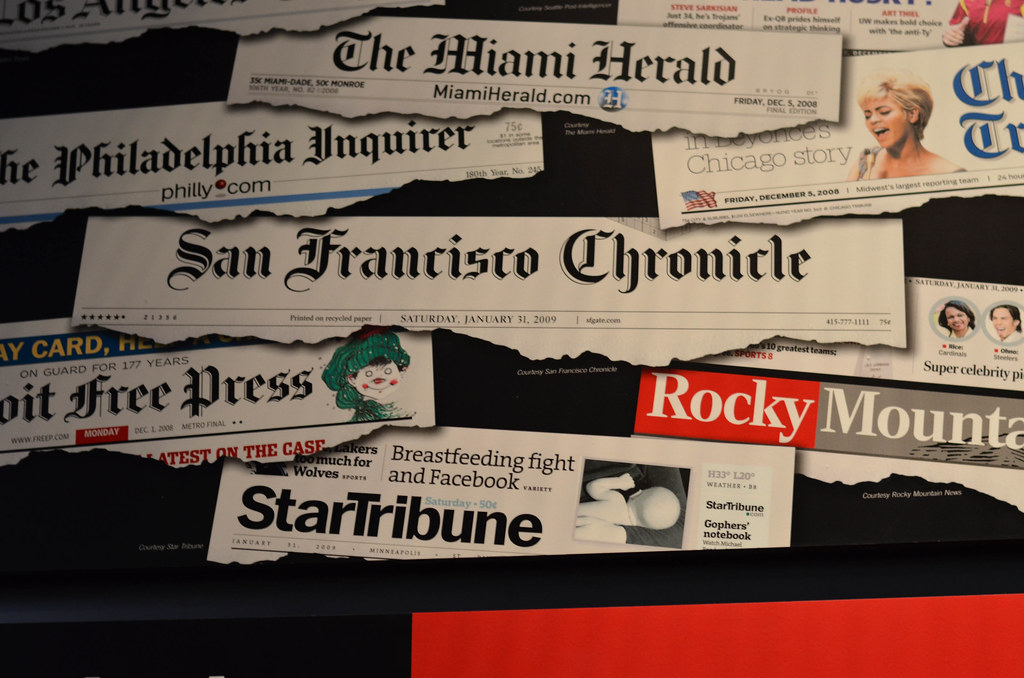
North American newspaper economics

Tim Worstall discusses some of the issues ailing Canadian and American newspapers which are not easily solvable (government subsidies, as attempted in Canada, just turn the recipients into an underpaid PR branch of the governing party … not a good look in a democratic nation):

“Newseum newspaper headlines” by m01229 is licensed under CC BY 2.0 .

So, as a little corrective, a quick jaunt through what actually ails American journalism. The concentration is upon the big newspapers because that’s where the problem is worst. The conclusion is that it’s gonna get a lot, lot, lot, worse too. Because the industry is facing a base economic problem that it’s not willing to actually face up to. Or, at least, all the journalists writing about it aren’t — there’s the occasional sign that some of the business side of the equation grasp it.

[…]

Before Y2K American newspapers were segmented along geographic lines. The size of the country, the lack of a long distance passenger railroad network, meant that this was just so. If you’re printing a daily paper then you’ve got to deliver it daily. On the day it’s meant to refer to as well. If Chicago is 1,100 miles (no, I’ve not looked it up but that’s within an order of magnitude of being right, which is better than many newspapers manage with numbers) from New Orleans then the same newspaper is going to find it difficult to print and deliver to both markets. Add in the fact that trains take a week to traverse that distance, passenger trains – anyone who has ever travelled Amtrak will say it feels that long at least — included.

You could not and therefore did not have national newspaper (USA Today, with satellite printing plants, was an attempt to deal with this and slightly earlier than our cut off date but doesn’t change the basic story) distributions. What you had was a series of local and regional monopolies. Each one centred on a large population centre and serving the area around it that could be reasonably reached by truck overnight. Chicago and Cincinnati, not 1,100 miles away from each other, did have entirely different newspapers.

By contrast, and just as an example, the British newspaper market was national from pre-WWI. We simply did have overnight at worst passenger rail that covered the country. Partly it’s a much, much, smaller place, partly the passenger rail system was just different. So, printing overnight (and some maintained separate Scottish editions and plants) meant that those papers that came off the press in London at 8pm were on sale in Glasgow at 8 am, those that came off the press in London at 4 am were on sale in London at 8am. That’s not exact but it’s a good enough pencil sketch.

Cincinnati newspaper(s) served Cincinnati. Chicago, Chicago and New Orleans the area of New Orleans. There simply wasn’t a “national press” in the US in that British sense.

OK. But this also meant that American newspapers were much more like a monopoly in their local area than anything else. Network effects still exist even before computer networks after all. The most important of which was the classifieds.

As with Facebook, we’re all on Facebook because everyone else is on Facebook. So, if we’re to join a social network we’re going to be on Facebook where everyone else is — except those three hipsters who are where it isn’t cool yet. This applies to classifieds sections. Folk advertise in the one with the most readers, the widest market. Readers buy the one with the most ads in it, the widest market. You advertise the bronzed baby shoes, unused, where there are the most people looking for bronzed baby shoes, unused.

So, the dominant paper will suck up the classifieds in any particular market. Classifieds, fairly obviously back in the days of prams, cheap used cars, waiters’ jobs and so on being geographically based.

No, this is important. A useful pencil sketch of American newspaper revenues pre-Y2K was that subscriptions produced some one third of revenues. They also, around and about, covered print costs and distribution. They were, roughly you understand, about a face wash in fact.

Display ads produced another one third and classifieds the final one third. Classifieds were also wildly profitable — no expensive journalists to pay, no bureaux, just a few women waiting to get married on the end of the phone line.

The lead-up to the Russo-Ukrainian War

Filed under: Europe, History, Media, Military, Russia, USA — Tags: , , , , , , — Nicholas @ 03:00

At Founding Questions, “El Barbudo” has a guest-post on the situation in Ukraine, including a lot of background to the outbreak of full-scale combat with Russia’s “Special Military Operation” strike that was intended to decapitate the Ukrainian government and capture Kyiv in February, 2022:

Britain’s Ministry of Defence regularly posts these situation maps through their Twit-, er, I mean “X” account. This is the most recent one from 2024-02-02.

One framing point: the Russians are fighting a conventional, industrial war, for real-world (economic, territorial and national-security) objectives. The Ukrainians are fighting a proxy information war — large-scale armed propaganda, if you will — where the primary purpose of battlefield action is to feed political-warfare objectives, and thereby maintain western support. Seen from Kyiv, the centre of gravity (the thing from which Ukraine draws its strength and freedom of action) is western support — making narrative (as seen from the west) central, while the media is enlisted as a conduit for narrative warfare. Hence, through a western media lens, what you’re seeing is carefully curated to influence rather than inform. (Nothing new here — I defer to the historians, but I think Paul Fussell made this point about World War Two. Ask yourself when was the last time you saw a dead Ukrainian soldier, intact or otherwise.)

What that means is that battlefield defeats can be managed, as long as the narrative — the core of the war, as western sponsors see it and as the Ukrainians therefore are forced to see it — can be maintained. What’s causing the current crisis is not so much the death, destruction or loss of territory (though those are real). It’s that the mismatch between rhetoric and reality has finally reached the point that people are noticing.

[…]

Ukraine has been at war with Russia in some fashion since 2013, with violence first spiking into the open in February 2014. The Ukrainians call the 2014-2022 period the Anti-Terrorist Operation (ATO) but it involved fairly heavy fighting — against Russian-backed separatist militias in the east, and internal to Ukraine among various factions including, yes, the Banderite nationalists (“neo-Nazis”) beloved of Russian media and Canadian parliamentarians alike, though they’re less prominent now (mainly because a lot of them are dead).

We should also note how this arose — first Russia and the U.S. forcing Ukraine to give up its nukes in 1994, then NATO expansion after Bosnia, and (publicly acknowledged) US interference in Russia’s 1996 election to ensure Boris Yeltsin got re-elected, creating a sense of threat in Moscow. Then Kosovo 1999, Bush and Putin’s failed attempt to make nice after 9/11, Estonia, Georgia, the Reset Button of 2009 and betrayal over Libya in 2011. (Hillary promised no ground troops or regime change, persuading then-president Dmitry Medvedev to abstain on the UN Security Council Resolution that authorised the intervention, only to renege on all counts then laugh on live TV when she found out Gaddafi had just been sodomised to death with a bayonet).

All of which infuriated the Kremlin, and confirmed the West was not “agreement-capable” (they have euphemisms in Moscow too) leading them to intervene in Syria to support the Assad regime. Then came the Ghouta gas attack of September 2013 — in which Obama failed to enforce his own Red Line, and John Kerry had to beg Sergey Lavrov (Russian foreign minister) to save us from the consequences of our own weakness … which convinced Russian leaders we were not only threatening and untrustworthy, but also weak. More great work there.

Russia’s seizure of Crimea followed, four months after the red-line debacle. It was clearly a result of Russian hatred and contempt. (Oderint dum metuant — the hatred was long-standing; what was new was the realisation, after Ghouta, that they had nothing to fear). Crimea was also a reaction to a US-backed revolution in Ukraine (Euromaidan), and the operation’s popularity should have made it clear that Ukraine is seen by Russians, of all political orientations, as integral to their identity, along with Belarus. No Russian politician could tolerate western advisers or weapons in Ukraine … which was the policy pursued after 2014. (There’s a chicken-and-egg security dilemma here. The west was reacting to perceived aggression from Russia, which was reacting to perceived western aggression. Both sides saw themselves as innocently defensive, and the other as aggressive.) [NR: Emphasis mine.]

Putin, by Russian standards, is a relative moderate on Ukraine — he frequently gets panned by war bloggers, retired generals and divers chickenhawks for being soft on the west, not prosecuting the war hard enough. If the neocons got their way and he was regime-changed, his replacement would likely be far worse for their interests — someone like, say, Nikolai Patrushev. Putin gets painted as Hitler in the media, but this is an artefact of the Alinskyite approach American political/media players take to any conflict: first freeze the target (no negotiation is possible) then personalise the enemy via an individual leader (Bin Laden, Mullah Omar, Saddam, Gaddafi, Kim etc), then paint that leader as irrational and evil (without limits, restraints or goals except to be evil). From that point, it’s good versus evil, any means necessary, war as moral imperative. Putin is the latest foreigner to get this treatment, Trump the latest domestic equivalent. Trump’s greatest foreign policy crime, in fact, may have been his willingness to treat Putin, Kim, Xi, MBS etc. as rational actors worthy of respect (for Trump values of “respect”) rather than moral pariahs. This has hilarious consequences when people previously given the pariah treatment (Maduro, MBS, the Taliban) need to be rehabilitated via creative retconning so the narrative can keep rolling.

Anyway, from 2014 to 2022 the war was pretty static, with a few bigger battles (Debaltsevo the main one), artillery exchanges and trench warfare: a foreshadowing of how things are today, though without the massive tech acceleration we’ve seen since February 2022, and far fewer casualties.

Trump’s people have suggested Putin was frightened of him, which is why Russia didn’t invade during Trump’s term. There may be some truth to that (Trump after all reversed Obama’s prohibition on lethal aid) but it’s more likely the Russians just saw Trump as dangerously unpredictable, a decision-maker who never fully controlled his own government, especially on Ukraine (see Impeachment #1). The Russian way of war involves predicting an adversary’s reaction to provocation, then doing just enough, ambiguously enough, to achieve a fait accompli without triggering a response. This goes back to Trotsky and Tukhachevsky in the 1920s, but when your adversary is Trump, it becomes impossible to predict the trigger or the reaction if you piss him off. (Qasim Soleimani says hi). There was also one particular battle in Syria in February 2018 where US SOF killed some large number of Wagner guys by refusing to play their little games, and when the Russians complained Trump basically said it served them right.

Once Trump was gone — with Washington in disarray after January 6th — the Russians sensed an opportunity, and began building up around the Ukrainian border from April 2021. Then in August, when we covered ourselves in glory during the Great Kabul Pants-Shitting, the Russians probably thought they had the measure of Biden — who they knew of old — and decided we were so flaccid they’d get away with a lightning move against Kyiv, “Crimea 2014 on steroids”. (PS: when neocons start overtly asserting, in their in-house journal, that “the Afghan withdrawal did not trigger the Ukraine invasion” you know it’s true — even if the Russians hadn’t already said as much, in as many words.)

So, the Russians tried Crimea on Steroids in February 2022 — and their plan failed by breakfast on D Day, triggering the protracted war of attrition we have now. The reasons were partly bad luck for the leading Russian air-assault units attempting to seize the airfield at Hostomel outside Kyiv, partly good initiative by U.S. and U.K. trained Ukrainian SOF and territorial defence guys, partly over-compartmentalisation on the Russian side — key players were kept out of the loop for OPSEC reasons, and the invasion was mostly planned by political hacks with limited military understanding. (Why should we have the monopoly on that?) This video is a decent open-source account of that happened.

QotD: Partisan media

Filed under: Media, Politics, Quotations, USA — Tags: , , — Nicholas @ 01:00

Conservative media is mainly designed to provide its readers with information. But liberal media is designed to give its readers permission to think certain thoughts. It’s not so much that the Politico article was informing democrats about certain uncomfortable Biden facts for the first time, although that is certainly true.

The article was more significant because it signaled to democrats that now acceptable to talk about Biden lying and about his being mixed up with all these sketchy characters.

Jeff Childers, “ONE YEAR ☙ Monday, November 6, 2023 ☙ C&C NEWS”, Coffee & Covid 2023, 2023-11-06.

February 7, 2024

A disturbing proportion of scientific publishing is … bullshit

Tim Worstall on a few of the more upsetting details of how much we’ve been able depend on truth and testability in the scientific community and how badly that’s been undermined in recent years:

The Observer tells us that science itself is becoming polluted by journal mills. Fools — intellectual thieves perhaps — are publishing nonsense in scientific journals, this then pollutes the conclusions reached by people surveying science to see what’s what.

This is true and is a problem. But it’s what people publish as supposedly real science that is the real problem here, not just those obvious cases they’re complaining about:

    The startling rise in the publication of sham science papers has its roots in China, where young doctors and scientists seeking promotion were required to have published scientific papers. Shadow organisations – known as “paper mills” – began to supply fabricated work for publication in journals there.

    The practice has since spread to India, Iran, Russia, former Soviet Union states and eastern Europe, with paper mills supplying ­fabricated studies to more and more journals as increasing numbers of young ­scientists try to boost their careers by claiming false research experience. In some cases, journal editors have been bribed to accept articles, while paper mills have managed to establish their own agents as guest editors who then allow reams of ­falsified work to be published.

Indeed, an actual and real problem:

    The products of paper mills often look like regular articles but are based on templates in which names of genes or diseases are slotted in at random among fictitious tables and figures. Worryingly, these articles can then get incorporated into large databases used by those working on drug discovery.

    Others are more bizarre and include research unrelated to a journal’s field, making it clear that no peer review has taken place in relation to that article. An example is a paper on Marxist ideology that appeared in the journal Computational and Mathematical Methods in Medicine. Others are distinctive because of the strange language they use, including references to “bosom peril” rather than breast cancer and “Parkinson’s ailment” rather Parkinson’s disease.

Quite. But the problem is worse, much, much, worse.

Let us turn to something we all can agree is of some importance. Those critical minerals things. We all agree that we’re going to be using more of them in the future. Largely because the whole renewables thing is changing the minerals we use to power the world. We’re — to some extent, perhaps enough, perhaps not enough — moving from using fossil fuels to power the world to using rare earths, silicon, copper and so on to power the world. How much there is, how much useable, of those minerals is important. Because that’s what we’re doing, we’re changing which minerals — from fossil to metallic elements — we use to power the world.

Those estimates of how much there is out there are therefore important. The European Union, for example, has innumerable reports and task forces working on the basis that there’s not that much out there and therefore we’ve got to recycle everything. One of those foundational blocks of the circular economy is that we’ve got to do it anyway. Because there’s simply not enough to be able to power society without the circular economy.

This argument is nads*. The circular economy might be desirable for other reasons. At least in part it’s very sensible too – if it’s cheaper to recycle than to dig up new then of course we should recycle. But that we must recycle, regardless of the cost, because otherwise supply will vanish is that nads*.

But, folk will and do say, if we look at the actual science here we are short of these minerals and metals. Therefore etc. But it’s the science that has become infected. Wrongly infected, infested even.

Here’s the Royal Society of Chemistry and their periodic table. You need to click around a bit to see this but they have hafnium supply risk as “unknown”. That’s at least an advance from their previous insistence that it was at high supply risk. It isn’t, there’s more hafnium out there than we can shake a stick at. At current consumption rates — and assuming no recycling at all which, with hafnium, isn’t all that odd an idea — we’re going to run out sometime around the expected date for the heat death of the universe. No, not run out of the universe’s hafnium, run out of what we’ve got in the lithosphere of our own Earth. To a reasonable and rough measure the entirety of Cornwall is 0.01% hafnium. We happily mine for gold at 0.0001% concentrations and we use less hafnium annually than we do gold.

The RSC also says that gallium and germanium have a high supply risk. Can you guess which bodily part(s) such a claim should be associated with? For gallium we already have a thousand year supply booked to pass through the plants we normally use to extract our gallium for us. For germanium I — although someone competent could be a preference — could build you a plant to supply 2 to 4% of global annual germanium demand/supply. Take about 6 months and cost $10 million even at government contracting rates to do it too. The raw material would be fly ash from coal burning and there’s no shortage of that — hundreds of such plants could be constructed that is.

The idea that humanity is, in anything like the likely timespan of our species, going to run short in absolute terms of Hf, Ga or Ge is just the utmost nads*

But the American Chemistry Society says the same thing:


    * As ever, we are polite around here. Therefore we use the English euphemism “nads”, a shortening of “nadgers”, for the real meaning of “bollocks”.

As the media now tell us, it’s dangerous to do your own research and you should just trust them about everything

Filed under: Books, Education, Media, Science — Tags: , , , , — Nicholas @ 03:00

David Friedman has some timely tips on how you might go about determining the truth of an assertion offered in the legacy media or online source of undetermined trustworthiness:

Following up the claim you come across an article, perhaps even a book, which does indeed support that claim. Should you believe it?

The short answer for all of those examples, some of them claims I agree with, is that you should not. As I think I have demonstrated in past posts, claimed proofs of contentious issues are quite often wrong, biased, even fraudulent.

More examples from previous posts, here or on my old blog:

An estimate of the cost of a ton of carbon dioxide calculated with about half the total depending on the implicit assumption of no progress in medicine for the next three centuries.

A factbook on state and local finance that deliberately omitted the most important relevant fact that readers were unlikely to know.

A textbook, in its third edition, with multiple provably false claims.

The important question is how to tell. There are three answers:

1. Read the book or article carefully, check at least some of its claims — easier now that the Internet provides you with a vast searchable library accessible from your desktop — and evaluate its argument for yourself. Doing this is costly in time and effort and requires skills you may not have; depending on the particular issue that might include near-professional expertise in statistics, history, physics, economics, or any of a variety of other fields. I have taught elementary statistics at various points in my career, both in an economics department and a law school, but gave up on a controversy of considerable interest to me (concealed carry) when the statistical arguments got above the level I could readily follow.

2. Find one or more competent critiques of the argument and see if you find them convincing. This is the previous answer on easy mode. You still have to think things through but you don’t have to search out mistakes in the argument for yourself because the critic will point you at them, with luck offer evidence.

There are three possible conclusions that that exercise may support: that the argument is wrong. that it might be wrong, that it is probably right. The way you reach the last conclusion is from the incompetence or dishonesty of the critique; I am thinking of a real case.

John Boswell, a gay historian at Yale, argued that both the scriptures and early Christianity, unlike modern Christian critics of homosexual sex, treated it as no worse than other forms of non-marital intercourse. What convinced me that Boswell had a reasonable case was reading an attack on him by a prominent opponent which badly misrepresented the contents of the book I had just read. People who have good arguments do not need bad ones.

Of course, there might be other critics with better arguments.

An entertaining version of this approach is to find an online conversation with intelligent people covering a wide range of views and follow discussions of whatever issues you are interested in. With luck all of the good arguments for both sides will get made and you can decide for yourself whether one side, the other, or neither is convincing. Forty years ago I could do it in the sf groups on Usenet, which contained lots of smart people who liked to argue. Five years ago I could do it in the comment threads of Slate Star Codex. Currently Data Secrets Lox works for a few controversies but the range of views represented on it is too limited to provide a fair view of most.

The comment threads of this blog are at present too thin for the purpose, with between one and two orders of magnitude fewer comments than the SSC average used to be, but perhaps in another few years …

3. Recognize that you don’t know whether the claim is true and have no practical way of finding out, at least no way that costs less in time and effort than it is worth. This is the least popular answer but probably the most often correct.

The Magician Who Fooled the Nazis (and all of us)

Filed under: Africa, Britain, Germany, History, Media, Military, WW2 — Tags: , , , , , — Nicholas @ 02:00

World War Two
Published 7 Nov 2023

Military deception is tricky. Sometimes you need to destroy a crucial piece of war industry or make an entire harbour disappear. Who do you call for this sort of job? Well, someone who knows a thing or two about tricking the eye. You need a professional magician. You need Jasper Maskelyne. But is there more to this illusionist than meets the eye?
(more…)

February 6, 2024

On gender issues, “Progressives may even find themselves — dare we say? — on the wrong side of history”

Filed under: Cancon, Government, Health, Media, Politics — Tags: , , , , , , — Nicholas @ 05:00

In the portion of The Line‘s weekly dispatch that’s visible to freeloaders, the editors discover to their horror that they have to weigh in on the gender fracas:

So to be clear, we really don’t have any problem with Alberta restricting elective gender-related surgeries on minors under the age of 17. While we are rather concerned about the use of puberty blockers and cross-sex hormones among minors, we also suspect that trying to ban these drugs for absolutely everyone under a certain age represents an overreach by the state.

Also, bluntly, we don’t think that in an ideal world, the state should be involving itself in most of this stuff at all. We want to exist in a country in which sports leagues, doctors, schools and teachers can be trusted to make sensible, evidence-based decisions on a case-by-case basis.

Take sports, for example: does a rec-league pickleball tournament need to have the same rules around trans participation as a competitive women’s rugby league? And do we really want any state regulation bulldozering over the people who are actually on the ground, and best understand the physical and cultural realities of that sport?

Or take puberty blockers.

Should we really be treating a 12-year-old who has displayed severe and crippling gender dysphoria since the age of three with the same treatment protocol as a depressed 14-year-old boy who comes into the gender clinic for the first time attached to a Munchausen-by-Proxy mom documenting every moment of her child’s transition for TikTok? Do we want politicians in Edmonton writing the precise rules that will be faithfully applied in both those situations?

Sigh.

We understand how we got here. Any discussion around trans issues is now highly insane; in a hyper-polarized, borderline hysterical moment, we actually can’t trust our institutions to possess the requisite reserve and dispassion needed to make credible and defensible decisions. These institutions are, or are perceived to be, too ideologically captured to be trustworthy.

For an example that just happened to cross our path today, take this quote from Dr. Simone Lebeuf, a pediatrician in Edmonton who specializes in gender-diverse youth. In it, she notes that restricting puberty blockers to children over the age of 15 effectively makes the treatment useless, as they would be administered at an age well past the onset of puberty.

“It’s done. The window has passed,” the doctor told City News. “And we really look at puberty blockers as an option for kids to have some space and time to make decisions about their future selves and who they might want to be as adults. Their puberty is not benign, it is not a nothing process to go through. The physical changes with puberty are permanent.”

Right off the bat, a statement like this ought to raise eyebrows, and not only because it’s a talking point we’ve already heard dozens of times on TikTok. This doctor — a physician who is actually treating children — is conflating the harms caused by artificially delaying a natural process with the apparent harms caused by the biological process itself. That logic is not sound. There is a clear difference between, say, permanent loss of sexual function and bone density caused by interfering in the natural course of puberty, and the harm of allowing a child’s body to grow an Adam’s apple despite that individual feeling like a woman.

Secondly, Dr. Lebeuf isn’t addressing the core concern with puberty blockers, above and beyond their physical side effects. The majority of children who present with gender dysphoria are not trans. Most of them turn out to be simply gay — a fact they discover via the process of growing up and sexually maturing. By delaying or denying a gender dysphoric child the opportunity to experience normal puberty, critics of these treatment protocols fear that a doctor may be preventing the very process by which gender dysphoria would resolve itself without medical intervention. Most — certainly not all, but most — gender dysphoric children would otherwise grow up to be at ease with their natal sex. But once kids start with the puberty blockers and then cross-sex hormones, this process of medical transitioning may be psychologically self reinforcing, pushing physically healthy minors into pursuing more and more unnecessary and invasive interventions with serious lifelong consequences.

In short, puberty blockers are not magic cures for gender dysphoria. They might be appropriate for some kids with lots of supports and monitoring. But they could be disastrous for others, and we have no foolproof way to know in advance which kids will fall into what camp.

This stuff is complicated, and it’s made more so because it’s difficult to study objectively in ideologically captured environments dominated by activists on all sides who muddy the waters with emotionally charged rhetoric, and confuse good science with bad. If you want to understand why people are turning to Danielle Smith instead of the Alberta Medical Association to address their fears, quotes like the one above are a prime example.

And, by the way, we include “The Media” writ large as having failed on this file. The lack of skepticism and neutrality that the media has demonstrated on even the most maximalist and unpopular positions on gender and sexuality has — to our mind — significantly contributed to the radical decline in its collective credibility.

The Sky People hold very different beliefs to those untouchable Dirt People

Filed under: Media, Politics, USA — Tags: , , , , , — Nicholas @ 03:00

Rob Henderson says that the gap is “Grand Canyon-sized” between ordinary Americans and the Ivy League grads who cluster at the top of every progressive organization:

55% of Ivy League graduates believe that the U.S. “provides too much individual freedom” compared with just 16% of ordinary U.S. voters.

Back in 2019, as I was developing what became the luxury beliefs framework, I read a recently issued chapter published by Cambridge University Press titled “Why Are Elites More Cosmopolitan than Masses?”

Authored by a team of social scientists, this 2019 paper reports stunning gaps in political views and outlooks between elites and ordinary people in various western countries.

In the introduction, they suggest that elite attitudes are expressions of cultural capital. That is, the large gap in views between elites and everyone results from elites drawing symbolic boundaries between themselves and the provincial masses.

Indeed, another report found that 65 percent of Americans believed that the most educated and successful people in America are more interested in serving themselves than in serving the common good. This view is held across the board — across age, gender, race, political party, and ideology.

The authors of the 2019 chapter write:

    Mastering intricacies of gender and race relations discourse and behavior has become a marker for belonging to the cosmopolitan class, in a similar way that tastes for classical music and art were markers of bourgeois culture in the 19th and 20th centuries.

Interestingly, the researchers find that social background and ideological affinities account for elite similarities more so than educational attainment. This might be one reason why, despite obtaining the same degrees from the same institutions as many elites, I still retain an outlook reflective of my provincial upbringing.

Following my experiences in the Los Angeles county foster system, my adoptive family and I settled in a dusty lower-class town in the northernmost region of California—a place just as provincial as any rundown neighborhood in flyover country—where I spent most of my youth.

The authors of the paper measured the opinions of elites (those holding the highest positions in each sector) across various fields including politics, finance, academia, and media, as well as the opinions of ordinary people.

Relative to the masses, elites are more likely to agree with statements such as “We should do everything possible to fight climate change, even if it slows economic growth.”

And elites are more in favor of allocating authority not to local or national governments, but to global organizational bodies (e.g., the U.N.).

The researchers also found that elites are significantly more pro-immigration, as measured by the extent to which they agreed with statements like “When jobs are scarce, employers should give priority to people of [this country.]”

I thought about those results for a long time. Especially as I came across another study indicating that educated people are more likely to express prejudice toward immigrants who are described as highly educated, relative to less educated, and are therefore seen as job competitors.

Among university students, attitudes toward immigrants were most negative when the immigrants had a university education, and most positive when the immigrants had little to no formal education. It’s nice for the educated class when immigrants provide cheap hired help and open interesting restaurants. They’re less excited when immigrants are competing with them for the same jobs. If thousands of people with bachelor’s and postgraduate degrees from, say, China and India, were unlawfully entering the U.S. each day, my guess is current elite attitudes around border security would be very different.

In a way, it’s rather reassuring that the Sky People are still demonstrably human, based on the change in opinions when it’s their ox being gored …

February 5, 2024

Sitzkrieg on the southern border

Filed under: Government, Media, Politics, USA — Tags: , , , , — Nicholas @ 04:00

Glenn “Instapundit” Reynolds on the stand-off between Texas governor Greg Abbot and President Joe Biden over the flood of illegal immigrants coming across the US-Mexican border:

So the war over the border between Texas and the Biden Administration is now in the “Sitzkrieg” stage. Texas Gov. Greg Abbott has essentially declared war on illegal immigration. He invoked Article I Section 10 of the United States Constitution, which forbids states from declaring war except when “actually invaded” (or in such imminent danger as to admit of no delay) and, by implication, allows them to declare war when that happens. He also invoked the Guarantee Clause of Article IV, which requires the federal government to protect the states against invasion.

Abbott’s legal argument is that since he’s being invaded, he’s entitled to respond, and since the federal government is defaulting on its obligations it has no business – it’s basically stopped from – complaining. There was a lot of huffing and puffing at the time, with members of Congress calling on President Biden to federalize the Texas National Guard and the like, but basically, nothing happened. The Supreme Court vacated an injunction forbidding the Border Patrol from cutting the barbed wire that Texas had installed along the border, but – contrary to many media reports – didn’t rule that what Texas had done was illegal, or order Texas to stop policing the border.

Now not much is going on. The big complaints about immigration are mostly coming from outside Texas, places like New York City where illegal immigrants beat police with impunity, being released without bail after being arrested. (The usual endgame for this sort of thing in other societies has been death squads, organized either by police or by police-adjacent groups, taking out those whom the legal system cannot or will not control; we’ll see what happens in New York City.)

But next month Texas’s law allowing the state to apprehend and effectively deport illegals will go into effect, and that’s when the sitzkrieg is likely to end. Following are my (very) preliminary thoughts.

To me what’s astonishing is how unpopular with everyone the immigration policies of the Administration – and a good chunk of the GOP – are. Open borders are unpopular with blacks, whites, rural and urban voters, and, really, just a vast bipartisan majority. But like “climate change”, another priority of the ruling class without matching popular support, the borders stay open.

Why? Because our ruling class seeks, in Bertolt Brecht’s famous phrase, “to dissolve the populace and elect another”. As Elon Musk tweeted:

Musk’s comments met with the usual outrage, but Democrats have pretty much touted this as the plan for years. Indeed, it goes back to Ruy Teixeira’s “Emerging Democratic Majority” strategy, though it’s been accelerated in recent years. (And Teixeira himself has retreated from that plan). Sure, naturalization takes years – though they may speed that up, as it’s just a matter of statute – and there have also been some moves to allow non-citizens to vote anyway. Think that’s unlikely? Maybe, but how many things are happening these days that seemed impossibly unlikely a few years ago? And it’s a long game; a bunch of Democratic voters in 5 or 6 years will suit them fine.

“Why can’t these Russians see how they’re being oppressed?”

Filed under: Food, Media, Politics, Russia — Tags: , , , — Nicholas @ 03:00

As the war in Ukraine has gone on, western media seem to have completely lost track of what ordinary Russians think about their government, replacing reality with a westernized imaginarium of Russia somehow being little more than a mirror of western progressive opinion:

For the average western normie, Russians are suffering under a brutal and vicious dictatorship, and cannot wait for the day that Putin loses power and western liberal democracy becomes the law of the land.

None of you reading this are normies, and all of you know full well that the overwhelming majority of Russians are not buying what western media and think tanks are selling. They have a unique (and foreign) history and culture that has at times moved towards Europe, but they have always managed to stand apart. This informs how Russians view their country and how they deal with the rulers that rule over them.

Many had hoped that the War in Ukraine would finally see Russians rise up against their own government and remove it from power. Those hopes were always misplaced and naive. Western journalists have long been blinded by their own false assumptions regarding the “superiority of western liberal democracy” and Russian sentiment. “Why can’t these Russians see how they’re being oppressed?”, is the generalized refrain. Harper’s Magazine sent two journalists to explore Russia along the Volga River, and what they found was a culture far removed from the West, and very proud of its own. It’s a long piece, so here are some highlights:

    Piotrovsky, who is mild-mannered and cerebral, and who wore his jacket loosely over hunched shoulders, seemed to have become a warrior. “Russia is many people, but one nation,” he asserted. “Russia along the Volga was able to incorporate everyone. Islam is just as much a religion of Russian tradition and identity as is Christian Orthodoxy. In Europe, in America, you speak of nothing but multiculturalism, but your cities are bursting with hate. For us, it didn’t take much to include everyone, because we’re an imperial civilization.” Then he grew more animated. “Look at the Hermitage!” he said, opening his arms to the room around us, widening his eyes. “It’s the encyclopedia of world culture, but it’s written in Russian because it’s our interpretation of world history. It may be arrogant, but that’s what we are.”

On renewed trade with Asia:

    Sergeeva took me to see the Jewish, Armenian, and Iranian neighborhoods of Astrakhan. An exhibition of photographs highlighting the civilian volunteers supporting the military was being set up outside of a park. At sunset, the elegant riverfront was swarmed with families and groups of young people talking and laughing in hushed tones. Couples sat on railings eating watermelon while food stalls projected multicolored lights on the Volga. There was a fin de siècle quality to the atmosphere, curls of smoke emanating from shashlik grills, a warm breeze delivering the lament of a distant violin. No military uniforms in sight.

    The café façades and the wrought-iron balconies reminded me of New Orleans. Sergeeva pointed out the renovations along the canal that runs through the old town, indicating the nineteenth-century wooden villas that will soon become hotels and luxury homes. “They seemed destined to crumble,” she said. “But now that money is going around, Astrakhan is once again the gateway to European Russia, Central Asia, and India. This is how it is for now. Later, we’ll see.

and

    In Astrakhan, it was rumored that the Iranians had invested billions in the development of the Caspian-Volga-Don corridor. There was talk of trafficking agricultural products and oil, but also turbines, spare mechanical parts, medicine, and nuclear components. I couldn’t verify this, but it was clear that Astrakhan is central to the anti-Western economic bloc’s efforts to turn east.

The general opinion in February of 2022 was that the Russians would easily seize much of Ukraine, but that they would pay a very large economic price, possibly the destruction of their entire economy. This was a safe bet, and it was totally wrong.

Import substitution:

    “The Russians are reacting to the sanctions in an extraordinary way, even with a weak ruble and the inevitable inflation. The prices of essential goods have held steady. And now we’re consuming better and healthier products than before the war, even exceptional cheeses.”

    I had never imagined that the rise of hyperlocal food would be one of the recurring themes of this trip. But it appears that the Western sanctions and war economy have intensified a traditional Russian gastronomy movement. Western products had piqued the palates of average urban Russians, and local producers were trying to fill their vacuum, proudly offering Russian-made Camembert and prosciutto, as if to provide some material evidence of Russkiy Mir, Putin’s ideology of Russian supremacy. As I dined along the Volga, menus often specified the farms from which ingredients had been sourced. Restaurants served svekolnik and okroshka, simple cold summer soups, exalting the quality of local radishes grown without Western fertilizers.

An ethnic Tatar foodstuffs producer from Kazan, Tatarstan on the sanctions regime leveled against Russia:

    Since then, the company’s net worth has become the stuff of legend. But Kazankov, too, is a great supporter of Western sanctions: “They’re an incredible developmental tool for Russia,” he told me. “The West should have imposed them back in the Nineties. We’d be the engine of the world by now. Too bad.” For him, the sanctions are pure adrenaline, and to prove it he added that his company has copied Italian, German, and Israeli “production means” to the letter: “We doubled processing in one year and we supply almost a thousand supermarkets in all of Russia.” Ivan believes that his “full-circle communist company” is the ideal model for “rebuilding a new Soviet Union with healthy local food from our lands.”

On the loss of vacationing in Europe:

    Was this fatalism? Indifference? Or arrogance, as Piotrovsky had implied back at the Hermitage? I struggled to find room in hotels or on ferries, all of which were overflowing with tourists forced to give up on the Mediterranean and make do with the Volga. Take Tatiana, the middle-aged manager of a supermarket chain. When I met her on a ferry in Yaroslavl, she wore a Panama hat, Gucci sunglasses, and capri sandals; she was heading downstream, to the same dacha where she had spent her summers as a girl. “I’ve had a boat docked in Mykonos for three years — who knows when I’ll see it again,” she told me. “I’m getting to know my river again. I’m running into friends I haven’t seen in thirty years. An interesting vacation.” I told her she looked a bit sad and resigned. “Russians have been sad and resigned for thousands of years,” she replied. “It’s how we stay resilient. I’m against this war, but I can’t do anything but wait, like everyone else. They manipulate us with artificial ideas. Garbage. But the West has been humiliating us for too long. Don’t we also have a right to be who we want to be without feeling like barbarians?

February 4, 2024

“[L]et’s face it head-on: you’re a social and political outlier, a dangerous extremist”

Filed under: Cancon, Government, Health, Media, Politics, USA — Tags: , , , , , , , — Nicholas @ 05:00

You, yes you are exactly the kind of dangerous extremist that mature and sensible journalists at all the right media outlets have been warning us about for years:

You’re very weird.

In fact, let’s face it head-on: you’re a social and political outlier, a dangerous extremist. Your views put you firmly on the fringe, and that fringe is becoming a real problem. For example, the Premier of Alberta, Danielle Smith, has just embraced a bunch of radical fringe policies about parent notification and consent regarding schools and transgender children, simultaneously limiting the ability of young children to have their bodies medically altered to match their declared gender — and some pretty disturbing people are supporting this crazy stuff. Look how appalled normal Canadians are by these extremist maneuvers to keep parents involved in the lives of LGBT children:

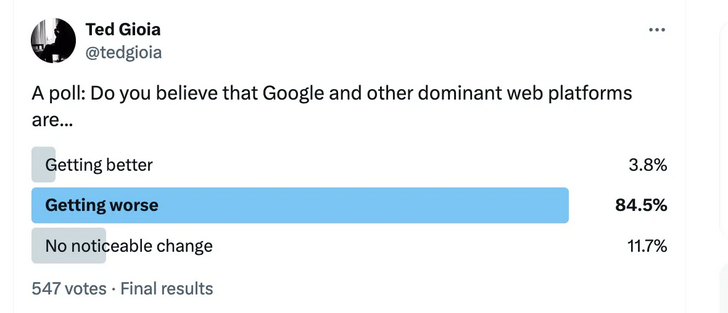
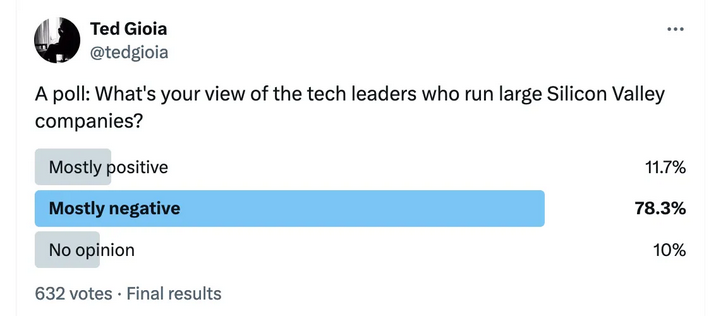
See the whole poll here, if you can stand the disgust from seeing extremist material, or see a detailed report on a poll of Californians that offers similar results.

Fortunately, the responsible mainstream leaders of the Liberal Party and NDP are standing strong with the 14% in the majority who want parents out of the lives of transgender children, rejecting the fringe views of the 78% who live at the extremist edges.

At the same time, the New York Times has just published a remarkable opinion piece on the growing concern among longtime transgender advocates, including transgendered clinicians, about the casual and rushed process by which American pediatric gender clinics are pushing children into gender transition. The essay centers on detransitioners, trans youth who change their minds and accept their biological sex.

This being the New York Times, the author is compelled to mention the true danger: “The real threat to transgender people comes from Republicans who wish to deny them rights and protections.” Ahh, but watch what comes next:

    But the doctrinal rigidity of the progressive wing of the Democratic Party is disappointing, frustrating and counterproductive.

    “I was always a liberal Democrat,” one woman whose son desisted after social transition and hormone therapy told me. “Now I feel politically homeless.”

    She noted that the Biden administration has “unequivocally” supported gender-affirming care for minors, in cases in which it deems it “medically appropriate and necessary.” Rachel Levine, the assistant secretary for health at the U.S. Department of Health and Human Services, told NPR in 2022 that “there is no argument among medical professionals — pediatricians, pediatric endocrinologists, adolescent medicine physicians, adolescent psychiatrists, psychologists, et cetera — about the value and the importance of gender-affirming care.”

Democrats are doctrinally rigid, and a top health official in the Biden administration says proudly that there is no debate. See, everyone believes the same thing, except mean Republicans, but that’s also now understood to be a sign of excessive ideological rigidity. Then the same piece in the Times also says a whole bunch of things like this:

    Studies show that around eight in 10 cases of childhood gender dysphoria resolve themselves by puberty and 30 percent of people on hormone therapy discontinue its use within four years, though the effects, including infertility, are often irreversible.

I’ve removed the links from the quoted paragraphs, because they don’t work well after cutting and pasting, but you can find them all at the link to the non-paywalled opinion piece.

Well, I guess the secret’s out:

February 3, 2024

The climate alarmists long ago gave up honest scientific reporting

Filed under: Environment, Government, Media, Politics, Science, USA — Tags: , , — Nicholas @ 05:00

Tom Knighton says he used to fully buy in to the climate alarmist message, but eventually realized the fix had been in for years, especially when it came to the predictive ability of all the climate change models … as in, their total lack of predictive ability:

When Al Gore’s An Inconvenient Truth came out, I watched it. I was terrified by the world being described, and since I was still pretty liberal and sort of an environmentalist, I took it all to heart.

Over time, as my personal politics shifted, I still had concerns regarding climate change. After all, it is what it is, right?

Until I came to look deeper into the issue and the one thing that shattered my belief in the whole concept: The fact that not a single climate model has ever panned out as predicted despite pretty much none of the draconian measures we’re told we need in order to avert disaster ever coming to fruition.

Science is supposed to be predictive. If it can’t predict something in its models, then scientists need to back up and figure out what the problem is. Instead, they seemingly just keep doubling down.

[…]

Let’s be clear here, the idea of taking measurements in heat islands is freshman year stuff. There’s absolutely no way they’re unaware the effect that’s having on their readings, even as most of their instruments are subject to heat bias.

In other words, I can’t accept this is a good faith error.

No, I believe this to be malicious.

Climatology isn’t exactly a field of science that would ever be considered sexy. Before all the climate alarmism, research grants were likely few and far between. People weren’t overly worried about the climate because it simply ways.

Then scientists started screaming that we were all doomed. The end is nigh, they told us, screaming at the top of their lung and acting just shy of wearing a sandwich board in Times Square.

With that came money and prestige.

Suddenly, climatologist could get recognition and write bestselling books. They could get grants from everyone and their brother to fund their research. The thing is, they had to keep up the charade. People had to believe that we were going to die if we didn’t do something.

Maybe they actually want the draconian measures they suggest, measures that pretty much amount to going back to living in mud huts, but with solar- and wind-created electricity so we won’t need to burn wood to survive.

Or something.

Justin Trudeau doesn’t seem to understand why he’s losing so much support from voters

Filed under: Cancon, Media, Politics — Tags: , , , — Nicholas @ 04:00

Tailing on to the previous article, here are some thoughts from The Line‘s Matt Gurney about the strengths and weaknesses of Justin Trudeau — and I despise the man, but I accept he’s a very good politician — and the odd fact that he can’t seem to grasp the reason for his ongoing fall in popularity among Canadians:

… it was a specific comment by the PM that really stayed with me. It’s this:

    … Trudeau does believe, however, that Liberals are up against something relatively new in this climate, which he calls opinion-as-identity politics.

    “I don’t think that was a feature too much of other times in politics — where what you think about something actually creates the circles and the people that you actually associate with, and it defines who you are.”

I’m going to let Tom Cruise in the delightful and little-remembered sci-fi film Oblivion convey my reaction to the PM’s comment there:

This is a statement that I’m having a hard time processing, and that I’ve been reflecting on for weeks, because there is no version of Prime Minister Justin Trudeau — at least, in my understanding of the man — that is dumb enough to believe such a silly thing. Dividing ourselves into tribes identified by our opinions on stuff is exactly what human beings do, and have always done. The first monkey to get out of a tree and stand on solid ground and think to themselves, “Hey, it’s kind of cool down here,” was undoubtedly, immediately ostracized by all the other monkeys that thought that life atop the trees could not possibly ever be beaten.

And we’ve been finding new things to disagree about, and kill each other over, ever since. Which skin colour is best, which holy book contains the real guide to salvation, which ideology is the path to true human enlightenment … human beings have slaughtered each other by the millions over this stuff for as long as there have been human beings. Sure, every so often we squabble over resources. Who gets to control which oil field or prime cattle pasture and the like. But most of our nastiest fights have been over opinions about stuff. Maybe substantive matters, things like racial identity or religious affiliation, but still just opinions. And if we’re honest, some of the opinions have been pretty dumb. Not worth killing or dying over.

Hell, as I was thinking about writing this column, my young son very solemnly and seriously told me about some drama on the schoolyard he’d been part of. It turns out some kids who are normally good buddies had come to tears and almost to blows because … they liked different NFL football teams, and tensions were running high during some of the recent playoff games. I know it’s easy to dismiss this as just boys being boys, but I actually think it’s pretty useful here as an example of humans being humans. There is nothing that symbolizes the way we simian-brained weirdos approach life better than imagining a bunch of thinking, feeling people becoming emotionally overwhelmed because of a disagreement over which collection of overpaid athletic prodigies should advance while a different collection of overpaid athletic prodigies wearing another colour shirt heads home for a long break.

It’s ridiculous. But it’s us. It’s humans. Through and through. I’m a sports fan, too, and I’m well aware of the fact that sports are one of those handy things we use as a society to channel our base, primal, aggressive instincts. I get up and cheer wildly when the Leafs beat the Canadiens because it satisfies some part of my brain, and millions of other brains, that would probably otherwise result in Toronto and Montreal raiding each other for chickens. Or worse. Human beings are constantly deciding stuff and then sorting whole populations accordingly, and then getting emotionally invested in those divisions. I like it more when we channel it into sports rivalries and fights over who has the superior bagel.

How can the prime minister not understand this about us?

« Newer PostsOlder Posts »

Powered by WordPress