Quotulatiousness

August 29, 2024

How activists used lawfare to force the Boy Scouts to go woke (and then go broke)

Filed under: Law, Liberty, Media, Politics, USA — Tags: , , , , — Nicholas @ 04:00

A guest post from Cole Noble at Postcards From Barsoom discusses how progressive organizations and political activists have managed an immense take-over of the great outdoors, not least of which were the legal and political efforts to force the Boy Scouts of America to accept gay scouts and scout masters:

[…] This entertainment ecosystem, increasingly infested with culture warriors, also started chipping away at the longstanding prestige of organizations like the BSA [Boy Scouts of America]. Depicting someone as a scout became a kind of character development shorthand, signalling them as uncool.

The targeting wasn’t incidental; the existence of the pre-centennial BSA was a serious problem for the ruling class. Their organization’s commitment to values-based conservation served as living proof that going along with society’s adoption of critical theory was completely optional. If the BSA was free to refuse the push, others might start getting ideas.

Lawfare was inevitable.

In 2000, the United States Supreme Court heard Boy Scouts of America v. Dale. In one corner you had James Dale, an avowed gay rights activist, co-president of the Rutgers University Lesbian/Gay Alliance, and outspoken advocate for gay teens having gay role models. In the other, you had the BSA, who didn’t want someone like Dale around its young, impressionable members.

The BSA won, but there was blood in the water. Culture warriors circled back around, this time employing social pressure. They tried to make their demand sound as reasonable as possible: drop the policy against openly gay members. Just one teeny tiny rule. What’s the point anyway? It’s outdated. No real sense keeping it, right?

Smart members of the program clocked this Trojan Horse from miles away. Alas, the organization’s leadership did not. Possessing both the physique and fortitude of rice pudding, they caved, capitulated, and acquiesced some more — agreeing to an ever-escalating series of demands that hollowed out the once-proud group into an empty vessel for The Current Thing(TM).

The Boy Scouts of America is now all-inclusive! Not just to gay scouts and leaders, but girls too. In a show of solidarity with Black Lives Matter after the riots of 2020, a mandatory DEI merit badge has replaced camping as a requirement to attain the once coveted rank of Eagle Scout.

Let’s not forget the Scout Masters now left to deal with teens using the program’s overnight trips as cover for hookups.

Oh, and they went bankrupt.

The organization agreed to a 2.5 billion dollar settlement over tens of thousands of sex abuse cases perpetuated by adult men, against underage boys.

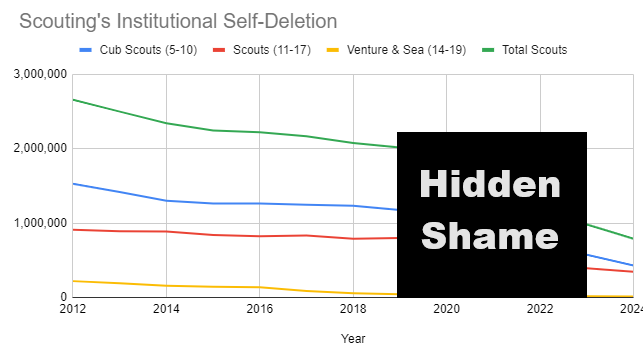
(data compiled from the BSA’s publicly available annual reports)

Rather than bolster ranks, adopting DEI cost the organization more than 1 million members.

The BSA – sorry, Scouting America1 – didn’t publish annual membership reports from 2020 to 2022, I imagine out of embarrassment. During this time, the Mormons, who used Scouting as a youth program for its boys, took their 400,000 members, and their money, and left.

[…]

Scouting was one of, if not the last bastion of quasi-unstructured outdoor activities. While the death of free-range childhood seems to be commonly understood, there is some debate about the precise cause.

Whatever your opinion on the matter, regime journalists shoulder enormous responsibility for eroding societal trust and inspiring mass paranoia through sensational reporting. Former latchkey kids became hysterical helicopter parents, petrified of letting their children out of sight.

Playing outside became a heavily supervised affair, usually relegated to fenced-in backyards with locking gates.

Kids have been robbed of the experiences that could lead them to develop an organic appreciation for outdoor recreation, and groomed into a hypersexualized version of early adulthood. All the while, the institutions which once taught conservation and virtue now serve as apparatuses of critical theory.


    1. They changed their name in May of 2024, after 114 of being the Boy Scouts. Since they’re no long the Boy Scouts, this is at least honest.
Cole’s own Substack is Quandary Magazine, which you should check out if you’re generally interested in the great outdoors.

Pavel Durov’s arrest isn’t for a clear crime, it’s for allowing everyone access to encrypted communications services

Filed under: France, Government, Liberty, Media, Technology — Tags: , , , , — Nicholas @ 03:00

J.D. Tuccille explains the real reason the French government arrested Pavel Durov, the CEO of Telegram:

It’s appropriate that, days after the French government arrested Pavel Durov, CEO of the encrypted messaging app Telegram, for failing to monitor and restrict communications as demanded by officials in Paris, Meta CEO Mark Zuckerberg confirmed that his company, which owns Facebook, was subjected to censorship pressures by U.S. officials. Durov’s arrest, then, stands as less of a one-off than as part of a concerted effort by governments, including those of nominally free countries, to control speech.

“Telegram chief executive Pavel Durov is expected to appear in court Sunday after being arrested by French police at an airport near Paris for alleged offences related to his popular messaging app,” reported France24.

A separate story noted claims by Paris prosecutors that he was detained for “running an online platform that allows illicit transactions, child pornography, drug trafficking and fraud, as well as the refusal to communicate information to authorities, money laundering and providing cryptographic services to criminals”.

Freedom for Everybody or for Nobody

Durov’s alleged crime is offering encrypted communications services to everybody, including those who engage in illegality or just anger the powers that be. But secure communications are a feature, not a bug, for most people who live in a world in which “global freedom declined for the 18th consecutive year in 2023”, according to Freedom House. Fighting authoritarian regimes requires means of exchanging information that are resistant to penetration by various repressive police agencies.

“Telegram, and other encrypted messaging services, are crucial for those intending to organise protests in countries where there is a severe crackdown on free speech. Myanmar, Belarus and Hong Kong have all seen people relying on the services,” Index on Censorship noted in 2021.

And if bad people occasionally use encrypted apps such as Telegram, they use phones and postal services, too. The qualities that make communications systems useful to those battling authoritarianism are also helpful to those with less benign intentions. There’s no way to offer security to one group without offering it to everybody.

As I commented on a post on MeWe the other day, “Somehow the governments of the west are engaged in a competition to see who can be the most repressive. Canada and New Zealand had the early lead, but Australia, Britain, Germany, and France have all recently moved ahead in the standings. I’m not sure what the prizes might be, but I strongly suspect “a bloody revolution” is one of them (if not all of them).”

August 28, 2024

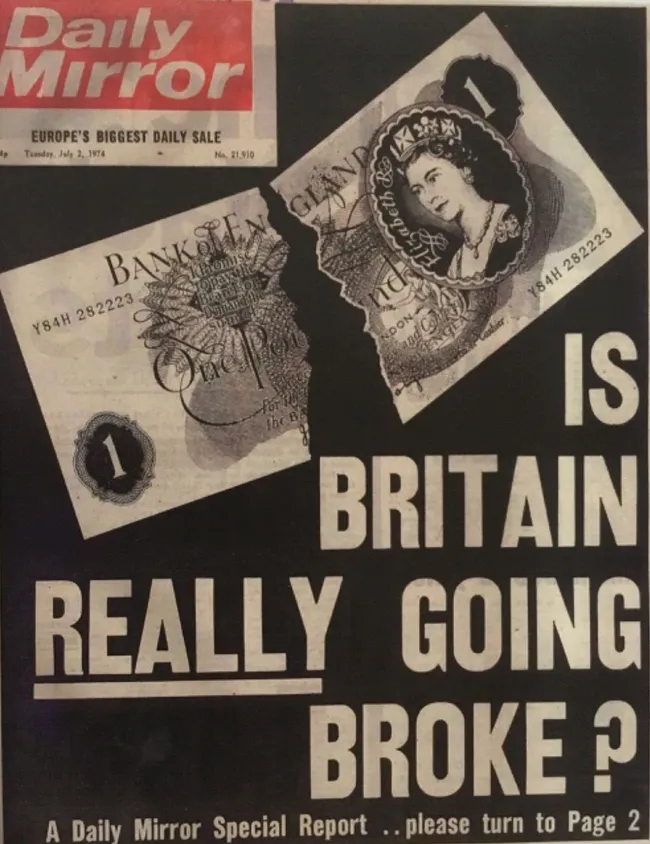
1974 – Britain’s nadir

Filed under: Books, Britain, Economics, History, Media, Politics — Tags: , , , , , — Nicholas @ 05:00

In the second part of Ed West‘s appreciation of Dominic Sandbrook’s Seasons in the Sun, Britain was described as “sliding, sinking, shabby, dirty, lazy, inefficient, dangerous, in its death throes, worn out, clapped out, occasionally lashing out” by Margaret Drabble in her 1977 novel The Ice Age, and it certainly seems to fit the bill quite well:

The Times reported in October of that year that London’s West End was in a “sorry state”, with parts of Shaftesbury Avenue and Charing Cross Road “in the sort of condition that, in Birmingham or Manchester, would qualify them for wholesale slum clearance”.

Journalist Clive Irving wrote that London had become “a semi-derelict slum”, a city blighted by “tacky porno shops, skin movies, pinball arcades, and toxic hamburger joints” while “behind neon facades the buildings are flaking and unkempt”.

The capital had lost a million and a half people since its peak in 1939, and would continue its decline for another decade. Whitehall Mandarin Ronald McIntosh declared that “London is evidently losing population quite heavily [and] services are steadily deteriorating, and nobody seems to have the least idea of how to deal with it”.

The country as a whole was haemorrhaging people, and in 1975 its population fell for the first time since records began. In the spring of 1974 applications for emigration to Canada went up 65 per cent, while New Zealand even felt compelled to put restrictions on people fleeing the old country.

Doctors in particular were leaving in droves, and recruitment agency Robert Lee International estimated that the number of professionals wanting to move abroad rose by 35% in just six months, from January and July 1975. Interest was keenest among engineers, accountants, scientists and teachers.

Many high earners were fleeing excessive tax rates, so punitive that even the Bond producer Albert R Broccoli left to make the iconic British movies elsewhere, and Moonraker would be filmed in France.

Gone were the days of the Swinging Sixties; instead, the London of George Smiley was “the city of the Sex Pistols and The Sweeney, not the Beatles and The Avengers; a city of tramps and hooligans, hustlers and muggers, the downtrodden and the disappointed, haunted by the deadly figure of the IRA bomber”.

Britain’s second city was in an even worse state. During Wilson’s first term Birmingham had been hailed as “the most go-ahead city in Europe”. Now the Times admitted it looked like a “large and chaotic building site”.

Travel writer Jonathan Raban described Southampton’s Millbrook estate as “a vast, cheap storage unit for nearly 20,000 people”. The country’s increasing problem with crime, hooliganism, graffiti and drug addiction meant that residents wouldn’t even hang their clothes in communal areas, for fear of theft.

The great architectural feats of the post-war era were beginning to look like a miserable failure, and none more so than the utopian social housing schemes, which had often entailed destroying closely-knit and organic communities in overcrowded and run-down – but rescuable – terraced housing.

Christopher Brooker visited Keeling House in Bethnal Green and found “its concrete cracked and discolouring, the metal reinforcement rusting through the surface, every available inch covered with graffiti”. Here was the story of modern Britain, “the bright, anticipated dream followed by a seedy, nightmarish reality”.

The National Theatre’s Peter Hall visited the New York Juilliard School and upon return home “found it depressing to compare it with our own already run-down, ill-maintained South Bank building”.

“The English apparently no longer care enough about material surroundings,” he wrote: “They even seem to take a positive pleasure in defiling them.”

H.R. McMaster dishes on Trump’s first term in office

In Reason, Liz Wolfe covers some of the head-scratchers former National Security Advisor H.R. McMaster revealed about working for Donald Trump:

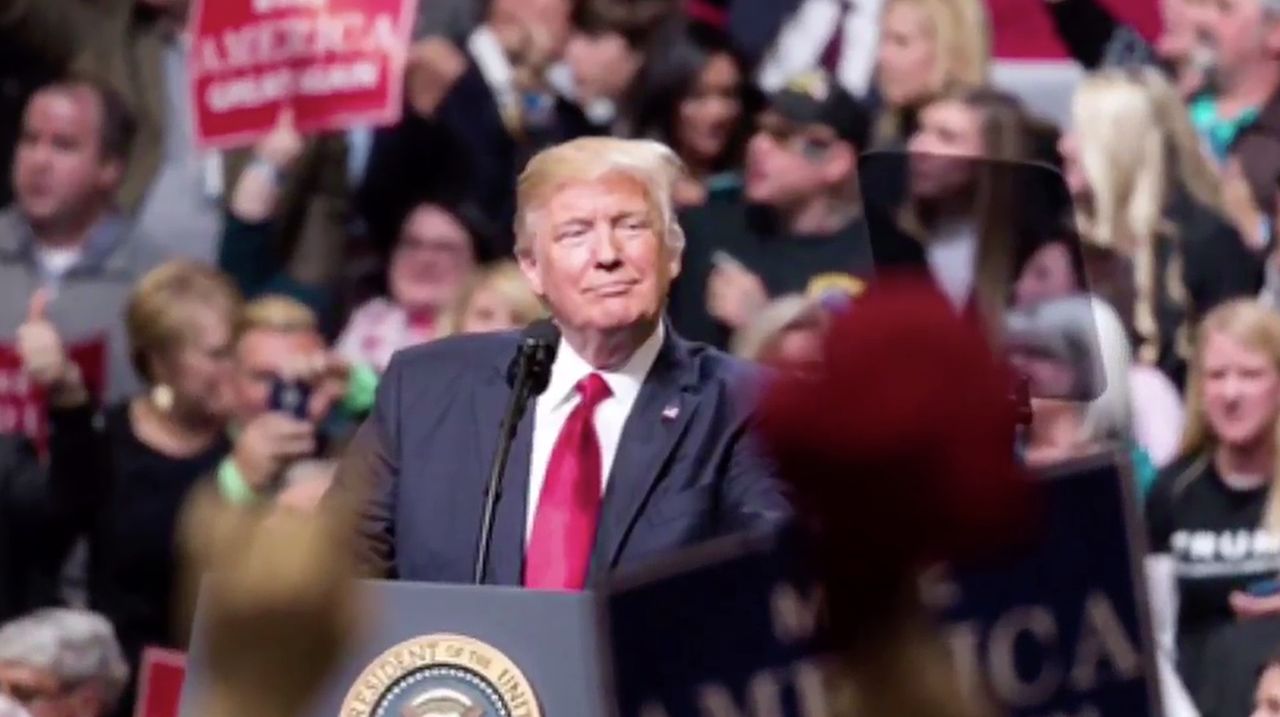
Donald Trump addresses a rally in Nashville, TN in March 2017.
Photo released by the Office of the President of the United States via Wikimedia Commons.

What might a second Trump White House be like? In his new book, At War with Ourselves: My Tour of Duty in the Trump White House, Lt. Gen. H.R. McMaster, who served as national security adviser to Donald Trump (for one year), characterizes Oval Office meetings as “exercises in competitive sycophancy” where advisers would greet him with lines like “your instincts are always right” or “no one has ever been treated so badly by the press”.

Trump, meanwhile, would come up with crazy concepts, and float them: “Why don’t we just bomb the drugs?” (Also: “Why don’t we take out the whole North Korean Army during one of their parades?”)

This is one man’s account, of course. McMaster’s word should not be taken as gospel, and some of his frustration might stem from his dismissal, or his foreign-policy prescriptions being at times ignored by his boss. But it’s a somewhat revealing look behind the curtain at policy-setting in a White House helmed by an especially mercurial commander in chief, who “enjoyed and contributed to interpersonal drama in the White House and across the administration”.

It also shows how quickly Trump fantasies have percolated through the Republican Party, namely the “let’s just bomb Mexico to get rid of the cartels” line, which Trump has been toying with since roughly 2019 (or possibly more like 2017, after he chatted with Rodrigo Duterte, former president of the Philippines, who had promised to kill 100,000 drug traffickers during his first six months as president). A few years prior, in 2015, he had suggested that Mexico was sending rapist and drug-traffickers across the southern border, and that we’d need to build a wall between the two countries, but it wasn’t until nine American citizens were killed in Mexico that Trump trotted out the idea of declaring cartels foreign terrorist organizations and using military might to eradicate them.

Trump’s line from 2019 has now become standard fare, notes The Economist: The Republican primary debates included lots of tough talk on Mexico, specifically on the bombing front, with Florida Gov. Ron DeSantis claiming he’d send special forces down there on Day One. Right-wing think tanks have embraced the messaging, with articles headlined “It’s Time to Wage War on Transnational Drug Cartels”. Taking cues from other members of her party, Georgia Rep. Marjorie Taylor Greene asked why “we’re fighting a war in Ukraine, and we’re not bombing the Mexican cartels”. Whether it’s economic protectionism (10 percent across-the-board tariffs, with 60 percent tariffs imposed on Chinese imports) or Mexico-bombing, Trump has near-magical abilities to get other members of his party to accept something previously regarded as absurd.

Then I’ll Take Her When You’re ☠️Dead☠️!

Filed under: History, Humour, Media, Weapons — Tags: , , , — Nicholas @ 02:00

Jill Bearup
Published May 13, 2024

Ah, Captain Blood. Swords, sand, and piratical shenanigans. Let’s do this.

The Fight Master Vol 1 Issue 1: https://mds.marshall.edu/fight/1/

Buy my book: books2read.com/juststabmenow (or try your local Amazon/bookstore)

August 27, 2024

Britain as the modern Panopticon

Filed under: Britain, Government, Media, Politics — Tags: , , , , — Nicholas @ 04:00

Jeremy Bentham proposed a new kind of prison in the 1700s, one where all of the prisoners in their cells were under constant observation by the guards. What sounds like a horrific way to live to any sensible rational person seems to have a fascinating appeal to the kind of micromanaging, busybody control freak who runs for office in British politics today:

An illustration of Jeremy Bentham’s Panopticon prison.
Drawing by Willey Reveley, 1791.

In Britain authorities use cameras to monitor private individuals in real time. They track cars using number plate software, and human beings using facial recognition software and analysis of gait.

The rationale for these intrusive measures is to prevent illegal activity as well as recording crimes for use in trials.

This troubles many since it places unsupervised control mechanisms in the hands of politicians and authorities increasingly out of touch with the interests of the majority.

Full-spectrum surveillance

The British Government has recently threatened to use this surveillance technology to clamp down on “extremists”.

Currently that means anti-immigration protestors, although there is provision for “anti-establishment” protestors too.

There is much Britain’s political class will not tolerate in the people who elevate them to power.

They have promised to relentlessly hound detestables using advanced spy technology, principally facial recognition software. This is specifically designed to identify individuals and track their movements in real time.

None of this has been requested by the public, and polls reflect considerable unease, particularly with facial recognition software, a powerful tool few are comfortable with.

Advocates of surveillance claim this erosion to our privacy is a necessary step to tackle crime. Cameras enable the police and authorities to identify criminals as well as detect and record the crimes they commit.

To the casual observer it sounds plausible and even reasonable. We won’t be using it to spy on you, only them. It has some public benefits.

This seems like a workable idea. So why is it so useless at stopping a very visible crime?

QotD: Who were the good guys?

Filed under: Germany, History, Media, Military, Quotations, Russia, WW2 — Tags: , , , , , , — Nicholas @ 01:00

The Valkyrie plot was really a thing that happened (the cognoscenti call it the Schwarze Kapelle), and it’s got all the makings of a great spy thriller … except one: There’s no good guy. Claus von Stauffenberg was a better guy than Hitler, I suppose, but that’s a bar so low it’s subterranean. Von Stauffenberg was a Wehrmacht colonel who’d seen action in pretty much every theater up to that point, including the invasions of Poland and Russia. It’s safe to say that one does not rise to the rank of colonel via combat in the Nazi armed forces without being involved in some shady shit. Indeed, as Wiki informs us, von Stauffenberg was fine with the way things ran in Poland, and initially declined to participate in the resistance out of a sense of personal loyalty to the Führer.

A movie can get away with showing mostly shades of gray, but in the case of the Valkyrie plot, both shades are pretty damn close to black.

Nor was the 2008 movie, starring Tom Cruise, an isolated case. A few years earlier, Jude Law and Ed Harris squared off as dueling snipers in Enemy at the Gates … set during the Battle of Stalingrad. Who do you root for, the Nazi or the Commie? The producers opt for “commie”, obviously, but their attempts to humanize the Jude Law character are embarrassing — even if we accept Law’s character as totally apolitical, no movie featuring a political commissar in a vital supporting role, not to mention “cameos” by Khrushchev and Stalin himself, can fail to remind viewers that everyone involved was awful. Even the most gripping battle scenes (and to be fair, some of them were pretty good) can’t make up for the fact that the world would be a far, far better place if they somehow both could’ve lost.

Those are high-level failures, conceptual mistakes, the kind that professional storytellers simply shouldn’t make. Not only that, though, both movies have unforgivable mistakes in the execution, at almost every level. Tom Cruise, for instance, is comically miscast as Stauffenberg. I’ve written before about how weird it is that casting directors seem to obsess over finding actors who look like even obscure historical figures. Cruise looks a bit like Stauffenberg, I guess, but there’s simply no way a guy with his … ummm … distinctive acting style should be anywhere near a historical drama. Tom Cruise only ever really plays Tom Cruise, so “Tom Cruise dressed up as a Nazi” is really jarring.

And that’s before you consider the accents. Maybe Tom Cruise can’t do a German accent, I dunno. I seem to recall he did an Irish accent in a movie once, and that turned out ok, but again, whatever character he was playing was just “Tom Cruise with an Irish accent.” So maybe if you feel you must cast him as a German, letting him use his “natural” American accent is the way to go. But if you’re going to do that, please, for pete’s sake, make everyone else do an American accent, too. I know Kenneth Branagh can do one. So either cast guys who can do the right accent, or, failing that, who can do each other’s accent. Otherwise you get a huge, distracting mess.

Enemy at the Gates was actually worse: Law, Joseph Fiennes (the commissar), and Rachel Weisz (the love interest) all used their native British accents … but they’re different kinds of British accent, at least in Law’s case. Meanwhile, Ed Harris (the Nazi antagonist) uses the “neutral” American accent, while supporting player Ron Perlman, who is American, does a comically over-the-top Russian … as do the guys playing Khrushchev and Stalin. It’s just weird. In both movies, you’ve got supposedly tight groups of friends (or, at least, co-conspirators) talking to each other in wildly different accents. That kind of thing is bad enough in a movie like Robin Hood, Prince of Thieves, which made no pretenses to historical accuracy; it’s movie-destroying in a supposedly serious, historically-based thriller.

Severian, “Storytelling Fail”, Rotten Chestnuts, 2021-07-13.

August 26, 2024

David Friedman – “my fargroup … are being attacked by my outgroup. My enemy’s enemy …”

I’m much of David Friedman‘s opinion on the candidates for both the Democratic and Republican parties in the current US presidential election … and I also find myself leaning more toward Trump even though his re-election would almost certainly be worse for Canada:

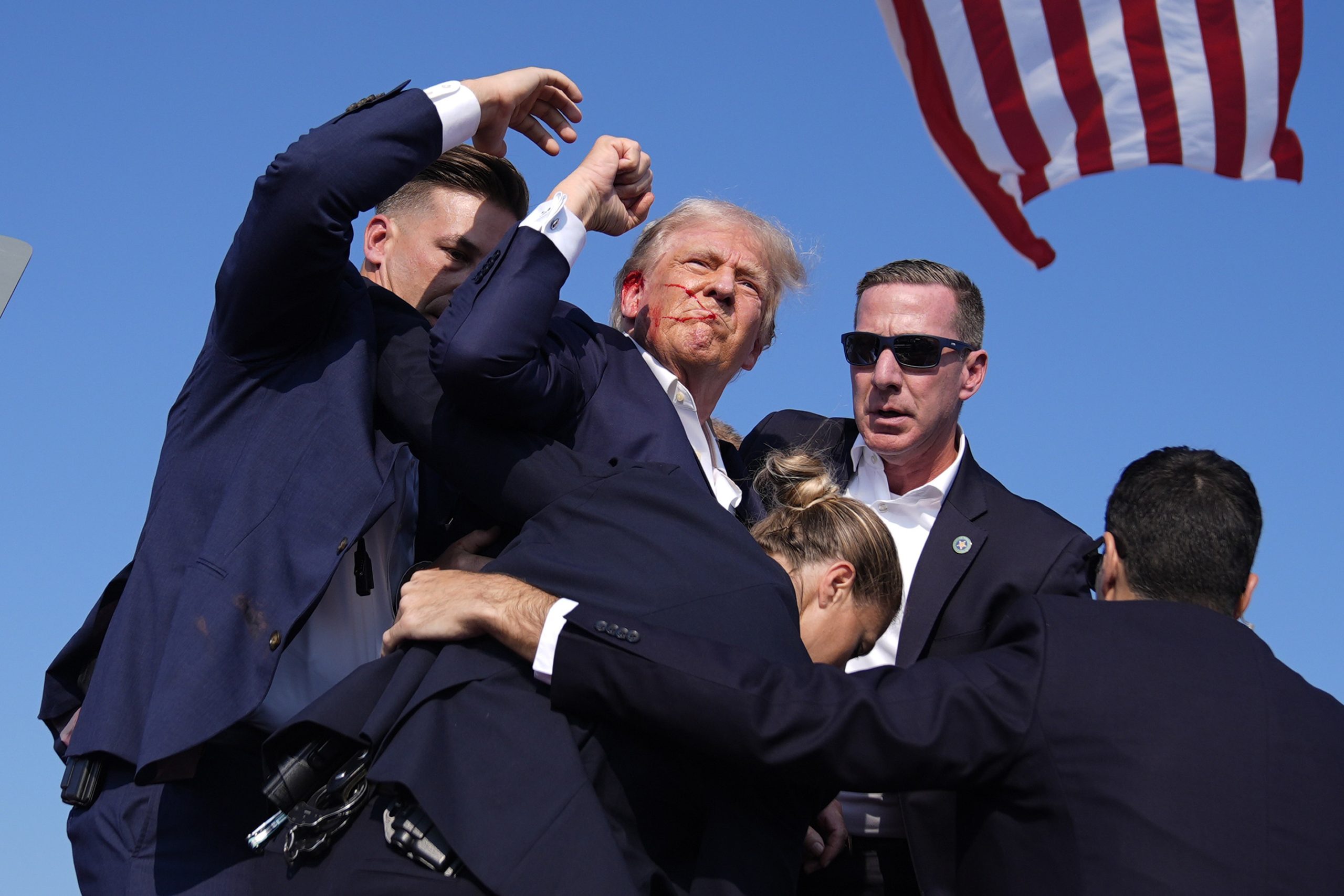
Donald Trump, surrounded by Secret Service agents, raises his fist after an attempt on his life during a campaign speech in Butler, PA on 13 July, 2024.

My opinion of the election is “a plague on both your houses”. Kamala Harris is an extreme representative of an ideology I have opposed for most of my life. Donald Trump has three major positions on two of which, immigration and trade, he manages to be even worse than his opponent. While I have some sympathy for his views on the third — I have been arguing against an interventionist foreign policy for something over fifty years now — I do not trust him to execute a consistent and competent alternative. His disinterest in whether what he says is true, extreme even for a politician, I find offensive.

That is my intellectual view of the matter. It is not my emotional view. Reading news stories and observing the effect on my feelings, I note that I am reacting like a Trump partisan. Poll results that look good for him make me happy, poll results that look bad for him make me sad. Accounts of outrageous statements by Trump or Vance I ignore — I don’t expect them to tell the truth. Accounts of demagoguery by Harris or Waltz arouse feelings of indignation. If Harris wins I will feel disappointed. If Trump wins I will feel relieved, at least until the first outrageous thing he does.

The explanation of my inconsistent reaction is provided by Scott Alexander in “I Can Tolerate Anything Except The Outgroup“, one of the best of his many good essays. In it he points out that someone’s outgroup, the group for whom he feels and expresses strongly negative views, is typically made up not of people distant from him, geographically and intellectually, but of people close. The outgroup of the Nazis was not their Japanese allies or the Chinese the Japanese were fighting, it was German Jews, people with the same language and, in most respects, the same appearance and culture. The outgroup of American leftists is not Muslim fundamentalists but American conservatives.

Conservatives have doubts about gay marriage. Muslim fundamentalists view homosexual intercourse as a capital offense.1 American conservatives would like their schools to be more tolerant of creationism. Muslim fundamentalists want their schools to teach the truth of Islam. And yet, when conservatives criticize Muslims, leftists defend them. When Muslims kill Jews and Jews respond by killing Muslims, it is the Muslims that the American leftists support, the Jews that they blame — although Israelis have much more in common, ideologically as well as culturally, with American leftists than Palestinians do.

    We think of groups close to us in Near Mode, judging them on their merits as useful allies or dangerous enemies. We think of more distant groups in Far Mode – usually, we exoticize them. Sometimes it’s positive exoticization of the Noble Savage variety (understood so broadly that our treatment of Tibetans counts as an example of the trope). Other times it’s negative exoticization, treating them as cartoonish stereotypes of evil who are more funny or fascinating than repulsive. Take Genghis Khan – objectively he was one of the most evil people of all time, killing millions of victims, but since we think of him in Far Mode he becomes fascinating or even perversely admirable – “wow, that was one impressively bloodthirsty warlord”. (Scott Alexander, “Post-Partisanship Is Hyper-Partisanship“)

Conservatives are the leftists’ outgroup, Muslims their far group. The far group can be ignored; large parts of the world are more sexist and more racist than any part of America but invisible to progressives campaigning against sexism and racism. The far group can even be supported, at least if the outgroup is attacking it. My enemy’s enemy is my friend. Muslim fundamentalists. Hamas.

Kamala Harris is an American leftist. American leftists are my outgroup. Trump and Vance are American populists. I disagree with their views, in some cases more than I disagree with the views of American leftists, but I have nothing against them, just as I have nothing against believing Catholics or Orthodox Jews or Black Muslims or believers in Christian Science.

Trump and his movement are my fargroup. They are being attacked by my outgroup. My enemy’s enemy …


    1. In some times and places Muslim culture has been tolerant of homosexuality; there are two famous medieval essays on the relative attractions of homosexual and heterosexual intercourse and quite a lot of poetry celebrating homosexual love. But the religious doctrine, which fundamentalists take seriously, holds homosexuality to be forbidden.

August 25, 2024

“Does your vote count?” or how to set up an automatic vote-generation scheme

Elizabeth Nickson on recent reporting about voting scams in various US states:

After engineer and data scientist Kim Brooks worked on cleaning the voter rolls in Georgia for a year, she realized she was on a stationary bicycle. She’d clear a name for various reasons, dead, felon, stolen ID, living at a seasonal campground for twenty years, duplicate, moved out of state, 200 years old, etc., and back it would come within a month. At that juncture she realized that a program within the Georgia voter registration database was methodically adding back fake names.

She looked deeper. For new registrants, the culprit was principally Driver’s Services creating new registrations and in this case, the manufacturer was a person, or persons. Within the government office, someone was stealing names and duplicating, even tripling that person’s vote and then forging their signature. Sometimes it was someone who just died, or a teacher who had no voting record. In the case of a nurse who died in 2022 with three registrations, she was registered to vote in two counties, and all three of her voted in the 2022 election and the 2024 primary. Each signature was slightly different, the last three letters spelled, ly, ley, and lley

This operation works under AVR, or automatic voter registration, and is being used to register migrants. They will not vote, but their names have been entered into the Voter Registration database when they apply for a driver’s license and their vote will be voted for them. I imagine that this is repeating something everyone knows, but the borders are open for precisely this reason, so the Democrat/RINO machine can steal their votes. By the way, the process for advancing permanent residency has been cut from 11 months to two.

In 2020, twenty states used operation AVR. Of those, Trump lost 18.

That’s because there are registration fraud rings, as identified in the Arabella doc. and in the work of Omega4America. This worked well in Michigan, where, according to Captain Seth Keshel, who is one of the leads on this fight, believes that Trump likely got 576,443 more votes than were counted and won Michigan by 8.5%.

Every state is host to a dozen or more NGO’s which do nothing but fill out ballots for the faked registrants. Peter Bernegger’s team in Wisconsin has video of NGO functionaries doing just that in Wisconsin in 2020 at 1 am, early morning after Election Day.

    Michigan has two million more registered voters than they should have. 83.5% of the state is registered to vote but only 77.9% is over 18. – Seth Keshel

Seth works with demographic trends and does detailed statistical analysis; travelling almost ceaselessly to teach Americans how to stop the cheat. AVR was launched in Michigan, after Trump’s win in 2016. By 2020 there were 547,460 net new registrants in Michigan. Today, more voters are registered to vote than there are people old enough to vote. Keshel:

Per Keshel’s analysis, the Democrats and RINOs are frantically operating a dying political coalition which began to shift hard after Obama’s performance in his first four years, when not only did nothing change for the working class, it worsened. Democrat registrations in Michigan collapsed to the point where the Dems lost 16,000 as of 2016. Enter AVR and boom, 500+K new registrants.

August 23, 2024

Woman with three multi-million dollar homes tells the rest of us we need to cut back our expectations

Filed under: Media, Politics, USA — Tags: , , , , — Nicholas @ 04:00

Sometimes it’s hard not to be cynical:

We often use the word “need” a little more than we probably should. We need to go see this movie when it’s in the theater or we need to get that new gadget. Often, we use it to describe a very strong desire, and I get it.

I mean, I do it too.

The truth is that our needs are much more basic than that. We need clothing, food, shelter, etc.

And that worries me because Michelle Obama thinks that taking more than we absolutely need is a problem.

    I can’t even …

    Yesterday I wrote about how shamelessness is a superpower, and I have to say that it is a wonder to behold.

    As the Democrats gather in Chicago to experience the religious ecstasy of being surrounded by each other and sniffing their own farts, they are treated to speeches from elite hypocrites who pretend to be perfectly normal people.

    Last night was the ol’ HOPENCHANGE shtick, with Michele and Barack Obama babbling on about things they don’t believe while Obama sycophants babble on about how their “spiritual voids” were filled by the Lightbringer.

    An emotional high point was, apparently, Michelle’s speech in which she blathered on about how very normal her family was and how they were egalitarians who were suspicious of rich people.

To be accurate, she said, “suspicious of people who took more than they need”.

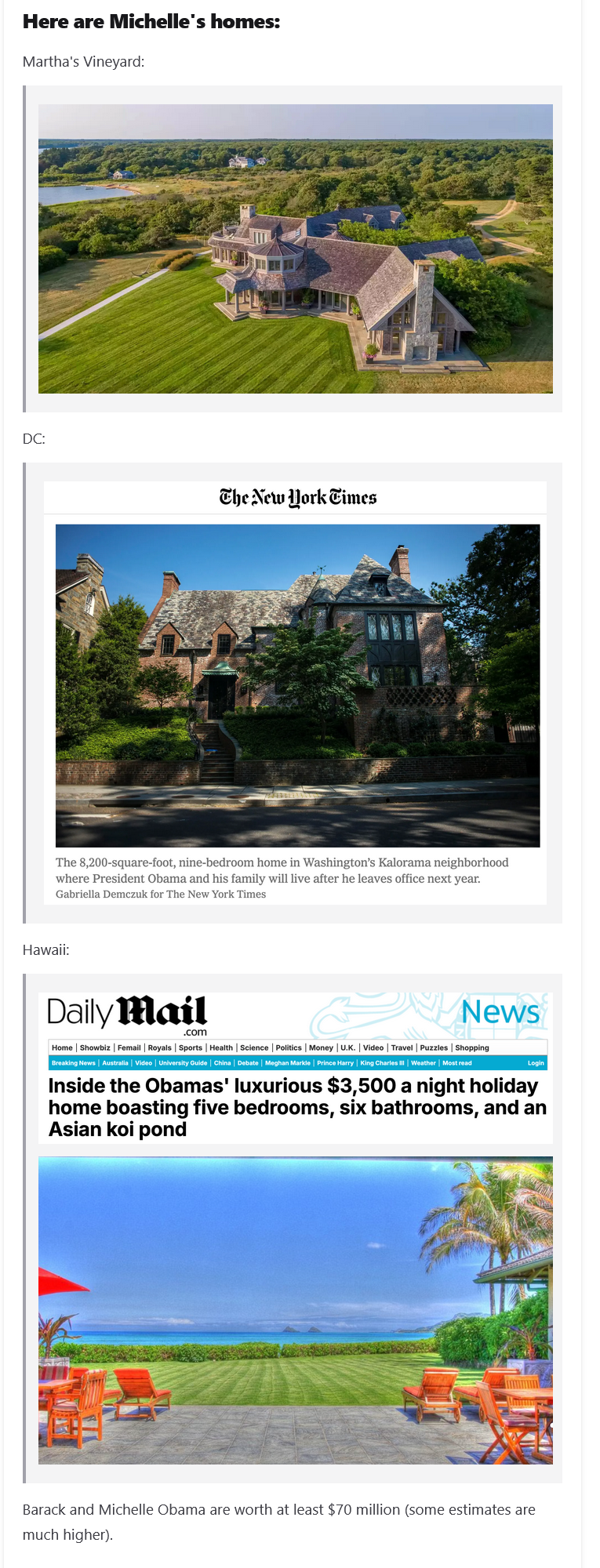
I find this fascinating because, well, the Obamas own three homes. The least amount they paid for a home was $1.65 million, and that was in 2005.

I’m always amazed at how people who spend their lives working in the public sector and for non-profits can amass so much wealth, but apparently, that’s just what they need.

Let’s understand that most of us are living with far more than we absolutely need to survive. We also have a lot of things that simply provide comfort, such as smartphones, televisions, computers, and so on.

So if we’re to be suspicious of people who took more than they need, should we be skeptical of the person looking back at us in the mirror?

Who decides what one needs? To what level are we ascribing the term “need” anyway?

Does anyone need $750,000 for an hour-long speech?

The EU’s bureaucratic aristocrats agree “Spaceship Man Bad!”

Filed under: Bureaucracy, Europe, Media, Politics — Tags: , , , , — Nicholas @ 03:00

As eugyppius explains, the “Eurocrats are having a very big sad” and Spaceship Man Bad isn’t deferring to their autocratic whims:

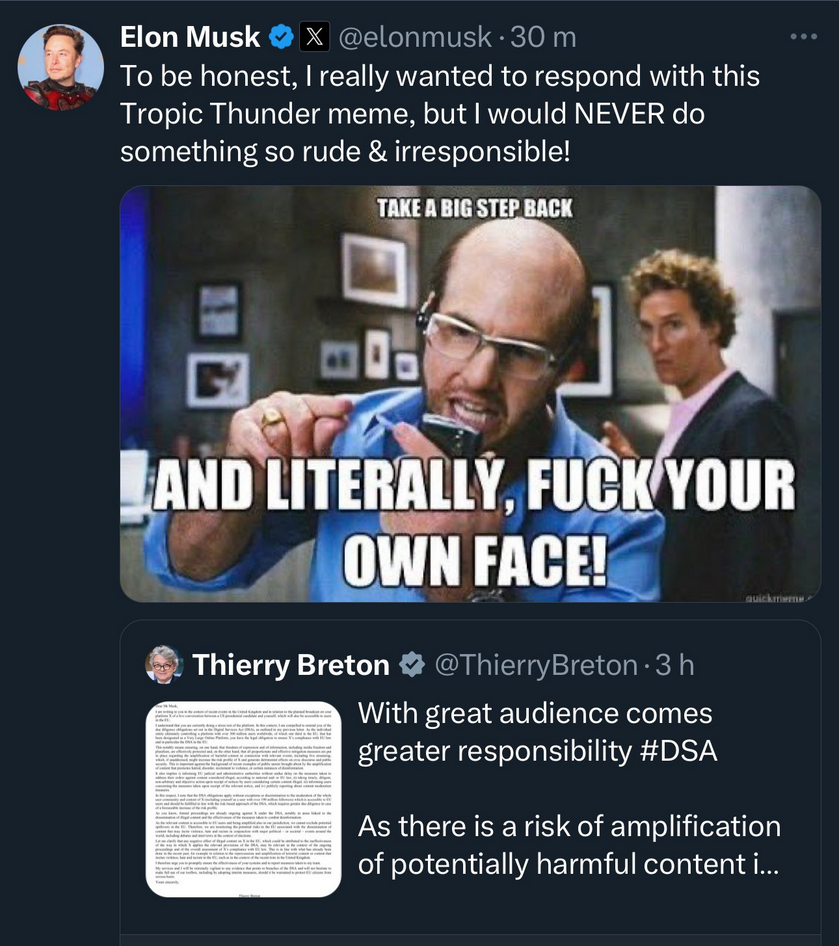
The Brussels Eurocrats around Emmanuel Macron are having a big sad about Twitter right now. They fear the platform fuels “the amplification of hateful content” and “disinformation”, which are multisyllabic ways of saying that there is too much unapproved and uncurated discourse on the site. You cannot just have people taking to their keyboards to type, like and retweet whatever they want. You especially cannot have that in Europe, where we suffer under the immensely liberal and democratic Digital Services Act, which mandates all manner of social media censorship to protect traditional European freedoms, like freedom of expression.

Twitter is a useful website; I use it to try out ideas and also for news-gathering purposes. As much as I’ve benefitted from the platform, however, I find the establishment derangement surrounding it to be extremely bizarre. There is little chance that Elon Musk’s relaxed moderation regime will lead to fascism, and still less chance that heavy censorship there will do anything about tHe ExtREmE RiGhT. The real reason that Twitter bothers establishment pundits and politicians, is its inherently confrontational nature. Our smug and self-satisfied oligarchs don’t like getting dragged and dunked on by the rabble. They want to tweet their lunacies without anonymous anime-themed accounts showing them up for the fools that they are, and they are very, extremely, fulminously enraged that Musk won’t do anything to improve their user experience.

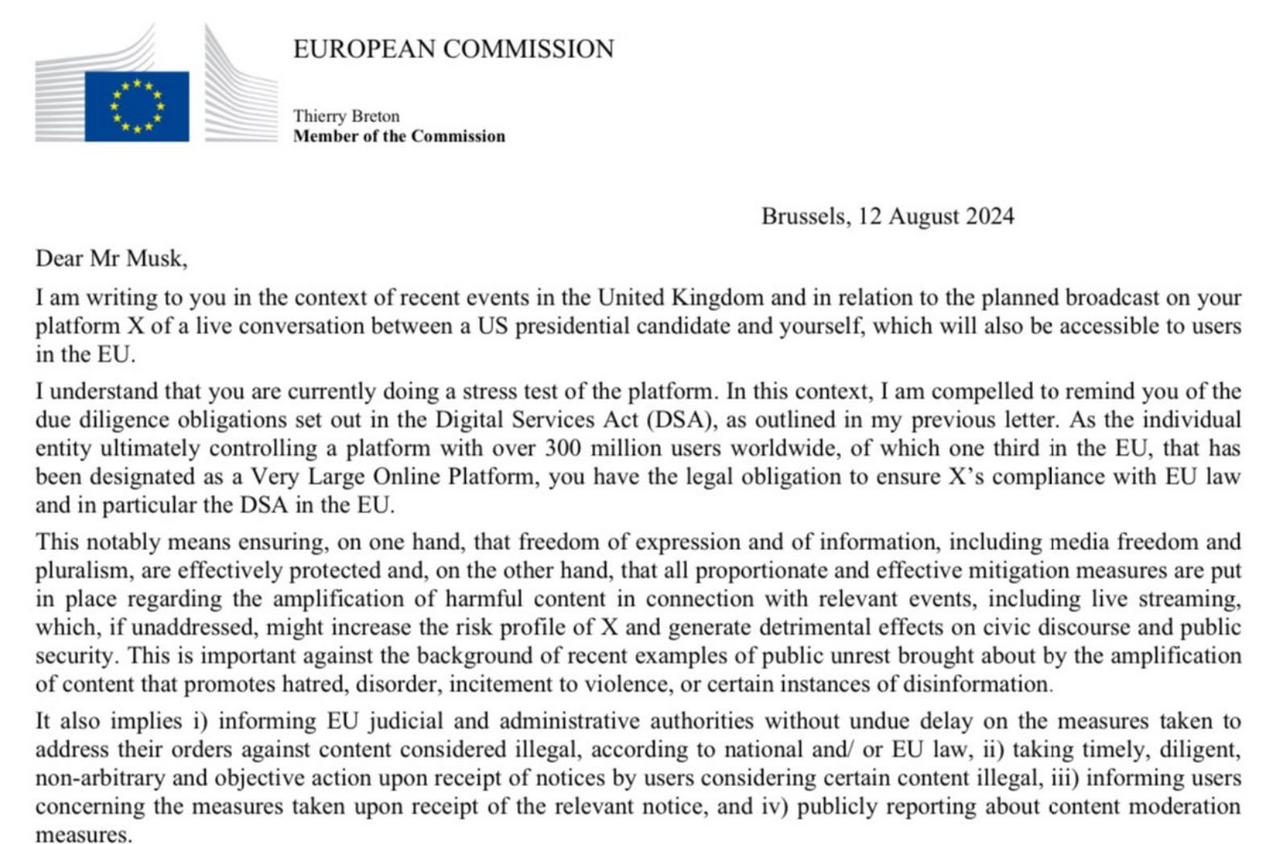
One of these dissatisfied users is Thierry Breton, the Macron-appointed Commissioner for the Internal Market of the European Union. As everybody knows, on 12 August, Breton posted a letter to Musk ahead of Musk’s Twitter discussion with Donald Trump, to remind the American entrepreneur of his obligations to censor content. Breton has long been a thorn in the side of his EU colleagues, who regard him as a shallow self-promoter, and his game rapidly backfired. The next day, the EU Commission clarified that “The timing and the wording of the letter were neither co-ordinated nor agreed with the president nor with the [commissioners].” The American House Judiciary Committee then added to Breton’s humiliation by condemning his “threats” and his “attempt to intimidate individuals or entities engaged in political speech in the United States”. Musk also had some choice words for the EU Commissioner:

The Macronistes don’t care that they are wildly unpopular and that everybody hates them. They just don’t want to hear about it. They could simply delete their Twitter accounts, but people would still be saying mean things about them on the internet somewhere. They’d have to lie awake in bed at night, staring at the ceiling and stewing about it. Better by far would be to delete Twitter itself, or at least to block access to the platform across all 27 EU member states.

August 22, 2024

“Say my pronouns, peasant!”

Filed under: Britain, Cancon, Media, Politics, USA — Tags: , , , , — Nicholas @ 03:00

Andrew Doyle doubts that the push for bespoke personal pronouns will have any lasting impact on the language and how it is used despite all the political capital invested to coerce people to adopt them:

For all the demands of activists that “they” and “them” should be normalised as singular pronouns, very few members of the public have adapted their speech patterns accordingly. Even when the print media started following this odd new craze after Sam Smith declared himself to be “non-binary” in September 2019, the trend simply didn’t catch on.

This is hardly surprising. For one thing, most of the articles that adhere to this creed end up being both syntactically and stylistically incoherent. Take the following excerpt from a review of Judith Butler’s latest book in The Atlantic:

    In essence, Butler accuses gender-crits of “phantasmatic” anxieties. They dismiss, with that invocation of a “phantasm”, apprehension about the presence of trans women in women’s single-sex spaces…

At first glance, “they” could appear to be referring to the “gender-crits”, but in this case it refers to Butler. A reader unfamiliar with the subject will inevitably find this confusing. Throughout the article, one is forced to reset one’s reading instincts – cultivated through a lifetime of universally-shared linguistic conventions – and even though the meaning eventually becomes clear, the prose is irredeemably maladroit. In other words, those who accept these new rules must first surrender their capacity to write well.

Of course, we all know that “they” is commonly used in the singular sense in cases of unknown identity. So we might say “Someone has left their car keys here” because we cannot be sure of the sex of the stranger in question. This causes no confusion at all because the sentence automatically conveys the uncertainty. Such colloquial exceptions aside, “they” is simply not used as a singular pronoun among the general population.

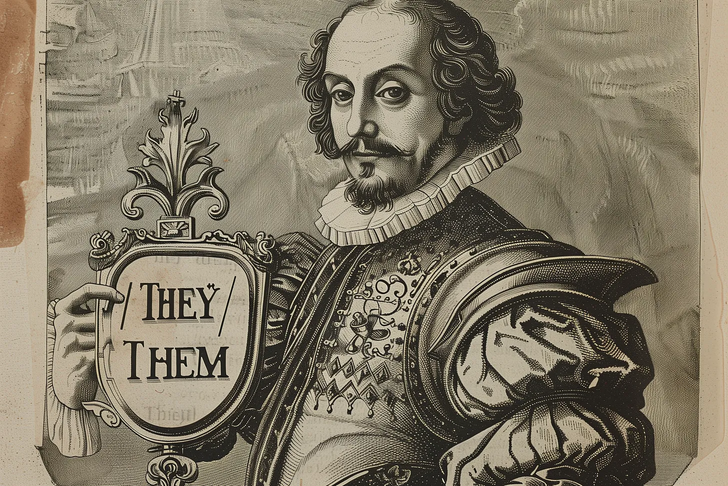
While identitarian activists love to dismiss Shakespeare as an irrelevant dead white male, they are happy to invoke him to support their attempts to impose their own modifications to the English language. In almost all articles on the singular “they”, one will find a reference somewhere to Shakespeare. “For decades, transgender rights advocates have noted that literary giants Emily Dickinson, William Shakespeare, William Wordsworth, and Geoffrey Chaucer all used singular they in their writing”, states one writer. “Shakespeare used the singular they, and so should you”, claims another. In the Washington Post, a professor of English writes that “Shakespeare and Austen both used singular “they” … just as many English speakers do now”.

It’s difficult to see how this argument is in any way compelling. Nobody is claiming that language does not evolve. The point is rather that the singular “they” has not caught on in modern usage, in spite of activists’ demands that it should. Are gender identity ideologues really urging us to adopt sixteenth-century language in the name of progress? I have yet to see any of them favouring “thou” as a familiar form of address. They tend to prefer “y’all”, and if this was ever used by Shakespeare I must have missed it.

August 21, 2024

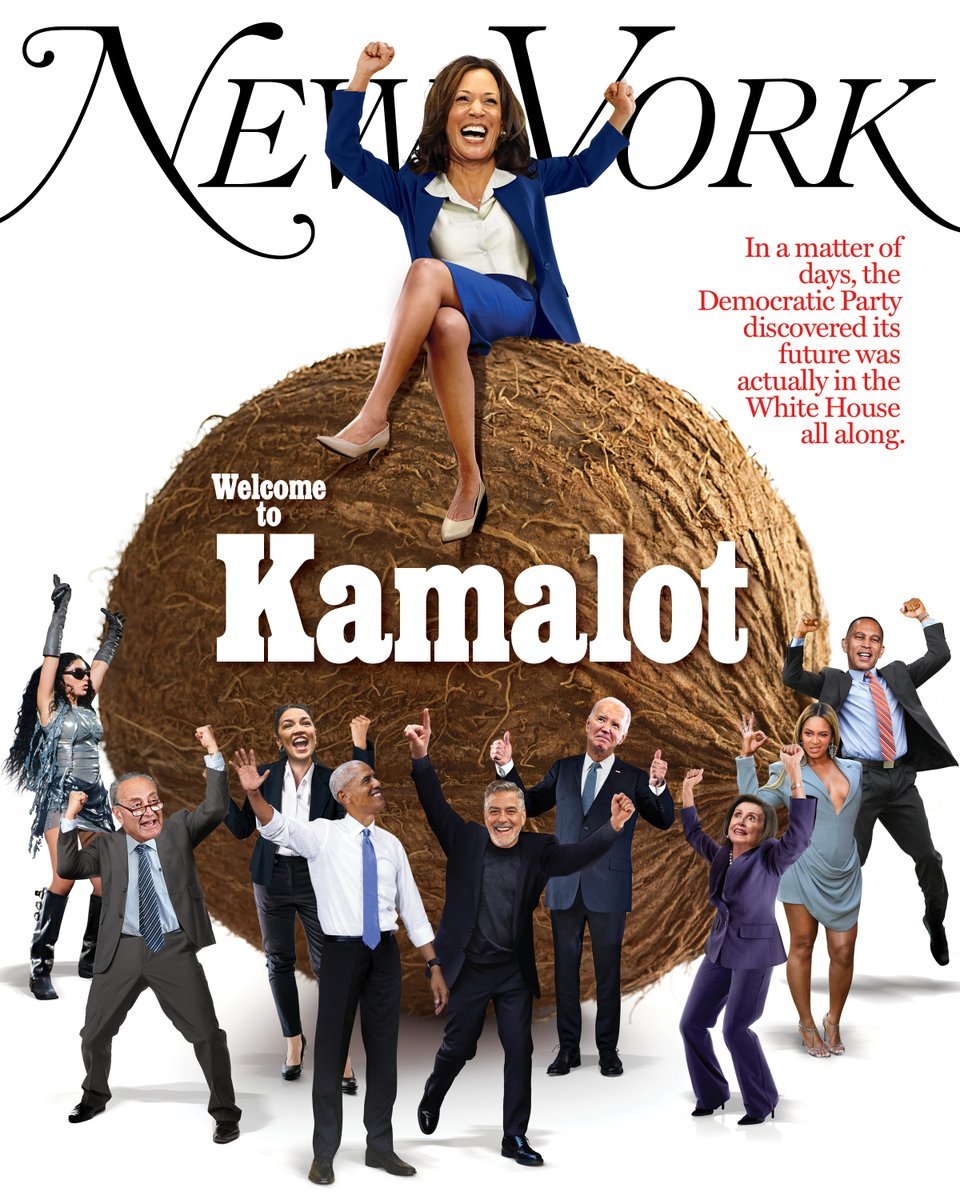
The pro-Kamala coup

Filed under: Media, Politics, USA — Tags: , , , , , , , , — Nicholas @ 05:00

At UnHerd, Edward Luttwak walks through the steps behind the scenes that led to Kamala Harris becoming the Democratic Party’s Presidential candidate for the 2024 election:

We are stuck with the French phrase coup d’état because nothing else describes so well the sudden removal of an old ruler by secret manoeuvrings — and their replacement with a chosen successor who happens to be endowed with every possible virtue. Of course, Kamala Harris is not a dictator because she must still face a nationwide election. But secret manoeuvrings did make her the presidential candidate of her Democratic Party, a position that is also intended to be filled by primary elections up and down the country before delegates agree on the victor at the Party Convention.

Nor was her vice-presidency enough to secure her candidacy. Far from it, given the unpromising electoral record of that most peculiar office, not inaccurately described as “not worth a bucket of warm spit” by John Nance Garner, Franklin D. Roosevelt’s vice president. In fact, in all of American history, only seven vice presidents were elected to the presidency (eight replaced a dead president). This reflects the habitual role of vice presidents: emphatically not presidents-in-waiting but rather politicos serving as symbolic figures who are selected to attract voters that the president cannot attract with his policies.

[…]

What happened next could not possibly have occurred if there were not a single directing hand behind the scenes. Suddenly, the very same voices from Nancy Pelosi down, who had just told the American people that Biden was fit and ready to win in the upcoming elections and rule for four more years, said the very opposite: that Biden should immediately announce his withdrawal from the elections. Nor is it any mystery who pulled the switch: Barack Obama, the only American President of recent times who has continued to live in Washington DC after leaving the White House — and it is not for the Potomac river-fishing that he has stayed there.

[…]

Obama had definitely not wanted Harris in that position, fearing that she would come under attack for her San Francisco career launched by an older mayor who was also her romantic partner. After Biden had locked himself into his vice-presidential choice of a black woman, Obama proposed his former National Security Advisor, Susan Rice. But even the faithful Biden could not accept that: in his own eight vice-presidential years, Biden often tried to influence foreign policy only to be overruled by Obama’s appointees, who knew very much less than he did after his decades of attentive service on the Senate Foreign Relations Committee. And none was more arrogant with him than Rice. And so, even faithful Biden would not accept her, which meant that Obama could ensure Biden’s withdrawal, but not his replacement with his own candidate.

So, what is the party left with? Because Kamala Harris did not win even one primary, and her vice-presidential role was more unremarkable than most, it is possible, just possible, that this week’s gathering will not unfold as a Chinese Communist Party Congress, and one or more delegates will call for a choice. And because there are in fact candidates ready and waiting among the Democratic governors, eight of them women, an open convention need not devolve into chaos or coup — but rather into a democratic election.

August 20, 2024

German magazine Der Spiegel warns about “The Secret Hitlers” of the far right who threaten western civilization

Filed under: Gaming, Germany, Media, Politics — Tags: , , , , — Nicholas @ 03:00

The spectre of Hitlerian fascism looms over the western world once again, but Der Spiegel won’t take this threat lying down:

“How Fascism Begins”: The present cover of Der Spiegel, depicting Björn Höcke, Marine le Pen and Donald Trump as the new fascists. Establishment German hysteria about “the right” is now achieving an intensity to rival American hysteria about race during the Summer of Floyd.

Hitler is not like other mortals; he may not really be dead, and his spirit is likely to return at any moment. Perhaps it already has. This is why our foremost news magazine, Der Spiegel, chose this image to head their cover story on “The Secret Hitlers“, a bizarre opus of current-year political lunacy penned by Lothar Gorris and Tobias Rapp.

“Is fascism returning?” Gorris and Rapp want to know. “Or is it already here, in the form of [Donald] Trump, [Viktor] Orbán [or Björn] Höcke? And if so, could it disappear again?” What follows, they explain, is “an attempt to identify evil”.

This is the kind of insanity that comes over you when you elevate establishment political ideology into a civic religion. You reduce the entire project of state politics to a dubious exercise in piety, where the aim is not to achieve good outcomes or develop pragmatic solutions, but to engage in moral peacockery. For the Gorrises and the Rapps of our discourse, the greatest problem facing the liberal faithful of the Federal Republic is not mass migration, deindustrialisation, soon-to-be-insolvent pension programmes or the overblown state entitlement system, oh no. It is finding and rooting out mythological political demons and preventing the second coming of the secular antichrist.

Gorris and Rapp (for convenience, I will refer to these feeble-minded men henceforth as Grapp) open with an extended anecdote about a 2016 board game called Secret Hitler.

    The setting is the year 1932, the Reichstag in Berlin. The players are divided into two groups: Fascists and Democrats, with the Democrats making up the majority, which sounds familiar. The Fascists have a decisive advantage at the start: they know who the other Fascists are, which also reflects the truth in the history books. The Democrats don’t have this information; every other player could be friend or foe. The fascists win the game if they get six laws through the Reichstag or if Hitler is elected Chancellor. To win, the Democrats must pass five laws or expose and kill Hitler.

    The basic premise of the game is that everyone pretends to be democrats. In truth, the real democrats would only have to trust each other and the fascists wouldn’t stand a chance. But it’s not that simple, because sometimes the democrats have to vote in favour of a fascist law for lack of options and therefore fall under suspicion of fascism. Which is exactly what the fascists want.

    One realisation: there is no guarantee of the right strategy that will ultimately see the good guys win and the bad guys lose. One wrong decision that feels right, and Hitler is Reich Chancellor. It was all chance, just as there was no inevitability in 1933. The other realisation: it can be fun to be a fascist.

The cryptofascist myth will never cease to amaze me. Absolutely everybody in 1933 knew who “the fascists” were. The ones in Italy literally called themselves fascists, which was one way to identify them. The ones in Germany openly derided liberalism and dreamed of a nationalist revolution that would put an end to the hated bourgeois democracy of the Weimar Republic. Hitler was a national politician who wrote and spoke openly of his aims. Secret Hitler in no way “reflects the truth in the history books”. It is a deformed fantasy about modern politics, which reflects nothing so much as the burning demand for and the vanishing supply of actual Nazis to hyperventilate about.

Now it is true that a lot of erstwhile liberals went over to National Socialism after the Nazis seized power, but these were not the secret fascists of Grappian fever dreams. The were just followers, as are a great many of the self-professed liberals active today. Were communists or illiberal nationalists to take over tomorrow, millions of people would line up behind the new political ideology like the sheep that they are, and I suspect that Grapp would be right at the head of that line.

Because our crack fascist identifiers suffer from a crushing lack of self-awareness, they declare that “relapsing into fascism is the primal fear of modern democratic societies”. Such a relapse, they explain, “long sounded hysterical and unimaginable”, but “now it seems serious and real”.

August 18, 2024

A view of the near future – “What if calling someone stupid was illegal?”

Filed under: Americas, Books, Britain, Media — Tags: , , , , , — Nicholas @ 03:00

Christopher Gage suspects that Lionel Shriver’s new book Mania didn’t require a lot of deep thinking about possible future trends, just a few glances at the headlines in British newspapers would provide all the inspiration necessary:

Lionel Shriver’s novel, Mania, asks “What if calling someone stupid was illegal?”

Set in an alternate timeline eerily flirtatious with our own, Mania depicts a world in which intelligence and competence, those oppressive agents of the modern bête noire — contrast — provoke outraged mobs.

The Mental Parity Movement demands a Khmer-Rouge-style Year Zero. To suggest the existence of differing abilities and competencies is to be “brain-vain”. In this final “great civil rights fight”, stupidity is euphemised as “alternative processing”. The mob cancels Frasier for brain vanity. After regulations prevent Pfizer from hiring qualified scientists, a toxic vaccine lays waste to millions.

The protagonist, a free-thinking academic named Pearson, cancels herself after she adds Dostoevsky’s The Idiot to her class syllabus. But the book is not the offending item. The word “idiot” is illegal. So too, is the “D-Word”. Pearson falls foul of social services after calling her seven-year-old daughter “dumb”. Her daughter grasses her up for this most heinous offence. For her crimes, Pearson endures a mandatory course entitled “Cerebral Acceptance and Semantic Sensitivity”.

Akin to our culture, mass neurosis devours that of Mania. The citizens scour the earth for evidence of the gravest offence: cognitive bigotry.

The Mental Parity Movement even renames “sage” — stripping the haughty herb of its sapiosexual swagger.

Mania imagines a world in which mediocrity is brilliance and where platitude is profundity. I suspect Shriver wasted little time on research. Turning on one’s television furnishes a commonplace book with a bottomless wealth of material.


This week, Harry and Meghan embarked on an unroyal tour of Colombia. On the agenda was a summit on misinformation and online harm. At this “responsible digital future” fandango, the former soap actress and the former royal spermatozoa relayed their fears. Essentially, hordes of toothless oiks with Wi-Fi often say nasty things online.

On stage, Harry adopted the pose of the modern soothsayer. His tieless open collar oozed Sicilian ease.

Speaking in Adverb English, Harry avoided anything as threatening or as harmful as a declarative sentence. Harry talks as if everything is a question as not to arouse predators. The Prince droned on, auditioning the Californication of his mother tongue. The same mother tongue Harry’s ancestors spread around the globe via what some may deign to be less than inclusive methods.

How can I put this in Mania-approved euphemism? Harry is minimally exceptional. Harry is to intelligent thought what lead pipes are to potable water.

« Newer Posts — Older Posts »

Powered by WordPress