
Quotulatiousness

December 18, 2011

Tyler Cowen on “aesthetic stagnation”

Filed under: Liberty, Media, Technology — Tags: , , , — Nicholas @ 11:34

Responding to an article in Vanity Fair by Kurt Andersen, Cowen lists a few things that must be taken into consideration:

1. Movies: The Hollywood product has regressed, though one can cite advances in 3-D and CGI as innovations in the medium if not always the aesthetics. The foreign product is robust in quality, though European films are not nearly as innovative as during the 1960s and 70s. Still, I don’t see a slowdown in global cinema as a whole.

2. TV: We just finished a major upswing in quality for the best shows, though I fear it is over, as no-episode-stands-alone series no longer seem to be supported by the economics.

3. Books/fiction: It’s wrong to call graphic novels “new,” but they have seen lots of innovation. If we look at writing more broadly, the internet has led to plenty of innovation, including of course blogs. The traditional novel is doing well in terms of quality even if this is not a high innovation era comparable to say the 1920s (Mann, Kafka, Proust, others).

4. Computer and video games: This major area of innovation is usually completely overlooked by such discussions.

He also includes something which — at least for me — counts as a “killer app” for this kind of discussion:

7. Your personal stream: This is arguably the biggest innovation in recent times, and it is almost completely overlooked. It’s about how you use modern information technology to create your own running blend of sources, influences, distractions, and diversions, usually taken from a blend of the genres and fields mentioned above. It’s really fun and most of us find it extremely compelling

That “personal stream” is so pervasive that we generally don’t notice that it’s a hallmark of the modern era. We don’t get our news from single sources anymore: not just a single local newspaper, or a single TV newscast. We can easily find like-minded communities for just about all our niche interests with relatively minimal effort. In the past, such communities were severely distance-challenged to even form, never mind to thrive.

That we now can easily control and direct our personal streams to include and exclude in such fine gradations is something that few could even imagine 20 years ago. In a sense, we all have “clipping services” providing us with interesting and relevant snippets, but we can literally have hundreds of such services — at little or no cost — to chase down our merest whims for fresh information. It doesn’t show up on the GNP as a gain, but it’s very much a differentiator between today and just a few years back. Yet we don’t notice because we’re immersed in it.

December 17, 2011

We are “at the mercy of underachieving Congressional know-nothings that have more in common with the slacker students sitting in the back of math class than elected representatives”

Filed under: Government, Law, Liberty, Media, Technology — Tags: , , , , — Nicholas @ 10:52

A great post on the folks who are currently debating — if so many declarations of ignorance can be called “debating” — hacking away at the very basis of the internet we’ve come to love:

Some background: Since its introduction, SOPA and its Senate twin PROTECT-IP have been staunchly condemned by countless engineers, technologists and lawyers intimately familiar with the inner functioning of the internet. Completely beside the fact that these bills as they currently stand would stifle free speech and potentially cripple legitimate businesses by giving corporations extrajudicial censorial powers, they have found an even more insidious threat: The method of DNS filtering proposed to block supposed infringing sites opens up enormous security holes that threaten the stability of the internet itself.

The only problem: Key members of the House Judiciary Committee still don’t understand how the internet works, and worse yet, it’s not clear whether they even want to.

It’s of course perfectly standard for members of Congress to not be exceptionally proficient in technological matters. But for some committee members, the issue did not stop at mere ignorance. Rather, it seemed there was in many cases an outright refusal to understand what is undoubtedly a complex issue dealing with highly-sensitive technologies.

When the security issue was brought up, Rep. Mel Watt of North Carolina seemed particularly comfortable about his own lack of understanding. Grinningly admitting “I’m not a nerd” before the committee, he nevertheless went on to dismiss without facts or justification the very evidence he didn’t understand and then downplay the need for a panel of experts. Rep. Maxine Waters of California followed up by saying that any discussion of security concerns is “wasting time” and that the bill should move forward without question, busted internets be damned.

Why is everyone upset about SOPA but not about all the other power grabs by the government?

Filed under: Government, Law, Liberty, Media, Technology — Tags: , , , — Nicholas @ 10:24

ESR wonders why SOPA seems to finally have woken up many people about their rapidly eroding liberties, but not all the other things the federal government has done:

A government that is big enough to give you everything you want is big enough to take everything away from you — including your Internet freedom.

That’s the thought that keeps running through my head as I contemplate the full-scale panic going on right now about SOPA, the “Stop Internet Piracy Act”.

It’s a bad bill, all right. It’s a terrible bill — awful from start to finish, idiotic to the core, corruptly pandering to a powerful special-interest group at the cost of everyone else’s liberty.

But I can’t help noticing that a lot of the righteous panic about it is being ginned up by people who were cheerfully on board for the last seventeen or so government power grabs — cap and trade, campaign finance “reform”, the incandescent lightbulb ban, Obamacare, you name it — and I have to wonder…

Don’t these people ever learn? Anything? Do they even listen to themselves?

December 16, 2011

Lorne Gunter on the Kyoto cult: “Ottawa is right to get out of it while it could.”

Filed under: Cancon, Environment, Liberty, Media — Tags: , , , , — Nicholas @ 09:44

Much has been made — at least in the British press — about Canada announcing it will withdraw from the Kyoto agreement. Lorne Gunter agrees with the government that it was high time to leave:

It has been written in several places that should Canada fail to bring its emissions down drastically in the coming year, it could be subject to up to $19-billion in fines imposed by Ms. Figueres and the UNFCCC. How? The fines would be in the form of “carbon credits” — we would pay developing countries that aren’t current producing many emissions for their unused carbon. In other words, we could buy the equivalent of medieval indulgences to cover off our carbon sins. No emissions would be reduced, but the UN would be placated by this accounting device.

But what if we refuse to buy credits? In logic that would only ever make sense to UN bureaucrats, the UNFCCC then has the authority to penalize us by making us buy 30% more credits. That’s right, if we refuse to pay $19-billion in environmental baksheesh to cover off our extra emissions, the UN somehow thinks it will be able to convince us to pay $25-billion as a punishment.

Seriously, these people believe this stuff makes sense.

One of the reasons UN bureaucrats have begun using language such as “legal obligation” is that they are hoping to convince national supreme courts to enforce international treaties for them. At the Durban climate summit recently concluded in South Africa, delegates agreed to form an International Climate Court of Justice, partly in hopes that rulings from such a body would be enforced by domestic courts, even against countries, such as Canada, that withdraw from climate treaties.

The UN environmental cult becomes more dangerous to national sovereignty and personal freedom every day. Ottawa is right to get out of it while it could.

December 15, 2011

Gary Johnson’s GOP Catch-22 forces him out of the race

Filed under: Liberty, Media, Politics, USA — Tags: , , , , , — Nicholas @ 15:33

The difficulty of running for the GOP nomination is made that much harder if you don’t already have a lot of name recognition. Being the successful governor of a small state isn’t enough to get your name known, and the GOP’s party officials have concocted a lovely Catch-22 to prevent unknowns from breaking into the race: you can only be in the debates if you’re doing well in the polls, and you can only be in the polls if we decide you should be.

As a result of being frozen out of the race, Governor Gary Johnson is leaving the GOP and will seek the Libertarian Party’s nomination instead:

Republican presidential candidate Gary Johnson has been “hung out to dry” by the GOP establishment and that is the reason he is likely to leave the party and run for the presidency as a libertarian, he says.

The former New Mexico governor tells Newsmax.TV he has faced a Catch-22 situation because his name has not appeared in the opinion polls that decide whether he has enough support to get him a place in the party’s debates, which means he has not been able to gain the exposure that could have lifted him in the polls.

[. . .]

Johnson, who describes himself as fiscally conservative but socially liberal, is due in New York on Thursday and he is expected to announce formally that he is joining the Libertarian Party.

He has never managed to gain traction in the run-up to the Republican primary season. He says time is running out because of “sore loser laws” in some states that say a candidate cannot run in primaries and then stand on a different ticket in the general election.

December 14, 2011

Revolt in a Chinese fishing village

Filed under: China, Government, Media — Tags: , , , — Nicholas @ 13:08

Local unrest is hardly uncommon in China, but unrest of this nature is almost unheard of:

For the first time on record, the Chinese Communist party has lost all control, with the population of 20,000 in this southern fishing village now in open revolt.

The last of Wukan’s dozen party officials fled on Monday after thousands of people blocked armed police from retaking the village, standing firm against tear gas and water cannons.

Since then, the police have retreated to a roadblock, some three miles away, in order to prevent food and water from entering, and villagers from leaving. Wukan’s fishing fleet, its main source of income, has also been stopped from leaving harbour.

The plan appears to be to lay siege to Wukan and choke a rebellion which began three months ago when an angry mob, incensed at having the village’s land sold off, rampaged through the streets and overturned cars.

Of course, one of the reasons we rarely hear about protests of this nature is that the Chinese government actively suppresses media coverage. This is only coming to our attention because western journalists are there and able to communicate with their employers.

H/T to Jon, my former virtual landlord, who commented “You have to admire these 20,000 future organ donors for their intestinal fortitude”.

Eurosceptics described as “bunch of insular snobs who seem to have a hard time restraining their inner fascist”

Filed under: Britain, Europe, Media, Politics — Tags: , , , , — Nicholas @ 09:06

Frank Furedi exposes the real reasons behind the chattering classes’ abuse of David Cameron:

It is one thing to accuse Cameron of committing a diplomatic faux pas or the Foreign Office of ineptitude. But the criticisms currently being made of Cameron verge on the hysterical. When I listen to the hyperbole about what will apparently be the consequences of his destructive behaviour, it almost sounds as if he has committed an act of political betrayal in order to appease a handful of incorrigible reactionary Eurosceptics.

Why this over-the-top reaction to what could turn out to be a relatively minor case of diplomatic miscommunication?

Outwardly, the anger of the cosmopolitan clerisy is directed at Cameron’s alleged appeasement of Tory Eurosceptics. The term Eurosceptic has a special meaning for the adherents to cosmopolitan policymaking. In their view, Euroscepticism is associated with values they abhor: upholding national sovereignty, Britishness and a traditional way of life. The moralistic devaluation of these values was vividly communicated by the New York Times columnist Roger Cohen, who this week characterised Tory Eurosceptics as the ‘pinstriped effluence of an ex-imperial nation’. He seeks to dehumanise these people by arguing that this ‘specimen’s ascendancy’ was reflected in Cameron’s behaviour during the treaty negotiations. Cohen’s moral devaluation of Eurosceptics, his dismissal of them from the ranks of humanity, is captured in his description of them as a ‘bunch of insular snobs who seem to have a hard time restraining their inner fascist’.

The intemperate language suggests that the venomous anger directed at Eurosceptics cannot simply be driven by the clerisy’s love affair with the European ideal. Rather, what is at issue here is the clerisy’s preference for the technocracy-dominated and cosmopolitan-influenced institutions of Brussels. From their standpoint, the main virtue of the EU is that its leaders and administrators speak the same language as the UK clerisy. They read from the same emotional and cultural script, which they believe to be superior to the script and values associated with national sovereignty. That is why it isn’t surprising that a BBC journalist can casually ask the Estonian prime minister to have a go at her own national leader. The UK-based communications clerisy has a greater affinity with the outlook of EU technocrats and political administrators than it does with the outlook of its own people.

December 13, 2011

Gary Johnson has been “hung out to dry” by the RNC

Filed under: Liberty, Media, Politics, USA — Tags: , , , , — Nicholas @ 12:02

A profile of Gary Johnson in the St. Petersburg Times:

The wildly popular former two-term governor of New Mexico, who lost part of his toe to frostbite climbing Mount Everest on a broken leg, has been excluded from 15 of 17 presidential debates.

The 58 year old who was elected governor in a state where Democrats outnumber Republicans 2 to 1 has virtually disappeared from major political polling. The governor who got rid of 1,200 state employees, vetoed 750 bills and left New Mexico with a billion-dollar budget surplus is not Republican enough for the GOP.

“They won’t return my calls,” he said.

That’s why he thinks you’ve probably never heard of Gary Johnson. Even if he grew a handyman business in Albuquerque from scratch to 1,000 employees. Even if he has ridden his bike across mountain ranges. Even if some see him as an electable version of Ron Paul.

“The Republican National Committee has turned their backs on a message that appeals more and more to the American public,” he said.

That message?

Less government is the best government. He wants to cut federal spending by 43 percent. He advocates throwing out the entire U.S. tax system in favor of a 23-percent fair tax on consumption that he says would create thousands of jobs overnight. He wants to abolish the Department of Education and the IRS, and he promises to submit a balanced budget in 2013.

Maybe those are ideas many Republicans can swallow. But his stance on social issues, Johnson knows, rub many the wrong way.

He thinks building a fence between the United States and Mexico is an awful idea; better to have a smooth and easy work-visa program. He supports gay marriage. He is fully in favor of a woman’s right to choose. He wants to legalize marijuana (and yes, he has smoked pot for pleasure and for medical purposes, but quit several years ago) and decriminalize drug use.

December 12, 2011

Next up for the weekly “This week in Guild Wars 2” posting

Filed under: Administrivia, Gaming, Media — Tags: , — Nicholas @ 14:37

I’ve been posting a once-a-week Guild Wars/Guild Wars 2 summary for most of this year, but this week’s entry will probably be a bit different: I’ve been invited to take over the regular “Community Roundup” column at GuildMag. This will be a super-set of the information I normally provide in the “This week in Guild Wars 2” posting. I don’t know if I’ll still post a shorter version here or if I’ll just link to the new column at GuildMag (it’ll probably depend on how much extra work will be required to post in multiple places).
December 10, 2011

“It was not, all in all, Canada’s finest hour. Perhaps that’s why we still don’t talk about it much.”

Filed under: Books, Cancon, History, Media — Tags: , , , , , — Nicholas @ 12:48

Robert Fulford on the event in Ottawa that started the Cold War:

For just one moment in history, Canada found itself at the dangerous centre of global politics. That was in 1945, when Igor Gouzenko left the Russian embassy in Ottawa with documents proving the Soviet Union was spying on Canada with the help of Canadian communists.

Gouzenko’s revelations were the opening shot in the Cold War. A new book, Stalin’s Man in Canada: Fred Rose and Soviet Espionage by David Levy, takes a rambling, anecdotal approach to a major figure in the story, the only Canadian member of Parliament ever convicted of conducting espionage for a foreign state.

Official Ottawa reacted badly to the news that there were spies in its midst. The government arrested the suspects and locked them up for weeks, without access to lawyers or families. They were paraded before a secret royal commission and persuaded to incriminate themselves. Gouzenko was given a new identity to protect him from Soviet assassins but the Mounties leaked nasty stories about him. For decades journalists treated him as a money-grubbing clown rather than the hero that he was.

Today the case remains largely unexplored and poorly remembered. Among those involved, only Gouzenko described his experience in a book, This Was My Choice, a rather thin and hasty account. Twentieth Century Fox produced a forgettable adaptation, The Iron Curtain, with Dana Andrews as Gouzenko.

Nick Gillespie: Five myths about Ron Paul

Filed under: Liberty, Media, Politics, USA — Tags: , , , — Nicholas @ 12:20

Nick Gillespie in yesterday’s Washington Post:

Ron Paul is the Rodney Dangerfield of Republican presidential candidates. The 12-term Texas congressman ran for president on the Libertarian Party ticket back in 1988 and was widely seen as a sideshow in 2008, despite finishing third in the GOP field behind John McCain and Mike Huckabee. Why, despite a small but devoted set of supporters, does this 76-year-old obstetrician turned politician routinely get no respect from the media and GOP operatives? Let’s take a look at what “Dr. No” — a nickname grounded in his medical career and his penchant for voting against any bill increasing the size of government — really stands for.

1. Ron Paul is not a “top-tier” candidate.

At some point in the race for the 2012 Republican presidential nomination, the mainstream media became more obsessed than usual with designating GOP hopefuls as “top-tier” candidates, meaning “people we want to talk about because we find them interesting or funny or scary.” Or more plainly: “anybody but Ron Paul.”

Former Massachusetts governor Mitt Romney has been accorded top-tier status from the start, but otherwise it’s been a rogues’ gallery. As their numbers soared, Texas Gov. Rick Perry and pizza magnate Herman Cain enjoyed stints in the top tier, and former House speaker Newt Gingrich is now ensconced in that blessed circle.

Back in August, Rep. Michele Bachmann (Minn.) was designated “top tier” after winning Iowa’s Ames Straw Poll.Paul was not, despite losing to her by only about 150 votes. And when Paul won the presidential straw poll of about 2,000 attendees at the Family Research Council’s Values Voter Summit in Washington in October, the contest’s organizer pronounced him “an outlier in this poll.”

“Green is the easiest virtue”

Filed under: Cancon, Environment, Government, Media, Politics — Tags: , , , — Nicholas @ 12:00

Rex Murphy looks at how what he calls Dalton McGuinty’s “reasonably competent government” could fall for the snake oil salesmen of every shabby Green initiative going:

The Ontario government, and Premier McGuinty in particular, gave themselves over to this madness, becoming overzealous crusaders, because the cause was green. And, sadly, there seems to be no other area of public policy in which fitful enthusiasms, pie-in-the-sky thinking, under-researched proposals and the mere hint of possible benefit get so respectful a response and are shielded — almost as if by magic — from the criticisms and analysis that would greet proposals from any other policy area whatsoever. Call it green and every other consideration goes out the window. Start phantom carbon markets, subsidize a Solyndra, put gardens on roofs . . . green will rationalize every cost and subdue every sane objection.

For example: During the early day’s of McGuinty’s determination to “make Ontario a world leader in green technology,” it was interesting to watch him and his government studiously ignore the articulate criticisms and protests from some Ontario landowners. Now any other project inspiring such protests would naturally instigate the usual relentless series of environmental studies that have become so common in our time. But — windmills being “green initiatives” — naturally it was the reverse. The landowners who protested were pilloried as being the worst of the NIMBY crowd, just selfish types safeguarding their little nooks against the common green future.

Green is the easiest virtue. All it takes in most cases for politicians is simply to say the word often enough and whatever they propose — for a time — gets a pass. Who would question McGuinty against those “selfish” landowners. Wasn’t Dalton moving towards a greener world? Enough then. No studies required. No review of the windmills (until election time, that is, when suddenly Ontario voters were told, in effect, the science “wasn’t in” on what secondary effects windmills might have). Question the contracts for solar power? Impossible. Solar power is “clean.”

December 9, 2011

600 million “virtual war criminals” to be snagged in new virtual Geneva Convention

Filed under: Bureaucracy, Media, Technology — Tags: , , , , — Nicholas @ 09:10

Look out FPS gamers — the Red Cross has you in their sights:

Move aside, Milosevic. Out of the way, al-Bashir. It’s the world’s videogamers who should be hauled up on war crimes charges, some members of the Red Cross seem to think.

During the 31st International Conference of the Red Cross and Red Crescent, which took place in Geneva last week, attendees were asked to consider what response the organisations should make to the untold zillions of deaths that can be laid at the feet of videogamers.

[. . .]

There is “an audience of approximately 600 million gamers who may be virtually violating international humanitarian law (IHL),” it noted.

The key word there, folks, is ‘virtually’. Ruthlessly gunning down civilians, fellow combatants and/or extraterrestrial visitors may be a crime if you do it for real, but not if you merely imagine the action, even if helped by the realistic visuals of the likes of Battlefield 3 and Call of Duty: Modern Warfare 3.

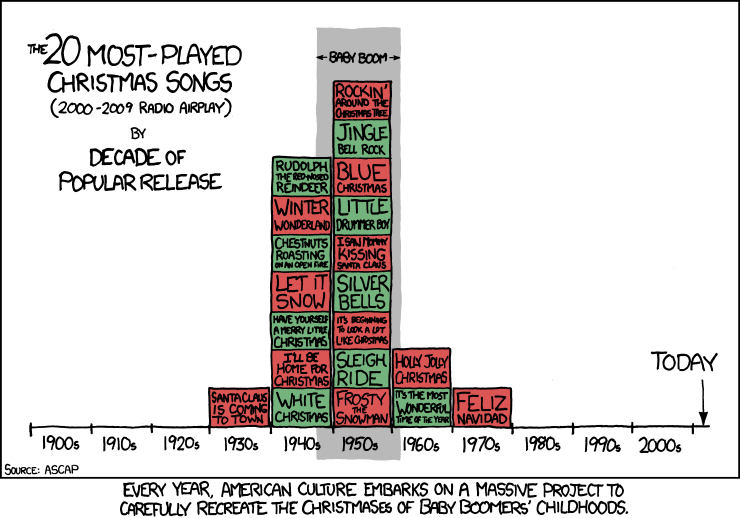
“An ‘American tradition’ is anything that happened to a baby boomer twice”

Filed under: Humour, Media, Randomness — Tags: , , — Nicholas @ 08:30

Hard to refute the latest xkcd take on Christmas music:

December 8, 2011

The Law of Misguided Subsidies

Filed under: Economics, Government, Media, Politics — Tags: , , , , , — Nicholas @ 09:44

T.J. Rogers explains the latest corollary to the well-known Law of Unintended Consequences (for examples of that law in operation, see your local, regional, or national government):

Wall Street understands how to make money, up-market or down. “Margin Call” may fuel Occupy movement ire, but in creating mortgage-backed securities, Wall Street did nothing other than facilitate home-financing access to the next tier of less-qualified home buyers, as demanded by every president since Bill Clinton. After that, the bankers did exactly what their shareholders wanted: bundle those risky loans into securities, sell them to lock in the profits, and dump the risk right back onto the federal government — where it belonged.

My purpose is not to debate the morality of mortgage-backed securities but to update the Law of Unintended Consequences with the corollary Law of Misguided Subsidies: Whenever Washington disrupts a market by dumping subsidies into it, Wall Street will find a way to pocket a majority of the money while the intended subsidy beneficiaries are harmed by the resulting market turmoil.

Rogers also explains why so many “special Limited Liability Corporations (LLCs)” are getting into the solar power business — not the manufacturing side, but the retail side. The profit margins are obscene. If the government hadn’t set up the market to work this way with their subsidies, the profit margins would be much lower.

« Newer PostsOlder Posts »

Powered by WordPress


