
Quotulatiousness

October 30, 2012

Detecting Photoshopped images – a primer

Filed under: Media, Technology — Tags: , , , — Nicholas @ 10:18

I’m sure almost everyone saw dramatic and scary images of “Hurricane Sandy” like this one that went round my friends’ Facebook timelines yesterday:

As you’ve probably guessed from the title, this is a ‘shopped image. RJS Security has a quick primer on detecting doctored images using this example:

Whenever a major media event happens (like Hurricane Sandy), we are inundated with news. Sometimes that news is useful, but often it merely exists to create FUD… Fear, Uncertainty and Doubt. While I have not personally seen any malware campaigns capitalizing on the event yet, it is inevitable. The pattern is generally as follows:

  1. Event hits the news as media outlets try to one-up eachother to get the word out.
  2. People spread the warnings, making them just a little bit worse each time they are copied.
  3. Other people create hoaxes to ride the wave of popularity.
  4. Still other people create custom hoaxes to exploit the disaster financially.

A few minutes ago, at least in my little corner of the internet, we hit stage 3 when this image was posted

H/T to Bruce Schneier for the link.
A source of obscure and unusual do-it-yourself books

Filed under: Books, History, Media, Technology — Tags: , — Nicholas @ 08:51

Michael Bradshaw‘s letter to the editor in the most recent Libertarian Enterprise alerted me to a possible source of interesting and unusual do-it-yourself books and pamphlets:

“The Lindsay” of Lindsay’s Books has announced his retirement “in 2013 or earlier” and the closing of his book store.

For many decades Mr. Lindsay has been the premier supplier of technical books to the do-it-yourself crowd, machine shop mavens, foundry sand-crabs, eccentrics, nut cases (like me) and geniuses at large (like “Uncle Dave” Gingery).

It ain’t all Uncle Dave.

He (Lindsay, not Dave) has titles from all over and back to the mid nineteenth century. He used to have De Re Metallica by Agricola in the Hoover English translation, but I don’t know if it is still cataloged. There are tech-school text books, how-to volumes from some of the best industrial arts guys around and collections of articles from technical manuals and magazines back to the early twentieth century. Get a 1940’s version of “How to Run a Lathe” by the South Bend Machine Tool Company.

His titles cover a plethora (really!) of stuff, such as:

  • Machine shop practices, building the major tools from scratch — from scrap (the Gingery series), building EDM machines and other shop tools and techniques.
  • Foundry tools and methods. Make your own molding shop and blast furnaces for the back yard. Fuel them with charcoal, propane or natural gas. Pour castings in aluminum, zinc and pot metal, copper alloys, iron alloys. Design and build centrifugal fans to power your crucible and cupola furnaces. Make your own crucibles. Dig ore for your cupola furnace, with a sharp stick, while wearing a leather breech-clout, a tie and a top hat! (OK, that last one was a joke. Lame.)
  • Sheet metal shop tools and methods. Make your own brake and slip-roll. Books of projects. Start a local sheet metal fabricating business.
  • Make electric generators, modify alternators, re-build or modify motors, make electro- and permanent magnets. Make radios from scratch. Emulate Nicola Tesla. Short circuit yourself and go up in a puff of smoke!
  • Learn about old-time chemistry. Set up a chem-lab. Screw up and dissolve, stain, burn, poison, blow-up and generally kill yourself in the most ingenious ways! Go up in another puff of (green) smoke!
  • Make wooden toys for kids. Make ship models for yourself.
  • Make steam, sterling, turbines and other kinds of engines. Build boilers from scratch and blow yourself (and the garage) up again! Build locomotives from scratch. Well, “maybe” on that last one.
  • Make wind and water turbines to power your generators or shop. Recycle waste oils.
  • Other stuff that I forgot to mention.

Basically, if you drop a bunch of money (including postage) on Lindsay, he will show you how to make a very complete industrial revolution. You may even have some fun. While killing yourself in the most ingenious ways. Count your fingers at the end of the day.

[. . .]

Get a catalog for $2 from Lindsay at lindsaybks.com Order some books. Do it NOW while you still can. The complete machine shop from scratch series is available in a package deal at a discount. There are some other package discounts. Check out the trauma center and links to other book dealers. Some are available on Amazon.com, but not many.

You can also buy Uncle Dave’s books (and his son Vince’s, too) direct, at the Gingery book store.

Note: I just received a note from Lindsay Books. Here is the pertinent part:

    “In the future, you may want to visit our new associate e-store:

    Your Old Time Bookstore
    youroldtimebookstore.com
    YOTB’s site offers all books printed by Lindsay and provides decline/error notification before processing…

    Thanks!
    Lindsay Publications, Inc.

    PO Box 538
    Bradley, IL 60915
    Fax: 815-935-5477″

See you in the shop.

October 29, 2012

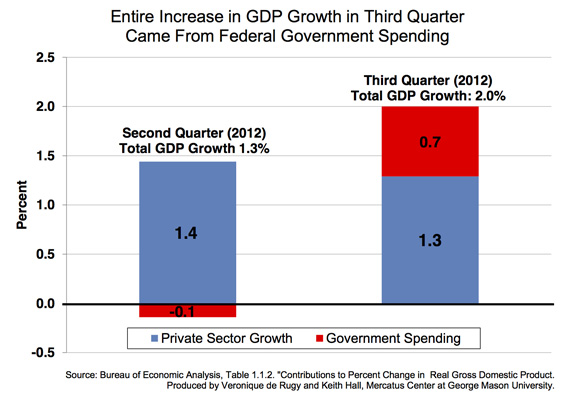
US 3rd quarter GDP number less substantial than it appears

Filed under: Economics, Media, USA — Tags: — Nicholas @ 11:17

A bit of a downer for what would otherwise be good economic news:

Chart from the Mercatus Center at George Mason University.

Polls are less accurate thanks to a 9% response rate (and falling)

Filed under: Media, Politics — Tags: , , , — Nicholas @ 10:41

Iowahawk has been posting a daily Twitter update reminding people that the reliability of political polls is much lower than ever before:

At Macleans, Colby Cosh digs a bit deeper to find out how polling organizations are responding to their approaching-flatline response rate:

The boffins are becoming increasingly reliant on “non-probability samples” like internet panel groups, which give only narrow pictures of biased subsets of the overall population. The good news is that they can take many such pictures and use modern computational techniques to combine them and make pretty decent population inferences. “Obama is at 90 per cent with black voters in Shelbyville; 54 per cent among auto workers; 48 per cent among California epileptics; 62 per cent with people whose surnames start with the letter Z…” Pile up enough subsets of this sort, combined with knowledge of their relative sizes and other characteristics, and you can build models which let you guess at the characteristics of the entire electorate (or, if you’re doing market research, the consumerate).

As a matter of truth in advertising, however, pollsters have concluded that they shouldn’t report the uncertainty of these guesses by using the traditional term “margin of error.” There is an extra layer of inference involved in the new techniques: they offer what one might call a “margin of error, given that the modelling assumptions are correct.” And there’s a philosophical problem, too. The new techniques are founded on what is called a “Bayesian” basis, meaning that sample data must be combined explicitly with a prior state of knowledge to derive both estimates of particular quantities and the uncertainty surrounding them.

[. . .]

Pollsters are trying very hard to appear as transparent and up-front about their methods as they were in the landline era. When it comes to communicating with journalists, who are by and large a gang of rampaging innumerates, I don’t really see much hope for this; polling firms may not want their methods to be some sort of mysterious “black box,” but the nuances of Bayesian multilevel modelling, even to fairly intense stat hobbyists, might as well be buried in about a mile of cognitive concrete. Our best hope is likely to be the advent of meta-analysts like (he said through tightly gritted teeth) Nate Silver, who are watching and evaluating polling agencies according to their past performance. That is, pretty much exactly as if they were “black boxes.” In the meantime, you will want to be on the lookout for that phrase “credibility interval.” As the American Association for Public Opinion Research says, it is, in effect, a “[news] consumer beware” reminder.

Twenty million broken windows

Filed under: Economics, Environment, Media — Tags: , , — Nicholas @ 09:03

At Forbes, Tim Worstall patiently explains that the damage from Hurricane Sandy (or any major storm) will appear to boost GDP, because it only measures money spent to repair damage, not the costs incurred or the opportunities foregone because of the damage:

We know very well that Hurricane (or Frankenstorm as some are calling it) Sandy will leave a trail of destruction across parts of the US today. There will almost certainly be deaths, as there have been in the hurricane’s passage across the Caribbean. And there will also be a boost to the US economy. Which is really evidence of quite how wrong we are in the way that we measure the economy.

[. . .]

The problem with this is that it is only true because of the way that we calculate GDP. In our working of the numbers we assume that it’s final consumption at market prices: that is, the value that consumers put on everything. However, this is not true of government spending. It’s very difficult indeed to work out what government spending is actually worth: for as we’ve not a choice in it then there’s no market price nor accurate valuation from the people who actually get whatever is produced. Some government spending is most certainly worth more than the actual amount spent. The court system say: a pre-requisite of our having a complex society at all. Other parts not so much: what is the true value of a diversity adviser for example? So what we actually do is value all government spending, for GDP purposes, at the cost of that actual spending. Government spends $100, GDP goes up by $100. That’s just how we define it. This can cause amusement in measuring the success of welfare programs for example. Even Census admits that some of the people who receive Medicaid, or food stamps, value what they receive at less than the cost of providing it.

[. . .]

Now imagine that Hurricane Sandy does $10 billion of damage to that wealth (for our purposes it doesn’t matter whether it’s $100 billion or $1 trillion. Although this obviously matters to everyone except for the purposes of this example). The US is now worth $99.990 Trillion. GDP might rise to $15.1 trillion as we repair that damage. But we’re not in fact any richer at all: despite the fact that GDP has gone up. What has actually happened is that some of our stock of wealth has been destroyed and we’re having to do more work in order to rebuild it. This is exactly the same as our pollution example. We’re measuring what we produce but not the capital stock of what we have (or had).

Yes, the rebound from Sandy may well provide a boost to the economy. But that’s a function of the way that we measure that economy, not a real boost in our general wealth.

October 28, 2012

Yup. Nastiest political rhetoric ever. Or not.

Filed under: History, Media, Politics, USA — Tags: , , — Nicholas @ 12:43

Malaysian group calls for “Films that carry confusing messages” to be banned

Filed under: Asia, Media, Religion — Tags: , , , , — Nicholas @ 11:52

A Bollywood film is at the centre of controversy in Malaysia:

An influential Muslim youth group said today that Bollywood superstar Shah Rukh Khan’s “My Name Is Khan” movie confuses Muslims as it promotes liberal Islam and religious pluralism, and warned Malaysian broadcasters not to air the hit film.

The Muslim youth group’s statement comes after the Malay right-wing group Perkasa’s call last week for Muslims nationwide to boycott award-winning singer Jaclyn Victor for singing the Malay-language Christian song “Harapan Bangsa”, which she has said is meant for Christians.

“Angkatan Belia Islam Malaysia (ABIM) strongly protests the screening of ‘My Name Is Khan’ on TV3 on the second Hari Raya Aidil Adha.

“Films that carry confusing messages clearly shouldn’t (tidak wajar) be screened by a main Malaysian television station,” the group’s vice-president Ahmad Saparudin Yusup said in a statement today.

He questioned the timing of the film screening, saying that it raises the question of where the “media’s care and responsibility in their broadcasting materials” went.

H/T to Blazing Cat Fur for the link.

The Two Scotts pick this week’s NFL matchups

Filed under: Football, Humour, Media — Tags: , , , — Nicholas @ 10:55

Scott Reid and Scott Feschuk get serious about something … but not football, of course:

New York Giants (plus 2) at Dallas

Scott Reid: I have no way of knowing but I like to imagine that deep down, Tony Romo and Eli Manning loathe one another.

Romo’s hatred would be all bound up in his feelings of insecurity and gross inadequacy (not unlike your own feelings toward me, Mr. Feschuk). Manning probably just hates the dimples. My fondest hope is that deep in the fourth quarter of this week’s matchup – after the Giants gain a 10-point lead – Romo breaks down on television and begins to sob uncontrollably, confronted with the awful truth that he’ll never best his rival. Manning, meanwhile, will make Jessica Simpson jokes and snicker about the hands-off approach of John Mara. Eventually Romo cracks completely and beats Manning savagely with a Gatorade bottle – leaving Eli dead and himself condemned to a life behind bars. In no way would this scenario make Mike Vick the best starting quarterback in the NFC East. Pick: New York.

Scott Feschuk: That’s all very interesting but I have a more important question: What man would ever agree to date Taylor Swift? You’d have to know right from the get-go that everything that happens is basically fodder for her next three albums, right? Wouldn’t it get awkward pretty quick?

You and Taylor Swift are in bed.

You: That was amazing. Let’s do it again.

[Swift opens her journal and starts writing.]

You: What are you doing?

Taylor: Oh, nothing. What rhymes with horndog?

You: Are you writing a song about me and our relationship?

Taylor: What? No. No, of course not!

You: Then who are these guys? [Points to drummer, guitarist and fiddler in bed with them.]

Taylor: Take five, fellas. I need to work on the bridge anyways.

Pick: New York.

On foreign policy, Romney and Obama sing from the same hymnbook

Filed under: Government, Media, USA — Tags: , , , , — Nicholas @ 10:42

At Reason, Sheldon Richman explains why there seemed to be so little difference between President Obama’s foreign policies and those of Mitt Romney:

If we needed evidence of the impoverishment of American politics, the so-called debate between President Barack Obama and Mitt Romney gave us all we could ask for.

We normally expect a debate to highlight some disagreement, but in American politics disagreement is reserved for minor matters. The two parties — actually the two divisions of the uniparty that represents the permanent regime — agree on all fundamentals. If you need proof, observe how the establishment media treated Ron Paul, who challenged the permanent regime’s basic premises on foreign policy, civil liberties, and monetary control. He dug too deep.

It’s been noted, mostly by humorists, that Romney continuously expressed his agreement with Obama across a range of issues: drone warfare, Iran, Afghanistan, even Iraq. He tried to manufacture differences by suggesting that he would have done more sooner. But this all sounded flaccid; Romney seemed desperate to draw some contrast with a foreign policy that he embraces.

What does Romney really believe? Who can say? What we do know is that he’s taking his foreign-policy advice from a team of neoconservatives, formerly of the George W. Bush administration, who helped dig the hole the country is in.

October 27, 2012

Chemophobia, “a fear so rampant that it has infected an entire generation of women”

Filed under: Environment, Health, Media — Tags: , , , — Nicholas @ 12:13

Margaret Wente in the Globe and Mail:

Ms. Williams is right that our bodies contain trace amounts of pretty much everything that’s in our environment. But toxicity is a matter of degree. And technology is so advanced that we can measure trace amounts in parts per trillion. As yet, research has found no trace of harm. For example, after a comprehensive review of environmental causes and risk factors for breast cancer, the U.S. Institute of Medicine found no conclusive link between any of these chemicals and an increased risk of breast cancer. According to Scientific American, “some research shows the toxic load in breast milk to be smaller than that in the air most city dwellers breathe inside their homes.”

[. . .]

This is not to say there’s no impact from environmental factors. But these effects are small and uncertain. To eliminate them all, we’d have to eliminate modernity and return to being hunter-gatherers again.

But I’m afraid chemophobia is here to stay. Fear sells. Fear of chemicals manufactured by rapacious, greedy, money-sucking capitalist enterprises sells even better. Fear is is the main product peddled by interest groups such as the Environmental Defence Fund, which has been quite successful at marketing the notion that invisible dangers lurk all around us. The media love this stuff because it makes for easy headlines: If your shampoo doesn’t kill you, your lipstick will! Fear is a staple of celebrity experts like Dr. Oz, who has advised readers to avoid toxic sales receipts from fast-food restaurants and gas stations.

In praise of (invisible) editors

Filed under: Books, Media, Technology — Tags: — Nicholas @ 11:32

I don’t have a huge library of ebooks: partly because I’m still years behind in reading my actual printed book backlog, and partly because I’m not over-fond of reading books off a screen. However, I’ve often heard from those who do read some of their books in ebook format that typos are much more common there than in the printed versions:

… the reason for so many typos here is that almost no self-publishers are passing their work under the nose of an editor. Perhaps this distinction is easier if I use the English English words, editor and subeditor (or “sub”). An editor decides on what is going to be published, how stories are going to be tackled. A sub does the work that is lacking here. Correcting typos, making sure sentences are whole, perhaps rewriting the occasional line to make it flow.

What almost everyone who hasn’t worked for a newspaper doesn’t understand is that all of the copy in anything has been passed under such a nose. The subs rescue many of us from the its/it’s problems, dangling participles (not that I even know what that is) and so on. One of the things that everyone writing online has had to learn (or relearn!) is all of these rules. For we don’t have subs online.

We’ve all also had to learn (or relearn) that subbing your own writing is near impossible. The eye just skips over some of the things that a writer is prone to. Sure, spellcheckers help but they’re not perfect. And they won’t help with grammar or the its/it’s thing, or “arc” and “are”.

So this is the first reason that many ebooks are filled with mistakes and typos. Many are being written by those who don’t know about the vital function of the sub and wouldn’t afford one even if they did. And given that it is incredibly difficult to sub your own work this might well be a problem that doesn’t have a solution.

An argument against further publicizing the Jimmy Savile victims

Filed under: Britain, Law, Media — Tags: , , , , , — Nicholas @ 09:59

At the Huffington Post, Brendan O’Neill points out that with Savile dead, the hue-and-cry to round up all the alleged victims and have them pour out their stories will not actually benefit anyone except the “theraputic industry”:

The victims themselves don’t get much out of it, since they are cajoled into reliving unpleasant things that happened decades ago. Worse, they’re publicly branded as damaged, as permanently scarred, despite the fact that many of them will have led full, interesting lives since that one time a dirty old man did something bad to them.

They are immortalised as one of Jimmy’s Victims, and in the process they are dehumanised, turned from rounded, complex individuals into simply sufferers.

Justice doesn’t benefit from these revelations, either, since Savile is dead and cannot be found guilty of anything. It is virtually impossible to prove beyond reasonable doubt that the allegations against him are true, because, in a civilised society at least, the dead cannot be put on trial. Which raises the question of why so many of the police’s resources are being pumped into gathering more and more Savile abuse stories.

And society as a whole doesn’t benefit from the open invitation to every person who had a bad encounter with Savile to reveal all. In fact, society, the big communal space we all inhabit, looks set to be the biggest loser in all this.

The Savile scandal will further dent social solidarity. The promotion of the idea that paedophiles lurk everywhere, that, in the words of the deputy children’s commissioner Sue Berelowitz, “There isn’t a town, village or hamlet in which children are not being sexually exploited”, will exacerbate today’s climate of suspicion and mistrust. The now widely accepted idea that there were “paedophile networks” at the Beeb, in the NHS, even around Parliament, will ratchet up already high levels of public cynicism towards institutions and the political sphere.

October 26, 2012

“Canada has effectively become the Digital Third World”

Filed under: Business, Cancon, Media, Technology — Tags: , , — Nicholas @ 09:21

In Forbes, Reuven Cohen looks at the state of internet access in Canada:

Before I get into what was discussed, I need to provide some context to the current state of Internet connectivity in Canada. To understand the Internet landscape in Canada is to endeavour into the realm of duopolies, bandwidth caps and mediocre Internet connections. As it stands today, Canada has effectively become the Digital Third World.

A recent video interview with The Globe and Mail’s Omar El Akkad and Netflix CEO Reed Hastings summaries the problems with cloud computing in Canada. Hastings’ specifically calls out capped Internet plans as compared to the rest of the world saying “Canada has the misfortune of being the country with the lowest internet caps maybe in the world but certainly in the developed world and in all of the Netflix world. In Mexico, Internet is largely uncapped; in the US it’s largely uncapped; in the UK it’s completely uncapped; in Canada there’s a number of providers with very low caps…I don’t quite understand it.”

Herein lies the problem, the widespread use of bandwidth caps in Canada is partially the result of a market defined by vast geographies and a limited population base. This has resulted in a highly concentrated market controlled by a small group of ISPs. Making things worse is a highly government controlled telecom industry that prevents foreign investments, particularly for wireless and broadband services. This combination of factors has led to one of the most restrictive markets for cloud computing as well as other internet related services found in any of the major industrialized nations today.

October 25, 2012

The Apple cult as a modern religion

Filed under: Business, Media, Religion, Technology — Tags: , , , — Nicholas @ 09:40

Do non-Apple fans sometimes think they’re talking to religious fanatics when they talk to Apple users? It’s a silly question, isn’t it? Of course they do, because Apple has become more and more a religious experience rather than a mere technology company:

[Kirsten Bell] wrote in the Christian Science Monitor that a stranger observing one of the launches could probably be forgiven for thinking they had stumbled into a religious revival meeting.

Bell now studies the culture of modern biomedical research, but is an expert on messianic religious movements in South Korea.

She said that an Apple product launch takes place in a building “littered with sacred symbols, especially the iconic Apple sign itself”.

Keynote speeches feature an Apple leader reawakened and renewing their faith in the core message and tenets of the brand/religion.

The tradition of not broadcasting launches in real time is akin to a religious event where it is forbidden to broadcast Sacred Ceremonies.

Instead scribes or its Tame Apple Press act like the writers of the gospels, “testifying to the wonders they behold” in a completely non objective way.

October 24, 2012

Frank Furedi on the “culture of abuse”

Filed under: Britain, Media — Tags: , , , — Nicholas @ 08:49

In sp!ked, Frank Furedi talks about the ongoing investigation into the late British TV personality Jimmy Savile in the context of applying today’s cultural standards to the past:

Back in 1997, when I wrote my first book on the sociology of fear, I argued: ‘The theme of abuse has become one of the most distinct features of contemporary Western culture. The frequency with which the term is used and the growing number of experiences that are defined as abusive are symptomatic of the significance of this artefact of contemporary culture.’

Even in the late 1990s, it was evident that people regarded one another with a level of suspicion that was historically unprecedented. If parents are continually concerned about the motives of carers looking after their children, and if adults must be vetted by the state before they can come into contact with youngsters, than the following question will always emerge: ‘Who can you trust?’ It is precisely because this has become an unanswerable question that British society will continue to discover more and more Jimmy Saviles.

The current fascination with abuse is not confined to relationships between adults and children. Any interaction that touches on the emotions, or which involves physical or sexual experiences, can be potentially labelled as abusive. There are claims that ‘peer abuse’ is the key problem of our time; others demand action against ‘elder abuse’. And for good measure, the alarm has been raised about ‘pet abuse’ and ‘chicken abuse’. There is little resistance to the depiction of most forms of human relationships as potentially abusive.

The metaphor of abuse has a quasi-religious feel to it, signifying a morally corrupt act which brings about the moral pollution of the innocent victim. The implication is always that, through being abused, a person’s very being is invaded, to the extent that he will never be the same person again. So professionals and experts tell us that acts of abuse inflict a legacy of life-long suffering; they talk about people being ‘scarred for life’ or ‘damaged for life’.

Traditionally, the word abuse meant misuse, improper use, perversion; it also carried connotations of violation, pollution and defilement. In the eighteenth century, the term self-abuse was defined as ‘self-pollution’. In the twenty-first century, the emphasis in discussions of abuse is not on the pollution of the self but on the defilement of others. The main achievement of the abuse narrative is that it has redefined relations of conflict through the metaphor of pollution. Like the effects of toxic waste, the effects of human pollution are long-term, apparently. That is why many believe that the causes of our present-day distress can be located in the distant past. Memory is believed to have the power to discover the truth that evades us in the present, and so the official inquiry becomes the institutional setting through which the ritual of revelation is conducted.

« Newer PostsOlder Posts »

Powered by WordPress


