
Sometime in the mid-first century a.d., an otherwise little known consular official, Gaius Petronius, wrote a brilliant satirical novel about the gross and pretentious new Roman-imperial elite. The Satyricon is an often-cruel parody about how the Roman agrarian republic of old had degenerated into a wealth-obsessed, empty society of wannabe new elites, flush with money, and both obsessed with and bored with sex. Most of the Satyricon is lost. But in its longest surviving chapter — “Dinner with Trimalchio” — Petronius might as well have been describing our own 21st-century nomenklatura.
[…]
Another farce in the Satyricon involves the nonchalant ignorance of Trimalchio and his guests. The wannabes equate influence and money with status and learning and so pontificate about current events, with made-up mythologies and half-educated references to history. When Trimalchio and his banqueters begin to sermonize on literature, almost everything that follows turns out to be wrong — as Petronius reminds us how high learning has become as inane a commodity as food or sex, and only sort of half consumed, rather like the 2008 campaign of faux Greek columns and Vero possumus, which were supposed to convey gravitas.
Likewise, in our version, what does a $200,000 Ivy League education or a graduate degree really get you any more? In the sophisticated world of our political and highly credentialed elites, there are 57 states. Atlantic Coast cities are said to lie along the Gulf of Mexico; after all, they are down there somewhere in the South. The Malvinas become the Maldives — Ma- with an s at the end seems close enough. Corps-men serve in the military (as zombies?). Medgar Evans was a civil-rights icon, but you know whom we mean. President Roosevelt addressed the nation on television after the stock-market crash in 1929 — well, he would have, had he been president then and if only Americans had had televisions in their homes. And how are we to know that what we read from celebrity authors is not just made up or plagiarized, whether a Maureen Dowd column or a Doris Kearns Goodwin book?
The famously nouveau-riche Trimalchio’s guests drop the names of the rich and powerful, mostly to remind one another that they are now among the plutocracy that is replacing the old bankrupt aristocracy. We too are seeing something like that metamorphosis. It is hard to guess on any given summer weekend which populist progressive family — the Obamas, the Clintons, the Kerrys, the Gores — will be ensconced on what particular Hamptons, Nantucket, or Martha’s Vineyard beach, rubbing shoulders with just the sort of Silicon Valley or Wall Street new zillionaires who during work hours are supposed to be the evil “1 percent” and “fat cats” who need to be forced to pay their “fair share.”
Victor Davis Hanson, “An American Satyricon”, National Review Online, 2013-08-27
November 16, 2013
QotD: Petronius was right
November 15, 2013
Nadine Strossen is against banning “dangerous” ideas
Brendan O’Neill talks to former ACLU president and ardent feminist Nadine Strossen about censorship and the demand to ban “rape porn”:
New York City doesn’t only have better buildings, bridges and burgers than London — it also has better feminists.
As British feminists agitate tooth-and-nail for the banning, or at least modesty-bagging, of lads’ mags, rape porn, Page 3 and pop vids, the NYC-based feminist and former president of the American Civil Liberties Union, Nadine Strossen, tells me she wouldn’t support the censoring or censure or even stigmatisation of any misogynistic material, including the most warped, woman-objectifying porn.
‘As a feminist, I vehemently disagree with the idea that women are sex objects, that women should be raped, that women should be discriminated against or treated unfavourably in any way’, she tells me in her offices at the New York Law School in downtown Manhattan, where she is professor of law. ‘And yet, to paraphrase Voltaire, I would defend to the death your right to say any of those things, and to say them explicitly, and to say them using sexual language.’
But what about the claim that porn, especially the disturbing rape-fantasy stuff, gives some men a skewed impression of women, implanting in their possibly dim-witted heads the idea that women are objects existing solely to satisfy male lust?
‘Well, if the “harm” [she asks for those quote marks] of a certain form of speech is that the idea it is promoting is one of which society disapproves, then that is the exact antithesis of a justification for censoring it’, she says. So far from dodging the cri de Coeur of our censorious age — which is that speech and film and porn and all the rest of it can affect individuals’ view of the world — Strossen turns it into an argument against censorship. ‘Any expression can potentially affect people’s attitudes. That is why speech is so important to protect — precisely because it can influence ideas’, she says.
November 12, 2013
Useful answer sheet for new technology effects
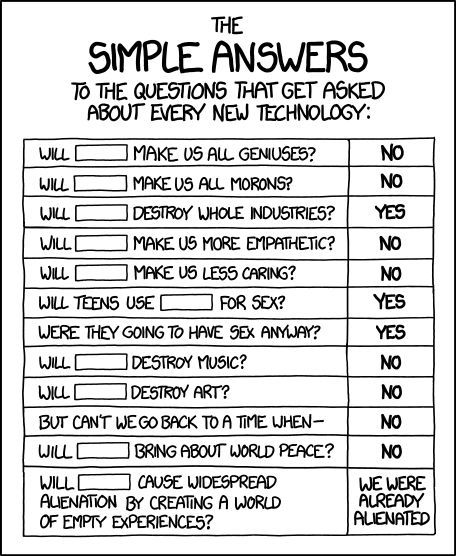
Every time a new technological gizmo comes along, there are some questions which immediately start to be asked (usually by non-tech-savvy journalists). Here’s the XKCD summary sheet of simple answers for technology questions:
The cult of the victim
In sp!ked, Barbara Hewson explains why the “believe the victim” mantra is a “recipe for injustice”:
First, it creates an ideal climate in which those who have not been abused can claim that they have been. Second, it ignores the ease with which false memories of abuse can be created, whether by self-persuasion, interaction with victim/survivor groups, or influence by third parties with axes to grind. Those third parties may include therapists, policemen, injury lawyers, campaign groups, and journalists avid for scandal. All these players espouse the ideology of victimisation.
In 1997, the US sociologist Joel Best identified seven widely accepted propositions which, taken together, create this powerful ideology:
1) Victimisation is widespread;
2) Its consequences are fundamentally psychological, and long-lasting;
3) Victims are innocent, victimisers are exploitative, and there is no room for moral ambiguity;
4) Both society and victims themselves fail to appreciate the extent of victimisation;
5) People must be taught to recognise their own, and others’ victimisation;
6) Claims of victimisation must not be challenged, as this is ‘victim-blaming’;
7) The word ‘victim’ connotes powerlessness: the term ‘survivor’ is preferable. (1)Victims/survivors are praised for their courage, and enjoined to recover. The language of recovery is permeated by the doctrinaire religiosity of the 12-step movement, pioneered by the founders of AA in the US. This may explain why some victim-advocacy groups can sound cult-like, with their own jargon (‘grooming’, ‘trafficking’, ‘mind control’) and their disdain for non-believers.
But, like any religion, the victim/survivor movement needs new recruits and new spheres of influence. Not satisfied with sensitising society to victims’ needs, they then demand integration within institutional structures, and then wholesale institutional change. The contemporary victim industry, according to Best, mass-produces victims.
Even those who deny prior experience of victimisation are seen as candidates for conversion. Best quotes the comedienne Roseanne Barr from the early Nineties: ‘When someone asks you, “Were you sexually abused as a child?”, there’s only two answers. One of them is, “Yes”, and one of them is “I don’t know”. You can’t say no.’
What Barr alludes to is the concept of ‘gradual disclosure’. Hugely influential with therapists and social workers, this posits that people who have been abused will initially deny it, and need help to overcome their denial. This is a deeply flawed approach, because it assumes that there is always something to disclose. It refuses to countenance the possibility that a denial means there is nothing to disclose. According to researchers, there is no clinical evidence to support the theory of gradual disclosure (2).
November 10, 2013
Alison Bechdel on the revived popularity of the “Bechdel Test”
You’d think, with all the social advances in equality for women over the last few decades that our media would more directly reflect that equality … but you’d be wrong. Quite some time ago, Alison Bechdel outlined a quick test you could use to determine whether a book or movie treated women as real people or just as foils for males:
The Bechdel test is used to identify gender bias in fiction. A work passes the test if it features at least two women who talk to each other about something other than a man. Commentators have noted that a great proportion of contemporary works fail to pass this threshold of representing women. The test was originally conceived for evaluating films, but has since been applied to other media.
Pretty low hurdle, yet a vast number of books and movies fail to meet even this minimal standard. Recently a Swedish theatre chain decided to use the Bechdel Test to evaluate the movies they were showing (with Bechdel’s blessing), which has revived interest in the test itself. Bechdel talks about this on her blog:
I said sure, that sounds awesome, go for it.
So they did, and the Guardian ran an article about it on Wednesday. Which prompted a flurry of emails from radio programs who wanted to talk to me. I spoke to Marco Werman at PRI’s The World, and got to join in his conversation with Ellen Tejle, the director of the participating cinema in Stockholm. I also did a background interview with the NPR program Here and Now.
Yesterday I got a lot of other requests from other media outlets but I’m ignoring them. I feel bad about this. There seems to be something fundamentally wrong about not seizing every possible chance for publicity — if not for myself, then at least for the brave Swedish cinema consortium, not to mention the cause of women everywhere.
But inevitably in these interviews I say simplistic things, or find myself defending absurd accusations — like that the formal application of the Test by a movie theater is somehow censorious.
I have always felt ambivalent about how the Test got attached to my name and went viral. (This ancient comic strip I did in 1985 received a second life on the internet when film students started talking about it in the 2000′s.) But in recent years I’ve been trying to embrace the phenomenon. After all, the Test is about something I have dedicated my career to: the representation of women who are subjects and not objects. And I’m glad mainstream culture is starting to catch up to where lesbian-feminism was 30 years ago. But I just can’t seem to rise to the occasion of talking about this fundamental principle over and over again, as if it’s somehow new, or open to debate. Fortunately, a younger generation of women is taking up the tiresome chore. Anita Sarkeesian, in her Feminist Frequencies videos, is a most eloquent spokesperson.
November 9, 2013
Virginia Postrel on the persistence of glamour
At the Daily Beast, Virginia Postrel argues that far from being dead, glamour is still a powerful force in our lives:
In a world that prizes transparency, honesty, and full disclosure, the very idea seems out of place. Glamour is an illusion that conceals flaws and distractions. It requires mystery and distance, lest too much information breaks the spell. How can its magic possibly survive in a world of tweeting slobs?
But glamour does in fact endure. It is far more persistent, pervasive, and powerful than we realize. We just have trouble recognizing it, because it has so many different incarnations, many of which have nothing to do with Hollywood or fashion.
Glamour isn’t just a style of dress or a synonym for celebrity. Like humor, it’s a form of communication that triggers a distinctive emotional response: a sensation of projection and longing. What we find glamorous, like what we find funny, depends on who we are.
One person who yearns to feel special finds glamour in the image of U.S. Marines as “the few, the proud,” while another dreams of getting into the city’s hottest club and yet another imagines matriculating at Harvard. For some people, a glamorous vacation means visiting a cosmopolitan capital with lots to do and see. For others, it means a tranquil beach or mountain cabin. The first group yearns for excitement, the second for rest. All of these things are glamorous — but to different people.
November 8, 2013
Al Stewart at the Royal Albert Hall, October 15th, 2013
Published on 16 Oct 2013
Al Stewart YOTC Classic Album concert. Extended version of this classic song with Al mixing up the words for fun
November 7, 2013
Astounding historical ignorance … or is he just trolling?
You’d have to go a long way to match the degree of ignorance that the Washington Post‘s Richard Cohen admits to in this article:
I sometimes think I have spent years unlearning what I learned earlier in my life. For instance, it was not George A. Custer who was attacked at the Little Bighorn. It was Custer — in a bad career move — who attacked the Indians. Much more important, slavery was not a benign institution in which mostly benevolent whites owned innocent and grateful blacks. Slavery was a lifetime’s condemnation to an often violent hell in which people were deprived of life, liberty and, too often, their own children. Happiness could not be pursued after that.
Steve McQueen’s stunning movie 12 Years a Slave is one of those unlearning experiences. I had to wonder why I could not recall another time when I was so shockingly confronted by the sheer barbarity of American slavery. Instead, beginning with school, I got a gauzy version. I learned that slavery was wrong, yes, that it was evil, no doubt, but really, that many blacks were sort of content. Slave owners were mostly nice people — fellow Americans, after all — and the sadistic Simon Legree was the concoction of that demented propagandist, Harriet Beecher Stowe. Her Uncle Tom’s Cabin was a lie and she never — and this I remember clearly being told — had ventured south to see slavery for herself. I felt some relief at that because it meant that Tom had not been flogged to death.
No modern American — working in the media — could possibly be so ignorant, so he must be trolling. H/T to Julian Sanchez for the link.
Harper’s convention speech – no wonder he ignored the senate scandal
In Maclean’s, Paul Wells explains why Stephen Harper decided not to say anything substantive about the senate scandal in his big speech at the Conservative convention. In short, it would be all drawbacks and no benefits to say any more than he did:
Some commentators hoped Harper would use his speech to the Conservatives to explain why any of this makes sense. Perhaps we should not be surprised that Harper decided not to rise to that challenge.
The Prime Minister’s twists and turns on the Senate affair would break a snake’s back. There is no explaining them. In the insane hypothesis that Harper had tried to explain them in Calgary, the first question we would have asked afterward is why he waited from May until November to do it. So essaying an explanation now would not really have helped. It’s just a mess, a sinkhole of judgment whose radius is very much larger than the distance between Harper’s office and the one Wright used to occupy. As another former Harper spokesman once said, more than a decade ago and in very different circumstances, “This turd won’t polish.”
So why bother? For a man whose goal is to endure as prime minister long enough to change the country, this question would have occurred to Harper very early. One can imagine him thinking something like this:
“I could try to explain away the behaviour of my appointees and the zigzags in my own response to it. I could spend the next few months talking about the terrible judgment of my plutocrat fixer-in-chief and my TV-star Senate appointee. I could air, in public, questions that will probably be tried in courts of law later, and make spotting the contradictions a national parlour game.
“Or I could talk about some other stuff.”
Easy to see why he decided to talk about other stuff.
The other big talking point of the convention was how the Conservatives kept the press cordoned off from pretty much any opportunity to talk to delegates or cover any of the events. The press collectively found themselves held in the same contempt that so many of them express for the Tories in general and Harper in particular:
Reporters were cooped up in a filing room without potable water or free WiFi. Three of the convention’s four halls were closed to reporters for the duration, and when we ventured past an imaginary line on the floor of the fourth, volunteers in blue pushed us back. After his speech, Harper and his band played classic-rock hits at a casino next to the convention centre; reporters were barred.
In its details, this cheerful contempt was an extension and refinement of the treatment Harper used to reserve for the press corps. As late as 2011, I could walk around on the floor of a Conservative party convention at leisure and unharassed. The Conservative party had meetings to decide how much further to tighten the cordon sanitaire, appointed staffers to enforce it who might have been given other tasks. A few Harper supporters will be delighted to hear we were denied our “perks,” as if water and freedom of association are luxuries. Here again, Harper was just being Harper. It’s worked for him for nearly a decade. He won’t stop now.
November 6, 2013
“Dear Mayor Ford: among our living national treasures”
David Warren explains why Toronto’s Mayor Rob Ford had to exist:
… every left-thinking person in the Greater Parkdale Area had been teased to apoplexy by the contemplation of this gentleman. This because he was: 1. fat, 2. colourful, 3. rightwing &, 4. freely elected by a large margin over some gay leftwing establishment darling. (Some other reasons have accumulated since then.)
Turns out, the police have recovered some video in which — it is alleged — our peerless mayor is shown doing crack with local low-life. Whether smoking or snorting or otherwise ingesting, we do not know, & neither apparently does our splendid mayor, who now says he was actually too drunk to remember the occasion. Dear Mayor Ford: among our living national treasures.
[…]
Quite frankly, we tried mayors who were not crackheads. They didn’t work out. Also, the last one didn’t drink enough. That’s why we elected Ford. He’s doing great: slashing through the city bureaucracy & privatizing everything he can. He even holds the civic unions in subjection: not one has dared to strike. And ho, he’s trying to build subways. Anyone who has attempted to ride a trolley across this town will understand our need to tunnel. So what is the problem?
As our good, excellent mayor told his Police Chief: bring on your video! Ford says he’s curious to see it himself, & that the rest of Toronto would surely also like a chance to catch it on YouTube.
Gentle reader knows I am a traditionalist in most things, & a loyal Canadian. Our very first prime minister, Sir John A. Macdonald, was a magnificent drunkard, who managed to hold office for nearly twenty years. There is an Arabian Nights of anecdotes that our primly officious historians have been too shy to tell. Verily, half of Macdonald’s Cabinet were awash most evenings, & the debates in Parliament were enlivened thereby. Almost all the damage ever done to this country was by sobersides.
Update: Take it away, Taiwanese animators!
Your website needs more Infographics!
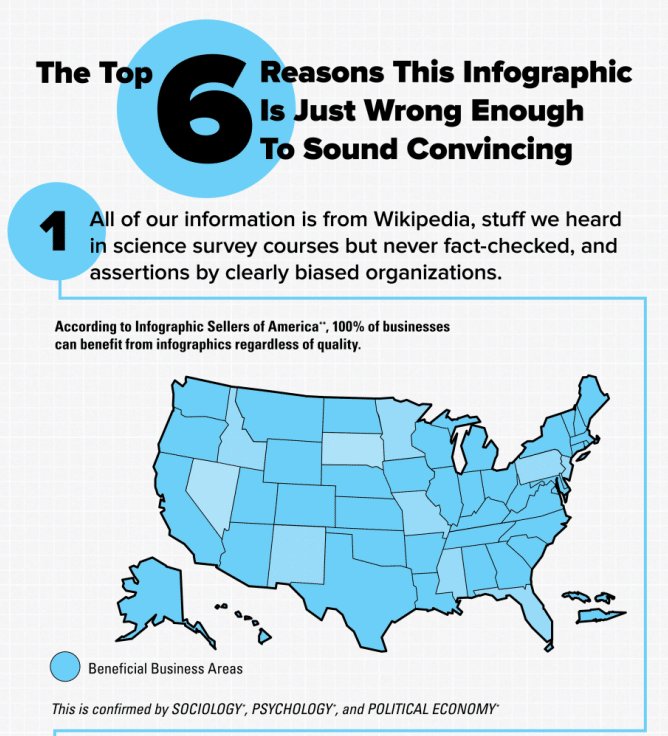
Click image to see full-size infographic at SMBC
“…the only real Doctor was William Hartnell”
In the Telegraph, Tim Stanley discusses the original Doctor Who:
Everybody has a favourite Doctor, but the only real Doctor was William Hartnell. No one else came close to matching his authority and scariness. He was genuinely alien.
Hartnell the man was born in poverty to a single mother in 1908. His career took off in the 1940s, playing hard men and soldiers in cop shows and sitcoms. He was spotted by producer Verity Lambert playing a rugby talent scout in This Sporting Life and offered a part in a new sci-fi show called Doctor Who in 1963. Bill was reluctant at first to work on a mere kids programme — but it turned out to be rather more special than that.
The genius of that early series was that it was pitched perfectly between children and adults; it’s a testament to how much more “adult” children were treated back then. The real focus of the plot were two teachers, Ian and Barbara, who follow a precocious pupil home and find that she’s living in a police box. The police box turns out to be a time ship (rather roomier on the inside than out) and her “grandfather” — the Doctor — is less than thrilled to meet them. In fact, he’s so furious that he shuts the doors, presses a button and kidnaps them. Compare that with present-day Who where the Doctor only ever meets young women with regional accents who he instantly wants to bed but can’t because — I don’t know — he’s impotent or something. Everything about 60s Who was way more mature and sinister.
To be honest, Hartnell’s stories can be tough to re-watch. Each serial ran for upwards of 12 episodes a time, some of the scripts were plodding (I challenge you to sit through The Space Museum without slipping into a coma) and the effects shockingly poor. The Web Planet featured a cast of gay butterflies on strings, dancing ants and grubs on rollers that occasionally crashed into the camera. Bill sometimes let the side down by fluffing his lines (When invited to climb a hill: “My dear, I’m not a mountain goat and I prefer walking to any day.” Awkward pause. “And I hate climbing”). There are moments when he looks lost and helpless before the cameras, the line on the tip of his tongue but he can’t remember if it’s “Daleks” or “cabbages”.
November 3, 2013
“More bombshells” in the police document on Mayor Rob Ford, says the Toronto Star
I’ll be honest: I haven’t been following the twists and turns of the crusade by the Toronto media to oust Mayor Rob Ford. That’s not to say there isn’t actually news on the situation:
More bombshells are contained in a weighty police document used to obtain a search warrant for Mayor Rob Ford’s friend and occasional driver, according to a Star analysis of court information already released.
“Project Traveller and the Rob Ford connection” is the bold heading atop one section of still-sealed information. The pages are blacked out pending an ongoing court challenge.
Project Traveller was the recent guns and gangs investigation that saw massive arrests in north Etobicoke. Police Chief Bill Blair has said information learned in that probe led to the creation of the Ford investigation, dubbed Project Brazen 2. (Brazen 1 was an unrelated Scarborough investigation.)
Nearly 500 pages of a document presented before a judge to obtain a warrant to search Alexander “Sandro” Lisi’s home were released Thursday. Half is censored pending a court challenge by the Star and other media lawyers.
In examining the document, the Star has learned that some remarkable information remains sealed.
Whether any of the censored pages relate to the mysterious second video the Star first learned about in early August, and Blair confirmed last week, is not known.
The Star has been told by two sources this second video also features the mayor. Blair has said the second video is “relevant to this investigation.”
In his dramatic Thursday news conference Blair answered a question about whether Ford was in the first video. The chief first said the mayor was in “those” videos, then caught himself and only spoke about the first video.
Update: It’s worth noting that Ford’s popularity actually increased after the latest news came out.
October 28, 2013
Nanny gets bigger – mission creep in “public health”
In sp!ked, Christopher Snowdon starts off by listing a few “public health” proposals that have been suggested recently:
An abridged list of policies that have been proposed in the name of ‘public health’ in recent months includes: minimum pricing for alcohol, plain packaging for tobacco, a 20 per cent tax on fizzy drinks, a fat tax, a sugar tax, a fine for not being a member of a gym, graphic warnings on bottles of alcohol, a tax on some foods, subsidies on other foods, a ban on the sale of hot food to children before 5pm, a ban on anyone born after the year 2000 ever buying tobacco, a ban on multi-bag packs of crisps, a ban on packed lunches, a complete ban on alcohol advertising, a ban on electronic cigarettes, a ban on menthol cigarettes, a ban on large servings of fizzy drinks, a ban on parents taking their kids to school by car, and a ban on advertising any product whatsoever to children.
Doubtless many of the proponents of these policies identify themselves as ‘liberals’. We must hope they never lurch towards authoritarianism. […]
As the definition of ‘health’ has been changed, so too has the meaning of ‘public health’. It once meant vaccinations, sanitation and education. It was ‘public’ only in the sense that it protected people from contagious diseases carried by others. Today, it means protecting people from themselves. The word ‘epidemic’ has also been divorced from its meaning — an outbreak of infectious disease — and is instead used to describe endemic behaviour such as drinking, or non-contagious diseases such as cancer, or physical conditions such as obesity which are neither diseases nor activities. This switch from literal meanings to poetic metaphors helps to maintain the conceit that governments have the same rights and responsibility to police the habits of its citizens as they do to ensure that drinking water is uncontaminated. It masks the hard reality that ‘public health’ is increasingly concerned with regulating private behaviour on private property.
The anti-smoking campaign is where the severe new public-health crusade began, but it is not where it ends. Libertarians warned that the campaign against tobacco would morph into an anti-booze and anti-fat campaign of similar intensity. They were derided; ridiculed for making fallacious ‘slippery slope’ arguments. In retrospect, their greatest failing was not that they were too hysterical in their warnings but that they lacked the imagination to foresee policies as absurd as plain packaging or bans on large servings of lemonade, even as satire.
October 27, 2013
Good news – we’re not in 1984; Bad news – we’re in Brave New World instead
I’ve already quoted from this week’s edition of Jonah Goldberg’s The Goldberg File email, but I quite liked this passage as well:
The bad news is that we don’t feel that way — anymore — about softer, more diffuse and bureaucratic forms of tyranny. Every American is taught from grade school up that they should fear living in the world of Orwell’s 1984. Few Americans can tell you why we shouldn’t live in Huxley’s Brave New World. We’ve got the dogmatic muscle and rhetorical sinew to repel militarism, but we’re intellectually flabby when it comes to rejecting statist maternalism. We hate hearing “Because I said so!” But we’re increasingly powerless against, “It’s for your own good!”
(Sadly, the surest route to the 1984-ification of America is to embrace Brave New Worldism. Once you’ve created a society of men without chests — in C. S. Lewis’s phrase — you’ve created a society ripe for a father-figure to make all of the decisions).
For instance, when the national-security types intrude on our privacy or civil liberties, even theoretically, all of the “responsible” voices in the media and academia wig out. But when Obamacare poses a vastly more intrusive and real threat to our privacy, the same people yawn and roll their eyes at anyone who complains. If the District of Columbia justified its omnipresent traffic cameras as an attempt to keep tabs on dissidents, they’d be torn down in a heartbeat by mobs of civil libertarians. But when justified on the grounds of public safety (or revenue for social services or as a way to make driving cars more difficult), well, that’s different.
And it is different. Motives matter. But at the same time, I do wish we looked a bit more like the America Edmund Burke once described:
In other countries, the people, more simple, and of a less mercurial cast, judge of an ill principle in government only by an actual grievance; [In America] they anticipate the evil, and judge of the pressure of the grievance by the badness of the principle. They augur misgovernment at a distance; and snuff the approach of tyranny in every tainted breeze.


