Quotulatiousness

January 2, 2014

Chris Kluwe burns his bridges in Minnesota … and the rest of the NFL

Filed under: Football, Liberty, Media — Tags: , , , , , — Nicholas @ 13:57

He’s been looking for work since his time in Minnesota came to an end shortly after the team drafted Jeff Locke in the 2013 draft, but hasn’t been able to catch on with a team, despite his still-respectable abilities. He has strong suspicions why this might be, and he’s probably right. Now that he’s come to terms with the end of his punting career, Chris Kluwe explains what he think happened between him and the Vikings in 2012 and pretty much guarantees he will never work in the NFL again:

During the summer of 2012, I was approached by a group called Minnesotans for Marriage Equality, which asked if I would be interested in helping defeat what was known as the Minnesota Gay Marriage Amendment. The proposed amendment would have defined marriage as “only a union of one man and one woman.” (It was voted down, and same-sex marriage is now legal in Minnesota.) I said yes, but that I would have to clear it with the team first. After talking to the Vikings legal department, I was given the go-ahead to speak on the issue as long as I made it clear I was acting as a private citizen, not as a spokesman for the Vikings, which I felt was fair and complied with. I did several radio advertisements and a dinner appearance for Minnesotans for Marriage Equality. No one from the Vikings’ legal department told me I was doing anything wrong or that I had to stop.

On Sept. 7, 2012, this website published a letter I had written to Maryland delegate Emmett C. Burns Jr. chastising him for trampling the free-speech rights of Baltimore Ravens linebacker Brendon Ayanbadejo. The letter also detailed why I supported the rights of same-sex couples to get married. It quickly went viral.

On Sept. 8, the head coach of the Vikings, Leslie Frazier, called me into his office after our morning special-teams meeting. I anticipated it would be about the letter (punters aren’t generally called into the principal’s office). Once inside, Coach Frazier immediately told me that I “needed to be quiet, and stop speaking out on this stuff” (referring to my support for same-sex marriage rights). I told Coach Frazier that I felt it was the right thing to do (what with supporting equality and all), and I also told him that one of his main coaching points to us was to be “good men” and to “do the right thing.” He reiterated his fervent desire for me to cease speaking on the subject, stating that “a wise coach once told me there are two things you don’t talk about in the NFL, politics and religion.” I repeated my stance that this was the right thing to do, that equality is not something to be denied anyone, and that I would not promise to cease speaking out. At that point, Coach Frazier told me in a flat voice, “If that’s what you feel you have to do,” and the meeting ended. The atmosphere was tense as I left the room.

[…]

So there you have it. It’s my belief, based on everything that happened over the course of 2012, that I was fired by Mike Priefer, a bigot who didn’t agree with the cause I was working for, and two cowards, Leslie Frazier and Rick Spielman, both of whom knew I was a good punter and would remain a good punter for the foreseeable future, as my numbers over my eight-year career had shown, but who lacked the fortitude to disagree with Mike Priefer on a touchy subject matter. (Frazier was fired on Monday, at the conclusion of a 5-10-1 season.) One of the main coaching points I’ve heard throughout my entire life is, “How you respond to difficult situations defines your character,” and I think it’s a good saying. I also think it applies to more than just the players.

If there’s one thing I hope to achieve from sharing this story, it’s to make sure that Mike Priefer never holds a coaching position again in the NFL, and ideally never coaches at any level. (According to the Pioneer Press, he is “the only in-house candidate with a chance” at the head-coaching job.) It’s inexcusable that someone would use his status as a teacher and a role model to proselytize on behalf of his own doctrine of intolerance, and I hope he never gets another opportunity to pass his example along to anyone else. I also hope that Leslie Frazier and Rick Spielman take a good look in the mirror and ask themselves if they are the people they truly profess themselves to be.

Update, 3 January: The Vikings have hired two lawyers, one of them the former chief justice of the Minnesota Supreme Court, to investigate Kluwe’s allegations.

Eric Magnuson, the former chief justice of the Minnesota Supreme Court, and Chris Madel, a former U.S. Department of Justice Trial attorney, will lead the investigation.

“It is extremely important for the Vikings organization to react immediately and comprehensively with an independent review of these allegations,” Vikings owner/president Mark Wilf said in a statement issued by the team Friday.

Magnuson and Madel are partners in the firm Robins, Kaplan, Miller & Ciresi L.L.P. Their investigation is already underway, according to the Vikings’ release.

“This is a highly sensitive matter that we as an organization will address with integrity,” Vikings vice president of legal affairs and chief administrative officer Kevin Warren said in the statement.

“Eric and Chris have stellar reputations in both the local and national legal community. They have handled numerous cases involving a wide range of issues, and we are confident they will move swiftly and fairly in completing this investigation.”

[…]

The Vikings investigation comes a little less than two months after the NFL hired attorney Ted Wells to investigate issues of workplace conduct with the Miami Dolphins, who asked the league for help after representatives for tackle Jonathan Martin turned over evidence of alleged abuse at the hands of teammate Richie Incognito.

The results of Wells’ investigation, which are to be made public, have not yet been released. Martin never returned to the team after a cafeteria prank Oct. 28. Incognito finished the season on the suspended list.

“The Vikings contacted us yesterday about the matter and have kept us fully informed,” league spokesman Greg Aiello wrote in an email to USA TODAY Sports. “We have no plans to conduct a separate review.”

QotD: Why progressive policy ideas get more media attention

Filed under: Media, Politics, Quotations, USA — Tags: , , , , , , — Nicholas @ 11:34

When it comes to crafting winning political narratives, progressives have a natural advantage over conservatives. That’s because progressives have a free hand to project rosy visions of the future while conservatives must constantly defend against progressives’ distorted depictions of the past.

Two fundamental techniques undergird progressives’ success at narrative spinning. The first is skillful framing of the debate through investing heavily in public opinion making machinery. This disarms critics while giving lawmakers cover to vote for bills they’ve neither read nor understood. Thus framed, policies are judged only by their stated intentions, never their actual results. This allows politicians to promote new pieces of legislation named for their lofty objectives, even if the thousands of pages of vague and contradictory content deliver just the opposite.

The second is dodging all responsibility for failure. This is accomplished by blaming insufficient resources, the prior administration, the greedy 1 percent, sabotage by Republicans, or even the people’s obdurate failure to appreciate the progressive benefits conferred upon them. When the going gets tough, reality can be dismissed with a slogan. Forward!

Bill Frezza, “2013: The Year The Progressive Narrative Collided With Reality”, Forbes, 2013-12-30

John and Sherlock

Filed under: Britain, Media — Tags: , , , , — Nicholas @ 09:26

The first episode of Sherlock season three was aired in the UK yesterday. On this side of the pond, we won’t get to see it until later in the year, so we have to rely on media reaction to the show, and Tim Stanley wasn’t over-pleased with the producers’ efforts, calling it a “roller-coaster ride” that “leaves you confused and nauseous”:

Holmes has always been a wonder, but here he is wondrous to the point of smug and irritating. How can Watson love him? Presumably because they are such good friends and one of Sherlock‘s strong points is the genuine chemistry between Martin Freeman and Benedict Cumberbatch. But even this comes with an irritating postmodern twist. Everyone presumes they’re gay. Because of course if two men spend more than five minutes in each other’s company they’re obviously candidates for some Brokeback-style hot cowboy action in a tent.

One of the saddest things about our culture is the death of brotherhood. Watch any of the pre-Millennium Sherlocks and you’ll be in no doubt that these men would take a bullet for one another. In the excellent Murder By Decree, Christopher Plummer and James Mason’s heroes are so tender that they share a blanket on a carriage ride — Sherlock gently tucking Watson in. When Vasily Livanov’s Holmes “dies” in the Russian version of The Final Problem, Vitaly Solomin’s Watson collapses against a tree and weeps uncontrollably. But no one ever questions their sexual preference. There’s no need to. They’re just friends.

By contrast, contemporary British culture has become so pornified and sex-obsessed that the running gag in Sherlock is that everyone thinks Cumberbatch and Freeman are in a civil partnership. Don’t get me wrong — I’m sure there’s an enjoyable version of Holmes yet to be written in which they’re at it like knives. But the constant snickering that goes on in Sherlock just adds to a sense of the show’s lack of maturity. It’s knowing, clever-clever, hip, ironic, tech-obsessed, geeky, hipster and just about everything else that gets in the way of a sophisticated yarn well told. For that, you have to go back to the Jeremy Brett Sherlock, which was distinctly lacking in action but high on good prose. Most episodes were an hour of Jeremy sitting in the gloom in Baker Street complaining that he’s got nothing to do. Compulsive viewing.

Casualties from the most recent copyright term expansion

Filed under: Books, Business, Law, Media, USA — Tags: , , — Nicholas @ 09:14

At Techdirt, Mike Masnick mourns the creative works that should have entered the public domain yesterday, but thanks to Congress will remain locked up for much, much longer:

As they do every year, unfortunately, the good folks at the Center for the Study of the Public Domain at Duke have put together a depressing list of what should have entered the public domain yesterday. As you hopefully know, until 1978, the maximum amount of time that work in the US could be covered by copyright was 56 years (you initially received a 28 year copyright term, which could be renewed for another 28 years). That means, back in 1957, everyone who created the works in that list knew absolutely, and without a doubt that their works would be given back to the public to share, to perform, to build on and more… on January 1, 2014 at the very latest. And they all still created their works, making clear that the incentive of a 56 year monopoly was absolutely more than enough incentive to create.

And yet, for reasons that still no one has made clear, Congress unilaterally changed the terms of the deal, took these works away from the public, without any compensation at all, and will keep them locked up for at least another 40 years. At least.

[…]

And it’s not just arts and entertainment. The post points out plenty of science and technology is still locked up thanks to all of this.

    1957 was a noteworthy year for science: the USSR launched Sputnik 1 and Sputnik 2, IBM released the first FORTRAN compiler, and the UK’s Medical Research Council published an early report linking smoking and lung cancer. There were groundbreaking publications in the fields of superconductivity and astrophysics such as “Theory of Superconductivity” by John Bardeen, L.N. Cooper, and J.R. Schrieffer and “Synthesis of the Elements in Stars… ” by Geofrey Burbidge, Margaret Burbidge, William Fowler, and Fred Hoyle.

They further make an important point that while the works listed above grab all the attention, because they were so successful, the real shame is in lots of other works that are simply not available at all any more. And this would likely include all sorts of works from 1985. After all, works created in 1985, if created under the old law, would have been given an initial 28 year copyright term, which would also be expiring, and if history is any guide, the vast majority of those would not have their copyrights renewed. Instead, they’re locked up… and quite frequently completely unavailable, with a very real risk of being lost to history.

The really crazy part about all of this is that it’s the exact opposite of the entire original purpose of copyright. Copyright law was put in place specifically to encourage the creation of works that would be put into the public domain to promote learning, knowledge and understanding. Yet, instead, it’s been distorted, twisted and misrepresented into a system that is used solely to lock stuff up, make it less accessible and less available, limiting the ability to promote knowledge and learning. What a shame.

Green Bay playoff game at risk of TV blackout in home market

Filed under: Business, Football, Media — Tags: , , , , — Nicholas @ 08:39

For some reason, I had the impression that NFL blackout rules didn’t apply in the post-season, but Dan Zinski says there’s a real risk that the Green Bay Packers may not sell all of their tickets for this weekend’s game against the San Francisco 49ers:

Packer fans are the greatest, most loyal and diehard fans in the world. Which explains why, as of Wednesday afternoon, there were reportedly still 7,500 tickets available for Sunday’s home playoff game against the San Francisco 49ers.

Huh?

Yes it’s true. Amazingly, the Packers are struggling to sell out their home playoff game. Despite their fans being better than everyone else’s fans.

[…]

The tickets must be sold by 3:40 PM Thursday to avoid a blackout. But if history is any indication the NFL will give the Packers an extension.

If the Packers still can’t sell the tickets and the blackout goes into effect? Look for a mass exodus out of Green Bay and Milwaukee and into all the towns where the game is on television. That will be a bad time to be traveling anywhere in Wisconsin.

And just wait until Sunday night when everyone is driving home, totally wasted. In the name of public safety, maybe the state government should buy up the tickets.

My guess is that the nightmare scenario won’t come to pass, that the tickets will get bought up and everyone will be able to see the game. And what an enjoyable game it will be…for people who hate the Packers.

On the other hand, I’ve seen predictions that the game-time temperature could be as low as -15F, which would be the coldest game in NFL history (the current record is -13F at the “Ice Bowl” in 1967). I wouldn’t blame the fans quite as much for not wanting to be part of that kind of historical event.

Update, 3 January: Earlier this afternoon, the Packers announced that they’d sold all the tickets to the game (a local business apparently stepped in to buy the remainder), so the game will be available on TV in the Wisconsin area. The weather reports are looking worse, however, as the temperature could go as low as -18F (or -25F) with a potential windchill of -53F. Brrrrrrrrrrrr.

January 1, 2014

The hazards facing the Australasian Antarctic Expedition

Filed under: Environment, Media, Science — Tags: , , — Nicholas @ 12:25

AntarcticaThe Australasian Antarctic Expedition (AAE) has run into far harsher sea and ice conditions than they’d banked on, and it raises questions about the scientific validity of the expedition:

The purpose of the AAE expedition was to take a science team of 36 women and men south to discover just how much change has taken place at Mawson Station over 100 years. The expedition was also intended to replicate the original AAE led by explorer Sir Douglas Mawson a century ago, in 1913. The new expedition was to be led by Prof. Chris Turney, a publicity-hungry professor of climate change at Australia’s University of New South Wales.

Antarctic-AAE

Also the expedition was designed to generate lots of publicity. Along the scientists and ship’s crew were 4 journalists from leading media outlets who would feed news regularly, and later report extensively on the results and findings. All this in turn would bring loads of attention to a region that is said to be threatened by global warming. The AAE’s donation website even states that the expedition’s purpose is to collect data and that the findings are “to reach the public and policy makers as soon as possible“.

But expeditions of this type are expensive and funding is not always easy to come by. Costs can run in the millions as special equipment is needed to handle the extremely harsh conditions of the South Pole. Downplaying the conditions to justify cost-cutting by using lower grade equipment rapidly jeopardizes safety.

Inadequate, bargain-price research vessel

The first error expedition leaders made was under-estimating the prevailing sea ice conditions at Mawson Station, their destination. The scientists seemed to be convinced that Antarctica was a warmer place today than it had been 100 years earlier, and thus perhaps they could expect less sea ice there. This in turn would allow them to charter a lighter, cheaper vessel.

This seems to be the case judging by their choice of seafaring vessel. They chartered a Russian vessel MS Akademik Shokalskiy, an ice-strengthened ship built in Finland in 1982. According to Wikipedia the ship has two passenger decks, with dining rooms, a bar, a library, and a sauna, and accommodates 54 passengers and a crew of up to 30. Though it is ice-reinforced, it is not an ice-breaker. This is a rather surprising selection for an expedition to Antarctica, especially in view that the AAE website itself expected to travel through areas that even icebreakers at times are unable to penetrate, as we are now vividly witnessing. Perhaps the price for chartering the Russian vessel was too good to pass up.

Luring naïve tourists as a source of cash

What made the expedition even more dubious is that Turney and his team brought on paying tourists in what appears to have been an attempt to help defray the expedition’s costs and to be a source of cheap labor. According to the AAE website, the expedition was costed at US$1.5 million, which included the charter of the Akademik Shokalskiy to access the remote locations. “The site berths on board are available for purchase.” Prices start at $8000!

The expedition brought with it 4 journalists, 26 paying tourists.

Update, 2 January: An editorial in The Australian after news came out that all of the 52 passengers had been rescued from the ice-bound Akademik Shokalskiy:

YOU have to feel a touch of sympathy for the global warming scientists, journalists and other hangers-on aboard the Russian ship stuck in impenetrable ice in Antarctica, the mission they so confidently embarked on to establish solid evidence of melting ice caps resulting from climate change embarrassingly abandoned because the ice is, in fact, so impossibly thick.

[…]

Professor Turney’s expedition was supposed to repeat scientific investigations made by Douglas Mawson a century ago and to compare then and now. Not unreasonably, it has been pointed out Mawson’s ship was never icebound. Sea ice has been steadily increasing, despite the Intergovernmental Panel on Climate Change’s gloomy forecasts. Had the expedition found the slightest evidence to confirm its expectation of melting ice caps and thin ice, a major new scare about the plight of the planet would have followed. As they are transferred to sanctuary aboard the icebreaker Aurora Australis, Professor Turney and his fellow evacuees must accept the embarrassing failure of their mission shows how uncertain the science of climate change really is. They cannot reasonably do otherwise.

The 22 crew members will stay on board the vessel until it can be released from the ice (or until another rescue effort needs to be mounted).

December 31, 2013

Blog traffic, 2013

Filed under: Administrivia, Media — Tags: , — Nicholas @ 10:43

While the blogging “revolution” may be over, I think that providing links and interesting posts that generated nearly 1.5 million unique visits shows there’s still a bit of life in the blogging world:

Quotulatiousness 2013 traffic

Quotulatiousness visits and hits 2010-2013

As I took these screenshots at about 10:30 in the morning, the final numbers for 2013 will be 2,000-2,500 higher than shown.

December 30, 2013

QotD: Yes, but what is it really about?

Filed under: Books, Media, Politics, Quotations — Tags: , , , — Nicholas @ 00:01

A very common way of thinking in literary criticism is not seen as a consequence of Communism, but it is. Every writer has the experience of being told that a novel, a story, is “about” something or other. I wrote a story, “The Fifth Child,” which was at once pigeonholed as being about the Palestinian problem, genetic research, feminism, anti-Semitism and so on.

A journalist from France walked into my living room and before she had even sat down said, “Of course ‘The Fifth Child’ is about AIDS.”

An effective conversation stopper, I assure you. But what is interesting is the habit of mind that has to analyze a literary work like this. If you say, “Had I wanted to write about AIDS or the Palestinian problem I would have written a pamphlet,” you tend to get baffled stares. That a work of the imagination has to be “really” about some problem is, again, an heir of Socialist Realism. To write a story for the sake of storytelling is frivolous, not to say reactionary.

The demand that stories must be “about” something is from Communist thinking and, further back, from religious thinking, with its desire for self-improvement books as simple-minded as the messages on samplers.

Doris Lessing, “Questions You Should Never Ask a Writer”, New York Times, 1992-06-26 (reprinted 2007-10-13)

December 28, 2013

Un-noticed marker of social change

Filed under: Books, History, Media, WW2 — Tags: — Nicholas @ 10:36

Ann Althouse talks about the dust-up at National Review Online, where an editor objected to something that Mark Steyn wrote and posted what I’m sure he thought was a gentle rebuff. Steyn reacted exactly the way you’d expect him to, and in the end the editor got a chance to polish up his resumé for his next position. As an addendum to the original post, she quotes from William Shirer’s The Rise and Fall of the Third Reich as a rather jarring example of how much society’s attitudes to homosexuality have changed (for the better) since the early 1960s:

The point of the Rat Pack joke — “How do you make a fruit cordial?”/ “Be nice to him.” — wasn’t that it’s funny. It’s that not too long ago junk like that was the norm. It was probably considered sweet, gentle and even gay-friendly. Steyn is paying attention to how cultural norms change. This is something I’ve been talking about too, and I am confounded by what a hard time people have understanding this subject.

[…]

ADDED: Here’s something a little different that corresponds to that Rat Pack joke, not in the realm of comedy, but in a best selling history book that was published in 1961 and got high praise in places like The New York Times Book Review and won the National Book Award. It’s William Shirer’s The Rise and Fall of the Third Reich. Listening to the audiobook, I was struck by the references to homosexuality, made in an offhandedly negative way that you’d never encounter in a book published today by a respectable publisher and an author who meant to be taken seriously. Examples:

A tough, ruthless, driving man — albeit, like so many of the early Nazis, a homosexual — [Ernst Roehm] helped to organize the first Nazi strong-arm squads which grew into the S.A., the army of storm troopers which he commanded until his execution by Hitler in 1934….

Such was the weird assortment of misfits who founded National Socialism…. The confused locksmith Drexler provided the kernel, the drunken poet Eckart some of the “spiritual” foundation, the economic crank Feder what passed as an ideology, the homosexual Roehm the support of the Army and the war veterans, but it was now the former tramp, Adolf Hitler… who took the lead….

“I know Esser is a scoundrel,” Hitler retorted in public, “but I shall hold on to him as long as he can be of use to me.” This was to be his attitude toward almost all of his close collaborators, no matter how murky their past — or indeed their present. Murderers, pimps, homosexual perverts, drug addicts or just plain rowdies were all the same to him if they served his purposes….

But the brown-shirted S.A. never became much more than a motley mob of brawlers. Many of its top leaders, beginning with its chief, Roehm, were notorious homosexual perverts. Lieutenant Edmund Heines, who led the Munich S.A., was not only a homosexual but a convicted murderer. These two and dozens of others quarreled and feuded as only men of unnatural sexual inclinations, with their peculiar jealousies, can….

No other party in Germany came near to attracting so many shady characters. As we have seen, a conglomeration of pimps, murderers, homosexuals, alcoholics and blackmailers flocked to the party as if to a natural haven. Hitler did not care, as long as they were useful to him…..

QotD: Dance

Filed under: Humour, Media, Quotations — Tags: , , , , , — Nicholas @ 09:48

Those Puritans who snort against the current dances are quite right when they argue that the tango and the shimmie are violently aphrodisiacal, but what they overlook is the fact that the abolition of such provocative wriggles would probably revive something worse, to wit, the Viennese waltz. The waltz never quite goes out of fashion; it is always just around the corner; every now and then it comes back with a bang. And to the sore harassment and corruption, I suspect, of chemical purity, the ideal of all right-thinkers. The shimmie and the tango are too gross to be very dangerous to civilized human beings; they suggest drinking beer out of buckets; the most elemental good taste is proof enough against them. But the waltz! Ah, the waltz, indeed! It is sneaking, insidious, disarming, lovely. It does its work, not like a college-yell or an explosion in a munitions plant, but like the rustle of the trees, the murmur of the illimitable sea, the sweet gurgle of a pretty girl. The jazz-band fetches only vulgarians, barbarians, idiots, pigs. But there is a mystical something in “Weiner Blut” or “Kiinstler Leben” that fetches even philosophers.

The waltz, in fact, is magnificently improper the art of tone turned bawdy. I venture to say that the compositions of one man alone, Johann Strauss II, have lured more fair young creatures to lamentable complaisance than all the hypodermic syringes of all the white slave scouts since the fall of the Western Empire. There is something about a waltz that is simply irresistible. Try it on the fattest and sedatest or even upon the thinnest and most acidulous of women, and she will be ready, in ten minutes, for a stealthy kiss behind the door nay, she will forthwith impart the embarrassing news that her husband misunderstands her, and drinks too much, and cannot appreciate Maeterlinck, and is going to Cleveland, 0., on business to-morrow …

H.L. Mencken, “The Allied Arts: Tempo di Valse”, Prejudices: Second Series, 1920.

Reasons a true-to-the-text version of The Hobbit wouldn’t work

Filed under: Books, Media — Tags: , , — Nicholas @ 09:41

Actually, Dr. J says a more faithful movie would stink (note that there are mild spoilers in the quoted section and bigger spoilers in the full post):

I love J.R.R. Tolkien’s The Hobbit. I read it for the first time when I was six years old and have returned to it many times over the years. I still have a soft spot in my heart for the cheesy cartoon version of the story that Rankin/Bass did when I was a kid. I’ve shoved the book into each of my children’s hands as soon as I thought his reading skills could handle it.

So I can understand it when writers I respect, such as Daniel Larison at the American Conservative, express a sense of horror at Peter Jackson’s film adaptations of the beloved book, particularly the second film, The Desolation of Smaug, which is now in theaters. The criticisms abound. Why did Jackson think he could turn a 200-page children’s book into three lengthy films? Why does he have Gandalf wandering around mountain tombs and an old, ruined fortress, settings that appear nowhere in the book? Why did he put Legolas in the film when the elf does not appear in the book? Why does Bard the bowman get a complicated back story that’s absent in the book? Why does Smaug chase the dwarves around the halls of Erebor when they never even confronted each other in the book? (Are you noticing a pattern here?)

What appears to be the common desire of these critics is for Jackson to have made a simpler Hobbit with the story told in one or (at most) two films and with a script that hews closely to the text of the original book. As something of a Tolkien purist myself, I completely understand this wish. However, although I disagree with some of Jackson’s decisions (particularly the elf/dwarf romance in the Desolation of Smaug), I have to come to his defense on his overall approach to these films. In fact, I’m certain that the “faithful film adaptation” of the 1937 Hobbit these critics seem to want would in fact turn out to be awful, or at least fall far short of Tolkien’s ultimate vision. Here are five reasons why:

December 27, 2013

Peter Jackson’s variations from the original Hobbit story

Filed under: Media — Tags: , , , — Nicholas @ 10:24

At the Smithsonian blog, Rachel Nuwer talks to some Tolkien scholars about the latest installment of The Hobbit:

Die-hard J.R.R. Tolkien fans, however, likely side with that first review, as shown in some blog posts, Reddit threads and Tolkien forums. Jackson strayed from The Hobbit book in his first movie but those additions largely borrowed from Tolkien’s broader lore. In this film, however, the director has taken more liberties, beefing up the action and introducing invented characters such as Tauriel, the “she-elf,” but sacrificing some development of beloved characters in the process.

To stretch The Hobbit — originally a light-hearted 300-page children’s story — into what, in the end, will likely be a nearly nine-hour epic trilogy, Jackson again relied on three main sources: original material from The Hobbit book, including expanding on minor elements that were mentioned only in passing in that text; details that Tolkien revealed in The Lord of the Rings books and their Appendices; and things he just made up himself. The sly allusions to Tolkien’s broader world are still there, but they are even more obscure than before. In some ways, however, this makes picking out those hidden gems and Easter eggs all the more appealing for fans.

Last year, we consulted with two Tolkien experts, John Rateliff, an independent scholar, and Michael Drout, an English professor at Wheaton College, to help us sort through the cinematic noise and identify true Tolkien threads. We’ve returned to them this year to get their take on the new movie and help us navigate the sliding scale from unadulterated Tolkien to Jackson invention.

December 26, 2013

Socialism and science fiction

Filed under: Books, Media — Tags: , — Nicholas @ 09:01

Todd Seavey declares that science fiction is inherently socialistic:

Tim Kreider called for visionary — and anti-capitalist — science fiction in a recent article in New Yorker. Tyler Cowen replied that we may be safer if plans to remake society, sometimes in violent fashion, remain the stuff of fiction, and he wonders if any sci-fi captures that point.

I suspect Kreider would reply that he’s not calling for the immediate remaking of society so much as a tentative effort to understand it in all its complexity — but any social conservative who has watched deconstructionists ignore the lessons of tradition, and any free-marketeer who has heard intellectuals’ warmed-over Marxist attempts to understand economics, can tell you where overconfident explanations of society often lead.

[…]

Since Kreider appreciates the science of ecology (central to Kim Stanley Robinson’s books), he might think of the problem of overly-simple models as comparable to the dangers of creating a terrarium and expecting it to replicate all the nuances of an entire rain forest. Such an experiment might well be worth a try but probably only if done with its drastic limitations in mind — perhaps even with the primary purpose of illustrating those shortcomings. Frank Herbert, J.R.R. Tolkien, and Kim Stanley Robinson just barely begin to gesture feebly at the rich complexity of real societies – which have subtle, often unnoticed, subsidiary systems — and all three writers notoriously had to put a hell of a lot of work into it even to get that far.

Most writers, understandably, are still struggling to capture accurately what something as simple as, say, an awkward Christmas dinner feels like. They struggle even when drawing heavily from their own family experiences. We probably ought to admire the humility of their ambitions.

Coincidentally and tragically, as I write this, word reaches me that Ned Vizzini, one of my fellow New York Press veterans and the young author of the sci-fi novel Be More Chill, about the difficulty of fitting in in high school, has committed suicide, despite much of his short writing career having been devoted to trying to understand depression. His very life depended on figuring out one phenomenon with which he had direct experience, and he still couldn’t quite master it. Should the rest of us pretend to have figured out civilization?

December 24, 2013

Brendan O’Neill on how to become a cause célèbre

Filed under: Media, Russia — Tags: , , — Nicholas @ 09:25

It may sound rather cynical, but it does seem to capture the essential elements:

Yesterday, as the world cheered the release of two members of the punk band Pussy Riot from prison in Russia, 450 members of the Muslim Brotherhood went on hunger strike in jails in Egypt. These political prisoners, whose ‘crimes’ include supporting deposed President Mohamed Morsi and taking part in protests calling for his reinstatement, have received rather less global sympathy than Pussy Riot. Even when, last month, 14 women and seven girls were sentenced to 11 years’ imprisonment in Egypt for taking part in an unauthorised pro-Morsi protest, still there was little global outrage. The women and girls (whose punishment has since been reduced to a one-year suspended sentence) were not emblazoned on trendy Westerners’ t-shirts; Madonna didn’t demand their release; Amnesty didn’t pump vast amounts of its resources into calling for their sentences to be squashed, as it has done with Pussy Riot, who have been its main campaigning priority over the past year.

So what does it take for political prisoners to become a cause célèbre among influential Westerners? How can political prisoners overseas win the attention and flattery of human-rights groups, celebs and the concerned commentariat? Here’s an invaluable guide for any locked-up man or woman of conscience who craves the support of human-rights activists.

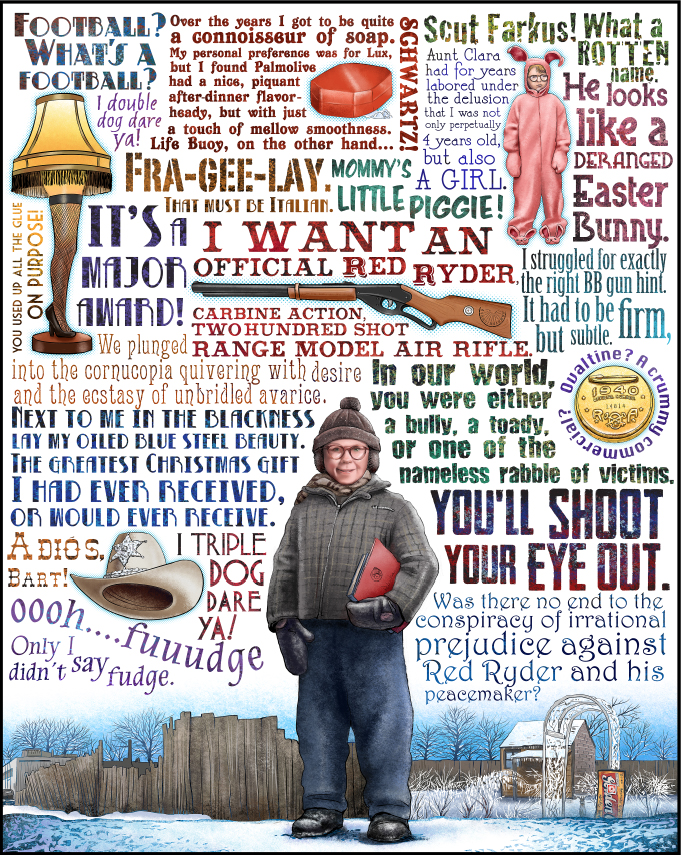
“I want an Official Red Ryder carbine action 200-shot Range Model air rifle”

Filed under: Humour, Media — Tags: , , — Nicholas @ 00:01

ChristmasStory-blog

H/T to KA-CHING! for the image.

« Newer PostsOlder Posts »

Powered by WordPress