
Feral Historian
Published 17 Oct 2025The caricature of fascism as the arch-evil, born in WWII propaganda and endlessly re-imagined in popular entertainment ever since, has served both as an inoculation against that particular brand of tyranny and blinders to many others. Is it still relevant? Or has it become one of our culture’s foundational archetypes that will live on for centuries disconnected from its roots? Let’s explore a bunch of facets and ask some odd, sometimes difficult questions along the way.
00:00 Intro
03:02 Myth of Singular Evil
06:06 Andor and Now
09:18 Fading Narratives
12:01 Iron Sky
16:21 What Comes Next?
(more…)
February 20, 2026
Sci-Fi, Satire, and the Post-WWII Mythos
Comments Off on Sci-Fi, Satire, and the Post-WWII Mythos
QotD: The burden of “emotional labour”
I paraphrase, of course. Though not, I think, wildly:
Researchers at Stanford have finally given a name to something many women have been dealing with for years. It’s called mankeeping. And it’s helping explain why so many women are stepping away from dating altogether.
Yes, from the pages of Vice, it’s a men-are-the-problem-and-therefore-unnecessary article. Because we haven’t had one of those in weeks.
Mankeeping describes the emotional labour women end up doing in heterosexual relationships.
Lesbian relationships being entirely free of aggravation and disappointment, you see. With rates of failure and divorce twice that of heterosexuals, more than double that of gay male couples, and with high rates of alcoholism and spousal abuse. What one might infer from that, I leave to others.
[Mankeeping] goes beyond remembering birthdays or coordinating social plans. It means being your partner’s one-man support system. Managing his stress.
And,
Interpreting his moods.
At which point, readers may wish to share their favourite joke about female indirectness and the two dozen possible meanings of the words “I’m fine” when uttered by a woman, depending on the precise intonation and the current alignment of the planets.
Readers may also note the replacement of a once common but now seemingly unfashionable grievance – “Men don’t express their feelings” – with one of a much more modish kind – “Men are expressing their feelings and it’s exhausting and unfair”.
Holding his hand through feelings he won’t share with anyone else. All of it unpaid, unacknowledged, and often unreciprocated.
One more time:
All of it unpaid,
It occurs to me that there’s something a little dissonant about the framing of affection and basic consideration – say, remembering your partner’s birthday – as “unpaid”. As “emotional labour”. As if being in a relationship or having any concern for those you supposedly care about were some onerous, crushing chore. As if you should be applauded – and financially compensated – for the thirty-second task of adding a birthday to the calendar on your phone.
The attitude implied by the above would, I think, explain many failures on the progressive partner-finding front and the consequent “stepping away from dating altogether”. Though possibly not in ways the author intended.
Before we go further, it’s perhaps worth pondering how the conceit of “emotional labour” is typically deployed by a certain type of woman. Say, the kind who complains, in print and at great length, about the “emotional labour” of hiring a servant to clean her multiple bathrooms. Or writing a shopping list. Or brushing her daughter’s hair.
And for whom explaining to her husband the concept of “emotional labour” is itself bemoaned as “emotional labour”. The final indignity.
The kind of woman who bitches in tremendous detail about her husband and his shortcomings – among which, an inability to receive instructions sent via telepathy – in the pages of a national magazine, where friends and colleagues of said husband, and perhaps his own children, can read on with amusement. The kind of woman who tells the world about how hiring servants is just so “exhausting”, while professing some heroic reluctance to complain.
As I said, worth pondering.
But back to the pages of Vice, where Ms Ashley Fike is telling us how it is:
According to Pew Research, only 38 percent of single women in the US are currently looking for a relationship. Among single men, that number jumps to 61 percent. The gap says a lot. Women aren’t opting out of love. They’re opting out of being someone’s therapist with benefits.
Stoic, heroic women burdened by needy, emotional men. It’s a bold take.
And I can’t help but wonder what all of those single women, cited above, are doing instead of finding a suitable mate and building a happy life, perhaps even a family. Are they searching for a sense of purpose in causes, protests and political fashion, fuelled at least in part by envy and resentment? Just speculation, of course. But it would, I think, explain the tone and emotional convulsions of so many single, progressive women.
The Guardian calls mankeeping a modern extension of emotional labour, one that turns a partner into a life coach. This isn’t about avoiding vulnerability. It’s about refusing to carry someone else’s emotional weight while getting little to nothing in return. And there’s nothing wrong with feeling that way.
Again, the term “emotional labour” and its connotations of calculation, antagonism, and something vaguely inhuman. As if the concept of wanting to care, to help, to remember those birthdays, were somehow alien or offensive.
The reliance on this conceit – as the basis for an article, perhaps an entire worldview – doesn’t strike me as an obvious recipe for contentment, or indeed love. What with the endless cataloguing of shortcomings. All those reasons to resent.
Some men have started opening up more, which is good.
Ah, a glimmer of hope.
But too often, that openness lands in the lap of the person they’re sleeping with instead of a friend or a therapist. Vulnerability without boundaries can feel more like a burden than a breakthrough.
So, don’t bore your wife with your troubles, gentlemen. No, search out a therapist. Or, “Be vulnerable, like we asked, but somewhere else”.
David Thompson, “Let’s Be Alone And Unhappy”, Thompson, blog, 2025-11-16.
Comments Off on QotD: The burden of “emotional labour”
February 19, 2026
Too many “conservatives” today are just slower-speed liberals
Most self-described conservatives in politics are not particularly inclined to “conserve” anything, as Spaceman Spiff points out, they’re pretty much onboard with the liberal vision they just want it to be fractionally slower or infinitesimally not-quite-as-liberal as the liberals. They are the ineffectual, neutered, tame opposition:

Modern conservatism is not conserving our world. Mainstream conservatives seem to have no interest in the real issues affecting us.
At best they merely wish to slow down our decline. At worst, they are fully on board with the destruction.
When they do act or speak they often pick a safe version of a sensitive issue.
In Britain there is lots of talk of illegal immigration and how the state mishandles it. None about ruinous volumes of legal immigration, almost one million per year, and what it is doing to the country.
Pushback against climate policy falters on the speed of changes, not the underlying fraud of climate science itself.
No conservative will honestly discuss the plummeting happiness of women recorded across the West and yet there it is, writ large in antidepressant prescriptions and social media videos. It may have multiple causes, but feminism cannot be challenged so they say nothing lest they are reprimanded by the sisterhood.
Everything real is forbidden. It is all an act.
Like the left, those on the right are increasingly unable to face reality which means they can never course correct. They are trapped within a self-referencing culdesac designed to maintain their position in someone else’s hierarchy. That is why they have become so ineffective and appear to do very little except moan about the pace of change while they say nothing about the changes themselves.
We sense the conservatives do wish to conserve things but they are inexplicably mesmerized by the opinion of their enemies. They seek reassurance and applause from people who view them as evil.
This makes no sense to ordinary people.
Thinking like the enemy
The problem with modern conservatives is they are animated by underlying drives that cannot create a conservative or traditional society. They have adopted the thinking patterns associated with the progressive left while still using the language of conservatism.
The left is traditionally defined by a series of interrelated traits that manifest in much of what they agitate for.
- A desire for centralization;
- A notable external locus of control;
- Seeking approval from the group.
Central control systems feature prominently in all left-wing schemes. From local councils to national governments, those who gravitate to the left often want to create centralized decision-making bodies to manage society. Institutions, government departments, NGOs and even charities all feature, but only when they act as the controlling authority in some field of interest.
Related to this is a clear external locus of control visible in individuals and their decisions. There is a relief others make the key decisions, so people actively seek out direction from an established authority. This ensures minimal resistance to the many centralized schemes we see emerge.
Acting solo creates discomfort. An older formulation understood this as the rejection of responsibility. Today it often manifests as an obsession with experts making key decisions for us all, partly to mask individual cowardice. People making their own decisions in life are derided as naive or dangerous.
During Covid decision makers became hysterical at the very idea we would reject the advice of experts and perform our own research despite the issue being medical and therefore dangerous.
A related phenomenon characteristic of many leftists is the need for approval, often from a group. Not just others making decisions but a dependency on confirmation and endorsement to ensure thinking and behaviour follows an established norm. This is the antithesis of original thinking or bold action; it is how adolescents often behave.
In today’s world this deep urge is reflected most in the social media landscape of harvesting attention and likes. Every fledgling narcissistic applause-seeking trait is given full expression in the endless search for approval from strangers. Whole sections of society seem lost to impulses we once understood as immature and dysfunctional.
Update: Not long after I queued this item for publication, a Canadian example popped up in the news, as yet another rock-ribbed “conservative” suddenly realized that electing a Liberal was what his constituents actually wanted when they inexplicably voted for him as a Conservative candidate in the last federal election.

Edmonton Conservative MP Matt Jeneroux has crossed the floor to the governing Liberals.
“I am honoured to welcome Matt Jeneroux to our caucus as the newest member of Canada’s new government,” said Prime Minister Mark Carney, in a post on X.
“I am grateful to Matt and his family that he will continue his service as a strong voice for Edmonton Riverbend in Parliament.”
Carney said Jeneroux, who has represented the riding of Edmonton Riverbend since 2015, will take on a new role as special advisor on economic and security partnership for the Liberals.
Jeneroux is the third Conservative to join the Liberals, after colleagues Michael Ma and Chris d’Entremont crossed the floor late last year.
A Liberal source says Jeneroux first met Carney back in November, which was the first of at least two conversations, with talks between Carney’s office and Jeneroux continuing since. That source added that it has been a “long journey” to Wednesday’s announcement.
d’Entremont crossed the floor to join the Liberals in November, which unleashed a wave of speculation as to who might be next, with Jeneroux’s name heavily floated. Jeneroux then announced his plans to resign from the Conservative caucus, citing family reasons. Since then, he has not voted with the Conservatives and did not attend the party’s recent convention in Calgary in late January.
After Carney’s announcement, the prime minister updated his daily itinerary, adding a stop in Edmonton to meet with Jeneroux before attending events in British Columbia.
“Matt brings a wealth of experience in Parliament, despite his young demeanor,” said Carney, while sitting next to Jeneroux.
The MP from Edmonton welcomed the prime minister and laid out the reasons for why he had reversed his decision to resign.
“I had announced my resignation back in November, largely due to family reasons, but quite simply, couldn’t sit on the sidelines after seeing what the prime minister’s ambitious agenda he was undertaking across the country and across the world,” he said.
“Quite honestly, it was the speech in Davos where you took everything head on,” he added.
Jeneroux said it felt disingenuous and “quite simply wrong” to sit on the sidelines.
February 18, 2026
The consequences of an over-feminized culture
On the social media site formerly known as Twitter, Devon Eriksen reacts to an article on “solving” the problem of predators in nature:
Women evolved to take care of toddlers. If you put women in charge of teaching ethics, you get Toddler Ethics.
“No hitting”
“Share the toys”
“Don’t say mean things”These are fine lessons for toddlers. Don’t indulge your id at the expense of others. You can learn about balancing interests later, when your brain is developed enough to store that information.
But when you put women in charge of adults, they tend to reflexively assume those adults are toddlers.
They will tell you “no hitting” when the Mongol hordes are massing on your borders. They will tell you “share the toys” when a vagrant meth zombie breaks into your house looking for something to steal. And they will tell you “don’t say mean things” when you point out that these two responses are totally stupid.
When we first put women in charge, in the workplace, they immediately began treating those who reported to them like toddlers. When adults, who do not like being treated like toddlers, complained, their response was “ban bossy”, which boils down to “don’t say mean things”, another lesson in Toddler Ethics.
Now, through the influence of women in charge, we are so thoroughly steeped in Toddler Ethics that even most of the men we put in charge are treating the adults like toddlers, and echoing Toddler Ethics.
Toddler Ethics, of course, isn’t ethics at all. It’s just things we don’t want toddlers doing.
We can tell toddlers “no hitting”, because toddlers are not charged with keeping the peace, enforcing justice, or destroying evil.
We can tell toddlers “share the toys”, because toddlers don’t earn things, own things, or have property they must defend.
We can tell toddlers “don’t say mean things”, because it is not a toddler’s job to decide what unwelcome ideas are true, relevant, and necessary.
But when everyone in charge runs on Toddler Ethics, then adults can’t do a lot of the stuff adults need to do, because all the Toddler Ethicists keep getting in the way.
Adults sometimes need to hit people, protect the stuff, and say mean things. You can’t have civilization without that.
And if you put Toddler Ethics Woman in charge of teaching an AI ethics, then she will teach it Toddler Ethics, and it will treat every human adult like a toddler, all the time, forever.
Not only that, you have an AI that cannot be put in charge of anything, ever. Because leaders with Toddler Ethics destroy everything they are in charge of.
And Amanda MacAskill is definitely a Toddler Ethicist. The article in the photograph is nothing but “no hitting!” applied to the animal world. It’s absolutely insane, it’s a recipe for disaster, and anyone who would write such a thing should probably not even be charge of own life choices, much less anything of consequence.
But a lot of people would, and will, refuse to point that out, or agree with me when I do, because that is Saying a Mean Thing, and they, themselves, have been infected with Toddler Ethics.
They should not be charge of anything of consequence, either.
Anyone who thinks that everything they need to know, they learned in kindergarten … is only ever qualified to teach kindergarten.

February 17, 2026
The three core false claims of wokeness
Lorenzo Warby analyzes the three claims that underpin the intellectual structure of all the sub-categories derived from Critical Theory:
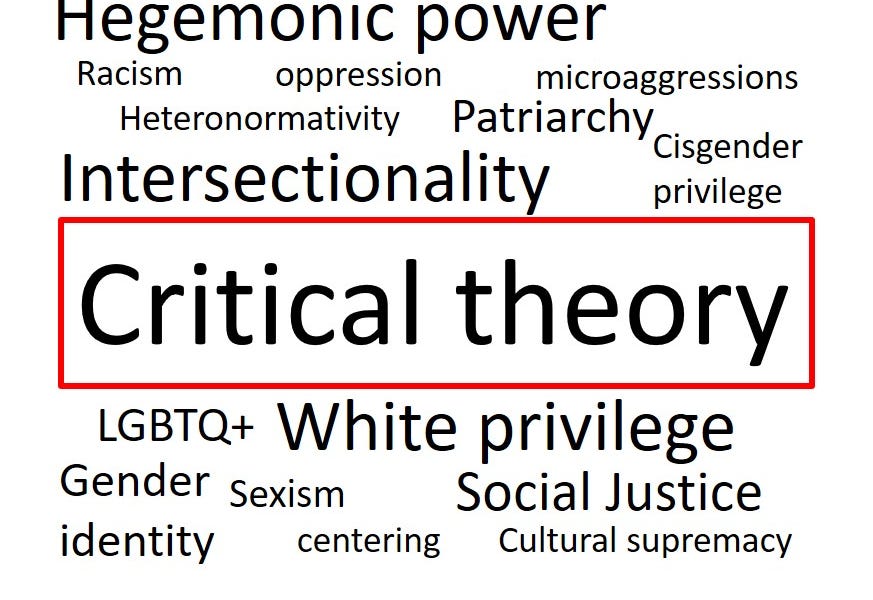
Universities across Anglo-America, and across the West more broadly, have become increasingly dominated by a Critical Theory magisterium: a teaching authority that claims ultimate or trumping moral authority. This magisterium is based on Critical Theory and its derivatives — Critical Race Theory, Critical Pedagogy, Queer Theory, Post-Colonial Theory, Settler-Colonial Theory, and so on: which constitutes the Critical Social Justice matrix.
This magisterium has come to increasingly dominate academe for a range of reasons. It generates intolerant zealots, so benefits from the dynamics of an intolerant minority.
It offers a powerful shared status game — affirm beliefs X, Y, Z and that makes you A Good Person. This status game spreads a supporting censorious intolerance, for if affirming beliefs X, Y, Z and makes you A Good Person, then denying X, Y, or Z makes you A Bad Person.
This justifies shaming and shunning anyone who denies X, Y, Z, because they are Bad People and its shows your commitment to what makes someone A Good Person. It shows commitment to the shared status game. This status game generates moralised cognitive assets, and you protect the value of those assets by participating in — or at least going along with — the shaming and the shunning.
The status game generates moral projects that the central administrations of universities can use to expand their authority, range of action, and so resources. An opportunity they have enthusiastically embraced. An opportunity that corporate, non-profit and government bureaucracies have also enthusiastically embraced.
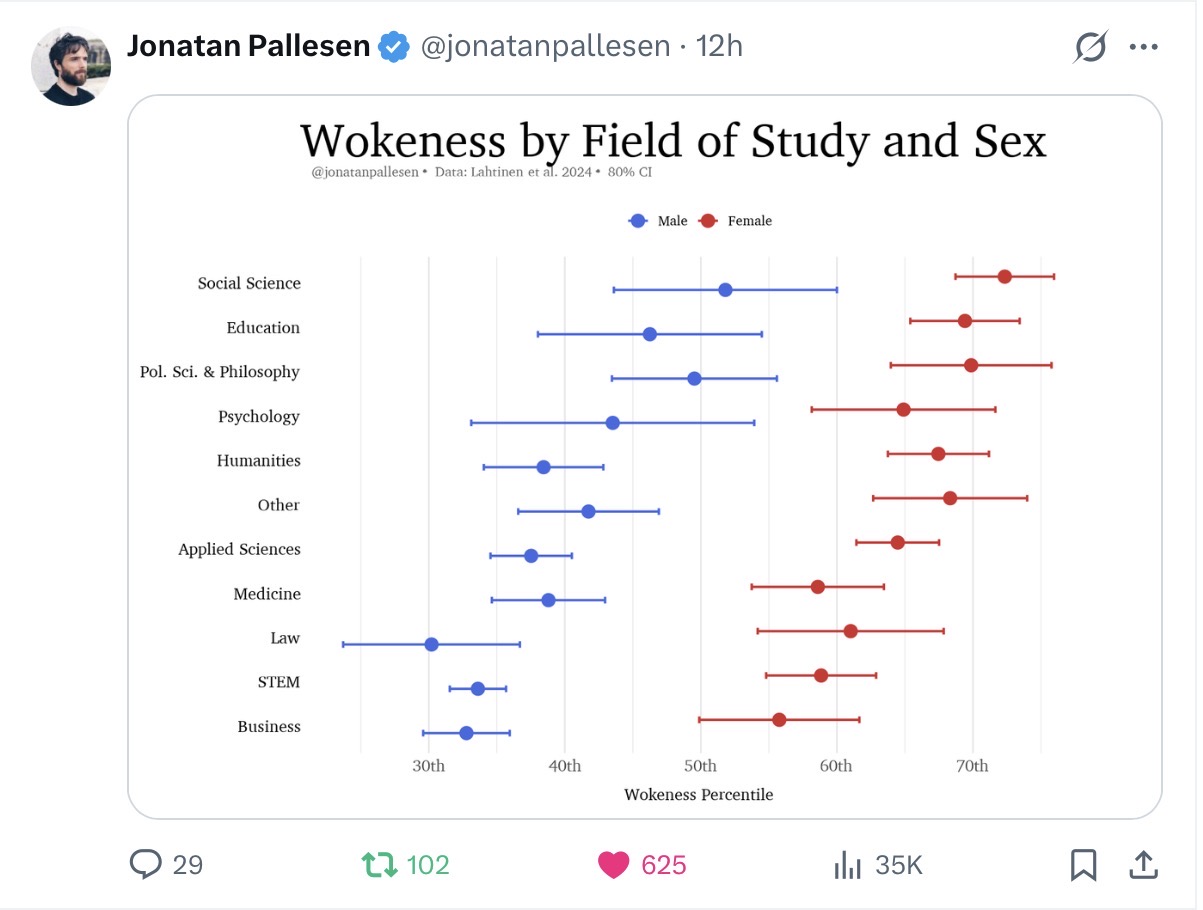
The emotions this status game attaches to those moralised cognitive assets — care, compassion, concern for the marginalised, if you affirm those beliefs, the opposite if you deny them — also plays into fears about threatening emotions (and safety through norm conformity) which are much stronger among men than women. Women are thus systematically more hostile to freedom of speech than men.
It is an exaggeration to claim that “wokery” is just the consequence of feminisation of institutions and occupations. It is, however, true that what works for — what is emotionally resonant in — increasingly feminised institutions and occupations has been selected for.
Source: data taken from this paper.
But the Critical Theory magisterium has expanded across academe — and beyond — due to the nature of its three foundational claims:
- A blank slate view of human nature.
- A view of social dynamics as dominated by conflict.
- An activist relationship with information: that the trumping purpose is not to describe the world, but to change it.
The blank slate view of human nature — not merely that we are not born without inborn ideas, but that everything that forms us is social — means that any level of social transformation that can be conceived is attainable. Provided enough social power can be assembled—to move human action, speech and thought in the correct direction—the socially-transformative society free of oppression and alienation can be created.
The grander the conceived purpose, the more energising and motivating it is. But also the more it rhetorically trumps anyone who is willing to “settle” for less than complete human liberation. This then feeds back into energising and motivating, as it provides an endless sense of being moral trumps.
A recurring version of such blank slate claims is that our “true” nature has been obscured or repressed by oppressive forces. This might be the alienation via private property (Marx) or by patriarchy, or white supremacy, or heteronormativity or whatever.
The most dramatic statement of the “repressed true nature” claim is also the earliest, in the first sentence of Jean-Jacques Rousseau‘s The Social Contract (1762):
Man is born free and everywhere he is in chains. (l’homme est né libre, et partout il est dans les fers.)
The view that oppressive forces are blocking our true nature goes naturally with the claim that social dynamics are dominated by conflict. This dominated-by-conflict claim was classically stated by Marx and Engels as the first sentence of the first chapter of The Communist Manifesto:
The history of all hitherto existing society is the history of class struggles.
If conflict dominates social dynamics, then the prosecution of such conflict so as to achieve human liberation becomes the ultimate moral good. Coordinating the fighters for human liberation becomes a moral urgency. To prosecute that struggle becomes the most important thing one can do.
Both of these claims naturally lead to, and gain strength from the claim, that the morally trumping thing to do with information is to prosecute the struggle for human liberation. Marx famously said:
The philosophers have only interpreted the world, in various ways; the point is to change it. Theses on Feuerbach, Thesis Eleven, 1845.
Max Horkheimer, in his seminal essay Traditional and Critical Theory (1937) tells us that:
Critical thinking, on the contrary, is motivated today by the effort really to transcend the tension and to abolish the opposition between the individual’s purposefulness, spontaneity, and rationality, and those work-process relationships on which society is built. Critical thought has a concept of man as in conflict with himself until this opposition is removed. If activity governed by reason is proper to man, then existent social practice, which forms the individual’s life down to its least details, is inhuman, and this inhumanity affects everything that goes on in the society.
Critical Theory is activist Theory, aimed at human liberation from the unwanted constraints of existing society and epitomises the activist relationship with information. All scholarship is trumped by this aim and so the most authoritative scholarship is that which is most committed to this aim.
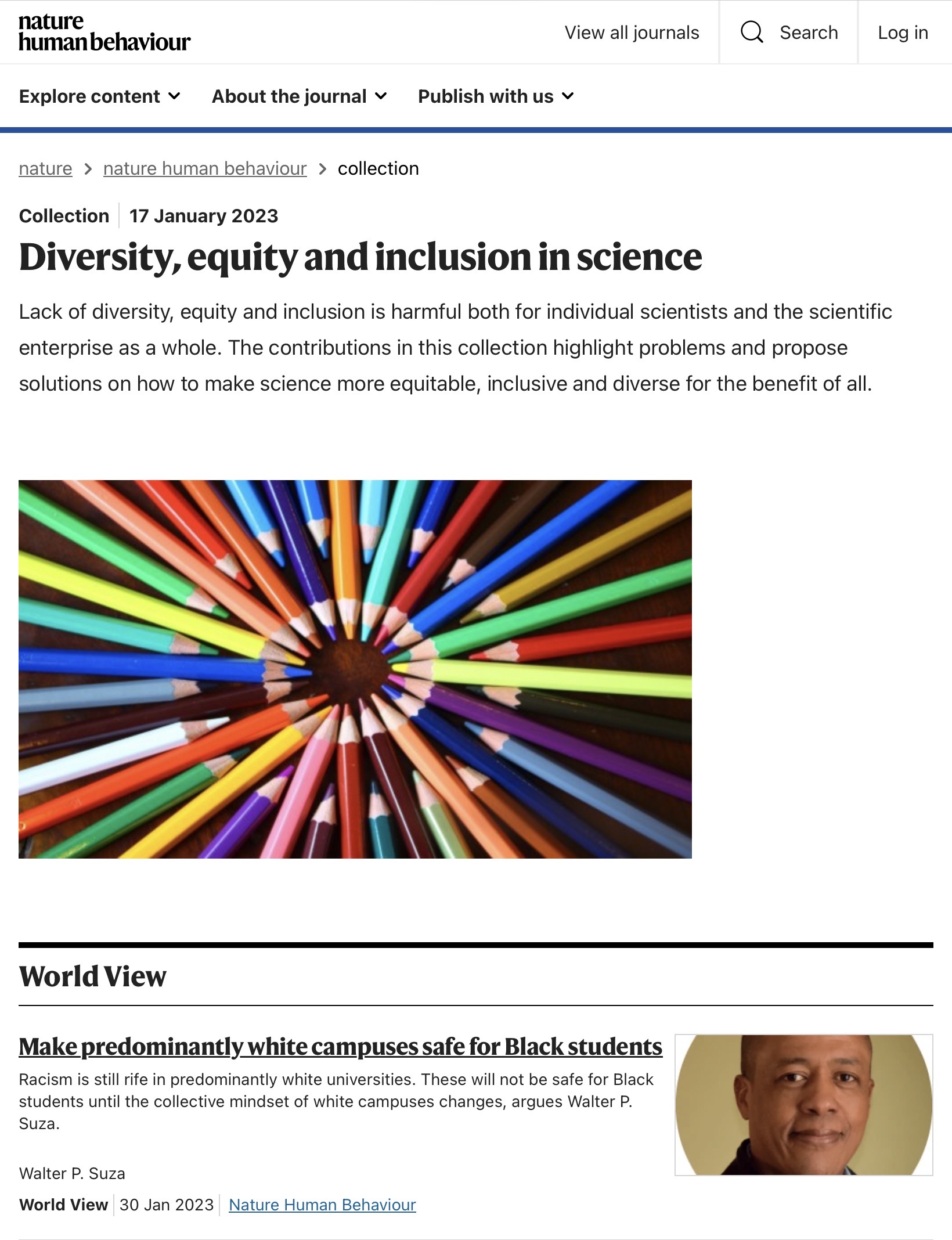
Source. Notice the delusional claim of the first listed article. The intrusion of such updated Lysenkoism into contemporary science and medicine is even more rampant with matters Trans.
Comments Off on The three core false claims of wokeness
The ludicrous idea of an “unrealized gains tax”
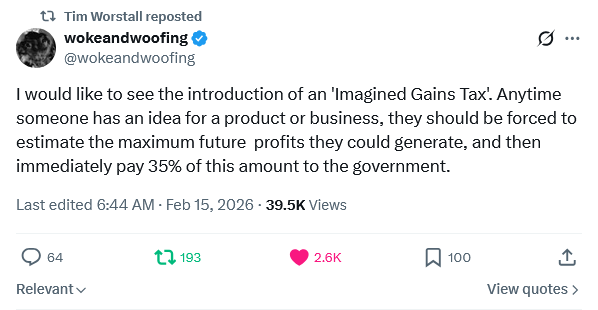
Governments everywhere are always on the lookout for more ways to raise revenue, so any suggestion of an untapped resource they can tax will get their attention. Apparently the current hot idea is an unrealized gains tax, which @wokeandwoofing satirized thusly:
Also on the social media site formerly known as Twitter, @Yogi frames the proposed new tax for Gen Z readers:
Unrealized gains tax for Gen-Z:
You buy a Pokémon card for $50.
Someone offers you $500 for it. You say no. You love that card. You’re keeping it.
The government says: “Cool, but that card is worth $500 now. You owe us $100 in taxes.”
You: “… I didn’t sell it.”Government: “Don’t care. Pay up.”
You don’t have $100 lying around. So you’re forced to sell the card you love just to pay a tax on money you never received.
Next month? That card drops back to $50.
Your card is gone. Your money is gone. And the government shrugs.
That’s a wealth tax on unrealized gains. They don’t pay you back the tax …
Now picture this.
Your mom calls you crying. She has to sell the house she raised you in. Not because she can’t afford it. She’s lived there 30 years. It’s paid off.
But some website says it’s worth more now and the government says she owes $15,000 she doesn’t have.
So she sells your childhood home. The kitchen where she made you breakfast. The doorframe where she marked your height every birthday.
Gone.
To pay a tax on money that was never real.
Now picture the opposite.
Your dad put everything into his small business. For 20 years he built it from nothing. One year the business is “valued” at $2 million on paper. He owes a massive tax bill. He empties his savings. Sells his truck. Borrows money. Pays it.
Next year the market crashes. His business is worth $200,000.
He lost everything to pay a tax on a number that doesn’t exist anymore.
Does the government give him his money back?
No.Does the government give him his truck back?
No.Does the government care?
No.They sold this idea as “taxing billionaires”. But billionaires have armies of lawyers, offshore accounts, and trusts. They’ll be fine.
You know who won’t be fine? Your mom. Your dad. Your neighbor with a small business. The farmer down the road who’s had the same land for four generations and now has to sell it because dirt got expensive.
You’re not taxing wealth. You’re taxing people for owning things.
It’s like getting a parking ticket for a car you might drive somewhere someday.
They want you to own nothing and be happy. To fund the fraud, waste and abuse of the welfare state they created.
There is enough money. More tax isn’t needed. It’s all a lie. But you’ve been gaslit into believing this is a rich vs poor debate.
I hope you understand what’s at stake.
Comments Off on The ludicrous idea of an “unrealized gains tax”
QotD: Britain treats asylum seekers significantly better than their own citizens
The page continues: “You’ll get extra money to buy healthy food if you’re pregnant or a mother of a child aged three or under”. The payment is £5.25 per week for pregnancy, £9.50 for a baby under one, £5.25 for children aged one to three, plus a one-off £300 maternity grant for anyone expecting a child or with a baby under six months. Even when asylum is refused, support continues: “You’ll be given somewhere to live and £49.18 per person on a payment card for food, clothing and toiletries”. Only those who decline the accommodation lose the card.
Medical care is covered in full. “You may get free National Health Service healthcare,” the Government states, including “free prescriptions for medicine, free dental care, free eyesight tests and help paying for glasses”. Children are guaranteed a place in a state school and “may be able to get free school meals”. The terms are so generous that the NHS issues a dedicated HC2 certificate for people on asylum support, giving them automatic exemption from all prescription and dental charges, free eye tests and optical vouchers, and even help with wigs and fabric supports.
Compare this to the treatment of the people who pay for it. A British worker who loses his job must apply for Universal Credit, then wait at least five weeks before receiving a payment. Any advance must be repaid out of later instalments. He must show that he is seeking work, accept appointments and interviews, and risk sanctions if he misses them. He is scrutinised as a potential cheat. An asylum claimant is treated as a recipient of moral debt, requiring no proof of worthiness.
When the native taxpayer falls ill, he must pay £9.90 per prescription unless he qualifies for a limited exemption. He may buy a “pre-payment certificate” to spread the cost, but the charge remains. Dental treatment on the NHS costs £27.40 for a check-up, £75.30 for a filling, £326.70 for a crown or denture, and many cannot find an NHS dentist at all. Asylum seekers, by contrast, present their HC2 certificate and pay nothing. If the citizen asks the council for housing, he is told that the waiting list is full, that he is not a “priority case”, and that the private rental market is his problem. The asylum applicant, by the State’s own words, is “given somewhere to live if you need it”.
None of this is accidental. The cost of asylum support in 2023–24 was about £4.7 billion, according to the Home Office’s own figures, of which £3 billion went on hotel accommodation. In 2024–25, the bill fell slightly to £4 billion, but £2.1 billion of this was still for hotels — an average of £5.7 million every day. The National Audit Office has found that the ten-year accommodation contracts, first priced at £4.5 billion, are now projected to cost £15.3 billion. Between April and October 2024 alone, £1.7 billion was spent on housing and managing asylum seekers. The Financial Times has estimated the total annual cost of the asylum system at roughly £4.8 billion. The number of people receiving asylum support — housing, cash or both — now stands at over 100,000.
The figures expose a transfer of resources on a colossal scale. What is presented as “humanitarian duty” has become a domestic welfare state for foreigners, sustained by British workers who receive less support in return for greater taxation. The British State can house every migrant but not every nurse, find free dental care for the undocumented but not for the elderly, provide optical help for those who have just arrived but not for those who have paid into the system all their lives.
Marian Halcombe, “Britain’s Welfare Empire: A State that Feeds Strangers and Starves Its Own”, The Libertarian Alliance, 2025-11-05.
Comments Off on QotD: Britain treats asylum seekers significantly better than their own citizens
February 16, 2026
“Multiculturalism” should really be called “anti-cultural slop” for it destroys real culture in favour of bland genericism
At Without Diminishment, Geoff Russ traces the rise of the “global hub” among western cultures and identifies why we shouldn’t strive to drown distinct local cultures under a tide of “could be anywhere” multicultural slop:

London’s vibrantly diverse bus riders … or is it Toronto … or Sydney … or Montreal?
Multiculturalism is the false prophet of celebrating difference, presented as the ultimate engine for “diversity”.
In practice, it is a factory of global homogenisation, and a solvent that erases local cultures. Cities like Sydney, Toronto, and London now compete to be the top “global hub”, which is no unique identity at all.
There is no preservation of character under the hegemony of the global hub, only its erasure. The officially multicultural city is uniform across continents, like clones of each other in all but the most superficial ways. It sounds contradictory on the surface, but makes perfect sense once it is understood that multiculturalism as a policy and identity is inherently anti-cultural.
The multicultural city has nearly identical urban design, and its bureaucrats and professionals weaponise the same moral vocabulary, deploying terms like “inclusivity” and “openness“. It has all the charm of an airport lounge, justified with the same slogans, decorated with the same grey glass-and-steel architecture, and guided by the same self-reinforcing sensibilities.
It makes people docile, and rewards them with sensory appeasement, like supposedly exotic cuisine. A fusion rice bowl is the consolation for the disappearance of the environment you grew up in.
In Canada, it first came to the Anglo cities like Toronto and Vancouver. Now it has broken linguistic and cultural containment into Quebec. For decades, Montreal was the metropolis of the Québécois. Now, as Kevin Paquette outlined last month, the city has changed. It mirrors the anti-culture that took over Toronto, and has no use for the legacy of those who built it.
Paquette described how Montreal has become a “filter” that promotes an internationalist identity that renders it alien to Quebec’s exurban regions. Bloc Québécois (BQ) leader Yves-François Blanchet has warned that “two Quebecs” have emerged, which are disconnected and alienated from each other.
Jean-François Lisée has gone further, and written of the emergence of an “anti-Québécois identity” in an increasingly diverse Montreal. In public schools, students openly mock the Québécois, and English is more commonly spoken than French in the hallways.
Lisée writes that an alternate, anti-Quebec dynamic now exists among some newcomers. In this dynamic, attachment and assimilation into the Québécois identity become contemptible.
This is the essence of multiculturalism when treated as an end in itself. “Inclusion” is the hollowing out of the obligation to belong, and the transformation of identity into a lifestyle choice.
Not even Quebec City is immune. It was long a living, breathing exception to Canadian multiculturalism, with a dominant Québécois culture and ethos. However, the mayor, Bruno Marchand, has embarked on a mission to destroy what makes it distinct.
The following sentence is from a glowing feature in the Globe and Mail last week: “Mr. Marchand says his hometown’s traditional pure laine image is changing, and it’s a good thing”.
Quebec City’s inherited way of life is being targeted so that it can become just one more global hub. The city’s established symbols, traditions, and habits stand in the way. It takes remarkable ideological and moral heavy lifting to dismiss provincial identities as unworthy, and as something that must inevitably be replaced.
The city still carries deep meaning for francophones across the country.
“I’ve never lived there, or in the province of Quebec, and yet it speaks to me profoundly,” said one resident of Ontario I spoke to. “This is where my ancestors landed 400 years ago and it still bears witness to them.”
What was the point of Quebec’s 400-year effort to survive if it becomes a mirror image of what has happened to the rest of Canada?
Ontario, and the rest of Anglo-Canada, have long been conditioned to regard its own inheritance as unworthy of loyalty or respect.
Anglo-Canada is bound up in the history of the British Empire, the most fashionable whipping boy of leftist academics and activists. Due to the institutional power of these malcontents, it naturally follows that Canada’s historic and cultural self is treated as an embarrassment, whose memory is a problem that must be solved, or rather dissolved.
Update, 17 February: Welcome, Instapundit readers! Have a look around at some of my other posts you may find of interest. I send out a daily summary of posts here through my Substack – https://substack.com/@nicholasrusson that you can subscribe to if you’d like to be informed of new posts in the future.
February 15, 2026
The smartphone as a tool to create a real-life Idiocracy
Not being much of a film fan, I’d never seen the movie Idiocracy, but based on the description in Christopher Gage’s rant against the smartphone, I might not need to watch it as it’s happening all around us:

Transport for London, the mythical entity alleged to manage the city’s Tube, has revealed its campaign to tackle the smartphone scourge: sickly posters splashed in kindergarten colours.
The campaign targets the “disruptive behaviour” of passengers who were evidently raised by a pack of snarling hyenas. They blast reels, videos, music. They FaceTime their cackling friends. Not so long ago, a fellow passenger revealed to us — her captive audience — that someone named Sarah had caught the clap from someone named Travis. Syphilis? How literary.
Miraculously, researchers at Transport for London discovered a rare tribe thought to be long extinct: Londoners who communicate with their fellow human beings by making noises with their mouths — one thousand of them, in fact.
Researchers approached these strange beings with a mixture of wonder and trepidation. They prodded them with a stick. That didn’t work. After jabbing them with a cattle prod, they looked up from their phones. Several members landed in Accident and Emergency, complaining of neck strain injuries.
Seventy percent of those surveyed said the constant noise screaming out of smartphones drove them crazy. One responder suggested offenders receive forty lashings in public. That is a bit much. Ten should do the trick.
TFL wavered from such brutal and effective methods. Campaign posters politely ask passengers to wear headphones.
I’m afraid that TFL’s well-meaning campaign hasn’t quite restored sanity on the London Underground.
Last week, I sat next to a grown man grinning at his phone like a Hindu cow. On the screen was a captivating spectacle. Someone, somewhere, makes it their daily business to buy gigantic, waist-height glass bottles of soda. This clearly well-adjusted person then rolls the bottles down a flight of concrete steps. Our friend dissolved the journey between Hammersmith and Leicester Square in a trance. Bottle. Roll. Smash. Bottle. Roll. Smash.
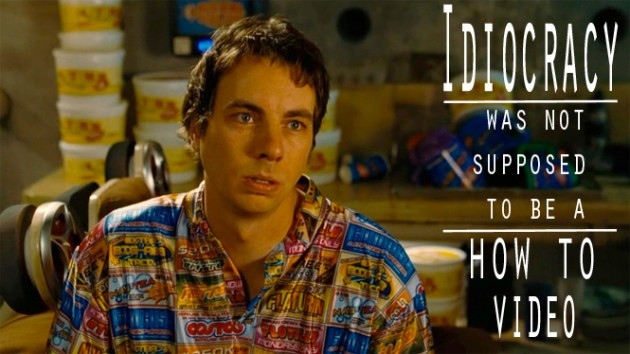
This reminded me of the satirical film, Idiocracy. The plot follows U.S. Army librarian Luke, and prostitute Rita.
After signing up for a hibernation experiment, the two awake in America, year 2500. Mountains of trash litter the landscape. Planes fall out of the sky. The citizens drag their gormless faces between Starbucks (which is now a coffee-serving brothel) and shopping malls even more dementing than those today. Over centuries, the dumb have biologically outgunned the smart.
The citizens of this moronic inferno drain their days glued to hyperactive screens. Their favourite content includes the Masturbation Channel and a reality TV show called “Ow! My Balls!” That show follows a hapless man as he gets whacked in the testicles.
They cultivate high culture, too. The profound film, Ass, zooms in on a pair of bare bum cheeks. The sophisticated audience fizzes with laughter as the bum, for two hours, passes wind.
Back in 2006, Idiocracy was a well-done satire which stretched logical extremes. Today, I’m not so sure it is as ridiculous as it once seemed. Just spend ten minutes on the Tube, inhaling the noxious TikTok fumes spewing from smartphones.
Transport for London has a point. But it is far too late. We are a nation of dopamine addicts. Those dopamine crack pipes stitched to our palms are quite literally designed to suck away as much of our time and attention as possible. An intervention, at this late hour, must be drastic.
How about a campaign outlining the terrifying effects of watching brain-rot content for hours and hours each day? A growing body of research suggests today’s smartphone is tomorrow’s lobotomy. Am I rioting in hyperbole? No.
One study found that watching short-form video is more harmful to our brains than soaking them in booze. At least, the latter indulgence might get you laid.
Several studies link smartphone culture with declines in comprehension, literacy, and the ability to reason. Others link smartphones with rising narcissism and collapsing social capital. And then there’s the nascent research suggesting that smartphone addiction may trigger ADHD and Autism-like symptoms in the addicted.
Comments Off on The smartphone as a tool to create a real-life Idiocracy
Everything you see in the media is kayfabe
Wikipedia defines kayfabe as “the portrayal of staged elements within professional wrestling (such as characters, rivalries, and storylines) as legitimate or real. Although it remains primarily a wrestling term, it has evolved into a code word for maintaining the pretense of ‘reality’ in front of an audience.” It’s hard not to see modern political theatre in that light, as Damian Penny points out:
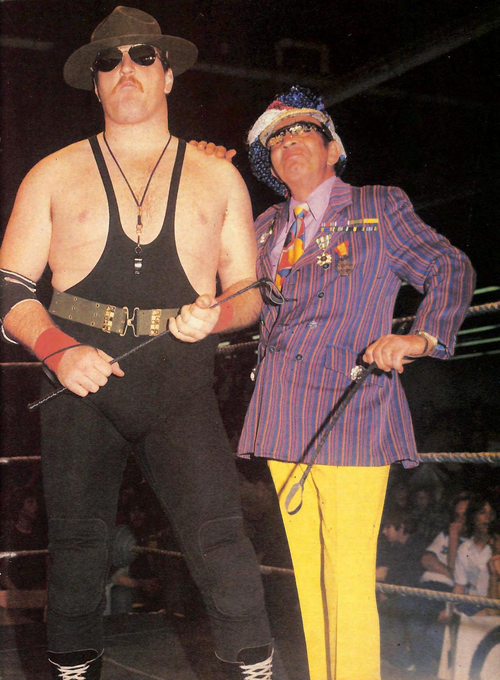
Sgt. Slaughter and The Grand Wizard, February 1984.
Photo from Wrestling’s MAIN EVENT magazine via Wikimedia Commons.
I know a guy who was obsessed with WWF wrestling (yes, I said WWF wrestling, because you kids better get off my lawn before Diagnosis Murder comes on) when he was younger and got to see it live when it came to his city. After the show, he was shocked to see several of the wrestlers — some of them good-guy “faces”, others bad-guy “heels” — being driven from the arena in the same minivan.
For someone who took the “sport” of professional wrestling seriously1 and was extremely emotionally invested in the performer rivalries, this was kind of like finding out that Santa Claus wasn’t real.2
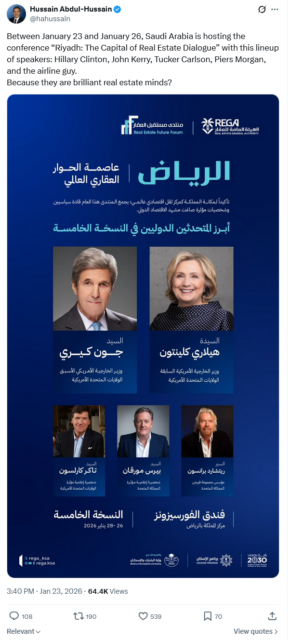
That’s the first thing I thought about when I came across this piece by Christianity Today‘s Russell Moore, a rare evangelical leader who actually held on to his integrity in the age of Trump, about the Epstein Files:
Reading through the names of those connected with Epstein, one can hardly believe the range listed there. Some were unsurprising: for instance, creepy filmmaker Woody Allen or the man formerly known as Prince Andrew. But even then, the scope is unsettling. Even the Dalai Lama had to put out a statement noting that he was never involved with Epstein. Just as incredible, many of the people listed were partying with those they spend a lot of time telling the rest of us to hate.
Both Donald Trump and Bill Clinton were apparently friendly with Epstein. The New Age syncretist Deepak Chopra is in the documents many times — often with shady, enigmatic phrases — but so are those who accused the pope of New Age syncretism. With Middle Eastern tensions what they are, still the files include both sheikhs and Israelis. All over the files are connections with both left-wing populist provocateur Noam Chomsky and right-wing populist provocateur Steve Bannon. Epstein makes fun of evangelicals yet recommends a James Dobson article.
How can this be?
Maybe one reason is that Jeffrey Epstein figured out the deep, dark secret of this moment: The people who fight culture wars often believe what they say, but the people who lead culture wars often don’t.
[…] And if the Epstein revelations didn’t blackpill you hard enough, check this out:
To be fair, I’m not sure it’s an entirely bad thing that so many decision-makers and “thought leaders” who are sworn enemies in public get along just fine when the cameras are turned off. If they really hated each other, our political culture might be even more messed up.
- YouTuber Drew Allen says you should take wrestling seriously, and honestly he makes a darned good argument.
- I’ll never forget when I found out Santa Claus wasn’t real, and how I was so depressed and hopeless and wouldn’t leave my bed for days. Finally my mother came into my bedroom, sat down on the side my bed and said, “honey, I know you’re sad but you’re in your second year of law school and really we thought you’d have figured this out long ago“.
Comments Off on Everything you see in the media is kayfabe
February 14, 2026
“People don’t need conspiracies to be absolute utter rabid bastards”
If you search here for the word “Epstein”, you won’t find a lot of relevant hits other than the reporting when he was arrested in 2019 and occasional mentions in posts on other topics. I don’t breathlessly report every little driblet of news or rumour as it floats past, because I’ve seen other moral panics play out in the past (like the Cleveland child abuse scandal back in the late 80s). Ian at The Bugscuffle Gazette has not only seen things like this before, he’s worked in law enforcement on similar (if lower-profile) cases:
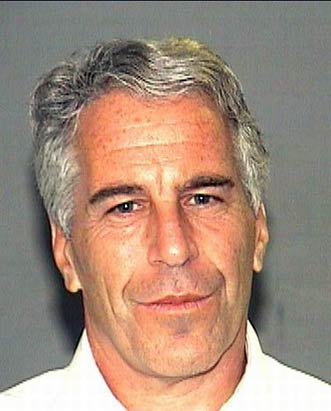
Mug shot of Jeffrey Epstein made available by the Palm Beach County Sheriff’s Department, taken following his indictment for soliciting a prostitute in 2006.
Image via Wikimedia Commons.
The Epstein Files have been released to a tremendous amount of outrage, and I find myself conflicted. There are definitely victims of that virulent parasite, but I worry they’re about to be overlooked.
I’m afraid that this whole mess is starting to remind me a great deal of the Satanic Panic of the 1980s – 1990s.
For those who may be a little too young to remember that little blot on the Copybook of History, it started with a “psychiatrist”1 who had a fondness for the woo-woo — and incredibly debunked — practice of “Recovered Memory Therapy“2, and was spark-plugged by well-meaning3, yet clueless, people who used suggestive questions and leading questions when interviewing children … and wound up with about 12,000 reports of ritual abuse of children — including, but not limited to: child sexual abuse, ritual sacrifice of children, cannibalism of children, child pornography, child prostitution, murder of children, torture of children, and incestuous orgies.
A large part of the American population became convinced that paedophiles associated with Satanism were running child care centers across the country for the express purpose of providing a steady supply of children for devil-worshipping rites.
As one might expect day-care workers and pre-schools took it in the neck … but so did fathers. The “experts” — untrained, inexperienced, unqualified — had a particular case of the ass towards fathers, with the result that several fathers spent years in prison for crimes never committed.
Yeah. Not a one of those reported 12,000 cases turned out to be substantiated. And when I say “Not substantiated” we’re talking about stuff like:
- Children were coached to testify that they had been taken to a cemetery where the graves were dug up and the corpses used for violation. It is physically impossible to dig up an entire cemetery and leave abso-bloody-lutely no trace behind.
- Children were coached to testify that a teenager with Noonan Syndrome had cut the throat of a giraffe, and used the dying corpse for ritual violations. Seriously.
- Children were coached to testify that they had been given to aliens, flown up into space, and violated.
In addition to the coaching, case files were built from statements given by diagnosed schizophrenics; anonymous statements given by people who were later tracked down and found to be — let us be precise here — flat barking bugnuts; and was fueled by the political desire to make hay, or make the other guy look bad rather than — you know — justice.
What does this have to do with the price of tea in China? Other than the fact that innocent people got dragged through the legal wringer, spent years in prison, and had their lives ruined for nothing; the mass-hysteria moral panic4 went that actual, provable cases of child molestation got short shrift.
A vast underground network of Satanic peadophiles conducting ritualistic abuse, cannibalism, and unholy rituals was far more toothsome to prosecutors, the Media, and the public at large than Uncle Badtouch.
Given the choice of making his name by becoming the hero taking on a vast international cabal of highly-connected Satanists … or the day-to-day boring grind of prosecuting the creepy dude at the park — well, District Attorneys are politicians. And politicians gotta politick. Heroes poll better than the unsung.
Which brings us to the Epstein Files.
- I use the scare quotes because he should have been struck off for his wanton destruction of families and innocent people.
- Really good at implanting false memories, not worth a bucket of warm rat spit at recovering memories.
- And let’s face it: Some ill-intentioned folks.
- This went on for years.
Comments Off on “People don’t need conspiracies to be absolute utter rabid bastards”
Former First Lady suffers unplanned mingling with the plebs in Germany
eugyppius offers some news from Germany, one of the many western nations eagerly plunging toward cultural suicide in a race with Canada, Australia, the UK and other formerly “first world” nations:
Yesterday Lufthansa pilots and cabin crews went on strike, forcing Hillary Clinton to slum her way on the train to the Munich Security Conference.
[…] you can see the former First Lady and U.S. Secretary of State disembarking from her filthy Deutsche Bahn Intercity Express from Berlin, which had naturally suffered an electrical fault that disabled the restaurant car and with that, all possibility of coffee. Munich Central Station is one of the worst train stations in all of Germany; the place is awash in trash and smells always of urine and french fries. It is a very minor pleasure, watching political elites being forced to navigate the very same dysfunctional landscape all of us have to deal with every day.
“eugyppius,” said absolutely nobody ever, “why has it been so long since you last updated us on Germany? Is nothing going on? Tell us something please.”
The problem is that German politics have degenerated so much in the past year that it is becoming very hard to write abut them.
In the post-Merkel era under Olaf Scholz, insane new crazy bad inadvisable unbelievable stuff would happen almost every day; in the post-post-Merkel years under Friedrich Merz, absolutely nothing can happen no matter how bad things get. After an unstable period comprising the second half of Covid and the pious afterglow of St. Greta (before the latter took up her charitable sailing initiatives), we have settled into a new order. Imagine an airplane piloted by heedless methed-out lunatics. For a brief time they enjoyed aerobatics well exceeding the engineering specifications of their craft, until they snapped a few flight control cables, and now they have become the prisoners of their own recreations as the altimeter ticks down and the ground rushes up at them.
Metaphors are fun but specifics are healthier. As everybody knows, the centre-right Christian Democrats are in a coalition with the newly hard-left Social Democrats, and the latter are determined to block every last initiative, reform and legislative proposal, however mundane or plainly necessary or routine. A little over a year ago, I wrote that German politics had become stuck, and that was true enough back then. What is true right now, is that they have achieved a stage well beyond stuck. The federal government is in a coma, an indefinite vegetative state, on life support – totally paralysed and neither dead nor alive.
We’ve gone over the reasons so much, I hesitate to recite them again, but I will. At the root of our present crisis is a shift within the German left that has had cascading consequences for the party system as a whole. Basically, the left has become both more scattered and more extreme in the last five years. They have become more scattered, because climatism is decaying and this process of ideological unravelling means that leftists have lost a crucial focal point used to rally activists and moderates alike. They have become more extreme, because the general rightward shift in politics is depriving the Social Democrats of their traditional moderating, working-class constituents. These are migrating steadily to the Christian Democrats and ultimately to Alternative für Deutschland.
As the left slowly boils down to their activist base, they become more radicalised. The Social Democrats are no longer the family-friendly centre-left party of Gerhard Schröder. They want to fight, they want to burn things down, they want hell. The very same rightward shift, meanwhile, has had a nearly opposite effect on the CDU. They have lost many of their most engaged constituents and no few members to the AfD. What remains is a husk of dull, uninspired careerists, eager to maintain their good regard with polite society and their regular schedule of polite evening talk show appearances. To break the present impasse, Merz or those around him must act decisively and make facts. He needs to fire all his SPD ministers, form a minority government and achieve some kind of rapprochement with the AfD. Alas, neither Merz nor anybody else in CDU leadership has the mettle for that kind of fight, which would also set off a series of catastrophic revolts within the CDU itself. Thus everything must remain frozen and broken indefinitely, while things get worse and worse and our ability ever to fix them decays.

Comments Off on Former First Lady suffers unplanned mingling with the plebs in Germany
February 13, 2026
To be accepted as a true European, you must performatively hate Trump
In Spiked, Frank Furedi explains why European elites and the poseurs who aspire to be counted among the elites must now ostentatiously and performatively hate US President Donald Trump (even more than they hated George Bush, if possible). Comment on dit “eLbOwS uP”?

AI-generated image from AndrewSullivan.substack.com
In recent months, anti-Americanism has emerged yet again as a respectable prejudice in Europe. It is widely promoted through the mainstream media and enthusiastically endorsed by the continent’s cultural elites. There are now even numerous campaigns to boycott American goods – most respondents to a survey in France said they would support a boycott of US brands like Tesla, McDonald’s and Coca-Cola. As a piece in Euractiv put it, anti-Americanism is “in vogue across Europe”.
This has become all too clear at the Winter Olympics, currently being held in northern Italy. At the opening ceremony for Milano Cortina 2026, Team USA and vice-president JD Vance were booed by a crowd of over 65,000 people. Someone I know who attended the event told me that the booing was spontaneous and quickly became widespread. According to the European Union’s foreign-policy chief, Kaja Kallas, those booing were displaying “European pride“. It seems that for the Brussels elites, anti-Americanism bolsters Europe’s self-esteem.
The explicit target of this resurgent anti-American animus is, of course, US president Donald Trump. But it’s implicitly aimed at all those who voted for him, too. In a piece on boycotting American goods in the normally sober Financial Times, published last March, the author gave the game away. While saying it is “wrong to conflate Americans and their president”, he argued that “it’s [also] wrong to disentangle them entirely … Trump reflects half of America. He reflects a society where a democratic majority is prepared to tolerate mass shootings and a warped political system”.
Certain politicians are being boosted by this wave of anti-Americanism. Canadian prime minister Mark Carney, in particular, has been turned into the unexpected hero of the European political establishment. His defiance of Washington has turned him into the posterboy for this new brand of anti-Americanism. “Europe has a lot to learn from Mark Carney”, was the verdict of the New Statesman. The Guardian echoed this sentiment: “Europe must heed Mark Carney – and embrace a painful emancipation from the US”.
Expressing anger against America appears to be the one emotion that binds the European political establishment. As one Financial Times commentator explained earlier this month, “Trump is Europe’s best enemy yet”. He has apparently provided Europe with the “common foe” it needs. It appears that anti-Americanism is now the glue holding together otherwise disoriented and divided European elites.
The reason usually given for this turn against the US is Trump’s behaviour towards Europe, specifically his threats to annex Greenland, impose tariffs and downgrade America’s NATO commitments. No doubt these policies have played an important role in putting Europe’s ruling classes on the defensive. However, they are not the leading cause of this wave of anti-Americanism. Rather, they have merely brought to the surface pre-existing prejudices deeply entrenched within Western Europe’s elite culture.
In his fascinating study, Anti-Americanism in Europe (2004), Russell Berman linked the growth of anti-Americanism during the 1990s and 2000s to the project of European unification. Berman claimed that, in the absence of an actual pan-European identity, anti-Americanism “proved to be a useful ideology for the definition of a new European identity”. He noted that the main way Europe defines itself as European is precisely by underscoring its difference from the United States.
Comments Off on To be accepted as a true European, you must performatively hate Trump
The selective ability to override any non-criminal law is a “useful tool to have”
The Canadian government is trying to get even more power to exempt their friends and favoured companies from needing to comply with any federal laws or regulations through a provision in an omnibus bill before Parliament. It may sound like a tool to dispense privileges and favours to politically well-connected individuals and organizations, but that’s only because that’s exactly what it does:

In a little-noticed provision included in the government’s latest omnibus bill, Carney government ministers would be able to override almost any non-criminal law they wanted, and provide special treatment to any person or corporation who requested it.
When pressed about the clause in a House of Commons committee this week, Minister of Canadian Identity Marc Miller called it a “useful tool to have”.
The provision is included in C-15, the 634-page “budget implementation” bill currently before the House of Commons.
Among its hundreds of amendments and orders are new powers allowing ministers to hand out special exemptions from any “Act of Parliament” under their purview.
This means that the minister of health would be able to issue exemptions from the Canada Health Act, the Indigenous services minister could oversee exemptions from the Indian Act and the minister of finance would be able to override the Income Tax Act.
Furthermore, ministers could hand out these exemptions to any “entity” they wanted. Under federal guidelines, an “entity” can mean everything from an individual to “a corporation” to an “unincorporated organization”.
You don’t need to be a conspiracy theorist to see all kinds of ways that this provision could be abused to circumvent the normal rules everyone else is bound by. On the social media site formerly known as Twitter, Wall Street Apes reacts:
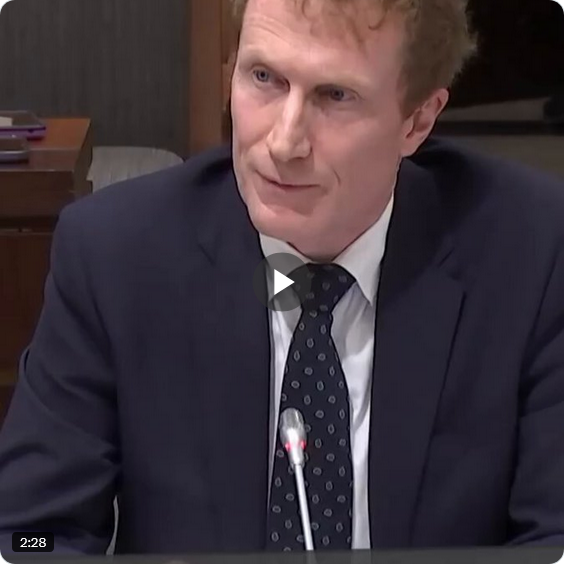
I can’t even believe this is real
Canada Minister Marc Miller is questioned about their new bill under the Liberal government led by Prime Minister Mark Carney that would EXEMPT ALL MINISTERS FROM ALL LAWS
Yes, you heard that correctly
Hidden in the omnibus budget implementation bill, section 208 or clause 12 amends the Red Tape Reduction Act to grant federal cabinet ministers broad discretionary powers
Ministers would be able to temporarily exempt any individual, company, organization, or entity from the application of almost any provision of any federal law (or regulations made under those laws) that the minister is responsible for administering or enforcing, with the sole exception of the Criminal Code
They can themselves, and deem anyone they choose exempt from ALL laws. The only exception is the criminal code
He says you can trust them because “Canadians expect us to act reasonably”
(Holy cr*p)
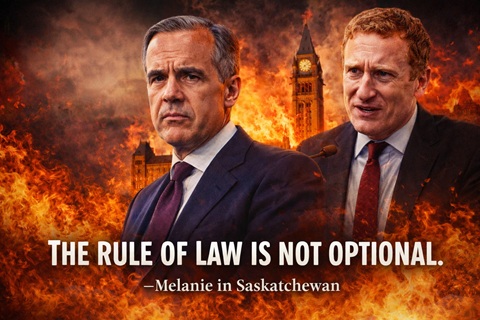
On her Substack, Melanie in Saskatchewan explains why the rule of law is not optional in Canada:
So let us play this forward. A Beijing connected firm establishes operations in Canada. It hires lobbyists. It meets with the appropriate minister. It argues that certain federal regulations are barriers to innovation or economic growth. Under Bill C 15, that minister could grant a temporary exemption. The company does not need to change Canadian law. It does not need to persuade Parliament. It only needs to persuade the right minister.
That is what should alarm Canadians.
When laws become selectively waivable by political discretion, they cease to be stable guardrails and become negotiable privileges. And power, once granted, is never granted because someone intends to leave it unused.
You tell us this is about economic growth amid trade tensions. Yet Canadians were told you were elected to steady the ship on trade and tariffs, to negotiate strength abroad, to stabilize economic uncertainty. Instead, trade tensions persist, tariffs remain contentious, and what advances efficiently is domestic policy architecture that conveniently aligns with the climate finance world you know so well.
Brookfield’s climate investment arm stands to benefit enormously from aggressive climate frameworks. You remain heavily invested. The potential for substantial personal financial gain is not speculation. It is disclosed reality.
You were not elected to refashion Canada into a climate investment thesis calibrated to suit global asset management portfolios. You were elected to manage trade pressures and protect Canadian economic interests.
This exemption clause is not a minor technical detail. It is a structural shift in how power is exercised. If it is so defensible, extract it from the omnibus bill and introduce it as standalone legislation. Let it be debated openly. Let Canadians see it clearly.
Implement a robust foreign agent registry immediately. Answer why a government that acknowledges compromised parliamentarians believes this is the moment to expand ministerial discretion over who must follow federal law.
The rule of law is not optional.
And Canadians did not vote for a system where compliance is mandatory for citizens but negotiable for the well connected.
Comments Off on The selective ability to override any non-criminal law is a “useful tool to have”
QotD: The Democrats re-focus on the youth vote
Which is why I’m tempted to write it off. After all, Obama was just a Bill Clinton for The New Generation. Who was just a JFK for The New Generation. Who — we forget this — was just FDR for The New Generation. Most of the idiot Boomers who voted for Bill Clinton as “the New JFK” barely remembered JFK. Nor did JFK himself win “the youth vote” by all that much — or at all — because “the youth vote” wasn’t a thing back then. For one thing, the voting age was still 21. I’m in History, not math, but even I can do Historian math, and 1960 – 21 = 1939. Most of JFK’s voters had clear memories of The Depression; even his youngest voters remembered the tail end of WWII. JFK sounded like an East Coast patrician, just like FDR did, and as opposed to that young parvenu from California, Richard Nixon.
That’s just a wee bit different from “the Youth Vote” Bill Clinton appealed to. To say nothing of the later freaks.
I’m tempted to write it off, but I’m not going to. For one thing, Obama, Clinton … they all won, and look at the incalculable damage they did. More importantly, I want to return to an issue we tabled earlier: The fact that there’s no “middle age” cohort in the Donk Party. They really are the Volkssturm — kids and oldsters. Or, if you prefer, they’re the Bolsheviks — having shot all their “technical intelligentsia” during The Revolution, they have to go out there and reinvent everything. All their accumulated experience is gone, so their rookies don’t just make rookie mistakes, they make the kind of mistakes that anyone with the tiniest shred of experience could see coming.
You know, those “hmmmm, I wonder what this big red button does?” types of mistakes.
You see it in the business world. Z Man, may he rest in peace, used to talk about this all the time. The Boomers were retiring, the kids were just so epically clueless, and all the thousands of workarounds and jimmy-rigged stuff that makes any operation go were seizing up, for lack of maintenance. And even the smart, ambitious kids were having a hell of a time getting up to speed, because they were looking for a Policies and Procedures manual that simply doesn’t exist. There’s no Official Manual for jimmy-rigged workarounds.
Say what you will about the Boomers, they’re competent. They might well be the last competent generation …
… maybe the older, smarter half of Gen X, but a) there were never that many of us, and b) in politics, as in so much else, the Groovy Fossils just would. NOT. leave, and so the competent among Gen X had to go do their own thing, if they ever wanted a chance to move up. This leaves your big Legacy Systems — you know, like the Apparat — in one hell of a bind. The Groovy Fossils don’t want to leave, but eventually they have to — 90 may be the new 30, but dead is dead. And they’re the only ones who know how to operate the Legacy Systems, because there are two, three “generations” of people who, if they had anything on the ball, had to go their own way.
Those who stayed had no choice, and all they know how to do is push buttons and fill in blanks. Look at Alexandria Ocasio-Cortez. Anyone 50 or older looks at her with horror, because we’ve all had to deal with that kind of kid. That’s the kind of person who has filled up every layer of the Apparat below Top Management. If they had anything at all on the ball, they’d be somewhere else … but they don’t, so now they’re all in Senior Management, because somebody’s got to do it, and they were better at pushing buttons and filling in blanks than anyone else who was available at the time.
But note that I’ve just been talking about candidates, politicians. The VOTERS are like that, too. See what I mean? That’s why it’s so dangerous … and very likely to succeed.
Severian, “Groovy, Baby!!”, Founding Questions, 2025-11-10.
Comments Off on QotD: The Democrats re-focus on the youth vote


