Quotulatiousness

April 27, 2021

“I Love Rock ‘n Roll” [Bardcore]

Filed under: Media — Tags: , — Nicholas @ 02:00

Graywyck
Published 6 Jun 2020

Original: Arrows/Joan Jett & the Blackhearts – “I Love Rock ‘n Roll”

From the comments:

1Ring 42
6 months ago

Behold him merry by the musicians booth
I couldst see he was but a youth
The rhythm made me swoon
For they played my fav’rite tune
An I knew twould nay be long
Til he was wi’ me, aye me
An I knew twould nay be long
Til he was wi’ me, aye me, singing

I crave bardic lute
Toss another coin to yon bard milady
I crave bardic lute
Come spend th’eventide and make merry

He grinn’d thus I approached to ask his name
‘It matters not’ he quipped,
“For tis all the same”
Asked “Couldst I take thee home, whither we shalt be alone?”
An lo we traveled on,
He was wi me aye me
An lo we traveled on
He was with me aye me singing
An I knew twould nay be long
Til he was wi’ me, aye me, singing

I crave bardic lute
Toss another coin to yon bard milady
I crave bardic lute
Come spend th’eventide and make merry

Asked “Couldst I take thee home, whither we shalt be alone?”
An lo we traveled on,
He was wi me aye me
An lo we traveled on
He was with me aye me singing
An I knew twould nay be long
Til he was wi’ me, aye me, singing

(Repeat Chorus 5x)

April 26, 2021

QotD: Maple-flavoured schadenfreude

Filed under: Cancon, Humour, Media, Quotations, USA — Tags: , — Nicholas @ 01:00

Schadenfreude is of course the German word for taking pleasure in the discomfort of others. There should be a specific Canadian variant to indicate our enjoyment of Americans’ discomfort, which is and always has been a major source of satisfaction for many of our media elites. Maybe schadenfreud-eh?

William Watson, “Smug Canada probably wouldn’t let in a caravan of migrants either”, Financial Post, 2018-10-26.

April 25, 2021

The causes and effects of “ostrich parasitic syndrome”

Filed under: Media, Politics, Science — Tags: , , , , , — Nicholas @ 03:00

Barbara Kay on Canadian academic Gad Saad, who sometimes lets his “inner honey badger” get out on social media:

Gad Saad 2010 JMSB Faculty Portrait

Saad, 57, is a professor of marketing at the John Molson School of Business at Montreal’s Concordia University. His domain is evolutionary psychology as applied to business — a niche field, to be sure. He’s written such papers as “Gender differences in information search strategies for a Christmas gift,” and “Menstrual cycle effects on prosocial orientation, gift giving and charitable giving,” which provide valuable information to guide marketing strategies.

You’d be hard pressed to find any academic in Canada who’s more deeply steeped in knowledge about the ineluctable differences between the sexes. (Speaking of “the sexes,” business schools may be the last places left in academia to use those words to designate men and women and acknowledge their differences. Perhaps because their students want to succeed in the real world.)

[…]

Since then, Saad has understood the absolute necessity for critical thinking and freedom of speech. In the present, unhealthy climate, feelings rule, while critical thinking’s value declines daily. Just as our immune systems are designed to cope with novel intruders or atrophy, if we live in an intellectual bubble — as university students do now, rarely confronting opposing views — our cognitive immune systems atrophy, Saad says.

The consequence is what Saad calls “ostrich parasitic syndrome” (OPS). This disorder, in his words, “causes a person to deny realities that are otherwise as clear as the existence of gravity.” Science, reason, infinite data, common sense — all are rejected.

Cognitively disarmed, OPS sufferers accept alternate realities: climate change is “related to terrorism” (Bill Nye, the “science guy”); it is “gross and racist” to suggest Islam is connected to Islamism (Ben Affleck); the Israeli military “dehumanizes” Palestinian women by choosing not to rape them (not a typo: this was the thrust of an award-winning thesis by a radically leftist Israeli sociologist); men can literally be women (nearly everyone says this now, for fear of being labelled transphobic).

It used to be that you could “stand off on the sidelines” when you called out postmodern BS. No longer. There’s no middle ground anymore. You call out the BS or you keep schtum. If you choose the former, as Saad’s writing and actions demonstrate, you need to cultivate your own inner honey badger. Nothing else works.

April 24, 2021

[“white” evil is] “not only objectivity, individualism, and writing, but linear thinking, quantitative reasoning, the Protestant work ethic, planning for the future, and being on time”

Filed under: Education, Media, Politics, USA — Tags: , , — Nicholas @ 03:00

The latest post by John McWhorter at It Bears Mentioning discusses the “white” behaviours and thought patterns that many activists believe are as harmful to American blacks as outright white supremacism:

John McWhorter’s Twitter thumbnail image

The organization 1776Unites, founded by my mentor and model Bob Woodson, has tweeted out a video where various black people decry a now fashionable idea that “whiteness” includes being smart. As in, precise, objective, fond of the written word, oriented towards dispassion, on time.

Those things are all manifestations of intelligence, vigilance, discipline. But according to our Elect folk, we black people are best off channeling our Crazy Badass Mothafucka. Because that’s more “authentic.” And, I get the feeling, fun to watch.

Because so many think that the battle that I and others are waging against Critical Race Theory’s transmogrification into education for children is an obsession with something that isn’t a real problem, I want to explore a bit. Someone I deeply respect not long ago surmised to me that the idea that black kids should be exempt from real standards is something being promulgated via mere paper “handouts,” and that the real problem is censorship from the right. I just don’t think so.

First, watch this, the 1776Unites video. Just a few minutes.

And now, as to what we are referring to, it starts actually before last summer. I knew something was really wrong when in 2019 at a conference in New York City for the city’s principals and superintendents, participants were presented with an idea that to teach with sensitivity to race issues meant keeping certain issues in mind.

These included ways of looking at things that are “white” rather than correct: namely, objectivity, individualism, and valuing the written word. Schools Chancellor Richard Carranza was fine with this, happily telling the media that it’s white people’s job to do the “work” of identifying the racist assumptions in how they go about their business.

So: to stand outside of matters and analyze them with one’s own private mind, and perhaps couch one’s conclusions with the considered artifice of writing rather than the spontaneity of speaking, is inauthentic for black and Latino people. It is racist to impose such things on black and Latino (and Native American?) kids. Or at best, brown kids should be taught this uptight “white” business only as a gloomy alternative to the realness of just hanging out sharing passing personal impressions via chatting.

[…]

This view of precision and detachment as white is a view about, more economically, reason. The idea is that to master close reasoning is suspect. It is exactly the roots of the “Math is Racist” notion, and if you want a whiff of how religiously people can glom on to such ideas, take a look at my Twitter feed in the week after I posted about that here.

Yet, seeing this educational philosophy laid out in the sunlight, The Elect cannot dismiss it as fringe “kookiness” — unless they want to insult the curators of a national museum devoted to celebrating the very black people The Elect live to liberate. At the African-American History Museum in Washington, D.C., for a hot minute or two in 2020 you could see a variation on the Jones-Okun business, an expanded presentation of what we must reject as “white” evil. An educational poster was displayed that slammed not only objectivity, individualism, and writing, but linear thinking, quantitative reasoning, the Protestant work ethic, planning for the future, and being on time.


April 17, 2021

“Today’s Liberal government is […] the most anti-Internet government in Canadian history”

Filed under: Cancon, Government, Media, Technology — Tags: , , , , — Nicholas @ 05:00

Michael Geist gives both barrels to Justin Trudeau’s government, then reloads and fires again:

Canadian Heritage Minister Steven Guilbeault, 3 February 2020.
Screencapture from CPAC video.

As I watched Canadian Heritage Minister Steven Guilbeault yesterday close the Action Summit to Combat Online Hate, I was left with whiplash as I thought back to those early days. Today’s Liberal government is unrecognizable by comparison as it today stands the most anti-Internet government in Canadian history:

  • As it moves to create the Great Canadian Internet Firewall, net neutrality is out and mandated Internet blocking is in.
  • Freedom of expression and due process is out, quick takedowns without independent review and increased liability are in.
  • Innovation and new business models are out, CRTC regulation is in.
  • Privacy reform is out, Internet taxation is in.
  • Prioritizing consumer Internet access and affordability is out, reduced competition through mergers are in.
  • And perhaps most troublingly, consultation and transparency are out, secrecy is in.

This is not hyperbole. The Action Summit is a case in point. I was part of the planning committee and I am proud that the event produced two days of thoughtful discussion and debate, where the both the importance and complexity of addressing online hate brought a myriad of perspectives, including from the major Internet platforms. There was none of that nuance in Guilbeault’s words, who spoke the evil associated with the “web behemoths” and promised that his legislation would target content and Internet sites and services anywhere in the world provided it was accessible to Canadians. The obvious implications – much discussed in Internet circles in Ottawa – is that the government plans to introduce mandated content blocking to keep such content out of Canada as a so-called “last resort”. When combined with a copyright “consultation” launched this week that also raises Internet blocking, Guilbeault’s vision is to require Internet providers to install blocking capabilities, create new regulators and content adjudicators to issue blocking orders, dispense with net neutrality, and build a Canadian Internet firewall.

If that wasn’t enough, his forthcoming bill will also mandate content removals within 24 hours with significant penalties for failure to do so. The approach trades due process for speed, effectively reducing independent oversight and incentivizing content removal by Internet platforms. Just about everyone thinks this is a bad idea, but Guilbeault insists that “it is in the mandate letter.” In other words, consultations don’t matter, expertise doesn’t matter, the experience elsewhere doesn’t matter. Instead, a mandate letter trumps all. If this occurred under Stephen Harper’s watch, the criticism would be unrelenting.

In fact, one of the reasons that the government finds itself committed to dangerous policy is that it did not conduct a public consultation on its forthcoming online harms bill. Guilbeault was forced yesterday to admit that the public has not been consulted, which he tried to justify by claiming that it could participate in the committee review or in the development of implementation guidelines once the bill becomes law. This alone should be disqualifying as no government should introduce censorship legislation that mandates website blocking, eradicates net neutrality, harms freedom of expression, and dispenses with due process without having ever consulted Canadians on the issue.

April 16, 2021

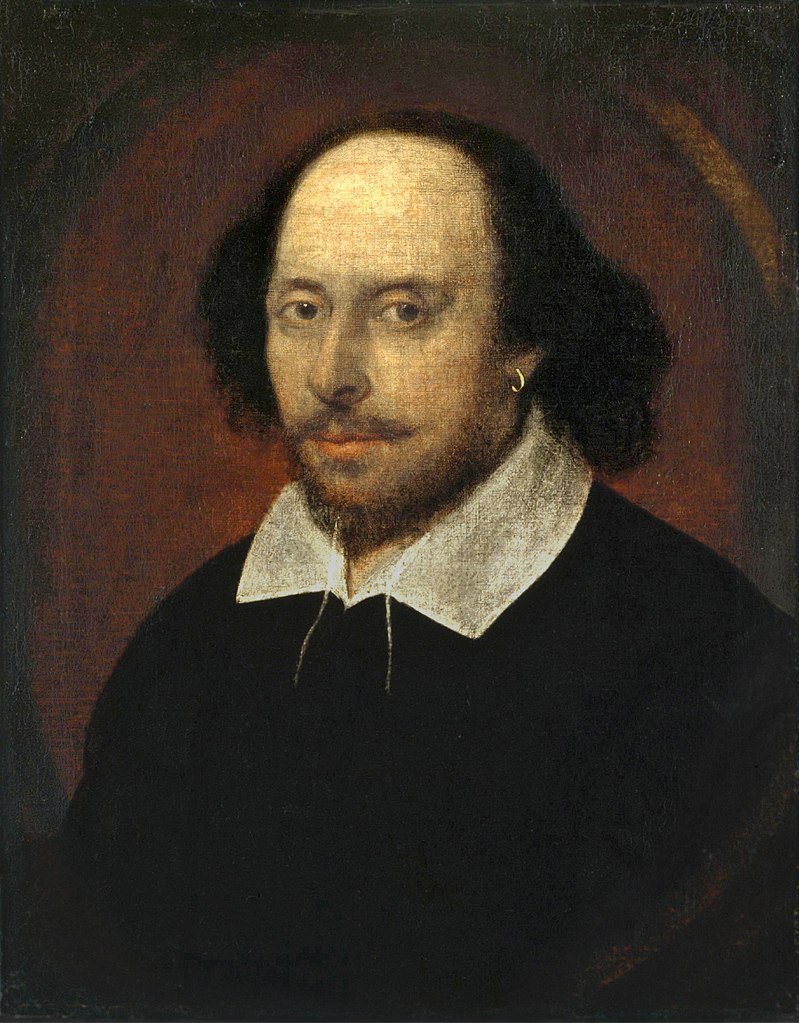
“Students will find in Shakespeare absolutely no moral compass”

Filed under: Britain, Education, History, Media — Tags: , , , — Nicholas @ 05:00

Sky Gilbert responds more than adequately to a demand to “Cancel Shakespeare” that also appeared in The Line recently:

This was long thought to be the only portrait of William Shakespeare that had any claim to have been painted from life, until another possible life portrait, the Cobbe portrait, was revealed in 2009. The portrait is known as the “Chandos portrait” after a previous owner, James Brydges, 1st Duke of Chandos. It was the first portrait to be acquired by the National Portrait Gallery in 1856. The artist may be by a painter called John Taylor who was an important member of the Painter-Stainers’ Company.
National Portrait Gallery image via Wikimedia Commons.

Allan thinks that Shakespeare’s language is difficult and old fashioned, and that students today find analyzing the complexities of his old-fashioned rhetoric boring and irrelevant. Yes, Shakespeare essentially writes in another language (early modern English). And reading or even viewing his work can be a tough slog. Not only did he invent at least 1,700 words (some of which are now forgotten today), he favoured a befuddling periodic syntax in which the subject does not appear until the end of a sentence.

But a study of Shakespeare’s rhetoric is important in 2021. There is one — and only one — exceedingly relevant idea that can be lifted from Shakespeare’s congested imagery, his complex, sometimes confusing metaphors — one jewel that can be dragged out of his ubiquitous references to OVID and Greek myth (references which were obviously effortless for him, but for most of us, only confound). And this idea is very relevant today. Especially in the era of “alternate facts” and “fake news.”

This idea is the only one Shakespeare undoubtedly believed. I say this because he returns to it over and over. Trevor McNeely articulated this notion clearly and succinctly when he said that Shakespeare was constantly warning us the human mind “can build a perfectly satisfactory reality on thin air, and never think to question it.” Shakespeare is always speaking — in one way or another — about his suspicion that the bewitching power of rhetoric — indeed the very beauty of poetry itself — is both enchanting and dangerous.

Shakespeare lived at the nexus of a culture war. The Western world was gradually rejecting the ancient rhetorical notion that “truth is anything I can persuade you to believe in poetry” for “truth is whatever can be proved best by logic and science.” Shakespeare was fully capable of persuading us of anything (he often does). But his habit is to subsequently go back and undo what he has just said. He does this so that we might learn to fundamentally question the manipulations of philosophy and rhetoric — to question what were his very own manipulations. Shakespeare loved the beautiful hypnotizing language of poetry, but was also painfully aware that it could be dangerous as hell.

In fact, Shakespeare’s work is very dangerous for all of us. That’s why students should — and must — read it. Undergraduates today hotly debate whether The Merchant of Venice is anti-Semitic, or whether Prospero’s Caliban is a victim of colonial oppression. Education Week reported that “in 2016, students at Yale University petitioned the school to ‘decolonize’ its reading lists, including by removing its Shakespeare requirement.”

It’s true that Shakespeare is perhaps one of the oldest and whitest writers we know. (And sometimes he’s pretty sexist too — Taming of the Shrew, anyone?). But after digging systematically into Shakespeare’s work even the dullest student will discover that for every Kate bowing in obedience to her husband, there is a fierce Lucrece — not only standing up to a man, but permanently and eloquently dressing him down. (And too, the “colonialist” Prospero will prove to be just as flawed as the “indigenous” Caliban.) William Hazlitt said: Shakespeare’s mind “has no particular bias about anything” and Harold Bloom said: “his politics, like his religion, evades me, but I think he was too wary to have any.”

Shakespeare Summarized: King Lear

Filed under: History, Humour, Media — Tags: , , — Nicholas @ 02:00

Overly Sarcastic Productions
Published 22 Jul 2014

Sorry it’s been a while. Summer vacation plays merry hell with both my work ethic and my voice. *discreetly hacks up a lung*

King Lear! He’s not a very good king, and he’s not a very good father! Good thing that, by the end, he’s neither of those things.

QotD: “Declaring passionate belief in freedom of speech”

Filed under: Books, Britain, Media, Quotations — Tags: , , , , — Nicholas @ 01:00

One of the phrases in the mouth of managers or bureaucrats that indicates almost unfailingly that they are about to commit an act of betrayal is, “We believe passionately in.”

The only thing that most managers or bureaucrats believe in passionately is their career, in the broad sense of that term: for they are quite willing to abandon or sacrifice a career completely in the narrow sense if it is in the interest of their career in a broader sense.

I learned this in the hospitals in which I worked. As soon as a hospital manager said “I believe passionately in the work that Department X has been doing,” I knew that Department X was about to be closed down by that very same manager.

Thus, when I read that a publisher claimed that “We believe passionately in freedom of speech,” I knew at once that the publisher was about to withdraw a book from publication that it had previously advertised for publication.

Theodore Dalrymple, “‘Passionate’ Belief in Freedom of Speech and Multiplying Orthodoxies”, New English Review, 2020-12-22.

April 9, 2021

QotD: Instant expertise

As every journalist and lawyer knows, it takes about half an hour to become an expert on any subject. In the days when I wrote for some of the less cerebral but well-paying publications of the British press, my protestations that I knew nothing whatever of the subject on which they wanted me to write was no discouragement to a commission. At most, it produced a slight prolongation of the deadline — about half an hour, in fact.

One of the effects of the COVID-19 epidemic has been to reveal to a very large percentage of the population the joys of instant expertise. The world now has hundreds of millions, if not several billions, of epidemiologists, virologists, and clinicians, all of whom know best how to deal with the pandemic. The only problem is that their solutions are at variance with one another.

It sometimes seems as if the certainty with which views are held is inversely proportional to the solidity of the factual basis on which they are founded. If commentary on the internet is anything to go by (it might not be, of course, for those who avail themselves of this means of self-expression are a self-selected rather than a representative sample), people often take a religious attitude toward their own doctrine and condemn as heretics all those who express doubts about it. I don’t want to sound like a psychoanalyst, that class of person who believes that he unfailingly knows the real meaning of what is said rather than its merely apparent meaning, but stridency of views is often indicative of unacknowledged uncertainties. Zinc supplementarians and others of the type cling to their beliefs with a fervor that evidence does not merit.

Theodore Dalrymple, “Everyone’s an Expert”, Taki’s Magazine, 2020-10-16.

April 8, 2021

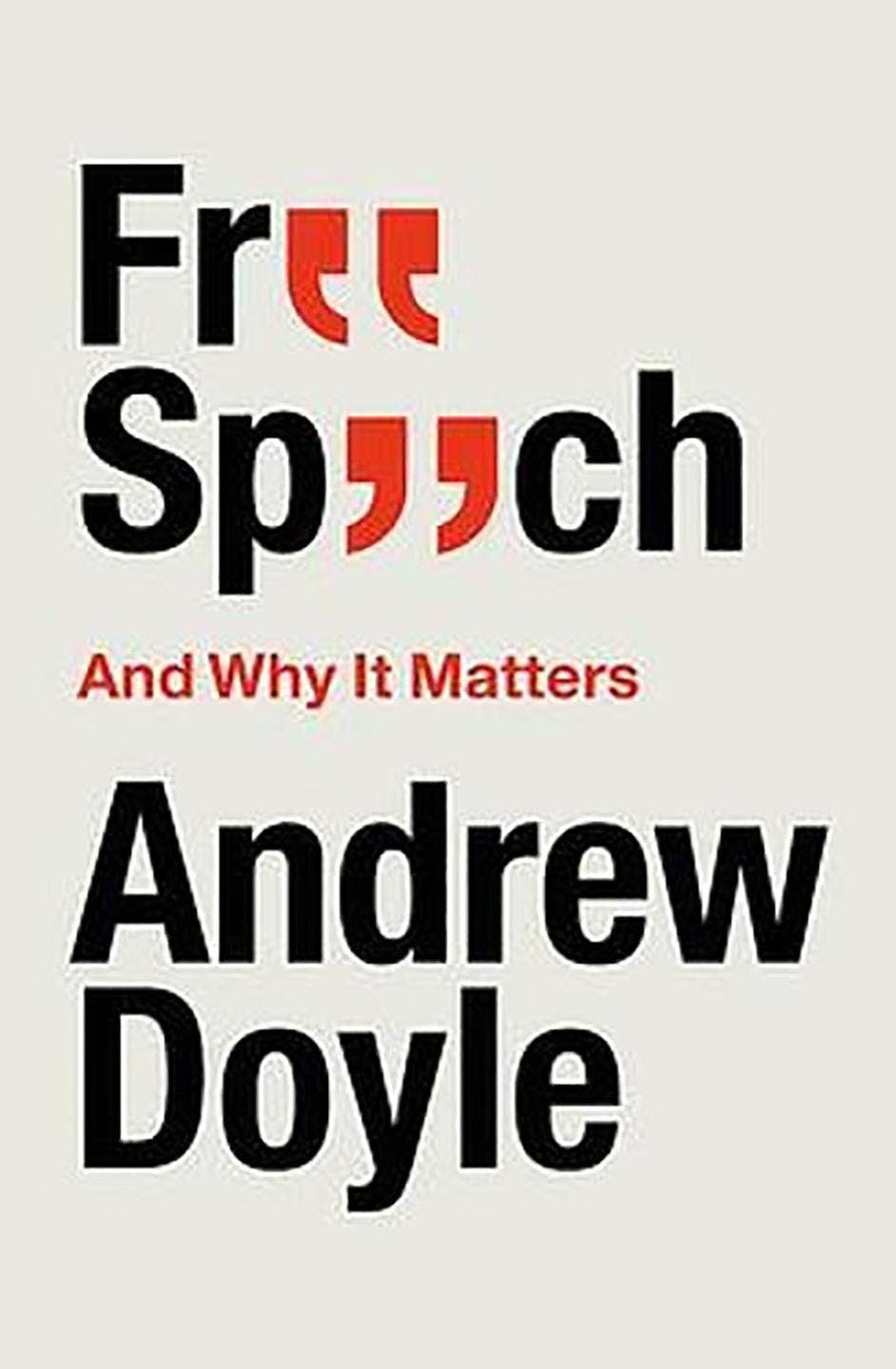
Andrew Doyle defends freedom of speech in his new book

In The Critic, Simon Evans reviews Free Speech And Why It Matters by Andrew Doyle (who is perhaps best known on this side of the pond for his ultrawoke Twitter persona “Titania McGrath”):

    When I am weaker than you, I ask you for Freedom, because that is according to your principles; when I am Stronger than you, I take away your freedom because that is according to my principles.
    Frank Herbert, Children of Dune

It is most peculiar. If the counter-culture had a dominant theme, it was the right to criticise the establishment and to question orthodoxy of all kinds. Back in the Sixties, it was central to its mission to Expand your Consciousness, man. And it worked. Walls came tumbling down. Yet now, everywhere you look, it seems the elements of society — students, academics, comedians — that one would most naturally associate with that freedom of expression, are introducing caveats and qualifiers to that principle faster than you can cry “Stop Little Pol-Pot, Stop!” They are turning, before our very eyes, into actual scolds.

It must be supposed that what was once the siege army, camped outside the moat like Occupy Wall Street, has captured the castle, for they are demanding that the walls be re-erected. That “hate” speech be distinguished from free speech and dealt with accordingly. That freedom of speech need not mean freedom from consequences. And a general suspicion is at large, among the young, that free speech is some sort of artefact of complacent boomer self-indulgence, like Steely Dan and second homes. No longer counter-culture, but decidedly counter-revolutionary.

I’m a comedian, and these have been strange times for our trade. Brexit saw comedians side with the mirthless neo-liberal consensus, against the humorous, sceptical grumble of the common rabble. The same thing happened in America, with bar-room stand-ups horrified by the vulgarity of Trump. And now the latest revision sees many of my fellow jesters and fools unsure whether people can really be trusted with free speech.One might have thought this issue had been settled long ago, in this country, and in liberty’s favour. But no, it seems we need to sharpen our tools once again, and Andrew Doyle’s new book is an excellent place to start.

Making the case for the defence, Doyle’s book is terse, restrained and as carefully argued as a QC’s summing-up in a top-drawer courtroom drama. Whether his command of the material comes from his doctorate in Renaissance literature or his experience of defending the comedy character Titania McGrath from infuriated wokerati, who knows? It is a beautifully balanced and comprehensive overview that will of course be read by no one who needs to hear it.

It is admirably historically literate. Doyle takes a quote from Milton’s Areopagitica as his epigram, with the old poet, declaiming over the din of the Civil War, as defiant as Satan himself, “Give me liberty to know, to utter, and to argue freely according to conscience, above all liberties.”

This sets the tone for the whole book, but Doyle also presents arguments intended to appeal to those who insist that we live in a society. With the compromises that entails. This was most famously recognised by notorious cis-hetero white man and free speech absolutist John Stuart Mill, who was surveying the world from the heights of Victorian Exceptionalism when he published the still unsurpassed On Liberty.

The Weird Years of The Simpsons (1989-1994)

Filed under: Humour, Media, USA — Tags: , , , — Nicholas @ 02:00

J.J. McCullough
Published 2 Jan 2021

The show struggled for five years to figure out what kind of show it wanted to be, and how to treat its characters. It could have been much weirder than it was.

FOLLOW ME:

🇨🇦Support me on Patreon! https://www.patreon.com/jjmccullough
🤖Join my Discord! https://discord.gg/3X64ww7
🇺🇸Follow me on Instagram! https://www.instagram.com/jjmccullough/
🇨🇦Read my latest Washington Post columns: https://www.washingtonpost.com/people…
🇨🇦Visit my Canada Website http://thecanadaguide.com

HASHTAGS: #tv #animation

April 7, 2021

QotD: The G-[pick-a-number] meetings

There are far too many of these “summits,” far too undistinguishedly attended, expensive to organize, and conducted in public in ways that attract swarms of hooligans who vandalize shops, beat up bystanders, and provoke the police. Canada spent $400 million on three days of photo-ops at La Malbaie, to achieve practically nothing. For the first nearly 30 years of summiting, there were only nine such meetings; Roosevelt, Churchill and Stalin at Tehran and Yalta (1943 and 1945), Stalin, Truman and Attlee at Potsdam (1945), Eisenhower and the divided Russians and Anthony Eden and Edgar Faure at Geneva (1955), Eisenhower, Khrushchev, Macmillan and de Gaulle at Paris (1960), Kennedy and Khrushchev at Vienna (1961), Lyndon Johnson and Alexei Kosygin at Glassboro (1967), and Richard Nixon and Leonid Brezhnev at Moscow and San Clemente, Calif. (1972, 1973).

The first three were essential to plan for victory and peace, though many of their key provisions, especially for the liberation of Eastern Europe, were ignored by Stalin. The first Nixon-Brezhnev meeting was substantive and a couple of the later Reagan-Gorbachev meetings were very productive. These were intense business meetings between people who really were at the summit of world power and influence. The only matter agreed to in meetings between Soviet and American leaders between 1945 and 1972 was in the “kitchen debate” between then vice-president Nixon and Khrushchev in Moscow in 1959, when (forgive my coarseness in the interests of historical accuracy), Khrushchev accused Nixon of uttering “Horse shit, no, it is cow shit, and nothing is fouler than that” to which Nixon replied, “You don’t recognize the truth, and incidentally, pig shit is fouler than cow shit.” Khrushchev conceded the second point.

Conrad Black, “Take heed Canada: the U.S. would win a true trade war”, Conrad Black, 2018-06-16.

April 6, 2021

QotD: Rap music

Filed under: Humour, Media, Quotations — Tags: , — Nicholas @ 01:00

I would like to think that nothing human is alien to me (as the Roman playwright and former slave Terence put it), but it is not quite true. I draw the line, for example, at rap music, which always puts me in mind of experiments I witnessed during physiology classes fifty years ago, in which electrodes were placed in the amygdala of cats and stimulation of which caused a reaction of insensate and undirected rage (in the cat). To change the analogy slightly, rap music is the noise that hornets, if they could vociferate, would make when their nest was disturbed.

Theodore Dalrymple, “Liars and Maligners”, Taki’s Magazine, 2020-11-13.

April 5, 2021

QotD: NYC goes out of its way to “afflict the comfortable”

Filed under: Government, Humour, Media, Quotations, USA — Tags: , , , , — Nicholas @ 01:00

In July, the city moved 700 homeless single men into hotels on the densely populated and famously tolerant Upper West Side, purportedly as a response to the pandemic. Residents were stunned to find their neighborhood turned overnight into a skid row, with nonstop open drug sales and drug use, public sex acts, and rampant street harassment of women and girls. During a contentious local community board Zoom meeting about the issue, Erin Drinkwater, a deputy commissioner of intergovernmental and legislative affairs at the Department of Social Services, spoke blandly about the need for “compassion” and implied that the concerned neighbors were racist for opposing the city’s move. Following the meeting, Drinkwater tweeted “Comfort the afflicted; afflict the comfortable.” When asked what she meant by this, she said that it was a quotation from the Bible’s Book of James, and that it spoke to her sense of mission.

One might ask why a social-services functionary in New York City would cite the Bible in defense of public policy — except that the quotation is not even from the Bible. In fact, it is from Finley Peter Dunne, a popular Chicago columnist from the 1890s who invented a humorous character named “Mr. Dooley,” an Irish bartender who delivered his wisdom in dialect.

The original quotation, in which Mr. Dooley described the function of the newspaper: “Th’ newspaper does ivrything f’r us. It runs th’ polis foorce an’ th’ banks, commands th’ milishy, controls th’ ligislachure, baptizes th’ young, marries th’ foolish, comforts th’ afflicted, afflicts th’ comfortable, buries th’ dead an’ roasts thim aftherward.” Somehow, in a bizarre game of “cultural telephone,” this mock-sonorous fiddle-faddle has gathered the effulgence of holy writ for progressives, who take it as descriptive of their “joyous responsibility.”

On the one hand, it’s comical that this scrap of tabloid wit is taken so gravely by self-righteous officials. Properly speaking, isn’t it their job to make people more comfortable, not to diminish comfort? But on the other hand, it’s frightening to consider that New York is now run by progressive militants who appear to believe that their vocation is to “afflict” their constituents by disrupting their undeserved calm and comfort. Mass immiseration is not a side effect of bad policy; it is the policy.

Seth Barron, “The Politics of Affliction”, City Journal, 2020-12-17.

April 3, 2021

Metallica – “Nothing Else Matters” – Medieval Style – Bardcore

Filed under: Media — Tags: , , — Nicholas @ 02:00

Algal the Bard
Published 19 Jun 2020

Song composed by James Hetfield & Lars Ulrich
Spotify: https://open.spotify.com/artist/6AU6D…
iTunes: https://music.apple.com/us/artist/alg…
Google Play: https://play.google.com/store/music/a…
Twitter: http://twitter.com/Alvariu
Instagram: https://www.instagram.com/alvariu360
Instruments: Lute-guitar, Irish bouzouki, Low whistle (D), Drums.

« Newer PostsOlder Posts »

Powered by WordPress