
In the first place, it would efface from everybody’s conscience the distinction between justice and injustice. No society can exist unless the laws are respected to a certain degree, but the safest way to make them respected is to make them respectable. When law and morality are in contradiction to each other, the citizen finds himself in the cruel alternative of either losing his moral sense, or of losing his respect for the law — two evils of equal magnitude, between which it would be difficult to choose.
Frédéric Bastiat, The Law, 1850.
September 4, 2018
QotD: Law and morality
Comments Off on QotD: Law and morality
September 2, 2018
Amtrak service and the “takings” clause
Back in August, Fred Frailey reluctantly came to the conclusion that at some point American freight railways are going to have to challenge in court Amtrak’s legislated ability to pre-empt freight traffic on their networks:

Amtrak’s
Eastbound Empire Builder crossing Two Medicine Trestle at East Glacier MT on 20 July 2011.
Photo by Steve Wilson via Wikimedia Commons.
We all know about “taking the Fifth.” It’s our right under the Fifth Amendment to the U.S. Constitution not to be compelled to testify against ourselves. In other words, a court cannot force us to admit to driving 60 mph in a 45-mph zone (or something worse). That amendment has another, less-well-known clause, which says government cannot take away our property without just compensation. Lawyers know this as the “Takings Clause.” The Fifth came to mind the other day as I rode Amtrak’s Empire Builder from Seattle to Chicago. I’ll get to my point, but first the experience.
[…]
All of this did terrible things to our schedule-keeping. By the third morning, as the train approached Devils Lake, N.D., we were more than eight hours late (the next day’s eastbound Builder was even later). But imagine what the Empire Builder does to BNSF’s freights every day. The Amtrak Improvement Act of 1973 reads: “Except in an emergency, intercity passenger trains operated by or on behalf of [Amtrak] shall be accorded preference over freight trains in the use of any given line of track, junction, or crossing.”
BNSF appears totally committed to obedience of this law but doing so devours the capacity of this route. It’s not just that freights give way; whizzing along at a 79 mph versus 55 or 60 for the freights, the Empire Builder eats capacity as if it were two or three freights, Six high-priority Z trains prowl the northern Transcon every day, and I don’t think a single one of them that I observed was moving as we went by. One Z train was sandwiched between two stopped manifest trains, all making way for our Builder.
Obviously, Amtrak pays BNSF for the right to run trains over the freight railroad. But whatever it pays is but a fraction of the cost in delays to its own trains incurred by BNSF. Were the northern Transcon double-tracked all the way, these delays would obviously be minimized. But at $3 million or more a mile, double tracking consumes capital like a dry sponge, and it’s not Amtrak’s capital, either.
So now to my point: Isn’t it fair to say that Amtrak, which the U.S. Supreme Court in 2015 decreed to be an arm of government, is confiscating the property (track capacity) of host railroads? And if it is, shouldn’t the freight railroads be fairly compensated for the delays to their freights caused by the loss of this capacity? Try as I might to say otherwise, I am forced to answer “yes” to both questions.
Comments Off on Amtrak service and the “takings” clause
September 1, 2018
The legal tangle around the Trans-Mountain pipeline approval process
Jay Currie suspects the process has been intentionally complicated to the point that there may not be a way out for this government:
What the Court essentially asked was, “Did the Federal Government consult enough?” and then concluded, “No, not enough.”
How much is “enough”? That is a question which this decision really does not answer. And I suspect it does not answer it because there is actually no answer which is even close to true.
In a normal process a reasonable level of public consultation would be reached when the public has been given an opportunity to comment on the matter at hand. Which is a bit vague but there is case law which fleshes out what such an opportunity might look like.
However, once environmentalists and First Nations are engaged it is not at all obvious that merely having the opportunity to comment is sufficient. Unlike a rezoning application, an application to build a pipeline (or, realistically, virtually any other large undertaking) creates the opportunity for First Nations to talk about everything from ancient hunting rights, to sacred grounds, to former village sites, to disruptions to present First Nation culture and so on. Having the environmentalists involved ensures that the relatively easy solution of simply paying the First Nations’ people for their consent, is off the table. That solution will be denounced by the enviros as cultural genocide and worse.
All of which creates, and might arguably have been intended to create, a Gordian knot when it comes to considering major projects. Consultation becomes an endless task and one which has no defined parameters. The decision today indicates that an extensive consultation process is not enough but it does not indicate what might be enough.
Delightfully, the shareholders of Kinder Morgan – which owns TransMountain – voted today to sell the project to Canada’s feckless Federal Government for several billion dollars.
I suspect the CEO danced a little jig relieved that he no longer had to guess at how far consultations have to go. But Canada is stuck with a completely dysfunctional system which is being exploited by environmentalists and First Nations to prevent infrastructure from being built. That will have to be fixed.
Comments Off on The legal tangle around the Trans-Mountain pipeline approval process
August 25, 2018
QotD: India’s caste system
… Gandhi, born the son of the Prime Minister of a tiny Indian principality and received as an attorney at the bar of the Middle Temple in London, [began] his climb to greatness as a member of the small Indian community in, precisely, South Africa. Natal, then a separate colony, wanted to limit Indian immigration and, as part of the government program, ordered Indians to carry identity papers (an action not without similarities to measures under consideration in the U.S. today to control illegal immigration). The film’s lengthy opening sequences are devoted to Gandhi’s leadership in the fight against Indians carrying their identity papers (burning their registration cards), with for good measure Gandhi being expelled from the first-class section of a railway train, and Gandhi being asked by whites to step off the sidewalk. This inspired young Indian leader calls, in the film, for interracial harmony, for people to “live together.”
Now the time is 1893, and Gandhi is a “caste” Hindu, and from one of the higher castes. Although, later, he was to call for improving the lot of India’s Untouchables [Dalits], he was not to have any serious misgivings about the fundamentals of the caste system for about another thirty years, and even then his doubts, to my way of thinking, were rather minor. In the India in which Gandhi grew up, and had only recently left, some castes could enter the courtyards of certain Hindu temples, while others could not. Some castes were forbidden to use the village well. Others were compelled to live outside the village, still others to leave the road at the approach of a person of higher caste and perpetually to call out, giving warning, so that no one would be polluted by their proximity. The endless intricacies of Hindu caste by-laws varied somewhat region by region, but in Madras, where most South African Indians were from, while a Nayar could pollute a man of higher caste only by touching him, Kammalans polluted at a distance of 24 feet, toddy drawers at 36 feet, Pulayans and Cherumans at 48 feet, and beef-eating Paraiyans at 64 feet. All castes and the thousands of sub-castes were forbidden, needless to say, to marry, eat, or engage in social activity with any but members of their own group. In Gandhi’s native Gujarat a caste Hindu who had been polluted by touch had to perform extensive ritual ablutions or purify himself by drinking a holy beverage composed of milk, whey, and (what else?) cow dung.
Low-caste Hindus, in short, suffered humiliations in their native India compared to which the carrying of identity cards in South Africa was almost trivial. In fact, Gandhi, to his credit, was to campaign strenuously in his later life for the reduction of caste barriers in India — a campaign almost invisible in the movie, of course, conveyed in only two glancing references, leaving the audience with the officially sponsored if historically astonishing notion that racism was introduced into India by the British. To present the Gandhi of 1893, a conventional caste Hindu, fresh from caste-ridden India where a Paraiyan could pollute at 64 feet, as the champion of interracial equalitariansim is one of the most brazen hypocrisies I have ever encountered in a serious movie.
Richard Grenier, “The Gandhi Nobody Knows”, Commentary, 1983-03-01.
Comments Off on QotD: India’s caste system
August 13, 2018
Blasphemy in modern Britain
Once upon a time, blasphemy was prosecuted by the Crown as an attack on the very basis of English law: “[blasphemy] law is needed to uphold the national law, which is based on Christianity. Thus, targeting Christianity is targeting the very foundation of England.” The last successful prosecution was in 1977. Modern prosecutions for blasphemy do not get filed under the old law, but the mechanism of the police, the courts, and the media are directed against those who dare to insult one particular faith:

Religious freedom is one of the core principles of any modern liberal society. As a secularist, I defend the right of religious people to send their children to faith schools, have their children circumcised, or wear the burqa. This does not mean I approve of any of these practices; they should be permissible but not protected from criticism. We should be free to ridicule, lampoon, chastise, critique, etc. every aspect of religious belief that we tolerate.
This is, more or less, what the U.K.’s former Conservative Foreign Secretary Boris Johnson wrote in his now infamous newspaper column in the Telegraph last week. Yet all hell has broken loose. It was greeted by near-hysterical outrage and shrill denunciations of Johnson’s alleged dog whistle racism; reports of civil war in the Tory Party over the matter; the now ubiquitous demands for an apology for causing offence (or else), which was backed in this instance by the Prime Minister. Boris’s is now the subject of an internal Party inquiry. It’s worth untangling this sorry tale as a snap-shot of today’s offence culture and how chilling it can be to a free society.
Johnson has been ‘called out’ as Islamophobic for arguing against – yes against – a ban on the burqa and for defending – yes defending – the right of any “free-born adult woman” to wear what she wants “in a public place, when she is simply minding her own business”. His column is predominantly an excoriating critique of Denmark’s betrayal of its own “spirit of liberty” and “the spirit of Viking individualism” by its decision to impose a state ban on the burqa or niqab (although he is not being indicted for caricaturing Danish culture). He rightly notes that being opposed to a ban should not be interpreted as approval and goes on to say – albeit in a somewhat crass manner – that “Muslim head-gear that obscures the female face… looking like letterboxes… like a bank robber…is absolutely ridiculous”.
As similes go, no doubt Boris could have been more tactful. I am no fan of BoJo-style private school wit. Indeed, I can understand that veil-wearing Muslim women – whom myriad journalists throughout the country have stopped on streets to ask if they like being compared to criminals or inanimate objects – would find the analogy offensive. But should all political comment on religion have to pass an offense test to be allowed? I am pretty sure that my two aunts – who are Catholic nuns – would be pretty offended if they heard my atheist mates’ denouncing as backward mumbo-jumbo a religion that believes the host and wine is literally the body and blood of Christ. But that’s the deal – a free society affords religious tolerance for nuns, imams, rabbis; and conversely liberty for others to stick the metaphorical boot into their beliefs.
Are Boris’s critics demanding respect for all religious practices regardless of whether they consider them backward, wrong-headed, or oppressive? Should we bite our lip in case we offend? We seem to have forgotten that we once all declared #JeSuisCharlie – a brief but inspiringly unapologetic defense of free speech after cartoonists for the satirical magazine Charlie Hebdo were brutally butchered in Paris for daring to publish cartoons deemed offensive to Islam. Should they have shut up until they learned to become more tactful?
Naturally, cheap sectarian Tory-bashing has driven some of the outrage. Supporters of the Labour Party, recently afflicted by an anti-Semitism scandal that is still rumbling on, were quick to denounce the “gross Islamophobia” in the article, even though criticism of the burqa has been commonplace in Labour and feminist ranks over the years. Emily Thornberry, Labour’s Shadow Secretary of State for Foreign and Commonwealth Affairs (and Boris’s shadow until his recent resignation), declared on BBC’s Question Time in 2013 that “I wouldn’t want my four-year-old looked after by somebody wearing a burka. I wouldn’t want my elderly mum looked after by somebody wearing a burka. They need to be able to show their face. I wouldn’t mind if they worked in records in the hospital.”
Comments Off on Blasphemy in modern Britain
July 26, 2018
QotD: Protecting the truth
No one ever heard of the truth being enforced by law. Whenever the secular arm is called in to sustain an idea, whether new or old, it is always a bad idea, and not infrequently it is downright idiotic.
H.L. Mencken, Minority Report, 1956.
Comments Off on QotD: Protecting the truth
July 25, 2018
Britain, refugees, and migrants
Alex Noble explains why Britain needs migrants, but not all migrants:
Nurses, doctors, engineers, scientists, computer programmers – our society is very advanced and a big chunk of our economic strength is based on advanced services that need skilled people like these. And there aren’t enough native Brits skilled in these areas – our demand outpaces our supply of people. We need lots of computer programmers and only relatively few native Brits are qualifying in computer sciences. And the shortage of young Brits taking STEM subjects is worsening.
So far so good – we need a supply of skilled migrants for the foreseeable future. Hopefully we can all agree on that.
Do we need unskilled migrants?
Because when people with no skills come to the UK, we suffer and so do they. They are either forced into crime, fall into modern slavery, or find themselves exploited working on the black market.
When they are forced into crime, we see more stabbings and rapes and burglaries and murders.
When they fall into modern slavery we see more people-trafficking, more forced prostitution.
When they are exploited, they are forced to work below minimum wage, and the jobs that young British teenagers might have taken are taken by those willing to work for a pittance just to stay alive. When they find themselves working in the black market, they pay no tax and have no protections.
Modern Britain does not need or desire these things – young people enslaved and forced to work for low pay, exploited, or forced into crime. These are profoundly negative developments for our society, and a grotesque abuse of people who were mislead into coming here for what they thought would be a new life.
Modern Britain does not need unskilled migrants, and should not enrich their slavers.
And that brings us to refugees.
Are there genuine refugees? Yes of course.
But we know what refugees look like – men, women and children staggering over the border into the nearest safe nation with the clothes on their backs and often not much else. Poverty-stricken and unable to return to the homelands, they throw themselves on the mercy of their neighbours. Refugees don’t abandon their families in war zones and travel thousands of miles alone. They do not have thousands of dollars to give to slave traders for a seat on their rickety barges.
What we see on the boats are not refugees.
They are mostly young men coming for a better life. And while we cannot begrudge them those intentions, we have already discussed why unskilled migrants cannot be welcomed here in large numbers. And unskilled migrants they mostly are, because skilled migrants come armed with work permits and speak the language. At the very least they have documentation to prove who they are, because being able to prove you are an Iranian heart surgeon is important. Being able to prove you are a penniless and unskilled Eritrean, who doesn’t speak English……………that’s not an identity worth retaining at a border check.
And so the Mediterranean sea floor is littered with their travel documents.
Genuine refuges stagger over the nearest safe border – we must help them if we can.
The unskilled migrants travel here in boats, trafficked by modern-day slavers into the underworlds of our nations. They may have hope in their hearts, but they are bringing misery into a society that cannot absorb them.
Comments Off on Britain, refugees, and migrants
QotD: How can you tell when a politician is lying?
This reality of outright lying during campaigns is so familiar that we excuse it. It’s just what politicians do.
But suppose that a business owner did the equivalent in the market. Such behavior wouldn’t be tolerated by customers or by law-enforcement officials. For example, suppose that the owner of Acme Furniture, in a scheme to get more sales, outright lies with a radio ad that promises that everyone who buys any piece of furniture from Acme will get half of the purchase price refunded in 12 months. “Wow! Darn good deal!” consumers think. They flock to Acme and buy furniture.
One year later, Acme customers submit their applications for the refunds of half of the purchase prices they each paid. But these customers, rather than getting what Acme promised, instead get a note from Acme explaining that the promise of a refund was made in jest; it was designed only to get more consumers to buy furniture from Acme. “But don’t worry!” the letter from Acme continues, “you’re still better off having bought furniture from Acme than from any of Acme’s competitors. Trust me on this! Yours Sincerely,….”
From time to time unscrupulous (and, typically, also really stupid or myopic) business people pull fraudulent stunts such as this one. Yet – rightly – no one excuses these stunts as being par for the course in business. One reason, of course, is that such stunts are not par for the course in private business; far from it. But such stunts are indeed par for the course in politics. And yet, despite this reality, we are constantly told that businesses operating in competitive markets cannot be trusted to behave honestly unless they are regulated by politicians and bureaucrats operating in political ‘markets.’
Politicians lie and such lying is excused because it’s normal. But it’s not normal; it’s not normal in the private sector; it’s normal only in the very abnormal world of politics.
Don Boudreaux, “Politicians Lie Openly and Such Behavior Is Excused Because It’s ‘Normal’”, Café Hayek, 2016-09-05.
Comments Off on QotD: How can you tell when a politician is lying?
July 14, 2018
Hernando de Soto Knows How To Make the Third World Richer than the First
ReasonTV
Published on 13 Jul 2018The Peruvian economist says blockchain technologies and social media will transform the planet by securing property rights.
—————-In the spring of 1989, Chinese students occupied Tiananmen Square, erected a replica of the Statue of Liberty, and called for democracy and individual rights. By the fall, people living in East Germany took hammers and chisels to the Berlin Wall, unleashing a wave of revolutions that ultimately led to the collapse of the Soviet Union. It was an auspicious year for human freedom.
Nineteen eighty-nine was also the year that Peruvian economist Hernando de Soto published The Other Path: The Invisible Revolution in The Third World, which radically challenged conventional wisdom about the underlying cause of persistent poverty in the post-colonial landscape. Drawing on his extensive field work with the Peruvian-based think tank the Institute for Liberty and Democracy, de Soto argued that people were pushed into the black market and wider informal economy because governments refused to recognize, document, and promote legal ownership of land and other assets.
Without clear title and the right to transfer property, common farmers understandably refused to invest much in the land they tilled, and they couldn’t use it as collateral. This created what de Soto later called “citadels of dead capital” with value that could never be fully accessed.
No one, he argued, would plan for the future if everything they accumulated could just be taken away. As much an activist as an intellectual, De Soto has been called “the world’s most important living economist” by former President Bill Clinton. He is credited with changing policy in Peru and elsewhere by pushing governments to create property regimes that are public, transferable, and secure. His latest endeavor is a partnership with Overstock.com founder Patrick Byrne and others to use blockchain technology and social media to create totally public and perfectly transparent records of ownership.
Reason‘s Nick Gillespie caught up with de Soto in Washington, D.C. in June, where he received the Competitive Enterprise Institute’s Julian L. Simon Memorial Award, named for the late free-market economist who believed that “mankind is the ultimate resource.”
Comments Off on Hernando de Soto Knows How To Make the Third World Richer than the First
July 9, 2018
Nominating Amy Barrett “would be a tactical masterpiece on the level of Napoleon’s conduct of the Battle of Austerlitz, or Hannibal at Cannae”
I have no idea who President Trump will announce later today as his nominee for the vacancy on the US Supreme Court, but Conrad Black is plumping for one particular candidate:
The desperation of the Democrats to stop the apparently inexorable rise of a president they so completely discounted and despised, and assumed they could remove or emasculate just by turning up the volume and activity of their media organ monkeys, may drive them to accidental suicide over the latest Supreme Court vacancy. I have no standing at all to intuit whom the president may nominate. But if, as I suspect, it is Judge Amy Barrett, it would be a tactical masterpiece on the level of Napoleon’s conduct of the Battle of Austerlitz, or Hannibal at Cannae.
The U.S. Senate confirmed Barrett to the Seventh U.S. Circuit Court of Appeals on October 31, by a 55-43 vote. Three Democrats voted for her and two did not vote. It would not be easy to justify changing their votes now, as she has served unexceptionably. At her confirmation hearings, Senator Dianne Feinstein, the Judiciary Committee’s aged ranking Democrat, asked Barrett about her religious views, and the nominee responded that no judge should allow personal views, whether based on faith or anything else, to influence the imposition of the law. “The dogma lives loudly within you, and that is a concern,” Feinstein said infamously. This was an outrageous comment; Feinstein doesn’t know anything about the dogma of the Roman Catholic Church, and she has no idea what privately motivates Judge Barrett.
The fury and haste of the Democrats once the starting gun went off with the announcement of the retirement of Justice Anthony Kennedy from the Supreme Court, expressed their blind panic that their entire protracted regime of encroachments and embellishments on the Constitution — buttressing their centralized and authoritarian notion of administrative juridical governance with pretense to defending the rights of women, affirmative action, and the legislative role of the judiciary generally — was now under mortal assault.
[…]
I believe the president will nominate Barrett, that the Democrats will take definitive leave of their depleted senses, apostrophize the judge as a Trojan Horse of female submission, that she will clear her hearings with flying colors while the president’s formidable battery of social media and talk show supporters roast the Democrats for attacking an exemplary female achiever and a fine jurist whose only offense is to be a member of the Roman Catholic Church, by far the largest in the country with more than 70 million adherents. Remember, too, the Supreme Court in the final days of its term ruled that crisis pregnancy centers need not advertise the virtues of abortion with Planned Parenthood, and in 2016 said the Little Sisters of the Poor could not be compelled to pay for birth control and sterilization.
As at Cannae and at Austerlitz, the center of the defending force (Democrats), will crumble and President Trump will sweep the field. The Democratic playbook of endless ear-splitting allegations of serial outrages by the president, will not, finally, bring him down. On this issue, of mobilizing unfounded sexist paranoia against a flawless nominee, thereby insulting tens of millions of American women and U.S. Roman Catholics, before raising the objections of fair-minded non-Catholic men, at least another 20 percent of the population, the Democrats will immolate themselves in an unprecedentedly spectacular launch of their midterm election campaign.
Of course, no matter who is put forward, that person will immediately become the target of a supersized version of the “two-minute hate” that will literally last for months, or until the nominee is driven to decline the nomination, at which point the hate will be directed at the next nominee. Pedantically, however, Black’s use of Cannae and Austerlitz is only metaphorical: at Austerlitz, the allied centre did crumble, but at Cannae, it was the Roman cavalry on the flanks that crumbled, allowing the Carthaginians to envelop the rear of the main Roman army. Two very different battles.
Comments Off on Nominating Amy Barrett “would be a tactical masterpiece on the level of Napoleon’s conduct of the Battle of Austerlitz, or Hannibal at Cannae”
July 7, 2018
QotD: Crony rules
The direction [by government] of economic activity thus necessarily involves discrimination between persons, the creation of monopoly and privilege, while the aim of the Rule of Law is the abolition of all privilege, be it in favor of the strong or of the weak. And it is no less fatal to freedom if exemption from general legal rules is granted to the weak than when it is granted to the strong. Once the door is opened to differentiation on the ground of deserts or needs, it will be arbitrary will instead of objective rule which will govern men.
F.A. Hayek, “The Political Ideal of the Rule of Law”, 1955.
Comments Off on QotD: Crony rules
July 5, 2018
The soon-to-be-announced target of the two-minute unceasing hate
At Reason, Jacob Sullum says Trump did well with his first Supreme Court pick, and the unwillingness of Trump’s opponents to acknowledge that shows how much blind partisanship has gripped the left:
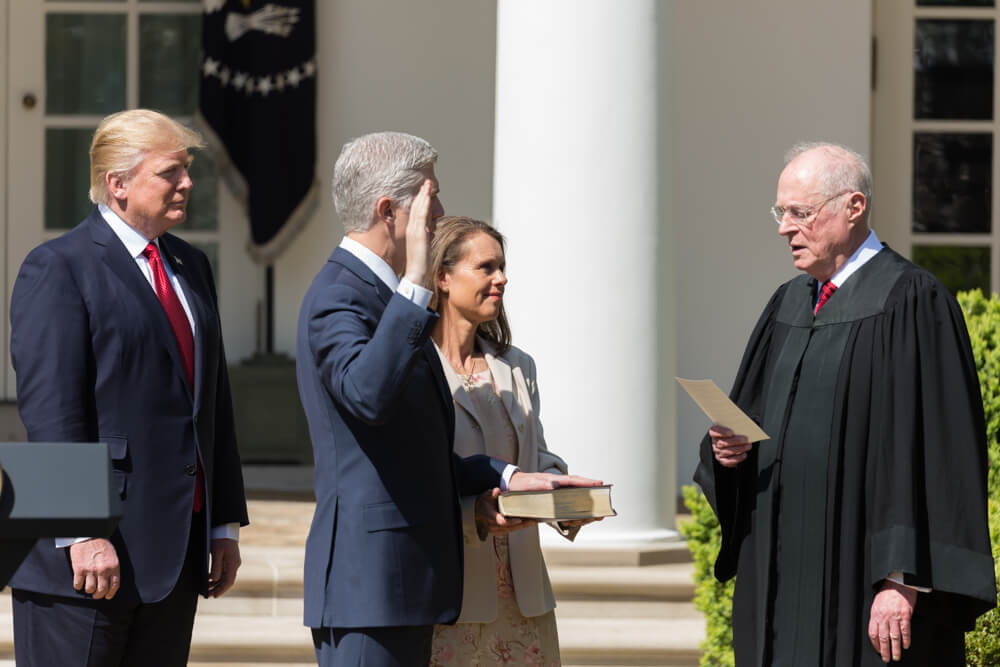
Anthony M. Kennedy, Associate Justice of the Supreme Court of the United States, swears in Supreme Court Justice Neil M. Gorsuch on Monday, April 10, 2017, in the Rose Garden of the White House in Washington, D.C. Also shown, Gorsuch’s wife Louise stands on stage holding a family Bible. Justice Gorsuch is the Supreme Court’s 113th justice.
White House photo via Wikimedia Commons.
“We have to STOP the next Trump nominee!” says a pop-up solicitation on People for the American Way’s website. Before you rush to “donate now,” you might want to consider the organization’s assessment of Trump’s last Supreme Court nominee.
“Far from being a fair-minded constitutionalist,” PFAW says, Neil Gorsuch “has proven to be a narrow-minded elitist who consistently votes in favor of corporations and the powerful.” The gap between that description and Gorsuch’s actual performance on the Court speaks volumes about the blind partisanship of Trump critics who care more about scoring political points than defending civil liberties.
PFAW is echoing the criticism of Democratic senators who worried, before Gorsuch was confirmed in April 2017, that he was not inclined to stand up for “the little guy.” Gorsuch’s record during a decade on the U.S. Court of Appeals for the 10th Circuit belied that claim, and his 15 months on the Supreme Court provide further evidence that he is not shy about defending the principles that protect politically disfavored individuals from the whims of the powerful.
In sharp contrast with the man who nominated him, Gorsuch worries about abuses of the government’s power to take people’s property “for public use.” In June 2017, when the Court declined to hear a case that raised the question of whether a state can impose limits on the “just compensation” it owes for takings under the Fifth Amendment, Gorsuch, joined by Clarence Thomas, urged his colleagues to address that issue at the “next opportunity.”
That pairing was notable because Gorsuch is on record as admiring Thomas’s passionate dissent from the widely condemned 2005 decision in which the Court approved the use of eminent domain to transfer property from one private owner to another in the name of economic development. Big businesses routinely use such arrangements to override the wishes of little people who get in the way of their plans.
Comments Off on The soon-to-be-announced target of the two-minute unceasing hate
July 2, 2018
QotD: Perverse incentives, death penalty edition
People cheered when, in the 1990s, Speaker of the House Newt Gingrich advocated mandatory executions for drug dealers. But economists wondered why Gingrich wanted to decrease the penalty for murder. How does the death penalty for drug dealers decrease the penalty for murder? Think about it this way: Suppose that Gingrich’s bill becomes law and the police bust into an apartment where three drug dealers have hidden their stash. What happens? The drug dealers know that if they give up, they will be put to death. So why not try to kill the police? If the dealers are lucky, they get away. If the dealers are unlucky, they are no worse off than if they didn’t fight because when drug dealing is a capital offense, drug dealers face no additional penalty for murder.
Tyler Cowen and Alex Tabarrok, Modern Principles: Microeconomics (3rd Edition), 2015.
Comments Off on QotD: Perverse incentives, death penalty edition
June 28, 2018
US Supreme Court rules on the Janus case
Eric Boehm reported soon after the decision was announced on Wednesday morning:
More than four decades after the Supreme Court ruled that public sector workers could be required to pay dues to unions even if they do not join one, a 5–4 majority on the high court overturned that precedent in a closely watched case that could have major ramifications for the future of public sector unions.
“Under Illinois law, public employees are forced to subsidize a union, even if they choose not to join and strongly object to the positions the union takes in collective bargaining and related activities,” Justice Samuel Alito wrote in the majority opinion. “We conclude that this arrangement violates the free speech rights of nonmembers by compelling them to subsidize private speech on matters of substantial public concern.”
In the short-term, the ruling in Janus v. American Federation of State, County and Municipal Employees means that plaintiff Mark Janus was successful in his decade-long fight to prevent the union from taking $50 out of his paycheck every two weeks. Over the years, Janus estimates, he’s contributed more than $6,000 to the union.
More broadly, Wednesday’s ruling could end the automatic deduction of union dues from millions of public employees’ paychecks, forcing unions like AFSCME to convince workers to voluntarily contribute dues — something workers would do, presumably, only if they have a reason to do so.
“So many of us have been forced to pay for political speech and policy positions with which we disagree, just so we can keep our jobs. This is a victory for all of us,” said Janus in a statement. “The right to say ‘no’ to a union is just as important as the right to say ‘yes.’ Finally our rights have been restored.”
The ruling is “a landmark victory for rights of public-sector employees,” said Mark Mix, president of the National Right to Work Legal Defense Foundation, which supported Janus’ lawsuit.
While today’s ruling certainly shifts the balance towards worker freedom, groups like the National Right to Work Legal Defense Foundation, which represented Janus, say they are already prepared for additional rounds of litigation. In states that previously have embraced right-to-work policies, unions have often tried to make it as difficult as possible for workers to renounce their membership.
At Hot Air, Jazz Shaw highlights a few of the key points:
Justice Alito wrote the decision and it followed along with the expectations of those who watched the case play out before the court. Also as expected, this was a 5-4 decision, split along partisan lines. At the heart of Janus was the question of whether or not unions can forcibly extract dues from workers’ paychecks without the worker proactively volunteering to contribute. In parallel to that, the court had to determine whether or not those extracted fees, being put toward lobbying efforts, constituted involuntary political speech on the part of the worker. The ruling answers both questions definitively.
You can read the full decision here [PDF] but I’ve extracted a couple of the key points from the syllabus. First is the issue of whether the previous ruling in Abood (which went in the unions’ favor) erred in allowing the forcible extraction of dues. Alito leaves no room for doubt.
The State’s extraction of agency fees from nonconsenting public sector employees violates the First Amendment. Abood erred in concluding otherwise, and stare decisis cannot support it. Abood is therefore overruled.
The second question was the one about subsidizing the speech of others when it runs contrary to your personal beliefs. Again, Alito is definitive.
Forcing free and independent individuals to endorse ideas they find objectionable raises serious First Amendment concerns. E.g., West Virginia Bd. of Ed. v. Barnette, 319 U. S. 624, 633. That includes compelling a person to subsidize the speech of other private speakers.
A union official, Paul Shearon, the IFPTE Secretary-Treasurer, put out an immediate statement saying that this was based on, “a bogus free speech argument.” He went on to say that the justices voting in the majority “are little better than political hacks.” That was followed up by a threat to take it to the streets.
In the short run, the Janus decision may hurt some unions financially, but in the long run it will serve to make unions and their members more militant and force a stronger culture of internal organizing. The recent statewide teacher strikes demonstrate that when public sector workers face limitations on their bargaining rights they take their case to the streets.
This is going to send shockwaves through not just the unions, but the Democratic Party at large. The amount of money that the unions flush into Democratic coffers every year is likely more than most of you imagine.
Steven Malanga in City Journal provides some rough figures on how much money was at stake for the unions and their political activities:
With the appointment of Justice Neil Gorsuch, unions feared the outcome of the Janus case. After all, many union members have stated that they would give up their memberships if the court ruled that compulsory fees were illegal. An officer of the Communications Workers of America, which represents government employees in New Jersey, told an AFL-CIO convention last fall that only 54 percent of its 60,000 members said that they would remain in the union if they could opt out of paying fees. The California Teachers Association, meanwhile, crafted a 2019 budget that anticipated that as many as 23,000 members would leave if the court overturned the Illinois law. The union will also suffer from the loss of revenues from 28,000 nonmembers who’ve been paying agency fees, and will presumably stop doing so now that they’re no longer compelled. The union, according to a published report, estimated it could suffer a loss of some $20 million annually as a result.
Even before the ruling, government unions were reeling. Their membership has declined from a peak of 7.9 million in 2009 to 7.2 million today — a drop of nearly 9 percent. The portion of government workers in unions, which peaked in the mid-1990s at 38.7 percent, is now down to 34.4 percent, according to unionstats.com. Some of the decline is due to a significant reduction in the number of government workers after the 2008 financial crisis; even today, nine years into a recovery, the total number of government workers remains 10 percent lower than before the recession — a loss of 233,000 positions. But unions have suffered an even bigger falloff, because when government employment began trending back upward in 2014, union membership stayed flat. Many of the gains in government jobs since then have been in nonunion positions.
Unions have suffered big losses in Wisconsin, which banned compulsory unionization in the public sector in 2011. Some 140,000 union positions have dried up as workers chose not to retain their memberships. But other states that continued to compel workers to join a union or pay agency fees have also seen major losses, including New York, where union membership has fallen by 150,000, Illinois (down 88,000), Pennsylvania (down 54,000), and New Jersey (down 50,000). Those declines are reflected in union numbers, too. The National Education Association, the largest teachers’ union, has lost nearly 250,000 members, or about 8 percent of its membership, since 2009. AFSCME’s national membership has shrunk by 200,000, or 13 percent.
Comments Off on US Supreme Court rules on the Janus case
June 27, 2018
Calico prohibition
In the current issue of Reason, Virginia Postrel outlines an eighteenth-century French government attempt to prohibit calico cloth:
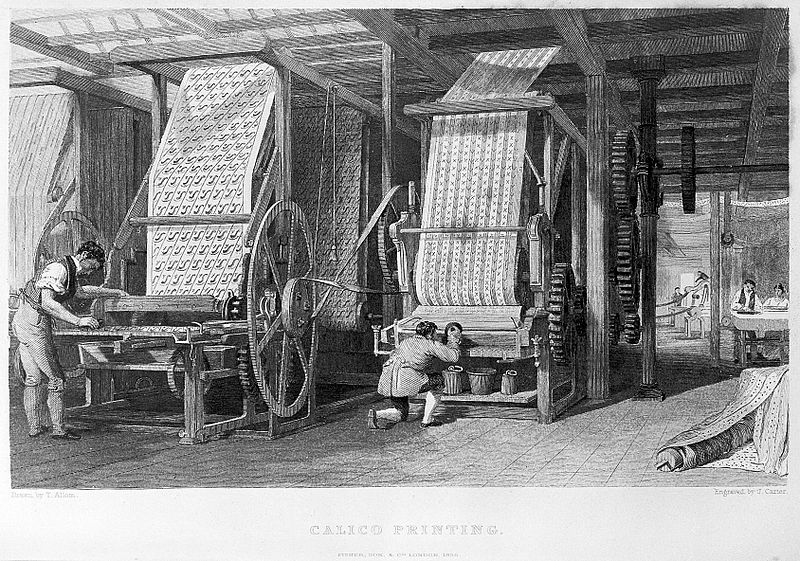
Calico printing, an image from Wellcome Images, via Wikimedia Commons
On a shopping trip to the butcher’s, young Miss la Genne wore her new, form-fitting jacket, a stylish cotton print with large brown flowers and red stripes on a white background. It got her arrested.
Another young woman stood in the door of her boss’ wine shop sporting a similar jacket with red flowers. She too was arrested. So were Madame de Ville, the lady Coulange, and Madame Boite. Through the windows of their homes, law enforcement authorities spotted these unlucky women in clothing with red flowers printed on white. They were busted for possession.
It was Paris in 1730, and the printed cotton fabrics known as toiles peintes or indiennes — in English, calicoes, chintzes, or muslins — had been illegal since 1686. It was an extreme version of trade protectionism, designed to shelter French textile producers from Indian cottons. Every few years the authorities would tweak the law, but the fashion refused to die.
Frustrated by rampant smuggling and ubiquitous scofflaws, in 1726 the government increased penalties for traffickers and anyone helping them. Offenders could be sentenced to years in galleys, with violent smugglers put to death. Local authorities were given the power to detain without trial anyone who merely wore the forbidden fabrics or upholstered furniture with them.
“The exasperation of the lawmakers, after forty years of successive edicts and ordinances which had been largely ignored, flouted or circumvented on a wholesale basis, can be sensed in this law,” writes the fashion historian Gillian Crosby in a 2015 dissertation on the ban. Her archival research shows a spike in arrests for simple possession. “Impotent at stopping the cross-border trade, printing or the peddling of goods,” she writes, “government officials concentrated on making an example of individual wearers, in an attempt to halt the fashion.”
They failed.
In the annals of prohibition, the French war on printed fabrics is one of the strangest, most futile, and most extreme chapters. It’s also one of the most intellectually consequential, producing many of the earliest arguments for economic liberalism. “Long before the more famous debates about the liberalisation of the grain trade, about taxation, or even about the monopoly of the French Indies Company, philosophes and Enlightenment political economists saw the calico debate as their first important battleground,” writes the historian Felicia Gottmann in Global Trade, Smuggling, and the Making of Economic Liberalism (Palgrave Macmillan).
Comments Off on Calico prohibition


