Quotulatiousness

July 1, 2020

Toronto Police won’t be facing a 10% budget cut after city council votes down proposal

Filed under: Cancon, Government, Law — Tags: , , — Nicholas @ 03:00

Chris Selley on the vote by Toronto city councillors to retain the existing budget for the city’s police force at $1.22 billion:

On Monday, Toronto City Council debated and passed a variety of proposed police reforms, the newsiest of which had been asking the department to table a 10-per-cent budget cut for 2021. That idea was voted down 16-8. Further proposed changes included asking the Toronto Police Service for a line-item budget, and subjecting police to the municipal auditor-general’s oversight — utterly revolutionary concepts, you will agree. (Both passed.)

The budget cut might at least have been a useful exercise: It would be interesting to know what the police would and wouldn’t do with $1.1 billion instead of $1.22 billion. If I had been a consensus-seeking councillor on the virtual floor, I might have moved a motion asking the police to table line-item budgets for both — and maybe push for 20 or 30 per cent, too. But the question of the budget sucked up too much oxygen.

That’s certainly understandable. The “defund the police” movement in all its permutations is having a moment. There are North American police departments and police unions that might as well be begging to be disbanded, as much with their banal and petulant misbehaviour as with their needless use of lethal force. A few might even get their wish.

Canadian departments haven’t been begging quite as hard, however, and too many Canadians take false solace in that. When it comes to police-involved fatalities, we fare quite poorly against Western nations other than the one next door. Our accountability mechanisms are, generally speaking, a sick joke; indeed, it seems considerably easier to fire flamboyantly terrible cops in the United States than it does here.

James Forcillo, the Toronto officer who was caught on tape fatally unloading nine shots at 18-year-old Sammy Yatim for no good reason, was on the payroll for two-and-a-half years until his criminal conviction. He was at least suspended. Simon Seguin, the Alberta RCMP officer caught on camera in March rugby-tackling, punching and choking Athabasca Chipewyan First Nation Chief Allan Adam in a dispute over an expired vehicle registration, was at the time awaiting trial for assault!

June 27, 2020

Canada’s “Gang of 19” urges abject surrender and hostage exchange with China

Filed under: Cancon, China, Government, Law, Politics — Tags: , , , , — Nicholas @ 03:00

As Canadian political life continues to revolve more and more around the Chinese model, we now have our very own political “gang”, just like China did!

“The Chinese People’s Liberation Army is the great school of Mao Zedong Thought”, 1969.
A poster from the Cultural Revolution, featuring an image of Chairman Mao.
Image via Wikimedia Commons.

A former leader of the New Democratic Party of Canada. A former Conservative foreign minister. Two former Liberal foreign ministers. Four former Canadian ambassadors to the United Nations, under Liberal and Tory governments. Two former Canadian ambassadors to the United States, under Liberal and Tory governments. A former Supreme Court justice. A former Liberal justice minister. A former Conservative senator. A flock of name-brand diplomats. Former CBC host Don Newman, for some reason.

This is the panoply of 19 elite opinion-makers that gathered in the Laurentian Boardroom at an online hotel and drafted a letter, released Wednesday, calling on Prime Minister Justin Trudeau to intervene in the extradition process, set Huawei CFO Meng Wangzhou free, and thereby secure the release of Canadians Michael Kovrig and Michael Spavor.

China, last seen denying the two men’s detention had anything to do with Meng, had changed its tune just hours earlier on Wednesday: Freeing her might “open up space for resolution to the situation of the two Canadians,” foreign ministry spokesman Zhao Lijian said.

And who stands in the way? A prime minister who was perfectly happy to stick his thumb on the scales of justice to save a cherished member of Quebec Inc. from the indignity of prosecution for rather flamboyant alleged corporate malfeasance in and concerning Gaddafi-era Libya (or to “save jobs,” if you prefer, although it emerged no one in Justin Trudeau’s government had bothered to inquire how many jobs might actually be lost if SNC-Lavalin were convicted).

You can hardly blame China for noting the precedent. And it’s sorely fitting that the Gang of 19 addressed their letter to Trudeau rather than to the fellow who would actually have to give the order: Justice Minister David Lametti. We all know who calls the shots in that particular relationship. Perhaps it’s best we just admit it.

Colby Cosh also finds the advice proffered to the Prime Minister to be … less than admirable:

Screen capture of a BBC News report on Canadians Michael Kovrig and Michael Spavor facing espionage charges in China.

I wanted to discuss the letter written by the 19 geriatric Canadian worthies who encouraged the Prime Minister to trade Huawei executive Meng Wanzhou, in Canadian custody fighting extradition to the U.S., for the “two (Canadian) Michaels” detained on ill-defined espionage charges in China. Colleague Chris Selley has gone over the ground, but that’s show biz for you. Selley concluded his overview by pointing out that the letter argues perversely for “surrender, then victory.” With the Meng-Michaels standoff out of the way, the various ex-diplomats and superannuated politicians argued, Canada could use the opportunity for a fresh foreign-policy start, deciding what “tough steps” ought to be taken against China. If any.

The letter, part of a campaign on the two Michaels’ behalf led by ex-Supreme Court Justice Louise Arbour and ex-justice minister Allan Rock, is self-refuting in parts. Yielding “to bullying or blackmail” is “repugnant,” the authors admit, while advising just that. But “resisting China’s pressure is no guarantee that it will never be applied again in the future … China might well decide that next time it will need to escalate by detaining more than two Canadians.”

The implication, if this argument is to have any force, is that actively rewarding China’s abduction of our citizens is a jim-dandy way of making sure it never happens again. The problem with this reasoning is obvious, but the authors are also careful not to define victory too precisely. They say that letting Meng go and getting Michael Kovrig and Michael Spavor back would permit Canada to “declare its position on Huawei’s involvement in the deployment of 5G technology in Canada,” a decision “that has been postponed time and again.”

Sooo … the authors think we should slam the door on Huawei, whose CEO is Meng’s father? They don’t say so! They only say that settling this quarrel would make it easier for us to decide. And they are only slightly clearer on issues of human rights in China and Hong Kong, which our current government and foreign service are allegedly being shy about “so as not to make the situation worse for the Canadian prisoners.”

June 23, 2020

The “Battle of Dijon”

Filed under: France, Law, Military — Tags: , , , — Nicholas @ 05:00

I post a lot of accounts of ancient and modern wars and battles, but the “Battle of Dijon” actually took place earlier this month and has been widely mischaracterized in the media, as John Lichfield recounts:

Dijon viewed from Saint-Bénigne Cathedral with the Palace of the States of Burgundy, the Notre-Dame and Saint-Michel churches, the Saint-Nicolas tower, the former Saint-Bénigne abbey palace (ENSA), The Lafayette galleries, the old department stores at Le Pauvre Diable and la Ménagère.
Photo by Twibo2 via Wikimedia Commons (caption translated by Google Translate).

Dijon, the capital of Burgundy, rarely attracts the world’s attention. There is Dijon mustard of course. There is Dijon blackcurrant liqueur (Cassis de Dijon). There are many beautiful, old Burgundian streets and buildings. But of all the medium to large cities in France, Dijon (population: 159,000) is surely the least talked about.

Then, abruptly, last weekend Dijon had the great misfortune to become newsworthy. War broke out, we were told, between “Chechen gangs” and “Arab gangs”. The dispute was, some French media reported, about the right to traffic drugs. The Daily Mail announced that the French army had been sent in to restore order. Marine Le Pen compared Dijon to Beirut. Similar “wars between migrant communities” now threatened, she said, all over France.

All these reports were, I believe, wrong or deeply misleading. What did happen in Dijon over four days the other weekend was surreal and disturbing. But the incidents defy simple explanation or political point-scoring. They say, perhaps, more about Chechnya, and the values — good and bad — of exiled Chechens, than they do about the wider racial issues of France. The severity of the violence probably owed something to the frustrations of France’s recent nine weeks of Covid lockdown. The political and media reaction was skewed by the fact that the events occurred while France was in the midst of a debate about race and policing – in the wake of the George Floyd killing in the United States.

On Sunday evening, on the third night of violence in Dijon, President Emmanuel Macron happened to be addressing the nation on TV. He said, among many other things, that he would resist all pressure to splinter France into ethnic communities.

So what had happened over four days in Dijon? There are several conflicting accounts. Here, briefly, are the facts that I have been able to establish.

On 9th June a 15-year-old (some say 16-year-old) boy of Chechen origin was badly beaten up outside a chicha (hookah) bar in central Dijon. His attackers were local men in their 30s of African and North African origin. According to the Chechen version of events, the men were drug-dealers. The injured boy apparently had no connection with drugs. The dealers attacked him because local Chechens were known to be hostile to drug-trafficking. They put a gun in the boy’s mouth and said: “We hate Chechens. We’re going to let you live so you can tell the other Chechens what’s going to happen to them.”

Three days later a convoy of cars arrived in Dijon packed with Chechen men from several other parts of France, as well as Belgium and Germany. Local media and police say that there were 100 of them; the Chechens say that there were only 15. They smashed up the chicha bar, assaulted its owner and then rampaged through the multi-racial Les Grésilles area of council estates just north-east of central Dijon.

June 21, 2020

Paul Wells – “Everyone agrees!” [on the need to fully investigate the Nova Scotia massacre] … “But so far there is no inquiry”

Filed under: Cancon, Law — Tags: , , , , , , — Nicholas @ 05:00

Paul Wells in Maclean’s:

We are faced, perhaps only temporarily, with a familiar Canadian paradox: everyone says they want something to happen, but it isn’t happening.

The “something” is a rigorous public inquiry into a horrible shooting spree that spanned two days and killed 22 people in Nova Scotia in mid-April. It was the worst mass murder in Canadian history. It was lurid in its weirdness. The gunman, Gabriel Wortman, spent two days driving around in a convincing replica RCMP vehicle, shooting at whim, while the force he was imitating and dodging failed to send out a more comprehensive emergency alert than their Twitter warnings, one that might have saved more lives. In the midst of the carnage, two actual RCMP officers apparently fired their weapons into the walls of a firehall in Onslow for reasons that remain unknown.

New reporting for Maclean’s by Shannon Gormley, Stephen Maher and Paul Palango raises troubling new questions about Wortman’s possible ties to organized crime and, especially, to the RCMP itself. This reporting is attracting a lot of attention and, here and there, vigorous online debate. This Twitter thread, for instance, asks hard questions about our latest story.

The questions raised by our investigative team including Paul Palango, author of three best-selling books (here, here and here) about the troubling history of the RCMP, are backed by a solid and growing network of well-informed sources. But past a certain point, even superb reporting can’t provide authoritative answers. That work is properly left to duly mandated public authorities, usually wearing judges’ robes. Some people, reading the most recent Maclean’s reporting, have said the RCMP has a lot of questions to answer. Unfortunately there is no reason to take any answer from the RCMP on faith. It’s time for a full judicial inquiry.

Everyone agrees! From Nova Scotia premier Stephen McNeil to the latest embattled RCMP commissioner to three Trudeau-appointed Nova Scotia senators to anguished families of the murdered to, I mean sort of, the Prime Minister. But so far there is no inquiry.

June 20, 2020

QotD: Morality and the government

Filed under: Government, Law, Quotations, USA — Tags: — Nicholas @ 01:00

If an action is immoral for me and you, it is also immoral for others, including those who constitute the government. Election to public office is not a licence to lie, defraud, extort, rob, kidnap, or murder. Those who believe that government officials, employees, and contractors may morally do what other individuals may not do are morally bankrupt. The government has the power to act immorally — and does so as its standard operating procedure — but power and just right are completely different things. To affirm that might makes right in a moral sense is to affirm that one has simply chosen to abandon all pretense of taking morality seriously.

Gaze upon the members of Congress, the president and his lieutenants, the justices of the Supreme Court, and the leading figures of the government bureaucracies. As I do so, I cannot help but wonder: Who are these people? I am not personally acquainted with a single one of them; they are complete strangers to me. I have not contracted with them for the provision of any services, nor have I agreed to support them financially. Why then do these strangers presume to dictate to me what I must do and not do, and to threaten me with violence if I do not obey? They might as well be alien invaders from outer space.

Robert Higgs, “A Straightforward View of Morality and the Government”, The Beacon, 2018-03-06.

June 16, 2020

QotD: A thumbnail history of the English language

Filed under: Britain, France, History, Humour, Law, Quotations — Tags: , , , , , — Nicholas @ 01:00

Languages are anything but static. Some change very slowly, like French — which owes much of its ponderousness to a government department specifically tasked with rooting out heretic words that creep in from the outside. Other languages undergo periods of very rapid change — the English of Chaucer (late 1300s) would be very confusing to Shakespeare (late 1500s and early 1600s). Two hundred years seems like a long period of time, but in the history of an entire country, it’s a drop in the bucket.

English doesn’t just borrow words; it lifts whole phrases and grammatical ideas from other languages without so much as a by-your-leave. With the coming of the Saxons to Britain, Germanic languages crashed headlong into Brythonic and became Old English. Then the Vikings went for a multi-century beer run starting in the late 700s and left behind a bunch of Norse words, because who doesn’t invent a new language every time they go out carousing? In 1066, William the Bastard decided he didn’t like his name, and brought Norman French with him when he went to the town clerk’s office to have his name legally changed to William the Conqueror.

For the next two hundred years, the English upper classes spoke French and the lower classes spoke a zillion dialects of Middle English (travel was difficult for poor people, so regional variations survived). All legal business was done in French, which was often translated on the spot into Latin for the official records. A person couldn’t even submit a legal plea in English until 1362. But with the start of the Hundred Years’ War in 1337, Edward III decided that speaking French was très passé, and began encouraging English as a spoken and written language, with a little French thrown in, just to keep things interesting. And ever since, English has been debating how sophisticated it wants to be, while making rude gestures across the Channel at France and grumbling when the French sneer northwards.

Blake Smith, “A Brief History of English and Why it Matters”, Mad Genius Club, 2018-03-07.

June 11, 2020

QotD: Equal rights

Filed under: Government, Law, Liberty, Quotations — Tags: , , , , , — Nicholas @ 01:00

We must separate the moral dimensions of a subject from the empirical questions surrounding it. For example, on the radioactive issue of sex (or gender) differences in cognitive abilities, there is the empirical question of whether or how men and women diverge in certain tasks, and then there is the moral question of how men and women should be treated. Empirically, there is much evidence that in some tasks women excel over men, and in other tasks, men excel over women. For example, women are more dexterous while men are better at throwing; women are superior in visual memory whereas men are better at mentally rotating shapes; women are better at mathematical calculation while men are better at mathematical problem-solving; in terms of overall general intelligence (g), however, there is no gender difference. Morally, however, none of this matters. We should support women’s rights regardless of any physical or cognitive differences between the sexes. To yoke one’s moral evaluation to empirical questions like this is a big mistake; worse is to assume that this is what people always do and therefore we must suppress any empirical evidence that there are differences, as this will only tilt people’s moral judgments toward empirical outcomes.

This reminds me of the debate in the late 1980s through mid-1990s about whether homosexuality was nature or nurture, something you were born to be or a lifestyle choice. Conservatives and Christians argued for the “choice” position and this led to efforts to “convert” gays to straight (or “pray the gay away”) because something that is learned can be unlearned. This led the gay community and supporters thereof to argue for the “born this way” position. The cumulative evidence from multiple lines of inquiry led to the nature position more than that of nurture, but this was another example of confusing the empirical question of the origin of homosexuality with the moral question of the rights of gays and lesbians (today the LGBTQ community). It should go without saying — but unfortunately in these times it must be said again and again — it doesn’t matter what the origins of homosexuality turn out to be, gays and lesbians and everyone else in the LGBTQ community are entitled to the same rights and privileges as everyone else protected by the constitution of their nation (and those nations that have yet to extend legal rights to gays and lesbians need to change their constitutions).

Michael Shermer, interviewed by Claire Lehmann, “The Skeptical Optimist: Interview with Michael Shermer”, Quillette, 2018-02-24.

June 5, 2020

Australia’s 1975 constitutional crisis back in the news

Filed under: Australia, Government, History, Law — Tags: , , — Nicholas @ 03:00

Colby Cosh outlines the events of 1975, where the Governer-General of Australia, Sir John Kerr, used his reserve powers to dismiss the government of Gough Whitlam and call for a fresh federal election in which Whitlam’s party was soundly defeated. In taking this action, Sir John corresponded with Queen Elizabeth and after his retirement deposited those documents with the National Archives. The bulk of his papers were made available to researchers after the statutary 30 year delay, but the letters involving Her Majesty were withheld for 60 years. An Australian historian has now successfully challenged the National Archives in Federal Court:

National Archives of Australia in Parkes, Australian Capital Territory.
Photo by Bidgee via Wikimedia Commons.

The confrontation at Yarralumla, and the various narrative twists and turns leading up to it, are a major event in Australian constitutional history. Which brings us to Jenny Hocking, a left-leaning historian who is a top specialist on the 1975 crisis.

Hocking knew that Kerr, after his retirement, had deposited copies of his correspondence with the Queen in Australia’s National Archives. Hocking made good professional use of Kerr’s formal papers, made available to the public in 2005 under the 30-year rule that covers Australian state papers. But Kerr had, with the agreement of the Archives, made separate arrangements for his letters to and from the Queen — the so-called “(Buckingham) Palace letters”.

[…]

The National Archives, trying to stand by its bargain with Kerr as a donor, successfully argued that while papers generated or received by “the official establishment of the Governor-General” would clearly be ordinary public records under Australian law, the letters that Hocking wanted to see didn’t involve “the official establishment,” but merely Kerr himself as … well, just a guy. The Federal Court found that the Palace letters therefore had the legal status of one of Sir John’s grocery bills, or sex diaries, or anything else that he would be perfectly entitled to stick in a locked box for 50 years.

(Or to burn in private. Which was an option he had, but rejected, explaining explicitly that he wanted future historians to have access to the material. But not for them to have it so soon that it might surprise or embarrass the Queen during her own lifetime.)

What happened last week was that the case reached Australia’s top court and Hocking won a smashing victory. Kerr’s correspondence with the Queen is known to have contained discussions of the Australian constitutional situation, and in view of that, the High Court said, the Federal Court’s distinction between Commonwealth records and personal correspondence must be regarded as a bogus artifice. The concepts aren’t mutually exclusive.

The Archives also asserted that queen-viceroy letters attract a higher level of secrecy “by convention” in all the Queen’s realms, but they couldn’t produce evidence that such a convention exists. Hocking’s costs must be covered by the Archives, and as far as the letters go, the ball is in their court legally. They could still use a “national security” exemption to withhold some of the material, and the freedom with which this magic formula is used by archival gatekeepers is notorious. But it may soon be possible for Australians to read the final chapter of the cataclysmic Kerr-Whitlam story.

June 2, 2020

Antifa

Filed under: Government, Law, Politics, USA — Tags: , , , , , — Nicholas @ 03:00

Arthur Chrenkoff welcomes the move to designate the Antifa movement as domestic terrorists:

“antifa 8973ag” by cantfightthetendies is licensed under CC BY 2.0

President Trump’s decision to designate Antifa as a terrorist organisation is long overdue.

Whether you call them a terrorist organisation or a criminal organisation – or both – the underlying facts are the same: Antifa is a network of groups committed to a violent revolution to overthrow the democratic system of government and replace it with some sort of a communist “dictatorship of proletariat”, whoever the current proletariat is supposed to be (which does not in the end matter very much, because it’s all about the party organisation rather than “the masses”). To effect such revolution, Antifa uses tactics of violence against people it considers enemies as well as destruction of property. Remember, these people are not Scandinavian social democrats or even Bernie and AOC-style “democratic socialists” who advocate and follow a democratic and peaceful path of transformation to achieve their objectives of building what they consider a better and more just society. Antifa are thugs who desire to tear down and destroy the current political and economic order and erect their utopia on its ashes. They want to abolish democracy, capitalism, liberalism and all the other existing institutions in favour of a Marxist-Leninist state — or just for the fun of it if they are more of an anarchist rather than communist frame of mind. Groups whose the entire modus operandi is based on breaking law and criminal activity have no legitimate place in a democratic society. Antifa are the political organised crime.

The label Antifa has been used and abused too long to muddy the waters and confuse people — many of whom, granted, want to be confused. Because fascism is objectively bad (and considers so by an overwhelming majority of people), calling themselves “anti-fascist”, Antifa seeks to claim the moral high ground and the role of the good guys who stand up to white supremacists, neo-Nazis and other extreme element. But you cannot simply judge people by who their enemies are, or who they say their enemies are — you also have to judge them by their intentions, actions and aims. In the Second World War, the United States and the United Kingdom and their Western allies were anti-fascist, but so was the Soviet Union. Stalin hated fascists (except for a period of two years in 1939-41 when he collaborated with them). This did not make him a good guy, even if for the Allies at the time it made him the lesser of the two evils. Coincidentally, for Stalin the label “fascist” was a very broad one, applying not just to German Nazis and their sympathisers but to anyone opposed to communism and the Soviet Union and so in turn opposed by them, including at times even social democrats and other non-revolutionary socialists {“social fascists” in the Stalinist nomenclature). And so it is for Antifa — we are all fascists, from the few skinheads at the political fringes to all the mainstream parties and ideologies of both the right and the left. Just as in Russia in 1917 onward and all the other communist countries in history, your position on the democratic political spectrum can never give you an ultimate immunity, it only determines the order in which you will be shot (left-wingers and anarchists last, because they can be used the longest by the forces of revolution).

June 1, 2020

QotD: The right to keep and bear arms

Filed under: Law, Liberty, Quotations, USA — Tags: , , , , — Nicholas @ 01:00

The bureaucrat who commands an army of over forty-nine thousand armed men and women (the largest police force in the world, slightly more than three Army divisions) in its century-old struggle against the Bill of Rights, has loftily decreed on 60 Minutes, the famous CBS newsish show, that it is “insanity” to “allow” national concealed carry reciprocity for law-abiding citizens. This according to an article that appeared this week on the Breitbart website, written by their distinguished Second Amendment specialist, A.W.R. Hawkins.

The bureaucrat in question is New York Police Department Commissioner James O’Neill, an individual who clearly believes that his thirty-five years spent plodding unspectacularly up the NYPD chain of command equips him better to tell you what your rights are, and what they are not, than the Founding Fathers of this country and the Framers of its unique social contract.

Well I’ve got news for you, Jimmy, there is no “allow”.

“Every man, woman, and responsible child has an unalienable individual, civil, Constitutional, and human right to obtain, own, and carry, openly or concealed, any weapon — rifle, shotgun, handgun, machine-gun, anything — any time, any place, without asking anyone’s permission.”* That’s the essential freight of the Second Amendment to the United States Constitution, the highest law of the land, which you and yours have been illegally suppressing since passage of the 1911 Sullivan Act, named for Tammany Hall’s Timothy Sullivan, perhaps the most corrupt, bigoted politician ever to occupy office in New York.

Since the ability to own and carry weapons unmolested by the State is a fundamental right, there can be no thought of any unit of that state “allowing” it or not “allowing” it. Any government employee who attempts to interfere with that right deserves a long stay in prison among those whose rights he’s violated. Note that I am not saying that peace and civil order are a bad thing, just that it has to be achieved within Constitutional parameters. The Founders put them there for a reason; they had seen the rule of law abused too often by arrogant and brutish British authorities.

* “The Atlanta Declaration”, L. Neil Smith, 1987

L Neil Smith, “There Is No ‘Allow’, Jimmy”, Libertarian Enterprise, 2018-02-18.

May 31, 2020

On “spontaneous” riots

Filed under: Law, Media, Politics, USA — Tags: , , , , — Nicholas @ 03:00

David Warren had a brush with a riot as a youngster — not as a participant, but as a near-victim — so the psychology of riots has a personal edge:

To a trained observer, the organizers of the riot stand out. They are dressed distinctly, they are giving orders; they are directing the attacks. They will usually be wearing expensive communications equipment. A drama coach would notice that their harangues are premeditated and rehearsed, to stir violence. That anger in the crowd was available to them, as their raw material, goes without saying; their art consists of “weaponizing” it.

Fascists — the real ones, in pre-war Italy and Germany — were masters of this art. So were the Communists with whom they had streetfights. The blackshirts today, a near-monopoly of the Left, descend from this rich tradition. When Antifa and other leftist scum shut down public discussions in universities and elsewhere, they may use the latest technology, but to old-fashioned ends.

What is alarming is not that these people exist — radical evil is a fact in human nature — but that they are given permission to act lawlessly. Rather than arrest and prosecute them, the liberal authorities agree to silence the legitimate speaker. They are trying to avoid confrontation, with people who sought confrontation, and will seek a larger confrontation next time. The prestige of these devils in human flesh is increased by their victories.

An injustice, such as the apparent murder of George Flynn by a vicious cop, while three more stood and watched, was the pretext for the riots. It was convenient for aggravating racial tensions, by which the Democrat party hopes to retrieve black votes that had been getting away from them. I would not wish to omit this dimension of the permission they grant to rioters. Politics are a cynical business.

But note, the mostly white folk in Antifa, prefer black neighbourhoods to start race riots, for that is where resentments will be easiest to exploit. (Masks help to conceal their whiteness.) This means that the victims of the riots, whose property and businesses are gutted, will also be mostly black. The media elide this aspect of the lawlessness, because they want Republicans to be defeated, too.

The moral stench is overpowering.

May 25, 2020

Thoreau would clearly support ending mandatory lockdowns

Filed under: Government, History, Law, Liberty, USA — Tags: , , , — Nicholas @ 03:00

In an article discussing civil disobedience in the face of unreasonable government action, Lawrence W. Reed recalls the opinions of noted civil disobedience supporter Henry David Thoreau:

Daguerreotype of Thoreau in 1856 by B. D. Maxham.
Image via Wikimedia Commons.

History is full of stories of people who practiced peaceful resistance in defense of sound principles in the face of official stupidity and oppression. Sometimes it has been the best way, if not the only one, to get bad policies changed.

One hundred and seventy years ago, a famous American figure wrote,

    Must the citizen ever for a moment, or in the least degree, resign his conscience to the legislator? Why has every man a conscience then? I think that we should be men first, and subjects afterward.

That figure was Henry David Thoreau. Born in Concord, Massachusetts in 1817, he was an eminent philosopher, poet and essayist. His best-known works are his book Walden: Life in the Woods and his essay, “Civil Disobedience”. The latter proved influential far beyond his time and place, shaping the thoughts and actions of eminent dissidents the world over. As we ponder the civil disobedience rising in reaction to coronavirus policies, now is a perfect time to give Thoreau’s essay another look. Toward that end, I offer some excerpts below.

One last thing before I do that: I want readers to know that, speaking strictly for myself, I endorse the re-opening of houses of worship (and many other things, for that matter), whether the government officially allows it or not. If that perspective makes life a little uncomfortable for the power-hungry at this time, so be it. The additional articles listed below reflect my reasoning.

Now, to Henry David Thoreau:

  • “Under a government which imprisons any unjustly, the true place for a just man is also a prison…, the only house in a slave state in which a free man can abide with honor.”
  • “If the injustice is part of the necessary friction of the machine of government, let it go, let it go; perchance it will wear smooth — certainly the machine will wear out. If the injustice has a spring, or a pulley, or a rope, or a crank, exclusively for itself, then perhaps you may consider whether the remedy will not be worse than the evil; but if it is of such a nature that it requires you to be the agent of injustice to another, then I say, break the law. Let your life be a counter-friction to stop the machine. What I have to do is to see, at any rate, that I do not lend myself to the wrong which I condemn.”
  • “I am as desirous of being a good neighbor as I am of being a bad subject.”
  • “If a thousand [citizens] were not to pay their tax-bills this year, that would not be a violent and bloody measure, as it would be to pay them, and enable the State to commit violence and shed innocent blood. This is, in fact, the definition of a peaceable revolution, if any such is possible.”
  • “The only obligation which I have a right to assume is to do at any time what I think right.”
  • “I saw that the State was half-witted, that it was timid as a lone woman with her silver spoons, and that it did not know its friends from its foes, and I lost all my remaining respect for it, and pitied it.”

Thanks for listening. See you in church

May 19, 2020

The Karenist coup

Filed under: Government, Health, Law, Liberty, USA — Tags: , , , , , , — Nicholas @ 03:00

L. Neil Smith on our current self-inflicted plight:

We find ourselves here, in this particular time and this particular place in the history of our republic, because of a 239-year-old oversight made by the Founding Fathers, in that the first ten amendments to the United States Constitution, commonly known as the Bill of Rights (the name itself is a mistake), contain no penalty clause for those — politicians, bureaucrats, policemen — who violate them. I’m not entirely sure it was accidental, but, as a result, they are violated daily, hourly, as a matter of course, and this Corona Virus farce — many others come to mind — is simply the most recent and most preposterous example.

(The name itself is an error because this document is not a mere list of privileges that the government generously lets the people exercise. Quite the opposite, it is a list of things that the government is absolutely forbidden to do It should have been called the “Bill of Limits”. And if the Founders, who had just fought and won a desperate, bloody war against the world’s most brutal and rapacious super-power, hadn’t meant them to be absolute, then why — for all you “living document” idiots out there — would they have even bothered to write them down?)

All over this bruised and battered country, a flock of mean, moronic, petty tyrants have issued illegal orders to those they clearly regard as the peasantry: stay home, avoid your fellow human beings, and above all, shut down the Machinery of Freedom which we know as capitalism. If it’s ever allowed to start up again, it must strictly be on terms that are essentially Marxist in character. No mere individual can ever again scratch his ass without written government approval and permission. In effect, the left has the revolution — as usual, achieved by somebody else — it has wanted for 180 years, since the days of Pierre-Joseph Proudhon.

What’s more, many otherwise decent and intelligent folks are out there begging for their rulers to let them be free again. I find that repulsive and unAmerican. And to those boobies (including Sean Hannity and Joy Behar) blubbering about patriots bring their weapons to demonstrations, listen up: the Founders meant the government to be intimidated by the people, you hapless buffoons.

My bottom line, here, is that, in the short run, we must free ourselves — now — from what we have to call Faucism. Scientific pleaders like the dictatorial doctor must be made painfully aware that when their pronouncements have clear political and economic consequences, their protests of innocence sound a bit too much like “I was just following orders”.

May 16, 2020

Remy: “Surfin’ USA” (Beach Boys Lockdown Parody)

Filed under: Government, Health, Humour, Law, Liberty, USA — Tags: , , , , , , — Nicholas @ 04:00

ReasonTV
Published 15 May 2020

Remy discovers the dangers of exercising alone.

Written and performed by Remy. Music tracks, mastering, and background vocals by Ben Karlstrom. Video produced by Meredith and Austin Bragg.

LYRICS:
If you go out on the ocean
Across the USA
And you’re wearing a swim shirt
‘Cuz of your scrawny weight (it’s for the sun, I swear)

Well, uh, you just might notice
The police in your wake
Cuz it’s illegal to be surfing
In the USA

They’re catching them out paddle boarding
Letting their children play
While they’re releasing this guy
A logical checkmate

You’re out in nature alone now
No one in six-foot range?
Well it’s illegal to be surfing
In the USA

If only you had flashed some children
It’d be your release date!
But you’re going to jail for surfing
In the USA

You’ve been distancing for months now
To keep the spread rate down
The only places you’ve been going
Are where there are no crowds

You’re making sacrifices
For your community
Now put your hands on your head because you are surfing
In the USA

He’s helping the flattening the curve now
He’s exercising alone
Rocking a super baggy swim shirt
To hide his muscle tone (I said it’s for the sun)

If only you had flashed some children
It’d be your release date!
But you’re going to jail for surfing
In the USA

May 15, 2020

Canada’s weird election laws

Filed under: Cancon, Law, Liberty, Politics — Tags: , — Nicholas @ 03:00

Chris Selley points out some of the oddities of the federal Elections Act:

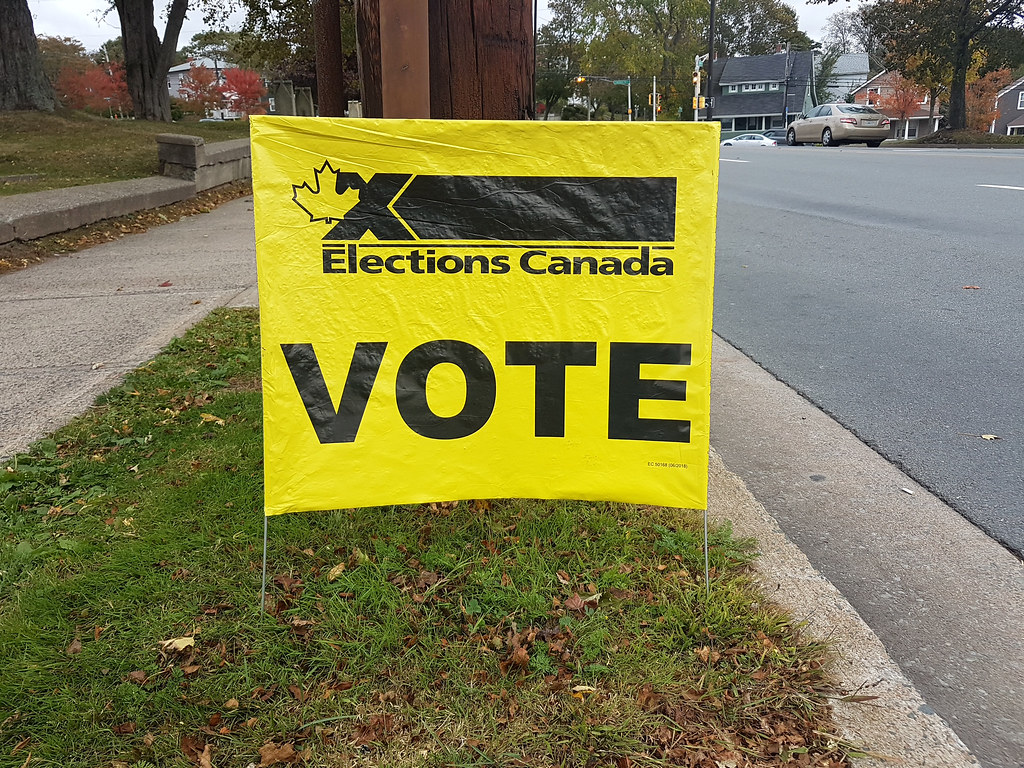
“2019 Canadian federal election – VOTE” by Indrid__Cold is licensed under CC BY-SA 2.0

It seems like about a hundred years ago, but one of the disquieting revelations of last year’s federal election campaign was that the Elections Act’s rules covering third-party spending are completely bananas.

Readers may recall Elections Canada warning environmental groups that they couldn’t just go on spending money in the fight against climate change without registering as third parties, with all the paperwork and bureaucracy that entails, all because People’s Party leader Maxime Bernier had supposedly made it a “partisan issue.” Now we have another bunch of overripe bananas on our hands: As the National Post first reported, the Commissioner of Canada Elections is investigating an anti-abortion organization called RightNow for having allegedly “recruited, trained and coordinated volunteers that were directed to over 50 campaigns” during the 2019 campaign.

RightNow’s mission is to identify pro-life candidates with a chance of winning, and connect them with volunteers eager to help them with their nomination and election campaigns. Readers may not find this particularly controversial. Members and supporters of all manner of groups, most famously and numerously labour unions, campaign alongside political candidates all the time. A quick rummage around Facebook from last year’s campaign finds both Toronto NDP MP Andrew Cash (who was eventually defeated) and Nova Scotia Liberal candidate Bernadette Jordan (who is now federal fisheries minister) thanking Unifor members wearing “Unifor Votes” t-shirts for their canvassing help. Photos on Unifor’s own Facebook page chronicle an October 5th event in Winnipeg called “Politics and Pancakes event plus canvassing for (NDP MP) Daniel Blaikie.”

[…]

At first blush, there doesn’t seem to be anything legally untoward with this — or indeed what RightNow was doing on a much smaller scale. (USW claimed $1.1 million in third-party expenses, PSAC $345,000, CUPE $161,000. RightNow splashed out a whopping $8,255.71.) “Volunteer labour” is explicitly exempt from the Elections Act prohibition against third parties donating to political parties or candidates, either in cash or in kind. But in an April 22nd letter to Albertos Polizogopoulos, RightNow’s legal counsel, the commissioner’s director of investigations, Mylène Gigou, argued that “the recruiting, training and coordinating of volunteers are core political activities of a political campaign” — and in performing those activities, RightNow may have “circumvented” the third-party donation prohibition.

This is, of course, preposterous. On what principle would we allow members or supporters of third parties to volunteer in election campaigns — as any healthy democracy ought to — while prohibiting spending so much as a dime to recruit said volunteers? “Training” or “coordinating” could be defined as narrowly as telling people what sorts of things to say on people’s doorsteps and what sorts of things not to. You don’t just turn people loose with your campaign materials, like sheep on a grassy meadow, and hope for the best.

« Newer PostsOlder Posts »

Powered by WordPress