Quotulatiousness

August 1, 2020

Masking stupidity

Filed under: Government, Health, Law, Liberty, Science — Tags: , , , — Nicholas @ 05:00

In The Critic, Patrick Fagan talks about the dehumanizing aspect of mandatory facemask orders:

“Utrecht: Facemask Store” by harry_nl is licensed under CC BY-NC-SA 2.0

In Joost Meerloo’s analysis of false confessions and totalitarian regimes, The Rape of the Mind, he coins a phrase for the “dumbing down” of critical resistance – menticide. “In the totalitarian regime,” he wrote, “the doubting, inquisitive, and imaginative mind has to be suppressed. The totalitarian slave is only allowed to memorise, to salivate when the bell rings.”

[…]

Face masks can now be added to the list of mandates that make you stupid. As if Piers Morgan feverishly promoting them weren’t evidence enough, here are the facts on why you absolutely, categorically should not wear a face mask. They make you suggestible; they make you more likely to follow someone else’s direction and do things you wouldn’t otherwise do. In short, they switch off your executive function – your conscience.

A great example comes from a study by Mathes and Guest (1976), who asked participants how willing they would be, and how much they would have to be paid, to carry a sign around the university cafeteria reading “masturbation is fun” (this being 1976, doing such a thing would be considered embarrassing; these days it will probably earn you a course credit!). The results showed that when people wore a mask, they were more likely to carry the sign and required less money to do so ($30 compared to $48, on average).

Meanwhile, Miller and Rowold (1979) presented Halloween trick-or-treaters with a bowl of chocolates and told them they were allowed to take only two each. When the children thought they weren’t being watched, they helped themselves. Children without a mask broke the rule, taking more chocolates, 37% of the time, compared to 62% for masked children. The authors concluded that masks “lead to lower restraints on behaviour”.

The effect has similarly been found online: the online disinhibition effect refers to the tendency for people to act antisocially when anonymous online (Suler, 2004). There is even an infamous trolling movement calling itself Anonymous and using a mask as its symbol.

The disinhibiting effects of wearing a mask are described by psychologists in terms of a suspension of the superego’s control mechanisms, allowing subconscious impulses to take over. Saigre (1989) wrote that masks “short-cut” conscious defence systems and encourage “massive regression” to a more primitive state; Castle (1986) wrote that eighteenth century masquerades allowed mask-wearers to release their repressed hedonistic and sexual impulses; and Caillois (1962) similarly wrote about European masked carnivals involving libidinal activities including “indecencies, jostling, provocative laughter, exposed breasts, mimicking buffoonery, a permanent incitement to riot, feasting and excessive talk, noise and movement”. In the 12th Century, Pope Innocent III banned masks as part of his fight against immorality; and in 1845, New York State made it illegal for more than two people to wear masks in public, after farmers wore masks to attack their landlords.

From a neuroimaging perspective, masks are known to inhibit identity and impulse control – both associated with executive function in the prefrontal cortex (e.g., Glannon, 2005; Tacikowski, Berger & Ehrsson, 2017). In other words, masks silence the Jiminy Cricket in the brain.

July 29, 2020

Some fascinating and disturbing information on the Nova Scotia murders

Filed under: Cancon, Law — Tags: , , , , — Nicholas @ 05:00

Once again, the Halifax Examiner provides information on the mass murder case in Nova Scotia that seems to be mystifyingly of little to no interest to the mainstream media outlets:

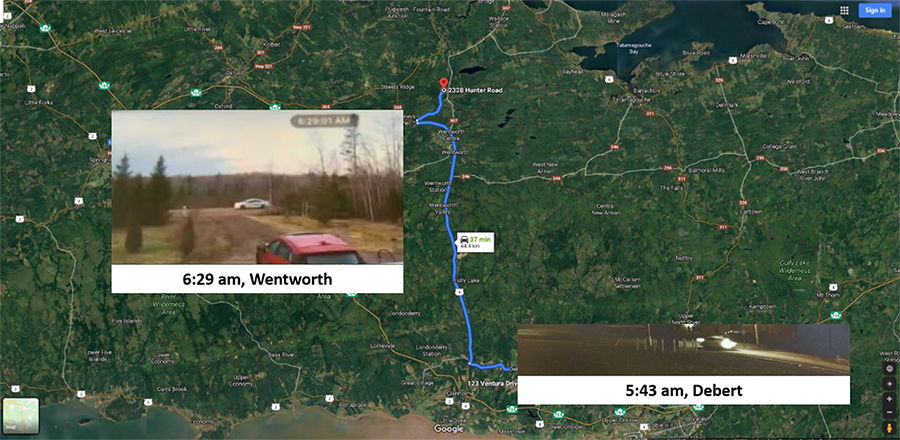
An annotated RCMP map shows the killer’s route from 123 Ventura Drive in Debert to 2328 Hunter Road in Wentworth. Insets of still images taken from different videos show the killer’s replica police car at 5:43am in Debert and passing a driveway on Hunter Road in Wentworth at 6:29am.

The most stunning revelation comes from one person who spoke with Halifax police. That person told police that the murderer, who the Examiner refers to as GW, “builds fires and burns bodies, is a sexual predator, and supplies drugs in Portapique and Economy, Nova Scotia.”

Moreover, the person said that GW “had smuggled guns and drugs from Maine for years and had a stockpile of guns” and GW “had a bag of 10,000 oxy-contin and 15,000 dilaudid from a reservation in New Brunswick.”

Another person who spoke with the RCMP gave information about GW’s properties, relating that it was known that there were secret hiding places at the properties. The person said GW had shown another person (whose name remains redacted) a “hidden compartment in the garage” [presumably in Portapique], which was under a workbench, and GW kept a “high powered rifle” in the space.

The person who spoke with the RCMP said that there was a “false wall” at GW’s Dartmouth residence. That information was echoed by another person who spoke with Halifax police on April 19, who said that “there is a secret room in the clinic in Dartmouth.”

Other information that is newly un-redacted confirms information that was widely known before.

July 20, 2020

The “epic failure” of the RCMP during the Nova Scotia killing spree

Filed under: Cancon, Law — Tags: , , , , , — Nicholas @ 03:00

In the Halifax Examiner, Paul Palango reconstructs the (known) series of events during the April pursuit of the killer at large in Nova Scotia:

The RCMP has claimed it did its best in trying to deal with the Nova Scotia mass killer on the weekend of April 18 and 19, but a reconstruction of events by the Halifax Examiner strongly suggests that the police force made no attempt to save lives by confronting the gunman or stopping his spree at any point.

“Public safety and preservation of life are the primary duties of any peace officer,” said a former high ranking RCMP executive officer who asked for anonymity out of fear of retaliation by current and former law enforcement officials who are vigilant about any criticism of policing by those in the field. “As far as I can tell, the RCMP did nothing in Nova Scotia to save a life. They weren’t ready. It is embarrassing to me. The entire thing was an epic failure.”

Based upon interviews with other current and former police officers, witnesses, and law enforcement, and on emergency services transcripts, it seems clear that there was a collapse of the policing function on that weekend.

At no point in the two-day rampage did the RCMP get in front of the killer, who the Examiner identifies as GW. It also seems apparent that some Mounties, many of whom were called in from distant locales, were stunningly unaware of the geography and landmarks in the general area as the RCMP tried to keep up with GW.

Sources within the RCMP say a major problem was that communications between various RCMP units was never co-ordinated. “Everyone was on their own channels,” the source said. “Nothing was synchronized. They could have gone to a single channel and brought in the municipal cops as well, but for some reason they didn’t. It was like no one was in charge.”

This incident is revealing:

Several RCMP and law enforcement sources say that a corporal from a nearby detachment who was the initial supervisor on the scene froze in place to the distress of other Mounties. The corporal later ran into nearby woods and turned off their flashlight and hid. That officer continues to be off work on stress leave.

Some veteran Mounties say that there were likely a number of factors which caused the first Mounties on the scene to hesitate.

“It could have been inexperience. Maybe there was no backup. And then there’s always that Canada Labour Code thing,” said one long time Mountie.

The “Canada Labour Code thing” is an interesting insight, although it doesn’t excuse the RCMP’s disorganization and lack of effective leadership over the two days.

An annotated RCMP map shows the killer’s route from 123 Ventura Drive in Debert to 2328 Hunter Road in Wentworth. Insets of still images taken from different videos show the killer’s replica police car at 5:43am in Debert and passing a driveway on Hunter Road in Wentworth at 6:29am.

As they say, “read the whole thing“, as the events unfold with what seems like an endless series of missed opportunities on the part of the RCMP to stop the killings.

H/T to Colby Cosh for the link.

July 12, 2020

Reforming the police

Filed under: Australia, Britain, Government, History, Law, USA — Tags: , , — Nicholas @ 05:00

A guest editorial at Catallaxy Files from former Australian senator David Leyonhjelm discusses the original civilian police force, the London Metropolitan Police, and the rules that governed their actions. Contrasting the origins of modern policing, he then discusses the ways police organizations have changed:

“On the bus” by OregonDOT is licensed under CC BY 2.0

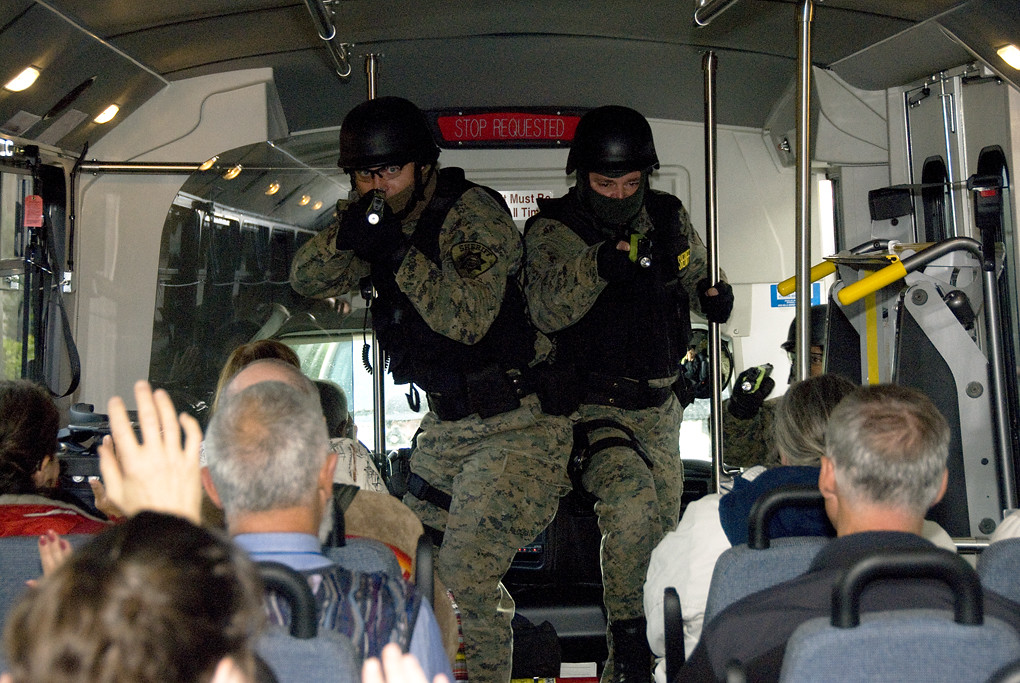
One issue is the steady militarisation of the police. This ranges from references to the public as civilians and assertions that the police place their lives on the line every day, to black uniforms, military assault rifles and equipment such as armoured personnel carriers. This is a bigger concern in America, where a lot of military surplus equipment is sold to police and the emphasis on armed conflict is more pronounced, but the trend is the same here.

When they see themselves as soldiers in a war, it is not surprising that some police have no regard for public welfare. The negligence leading to the death of Miss Dhu in police custody in [Western Australia], and of course the notorious deaths in America, are obvious examples of where that leads.

Peel’s principles also stipulate that police should only use physical force when persuasion, advice and warning are insufficient, to use only the minimum force necessary, and that the cooperation of the public diminishes proportionately with the necessity of the use of physical force and compulsion.

Yet how often do we see police resort to violence when making an arrest? People are tackled, forced to the ground with knees on their back and neck amid blows, kicks and the vindictive use of Tasers, simply to apply handcuffs. Being “non-compliant” or raising verbal objections is enough to prompt this, and some have died as a result.

Moreover, when the victims of such treatment are not convicted or imprisoned, such rough handling amounts to a form of punishment. That is also in conflict with Peel’s Principles, which require the police to avoid usurping the powers of the judiciary by authoritatively judging guilt and punishing the guilty.

Enforcement of the Covid rules, including the authoritarian decrees and fines imposed by state premiers, provide further examples: petty closing of cafes, prosecutions for reading in a park, chasing individuals along a closed beach, stopping fishing from a pier the day after 10,000 have gathered in a demonstration, and even a Police Commissioner who denounces the cruise industry as criminal, are among them. The Australian public are never likely to accept the police as one of them while those sorts of things occur.

Change is necessary. Corrupt and thuggish police must be rooted out and the enforcement of laws that the public does not support, including political and victimless crimes, should never have priority. Moreover, arresting people seldom solves problems that originate in drug use, alcoholism, mental illness and poverty.

The fundamental responsibility of governments is to protect life, liberty and property. If the police were to focus on these while upholding Peel’s Principles, Australians might even come to their aid.

QotD: “Getting tough on crime”

Filed under: Law, Media, Politics, Quotations, USA — Tags: , , — Nicholas @ 01:00

Whenever some crime becomes prominent in the public eye, some politician inevitably promises to fix it by getting really tough on criminals. No more of this namby-pamby mollycoddling! This time, we’re going to make it so miserable to be a criminal that no one will dare.

It is a bipartisan habit; progressives may talk enthusiastically about ending mass incarceration, but switch the topic to male sex offenders (or, say, 2008 bankers) and what you’ll hear often sounds like a recap from some Republican law-and-order conference, circa 1984. The belief that crime is a soluble problem if we’re willing to be mean enough is apparently nestled deep in the human psyche.

Megan McArdle, “Killing drug dealers won’t stop the opioid epidemic”, Washington Post, 2018-03-20.

July 11, 2020

Truncating the state of Oklahoma

Filed under: Government, History, Law, USA — Tags: , , , , — Nicholas @ 03:00

Colby Cosh on what might turn out to be the most important US Supreme Court decision in recent history:

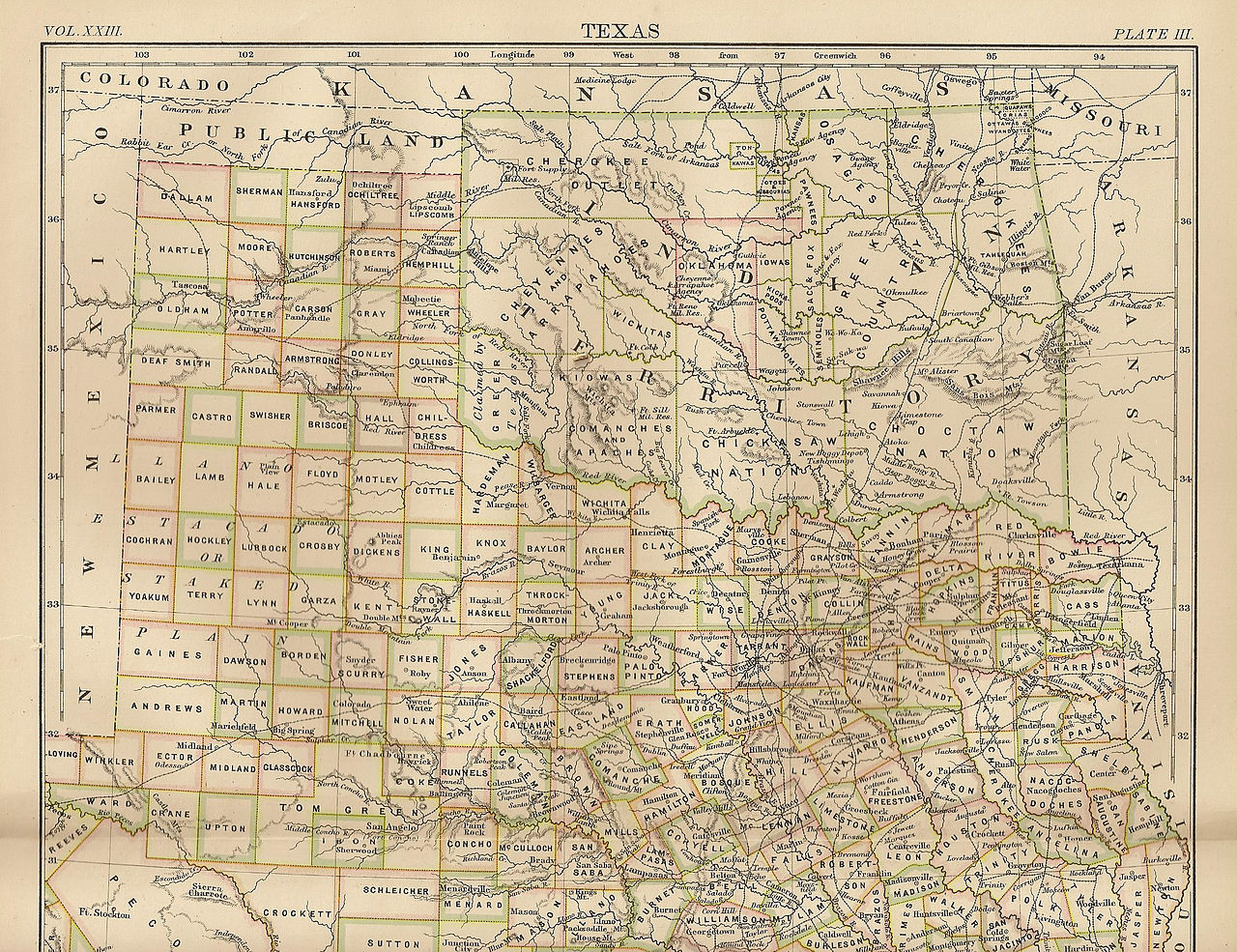
A map of Oklahoma from the mid-1880s showing county boundaries and the tribal areas of Indian Territory.
Encyclopedia Britannica, 9th edition, 1888 via Wikimedia Commons.

On Thursday the court published its judgment in the case of McGirt v. Oklahoma [PDF]. McGirt is Jimcy McGirt, a man convicted in state court in 1997 of heinous sex crimes against a four year old. A creative public defender had tried to argue for years in lower courts that, as McGirt was a member of the Seminole Nation and his crimes had occurred on territory set aside in the 19th century for Creek Indians, he was never subject to state prosecution.

He should have been tried, the argument ran, under the federal Major Crimes Act of 1885, which specifies that accusations of serious felonies against Indians in “Indian country” go immediately to federal court. Under an 1856 treaty between the U.S. and the Creeks, the Creek lands were to be a “permanent home” for the displaced nation for as long as it existed (at a time when Aboriginal-Americans were still widely expected to diminish and disappear as a race).

The formalized concept of an Indian reservation did not yet exist, but the theory, then and now, is that some Aboriginal nations have direct relationships, albeit ones of “dependence,” with the federal government. Sometimes it is said that the U.S. is the “suzerain,” the overlord, of otherwise sovereign Indian nations. The Creeks, and the other four “Civilized Tribes” who had been forced into the “Indian Territory” that once covered the eastern part of future Oklahoma, were given strong written promises that they would be held apart from the U.S. states proper and would have jurisdiction over crimes and civil matters on their lands. Only the United States Congress, as a power contracting with sovereign nations, could act to encroach upon this jurisdiction.

In a fashion familiar to anyone who has read even a shred of the history of the American Indian, these promises just kind of got … misplaced. In the early 20th century the Oklahoma tribes were encouraged by Congress to abandon communal property holding and take up individual “allotments” of Indian-held land. This ought not to have changed the underlying nation-to-nation relationship, any more than assigning homesteading parcels to settlers busted up or negated the ultimate sovereignty of the U.S. elsewhere in the American West. But that constitutional framework was more easily ignored once a contiguous bundle of territory began to be bought and sold. (Some of it became part of the city of Tulsa.) This history has helped to make similar allotment action in Canada impossible, whatever advantages it might have.

July 9, 2020

Austin Bay on how Malawi fixed a crooked election

Filed under: Africa, Government, Law — Tags: , , , — Nicholas @ 03:00

At Strategy Page, Austin Bay recounts the efforts to overturn an election that was clearly fraudulent in the small land-locked African country of Malawi:

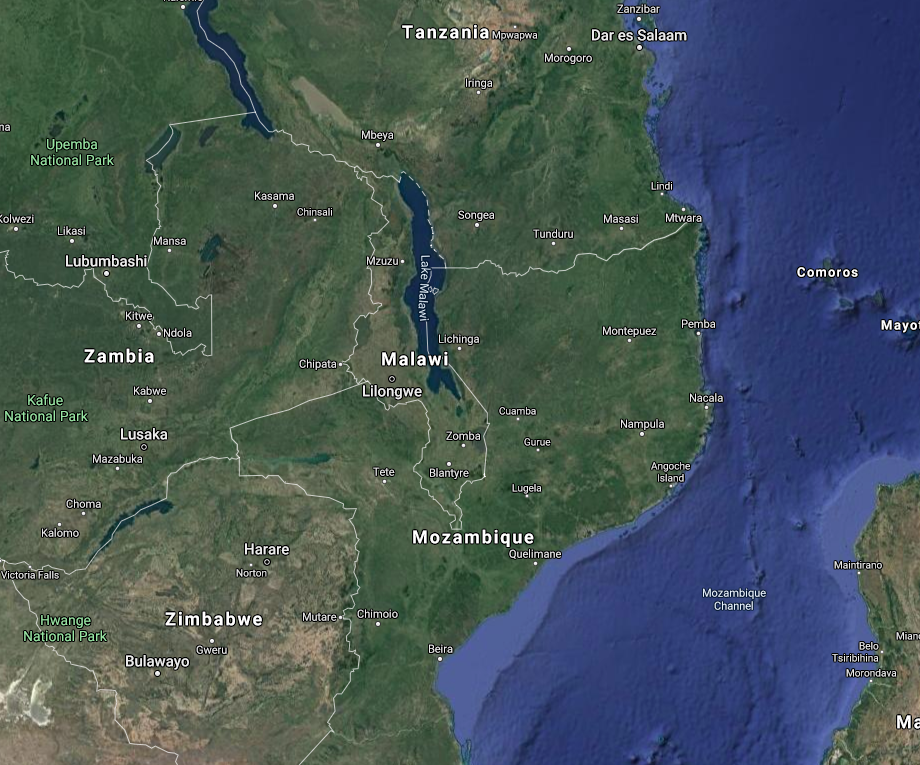
Malawi and surrounding countries in southern Africa.
Satellite image via Google Maps.

Since he retained the title of president, Mutharika believed he controlled the guns and the courts. The protests would fade.

He learned otherwise. Malawi’s military, the Malawi Defense Force (MDF) and the Malawi Police Service, watched the country carefully, keeping order but not taking sides. The opposition appealed to Malawi’s highest court, the Constitutional Court. MDF commanders made it clear their service, as protectors of the constitution, would protect the court’s justices and respect the court’s decision.

Ignoring intimidation and enticements (Mutharika offered splendid early retirement), in February 2020, the court annulled the 2019 results as tainted and ordered new elections in June 2020 — the Fresh Presidential Election.

MDF soldiers prepared to secure the FPE’s paper ballots. In a June briefing, an MDF general told motorists to “maintain a distance of at least one kilometer between them and vehicles” carrying ballots. Enter the security zone and get a warning, but “(overtly) following the vehicles can lead to loss of lives if one is not careful.” Beware political thugs — MDF weapons prevent ballot hijacking.

Voters need protection, too. On June 22, MDF soldiers in central Malawi detained 16 men local citizens identified as intruders seeking to disrupt the vote. When police officers questioned the 16, they admitted they worked for Mutharika’s governing Democratic Progressive Party.

On June 23, opposition leader Chakwera received 60% of the vote in the untainted do-over. Mutharika got 38%. An MDF contingent immediately began protecting Chakwera.

Voting irregularities occur in mature democracies. However, election fraud does severe harm to developing nations where the disenfranchised have little or no systemic recourse and free speech is risky. Hope and nascent civil participation give way to wrath and alienation, which produce violence and destruction, not stability and economic development.

In the six decades since decolonization, election rigging by sub-Saharan Africa elites has stunted economic and social progress in nations whose people deserve far better (see Ghana). Disregard of constitutional law and violent intimidation of opposition voters by the party in power inevitably accompany election theft. Burundi and Congo are examples.

July 1, 2020

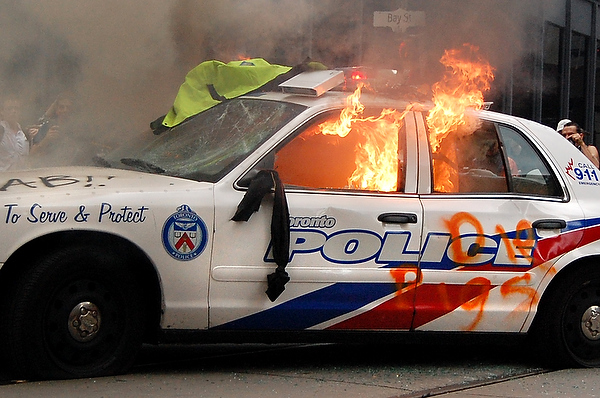
Toronto Police won’t be facing a 10% budget cut after city council votes down proposal

Filed under: Cancon, Government, Law — Tags: , , — Nicholas @ 03:00

Chris Selley on the vote by Toronto city councillors to retain the existing budget for the city’s police force at $1.22 billion:

On Monday, Toronto City Council debated and passed a variety of proposed police reforms, the newsiest of which had been asking the department to table a 10-per-cent budget cut for 2021. That idea was voted down 16-8. Further proposed changes included asking the Toronto Police Service for a line-item budget, and subjecting police to the municipal auditor-general’s oversight — utterly revolutionary concepts, you will agree. (Both passed.)

The budget cut might at least have been a useful exercise: It would be interesting to know what the police would and wouldn’t do with $1.1 billion instead of $1.22 billion. If I had been a consensus-seeking councillor on the virtual floor, I might have moved a motion asking the police to table line-item budgets for both — and maybe push for 20 or 30 per cent, too. But the question of the budget sucked up too much oxygen.

That’s certainly understandable. The “defund the police” movement in all its permutations is having a moment. There are North American police departments and police unions that might as well be begging to be disbanded, as much with their banal and petulant misbehaviour as with their needless use of lethal force. A few might even get their wish.

Canadian departments haven’t been begging quite as hard, however, and too many Canadians take false solace in that. When it comes to police-involved fatalities, we fare quite poorly against Western nations other than the one next door. Our accountability mechanisms are, generally speaking, a sick joke; indeed, it seems considerably easier to fire flamboyantly terrible cops in the United States than it does here.

James Forcillo, the Toronto officer who was caught on tape fatally unloading nine shots at 18-year-old Sammy Yatim for no good reason, was on the payroll for two-and-a-half years until his criminal conviction. He was at least suspended. Simon Seguin, the Alberta RCMP officer caught on camera in March rugby-tackling, punching and choking Athabasca Chipewyan First Nation Chief Allan Adam in a dispute over an expired vehicle registration, was at the time awaiting trial for assault!

June 27, 2020

Canada’s “Gang of 19” urges abject surrender and hostage exchange with China

Filed under: Cancon, China, Government, Law, Politics — Tags: , , , , — Nicholas @ 03:00

As Canadian political life continues to revolve more and more around the Chinese model, we now have our very own political “gang”, just like China did!

“The Chinese People’s Liberation Army is the great school of Mao Zedong Thought”, 1969.
A poster from the Cultural Revolution, featuring an image of Chairman Mao.
Image via Wikimedia Commons.

A former leader of the New Democratic Party of Canada. A former Conservative foreign minister. Two former Liberal foreign ministers. Four former Canadian ambassadors to the United Nations, under Liberal and Tory governments. Two former Canadian ambassadors to the United States, under Liberal and Tory governments. A former Supreme Court justice. A former Liberal justice minister. A former Conservative senator. A flock of name-brand diplomats. Former CBC host Don Newman, for some reason.

This is the panoply of 19 elite opinion-makers that gathered in the Laurentian Boardroom at an online hotel and drafted a letter, released Wednesday, calling on Prime Minister Justin Trudeau to intervene in the extradition process, set Huawei CFO Meng Wangzhou free, and thereby secure the release of Canadians Michael Kovrig and Michael Spavor.

China, last seen denying the two men’s detention had anything to do with Meng, had changed its tune just hours earlier on Wednesday: Freeing her might “open up space for resolution to the situation of the two Canadians,” foreign ministry spokesman Zhao Lijian said.

And who stands in the way? A prime minister who was perfectly happy to stick his thumb on the scales of justice to save a cherished member of Quebec Inc. from the indignity of prosecution for rather flamboyant alleged corporate malfeasance in and concerning Gaddafi-era Libya (or to “save jobs,” if you prefer, although it emerged no one in Justin Trudeau’s government had bothered to inquire how many jobs might actually be lost if SNC-Lavalin were convicted).

You can hardly blame China for noting the precedent. And it’s sorely fitting that the Gang of 19 addressed their letter to Trudeau rather than to the fellow who would actually have to give the order: Justice Minister David Lametti. We all know who calls the shots in that particular relationship. Perhaps it’s best we just admit it.

Colby Cosh also finds the advice proffered to the Prime Minister to be … less than admirable:

Screen capture of a BBC News report on Canadians Michael Kovrig and Michael Spavor facing espionage charges in China.

I wanted to discuss the letter written by the 19 geriatric Canadian worthies who encouraged the Prime Minister to trade Huawei executive Meng Wanzhou, in Canadian custody fighting extradition to the U.S., for the “two (Canadian) Michaels” detained on ill-defined espionage charges in China. Colleague Chris Selley has gone over the ground, but that’s show biz for you. Selley concluded his overview by pointing out that the letter argues perversely for “surrender, then victory.” With the Meng-Michaels standoff out of the way, the various ex-diplomats and superannuated politicians argued, Canada could use the opportunity for a fresh foreign-policy start, deciding what “tough steps” ought to be taken against China. If any.

The letter, part of a campaign on the two Michaels’ behalf led by ex-Supreme Court Justice Louise Arbour and ex-justice minister Allan Rock, is self-refuting in parts. Yielding “to bullying or blackmail” is “repugnant,” the authors admit, while advising just that. But “resisting China’s pressure is no guarantee that it will never be applied again in the future … China might well decide that next time it will need to escalate by detaining more than two Canadians.”

The implication, if this argument is to have any force, is that actively rewarding China’s abduction of our citizens is a jim-dandy way of making sure it never happens again. The problem with this reasoning is obvious, but the authors are also careful not to define victory too precisely. They say that letting Meng go and getting Michael Kovrig and Michael Spavor back would permit Canada to “declare its position on Huawei’s involvement in the deployment of 5G technology in Canada,” a decision “that has been postponed time and again.”

Sooo … the authors think we should slam the door on Huawei, whose CEO is Meng’s father? They don’t say so! They only say that settling this quarrel would make it easier for us to decide. And they are only slightly clearer on issues of human rights in China and Hong Kong, which our current government and foreign service are allegedly being shy about “so as not to make the situation worse for the Canadian prisoners.”

June 23, 2020

The “Battle of Dijon”

Filed under: France, Law, Military — Tags: , , , — Nicholas @ 05:00

I post a lot of accounts of ancient and modern wars and battles, but the “Battle of Dijon” actually took place earlier this month and has been widely mischaracterized in the media, as John Lichfield recounts:

Dijon viewed from Saint-Bénigne Cathedral with the Palace of the States of Burgundy, the Notre-Dame and Saint-Michel churches, the Saint-Nicolas tower, the former Saint-Bénigne abbey palace (ENSA), The Lafayette galleries, the old department stores at Le Pauvre Diable and la Ménagère.
Photo by Twibo2 via Wikimedia Commons (caption translated by Google Translate).

Dijon, the capital of Burgundy, rarely attracts the world’s attention. There is Dijon mustard of course. There is Dijon blackcurrant liqueur (Cassis de Dijon). There are many beautiful, old Burgundian streets and buildings. But of all the medium to large cities in France, Dijon (population: 159,000) is surely the least talked about.

Then, abruptly, last weekend Dijon had the great misfortune to become newsworthy. War broke out, we were told, between “Chechen gangs” and “Arab gangs”. The dispute was, some French media reported, about the right to traffic drugs. The Daily Mail announced that the French army had been sent in to restore order. Marine Le Pen compared Dijon to Beirut. Similar “wars between migrant communities” now threatened, she said, all over France.

All these reports were, I believe, wrong or deeply misleading. What did happen in Dijon over four days the other weekend was surreal and disturbing. But the incidents defy simple explanation or political point-scoring. They say, perhaps, more about Chechnya, and the values — good and bad — of exiled Chechens, than they do about the wider racial issues of France. The severity of the violence probably owed something to the frustrations of France’s recent nine weeks of Covid lockdown. The political and media reaction was skewed by the fact that the events occurred while France was in the midst of a debate about race and policing – in the wake of the George Floyd killing in the United States.

On Sunday evening, on the third night of violence in Dijon, President Emmanuel Macron happened to be addressing the nation on TV. He said, among many other things, that he would resist all pressure to splinter France into ethnic communities.

So what had happened over four days in Dijon? There are several conflicting accounts. Here, briefly, are the facts that I have been able to establish.

On 9th June a 15-year-old (some say 16-year-old) boy of Chechen origin was badly beaten up outside a chicha (hookah) bar in central Dijon. His attackers were local men in their 30s of African and North African origin. According to the Chechen version of events, the men were drug-dealers. The injured boy apparently had no connection with drugs. The dealers attacked him because local Chechens were known to be hostile to drug-trafficking. They put a gun in the boy’s mouth and said: “We hate Chechens. We’re going to let you live so you can tell the other Chechens what’s going to happen to them.”

Three days later a convoy of cars arrived in Dijon packed with Chechen men from several other parts of France, as well as Belgium and Germany. Local media and police say that there were 100 of them; the Chechens say that there were only 15. They smashed up the chicha bar, assaulted its owner and then rampaged through the multi-racial Les Grésilles area of council estates just north-east of central Dijon.

June 21, 2020

Paul Wells – “Everyone agrees!” [on the need to fully investigate the Nova Scotia massacre] … “But so far there is no inquiry”

Filed under: Cancon, Law — Tags: , , , , , , — Nicholas @ 05:00

Paul Wells in Maclean’s:

We are faced, perhaps only temporarily, with a familiar Canadian paradox: everyone says they want something to happen, but it isn’t happening.

The “something” is a rigorous public inquiry into a horrible shooting spree that spanned two days and killed 22 people in Nova Scotia in mid-April. It was the worst mass murder in Canadian history. It was lurid in its weirdness. The gunman, Gabriel Wortman, spent two days driving around in a convincing replica RCMP vehicle, shooting at whim, while the force he was imitating and dodging failed to send out a more comprehensive emergency alert than their Twitter warnings, one that might have saved more lives. In the midst of the carnage, two actual RCMP officers apparently fired their weapons into the walls of a firehall in Onslow for reasons that remain unknown.

New reporting for Maclean’s by Shannon Gormley, Stephen Maher and Paul Palango raises troubling new questions about Wortman’s possible ties to organized crime and, especially, to the RCMP itself. This reporting is attracting a lot of attention and, here and there, vigorous online debate. This Twitter thread, for instance, asks hard questions about our latest story.

The questions raised by our investigative team including Paul Palango, author of three best-selling books (here, here and here) about the troubling history of the RCMP, are backed by a solid and growing network of well-informed sources. But past a certain point, even superb reporting can’t provide authoritative answers. That work is properly left to duly mandated public authorities, usually wearing judges’ robes. Some people, reading the most recent Maclean’s reporting, have said the RCMP has a lot of questions to answer. Unfortunately there is no reason to take any answer from the RCMP on faith. It’s time for a full judicial inquiry.

Everyone agrees! From Nova Scotia premier Stephen McNeil to the latest embattled RCMP commissioner to three Trudeau-appointed Nova Scotia senators to anguished families of the murdered to, I mean sort of, the Prime Minister. But so far there is no inquiry.

June 20, 2020

QotD: Morality and the government

Filed under: Government, Law, Quotations, USA — Tags: — Nicholas @ 01:00

If an action is immoral for me and you, it is also immoral for others, including those who constitute the government. Election to public office is not a licence to lie, defraud, extort, rob, kidnap, or murder. Those who believe that government officials, employees, and contractors may morally do what other individuals may not do are morally bankrupt. The government has the power to act immorally — and does so as its standard operating procedure — but power and just right are completely different things. To affirm that might makes right in a moral sense is to affirm that one has simply chosen to abandon all pretense of taking morality seriously.

Gaze upon the members of Congress, the president and his lieutenants, the justices of the Supreme Court, and the leading figures of the government bureaucracies. As I do so, I cannot help but wonder: Who are these people? I am not personally acquainted with a single one of them; they are complete strangers to me. I have not contracted with them for the provision of any services, nor have I agreed to support them financially. Why then do these strangers presume to dictate to me what I must do and not do, and to threaten me with violence if I do not obey? They might as well be alien invaders from outer space.

Robert Higgs, “A Straightforward View of Morality and the Government”, The Beacon, 2018-03-06.

June 16, 2020

QotD: A thumbnail history of the English language

Filed under: Britain, France, History, Humour, Law, Quotations — Tags: , , , , , — Nicholas @ 01:00

Languages are anything but static. Some change very slowly, like French — which owes much of its ponderousness to a government department specifically tasked with rooting out heretic words that creep in from the outside. Other languages undergo periods of very rapid change — the English of Chaucer (late 1300s) would be very confusing to Shakespeare (late 1500s and early 1600s). Two hundred years seems like a long period of time, but in the history of an entire country, it’s a drop in the bucket.

English doesn’t just borrow words; it lifts whole phrases and grammatical ideas from other languages without so much as a by-your-leave. With the coming of the Saxons to Britain, Germanic languages crashed headlong into Brythonic and became Old English. Then the Vikings went for a multi-century beer run starting in the late 700s and left behind a bunch of Norse words, because who doesn’t invent a new language every time they go out carousing? In 1066, William the Bastard decided he didn’t like his name, and brought Norman French with him when he went to the town clerk’s office to have his name legally changed to William the Conqueror.

For the next two hundred years, the English upper classes spoke French and the lower classes spoke a zillion dialects of Middle English (travel was difficult for poor people, so regional variations survived). All legal business was done in French, which was often translated on the spot into Latin for the official records. A person couldn’t even submit a legal plea in English until 1362. But with the start of the Hundred Years’ War in 1337, Edward III decided that speaking French was très passé, and began encouraging English as a spoken and written language, with a little French thrown in, just to keep things interesting. And ever since, English has been debating how sophisticated it wants to be, while making rude gestures across the Channel at France and grumbling when the French sneer northwards.

Blake Smith, “A Brief History of English and Why it Matters”, Mad Genius Club, 2018-03-07.

June 11, 2020

QotD: Equal rights

Filed under: Government, Law, Liberty, Quotations — Tags: , , , , , — Nicholas @ 01:00

We must separate the moral dimensions of a subject from the empirical questions surrounding it. For example, on the radioactive issue of sex (or gender) differences in cognitive abilities, there is the empirical question of whether or how men and women diverge in certain tasks, and then there is the moral question of how men and women should be treated. Empirically, there is much evidence that in some tasks women excel over men, and in other tasks, men excel over women. For example, women are more dexterous while men are better at throwing; women are superior in visual memory whereas men are better at mentally rotating shapes; women are better at mathematical calculation while men are better at mathematical problem-solving; in terms of overall general intelligence (g), however, there is no gender difference. Morally, however, none of this matters. We should support women’s rights regardless of any physical or cognitive differences between the sexes. To yoke one’s moral evaluation to empirical questions like this is a big mistake; worse is to assume that this is what people always do and therefore we must suppress any empirical evidence that there are differences, as this will only tilt people’s moral judgments toward empirical outcomes.

This reminds me of the debate in the late 1980s through mid-1990s about whether homosexuality was nature or nurture, something you were born to be or a lifestyle choice. Conservatives and Christians argued for the “choice” position and this led to efforts to “convert” gays to straight (or “pray the gay away”) because something that is learned can be unlearned. This led the gay community and supporters thereof to argue for the “born this way” position. The cumulative evidence from multiple lines of inquiry led to the nature position more than that of nurture, but this was another example of confusing the empirical question of the origin of homosexuality with the moral question of the rights of gays and lesbians (today the LGBTQ community). It should go without saying — but unfortunately in these times it must be said again and again — it doesn’t matter what the origins of homosexuality turn out to be, gays and lesbians and everyone else in the LGBTQ community are entitled to the same rights and privileges as everyone else protected by the constitution of their nation (and those nations that have yet to extend legal rights to gays and lesbians need to change their constitutions).

Michael Shermer, interviewed by Claire Lehmann, “The Skeptical Optimist: Interview with Michael Shermer”, Quillette, 2018-02-24.

June 5, 2020

Australia’s 1975 constitutional crisis back in the news

Filed under: Australia, Government, History, Law — Tags: , , — Nicholas @ 03:00

Colby Cosh outlines the events of 1975, where the Governer-General of Australia, Sir John Kerr, used his reserve powers to dismiss the government of Gough Whitlam and call for a fresh federal election in which Whitlam’s party was soundly defeated. In taking this action, Sir John corresponded with Queen Elizabeth and after his retirement deposited those documents with the National Archives. The bulk of his papers were made available to researchers after the statutary 30 year delay, but the letters involving Her Majesty were withheld for 60 years. An Australian historian has now successfully challenged the National Archives in Federal Court:

National Archives of Australia in Parkes, Australian Capital Territory.
Photo by Bidgee via Wikimedia Commons.

The confrontation at Yarralumla, and the various narrative twists and turns leading up to it, are a major event in Australian constitutional history. Which brings us to Jenny Hocking, a left-leaning historian who is a top specialist on the 1975 crisis.

Hocking knew that Kerr, after his retirement, had deposited copies of his correspondence with the Queen in Australia’s National Archives. Hocking made good professional use of Kerr’s formal papers, made available to the public in 2005 under the 30-year rule that covers Australian state papers. But Kerr had, with the agreement of the Archives, made separate arrangements for his letters to and from the Queen — the so-called “(Buckingham) Palace letters”.

[…]

The National Archives, trying to stand by its bargain with Kerr as a donor, successfully argued that while papers generated or received by “the official establishment of the Governor-General” would clearly be ordinary public records under Australian law, the letters that Hocking wanted to see didn’t involve “the official establishment,” but merely Kerr himself as … well, just a guy. The Federal Court found that the Palace letters therefore had the legal status of one of Sir John’s grocery bills, or sex diaries, or anything else that he would be perfectly entitled to stick in a locked box for 50 years.

(Or to burn in private. Which was an option he had, but rejected, explaining explicitly that he wanted future historians to have access to the material. But not for them to have it so soon that it might surprise or embarrass the Queen during her own lifetime.)

What happened last week was that the case reached Australia’s top court and Hocking won a smashing victory. Kerr’s correspondence with the Queen is known to have contained discussions of the Australian constitutional situation, and in view of that, the High Court said, the Federal Court’s distinction between Commonwealth records and personal correspondence must be regarded as a bogus artifice. The concepts aren’t mutually exclusive.

The Archives also asserted that queen-viceroy letters attract a higher level of secrecy “by convention” in all the Queen’s realms, but they couldn’t produce evidence that such a convention exists. Hocking’s costs must be covered by the Archives, and as far as the letters go, the ball is in their court legally. They could still use a “national security” exemption to withhold some of the material, and the freedom with which this magic formula is used by archival gatekeepers is notorious. But it may soon be possible for Australians to read the final chapter of the cataclysmic Kerr-Whitlam story.

« Newer PostsOlder Posts »

Powered by WordPress