Quotulatiousness

May 19, 2010

Remembering Dunkirk, 70 years on

Filed under: Britain, France, Germany, History, Military, WW2 — Tags: , — Nicholas @ 08:53

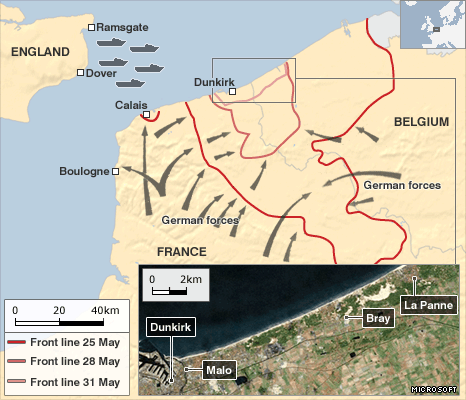
This is the 70th anniversary of the Dunkirk evacuation, where 338,000 British and French troops were carried out of the German encirclement by just about everything that could float.

“Without Dunkirk, Britain wouldn’t have had an Army and it’s extremely questionable whether Britain could have fought the war,” he explains.

Mr Hewitt gives the credit to the Royal Navy and Admiral Sir Bertram Ramsay, who led the operation, but also to all the civilians who helped.

“They thought they would bring back 30-40,000. In the end they rescued 338,000 British and French troops. It’s an extraordinary achievement.”

And this pulling together of civilians and the military meant an event that could have been seen as a failure became, in fact, a key turning point in World War II.

“Dunkirk was a military defeat, but it was a symbolic victory,” he adds.

May 18, 2010

Brontë Sisters Power Dolls

Filed under: Books, History, Humour, Media — Tags: , — Nicholas @ 08:40

H/T to Lois McMaster Bujold, who “especially liked the fire extinguisher among the accessories included.”

May 17, 2010

Bureaucracy, Crimean War style

Filed under: Britain, Bureaucracy, History, Military, Russia — Tags: , — Nicholas @ 08:39

A. A. Nofi reminds us that no matter what the technology of the day, the bureaucracy is eternal:

One night a particularly exposed British redoubt suddenly found itself the object of a strong Russian attack. Although the British managed to hold the Russians, they were consuming ammunition at a prodigious rate.

Fearing that his position would soon be overrun, the officer commanding the post tore a leaf from a pocket note book. On it he scrawled “In great danger. Enemy pressing hotly. For Heaven’s sake send us some ammunition,” the officer signed his name, handed it to an orderly and sent the man to the rear.

The fighting grew more intense, and as ammunition began running low the officer awaited the return of his messenger. Time passed, as the situation seemed to grow ever more desperate. Then, almost as suddenly as it began, the Russian assault ebbed, even as the British troops were virtually down to their last rounds.

Just about then the orderly returned, bearing a message from the Ordnance officer. One wonders what went through the officer’s mind when he read, “All communications to this Department must be written on foolscap paper with a two-inch margin.”

May 14, 2010

Remembering Henri le Grande

Filed under: Europe, France, History, Religion — Tags: , , — Nicholas @ 09:18

France is still fond of King Henri IV, who was assassinated 400 years ago:

“If we were to measure his approval ratings now, what result would we get?” wondered Nouvel Observateur magazine in a special report this week. “100% happy? 200%? At any rate a figure to make the late greats turn pale — even more so the not-so-greats who are still alive.” Nicolas Sarkozy, the subtext implied, would do well to watch and learn.

During his reign from 1589 to 1610, Henri le Grand was credited with turning a country torn apart by the wars of religion into a newly confident land where Catholics and Protestants were forced to tolerate, if not like, each other.

He converted from Calvinism to the faith of the vast majority of his subjects, but did not neglect the country’s long-persecuted Hugenot minority. In 1598, 26 years after thousands of people who had gathered for his wedding day died in the St Bartholomew’s Day massacre, he declared the Edict of Nantes, which guaranteed Protestants freedom of worship.

[. . .]

Aside from his political achievements, it is the amorous escapades of the “Green Gallant” which continue to titillate modern-day fans. Married twice but unimpeded by vows of fidelity, Henri had numerous affairs and flings. This week Francois Caviglioli, a journalist, summed him up by referring to a contemporary Italian bon vivant: “Henri seemed to be the Rocco Siffredi of the 16th century. A porn star who was said to never wash.”

Judging by the tributes being paid to him now, Henri IV seems to be working his magic from beyond the grave. Such was the impact of his reign — and the shock of his untimely death — that he has become a martyr who is viewed almost as the personification of good leadership.

A few years ago, I tried to find a good biography of Henri, but there didn’t appear to be anything currently in print (in English). For such an iconic leader, he is not well known outside France . . .

May 13, 2010

A “secret weapon” from WW2 updated for the 21st century

Filed under: History, Military, WW2 — Tags: , , , — Nicholas @ 07:54

Strategy Page looks at Operations Research in its modern guise:

It all began back in the 1970s, when some CIA analysts discovered a new way to analyze the mountains of information they were receiving. The new tool was predictive analysis. What does this do for intelligence analysts? Predictive analysis was the result of a fortuitous combination of OR (Operations Research), large amounts of data and more powerful computers. OR is one the major (and generally unheralded) scientific developments of the early 20th century. OR is basically applying mathematical analysis to problems. OR turned out to be a major “weapon” for the Allies during World War II. OR, like radar, was developed in the 1930s, just in time for a major war, when whatever was available was put to work to win the conflict. OR is also, half jokingly, called a merger of math and common sense. It is widely used today in science, industry and, especially, in business (it’s the primary tool of MBAs, where it’s called “management science”.) With predictive analysis, the most important OR tool was the ability to “backtest” (see if the simulation of a situation could accurately predict the outcome of something that had already happened, if the same historical decisions are made). For predictive analysis of contemporary situations, the backtest is, instead, a predictive tool that reveals likely outcomes.

Predictive analysis, like OR in general, creates a framework that points you towards the right questions, and often provides the best answers as well. Like many OR problems, especially in the business world, the simulation framework is often quite rough. But in war, as in commerce, anything that will give you an edge can lead to success over your opponents. A predictive analysis is similar to what engineers call “a 60 percent solution” that can be calculated on the back of an envelope.

The one form of predictive analysis that the general public is aware of is wargames, and these have been increasingly useful in predicting the outbreak, and outcomes, of wars. There have even been commercial manual (like chess) wargames that have successfully applied predictive analysis. The commercial manual wargames produced some impressive results when it came to actual wars.

In late 1972 a game (“Year of the Rat”) was published covering the recent (earlier in the year) North Vietnamese invasion of South Vietnam. This game didn’t predict the outcome of the war, but it got the attention of people in the intelligence community, especially those who knew something about wargames, for it was a convincing demonstration of what a manual wargame, using unclassified data, could do in representing a very recently fought campaign. There was even talk that these games could actually predict the outcome, and details, of a future war. The next year, wargames did just that, accurately portraying the outcome of the 1973 Arab-Israeli war. The game (“Sinai”) was about to be published when the war broke out, but some people in the intelligence community knew about it. A member of the Israeli UN delegation had watched the game in development (he was a wargamer), and was assigned to camp out at the publishers offices, while the war raged, and report what the game was predicting.

May 5, 2010

Three reasons not to remove the Downfall parodies

Filed under: History, Law, Media, WW2 — Tags: , , , , — Nicholas @ 12:50

3 Reasons YouTube Shouldn’t Censor Downfall Parodies

[. . .]

It’s understandable why Downfall’s production company, Constantin Film, might be upset that such a serious movie is being burlesqued, but pushing YouTube to ban the parodies is a terrible idea for at least three reasons:

1. It’s fair use! The parodies, which transform a few minutes of a three-hour movie, are clearly legit under existing copyright laws. Because they clearly transform the original and have no possibility of confusing viewers, the parodies are clearly protected speech.

2. This is free promotion! As George Lucas could tell the filmmakers, fan-generated videos help keep the original source material vital and relevant. Lucas used to try to police all Star Wars knock-offs, until he realized that his audience was promoting his films more effectively than he ever could. More people have surely seen Downfall due to the popularity of the parodies.

3. Let’s keep the Internet creative! The greatest cultural development over the past 20 or so years has been technologies that allow producers and consumers to create and enjoy an ever-increasing array of creative expression in an ever-increasing array of circumstances. This development is nowhere more powerful than on the Internet, which has unleashed a whole new universe of writing, music, video, and more. Indeed, YouTube is itself one of the great conduits of cyberspace. Pulling down the Downfall parodies may be within YouTube’s rights, but it nonetheless strikes a blow to the heart of what is totally awesome about the Internet.

April 29, 2010

Did Bruno Ganz do too good a job playing Adolf Hitler?

Filed under: History, Media, Technology — Tags: , , , , , , — Nicholas @ 12:11

Now that you actually have to work at it to find some of the Downfall parodies on YouTube, John Naughton looks at the cultural power of remix culture, which has been most recently popularized by Bruno Ganz in his mesmerizing performance as Adolf Hitler:

Ganz’s performance is a real tour de force, so much so that the New Yorker critic wondered aloud if it would have the effect of humanising Hitler. But the scene had another, equally extraordinary, side-effect. It became the basis for a wildly successful and entertaining comic virus, in which people used everyday video-editing software to remix the scene in modern contexts (politics, sports, technology, popular culture). The German soundtrack was left unchanged, but new subtitles were added and then the results were posted on YouTube.

[. . .]

Some of these parodies are tiresome. But many are side-splittingly funny, a testimony to the power of remixing as a way of enlivening cultural life. Nevertheless, not everyone is delighted by this new art form. Jewish organisations have been understandably disturbed by the way the architect of the Holocaust has been turned into a comic turn. “Hitler,” said the director of the Anti-Defamation League, “is not a cartoon character”.

[. . .]

The YouTube remix culture is thus a new take on a venerable tradition. I wouldn’t argue that the Downfall spoofs are high art, but they are evidence of bottom-up creativity and intelligence in a new medium. And if we allow narrow considerations of intellectual property to stifle this creativity, then we may all, except for the lawyers, live to regret it.

April 23, 2010

When old folkies get bitter and vindictive

Filed under: Cancon, History, Media — Tags: , — Nicholas @ 08:42

An interviewer for the Los Angeles Times found Joni Mitchell in a mood to settle some old scores with fellow 60’s icons:

The Times interviewer referred to Old Nasal Voice in passing, citing his name-change from Robert Zimmerman to Bob Dylan. (Mitchell also abandoned her birth name, Roberta Joan Anderson.) Mitchell launched into an unprovoked assault. “We are like night and day, he and I,” she scoffed. “Bob is not authentic at all. He’s a plagiarist, and his name and voice are fake. Everything about Bob is a deception.”

Cowed, the interviewer moved on to safer topics — such as Prince (apparently a Mitchell fan) and sex appeal. Yet Mitchell still had time to slag off Grace Slick and Janis Joplin (allegedly they were “[sleeping with] their whole bands and falling down drunk”), and Madonna. Railing against the “stupid, destructive” era we live in, Mitchell took aim at the Material Girl. “Americans have decided to be stupid and shallow since 1980. Madonna is like Nero; she marks the turning point.”

It wasn’t all piss and vinegar. Mitchell fondly recalled Hendrix, “the sweetest guy”, and late-night listening sessions together. But even this memory is shaded in frustration. “He made his reputation by setting his guitar on fire, but that eventually became repugnant to him,” she recalled. “‘I can’t stand to do that anymore,’ he said, ‘but they’ve come to expect it. I’d like to just stand still like Miles.'”

April 22, 2010

British Lib Dem leader on Britain’s “war guilt”

Filed under: Britain, History, Politics, WW2 — Tags: , , — Nicholas @ 12:20

The leader of Britain’s Liberal Democrats may have a lot of apologizing to do after an article he wrote as a member of the European parliament came to light:

A rattled Nick Clegg today sought to defend himself over his claim that the British people have a ‘more insidious cross to bear’ than Germany over World War II.

The Lib Dem leader attempted to laugh off criticism of his astonishing attack on our national pride — in which he said we suffered ‘delusions of grandeur’ and a ‘misplaced sense of superiority’ over having defeated the horrors of Nazism.

Campaigning ahead of tonight’s crucial second live TV showdown with party leaders, Mr Clegg said: ‘I must be the only politician who has gone from being Churchill to being a Nazi in under a week.’

Then again, despite the apparent anti-British taint, it might gain him votes in some crucial swing ridings where anti-British feelings are treasured and welcomed.

Update: Sorry about the original headline . . . must have started a cut-and-paste and then forgotten to fix it. Fixed now.

April 20, 2010

25 years on, the “Hackers” bestride the globe

Filed under: History, Technology — Tags: , , , , — Nicholas @ 07:34

Steven Levy revisits some of the people he profiled in his book Hackers, back in the Pre-Cambrian period of the geek revolution:

“It’s funny in a way”, says Bill Gates, relaxing in an armchair in his office. “When I was young, I didn’t know any old people. When we did the microprocessor revolution, there was nobody old, nobody. It’s weird how old this industry has become.” The Microsoft cofounder and I, a couple of fiftysomething codgers, are following up on an interview I had with a tousle-headed Gates more than a quarter century ago. I was trying to capture what I thought was the red-hot core of the then-burgeoning computer revolution — the scarily obsessive, absurdly brainy, and endlessly inventive people known as hackers. Back then, Gates had just pulled off a deal to supply his DOS operating system to IBM. His name was not yet a household word; even Word was not yet a household word. I would interview Gates many times over the years, but that first conversation was special. I saw his passion for computers as a matter of historic import. Gates himself saw my reverence as an intriguing novelty. But by then I was convinced that I was documenting a movement that would affect everybody.

The book I was writing, Hackers: Heroes of the Computer Revolution, came out just over 25 years ago, in the waning days of 1984. My editor had urged me to be ambitious, and so I shot high, crafting a 450-page narrative in three parts, making the case that hackers — brilliant programmers who discovered worlds of possibility within the coded confines of a computer — were the key players in a sweeping digital transformation.

I hadn’t expected to reach that conclusion. When I embarked on my project, I thought of hackers as little more than an interesting subculture. But as I researched them, I found that their playfulness, as well as their blithe disregard for what others said was impossible, led to the breakthroughs that would define the computing experience for millions of people.

I must have read Hackers during my first or second semester in college, as I tried to figure out how to get out of the series of dead-end jobs I’d had since leaving school. I found strong echoes of many of the characters Levy portrayed in the people I encountered in my first few “high tech” jobs, although I don’t think any of them have managed to become billionaires yet.

April 16, 2010

Wargame company accused of “simulat[ing] violent combat”

Filed under: Gaming, History, USA — Tags: , , , — Nicholas @ 16:19

<sarcasm>I know, I know, it’s shocking to discover that a wargaming company produces games that “simulate violent combat“. You’d think they’d realize that nobody is actually interested in violence or combat, and especially not “violent combat”, as this game is alleged to glorify:</sarcasm>

One player racks up points by defeating Native American tribal leaders, the other by snuffing out settlements of English colonists. Capture Boston or Plymouth Colony? Victory is yours.

That’s the gist of “King Philip’s War,” a board game based on a bloody and violent clash of the same name between colonists and Indian tribes in 17th-century New England, and developed by a company partly owned by former major league pitcher Curt Schilling.

The game’s designer says he hopes to educate children and others about a war that cost thousands of lives but receives scant attention in history books. But some Native Americans want the game blocked from release, saying it trivializes the conflict and insensitively perpetuates a stereotype of Indian tribes as bellicose savages.

The people getting all hot and bothered by this are clearly people who’ve never even seen a board wargame.

Given that the game wasn’t going to see publication until MMP got enough orders to justify printing and distributing it, I suspect this will end up being another Streisand Effect in operation.

April 13, 2010

Another interesting use of Twitter

Filed under: Britain, History, Military, WW2 — Tags: , , — Nicholas @ 09:53

The brief log entries at RAF Duxford, a Royal Air Force airfield in Cambridgeshire, will move from the historical Operations Record Book to Twitter to mark the 70th anniversary of the Battle of Britain:

Every squadron, station and certain other units in the Royal Air Force had to complete an Operations Record Book, known as a Form 540.

Those for RAF Duxford and No 19 Squadron from 1940 show events such as patrols over Dunkirk, the problems encountered with early cannon-armed Spitfires, and the arrival of Czech pilots to form 310 Squadron.

They describe the sorties carried out by No 19 Squadron and pilots’ experiences during dogfights over south-east England.

A museum spokesman said: “This exciting new campaign will give a direct insight into Battle of Britain history, and will show how the campaign built in momentum throughout 1940.

Follow RAFDuxford1940 on Twitter.

April 6, 2010

Boatin’

Filed under: Administrivia, History, USA — Tags: , , — Nicholas @ 09:34

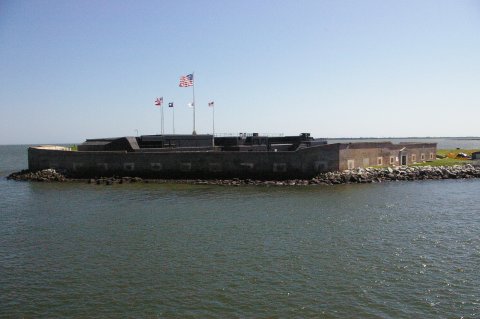
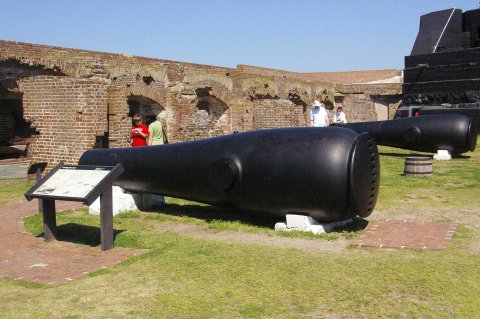
A few photos taken on our boat tour out into Charleston harbour, including a stop at Fort Sumter:


The (remains of) the fort, from the inner harbour, approaching the dock


Some of the recovered cannon from the Civil War sieges


The USS Yorktown, taken from the Aquarium on the other side of the river.

March 23, 2010

Anglo-Saxon hoard to stay in the Midlands

Filed under: Britain, History — Tags: , — Nicholas @ 12:18

It’s been called the greatest archaeological discovery in Britain since the second world war, and it’ll now be permanently housed near where it was discovered. The Birmingham and Stoke-on-Trent museums will share the artifacts, thanks to private fundraising and a major grant from the National Heritage Memorial Fund:

A grant of £1,285,000 from the National Heritage Memorial Fund (NHMF) will keep the glittering treasures of the Staffordshire hoard, the most spectacular heap of Anglo-Saxon gold ever found, in the region where an amateur metal detector found it last summer after it spent 1,300 years buried in a nondescript field.

[. . .]

When the find was announced in September the news went round the world. The gold was found by Terry Herbert, a passionate amateur metal detector whose best previous find was a broken piece of medieval horse harness, on farmer Fred Johnson’s land near Lichfield in July. When Herbert had covered his dining room table with gold, and was becoming thoroughly alarmed at the scale of his find, he called in the experts. The archaeologists and forensic scientists who hit the field – under the cover story from the local police that they were investigating a murder – found most of the pieces just below the surface, and some tangled in clumps of grass which had grown up through the delicate filigree gold: eventually they retrieved 2.5kg of silver and 5kg of gold. One gold-and-garnet Anglo-Saxon sword pommel would be regarded as a find of international importance: there were scores in the hoard, along with unique and enigmatic objects still baffling the archaeologists such as the wriggling gold serpents, and a biblical inscription on a strap of gold folded in half like a shirt collar.

Starkey said: “These are pieces from the period which we were brought up to call the dark ages, and they prove that it was no such thing. When the Normans invaded in 1066, they may have been better organised chaps — but it wasn’t that they were the civilised ones invading a primitive backwater, they came because they were desperate to get their hands on the wealth of Harold’s England.”

Earlier posts on this discovery here and here.

In contrast to my usual “the government has no business doing x” attitude, this is actually something in which I think the government has a valid role to play, and this is the sort of thing they should be doing in cases like this: paying a fair market value (rather than the usual governmental response, which is to expropriate, tax, or regulate).

March 18, 2010

Compare and contrast

Filed under: Cancon, Government, History, Politics, USA — Tags: , — Nicholas @ 13:16

Andrew Coyne looks at what would have happened in the Watergate scandal (the original “-gate”) if President Nixon had the same scope of power that a Canadian Prime Minister enjoys:

As the Watergate scandal deepened, the U.S. Senate struck a committee to investigate. Headed by Sen. Sam Ervin, it had broad powers to subpoena documents and compel evidence, together with a staff of investigators and legal counsel.

On July 13, 1973, Alexander Butterfield, Richard Nixon’s deputy assistant, told committee staff that discussions in the Oval Office were routinely tape-recorded. Before long, judge John J. Sirica had launched proceedings to force the president to hand over the tapes. Nixon refused, citing executive privilege, but in the end complied with a Supreme Court ruling ordering their release, with consequences that are well known.

But suppose the U.S. Congress functioned like Canada’s Parliament, and Nixon had the powers, not of a president, but of a prime minister of Canada. The committee, uncertain of its jurisdiction and with little in the way of staff or resources, would very likely never have learned of the tapes’ existence. Had it persisted with its inquiries, Nixon could have shut down the committee, and the Congress with it. And, rather than defend his case in court, Nixon could have hired a former Supreme Court judge to “advise” him on whether to release the tapes. And that would more or less be that.

He does say that he’s not trying to draw a direct comparison between the two situations (Watergate versus the Afghan detainee issue), but to highlight the relative amount of power a “mere” prime minister wields.

« Newer PostsOlder Posts »

Powered by WordPress