Quotulatiousness

May 21, 2015

John Monash – Australia’s greatest general

Filed under: Australia, History, Military, WW1 — Tags: , , , — Nicholas @ 02:00

Strategy Page reviews a new biography of Australia’s General John Monash:

The centennial of the First World War has brought forth renewed public interest and additional scholarly study of that still controversial conflict, variously the last 19th century imperial war and the first modern war. When its great generals are enumerated, one named by relatively few outside the Antipodes is Australian Army Corps commander John Monash (1865-1931), this despite Field Marshal Viscount Montgomery’s declaration half a century after the Armistice that Monash was “the best general on the Western Front in Europe,” and historian Sir Basil Liddell Hart’s even stronger accolade as “the greatest general of World War I by far.” Yet in the three-volume Cambridge History of the First World War, there is not one mention of him.

Monash, it must be said, has not been entirely overlooked. He was knighted in the field by George V (as a Knight Commander of the Order of the Bath) and subsequently given the title Knight Grand Cross of the Order of St. Michael and St. George, and in his homeland his name graces a university (indeed, the publisher of the book under review), a scholarship, a town and even a freeway. Nevertheless, in Maestro John Monash, former Australian Deputy Prime Minister Tim Fischer argues that Sir John has been wronged by history and not given his due. In a breezy hagiography (Fischer vehemently denies that characterization, protesting that his biography is “warts and all,” however, he downplays or dismisses most of the “warts” cited, e.g., other generals also had mistresses, and while he made mistakes at Gallipoli, he learned from them) and advocacy piece, he makes a justifiable case for Monash’s posthumous promotion to field marshal (backdated to 1930). Had he been promptly promoted postwar, rather than in 1929, to general (that is, full or four-star general), Fischer points out logically, he likely would have been promoted by the king one step up in rank to field marshal.

In his account of Monash’s life and military career, Fischer details the many obstacles faced and surmounted by “the most innovative general” of the war. His sobriquet for Monash, “maestro,” comes from Sir John’s comparison of a “perfected modern battle plan” to a “score for an orchestral composition.” Indeed, while some British and French generals were still thinking in terms of cavalry charges, sabers and bayonets, drawing on his engineering background, Monash made concerted use of infantry, artillery, tanks, aircraft and radio in (to quote him) “comprehensive holistic battle plan[s].” His strategy’s success became evident in thwarting Germany’s final westward push and smashing through the Hindenburg Line, in the 93-minute Battle of Hamel and the second Battle of Amiens, which German General Ludendorff later called “the black day of the German Army in the war,” victories achieved while Monash was still a lieutenant general (three stars). “Never has a general who did so much to help win a world war … been so unacknowledged,” affirms Fischer, returning to his theme.

May 20, 2015

Mustafa Kemal Atatürk I WHO DID WHAT IN WORLD WAR 1?

Filed under: Europe, History, Middle East, WW1 — Tags: , , , , — Nicholas @ 04:00

Published on 18 May 2015

Mustafa Kemal or simply Atatürk was the founder of the modern, secular Turkish Republic. He earned his stripes as an officer in World War 1 as the defender of Gallipoli against the ANZAC troops. You can find out all about Mustafa Kemal Atatürk during the last years of the Ottoman Empire in our biography.

May 17, 2015

The Yasukuni Shrine is part of the reason Japan can’t apologize for their historical aggressions

Filed under: Asia, History, Japan, Pacific, WW2 — Tags: , — Nicholas @ 02:00

At The Diplomat, J. Kevin Baird looks at Japan’s continued resistance to examining their own military and diplomatic history after the First World War:

Japan faces the expectations of its friends and neighbors to express itself on the occasion of the 70th anniversary of the end of the Pacific War. Prime Minister Shinzo Abe will formulate and express those words. In doing so, he faces a dilemma. The focus of that dilemma is Yasukuni Shrine and what it speaks to regarding Japan’s view of the Pacific War. Will Japan demonstrate contrition in seeking atonement, or does it aim for exoneration by rehabilitating its Greater East Asia Co-Prosperity Sphere motivations for the Pacific War? Histories yet to be may hinge on that choice.

[…]

In 2014, Shinzo Abe rejected the idea of Japan emulating Germany’s actions, citing differing political contexts for postwar Europe versus Asia. He implied the quest for European unification somehow mandated the German approach. A divided and adversarial East Asia, it seems, made Japanese attempts at atonement futile or counterproductive. That argument may be made, but it skirts the core issue of Japan’s stance, more deeply dividing the region and entrenching adversarial national relationships. Abe and his advisors surely understand this. Japan’s ability to shape regional and world affairs, as it is fully capable of doing and aspires to do, hinges upon how it is perceived by the community of nations, especially those of East Asia. Abandoning the ideal of reconciliation over its wartime actions cannot be an option on the Japan table. What strategy for realizing their ambition is at work? It may not be contrition and atonement.

German artist Hans Haacke wrote, “Museums are managers of consciousness. They give us an interpretation of history, of how we view the world and locate ourselves in it. They are, if you want to put it in positive terms, great educational institutions. If you want to put it in negative terms, they are propaganda machines.” A museum and shrine in Tokyo may bring Abe’s strategic posture on reconciliation into sharper focus. Yushukan Museum stands on the grounds of Yasukuni Shrine. Therein is locomotive C5631, identified as the first to trundle down the Thai-Burma rail line, where more than 100,000 forced laborers and prisoners of war died in its construction.

A memorial to Indian jurist Radhabinod Pal also stands on the grounds of Yasukuni Shrine – a member of the International War Tribunal for the Far East panel of judges, he wrote of the Class A war criminals, “I would hold that every one of the accused must be found not guilty of every one of the charges in the indictment and should be acquitted on all those charges.” Pal considered the Pacific War provoked by the Americans and the war tribunals a sham. He stood utterly alone in this dissent among his 11 peer judges, but Japanese nationalists hold his views as authoritative and see Pal as a heroic figure. In 1968, Japan secretly enshrined 1,068 executed war criminals at Yasukuni as divine martyrs. Like those who did not survive the war, the executed soldiers had nobly sacrificed their lives in defense of the Japanese motherland against European Imperialism. The museum explains this defensive nature of the Pacific War. Abe and many other prominent Japanese statesmen regularly pay homage to those men.

May 16, 2015

London on film, 1890-1920

Filed under: Britain, History, Media — Tags: — Nicholas @ 02:00

Open Culture posted this video which includes some of the oldest known footage of London:

May 15, 2015

QotD: Portuguese genetics

Filed under: Europe, History, Quotations, Science — Tags: , , — Nicholas @ 01:00

On the face of it it sounds like the nice narrative we are fed every time something like this happens. I haven’t been following the international scene, and frankly it wouldn’t even surprise me if Europe headed for nativism and blood-related nationality. It is what is at the basis of their nation states (even if it’s often a lie. For instance I’d hazard that a lot of people in Portugal — yes, d*mn it, I’ll do the DNA testing. Let the house sell and let me have some money first — are as mixed as Americans. My kids call Portugal the reservoir tip at the end of Europe, which is unkind but somewhat accurate since that portion of land was part of the Celtic commonwealth, before being invaded by Carthaginians, Greeks, Romans, Germanic tribes, Moors (though their contribution in the North is minimal as the North was usually administered by overseers with little or no actual colonization) French crusaders, Viking raiders. Then there were British and Irish merchants due to ties going back before the Carthaginians who would set up trading posts, send their younger sons over, sometimes engage in a bit of raiding, etc. There are unkind proverbs about blue eyed Portuguese, but there are also a lot of them. (Two of my grandparents. A third was green eyed.) And in the end sometimes I think all of us are the result of some girl who tripped (on purpose or not) while evading a foreigner. All this to say that when my dad talks of the “The Portuguese Race” (and boy, does he) he’s mostly talking of a mythical entity. But it’s one they all believe in as hard as they can.)

Sarah A. Hoyt, “Multiculturalism IS Racism”, According to Hoyt, 2015-04-04.

May 14, 2015

A new application for “dazzle” camouflage

Filed under: History, Military — Tags: , — Nicholas @ 04:00

RMS Olympic by Arthur Lismer 1919

RMS Olympic by Arthur Lismer 1919 (via Wikipedia).

Military History Now looks at some of the more eye-catching camouflage schemes of the world wars and suggests that something like it may have a modern application:

… nearly a century after the advent of dazzle, Dr. Nick Scott-Samuel of the University of Bristol believes that similar camouflage patterns painted on the sides of today’s jeeps and armoured cars will make it harder for enemy combatants to get a fix on military vehicles.

“Scott-Samuel, is the first to find evidence that dazzle camouflage can affect perception of speed – but only if the camouflaged object is moving quickly,” says a spokesperson with the British school. “These findings suggest that, while it would probably not have successfully distorted ships’ speeds in the two World Wars, dazzle camouflage could play a role in today’s battlefields where fast-moving army vehicles frequently come under attack from shoulder-launched, rocket-propelled grenades.”

Scott-Samuel arrived at his conclusion after putting volunteers through a series of visual tests. Researchers asked subjects to estimate the distance and speed of camouflaged objects in computer-simulated environments.

Participants observing virtual objects with dazzle patterns believed the targets were moving as much as 7 percent slower than they really were. Those who viewed unmarked objects were more likely to correctly estimate their speeds.

Scott-Samuel says the results indicate that military vehicles bearing dazzle patterns would be harder to hit than those painted with ordinary drab colours.

Moore’s Law challenged yet again

Filed under: Business, History, Technology — Tags: , — Nicholas @ 02:00

In Bloomberg View, Virginia Postrel looks at the latest “Moore’s Law is over” notions:

Semiconductors are what economists call a “general purpose technology,” like electrical motors. Their effects spread through the economy, reorganizing industries and boosting productivity. The better and cheaper chips become, the greater the gains rippling through every enterprise that uses computers, from the special-effects houses producing Hollywood magic to the corner dry cleaners keeping track of your clothes.

Moore’s Law, which marked its 50th anniversary on Sunday, posits that computing power increases exponentially, with the number of components on a chip doubling every 18 months to two years. It’s not a law of nature, of course, but a kind of self-fulfilling prophecy, driving innovative efforts and customer expectations. Each generation of chips is far more powerful than the previous, but not more expensive. So the price of actual computing power keeps plummeting.

At least that’s how it seemed to be working until about 2008. According to the producer price index compiled by the Bureau of Labor Statistics, the price of the semiconductors used in personal computers fell 48 percent a year from 2000 to 2004, 29 percent a year from 2004 to 2008, and a measly 8 percent from 2008 to 2013.

The sudden slowdown presents a puzzle. It suggests that the semiconductor business isn’t as innovative as it used to be. Yet engineering measures of the chips’ technical capabilities have showed no letup in the rate of improvement. Neither have tests of how the semiconductors perform on various computing tasks.

May 13, 2015

Driving a Dymaxion replica … Buckminster Fuller’s 1933 car of the future

Filed under: History, Technology, USA — Tags: , — Nicholas @ 05:00

Published on 24 Apr 2015

Buckminster Fuller’s 1933 foray into automobiles gave us the Dymaxion Car, and enthusiast Jeff Lane has one of the only working replicas in the world. WSJ‘s Rumble Seat columnist Dan Neil takes the road zeppelin for a spin…or should we say wobble?

H/T to Open Culture for the link … and do at least check out the over-the-top trailer for The Last Dymaxion on Facebook.

The Armenian genocide, a century on

Filed under: History, Middle East, WW1 — Tags: , , , — Nicholas @ 02:00

I saved this post by David Warren, then inconveniently forgot about it until now. Apologies to those concerned, but after a century, a week or two probably don’t make much difference … and perhaps a belated reminder might help keep the event in the minds of a few more readers:

The annihilation of more than a million Armenians (and their descendants) cannot be disputed. The larger estimates seem to be justified. April 24th, 1915, is recalled as a conventional opening event — when leading Armenian figures were arrested in Istanbul, on the pretext that they sympathized with the Russian enemy — but there were events before that. One could mention the Adana massacre of 1909, the Hamidian massacres of the 1890s (hundreds of thousands killed in these), and so forth.

This “Red Sunday” in Istanbul was itself immediately preceded by redder ones in distant Van. The official charge that Armenians were working with the Russians was occasioned by the fact that Russians had come to the aid of the Armenians in Van, threatened with imminent slaughter. In the end, Djevdet Bey, the murderous governor, was anyway able to exterminate more than fifty thousand of the Christians living in that vilayet alone.

Curiously, or not, the events of “Red Sunday,” then many similar as prominent Armenians were rounded up all over the country and sent to holding camps at Ankara from which they would never emerge, is closely connected with the other centenary we are celebrating, today. That is Gallipoli. The Ottoman authorities were acting under the impulse of war, in a moment when they began seriously (and reasonably) to doubt their own survival. But lest this seem an extenuation, it should be remembered that the same authorities had repeatedly turned on the Armenians each time their own global inadequacies had been exposed.

Under the notorious Tehcir Law, a model later for Hitler, all property belonging to Armenians could be seized, and arrangements began for their deportation to — undisclosed locations. These were prison camps which pioneered the methods of Auschwitz and Belsen. Germans and Austrians in the region, as allies of the “Sublime Porte,” were horrified by what they saw, using such descriptors as “bestial cruelty.” There was no possible question that the authorities intended to exterminate, not incarcerate. The Turkish people at large could also see what was happening around them, when not themselves participating in the slaughter. There is no extenuation for them.

The Treaty of Sèvres, after the War, proposed restoration of Armenian native lands within the defunct Sultanate to a new Armenian republic, but in turn triggered another campaign, now by the Turkish nationalists who succeeded the Ottomans. Their law allowed any remaining Armenian property to be seized by the state on the glib ground that it had been “abandoned.” During this later, post-Ottoman phase, perhaps another hundred thousand Armenians were massacred, often in places to which they had fled for safety. Mustafa Kemal “Ataturk,” the great secular Turkish patriot, was direct commander in the later stages of this Turkish-Armenian War, and much progressive effort has been expended washing the blood off his hands.

May 12, 2015

The Sky Was The Limit – World War 1 In The Air I THE GREAT WAR

Filed under: Europe, History, Military, Technology, WW1 — Tags: , , — Nicholas @ 05:00

Published on 11 May 2015

World War 1 saw several completely new technologies develop rapidly. The airplane itself was only a few years old but pioneering engineers soon saw its potential for military use. For recognisance and later as fighter or bomber, World War 1 had huge impact on aviation and warfare in general. This special episode gives you an idea about the obstacles that had to be overcome.

May 11, 2015

After 74 years, the remains of HMS Urge discovered off the Libyan coast

Filed under: Britain, History, Military, WW2 — Tags: , , — Nicholas @ 02:00

In The Telegraph a report on the discovery of a Royal Navy submarine wreck from 1942:

British U class submarine HMS URGE underway. (via Wikipedia)

British U class submarine HMS Urge underway. (via Wikipedia)

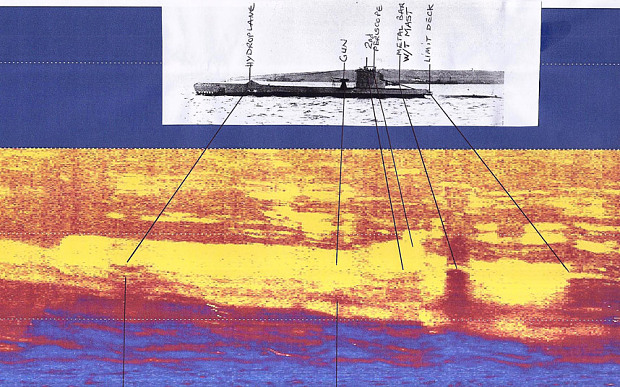
A Royal Navy submarine paid for by a town holding dances and whist drives is believed to have been discovered more than 70 years after it vanished during the Second World War.

The British submarine HMS Urge was paid for by the townspeople of Bridgend, South Wales, but sunk without trace in the Mediterranean in 1942.

It disappeared while making a voyage from the island of Malta to the Egyptian city of Alexandria – and families of the 29 crew and 10 passengers never knew what happened.

For more than 70 years, its resting place has remained a mystery. But a 76-year-old scuba diver claims he has discovered its wreck 160ft (50m) below the waves off the Libyan coast.

HMS Urge sonar image

May 10, 2015

In the Netherlands, 1945, nobody “swaggered”

Filed under: Cancon, Europe, Germany, History, Military, WW2 — Tags: , — Nicholas @ 05:00

David Warren on the task of the First Canadian Army after liberating The Netherlands:

It wasn’t only the liberation, but what our boys did after, in that devastated country. The Netherlands — but Canadians call her “Holland” — had suffered proportionally more than any other country the Wehrmacht had crushed and occupied, and would continue to suffer — famine — after their final defeat. The bastards blew the dikes to slow our allied advance. Breached, the lands flooded; … deaths heaped on deaths.

Victory is sweet, but there was no swagger, from the Dutch still mired in Hell.

And memorably, neither from our boys, who had liberated them. They didn’t swagger. Instead, they set down their guns and their helmets and went to work — spontaneously, voluntarily, on the enormous task of repair; of fixing the dikes and clearing the farms of salt-mud and debris. Of breaking the stones, and smoothing the roads, and shifting the rubble. The food bags, too, were starting to arrive, from Canada and the States — the tins and boxes; the cigarettes and medical supplies; and the candy, for the little children.

This wasn’t the Marshall Plan. It was three years before that. The Royal Canadian Air Force was dropping food from the sky, as fast as it could. (Our pilots read, “Thank you Canadians!” on rooftops.) Crates and drums were being discharged through the busted ports, wheat and flour from our Prairies. Yet thousands were still perishing from hunger.

And more: all the stuff sent by unorganized people, to wherever they thought it would do some good; to Germany as well as Holland; to wherever people must be desperate and starving. And back home our boys’ own families were throwing themselves into action, packing and shipping; and slipping in the letters of love and encouragement to strangers and new friends over the sea.

We were already hand-in-glove with the Dutch, from sheltering their royal family in exile. The magnificent Queen Wilhelmina, scourge of politicians (Churchill called her “the only real man” among all the exiled governors in London), no longer speaking in the nights, through the radio. For she had returned, to a rapturous welcome. And now, too, their little princess — Margriet Francisca — born in Ottawa Civic Hospital, in a maternity ward that had been declared Dutch sovereign territory for the occasion.

Every year, the tulips still come from Holland to decorate our Parliament Hill. And Dutch kids are still taught in school how to sing, “O Canada.”

Boozing “properly” during the Great War

Filed under: Europe, History, Military, WW1 — Tags: , , — Nicholas @ 04:00

At War on the Rocks, Jake Hall talks about the pervasive inflence of intoxication during the First World War:

The assassination of Archduke Franz Ferdinand is often regarded as the proverbial match in the tinderbox where World War I is concerned. The imperial-nationalist tensions surrounding Austria-Hungary’s waning empire, tensions which inspired the assassination and ensuing conflict, were frankly unwarranted, considering the swill these regions were, and still are, trying to pass off as potable spirits. Then again, what’s a tragic war of global scope without tragically misguided motivations at the start? One contributing factor to the war-primed Europe of 1914 sounds oddly familiar. Disenfranchised youth of marginalized states resorting to suicidal violence. It’s easy to see how the seven agents of Ferdinand’s assassination could be lining up to enlist in ISIS today. Youthful, “angsty,” and driven by an unhinged sense of importance and righteousness, it was a 19 year old, Gavrilo Princip, who carried out the clumsy assassination on the streets of Sarajevo. After a failed bombing attempt, failed suicide attempt, and a major security lapse by Ferdinand’s guards, the conspirators succeeded in gunning down the Archduke and Duchess almost by chance. With that act the Serbian nationalists, on a quest for south Slavic unification, killed a couple that were by many accounts lovely people, and started the July Crisis that led to the Great War.

The conflict that followed became the then-largest mobilization of military force ever, until the rematch 21 years later. HG Wells was the first to declare WWI the “war to end war,” and though that designation had contemporary critics, it quickly became a motto for the hostilities. A war to end war seems like an occasion for a drink, no? If it doesn’t, you’ve either never had a drink or you’ve never had a soul. In any case, what follows is an account of which powers were most benevolent during the war, measured chiefly by the alcohol rations secured and distributed to their soldiers. It presumes that the men fighting in the trenches on all sides had drawn short straws in life, and the side most willing to allow a little buzz on the front line exhibited a little humanity.

[…]

So how does all this play out in the end? France occupied the role of major supplier to all sides drinking needs. The Germans made large gains at the start of the war, and enabled rear-echelon troops to frequent taverns in their newly conquered territories. Couple that privilege with their substantial liquor rations, and the German rank-and-file were well situated for some time. Ultimately, the British naval blockade started affecting German supplies, which directly cut into their drinking. When the Allies reversed Germany’s advances and ended the war, they virtually ensured the Germans would only be drinking regret and resentment for nearly two decades. The French military was also generous with its rations where allies were concerned, attempting in a small way to soften the hard line the British and American citizens and leadership held with regard to their troops’ drinking. Russia incurred the mother of all hangovers when it finally stopped drowning itself in vodka for a minute, and basically played the role of your friend who passes out at the bar. Final outcome? À votre santé, France.

May 9, 2015

Fighting in 15th century plate armour

Filed under: Europe, History, Weapons — Tags: , — Nicholas @ 02:00

By way of Open Culture, here’s a brief video of what you could do while wearing full plate armour of the mid- to late-fifteenth century:

Above, Le Musée National du Moyen-Âge (otherwise known as The National Museum of the Middle Ages) and The University of Geneva recreate fight scenes from the 15th century, demonstrating the movements and techniques of combatants who clanked around in full suits of armor. If you’re like me, you’re watching with surprise — surprised by their agility and dexterity. Wasn’t quite expecting that!

May 8, 2015

The Lusitania Sinking & The Gorlice–Tarnów Offensive I THE GREAT WAR – Week 41

Filed under: Europe, Germany, History, Military, USA, WW1 — Tags: , , — Nicholas @ 03:00

Published on 7 May 2015

Ignoring the warnings and cruising carelessly slow the RMS Lusitania is hit by a torpedo of the German U-Boat U20. Almost 2000 people die during the sinking of the Lusitania, a sister ship of the famous RMS Titanic. At the same time the German and Austro-Hungarian army start a combined surprise offensive in the Carpathians. The Gorlice-Tarnów Offensive is a huge success for German commander August von Mackensen.

« Newer PostsOlder Posts »

Powered by WordPress