
The Best Film Archives
Published on 6 Oct 2015● Please SUPPORT my work on Patreon: https://bit.ly/2LT6opZ
✚ Watch my “Military Training Films” PLAYLIST: https://bit.ly/2G6XIrN
FLAK is German acronym of Fliegerabwehrkanone / Flugabwehrkanone (“aeroplane defence cannon”).
This US Air Force training film (1944) provides an in-depth look at the German anti-aircraft gun (Flak) system, and highlight the evasive maneuvers utilized by US pilots during their missions.
German Anti-Aircraft Gun System | Flak | US Air Force Training Film | 1944
TBFA_0019 (DM_0005)
NOTE: THE VIDEO REPRESENTS HISTORICAL EVENTS. SINCE IT WAS PRODUCED DECADES AGO, IT HAS HISTORICAL VALUES AND CAN BE CONSIDERED AS A VALUABLE HISTORICAL DOCUMENT. THE VIDEO HAS BEEN UPLOADED WITH EDUCATIONAL PURPOSES. ITS TOPIC IS REPRESENTED WITHIN HISTORICAL CONTEXT. THE VIDEO DOES NOT CONTAIN SENSITIVE SCENES AT ALL!
September 26, 2018
German Anti-Aircraft Gun System | Flak | US Air Force Training Film | 1944
September 25, 2018
Kingdom of Majapahit – Master of Intrigue – Extra History – #3
Extra Credits
Published on 22 Sep 2018After Raden Vijaya passed away, the crown passed on to his son Jayanagara — along with his reputation to create scandal and vice. Gajah Mada, whose name literally meant “elephant general” stepped up to make sure that the kingdom would run smoothly — maybe a little too smoothly.
Support us on Patreon! http://bit.ly/EHPatreon
China’s anti-Japanese attitudes
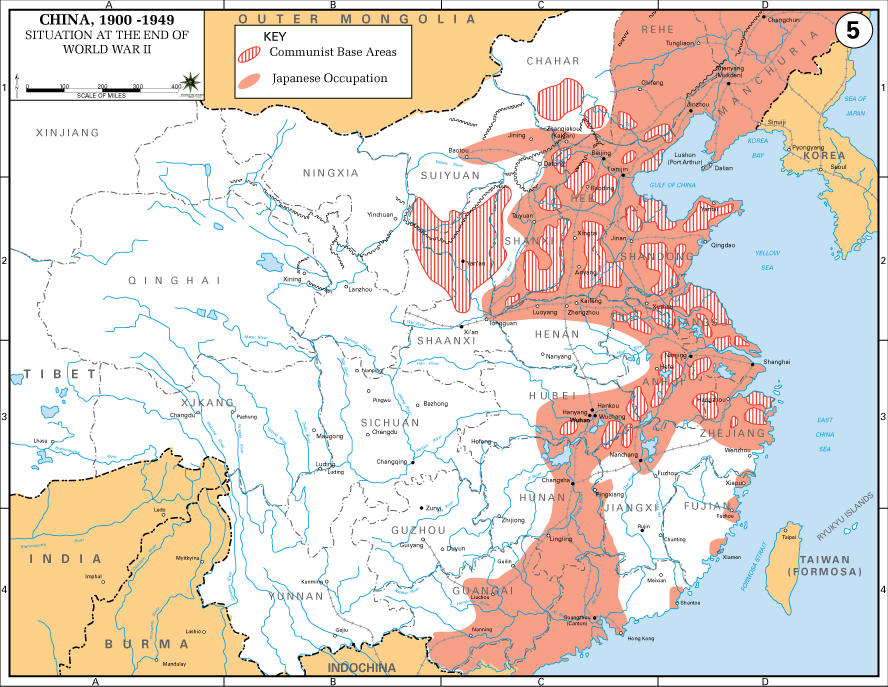
From the time that Japan broke out of its self-imposed isolation in the late 19th century, China has been one of its main targets, first for military action and more recently for economic expansion and competition. Japan’s reputation in China would have been bad enough even without the Japanese Imperial presence in large portions of China from 1937 through 1945, but the wounds from the Second Sino-Japanese War have never healed.
Last week, Nick Taber reported on some surprisingly intense anti-Japanese sentiments he encountered in China:
In 2017 in a rust-belt city in Northeast China I hopped in a taxi and began chatting with my driver who, when the conversation turned to politics, nonchalantly told me that he wished that the Chinese Government would kill every single Japanese person on the planet. I found this extreme to say the least, so I double-checked just in case my Chinese was failing me, “You mean kill every single Japanese man, woman, and child?”
“Yes, exactly,” he said.
Guessing by his apparent age I wrote my driver off as a fringe extremist whose possibly restricted worldview was likely shaped during the throes of the Cultural Revolution. I presumed that the vast majority of Chinese people today would decisively denounce this kind of violent sentiment of genocide. This presumption was wrong.
Chinese genocidal hatred against the Japanese simply cannot be dismissed as the bigotry of a nationalist fringe movement. Anti-Japanese sentiment is in fact so engrained in Chinese culture that it has become not only a political utility and form of patriotism but even a solid go-to branding opportunity.
The CEO of a major company in Hebei province sets his username on Weibo (China’s Twitter) to “killer of Japanese devils” and likewise a news anchor of a regional TV station sets his Weibo username to “destroy Japanese devils.” Weibo also has hundreds of users with the phrase “bomb Japan” in their username, and after a devastating 6.1 magnitude earthquake struck Osaka in June, the natural disaster began trending on Weibo with a large number of Chinese netizens lamenting that more Japanese people had not been killed. As one user put it, “The whole nation of Japan should perish as soon as possible. It’s an evil race that has infuriated god.”
Certainly not all Chinese hold such genocidal or hateful views. There is a sizeable minority that even frown upon these views and a growing number of more internationally-minded Chinese who have Japanese friends or study in Japan so are at the very least suspicious of this hate. Some Chinese even see this sentiment, in part, as a product of government propaganda and brainwashing. As The Chinese Communist Party (CCP) manages uncertainty over the future of its leadership, it exploits nationalism to boost its popularity and the painful memories of WWII anti-Japanese sentiment provides a relatively low-cost, high-yield opportunity for this purpose.
Chinese citizens who do openly support Japan in any way, shape, or form also risk being seen as traitors. Another user commenting on the Osaka tragedy remarked, “Any Chinese people in Osaka right now travelling or shopping? They should be buried together with the Japanese”.
In 2017, the China Badminton Super League told their own Lin Dan, the number one badminton champion in the world, that he would be forbidden from competing in the playoffs because he had a sponsorship contract with the Japanese sports brand Yonex. In 2012, the Chinese actress Li Bingbing refused to travel to Japan to promote her film, Resident Evil 5, saying that she “personally cannot handle it emotionally”.
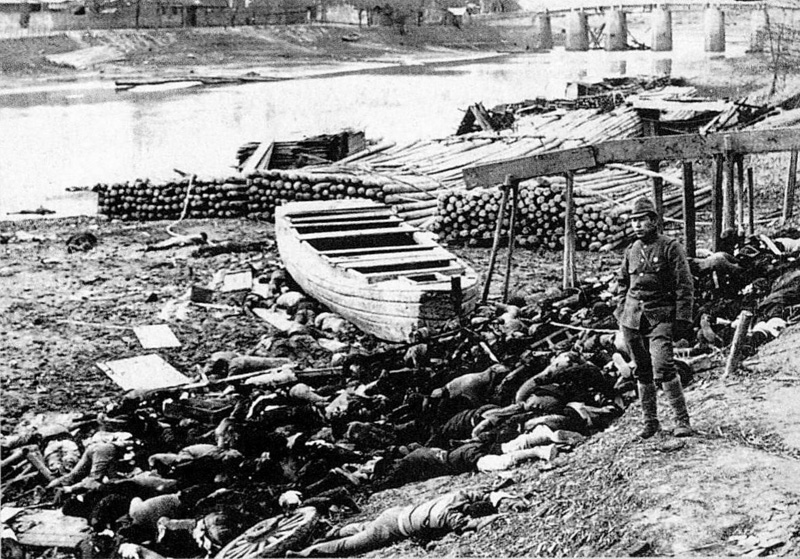
The origin of China’s anti-Japanese sentiment lies in the Chinese theater of World War II when the Imperial Japanese Army committed scores of harrowing war crimes on Chinese soil including the mass killing of civilians, sexual slavery, human experimentation, and cannibalism that resulted in the deaths of 10 to 20 million Chinese people.
Bodies of victims along Qinhuai River out of Nanjing’s west gate during Nanjing Massacre.
Detail of original photo by Moriyasu Murase, 村瀬守保 via Wikimedia Commons.
Belgium Under German Occupation During WW1 I THE GREAT WAR On The Road
The Great War
Published on 24 Sep 2018Visit the Ijser museum: http://www.museumaandeijzer.be/ijzert…
Indy talks to Peter Verplancke about Belgium during World War 1, in particular the German occupation policies.
Amazons – fierce fighting tribe or just ancient Greek porn?
Lindybeige
Published on 21 Jun 2011You can believe in them if you want, but if you do, you should out of fairness to other mythological characters believe in giants, cyclopes, griffins, and gorgons.
September 24, 2018
Verity Stob on early GUI experiences
“Verity Stob” began writing about technology issues three decades back. She reminisces about some things that have changed and others that are still irritatingly the same:
It’s 30 years since .EXE Magazine carried the first Stob column; this is its
pearlPerl anniversary. Rereading article #1, a spoof self-tester in the Cosmo style, I was struck by how distant the world it invoked seemed. For example:
Your program requires a disk to have been put in the floppy drive, but it hasn’t. What happens next?
The original answers, such as:
e) the program crashes out into DOS, leaving dozens of files open
would now need to be supplemented by
f) what’s ‘the floppy drive’ already, Grandma? And while you’re at it, what is DOS? Part of some sort of DOS and DON’TS list?
I say: sufficient excuse to present some Then and Now comparisons with those primordial days of programming, to show how much things have changed – or not.
1988: Drag-and-drop was a showy-offy but not-quite-satisfactory technology.
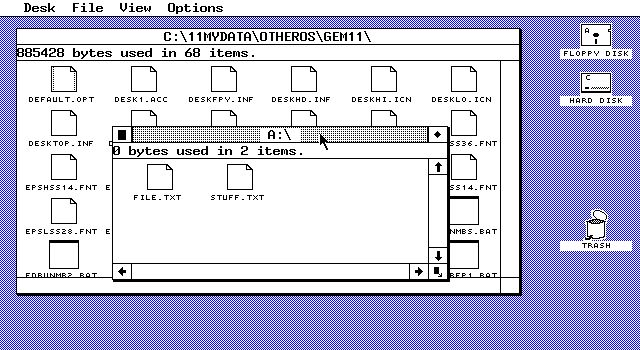
My first DnD encounter was by proxy. In about 1985 my then boss, a wise and cynical old Brummie engineer, attended a promotional demo, free wine and nibbles, of an exciting new WIMP technology called GEM. Part of the demo was to demonstrate the use of the on-screen trash icon for deleting files.
According to Graham’s gleeful report, he stuck up his hand at this point. “What happens if you drag the clock into the wastepaper basket?’
The answer turned out to be: the machine crashed hard on its arse, and it needed about 10 minutes embarrassed fiddling to coax it back onto its feet. At which point Graham’s arm went up again. “What happens if you drop the wastepaper basket into the clock?’
Drag-ons ‘n’ drag-offs
GEM may have been primitive, but it was at least consistent.
The point became moot a few months later, when Apple won a look-and-feel lawsuit and banned the GEM trashcan outright.
2018: Not that much has changed. Windows Explorer users: how often has your mouse finger proved insufficiently strong to grasp the file? And you have accidentally dropped the document you wanted into a deep thicket of nested server directories?
Or how about touch interface DnD on a phone, where your skimming pinkie exactly masks from view the dragged thing?
Well then.
However, I do confess admiration for this JavaScript library that aims to make a dragging and dropping accessible to the blind. Can’t fault its ambition.
Drafting – Poetry – Georg von Trapp I OUT OF THE TRENCHES
The Great War
Published on 22 Sep 2018Chair of Wisdom Time!
September 23, 2018
The Nimrod MRA4 – the world’s most expensive bad aircraft
Back in 2011, I posted an article about the retirement of the Hawker Siddeley Nimrod from the Royal Air Force inventory. I referred to the Nimrod as
… expensive to buy, eye-wateringly expensive to upgrade, but it must be cheap to operate, right? No:
[…] our new fleet of refurbished De Havilland Comet subhunters (sorry, “Nimrod MRA4s”) will cost at least £700m a year to operate. If we put the whole Nimrod force on the scrapheap for which they are so long overdue right now, by the year 2019 we will have saved […] £7bn
The Register certainly got in the right ballpark with this helpful graphic:

Earlier this month, the Nimrod saga was detailed at Naval Gazing, if only as a way to show that someone can have worse procurement experiences than the United States military. Despite being a military development of a passenger jet famous for crashes, the initial marks of the Nimrod were able to meet the RAF’s needs. The problems began when a requirement was generated for a British AWACS aircraft and the Nimrod was deemed to be the best candidate for conversion (“best” probably meaning “only British competitor”):
Things began to go wrong in the mid-70s, when the British decided to introduce an AWACS aircraft to support their air defense efforts. They had several options. The E-2 Hawkeye and E-3 Sentry were both about to enter service, and were rapidly proving themselves to have excellent radar systems during trials. The British could have had either aircraft, or bought their radar systems to integrate into an aircraft of their own. Or they could have only bought a few subcomponents, like the antenna or the radar transmitter itself, and built the rest domestically.
They decided to take none of these options. Instead, they would produce an entirely new radar system. Instead of an American-style radome, separate antennas would be installed in the nose and tail, and the system would sweep through one, and then the other. This was far more expensive and much riskier than buying from the Americans, but it did produce a lot more jobs in the British defense industry, which was apparently the government’s prime concern. In 1977, a contract was placed, making BAE and GEC-Marconi co-leads on the project to convert 11 surplus Nimrod MR1 airframes to the new configuration.
As might be expected based on that kind of decision-making, the resulting airplane had problems. The computer system chosen wasn’t powerful enough to integrate all of the data, particularly the area where the nose and tail radars overlapped. It was also horribly unreliable, with a mean time between failures of only two hours, in a system which took 2.5 hours to load the mission data from the tape. The Nimrod, considerably smaller than the American Sentry, was unable to carry more equipment to solve this problem. Different electronics racks were earthed to different points in the airframe, and the resulting potential differences caused false tracks to appear, overloading the computer even more. To make matters worse, most of the electronics units weren’t interchangeable for reasons that were never entirely clear. If one unit failed, several spares had to be tried before one that worked was found. The only system that functioned reliably was the IFF system, which could only track friendly aircraft and airliners. This was a major handicap in an aircraft intended to detect incoming Soviet bombers.
It probably isn’t a surprise to hear that the planes were delayed. A lot. And delaying military projects tends to drive the overall price higher. What was anticipated to be a £200-300 million project was over £1 billion before the government of the day came to their fiscal senses and pulled the plug (they ended up buying Boeing E-3 Sentry aircraft instead).
A few years later, the RAF ran a competition to replace the Nimrod MR2 maritime patrol aircraft. Lockheed, Dassault and Airbus entered the competition, but somehow, the RAF ended up selecting BAE’s bid which involved rebuilding 30-year-old Nimrod frames with new electronics and all the modern conveniences.
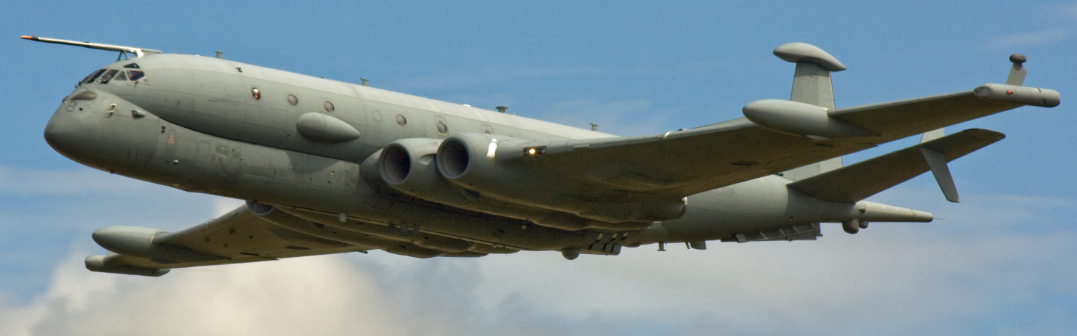
RAF Nimrod MRA4 on 18 July 2009.
Detail of original photo by Ronnie Macdonald, via Wikimedia Commons.
In 1996, a contract was issued for the new aircraft, designated Nimrod MRA4. 21 aircraft were to be produced at a cost of £2.8 billion, and they would be essentially new airplanes, with only the fuselage structure being retained. The antique Spey engines would be replaced with modern BR700s. These engines were significantly larger, and required much more air, forcing BAE to design a new, larger wing. The combined effect of these two changes was to double the Nimrod’s range and improve performance. Inside, the flight deck was replaced with one derived from the A340 airliner, and the mission systems were to be all-new.
A fuselage was sent to be reverse-engineered for the design of the new wing, and BAE designed and built it, then pulled in another aircraft to make the modification. And discovered that the wing didn’t fit. Apparently, the problem dated back to the initial construction of the aircraft. When positioning the frames, Hawker Siddeley had not done what all sensible manufacturers did, and measured from a common baseline. Instead, they had positioned each frame with a tolerance relative to the previous one, which meant that the position of the wings varied by as much as a foot across the fleet. Worse, the aircraft they had designed the wings for was one of the most extreme in wing position, so the new wings didn’t fit most of the other aircraft. This forced a redesign of the wings, further delaying the program.
Spoiler: they missed their delivery deadline. By nearly a decade. And the original plan to build 21 aircraft shrank to only 4 … but the budget continued to grow, from the original £2.8 billion to over £4.1 billion at cancellation. Each of the surviving airframes had literally cost more than £1 billion. That’s why Bean gave the Nimrod his “Naval Gazing Worst Procurement Ever” trophy, and I think it was very well-deserved.
The Russians are Coming! – WW2 004 September 22 1939
World War Two
Published on 22 Sep 2018When the USSR crushes the plans of the Allies for Poland and the Japanese plans in China in the same week, it is Germany that benefits.
Join us on Patreon: https://www.patreon.com/TimeGhostHistory
Or join The TimeGhost Army directly at: https://timeghost.tvBetween 2 Wars: https://www.youtube.com/playlist?list…
Written and Hosted by: Indy Neidell
Produced and Directed by: Spartacus Olsson and Astrid Deinhard
Executive Producers: Bodo Rittenauer, Astrid Deinhard, Indy Neidell, Spartacus Olsson
Research by: Indy Neidell
Edited by: Spartacus Olsson
Colorized Pictures by Olga Shirnina and Norman StewartOlga’s pictures: https://klimbim2014.wordpress.com
A TimeGhost chronological documentary produced by OnLion Entertainment GmbH
30 Years War | 3 Minute History
Jabzy
Published on 28 Oct 2015Thanks to Xios, Alan Haskayne, Lachlan Lindenmayer, William Crabb, Derpvic, Seth Reeves and all my other Patrons. If you want to help out – https://www.patreon.com/Jabzy?ty=h
September 22, 2018
Arthur C. Clarke – Master of Science Fiction – Extra Sci Fi – #1
Extra Credits
Published on 18 Sep 2018Arthur C. Clarke is well known for his work on 2001: A Space Odyssey, but even more importantly he ventured into writing novels instead of just magazine serializations. Works like The City and the Stars asked big philosophical questions in science fiction.
The Distant Early Warning Line
The History Guy: History Deserves to Be Remembered
Published on 23 Apr 2018The History Guy examines how the Cold War transformed Canada with the establishment of the U.S. Air Force’s distant early warning or dew line.
The History Guy uses images that are in the Public Domain. As photographs of actual events are often not available, I will sometimes use photographs of similar events or objects for illustration.
Patreon: https://www.patreon.com/TheHistoryGuy
The History Guy: Five Minutes of History is the place to find short snippets of forgotten history from five to fifteen minutes long. If you like history too, this is the channel for you.
QotD: Epicurean influences on Marx
… what’s also interesting is that our friends the Marxists also thought Epicurus was a great philosopher. Marx himself did his doctoral dissertation on the differences between the atomism of Epicurus and his forerunner Democritus.
Most books on Epicureanism published in France in the 20th century were written by Marxists. (Well, I suppose you could say that of most books published in France on any topics in the 20th century…!) I have a booklet on Lucretius at home published in France in the 1950s in a collection called Les classiques du peuple – The classics of the people. In the Acknowledgement section, the author thanks all the Soviet specialists of Epicureanism and materialism for any original insight that might appear in the book.
Marx found in Epicureanism a materialist conception of nature that rejected all teleology and all religious conceptions of natural and social existence.
Martin Masse, “The Epicurean roots of some classical liberal and Misesian concepts“, speaking at the Austrian Scholars Conference, Auburn Alabama, 2005-03-18.
September 21, 2018
Allied Breakthroughs In Palestine And Macedonia I THE GREAT WAR Week 217
The Great War
Published on 20 Sep 2018In a turbulent week of the First World War, the Allies break through at the Macedonian Front during the Battle of Vadar and in Palestine during the Battle for Palestine. At the same time, the Ottoman defeats the last defenders of Baku.
Declassified: The Old RAF Base Bringing Hollywood To Upper Heyford | Forces TV
Forces TV
Published on 30 Aug 2018Upper Heyford was one of the largest US Air Force bases in Europe, housing bombers that carried NATO’s intermediate-range nuclear weapons… now it’s attracting Hollywood A-listers…
Read more: https://www.forces.net/news/declassif…


