
Extra Credits
Published on 16 Sep 2018Is light a particle? Is light a wave? Let’s take a look at Thomas Young’s famous double-slit experiment — creating those really super funky interference patterns you might remember from your high school physics classes.
A tremendous thank-you to Alexander Tamas, the “mystery patron” who made this series possible. We finally found room in our busy production schedule to create and air this series alongside our regularly scheduled, patron-approved Extra History videos. A huge thank you to the multiple guest artists we got to work with, to Matt Krol for his skillful wrangling of the production schedule and keeping everyone happy, and to our Patreon supporters for your patience and support.
September 20, 2018
Quantum Computing – The Foundation of Everything – Extra History – #1
Comments Off on Quantum Computing – The Foundation of Everything – Extra History – #1
Perhaps we need a “Veterans’ Day”, but that’s not what Remembrance Day is for
Ted Campbell on the desire of the Royal Canadian Legion and Veterans Affairs Canada to change Remembrance Day to focus on veterans, rather than the war dead:
… given its mandate and, indeed, its very name, Veterans Affairs Canada manages, again, to totally misrepresent Remembrance Day, according to a report by CBC News. I’m not concerned that “at least half the participants in the English sessions did not recognize In Flanders Fields, nor did any of the Montreal participants.” Perhaps it is only right and proper that we have stopped teaching a poem that was intended to challenge those who, over 100 years ago, could still join the fight.
But the ‘message’ that Veterans Affairs seems, to me, to be trying to propagate, again, is that Remembrance Day is, somehow, all about veterans … that’s arrant nonsense. We veterans, I guess I count as one although it is not how I define myself, are there, as we should be, only to honour those who died, those who never got a chance to become veterans because they were blown to bits or died in a burning aircraft or drowned at sea or lay for hours, in no-man’s-land, wracked with pain, waiting for the blessed relief of death. That’s why we go to the cenotaph, once a year: to remember the 100,000+ Canadian men and women who were killed in our wars, large and small, from South Africa in 1899 (arguably, from North West Canada in 1885) until today. But, today, there is a movement, spearheaded by civil servants and the Royal Canadian Legion, to change the focus to honour their clients: veterans, like me … even at the expense of remembering our dead.
[…]
For myself, no matter what anyone else decides, I will continue to observe Remembrance Day for what it is meant to be, not what the bureaucrats and the Legion’s management want it to become; and if we have a Veterans’ Day I will stay home … I don’t need anyone’s thanks for my service; you paid me well enough, as much as your elected representatives thought fair, anyway, and I always tried my best to be worthy of my hire.
Comments Off on Perhaps we need a “Veterans’ Day”, but that’s not what Remembrance Day is for
The Last Lee Enfield: the L42A1 Sniper
Forgotten Weapons
Published on 31 Aug 2018More info: https://www.forgottenweapons.com/the-…
http://www.patreon.com/ForgottenWeapons
When the British military adopted the FAL (L1A1 SLR) in 1960, they adopted the 7.62x51mm NATO cartridge along with it. While the Bren guns were converted to the new cartridge, efforts at converting the Lee Enfield into a precision rifle were not successful at the time. However, civilian target shooters and the British NRA would work on perfecting that conversion for use in competition, and would ultimately produce very accurate 7.62mm rifles built on Lee Enfield actions – accurate enough that the military took notice. Copying the competition rifles, the British military would adopt the L42A1 in 1970, an Enfield action converted to 7.62mm NATO with a shortened and free-floated stock and hand guard and a heavy profile barrel. A total of 1,080 L42A1 rifles would be converted from existing No4 MkI(T) sniper rifles, and they would serve in the front lines of the British military until 1992, when they were replaced by the Accuracy International L96A1.
If you enjoy Forgotten Weapons, check out its sister channel, InRangeTV! http://www.youtube.com/InRangeTVShow
Comments Off on The Last Lee Enfield: the L42A1 Sniper
September 19, 2018
Belgian Uniforms Of World War 1 I THE GREAT WAR Special
The Great War
Published on 17 Sep 2018Visit the IJser Museum: http://www.museumaandeijzer.be/ijzert…
Indy talks to Peter Verplancke from the Museum at the former Yser front about the Belgian uniforms and their evolution during the war.
Comments Off on Belgian Uniforms Of World War 1 I THE GREAT WAR Special
The Byzantine Empire should really be called the “Medieval Roman Empire”
Sean Gabb makes the case for the least well-known part of the Roman world that outlasted the western empire by a thousand years:
Properly considered, the history of what I will from now call not the Byzantine Empire, but the Mediaeval Roman Empire, is perhaps the most astonishing instance of how courage and determination can keep civilisation alive in the face of the most forbidding and apparently overpowering challenges. In setting out my argument, I hope you will forgive me if I begin with an introduction covering much that many of your will know at least as well as I do, but that may not be so familiar to those reading the text or watching the speech on YouTube.
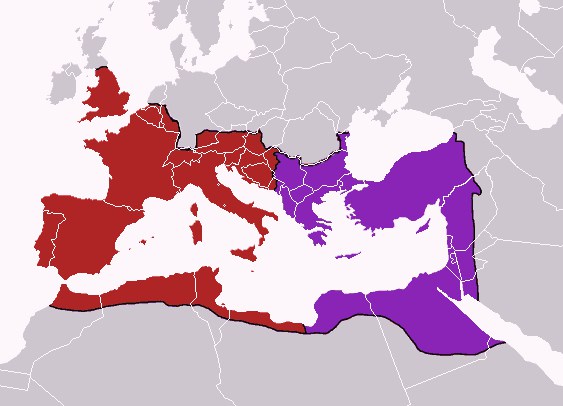
If you look at the first of the maps that I have put on your tables, you will see the Roman Empire as it was in the year 395 AD. This shows the Empire at something close it its greatest extent. The conquests that Trajan made to the north of the Danube and east of the Euphrates have been given up. But it includes the whole of the Mediterranean World and its various hinterlands – an area stretching from the North of England to Upper Egypt, from Casablanca to Trebizond. In that year, however, nearly a century of political experiments is formally ended with the division of the Empire into two administrative zones. There is the Western or the red Empire, ruled by an Emperor in Rome or Milan or Ravenna. There is the Eastern or the purple Empire, ruled by an Emperor in Constantinople.
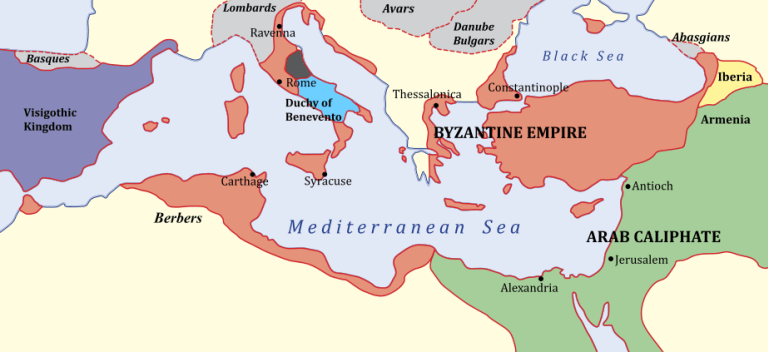
If you look at the second map, dated roughly 650 AD, you will see that the Western Empire has disappeared. Excepting North Africa and parts of Italy, now ruled from Constantinople, the whole of the Western Empire has disappeared – replaced by a set of barbarian kingdoms from which modern Europe takes its origin. The Eastern Empire itself has lost both Syria and Egypt to the Arabs.
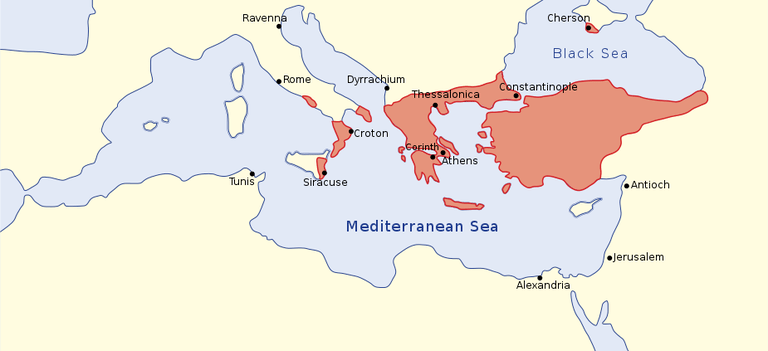
If you look at the third map, dated roughly 867 AD, you will see that the Empire has suffered the further loss of Cyprus and North Africa and most of Sicily. Nevertheless, what we have in that year should undeniably be called the Mediaeval Roman Empire. It has weathered the storm of the Early Middle Ages. It is the richest and most powerful state in the Mediterranean World. Indeed, during the next few centuries, it will expand. It has already reconquered Greece. It will conquer the Bulgarian Kingdom and re-establish its ancient frontier on the Danube. It will even retake Antioch and make Egypt for a while its economic and diplomatic client.
After 1071, the Empire falls on evil days. In that year, the Turks deprive it of its Anatolian heartland. But this loss is stabilised and in part reversed by a skilful handling of the Crusades. There is another disaster in 1204, when the Venetians take and plunder Constantinople. But this is not the end. The Empire is restored in large parts in 1261; and, even if as little more than a city-state based around Constantinople, it continues to the final Turkish conquest of 1453. Indeed, the formal extinction of the Empire comes nearly a decade after 1453, with the annexation of its last territories in Southern Greece.
There was a time when school textbooks in England dated the fall of the Roman Empire to 476 AD. Its continued survival for a thousand years after then had to be explained, where admitted, by taking a contemptuous view of what was called the Byzantine Empire. See, for example, W.E.H. Lecky:
Of that Byzantine empire, the universal verdict of history is that it constitutes, without a single exception, the most thoroughly base and despicable form that civilization has yet assumed. There has been no other enduring civilization so absolutely destitute of all forms and elements of greatness, and none to which the epithet “mean” may be so emphatically applied… The history of the empire is a monotonous story of the intrigues of priests, eunuchs, and women, of poisonings, of conspiracies, of uniform ingratitude.
Lecky is one of my favourite historians. But, if you look even at the mediaeval Greek and Italian historians of the Empire, you will see that this is a bizarre judgement. Undoubtedly, these historians tended to focus on intrigues in and about the Imperial Palace. But they also record much else. They record the story of a rich and powerful empire, directed with high military and diplomatic ability – an empire in which slavery and the death penalty have been almost abolished, where people lived, and knew that they lived, under a set of divinely-ordained laws that protected life, liberty and property to a degree unknown in any other mediaeval state.
Comments Off on The Byzantine Empire should really be called the “Medieval Roman Empire”
QotD: The “generations” of jet fighters
American warplanes like the F-22 and F-35 are often called “5th generation” fighters. This leaves many wondering what the other generations were and what the next one will be. The generation reference is all because of jet fighters, and the first generation was developed during and right after World War II (German Me-262, British Meteor, U.S. F-80, and Russian MiG-15). These aircraft were, even by the standards of the time, difficult to fly and unreliable (especially the engines). The 2nd generation (1950s) included more reliable but still dangerous to operate aircraft like the F-104 and MiG-21. The 3rd generation (1960s) included F-4 and MiG-23. The 4th generation (1970s) included F-16 and MiG-29. Each generation has been about twice as expensive (on average, in constant dollars) as the previous one. But each generation is also about twice as safe to fly and cheaper to operate. Naturally, each generation is more than twice as effective as the previous one. Increasingly it looks like the 6th generation will come without pilots. That’s because producing fifth generation fighters has proved difficult as well as very expensive. So far only the United States has managed to get 5th gen fighters (F-22 and F-35) into service. The Russians are still trying as are the Chinese, even though one of their stealth fighter designs (J-20) is technically in service (even though production has been suspended after less than a dozen were produced).
The Russians have said they will keep working on their 5th generation Su-57, although some of the derivatives of their Su-27 are at least generation 4.5. One of the reasons the Soviet Union collapsed was the realization that they could not afford to develop 5th generation warplanes to stay competitive with America. The Russians had a lot of interesting stuff on the drawing board and in development but the bankruptcy of most of their military aviation industry during the 1990s left them scrambling to put it back together ever since. At the moment the Russians are thinking of making a run for the 6th generation warplanes, which will likely be unmanned and largely robotic. As of 2018 they don’t have much choice because their answer to the F-22, work on the Su-57 was canceled (“indefinitely paused”.)
“Murphy’s Law: The Impossible 5th Generation”, Strategy Page, 2018-08-20.
Comments Off on QotD: The “generations” of jet fighters
September 18, 2018
Kingdom of Majapahit – Wrath of the Khan – Extra History – #2
Extra Credits
Published on 15 Sep 2018The Mongols came to the island of Java — the King of Singhasari had defied them for too long. But by the time they got there, the king had died, and instead someone claiming to be his stepson, Raden Vijaya, promised to be their vassal. The Mongol forces were in for quite a surprise.
Comments Off on Kingdom of Majapahit – Wrath of the Khan – Extra History – #2
September 17, 2018
American Rifles & Shotguns of World War 1 I THE GREAT WAR Special feat. C&Rsenal
The Great War
Published on 15 Sep 2018Othais from C&Rsenal tells Indy all about American rifles and shotguns from World War 1.
Comments Off on American Rifles & Shotguns of World War 1 I THE GREAT WAR Special feat. C&Rsenal
“Nazis on Drugs” – Wehrmacht & Meth – Wunderwaffe?
Military History not Visualized
Published on 17 Aug 2018There some over-blown claims out there that the “Blitzkriege” were mainly achieved due to the use of Meth (Pervitin) and that historians had ignored this issue. Is it true or false? In this video we take a look at Pervitin, the Wehrmacht, the early German victories aka “Blitzkriege” and various aspects. Was Pervitin a Wunderwaffe? Was the Wehrmacht on Meth? How long was it used? And some aspects.
Comments Off on “Nazis on Drugs” – Wehrmacht & Meth – Wunderwaffe?
September 16, 2018
Poland on Her Own – WW2 September 15 1939
World War Two
Published on 15 Sep 2018When the Wehrmacht and the SS continue devastating Poland and her people in the first weeks of September, her last chance is her western allies.
Join us on Patreon: https://www.patreon.com/TimeGhostHistory
Or join The TimeGhost Army directly at: https://timeghost.tvWritten and Hosted by: Indy Neidell
Produced and Directed by: Spartacus Olsson and Astrid Deinhard
Executive Producers: Bodo Rittenauer, Astrid Deinhard, Indy Neidell, Spartacus Olsson
Research by: Indy Neidell
Edited by: Spartacus OlssonA TimeGhost chronological documentary produced by OnLion Entertainment GmbH
Comments Off on Poland on Her Own – WW2 September 15 1939
Early Arab Conquests | 3 Minute History
Jabzy
Published on 13 Dec 2015Covering the conquests during the Rashidun Caliphate. I will probably do a separate video on the First Fitna.
Thanks for the 15,000 subs. And thanks to Xios, Alan Haskayne, Lachlan Lindenmayer, Derpvic, Seth Reeves and all my other Patrons. If you want to help out – https://www.patreon.com/Jabzy?ty=h
Comments Off on Early Arab Conquests | 3 Minute History
QotD: Austria’s share of the Nazi legacy
This ambiguity, or (to put it less kindly) dishonesty, if it really exists, replicates in symbolic fashion the attitude of Austria to its historical record in the 1930s and 40s. Officially, Austria was a victim of Nazi aggression; in reality, it was an enthusiastic participant in Nazi crimes. But whatever crimes Austrians as individuals committed during the war, they committed them as Germans, not as Austrians. They were responding only to force majeure; the Austrian state was not implicated.
Suspicion of Austria runs deep, and with good reason. Everyone thinks (though it cannot be proved or disproved) that Kurt Waldheim, the former Secretary-General of the United Nations, was elected president of the country not in spite of his Nazi past, but because of it. The Austrians claim that they insisted on voting for him because they resented the hypocritical reaction of the outside world to his candidature – surely, they said, powers with the combined intelligence resources of the United States, the Soviet Union, Britain and France must have known of his Nazi past when they accepted him as Secretary-General, so why should the Austrians themselves not accept him as President? Once again the Austrians were able to conceive of themselves as the injured party in the whole business.
Even the Austrian prohibition of Holocaust denial, under which the British Nazi-supporting historian David Irving was (in my view wrongfully) imprisoned until he recanted, or at least pretended to recant, is ambiguous. On the one hand, of course, it is a recognition of the moral monstrosity of what the Nazis did, and of the Austrians’ special responsibility for it; but on the other, it implies a deep mistrust of the Austrian people, who (it must have been feared by those who framed the law) might recant their anti-Nazism if they could.
Of course, there have been Austrians who were deeply disgusted by their countrymen. The greatest Austrian writer of the post-war period, Thomas Bernhard, inserted a famous clause in his will that repays reflection. He ordered that, for the duration of his legal copyright after his death, nothing he had ever written, including his plays, should ever be published or performed:
within the borders of the Austrian state, however that state
describes itself. I categorically emphasize that I want to have
nothing to do with the Austrian state and I safeguard myself
concerning my person and my work not only against every
interference but also against every approach by this Austrian
state to my person and my work for all time to come.‘For all time to come:’ that is a pretty strong injunction, implying as it does that the Austrian soul, or whatever you want to call it, is so tainted by its original sin, or sins, that it is irrecoverably and irremediably evil.
Theodore Dalrymple, “Austria and Evil”, New English Review, 2008-05.
Comments Off on QotD: Austria’s share of the Nazi legacy
September 15, 2018
Battle of Saipan – Suicide Island – Extra History – #2
Extra Credits
Published on 13 Sep 2018This series is brought to you by World of Tanks PC. Check out the game at the link below and use the invite code FORAGER for extra goodies. https://redir.wargaming.net/r06pve1j/…
As the ruthless clash of the Saipan invasion drags on into the second week, a unique and unlikely hero emerges. Marine scout Guy Gabaldon can speak Japanese. He deserts his post, not once but twice, to reach out to the enemy soldiers and civilians.
Comments Off on Battle of Saipan – Suicide Island – Extra History – #2
QotD: Churchill on brevity
To do our work, we all have to read a mass of papers. Nearly all of them are far too long. This wastes time, while energy has to be spent in looking for the essential points.
I ask my colleagues and their staffs to see to it that their Reports are shorter.
- The aim should be Reports which set out the main points in a series of short, crisp paragraphs.
- If a Report relies on detailed analysis of some complicated factors, or on statistics, these should be set out in an Appendix.
- Often the occasion is best met by submitting not a full-dress Report, but an Aide-mémoire consisting of headings only, which can be expanded orally if needed.
- Let us have an end of such phrases as these: “It is also of importance to bear in mind the following considerations…”, or “Consideration should be given to the possibility of carrying into effect…”. Most of there woolly phrases are mere padding, which can be left out altogether, or replaced by a single word. Let us not shrink from using the short expressive phrase, even if it is conversational.
Reports drawn up on the lines I propose may at first seem rough as compared with the flat surface of officialese jargon. But the saving in time will be great, while the discipline of setting out the real points concisely will prove an aid to clearer thinking.
Winston Churchill, memorandum to the War Cabinet, 1940-08-09.
Comments Off on QotD: Churchill on brevity
September 14, 2018
The Battle of Saint-Mihiel I THE GREAT WAR – Week 216
The Great War
Published on 13 Sep 2018The American First Army joins the fray on the Western Front with the Battle of Saint-Mihiel. All along the Western Front, the Allies are attacking or planning new attacks. The situation for the Germans looks dire even as the first war reparations from Russia arrive.
Comments Off on The Battle of Saint-Mihiel I THE GREAT WAR – Week 216


