Quotulatiousness

October 10, 2020

A century on, Greece and Turkey are back at daggers drawn

Filed under: Europe, Greece, History, Military — Tags: , , , , , , — Nicholas @ 03:00

John Psaropoulos on the ever-more-heightened tension in the Aegean Sea as Turkey looks to muscle in on Greek-claimed waters in search of natural gas (or a fight):

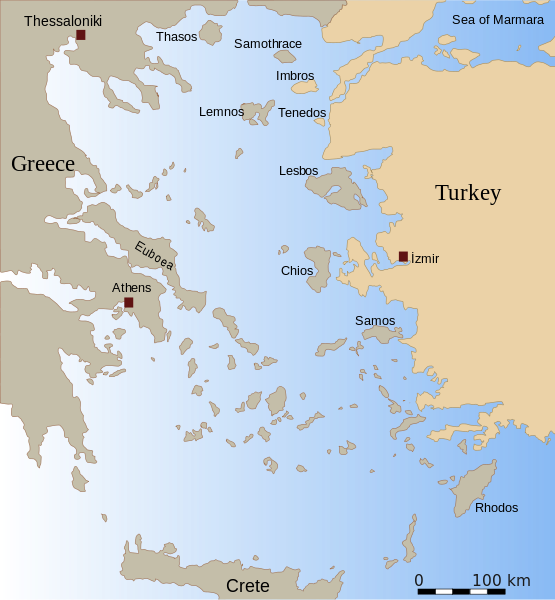
The Aegean Sea
Map via Wikimedia Commons

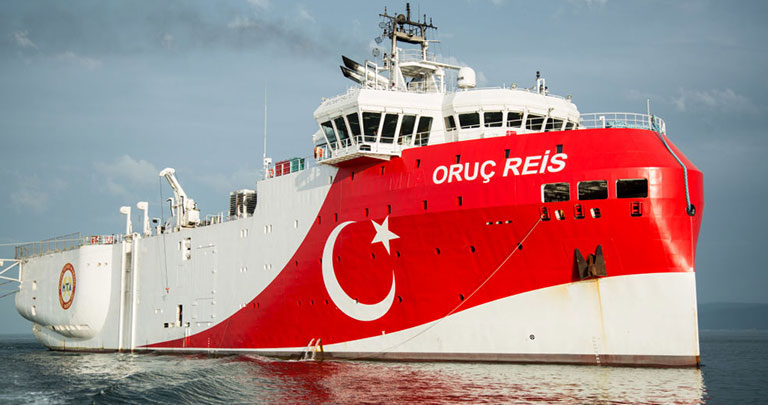
Last summer, Greece and Turkey came closer to war than they have done since 1974, when Turkey invaded Cyprus. The drama began to unfold on 21 July, when Turkey announced it was sending a seismic survey ship, the Oruc Reis, to look for oil and gas in areas the UN Law of the Sea awards to Greece.

Within hours, the Greek and Turkish navies had deployed throughout the Aegean and east of Crete. They remained so for two months. Greek helicopters pinned down Turkish submarines off the island of Evia. Frigates shadowed each other so closely, that on 12 August two of them collided when a Turkish frigate performed a manoeuvre across the bows of a Greek one. Greek and Turkish F-16s intercepted each other between Crete and Cyprus. Greece came close to invoking the European Union’s mutual defence clause.

On 13 September, Turkey withdrew the Oruc Reis, ostensibly for maintenance, and redeployed its navy. In the coming days, Greece and Turkey are to resume talks abandoned four and a half years ago on carving out their continental shelves – vast swathes of the east Mediterranean where they may exercise exclusive commercial rights to exploit undersea resources.

For now, there is de-escalation, but expectations for the outcome of these talks are low.

“Right now, Turkey doesn’t consider itself an extension of the West. It doesn’t consider that it has commitments and responsibilities towards the West,” says Konstantinos Filis, who directs the Institute of International Relations in Athens. “It believes it is an autonomous power in the region, that it is very potent, and that all its neighbours should respect it. The Turkish leadership doesn’t appear to be prepared for compromises with neighbours it considers inferior.”

The east Mediterranean is where the world’s most significant natural gas discoveries have occurred since the turn of the millennium. Israel and Egypt are now energy independent. Cyprus soon hopes to be. But Greece potentially dwarfs them all.

Seismic explorations it conducted six years ago suggest that Greece has natural gas reserves of 70-90 trillion cubic feet – as much as Israel, Egypt and Cyprus have discovered combined, with a pre-Covid-19 market value of about $200 billion. Assuming gas is viable for the next 25 years, Greece’s reserves, if proven, would cover its energy needs and turn gas into a lucrative export to the European Union. As much as a third of the value of the gas would go to the Greek state in taxes and royalties, allowing it to pay off a fifth of its external debt, now approaching twice its GDP.

This is clearly a future Turkey, with eight times Greece’s population and four times its economy, would rather claim for itself. Legally, it cannot do so. Under the rules of the UN’s Law of the Sea (UNCLOS), the lion’s share of east Mediterranean waters goes to Greece and Cyprus. Recep Tayyip Erdogan, Turkey’s leader for the past 18 years, feels that the Greeks are hemming him in.

Turkish research vessel MTA Oruç Reis, operated by the General Directorate of Mineral Research and Exploration for shallow water petroleum and natural gas survey work.
Photo from https://balkaneu.com/greece-oruc-reis-within-the-greek-continental-shelf-mitsotakis-contacts-michel-and-stoltenberg/

I AM Julius Caesar

The Study of Antiquity and the Middle Ages
Published 2 Jul 2020

Politician, warrior, priest, lover.

My name is Gaius Julius Caesar and I led one of the most extraordinary lives in recorded history.

My victories over foes both foreign and domestic are still studied today. I upended the Roman Republic and became its first dictator.

I loved Cleopatra.

My brutal assassination has been synonymous with bitter betrayal for 2000 years.

New videos from The Study of Antiquity and the Middle Ages, the I AM series allows the great figures of history to introduce themselves in brief, compelling, historically-accurate episodes. Look for more I AM videos of your favorites!

I AM Julius Caesar! Welcome to the first episode of the I AM series where you live history itself through the mind, viewpoints and lives of a historical character!

See and experience the world they lived and celebrate their triumphs and feel their defeats.

This first episode is on Julius Caesar, the revolutionary who set into place the foundations of what would become the Roman Empire.

This was written, directed and created by the extraordinary professional DW Draffin! He is an audio book narrator, stage actor, and independent author.

AUDIOBOOK NARRATOR
https://www.audible.com/search?search…

STAGE ACTOR
https://www.youtube.com/watch?v=xTept…

INDEPENDENT AUTHOR
https://www.amazon.com/DW-Draffin/s?k…

If you need a professional then contact him!

To support the channel, become a Patron and make history matter!

Patreon: https://www.patreon.com/The_Study_of_…

Donate directly to PayPal: https://paypal.me/NickBarksdale

Check out our newly opened store!
teespring.com/stores/antiquity-and-th…

Get your SPQR Face Masks today!
https://spqr-emporium.com/collections…

Enjoy history merchandise? Check out affiliate link to SPQR Emporium!
http://spqr-emporium.com?aff=3

*Dislaimer, the link above is an affiliate link which means we will earn a generous commission from your magnificent purchase, just another way to help out the channel!

Join our community!

October 9, 2020

Yugoslav Resistance and Serb Collaboration in 1941 – WW2 Special

Filed under: Europe, Germany, History, Military, WW2 — Tags: , , , — Nicholas @ 06:00

World War Two
Published 8 Oct 2020

Resistance has been brewing since the Axis invasion in April 1941. Multiple resistance groups fight for very different reasons and with different methods. When they launch a big offensive against the occupier, lines between friend and foe become blurry.

Join us on Patreon: https://www.patreon.com/TimeGhostHistory
Or join The TimeGhost Army directly at: https://timeghost.tv

Follow WW2 day by day on Instagram @ww2_day_by_day – https://www.instagram.com/ww2_day_by_day
Between 2 Wars: https://www.youtube.com/playlist?list…
Source list: http://bit.ly/WW2sources

Hosted by: Spartacus Olsson
Written by: Joram Appel
Director: Astrid Deinhard
Producers: Astrid Deinhard and Spartacus Olsson
Executive Producers: Astrid Deinhard, Indy Neidell, Spartacus Olsson, Bodo Rittenauer
Creative Producer: Maria Kyhle
Post-Production Director: Wieke Kapteijns
Research by: Joram Appel
Edited by: Miki Cackowski
Sound design: Marek Kamiński
Map animations: Eastory (https://www.youtube.com/c/eastory)

Colorizations by:
Mikolaj Uchman
Carlos Ortega Pereira – BlauColorizations, https://www.instagram.com/blaucolorizations
Dememorabilia – https://www.instagram.com/dememorabilia/

Sources:
Bundesarchiv
Museum of Yugoslavia
FORTEPAN / Konok Tamás ID 27502
Narodowe Archiwum Cyfrowe
from the Noun Project: Skull by Muhamad Ulum, Dead Soldier by Gan Khoon Lay, Helmet by Daniel Turner, Injury by Adriano Emerick, person by Adrien Coquet

Soundtracks from the Epidemic Sound:
Johan Hynynen – “Dark Beginning”
Johannes Bornlof – “Deviation In Time”
Johannes Bornlof – “The Inspector 4”
Reynard Seidel – “Deflection”
Andreas Jamsheree – “Guilty Shadows 4”

Archive by Screenocean/Reuters https://www.screenocean.com.

A TimeGhost chronological documentary produced by OnLion Entertainment GmbH.

Ruina Imperii” – End of an Empire – Sabaton History 088 [Official]

Filed under: Europe, History, Media, Military — Tags: , , , , , — Nicholas @ 04:00

Sabaton History
Published 8 Oct 2020

The death of Charles XII was followed by the rapid decline of the Swedish Empire. The Swedish nation had suffered much in the last ten years of his reign. The constant state of war had brought famine and poverty and ruined the state in many ways. Charles XII fought Sweden’s numerous enemies in the vain hope of restoring the empire to its old glory. He was the King who most strongly believed that Sweden was destined for imperial greatness, no matter the cost. What can be said about his reign? How would history judge his character or his decisions as a King?

Support Sabaton History on Patreon: https://www.patreon.com/sabatonhistory

Listen to “Ruina Imperii” on the album Carolus Rex:
Carolus Rex (English Version) – https://music.sabaton.net/CarolusRexEN
Carolus Rex (Swedish Version) – https://music.sabaton.net/CarolusRexSE

Listen to Sabaton on Spotify: http://smarturl.it/SabatonSpotify
Official Sabaton Merchandise Shop: http://bit.ly/SabatonOfficialShop

Hosted by: Indy Neidell
Written by: Markus Linke and Indy Neidell
Directed by: Astrid Deinhard and Wieke Kapteijns
Produced by: Pär Sundström, Astrid Deinhard and Spartacus Olsson
Creative Producer: Maria Kyhle
Executive Producers: Pär Sundström, Joakim Brodén, Tomas Sunmo, Indy Neidell, Astrid Deinhard, and Spartacus Olsson
Community Manager: Maria Kyhle
Post-Production Director: Wieke Kapteijns
Editor: Karolina Dołęga
Sound Editor: Marek Kaminski
Archive: Reuters/Screenocean – https://www.screenocean.com

Visual Sources:
– Nationalmuseum
– Carl Andreas Dahlström – httpruneberg.org dcateckn0126
– Icons form The Noun Project: Farm by Laymik, Fruit by Eucalyp, Vegetable by Eucalyp, treasure by dDara, treasure by Eucalyp, Wheat Grain Bag by Symbolon & Wine by Vladimir Belochkin.

All music by: Sabaton

An OnLion Entertainment GmbH and Raging Beaver Publishing AB co-Production.

© Raging Beaver Publishing AB, 2019 – all rights reserved.

October 8, 2020

DicKtionary – K is for Killer – Elizabeth Báthory

Filed under: Europe, History — Tags: , , — Nicholas @ 06:00

TimeGhost History
Published 7 Oct 2020

Elizabeth Bathory was a Hungarian noblewoman who holds the world record as the most prolific female murderer. This is her gruesome life story.

Join us on Patreon: https://www.patreon.com/TimeGhostHistory

Hosted & Written by Indy Neidell
Director: Astrid Deinhard
Producers: Astrid Deinhard and Spartacus Olsson
Executive Producers: Astrid Deinhard, Indy Neidell, Spartacus Olsson, Bodo Rittenauer
Creative Producer: Joram Appel
Post-Production Director: Wieke Kapteijns
Research by: Indy Neidell
Image Research by Karolina Dołęga
Edited by: Karolina Dołęga
Sound design: Marek Kamiński

Visual Sources:
– Wellcome Images
– Paul K from Flickr https://cutt.ly/Paul_K_Flickr
– Andreone93 from Wikimedia https://cutt.ly/Andreone93_Bathory
– Cleveland Museum of Art
– Metropolitan Museum of Art
– Lluís Ribes Mateu from Flickr https://www.flickr.com/photos/lluisri…
– Yvette Hoitink from Flickr https://www.flickr.com/photos/yhoitink/
– Civertan from Wikimedia https://cutt.ly/Civertan
– Jean Louis Mazieres https://www.flickr.com/photos/mazanto/
– Icons from The Noun Project: anti trust by Angelo Troiano, Castle by Vicons Design, Waiter by ProSymbols, Nun by Wolf Böse, Priest by Luis Prado, reject by Alice Design, User by Round Pixel, Zoo by Eugene Dobrik, User by Round Pixel.

“The Wedding March” – Traditional
“Stranger Days” – Alexandra Woodward
“Rise Of The Titan” – FormantX

Archive by Screenocean/Reuters https://www.screenocean.com.

A TimeGhost chronological documentary produced by OnLion Entertainment GmbH.

Keeping up with the Bonapartes, Sino-German relations and Barbarossa news – WW2 – OOTF 018

Filed under: China, Europe, France, Germany, History, Military, WW2 — Tags: , , , , — Nicholas @ 04:00

World War Two
Published 7 Oct 2020

What were the Bonapartes up to during World War Two? How were the German casualties of Operation Barbarossa reported, if at all, in Germany? And what exactly was the relationship between China and Germany in World War Two? Join Indy in the Chair of Infinite Wisdom to find out.

Join us on Patreon: https://www.patreon.com/TimeGhostHistory
Or join The TimeGhost Army directly at: https://timeghost.tv

Follow WW2 day by day on Instagram @ww2_day_by_day – https://www.instagram.com/ww2_day_by_day
Between 2 Wars: https://www.youtube.com/playlist?list…
Source list: http://bit.ly/WW2sources

Hosted by: Indy Neidell
Written by: Lewis Braithwaite, Ian Sowden, and Samir Mechel
Director: Astrid Deinhard
Producers: Astrid Deinhard and Spartacus Olsson
Executive Producers: Astrid Deinhard, Indy Neidell, Spartacus Olsson, Bodo Rittenauer
Creative Producer: Maria Kyhle
Post-Production Director: Wieke Kapteijns
Research by: Lewis Braithwaite, Ian Sowden, and Samir Mechel
Edited by: Monika Worona
Sound design: Marek Kamiński
Map animations: Eastory (https://www.youtube.com/c/eastory)

Colorizations by:
Daniel
Mikołaj Uchman
Musvage

Visual sources:
Bundesarchiv

Archive by Screenocean/Reuters https://www.screenocean.com.

A TimeGhost chronological documentary produced by OnLion Entertainment GmbH.

Fallen Flag — The Pacific Electric Railway

Filed under: Business, History, Railways, USA — Tags: , , , — Nicholas @ 03:00

This month’s Classic Trains featured fallen flag is southern California’s iconic Pacific Electric Railway Company, whose streetcars, interurbans, and buses served the vast area in and around Los Angeles and San Bernardino from 1901 until the passenger services were sold off in 1953. The electric service was converted to bus and the last electric rail line was discontinued in 1961. At its peak in the 1920s the “Red Cars” service was said to be the largest electric railway system in the entire world.

G. Mac Sebree covers the origins of the line in the late nineteenth century:

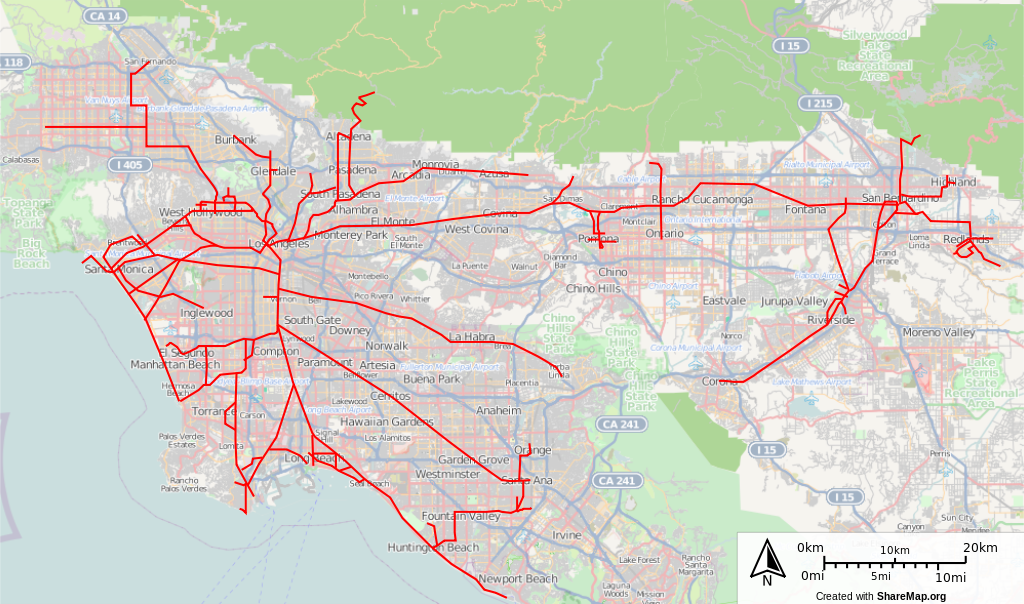
The story begins in 1895, when a line was completed from Los Angeles to Pasadena; a mere 10 years later, the system was virtually complete. To a great degree, PE was the brainchild of Henry Huntington, nephew of one of the Central Pacific’s “Big Four,” Collis P. Huntington. An active real-estate promoter, Henry needed the Big Red Cars and the transportation they provided to help sell lots and homes in the hinterlands.

His uncle’s Southern Pacific took control of the PE in 1911 in a deal that left the Los Angeles Railway, the narrow-gauge intracity system, in the nephew’s hands. The PE was built to standard gauge, and SP saw a brilliant future in freight for the interurban.

Pacific Electric route map.
Original data from http://sharemap.org/public/Los_Angeles_Pacific_Electric_Railways_(Red_Cars) via Wikimedia Commons.

Interurbans were not considered Class I railroads (or any other class — they were not “steam railroads”), but from the very start, PE was big business. The California Railroad Commission said the property was worth $100 million in Depression dollars. Atypically for an interurban, the system served as a gathering network for carload freight shipments from citrus groves, manufacturing plants, oil refineries, warehouses, and the harbor at San Pedro. The three line-haul railroads serving southern California — Santa Fe, Union Pacific, and especially SP — depended on the Pacific Electric to some degree.

Yet in its heyday, PE carried huge numbers of passengers. As late as 1953, 50 percent of its revenue came from riders — but absolutely none of its profit. An all-time list shows that PE operated 143 distinct passenger routes. Despite the so-called “Great Merger of 1911,” in which local and interurban services were supposedly separated, the heaviest PE passenger lines largely served the L.A. urban area. An example was the street-running L.A.–Hollywood–Beverly Hills line, in which two-car trains rumbled down Hollywood Boulevard at 10-minute intervals.

At one time or another, PE single-truck Birney cars plied local lines in Pasadena, Long Beach, Santa Monica, Redlands, Santa Ana, and San Pedro, although the 1920s were not far along before management sought to sell off or abandon these albatrosses.

After World War 2, the writing was on the wall for the Red Cars, as urban expansion and greatly increased car ownership cut at the economic basis for rail passenger service in southern California, especially as the new freeways were built.

After the war, though, things went downhill rapidly. As soon as buses were available, Pacific Electric began wholesale rail passenger-service abandonments. The new freeways were regarded as the rapid transit of the future. PE President Oscar Smith saw one possibility for saving rail service — if the state would pay. Just before the war, a short section of freeway between Hollywood and the San Fernando Valley had been built, with the PE tracks relocated to the center of the new highway.

Why not replicate this all over the basin? The PE would cooperate, but public officials turned a deaf ear, and that was that. Freight service, meanwhile, prospered, but by the mid-1950s, PE began replacing its electric locomotives and box motors with diesels (a few steam locomotives also had been used during the war). Over the years, PE rostered about 100 electric locomotives and at least 75 box motors — big business, indeed.

In 1953, PE sold its passenger service (four rail lines out of the 6th and Main station, two out of Subway Terminal, and many bus lines) to Metropolitan Coach Lines. The Metropolitan Transit Authority, first formed in 1951, bought MCL on March 3, 1958, and the end for electric passenger service came in 1961. SP continued the freight work with diesels, and merged PE away on August 13, 1965. Today under the Union Pacific shield, a good bit of the old PE freight lines remain in service, unique survivors, busier than ever.

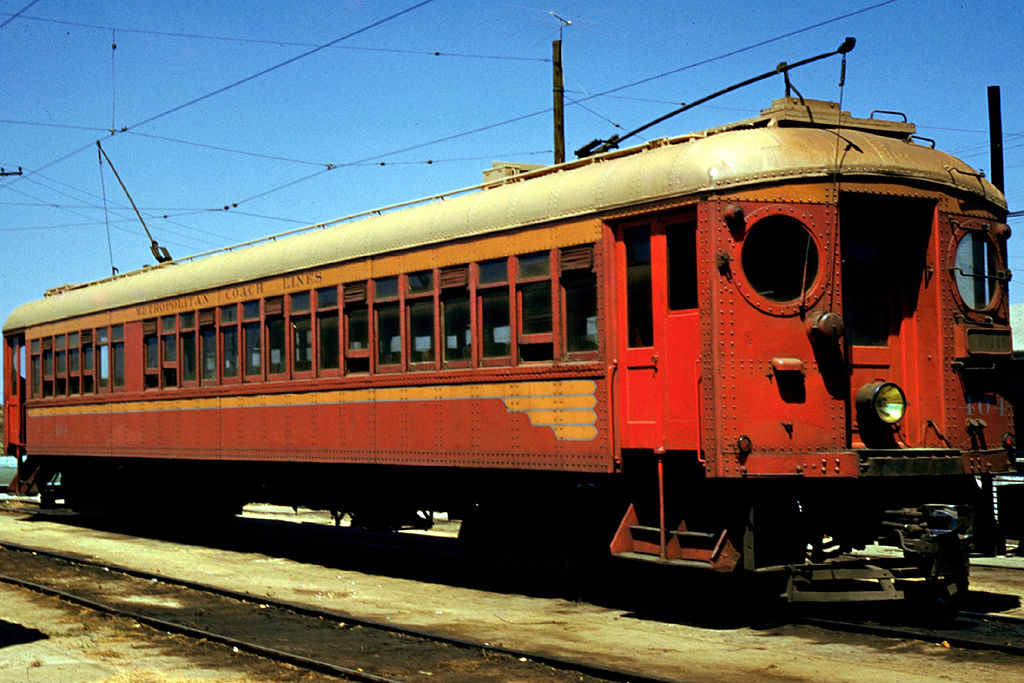
A veteran Pacific Electric “Big Red Car” already lettered for successor Metropolitan Coach Lines in the 1950s.
Photo by Voogd075 via Wikimedia Commons.

Winchester Lever Action Development: Model 1873

Filed under: History, USA, Weapons — Tags: , , — Nicholas @ 02:00

Forgotten Weapons
Published 9 Jun 2017

With the Model of 1873, Winchester was able to address the major remaining weakness of the Henry and 1866 rifles — the cartridge. The 1873 was introduced in tandem with the .44 Winchester Center Fire cartridge (known more commonly today as the .44-40). This cartridge kept the 200 grain bullet from the .44 Henry Rimfire round, but used a brass case (as opposed to copper) and was able to increase the powder charge from 28 grains to 40, for a substantial increase in velocity.

In addition, the Model 1873 used a lighter steel frame and introduced a sliding dust cover on the top of the action to help keep out dirt and debris. The centerfire nature of the cartridge made it possible to handload ammunition when a commercial source was not available (Winchester sold the reloading tools). The 1873 was available with a wide variety of options, including barrel and magazine lengths, buttstock and grips, sights, and fancy options like engraving. It would prove to be a massively popular weapon both in the United States and abroad, cementing Winchester’s position as the premier manufacturer of American repeating rifles.

Cool Forgotten Weapons merchandise! http://shop.bbtv.com/collections/forg…

http://www.patreon.com/ForgottenWeapons

If you enjoy Forgotten Weapons, check out its sister channel, InRangeTV! http://www.youtube.com/InRangeTVShow

October 7, 2020

The Great Swamp Fight: The Bloodiest Day of King Philip’s War

Filed under: Britain, History, Military, USA — Tags: , , , , — Nicholas @ 04:00

Atun-Shei Films
Published 6 Oct 2020

In December 1675, in the midst of King Philip’s War, an army of Puritan colonists made a preemptive strike against the neutral Narragansett tribe. Their desperate battle in the snowy wilderness of Rhode Island became a touchstone in the cultural lore of Anglo New England, while the subsequent massacre would go down as the darkest, most tragic event in Narragansett history.

Support Atun-Shei Films on Patreon ► https://www.patreon.com/atunsheifilms

Leave a Tip via Paypal ► https://www.paypal.me/atunsheifilms (All donations made here will go toward the production of The Sudbury Devil, our historical feature film)

Buy Merch ► teespring.com/stores/atun-shei-films

#KingPhilipsWar #NewEngland #AmericanHistory

Original Music by Dillon DeRosa ► http://dillonderosa.com/
Reddit ► https://www.reddit.com/r/atunsheifilms
Twitter ► https://twitter.com/atun_shei

~REFERENCES~

[1] Eric Schultz and Michael Tougias. King Philip’s War: The History and Legacy of America’s Forgotten Conflict (1999). The Countryman Press, Page 269

[2] Douglas Leach. Flintlock and Tomahawk: New England in King Philip’s War (1958). Parnassus Imprints, Page 58-62

[3] Leach, Page 112-117

[4] Schultz & Tougias, Page 246-247

[5] Schultz & Tougias, Page 247-255

[6] Leach, Page 127-129

[7] Schultz & Tougias, Page 259

[8] Leach, Page 129

[9] Leach, Page 148-149

[10] Joseph Dudley. Second Letter of Joseph Dudley (2001). Bigelow Society http://bigelowsociety.com/rod/battles…

[11] Schultz & Tougias, Page 260-261

[12] Leach, Page 130-131

[13] Benjamin Church. Entertaining Passages Relating to King Philip’s War, Tercentenary Edition (1975). Pequot Press, Page 95-102

[14] Schultz & Tougias, Page 264-265

[15] Leach, Page 131

[16] Church, Page 101

[17] “History – Perseverance.” Narragansett Indian Nation http://narragansettindiannation.org/h…

Ten Minute History – The French Revolution and Napoleon

Filed under: Britain, Europe, France, Germany, History, Middle East, Military, Russia, USA — Tags: , , , , , — Nicholas @ 02:00

History Matters
Published 12 Sep 2016

Twitter: https://twitter.com/Tenminhistory
Patreon: https://www.patreon.com/user?u=4973164

This episode of Ten Minute History (like a documentary, only shorter) covers the French Revolution and the Napoleonic Wars from the beginning of King Louis XVI’s reign all the way to the death of Napoleon Bonaparte in 1821. The first half covers the life and death of Louis XVI during the events of the revolution, including the rise and fall of Robespierre and the Reign of Terror. The second half covers the rise of Napoleon, the Napoleonic Wars and the eventual allied victory over France.

Ten Minute History is a series of short, ten minute animated narrative documentaries that are designed as revision refreshers or simple introductions to a topic. Please note that these are not meant to be comprehensive and there’s a lot of stuff I couldn’t fit into the episodes that I would have liked to. Thank you for watching, though, it’s always appreciated.

QotD: The gullible generation

Filed under: Government, History, Liberty, Quotations, USA, WW2 — Tags: , , , , — Nicholas @ 01:00

World War II, which I have described (in The Probability Broach) as a struggle between competing brands of fascism, was much the same thing. For the beleaguered people of Europe, it meant being forced to choose between Adolf Hitler and Josef Stalin. Would you rather be shot or gassed?

For Americans, it meant looking for protection by a political regime so grossly and criminally corrupt that future historians will shake their heads, wondering how an entire people could be such suckers. “The Greatest Generation”, that miserable collectivist mouthpiece Tom Brokaw has called them. Looking back over what my father told me of his life, how his family suffered in the government-caused Great Depression, how he and his comrades risked unspeakable danger in the war, and how he became a prisoner in Germany — all to aggrandize the virtual godhood of Franklin Delano Roosevelt — I call them “The Gullible Generation”.

On the other hand, people loved the Roosevelt Administration so much that they passed a Constitutional amendment to make sure that no sonofabitch could ever be elected to more than two Presidential terms again.

World War II gave government complete, dictatorial control of American society, control of industry, control of communications, control of the economy, control that Roosevelt had desperately lusted after before the war, but failed to achieve. If anyone objected, or insisted on his rights under the Constitution, all the other side had to say was, “Don’t you know there’s a war on?”

The government enjoyed that level of control. Once the war was won, and people looked forward to a period of peace, the government plunged us into the Korean War, Vietnam, and an increasing number of undeclared and stupid conflicts in order to retain its power. “Don’t you know there’s a war on?” never worked quite as well as it had to shut dissenters up, but it’s clear that this scam will go on and on and on until something drastic is done to stop it.

L. Neil Smith, “The Deep State”, Libertarian Enterprise, 2019-04-14.

October 6, 2020

“The Caucasus is a bad neighborhood”

Filed under: History, Middle East, Military, Religion, Russia — Tags: , , , , — Nicholas @ 03:00

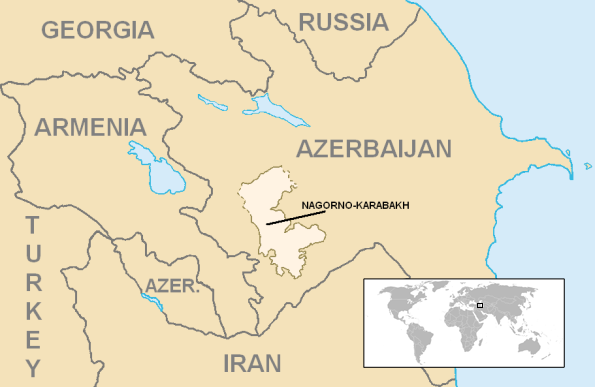
Fighting broke out between Azerbaijan and Armenia last week over the status of the Nagorno-Karabakh region, a quasi-independent Armenian-majority territory still technically part of Azerbaijan (Nagorno-Karabakh’s declaration was not followed by formal recognition by other states). Mark Movsesian provides some historical background to the conflict in First Things:

Thirty years ago, in response to discriminatory treatment and outright pogroms against Armenians, the region declared independence. Armenia (population 3 million) supported Karabakh — though it has never formally recognized its independence — and a bloody war followed, in which 30,000 people died and hundreds of thousands on both sides became refugees. Against all odds, Armenia and Karabakh prevailed and established a buffer zone comprising perhaps 20 percent of Azeri territory.

An unstable ceasefire has held since 1994. But last week, Azerbaijan launched a military offensive against Karabakh and Armenia itself. This is more serious than past Azeri efforts to break the stalemate. Flush with petrodollars, Azerbaijan has purchased a large stockpile of heavy weapons, which it now employs against Armenia. Moreover, Turkey (population 80 million), which borders Armenia on the other side, is supporting Azerbaijan. Azeris are a Turkic people, though they are Shia, not Sunni, Muslims, and the Erdogan government sees the conflict as a way to pursue its goal of pan-Turanism. Turkey has supplied Azerbaijan with military advisers and equipment, including drones and fighter jets and thousands of Islamist soldiers from Syria, who fight for Azerbaijan on the front lines.

[…]

One needs to go back at least a century, to the collapse of the Ottoman and Czarist Empires. The two empires had long contested the border between them, which ran to the southwest of the Caucasus. Armenians, an ancient Christian people who lived on both sides of the border, found themselves in the crosshairs. During World War I, fearful that Armenians on the border would rise up and side with Russia — some Armenians did fight with the Russians, but many others fought with the Ottomans, and the Armenian threat was always exaggerated — the Ottoman government undertook an ethnic cleansing campaign, killing millions of Armenians and other Christians in the Armenian Genocide.

The Genocide eliminated Turkey’s once sizable Christian population. It likely would have eliminated the Armenian population on the other side of the border, too, except that a hastily-organized Armenian militia stopped a Turkish army in 1918 at the Battle of Sardarabad, which took place just outside the city of Yerevan, today Armenia’s capital. Sardarabad is unknown in the West, but the image of a small group of Christian Armenians fighting, alone, to stop a Muslim Turkish army bent on their annihilation is a powerful part of Armenian consciousness today.

When the war ended, the Soviet Union quickly settled the border dispute with Turkey, giving up some historic Armenian lands around the city of Kars, and took over the Caucasus and divided it among the region’s ethnic groups. The Soviets initially promised to place Karabakh, whose Armenian identity dated back many centuries and whose population was more than 90 percent Armenian, in the new Soviet Republic of Armenia. But Stalin, as commissar for nationalities, decided to place the region in Azerbaijan instead, as part of a divide-and-conquer strategy. Armenians never accepted the decision and, when the Soviet Union collapsed and the nations of the Caucasus gained independence, the conflict over the region resumed.

⚜ | The Great Tank Destruction Myth ft. The Chieftain

Filed under: Britain, Germany, History, Military, Russia, USA, WW2 — Tags: , , , , — Nicholas @ 02:00

Military Aviation History
Published 24 May 2018

Planes kill tanks in the thousands, Sir! Why, do they really? Lets find out.

You can support my Channel with Patreon: https://www.patreon.com/Bismarck

Get a tanker’s perspective from ‘The Chieftain’: https://www.youtube.com/watch?v=AirRX…

⚜ Official Merchanidizing ⚜
[Teepublic] Click here – https://goo.gl/e2PMXu

⚜ Find Me On Social Media ⚜
– Twitch: http://www.twitch.tv/bis18marck70
– Twitter: https://twitter.com/Bis18marck70

⚜ Sources ⚜
Ian Gooderson, Air Power at the Battlefield
Amazon US (Affiliate): https://amzn.to/2GLsRkR
Amazon UK (Affiliate): https://amzn.to/2IJc08g

Tank Encyclopedia.org,

Zeller, “Estimates concerning the effectiveness of some contemporary American fighters in
defeating a defended and undefended IS-III tank”,

⚜ Music ⚜
Music and Sfx from Epidemic Sound

⚜ DISCLAIMER ⚜
Amazon Associates Program (US): “Bismarck is a participant in the Amazon Services LLC Associates Program, an affiliate advertising program designed to provide a means for sites to earn advertising fees by advertising and linking to amazon.com.”

Amazon Associates Program (UK): “Bismarck is a participant in the Amazon EU Associates Program, an affiliate advertising program designed to provide a means for sites to earn advertising fees by advertising and linking to amazon.co.uk.”

#CAS #GroundAttack #Typhoon

QotD: Herbert Hoover and the Belgian relief program

Filed under: Britain, Europe, Food, Germany, History, Quotations, WW1 — Tags: , , , , , — Nicholas @ 01:00

Just as Hoover is preparing to rest on his laurels, he receives a cry for help. Germany has occupied and blockaded Belgium. The blockade prevents this tiny, heavily urban country from importing food, and the Belgians are starving. Germany needs its own food for its own armies, and is refusing to help. The Belgians order a thousand tons of grain from Britain, but when their representative comes to pick it up, Britain refuses to let them transport it, nervous at sending food into enemy-occupied territory. During tense negotiations, someone suggests using neutral power America as a go-between. But America is 5,000 miles away and busy with its own problems. So the US Ambassador to Britain asks his new best friend Herbert Hoover if he has any ideas.

Hoover invites Emile Francqui, a Belgian mining engineer he knows, to Britain. Together, they plan a Committee For The Relief of Belgium, intended not just to help transport the thousand tons of grain at issue, but to develop a long-term solution to the impending Belgian famine. Nothing like this has ever been tried before. Belgium has seven million people and almost no food. No government is offering to help, and they don’t have enough money to feed seven million people even for one day, let alone indefinitely. Hoover springs into action …

… by crushing all competing attempts to provide food for Belgium. He attacks the Rockefeller Foundation, which is trying to help, with a blitz of press coverage accusing it of various forms of insensitivity and interference, until it finally backs off. Then he gets to work on the government:

    The letter bore several Hoover watermarks, beginning with its heavy load of facts and figures organized in point form. It noted that myriad relief committees were springing up both inside and outside of Belgium, and urged consolidation. “It is impossible to handle the situation except with the strongest centralization and effective monopoly, and therefore the two organizations [Hoover outside Belgium and Francqui inside it] will refuse to recognize any element except themselves alone.” The letter also contained Hoover’s usual autocratic and slightly paranoid demands for “absolute command” of his part of the enterprise.

Control attained, Hoover springs into action actually feeding Belgium. He launches one of the largest public relations campaigns the world has ever seen, sending letters to newspapers around the world asking for donations. He “urged reporters to investigate the famine conditions in Belgium and play up the ‘detailed personal horror stuff’. He personally arranged for a motion picture crew to capture footage of food lines in Brussels, and he hired famous authors, including Thomas Hardy and George Bernard Shaw, to plead for public support of the rescue effort.” He constantly telegrams his exasperated wife and children, now safely back in Palo Alto, demanding they raise more and more money from the West Coast elite.

He browbeats shipping conglomerates until they agree to ship his food for free, then browbeats railroads until they agree to carry it. By telegraph and letter he coordinates banks, railroads, docks, ships, and relief workers on both sides of the Atlantic. But that’s just the prelude. His real problem is the governments. Britain doesn’t want food shipped to Belgium, because right now the starving Belgians are Germany’s problem, and they don’t want to solve an enemy’s problem for them. But Germany also doesn’t want food shipped to Belgium, because the Belgians are resisting the occupation, and they figure starvation will make them more compliant. Shuttling back and forth across the North Sea, Hoover tries to get them to switch theories: Germany needs to think starving Belgians are their problem which it would be helpful to solve, and Britain needs to think starvation would make Belgians more compliant with the German occupation. In the end, both countries allow the shipments.

He goes on a fact-finding mission to Belgium, and managed to somehow offend everyone in the country that he is, at that very moment, saving from mass starvation […] By 1915, Hoover is, indeed, feeding millions of Belgians, indefinitely, using only private funding. He is also almost broke. Millions of Brits and Americans have given him contributions, from tycoons donating fortunes to ordinary people donating their wages, but it’s not enough. His expenses pass $5 million a month, which would be about $100 million today; all these bills are starting to catch up to him. In an act of supreme sacrifice, Hoover pledges his entire personal fortune as collateral for the Committee’s loans, then takes out more money. The grain shipments continue to flow, but his credit is at its end.

He continues beating on the doors of every government official he can find – British, German, American – demanding help. They all say their budgets are already occupied with the war effort. He begs them, lectures them, tells them that millions of people are doing to die. He goes all the way to the top, finagling an opportunity to meet with British Prime Minister David Lloyd George. Lloyd George later calls Hoover’s presentation “the clearest he had [ever] heard on any subject”, but he can offer only moral support.

What finally works is going to Germany and meeting with their top military brass. The brass are unimpressed; they still think that Belgium starving is as likely to help them as hinder. But the contact spooks top British officials, who agree to meet with Hoover again. Hoover feeds them carefully crafted lies, saying that the German brass have told him that British aid to Belgium would be a disaster to the Central Powers and so they, the Germans, are going to fund everything Hoover wants and more. “Oh no they don’t!” say the British, who promise to give Hoover even more funding than his imaginary German partners. The Committee for the Relief Of Belgium is finally back in the black. And what a black it is:

    The scope and powers of the Committee For Relief of Belgium were mindboggling. Its shipping fleet flew its own flag. Its members carried special documents that served as CRB passports. Hoover himself was granted a form of diplomatic immunity by all belligerents, with the British permitting him to cross the Channel at will and the Germans providing him a document saying “this man is not to be stopped anywhere under any circumstances”. Hoover had privileged access to generals, diplomats, and ministers. He enjoyed personal contacts with the heads of warring governments. He negotiated treaties with the belligerents, advised them on policy, and delivered private messages among them. Great Britain, France, and Belgium would soon be turning over to him $150 million a year, enough to run a small country, and taking nothing for it beyond his receipt. As one British official observed, Hoover was running “a piratical state organized for benevolence.”

Scott Alexander, “Book Review: Hoover”, Slate Star Codex, 2020-03-17.

October 5, 2020

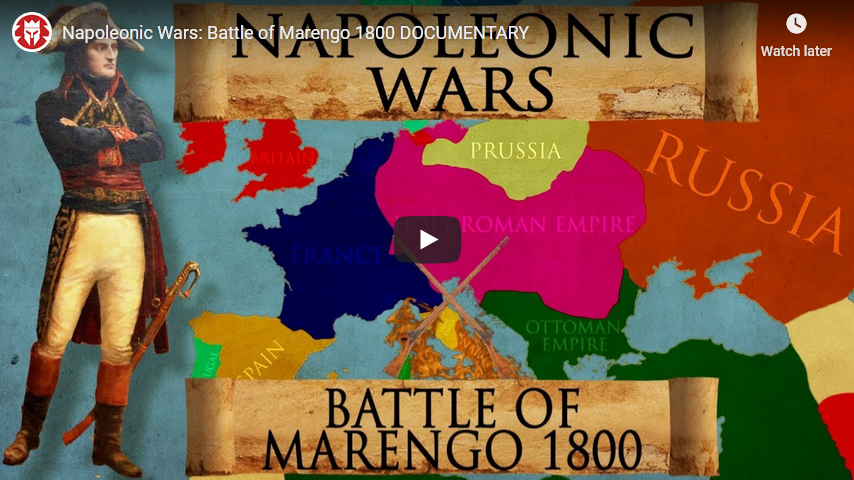
Napoleonic Wars: Battle of Marengo, 1800

Filed under: Europe, France, History, Italy, Military — Tags: , , , — Nicholas @ 04:00

Kings and Generals
Published 1 Oct 2017

Napoleon Bonaparte is one of the most talented military leaders in the history, so every battle he fought is fascinating, as well as his complete knowledge of tactical and strategic aspects of the war. He was part of the French Revolution and ended it, he was the biggest conqueror of Europe, but also brought its unity closer. The battle of Marengo of 1800, which took place during the War of the Second Coalition between Napoleon and Austrian troops under Baron Michael von Melas is interesting, as French leader committed a big mistake, but was able to score a big victory through sheer will and tactical acumen.

Support us on Patreon: http://www.patreon.com/KingsandGenerals or Paypal: http://paypal.me/kingsandgenerals

We are thankful to our patreons, who made this video possible: Koopinator, Ibrahim Rahman, Daisho, Łukasz Maliszewski, Nicolas Quinones, William Fluit and Juan Camilo Rodriguez

This video was narrated by good friend Officially Devin. Check out his channel for some kick-ass Let’s Plays. https://www.youtube.com/user/Official…

✔ Twitch ► https://www.twitch.tv/nurrrik_phoenix
✔ Twitter ► https://twitter.com/KingsGenerals
✔ Instagram ► https://www.instagram.com/nurrrrrik
✔ Steam ► http://steamcommunity.com/id/nurrrik

Primary sources used:
Chandler, David (1966). Campaigns of Napoleon. Scribner.
Hollins, David (2000). The Battle of Marengo 1800. Osprey Publishing
Тарле Е. В. Наполеон // Собрание сочинений: в 12 томах. — М.: Издательство АН СССР, 1959.

Inspired by: BazBattles, Invicta (THFE), Epic History TV and Historia Civilis, Time Commanders

Machinimas made on Napoleon: Total War

Production Music courtesy of Epidemic Sound: http://www.epidemicsound.com, Napoleon: Total War

Songs used:
Richard Beddow – “Napoleon Bonaparte” – Total War Napoleon Soundtrack
Peter Sandberg – “Subtle Substitutes 3”
Johannes Bornlof – “Solemn”
Magnus Ringblom – “Marching In”
Johannes Bornlof – “Exile Before Dishonor”
Rannar Sillard – “Emperors of Tomorrow 13”
Rannard Sillard – “Deathmatch 3”
Johannes Bornlof – “Barbarians”

« Newer PostsOlder Posts »

Powered by WordPress