Quotulatiousness

September 6, 2020

Tank Chats #78 Cruiser Mark I A9 | The Tank Museum

Filed under: Britain, History, Military, Weapons, WW2 — Tags: , , , , — Nicholas @ 02:00

The Tank Museum
Published 21 Jun 2019

The Tank Cruiser Mark I A9 is an interwar British tank. Tank Historian David Fletcher talks through the very first cruiser tank to go into service.

Support the work of The Tank Museum on Patreon: ► https://www.patreon.com/tankmuseum

Visit The Tank Museum SHOP: ► https://tankmuseumshop.org/

Twitter: ► https://twitter.com/TankMuseum
Instagram: ► https://www.instagram.com/tankmuseum/
Tiger Tank Blog: ► http://blog.tiger-tank.com/
Tank 100 First World War Centenary Blog: ► http://tank100.com/ #tankmuseum #tanks #tankchats

September 5, 2020

History Summarized: The Viking Age

Overly Sarcastic Productions
Published 4 Sep 2020

The Vikings are enjoying a new wave of enthusiasm in popular culture, but these seafaring Norsemen are still quite clearly a misunderstood force in medieval European history. So let’s take a wide look at the European world during The Viking Age!

Check out Yellow’s livestreams over at https://Twitch.tv/LudoHistory

SOURCES & Further Reading: The Vikings by Walaker Nordeide and Edwards, Vikings: A Very Short Introduction by Richards, Age of the Vikings and The Conversion of Scandinavia by Winroth, The Vikings By Harl via The Great Courses, The Viking World by Graham-Campbell, The Viking Way by Price.

This video was edited by Sophia Ricciardi AKA “Indigo”. https://www.sophiakricci.com/

Our content is intended for teenage audiences and up.

DISCORD: https://discord.gg/kguuvvq

PATREON: https://www.Patreon.com/OSP

MERCH LINKS: https://www.redbubble.com/people/OSPY…

OUR WEBSITE: https://www.OverlySarcasticProductions.com
Find us on Twitter https://www.Twitter.com/OSPYouTube
Find us on Reddit https://www.Reddit.com/r/OSP/

From the comments:

Ludohistory
23 hours ago (edited)
Thanks so much for having me on and letting me help out! It was a lot of fun (even if I talked a little too fast sometimes)! To clarify a piece that I know I did cover too briefly — missionary trips to Scandinavia occurred in Denmark around 823, on the orders of Louis the Pious, and in Sweden in 829, when Ansgar, a Frankish monk, traveled to the town of Birka, where he found a very small Christian community, probably mostly enslaved or formerly enslaved people, and converted a couple of Norse people, including the town prefect. (The graveyard for that town, incidentally, is where the 10th century “female warrior” that made waves a few years ago was buried).

There’s a lot we didn’t get a chance to talk about about the diaspora and its ending, so if there’s anything you all are curious on or find unclear, let me know here or on twitter 🙂

Finally, if you liked this, all the VODs for my personal streams (where I try to ramble about history in games) can be found by clicking on my name, and tomorrow I’ll be streaming CKIII on twitch (link in the description)!

Beginning the transition from personal rule to the modern bureaucratic state

Anton Howes discusses some of the issues late Medieval rulers had which in some ways began the ascendency of our modern nation state with omnipresent bureaucratic oversight of everyone and everything:

… the bureaucratic state of today, with its officials involving themselves with every aspect of modern life, is a relatively recent invention. In a world without bureaucracy, when state capacity was relatively lacking, it’s difficult to see what other options monarchs would have had. Suppose yourself transported to the throne of England in 1500, and crowned monarch. Once you bored of the novelty and luxuries of being head of state, you might become concerned about the lot of the common man and woman. Yet even if you wanted to create a healthcare system, or make education free and universal to all children, or even create a police force (London didn’t get one until 1829, and the rest of the country not til much later), there is absolutely no way you could succeed.

King James I (of England) and VI (of Scotland)
Portrait by Daniel Myrtens, 1621 from the National Portrait Gallery via Wikimedia Commons.

For a start, you would struggle to maintain your hold on power. Fund schools you say? Somebody will have to pay. The nobles? Well, try to tax them — in many European states they were exempt from taxation — and you might quickly lose both your throne and your head. And supposing you do manage to tax them, after miraculously stamping out an insurrection without their support, how would you even begin to go about collecting it? There was simply no central government agency capable of raising it. Working out how much people should pay, chasing up non-payers, and even the physical act of collection, not to mention protecting that treasure once collected, all takes substantial manpower. Not to mention the fact that the collecting agents will likely siphon most of it off to line their own pockets.

[…]

It was not until 1689, when there was a coup, that an incoming ruler allowed the English parliament to sit whenever it pleased. Before that, it was convened only at the whim of the ruler, and dispersed even at the slightest provocation. In 1621, for example, when James I was planning to marry his heir to a Spanish princess, Parliament sent him a petition asserting their right to debate the matter. Upon hearing of it, he called for the official record of parliamentary proceedings, personally ripped out the page with the offending vote, and promptly dissolved the Parliament. The downside, of course, was that James could not then acquire any parliamentary subsidies.

Ruling was thus an intensely personal affair, of making deals and finding ways to circumvent deals you had inherited. Increasing your capabilities as a ruler – state capacity – was thus no easy task, as the typical ruler was stuck in an essentially medieval equilibrium. Imposing a policy costs money, but raising money involves imposing policy. Breaking out of this chicken-and-egg problem took centuries of canny leadership. The rulers who achieved it most would today seem hopelessly corrupt.

To gain extra cash without interference from Parliament, successive monarchs first asserted and then abused their ancient prerogative rights to grant monopolies over trades and industries. They eventually granted them to whomever was willing to pay, establishing monopolies over industries like gambling cards or alehouses under the guise of regulating unsavoury activities. They also sold off knighthoods and titles, and in 1670 Charles II even made a secret deal with the French that he would convert to Catholicism and attack the Protestant Dutch, all in exchange for cash. Anything to not have to call a potentially pesky Parliament. At times, the most effective rulers even resembled mob bosses. Take Elizabeth I’s anger when a cloth-laden merchant fleet bound for an Antwerp fair in 1559 was allowed to depart. Her order to stop them had not arrived in time, thus preventing her from extracting “loans” from the merchants while she still had their goods within her power.

Chinese 7.62mm Sten Gun

Filed under: Cancon, China, History, Military, Weapons, WW2 — Tags: , , , , — Nicholas @ 02:00

Forgotten Weapons
Published 13 May 2020

http://www.patreon.com/ForgottenWeapons

https://www.floatplane.com/channel/Fo…

Cool Forgotten Weapons merch! http://shop.bbtv.com/collections/forg…

During World War Two, Canada supplied some 73,000 Sten guns (made by the Long Branch arsenal) to Chinese Nationalist forces in an effort to help them fight the Japanese. These Stens were standard MkII pattern guns, chambered for the 9x19mm Parabellum cartridge. However, many of these were eventually converted to 7.62mm Tokarev ammunition, especially after the victory of the Communist forces over the Nationalists. The conversion involved a new barrel and new magazine and magazine well. The 7.62mm barrels were typically longer than the original ones, and the magazine of choice was that of the PPS-43. Some were done by installed a magazine adapter into the original magazine well, and some (like this one) were done by cutting off the original magazine well and replacing it with a new one. In addition, some Sten guns were made domestically in China, both in 9mm and 7.62mm. The 7.62mm Tokarev cartridge was popular both from Russian pistols and submachine guns and also from China’s long military use of the dimensionally-identical 7.63mm Mauser cartridge in C96 pistols.

Many thanks to the Royal Armouries for allowing me to film and disassemble this interesting submachine gun! The NFC collection there — perhaps the best military small arms collection in Western Europe — is available by appointment to researchers:

https://royalarmouries.org/research/n…

You can browse the various Armouries collections online here:

https://royalarmouries.org/collection/

Contact:
Forgotten Weapons
6281 N. Oracle #36270
Tucson, AZ 85740

September 4, 2020

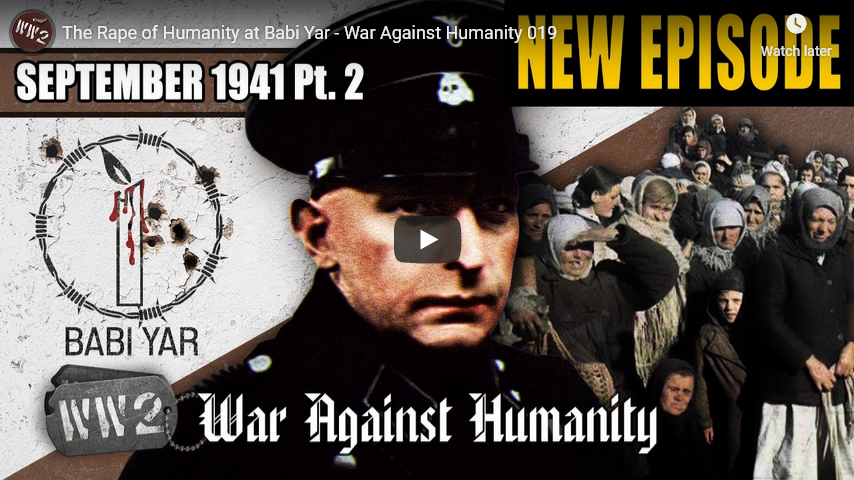
The ϟϟ and Wehrmacht Murder Inc. – War Against Humanity 017 – August 1941, Part 2

Filed under: Europe, Germany, History, Military, Russia, WW2 — Tags: , , , , — Nicholas @ 06:00

World War Two
Published 3 Sep 2020

Fegelein’s and Himmler’s actions to ‘comb’ the Pripet Marshes for Jews continues. The largest mass-murder yet is committed in Kamianets-Podilskyi, while new methods to commit genocide on an industrial scale are being devised.

Join us on Patreon: https://www.patreon.com/TimeGhostHistory
Or join The TimeGhost Army directly at: https://timeghost.tv

Follow WW2 day by day on Instagram @ww2_day_by_day – https://www.instagram.com/ww2_day_by_day
Between 2 Wars: https://www.youtube.com/playlist?list…
Source list: http://bit.ly/WW2sources

Hosted by: Spartacus Olsson
Written by: Spartacus Olsson and Joram Appel
Director: Astrid Deinhard
Producers: Astrid Deinhard and Spartacus Olsson
Executive Producers: Astrid Deinhard, Indy Neidell, Spartacus Olsson, Bodo Rittenauer
Creative Producer: Joram Appel
Post-Production Director: Wieke Kapteijns
Research by: Joram Appel
Edited by: Miki Cackowski
Sound design: Marek Kamiński
Map animations: Eastory (https://www.youtube.com/c/eastory)

Colorizations by:
Carlos Ortega Pereira, BlauColorizations – https://www.instagram.com/blaucoloriz…
Jaris Almazani (Artistic Man) – https://instagram.com/artistic.man?ig…
Julius Jääskeläinen – https://www.facebook.com/JJcolorization/
Norman Stewart – https://oldtimesincolor.blogspot.com/
Spartacus Olsson
Mikolaj Uchman
Klimbim – https://www.flickr.com/photos/2215569…

Sources:
Bundesarchiv
Yad Vashem 4220/2, 9292/17, 1570, 4248/20, 953, 4788/72, 75EO4, 3150/122, 48AO4, 4220/3, 10470/23, 4572/3, 4613/1055, 7283/146, 5705/48, 4216/18, 94DO1, 90FO3, 4613/625
National Parliament Library of Georgia
Bildersammlung des Bistumsarchivs Münster, des Erbnehmers der Urheberrechte
USHMM
Corpses of Auschwitz prisoners in block 11 (Auschwitz I) February 1945, USHMM, courtesy of Instytut Pamięci Narodowej
Lithuanian militia force Jewish women to undress before execution in the Pajuoste Forest 1941-1942, USHMM, courtesy of Saulius Berzinis
www.auschwitz.org
Bletchley Park Trust
Narodowe Archiwum Cyfrowe
From the Noun Project: Skull by Muhamad Ulum from the Noun Project

Soundtracks from the Epidemic Sound:
Johan Hynynen – “Dark Beginning”
Andreas Jamsheree – “Guilty Shadows 4”
Farell Wooten – “Blunt Object”
Fabien Tell – “Last Point of Safe Return”
Skrya – “First Responders”
Wendel Scherer – “Growing Doubt”
Jon Bjork – “For the Many”
Gunnar Johnsen – “Not Safe Yet”
Cobby Costa – “Flight Path”

Archive by Screenocean/Reuters https://www.screenocean.com.

A TimeGhost chronological documentary produced by OnLion Entertainment GmbH.

Shinzō Abe

Filed under: Government, History, Japan, Politics — Tags: — Nicholas @ 05:00

Kapil Komireddi on the achievements of Shinzō Abe, “the man who saved Japan”, who served four non-consecutive terms as Prime Minister between 2006 and 2020:

Shinzō Abe, Prime Minister of Japan, 2006-7 and 2012-20.
Official portrait from the Government of Japan under Government of Japan Standard Terms of Use (Ver. 2.0)

To appreciate the achievement of Shinzo Abe, who on Friday announced his decision to resign as Japan’s prime minister because of faltering health, consider the state of the country he inherited. Between 2007, the year Abe vacated the prime minister’s office after serving exactly for a year, and 2012 — when Abe staged a spectacular comeback — Japan had seen off five prime ministers in rapid succession. In fact, with the exception of Junichiro Koizumi, no Japanese prime minister had completed the full four-year term since 1987. A debilitating fatalism had seized Japan: a nation that had risen from the ashes of World War II to become the richest economy on earth after the United States was becoming reconciled to the prospect of irretrievable decline.

Such a posture may have struck some as virtuous. To Abe, it was sacrilegious. The scion of a storied political dynasty, he wanted Japan to become a “nation which can withstand the raging waves for the next 50 to 100 years to come”. Abe nursed a lifelong grievance against what he described as the “terrible” Constitution drafted by the Allied forces after Japan’s decimation in 1945. His greatest political aspiration was to revoke the clause that shackled Tokyo to pacifism as a form of punishment for the sins of imperial Japan. In a land where singing the national anthem with enthusiasm can be seen as a symptom of hawkishness, Abe approached voters with a pledge to “take back Japan”. As a campaigner, he was a populist before the word entered common usage. Once in office, however, he evolved into something altogether different.

The ideological passions that animated his politics were almost instantly subordinated to the higher cause of dispassionate service to Japan. As democracy after democracy fell to populists, Abe, the original populist, travelled in the opposite direction: a rare leader in the democratic world who did not allow partisanship to consume him. Abe did not disavow his conservatism: he aligned it to the challenges before him. The upshot? In the eight years since his return to power in 2012, he presided over the longest period of economic expansion in Japan’s post-war history and the lowest unemployment rate in at least a quarter century. He introduced free preschool and day care for children between the ages of 3 and 5 and created the conditions for the entry of a record number of women into the workforce.

Imparting stability to Japan was the preliminary act. As Tobias Harris reminds us in his important and outstanding new biography of Japan’s outgoing prime minister, The Iconoclast, Abe did not hesitate to dispute and dismantle the dogmas of his own side to pursue policies — such as the guest worker programme — he believed were imperative to securing Japan’s future. He deployed, Harris writes, “his power to defy his conservative allies and open Japan to the world”. At the same time, he strove to be conciliatory with all those who did not vote for him, regarded him with implacable suspicion, and marched against his “militarism” on the streets. This perhaps explains why, despite protests, criticism and scandal, he was able to lead his conservative Liberal Democratic Party to a series of comfortable victories at the ballot box and cement its position effectively as the default party of government in Japan.

“The Final Solution” – The Holocaust – Sabaton History 083 [Official]

Filed under: Europe, Germany, History, Media, Military, WW2 — Tags: , , , , — Nicholas @ 04:00

Sabaton History
Published 3 Sep 2020

Since Adolf Hitler’s rise to power, the Jews of Germany had suffered years of harsh anti-Jewish policies, harassment and public humiliation. The Nazis wanted the Jews to never feel safe or welcome again. With the Third Reich’s expansion and the start of the Second World War, more and more European Jews fell victim to persecution, ghettoisation and violence. It was hard to imagine that the crimes against them could get any worse. But by December 1941, the Nazis began preparing for a “Final Solution of the Jewish question”.

It aimed at nothing less than the extermination of all Jewish life in Europe.

Support Sabaton History on Patreon: https://www.patreon.com/sabatonhistory

Listen to “The Final Solution” on the album Coat Of Arms:
https://music.sabaton.net/CoatOfArms

Listen to Sabaton on Spotify: http://smarturl.it/SabatonSpotify
Official Sabaton Merchandise Shop: http://bit.ly/SabatonOfficialShop

Hosted by: Indy Neidell
Written by: Markus Linke and Indy Neidell
Directed by: Astrid Deinhard and Wieke Kapteijns
Produced by: Pär Sundström, Astrid Deinhard and Spartacus Olsson
Creative Producer: Maria Kyhle
Executive Producers: Pär Sundström, Joakim Brodén, Tomas Sunmo, Indy Neidell, Astrid Deinhard, and Spartacus Olsson
Community Manager: Maria Kyhle
Post-Production Director: Wieke Kapteijns
Editor: Iryna Dulka
Sound Editor: Marek Kaminski
Maps by: Eastory – https://www.youtube.com/c/eastory
Archive: Reuters/Screenocean – https://www.screenocean.com

Sources:
– Narodowe Archiwum Cyfrowe
– Bundesarchiv, CC-BY-SA 3.0: Bild_183-B04489, Bild_183-B04491, Bild_152-23-07A, Bild_101I-134-0782-24, Bild_183-E13871, Bild_101I-134-0769-33
– Yad Vashem: 139BO1, 1554_1, 1427_85, 1605_1722, 12CO9, 1552/34
– Imperial War Museum: HU 51692, HU 51689

All music by: Sabaton

An OnLion Entertainment GmbH and Raging Beaver Publishing AB co-Production.

© Raging Beaver Publishing AB, 2019 – all rights reserved.

How England used to vote

Filed under: Britain, History, Humour — Tags: , — Nicholas @ 02:00

Learnhistory3
Published 1 May 2011

Rowan Atkinson as Edmund BlackAdder in a sketch on the voting situation before 1832. Rotten boroughs and pocket boroughs etc

Script excerpt from BlackAdder Scripts:

At Mrs. Miggins’ home

E: Well, Mrs. Miggins, at last we can return to sanity. The hustings are
over, the bunting is down, the mad hysteria is at an end. After the
chaos of a general election, we can return to normal.

M: Oh, has there been a general election, then, Mr. BlackAdder?

E: Indeed there has, Mrs. Miggins.

M: Oh, well, I never heard about it.

E: Well of course you didn’t; you’re not eligible to vote.

M: Well, why not?

E: Because virtually no-one is: women, peasants, (looks at Baldrick)
chimpanzees (Baldrick looks behind himself, trying to see the animal),
lunatics, Lords…

B: That’s not true — Lord Nelson’s got a vote!

E: He’s got a boat, Baldrick. Marvelous thing, democracy. Look at
Manchester: population, 60,000; electoral roll, 3.

M: Well, I may have the brain the size of a sultana…

E: Correct…

M: …but it hardly seems fair to me.

E: Of course it’s not fair — and a damn good thing too. Give the like of
Baldrick the vote and we’ll be back to cavorting druids, death by
stoning, and dung for dinner.

B: Oh, I’m having dung for dinner tonight.

M: So, who are they electing when they have these elections?

E: Ah, the same old shower: fat tory landowners who get made MPs when
they reach a certain weight; raving revolutionaries who think that just
because they do a day’s work that somehow gives them the right to get
paid… Basically, it’s a right old mess. Toffs at the top, plebs at the
bottom, and me in the middle making a fat pile of cash out of both of them.

M: Oh, you’d better watch out, Mr. BlackAdder; things are bound to change.

E: Not while Pitt the Elder’s Prime Minister they aren’t. He’s about as
effective as a catflap in an elephant house. As long as his feet are warm
and he gets a nice cup of milky tea in the sun before his morning nap,
he doesn’t bother anyone until his potty needs emptying.

QotD: Muhammad Ali Jinnah

Filed under: History, India, Religion — Tags: , , , — Nicholas @ 01:00

Born into a Shia mercantile family, Jinnah left for England after high school, where he studied law and acquired a love for parliamentary procedure. Thoroughly and poshly anglicized (200 Savile Row suits were found in his closet after his death), he returned to India before the First World War, armed with a fearsome reputation as a barrister so brilliant judges tried to avoid him, and committed to Hindu-Muslim unity. His English was exquisite, but he spoke no Urdu. Completely secular, Jinnah was so indifferent to his religion — he drank and ate pork — that he planned Pakistan’s inauguration-day banquet as a luncheon, unaware it was Ramadan (they changed it to dinner).

Jinnah’s political intentions are hotly contested. According to New York Times Pakistan expert, Jane Perlez, many Pakistan researchers contend Jinnah had no interest in an Islam-dominated state, but “used the idea of Pakistan as a mere bargaining chip for Muslim majority rights within a loosely united post-colonial India.” With no autobiography or recollections from close friendships for our guidance, Jinnah remains a shadowy historical player, a political loner with an indeterminate goal beside Nehru, Gandhi and Viceroy Lord Mountbatten.

It is quite possible, for example, that Jinnah created the Muslim League and employed the rhetoric of Islam (slogan: “Islam in Danger”) and started wearing native clothes to harness religious fervour to political ambitions never fully articulated. But we can’t ever know, as a lifetime of chain smoking caught up with Jinnah, and he died before the first (bloody) year of Pakistan’s existence was out.

In Jinnah’s first speech to his newly minted country, though, we have this strong intentional clue: “You are free. You are free to go to your temples, you are free to go to your mosques or to any other place of worship in this state of Pakistan. You may belong to any religion or caste or creed — that has nothing to do with the business of the state.”

Barbara Kay, “A celebrated figure today could well be the condemned sinner of tomorrow”, National Post, 2018-06-05.

September 3, 2020

Fallen Flag — The Great Northern Railway

This month’s Classic Trains featured fallen flag is an American railway that definitely deserved to call itself “great”, James J. Hill’s Great Northern Railway. Hill was noteworthy as the only “Robber Baron” of that era who was scrupulous in avoiding government entanglements (including grants, loans, subsidies, and other forms of money-with-political-strings-attached), building his entire railway system using private funds and rational profit-oriented economic decision-making (the other transcontinental lines often over-built to claim higher subsidies or added money-losing branch lines to please powerful politicians). The result was that when economic hard times hit the railway business, his was the only transcontinental that never needed to declare bankruptcy.

In an earlier post, Dane Stuhlsatz summarized the GN’s engineering:

Hill’s line […] was methodically surveyed and built, on the shortest routes possible, with the least gradient possible, and using the best steel and other materials on the market at the time. Rather than political largess, Hill made his decisions based on profit and loss. But, for all the efficiency that Hill built into his line — he was able to transport across the country faster, cheaper, and with less maintenance costs than could the UP and CP — arguably the most important aspect for the viability of his business was the freedom to conduct business untethered by the strings that accompanied government subsidies.

Route map of the Great Northern Railway, circa 1920. Red lines are Great Northern trackage; dotted lines are other railroads.
Map by Elkman via Wikimedia Commons.

George Drury outlines the origins of the railway:

In 1857, the Minnesota & Pacific Railroad was chartered to build a line from Stillwater, Minnesota, on the St. Croix River, through St. Paul and St. Cloud to St. Vincent, in the northwest corner of the state. The company defaulted after completing a roadbed between St. Paul and St. Cloud, Minnesota, and its charter was taken over by the St. Paul & Pacific Railroad, which ran its first train between St. Paul and St. Anthony (now Minneapolis) in 1862.

For financial reasons the railroads were reorganized as the First Division of the St. Paul & Pacific. Both StP&P companies were soon in receivership, and Northern Pacific, with which the StP&P was allied, went bankrupt in the Panic of 1873.

Canadian-born “Robber Baron” James J. Hill (1838-1916) in 1914.

In 1878 James J. Hill and an associate, George Stephen, acquired the two St. Paul & Pacific companies and reorganized them as the St. Paul, Minneapolis & Manitoba Railway (“the Manitoba”). By 1885 the company had 1,470 miles of railroad and extended west to Devils Lake, North Dakota. In 1886 Hill organized the Montana Central Railway to build from Great Falls, Montana, through Helena to Butte, and in 1888 the line was opened, creating in conjunction with the StPM&M a railroad from St. Paul to Butte.

In 1881 Hill took over the 1856 charter of the Minneapolis & St. Cloud Railroad. He first used its franchises to build the Eastern Railway of Minnesota from Hinckley, Minnesota, to Superior, Wisconsin, and Duluth. Its charter was liberal enough that he chose it as the vehicle for his line to the Pacific. He renamed the road the Great Northern Railway; it then leased the Manitoba and assumed its operation.

[…]

Even before completion of the route from St. Paul, the Great Northern opened a line along the shore of Puget Sound between Seattle and Vancouver, British Columbia, in 1891. In the years that followed, Hill pushed a number of lines north across the international boundary into the mining area of southern British Columbia in a running battle with Canadian Pacific. In 1912 GN traded its line along the Fraser River east of Vancouver to Canadian Northern for trackage rights into Winnipeg.

Great Northern gradually withdrew from British Columbia after Hill’s death. In 1909 the Manitoba Great Northern Railway purchased most of the property of the Midland Railway of Manitoba (lines from the U.S. border to Portage la Prairie and to Morden), leaving the Midland, which was jointly controlled by GN and NP, with terminal properties in Winnipeg. The Manitoba Great Northern disposed of its rail lines in 1927. They were later abandoned.

Postcard photo of the Great Northern Railway’s “Empire Builder” streamliner between Everett and Seattle, Washington, circa 1963.
Great Northern Railway postcard via Wikimedia Commons.

The Great Northern and Northern Pacific lines agreed to a merger in 1901 (both lines were controlled by Hill) but the plan was vetoed by the Interstate Commerce Commission. A second attempt in the 1920s after Hill’s death was again turned down by the regulator unless the combined company divested ownership of the Chicago, Burlington & Quincy which was both railways’ connection from Minneapolis to Chicago. It was only on the final attempt in 1970 that the deal gained the government’s grudging approval and the Great Northern, Northern Pacific, and CB&Q merged to form the Burlington Northern.

Britain and France vs. The World | The Suez Crisis | Part 2

Filed under: Africa, Britain, France, History, Middle East, Military, USA — Tags: , , , , , — Nicholas @ 04:00

TimeGhost History
Published 2 Sep 2020

After much delay, Britain and France finally keep to their side of the bargain with Israel and begin their bombing campaign of Egypt. But the condemnation from America and the UN calls into question how long the invaders can keep this up.

Join us on Patreon: https://www.patreon.com/TimeGhostHistory

Hosted by: Indy Neidell
Written by: Francis van Berkel and Joram Appel
Director: Astrid Deinhard
Producers: Astrid Deinhard and Spartacus Olsson
Executive Producers: Astrid Deinhard, Indy Neidell, Spartacus Olsson, Bodo Rittenauer
Creative Producer: Joram Appel
Post-Production Director: Wieke Kapteijns
Research by: Francis van Berkel and Joram Appel
Image research by: Shaun Harrison & Karolina Dołęga
Edited by: Karolina Dołęga
Sound design by: Marek Kamiński

Colorizations by:
Mikołaj Uchman
Daniel Weiss
Norman Stewart – https://oldtimesincolor.blogspot.com/

Visual Sources:
Israeli Defense Forces
National Photo Collection of Israel
Universal Studios
Tony Clarke Collection – David Whitworth from Wikimedia Commons
Abubiju from Wikimedia Commons
Fortepan Donor
Government Press Office (Israel)
National Archives NARA
Icons from The Noun Project by: Gilberto, Komkrit Noenpoempisut, Alice Design, Smalllike

Music:
“As the Rivers Collapse” – Deskant
“Moving to Disturbia” – Experia
“March Of The Brave 10” – Rannar Sillard – Test
“Weapon of Choice” – Fabien Tell
“Disciples of Sun Tzu” – Christian Andersen
“London” – Howard Harper-Barnes
“Maze Heist” – Max Anson
“Descending Mount Everest” – Trailer Worx

Archive by Screenocean/Reuters https://www.screenocean.com.

A TimeGhost chronological documentary produced by OnLion Entertainment GmbH.

From the comments:

TimeGhost History
2 days ago (edited)
This episode is pretty much the same as the last, only turned up to 11. Israel continues making gains in Sinai, but they are now aided by British and French air forces that have finally arrived.

Meanwhile, Britain and France continue lying through their teeth about any collusion with Israel. The British Foreign Minister will lie to his own Parliament about military collaboration while French ships are supporting an Israeli offensive against the settlement of Rafah.

The economic costs of this also become very apparent in this episode. Nasser successfully closes the Canal, and with America in no mood to help, the whole of Europe faces oil shortages.

In short, the whole thing is a mess. Don’t worry though, Indy will guide you through it.

QotD: Racism

Filed under: History, Politics, Quotations, USA — Tags: , , , — Nicholas @ 01:00

Racism is stupid. Humans come in different shades for obvious biological reasons to do with the intensity of sunlight where their ancestors grew up. Apart from calculating intake of Vitamin D when living in cold climates, it shouldn’t matter. Yet people keep on making it matter — for all kinds of reasons; few if any of them good.

America’s race relations problems arise from its shameful history with slavery. Black Americans clearly feel a sense of solidarity based on that history. I can understand the magnificent language of the Declaration of Independence or the majestic ideas behind the US Constitution are tainted for black American students knowing, as they learn about them, that they didn’t apply to their ancestors. It must be hard for them to take the same pride in the foundation of their great nation as white classmates. I get that “Plymouth Rock landed on us” idea.

Many White Americans do feel a corresponding sense of shame but it’s daft to feel guilty for stuff people who share some random attribute with you did. Short people are not to blame for Napoleon and nor (fun though it is to tease them about him) are French people. No doubt we all do feel pride and shame about our ancestors’ achievements and sins, but it’s nuts to base law or policy on those irrational feelings or to allow them to taint relationships today.

Even if we were to go down the mad road of punishing people for the sins of the fathers, we’d have to find out what those “fathers” actually did, person by person. To do it skin tone by skin tone would itself be racist. It would involve, for example, some British people being heroes because their ancestors sailed with the Royal Navy squadron detailed to suppress the Slave Trade while others are villains because theirs crewed slave ships. There would be no way of knowing if you were hero or villain until you played that historical lottery.

As I told a Jewish American friend who teased me one Fourth of July about losing the American Revolutionary War, “That was a dispute between two sets of my ancestors — yours were in Germany at the time. Stay out of our family quarrels.” That’s a good joke but it would be dumb to base a social science on it. Yet America’s “grievance studies” types have done something remarkably similar in creating the wicked notion of “white privilege”.

Tom Paine, “Checking my privilege”, The Last Ditch, 2020-06-02.

September 2, 2020

Hitler’s Hangman and Himmler’s Protégé – Reinhard Heydrich – WW2 Biography Special

Filed under: Germany, History, Military, WW2 — Tags: , , , , , , — Nicholas @ 06:00

World War Two
Published 1 Sep 2020

After being taken in by Himmler as a sort of apprentice, Reinhard Heydrich rapidly climbed the Nazi political hierarchy. With the outbreak of World War Two, he expands his political power by ruthlessly carrying out political repression on the home front and genocidal racial policies of the Third Reich.

Join us on Patreon: https://www.patreon.com/TimeGhostHistory
Or join The TimeGhost Army directly at: https://timeghost.tv

Follow WW2 day by day on Instagram @ww2_day_by_day – https://www.instagram.com/ww2_day_by_day
Between 2 Wars: https://www.youtube.com/playlist?list…
Source list: http://bit.ly/WW2sources
Written by: Francis van Berkel
Hosted by: Spartacus Olsson
Director: Astrid Deinhard
Producers: Astrid Deinhard and Spartacus Olsson
Executive Producers: Astrid Deinhard, Indy Neidell, Spartacus Olsson, Bodo Rittenauer
Creative Producer: Joram Appel
Post-Production Director: Wieke Kapteijns
Research by: Wolfgang Seitz and Ian Sowden
Edited by: Karolina Dołęga
Sound design: Marek Kamiński

Colorizations by:
Jaris Almazani (Artistic Man), https://instagram.com/artistic.man?ig…
Spartacus Olsson
Carlos Ortega Pereira, BlauColorizations, https://www.instagram.com/blaucoloriz…

Visual Sources:
Bundesarchive
Yad Vashem: 153DO9, 1014/3/42, 4613/360, 48AO4, 2798/2, 1068/17, 3521/134, 3AO1, 1014 5 52, 5138/98, 3227 27, 1014/5/54, 112GO7, 75EO4, 07 1941, 4613_982, 1605/1431, 4613/1055
Riksarkivet: Fo30141711030060
Narodowe Archiwum Cyfrowe
National Archives NARA
Icon from The Noun Project: carlotta zampini
pellethepoet from filckr.jpg

Music:
“Last Point of Safe Return” – Fabien Tell
“March Of The Brave 10” – Rannar Sillard
“Not Safe Yet” – Gunnar Johnsen
“Moving to Disturbia” – Experia
“Easy Target” – Rannar Sillard
“Deflection” – Reynard Seidel
“Please Hear Me Out”- Philip Ayers
“Last Minute Reaction” – Phoenix Tail
“Never Forget” – Fabien Tell
“Other Sides of Glory” – Fabien Tell
“Split Decision” – Rannar Sillard

Archive by Screenocean/Reuters https://www.screenocean.com.

A TimeGhost chronological documentary produced by OnLion Entertainment GmbH.

Luger Model 1902 Carbine

Filed under: Germany, History, Weapons — Tags: , , — Nicholas @ 02:00

Forgotten Weapons
Published 2 Sep 2016

Failed to sell at auction.

With the advent of successful self-loading pistols, one of the additional markets that many companies tried to appeal to was the compact carbine. Self-loading rifles in proper rifle cartridges would not be developed as quickly as the pistols because their much greater chamber pressures represented a more difficult engineering problem. However by simply attaching a stock and long barrel to a pistol, many ambitious manufacturers hoped to sell a weapon as a sporting carbine. These were done by DWM with the Luger, as well as Mauser’s C96, Mannlicher 1894 pistol, and many others.

Model 1902 was the designation of the major batch of commercially made Luger carbines, although there were several small batches of prototypes prior. Only a couple thousand were made, and they ultimately took quite a long time to all sell — it turned out this type of firearm was simply not very popular for its cost. The same story was true with the other contemporary pistol-carbines — none would be very successful. DWM did make another group of carbines in the 1920s, although those were made from various leftover parts and are both not as nice as the original 1902 guns (which were mostly made in 1904 and 1905) and widely faked.

http://www.patreon.com/ForgottenWeapons

QotD: Prohibition

Filed under: History, Law, Liberty, Quotations, USA — Tags: , , — Nicholas @ 01:00

Prohibition only makes things worse, like when alcohol Prohibition turned us from a peaceful nation of wine and beer drinkers into a crazed culture going blind on bathtub gin while the distributors shot each other down with Tommy-guns in the streets.

Vin Suprynowicz, “On Reporters Who Ask No (Unapproved) Questions”, Libertarian Enterprise, 2018-06-03.

« Newer PostsOlder Posts »

Powered by WordPress