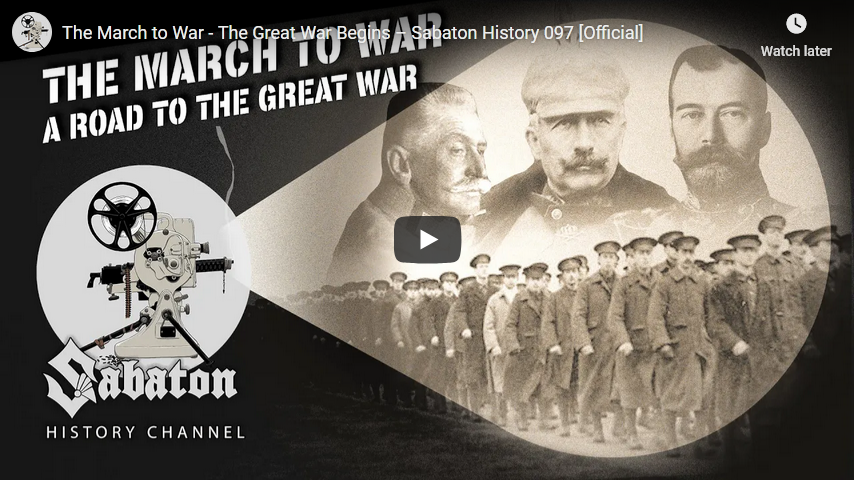
August 1914. Europe marched to war. Heavy boots resounded in unison over the pavement, while proud banners flew overhead the soldiers. Their leaders had promised them a short war. In a few weeks, maybe a couple of months, each man would return home as a hero. Cavalrymen in embroidered coats, white gloves, and plumed caps rode ahead, surging towards the front in search of promised glory. But the perceived enthusiasm, eagerly exploited by the propaganda, was not widely shared. Instead, it was the gloomy atmosphere, full of fear and doubt.
Hosted by: Indy Neidell
Written by: Markus Linke and Indy Neidell
Directed by: Astrid Deinhard and Wieke Kapteijns
Produced by: Pär Sundström, Astrid Deinhard and Spartacus Olsson
Creative Producer: Maria Kyhle
Executive Producers: Pär Sundström, Joakim Brodén, Tomas Sunmo, Indy Neidell, Astrid Deinhard, and Spartacus Olsson
Community Manager: Maria Kyhle
Post-Production Director: Wieke Kapteijns
Editor: Karolina Dołęga
Sound Editor: Marek Kaminski
Maps by: Eastory – https://www.youtube.com/c/eastory
Archive: Reuters/Screenocean – https://www.screenocean.com
Colorizations by:
Klimbim
Cassowary Colorizations
Sources:
Imperial War Museums: HU 68424, HU 68463, HU 68487, Q 81765, PST 2734, Q 81840B, Q 93521, Q 53472, Q70232, Q 115391
Narodowe Archiwum Cyfrowe
National Archives NARA
National Army Museum
Rijksmuseum
Bundesarchiv
Library of Congress
Picture of Three Emperors courtesy of Anna Moscowriuo
Pictures from French Manufacture of Weapons and Cycles courtesy of mediatheques.saint-etienne.fr
Picture from the Battle of Bulair courtesy of Dupnitsa Municipality, Historical Museum
Pictures of the French departure to War, courtesy of 66emeri from Wikimedia
Picture from the Battle of Mons courtesy of Champagnepapi22 from Wikimedia Commons
Map of Europe courtesy of Altenhof from Wikimedia Commons
All music by: Sabaton
An OnLion Entertainment GmbH and Raging Beaver Publishing AB co-Production.
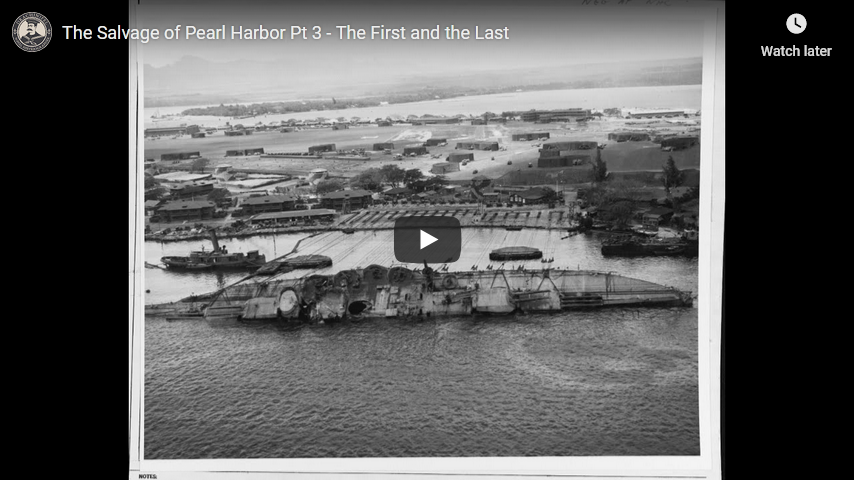
Today we look at the salvage efforts on the USS Shaw, first vessel salvaged from the remains of the attack on Pearl Harbor and the work on the last two vessels under the team’s care, the Utah and Oklahoma
Sources:
www.amazon.co.uk/gp/product/B00C0JIXJO https://www.history.navy.mil/our-coll…
www.amazon.co.uk/Pearl-Harbor-Fleet-Salvage-Appraisal/dp/0898755654
www.amazon.co.uk/Descent-into-Darkness-Harbour-Divers/dp/0891417451
Videos – US National Archives / US Department of Defense
Free naval photos and more – www.drachinifel.co.uk
Following up yesterday’s look at the history and mechanics of the Webley-Fosbery self-cocking revolvers [posted here], today we are out at the range to do some shooting with one.
In terms of handling, it is a comfortable gun to shoot, albeit with some exaggerated recoil because of the very high bore axis relative to the hand. It has an interesting two-part recoil sensation, because the upper assembly takes quite a long time to return forward into battery.
Most importantly, we discovered that this particular Webley-Fosbery has a worn hammer engagement, which results in the firing pin coming into contact with cartridge primers even when it is in the safety notch. In other words, it can — and will — sometimes fire when the action is closed and without any manipulation of the trigger. This is a condition that could happen to any Fosbery revolver, so owners should handle them with this possibility in mind! This is also a great example of why gun safety rules are redundant — occasionally guns do have mechanical failures, so don’t point them at anything you don’t want to shoot!
Thanks to Mike Carrick of Arms Heritage magazine for providing this Webley-Fosbery for this video! See his regular column here: https://armsheritagemagazine.com
The South could have become a running sore, a cauldron of low-level insurrection and guerilla warfare that blighted the next century of U.S. history. Instead, it is now the most patriotic region of the U.S. – as measured, for example, by regional origins of U.S. military personnel. How did this happen?
Looking back, we can see that between 1865 and around 1914 the Union and the former South negotiated an imperfect but workable peace. The first step in that negotiation took place at Appomattox, when the Union troops accepting General Robert E. Lee’s surrender saluted the defeated and allowed them to retain their arms, treating them with the most punctilious military courtesy due to honorable foes.
Over the next few years, the Union Army reintegrated the Confederate military into itself. Confederate officers not charged with war crimes were generally able to retain rank and seniority; many served in the frontier wars of the next 35 years. Elements of Confederate uniform were adopted for Western service.
The political leaders of the revolt were not executed. Instead, they were spared to urge reconciliation, and generally did. By all historical precedent they were treated with shocking leniency. This paid off.
Of course, not all went smoothly. The Reconstruction of the South between 1863 and 1877 was badly bungled, creating resentments that linger to this day and – in the folk memory of Southerners – often overshadow the harms of the war itself. The condition of emancipated blacks remained dire.
But overall, the reintegration of the South went far better than it could have. Confederate nationalism was successfully reabsorbed into American nationalism. One of the prices of this adjustment was that Confederate heroes had to become American heroes. An early and continuing example of this was the reverence paid to Robert E. Lee by Unionists after the war; his qualities as a military leader were extolled and his opposition to full civil rights for black freedmen memory-holed.
Lee’s heroism and ascribed saintliness would layer become a central prop in “Lost Cause” romanticism, which portrayed the revolt as an honorable struggle for a Southern way of life while mostly airbrushing out – but sometimes, unforgiveably, defending – the institution of slavery. Even today, the “soft” airbrushing version of Lost Cause retains a significant hold on Southerners who would never dream of defending slavery.
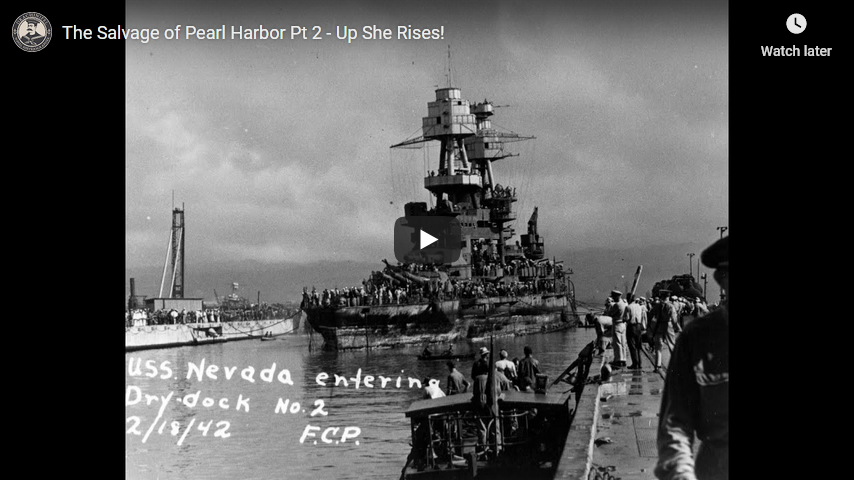
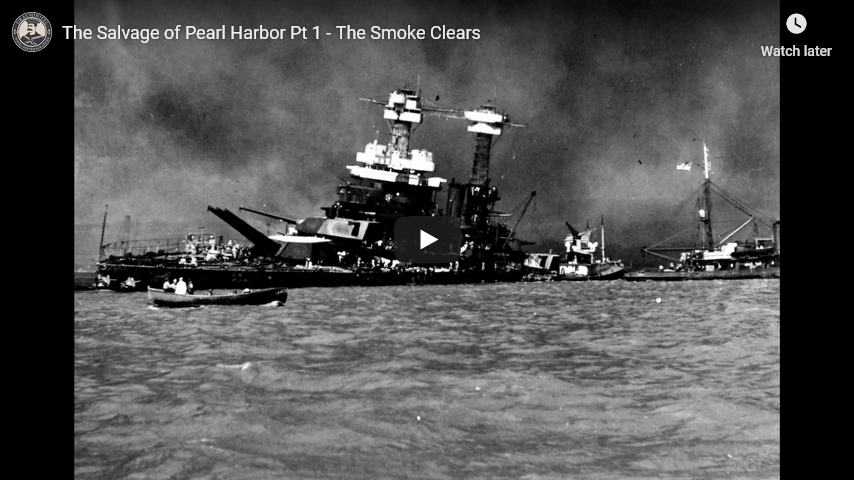
Today we look at the salvage efforts on the three battleships outright sunk in the attack on Pearl Harbor that would be returned to service.
Sources:
www.amazon.co.uk/gp/product/B00C0JIXJO https://www.history.navy.mil/our-coll…
www.amazon.co.uk/Pearl-Harbor-Fleet-Salvage-Appraisal/dp/0898755654
www.amazon.co.uk/Descent-into-Darkness-Harbour-Divers/dp/0891417451
Videos – US National Archives / US Department of Defense
Free naval photos and more – www.drachinifel.co.uk
… recently I ran across a quote beloved of American leftists in an email signature:
From Benito Mussolini: “Fascism should more properly be called corporatism, since it is the merger of state and corporate power.”
This quote is often misconstrued nowadays by leftists who view profit-making corporations under capitalism (especially multinational corporations) as instruments of the devil. They love the implied image of capitalist fat-cats and fascist dictators conspiring in gilded opulence. Alas for them that this quote actually doesn’t imply anything like that; the terminological ground under it has shifted.
The “corporatism” Mussolini to which was referring had, actually, nothing to do with corporations, joint-stock or otherwise (in the 1920s the word “corporation” did not yet have its modern sense, either in English or Italian). His use of the word had to do with a feature of fascist theory forgotten by almost everybody but specialist historians.
In fascist theory, “corporations” were bodies like unions, craft guilds, professional societies, and grange associations. See http://en.wikipedia.org/wiki/Corporatism for discussion; see especially the section “[F]ascist corporativism” [section name changed since 2009].
What Mussolini was actually enunciating was a sort of organic statism in which the state would bless or admit representatives of various “corporations” into its governing councils — and no, that didn’t mean Fiat or Beretta but (say) the Abruzzo Building Trades Association, or the Society of University Professors.
While corporations-in-the-modern-sense were not outright excluded from being legitimized “corporations” in the fascist sense, neither did they have any special status or power in the system. Actually, it was rather the reverse …
It’s worth remembering that the founders of fascism were mainly Leninists like Mussolini with a sprinkling of anarcho-syndicalists (George Sorel being the best known of those). Actual fascism retained the founders’ doctrinal hostility to what modern leftists would call “corporate power”, never renouncing its state-socialist roots and being (in fact) hostile to all centers of power other than the state itself.
The modern idea that German and Italian fascism were conservative or pro-business ideologies is essentially a fantasy constructed by pro-Soviet propagandists during and after World War II. In fact, classical fascism never wandered very far from its left-wing origins; corporatism can be seen as an elaboration of the theoretical role of worker’s soviets in Leninist theory.
In his Trains blog, George Hamlin discusses the changing colours of the ordinary railway boxcar in the brief era between post-war prosperity and the economic disasters of the 1960s and 70s:
Pre-war Duluth, South Shore & Atlantic boxcar number 18052 at the Mid-Continent Railway Museum. Photo by Sean Lamb via Wikimedia Commons.
The advent of streamlining in the 1930s started to blow historic convention with regard to car colors away on the passenger side of railroading, but had little impact on freight operations prior to World War II. Following that conflict, however, some of the industry began to consider livening up the equipment that produced much of the revenue (and most of the profits) from which they derived their economic existence.
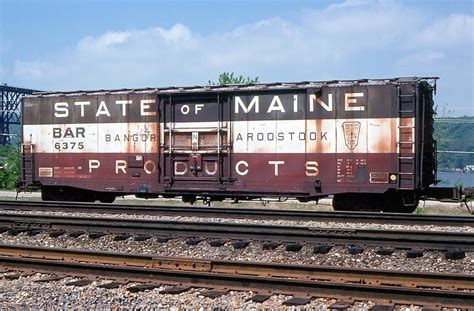
Some railroads also adopted more colorful boxcar paint schemes to promote special aspects of their freight service: the B&O had special schemes for both their “Sentinel” and “Timesaver” services; another example was the Missouri Pacific’s blue and gray (the road’s modern-day passenger colors) for their Eagle Merchandise Service. The Bangor & Aroostook had boxcars with red, white and blue horizontal stripes advertising products emanating from their home state, Maine.
Bangor and Aroostook boxcar 6375 in “State of Maine” paint scheme. Image originally from Panoramio, but no user information provided.
Another example was the large fleet of New York Central’s “Pacemaker” boxcars, adorned in a combination of bright red and gray. Early on, the NYC even ran solid trains of this equipment in an expedited service which was designed to re-capture LCL (less than carload lot) traffic from the increasingly competitive motor trucking industry. (Interestingly, the NYC also had a color they called “Pacemaker Green” that was used for the pre-World War II all-coach New York-Chicago service, as well as on the road’s initial orders of non-stainless steel streamlined coaches.)
In the late 1950s, the Central introduced a more radical change, and began painting its boxcars in a Jade Green color (“Century Green”, according to the railroad) that was quite a dramatic change from boxcar red. The Great Northern also adopted a similar shade. CB&Q boxcars still had the same basic hue, but now they came in a brighter version dubbed “Chinese Red”.
By the 1960s, a number of roads had livened up their freight car liveries; the modestly-sized Reading utilized bright green and beige/yellow for both freight cars and locomotives. Late in its career as an independent railroad, the Great Northern adopted the striking bright “Big Sky Blue” for both passenger and freight cars. At its formation in 1976, Conrail adopted “traditional red oxide” as its choice for freight cars, however, sticking with tradition (and reversing the NYC’s earlier efforts).
Great Northern boxcar 138660 in the “Big Sky Blue” paint scheme, delivered September 1967. Photo by David Pride http://www.davidpride.com/USA/Minnesota/Osceola_11_007.htm
Comments Off on The late steam-era boxcar and (a brief) flourish of colour
Overly Sarcastic Productions
Published 18 Feb 2016
Today, Blue discusses recurring themes in history! This one’s the Military Expedition, aka what happens when a powerful military juggernaut gets too big for its britches and starts saying stuff like “too big to fail” unironically.
Blue: If you’re curious about the weird chart/graph thing blue showed during the Napoleon segment, look up Charles Joseph Minard [mentioned here and here], the guy who made it. It’s a really cool chart that shows the size of the army as it traveled across Russia (tan) and back (black). You can see how perilous the journey was based on how narrow the line gets. Graphs are cool.
Comments Off on Historical Models Summarized: The Military Expedition
The problem goes back to the early 40s, when a revolution took place in jazz. At a Harlem club named Minton’s, while the swing era was still in full bloom, a group of musicians began experimenting with a new approach to the music. Bandleader Teddy Hill formed a house band with drummer Kenny Clarke, trumpeter Dizzy Gillespie, and pianist Thelonious Monk. During nightly jam sessions others would join them, most notably sax great Charlie Parker, who had gotten his start in the swing bands of Kansas City. Vats of ink have been spilled deciphering the meaning of bebop. If jazz writers are to be believed, it defies easy categorization and requires sets and subsets to understand, but a succinct four-part summary was offered by Neil Tesser in The Playboy Guide to Jazz a couple years ago. First, the beboppers used small, quick combos — most often of trumpet and sax backed by piano, bass, and drums — instead of orchestras. Second, they used more complex chords, exploring “lively, colorful combinations of notes that previous listeners considered too dissonant for jazz.” Third, they often abandoned the melody of a song in order to improvise, relying more heavily on the song’s harmony.
Fourth, beboppers had attitude: “Instead of smooth and hummable melodies designed for dancing, the beboppers created angular tunes with unexpected accents and irregular phrases — and they expected people to listen, rather than jitterbug, to these songs and the solos that followed. The boppers emerged as jazz’s first ‘angry young men.’ They saw themselves as artists first and entertainers second, and they demanded that others respect them and their music accordingly.”
Some of the new jazz was undeniably brilliant, and many of the bebop and hard bop recordings that have been remastered and reissued only seem to acquire more appeal with age. Albums like Parker’s Now’s the Time, Art Blakey and the Jazz Messengers, Dexter Gordon’s Go, Sonny Rollins Vol. 2, and Coltrane’s Blue Train are timeless, bristling with energy, jaw-dropping improvisation, and deep spirituality. But when they cast their spell, they laid complete waste to the pop-jazz tradition. Bebop offered challenges musicians thought they could never get from traditional swing bands, as well as an improvisational ethic that provided an escape from the tough work of writing strong melodies. Some of the players saw this: In 1949 drummer Buddy Rich fired his band because his players “just want to play bop and nothing else. In fact,” Rich added, “I doubt they can play anything else.” Louis Armstrong, whose centennial is being celebrated this year, once referred to bebop as “crazy, mixed-up chords that don’t mean nothing at all.” Before long swing had become a joke. Producer Quincy Jones recalls in the documentary Listen Up that as a young musician he once hid backstage from bebop trumpeter Miles Davis so Miles wouldn’t know he was in the swinging band that had just left the stage.
Suddenly, jazz was Art. Gone were the days when 5,000 people would fill the Savoy Ballroom to lindy hop to the sunny sounds of Ella Fitzgerald or Count Basie. Bebop was impossible to dance to, which was fine with the alienated musicians in Eisenhower’s America. (You can bet this era will be well represented by beatnik [Ken] Burns [in his then-unreleased Jazz documentary TV series].) Even bebop’s own founders weren’t safe from the ideological putsch: when Bird himself made an album of pop standards with a band backed up by a string section, he was labeled a sellout. Then Elvis, to simplify matters greatly, reinvented swing for a new generation, and the Beatles arrived with sacks of great new melodies, and jazz was over as a popular music. Remarkably, beboppers and their fans still blame the drop-off on American racism. Miles once called pop music “white music,” and Kareem Abdul-Jabbar, in a documentary about the Blue Note label, offers that “whites couldn’t appreciate anything that came from black culture.” Yet whites were as responsible as blacks for making stars of Ella, Basie, and other black swing artists. Only two kinds of music were allowed on the radio following the news of FDR’s death: classical and Duke Ellington.
When Germany began looking in late 1915 for a new weapon ideally suited for the “last 200 meters” of a combat advance, Hugo Schmeisser’s blowback submachine gun would prove to be the weapon that would set the standard for virtually all submachine guns to come. It was a fully automatic-only weapon with a simple blowback action and a rather slow 400 rpm rate of fire. Although relatively heavy, the only real shortcoming of the MP18,I was its use of 32-round Luger snail drum magazines, which was dictated by the German military. These magazines were unreliable and difficult to load, but they were already in production and were a reasonable logistical answer in a time when material and production shortages were an endemic problem in Germany.
The MP18,I managed to see frontline combat only in the closing few months of World War One (50,000 were initially ordered, 17,677 were produced before the Armistice, and only an estimated 3,000 actually saw frontline combat use). During that time, however, it made a significant impression, easily convincing anyone with an open mind that this new type of weapon would play a major role in future wars.
After the end of the war, the Germany Army was prohibited from using submachine guns, so most of the existing ones (including the example in today’s video) were transferred to police organizations instead.
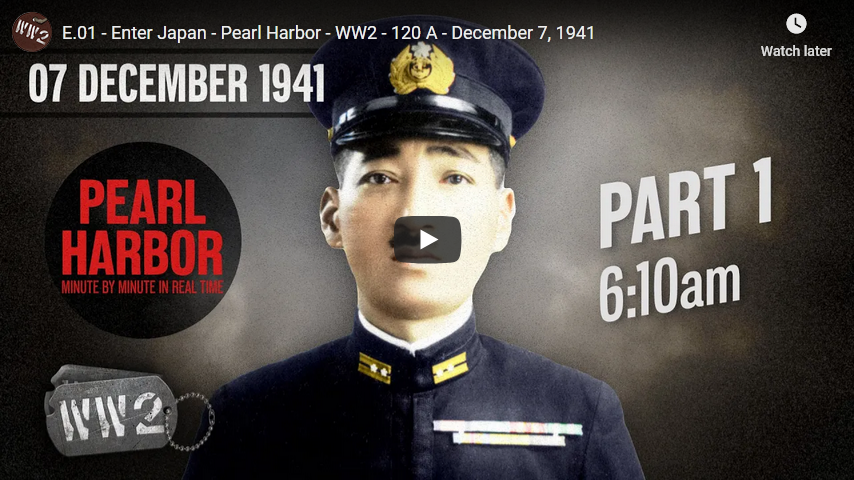
Powered by World of Warships – https://wo.ws/PearlHarbor – Register now to receive an exclusive bonus!
In this episode: Japan’s meticulous planning and preparation made it possible to surprise the Americans at Pearl Harbor. Alert on Oahu is largely nonexistent. It is the deep breath before the plunge.
Hosted by: Indy Neidell
Written by: Spartacus Olsson and Indy Neidell
Directed by: Wieke Kapteijns
Executive Producers: Astrid Deinhard, Indy Neidell, Spartacus Olsson, Bodo Rittenauer
Produced by: Astrid Deinhard and Spartacus Olsson
Co-Producers: Maria Kyhle and Francis van Berkel
Edited by: Iryna Dulka
Set Design by: Astrid Deinhard
Graphic Design by: Mikolaj Uchman
Map Animations by: Daniel Haczyk and Eastory
Assistant Editors: Miki Cackowski, Daniel Weiss, Karolina Dołega
Still Colorizers: Adrien Fillon, Norman Stewart, Jaris Almazani, Daniel Weiss, Mikolaj Uchman, Carlos Ortega Pereira
Research by: Indy Neidell, Spartacus Olsson, Markus Linke, Wieke Kapteijns, Bastian Gaete, Lewis Braithwaite, Tim Smith, Ian Irungu
Sound Design by: Marek Kamiński
Dogfights by: Daniel Weiss, Bastian Gaete, Ian Sowden, Dennis Stepanov
Voices:
Mitsuo Fuchida – Daniel Grieb
Ada Peggy Olsson – Shani Neidell Beard
Iyōzō Fujita – Emi Celis
James Anderson – Emi Celis
Dorinda Stagner – Zora Johnson
Jack Kelley – Ryan Socash
James McClelland – Spartacus Olsson
Phil Rasmussen – Spartacus Olsson
Dan Wentrcek – Dennis Stepanov
Thompson Izawa – Samir Mechel
Robert Isacksen – Ian Sowden
Joseph K. Taussig Jr. – Tim Smith
James Cory – Ryan Tebo
Film colorization by: Ricks Film Restoration
Naval Gameplay by: World of Warships
Archive material provided by: Reuters/Screenocean
A TimeGhost chronological documentary produced by OnLion Entertainment GmbH.
From the comments:
World War Two
1 hour ago (edited)
When we set out to do this crazy project we thought we wanted to try some really new things. As anyone knows that follows us regularly, our first and foremost goal is remembrance — to shine a light on our past and learn form our ancestors’ mistakes and achievements. We try our best to do that with a dedication to facts and details liberated from partisan, or ideological historiography. For this purpose, the attack on Pearl Harbor serves very well. It is a compact event over only a few hours that is spectacular in its nature, tragic in its effect, gripping in its drama, and has tremendous impact on WW2 on all fronts. It is also an event that is often simplified to the point of misunderstanding, has been woven into national mythology, and given rise to some pretty nutty conspiracy myths. Simply put: the Attack on Pearl Harbor is short enough, exciting enough, and misunderstood enough for us to do a limited series like this.
But more than that we also wanted to try some new technical and narrative things. Since we started doing historical documentaries with the Great War in 2014 we have tried to be on the forefront of pioneering new ways of creating historiography for the modern media world. Narratively, we have dedicated ourselves to chronologies, which in historiography is nothing new, but it is new in the world of film documentaries (at least to the level we do it) — so we thought; “heck what if we go down to minute by minute for this” — well we did and it taught us an enormous amount about Pearl Harbor, but also about how we can write. We will get back to that in further comment on the series. As for technology, it truly is technology that enables our work, well any media — for us it is social media, affordable ways to capture film, global virtual remote working spaces, digital research opportunities, digital film archives, and so on.
Two areas we had not been able to venture into was recreation of scenes using computer graphics and colorization of moving images. Using a gaming engine to create animation is also nothing new, but usually very, very expensive because you have to first create the world, the assets and the characters for your recreation. But for Pearl Harbor, World of Warships https://worldofwarships.com and World of Warplaneshttps://worldofwarplanes.com opened an opportunity to do this on a new scale at a cost that is only a fraction of what it usually costs. Along the way we also got to know Ricks Film Restorations (https://bit.ly/ricksfilmresorations and https://www.youtube.com/user/Rick88888888) who use AI technology to enhance and colorize film footage. While both of these technologies are only at the beginning of their potential, we think the results are spectacular. More than anything it has enabled us to enhance the emotional and visual experience for this series to a level we never reached before. Last but not least it enabled us to use the financial contributions of the TimeGhost Army, and World of Warships to create five hours of content for less than 1/50th — only 2% — of what it would cost to do with traditional means.
creatingstuff
In the Name of the entire TimeGhost Team,
Astrid, Indy, Spartacus, and Wieke
Episode Guide:
This is a 10 episode limited series within our weekly coverage of WW2 — to see the immediate events leading up to this day watch episode 119 from December 5, https://youtu.be/DYUzmBuX-6Y. Some of the events covered briefly as they start on this day, such as the invasions in the West Pacific will be covered in more detail in the coming weeks, especially in episode 120K (the 11th episode this week).coming out on December 12.
In The Critic, Zareer Masani debunks a recent book’s claim that British PM Winston Churchill was responsible for the Bengal famine during the Second World War:
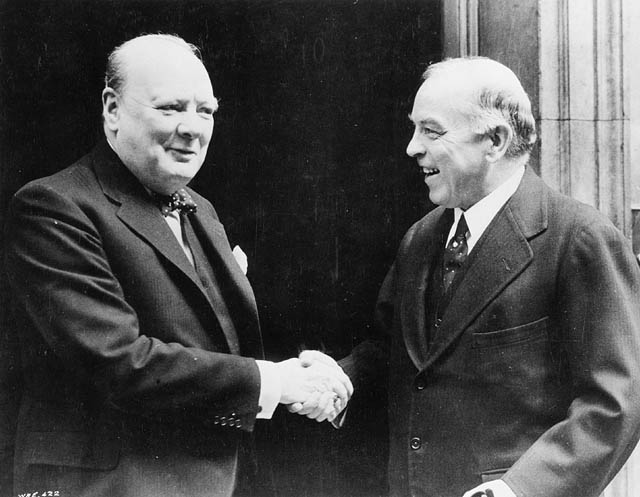
Prime Minister Winston Churchill greets Canadian PM William Lyon Mackenzie King, 1941. Photo from Library and Archives Canada (reference number C-047565) via Wikimedia Commons.
A favourite trope of the current Black Lives Madness and its left-liberal white apologists has been the alleged infamy of Britain’s most cherished hero, Winston Churchill, charged with everything from mere racism to actual genocide. The worst accusation is that of deliberately starving four million Bengalis to death in the famine of 1943.
The famine took place at the height of World War Two, with the Japanese already occupying Burma and invading the British Indian province of Bengal, bombing its capital, Calcutta, and patrolling its coast with submarines.
The famine raged for about six months, from the summer of 1943 until the end of that year, and estimates of its victims range from half a million upwards, depending on whether one includes its indirect and long-term effects. Most famine experts agree that famines can be caused by both nature and human agency, but never by any single individual. So how has a 67-year-old British prime minister in poor health, 5,000 miles away, fighting near-annihilation in a world war, come to be charged with causing such a cataclysmic disaster?
The attempt to lay this at Churchill’s door stems from a sensationalist book by a Bengali-American journalist called Madhusree Mukerjee. As its title, Churchill’s Secret War, indicates, it was a largely conspiracist attempt to pin responsibility on distant Churchill for undoubted mistakes on the ground in Bengal.
The actual evidence shows that Churchill believed, based on the information he had been getting, that there was no food supply shortage in Bengal, but a demand problem caused by local mismanagement of the distribution system. Ironically, his view found unexpected support in a 2010 exchange between Mukerjee and the Nobel Prize-winning economist Amartya Sen, the world’s foremost expert on famine in India.
Commenting in the New York Times, Sen said of Mukerjee, that “she seems satisfied with little information” and that her data came from only two rice research stations, and those in only two out of 27 districts in Bengal. “The analysis I made,” countered Sen, “using data from all districts … indicated that food availability in 1943 (the famine year) was significantly higher than in 1941 (when there was no famine) … There was indeed a substantial shortfall compared with demand, hugely enhanced in a war economy … but that is quite different from a shortfall of supply compared with supply in previous years … Mukerjee seems to miss this crucial distinction, and in her single-minded … attempt to nail down Churchill, she ends up absolving British imperial policy of confusion and callousness.”
Comments Off on Churchill and the Bengal Famine of 1943
The History Guy: History Deserves to Be Remembered
Published 22 Apr 2019
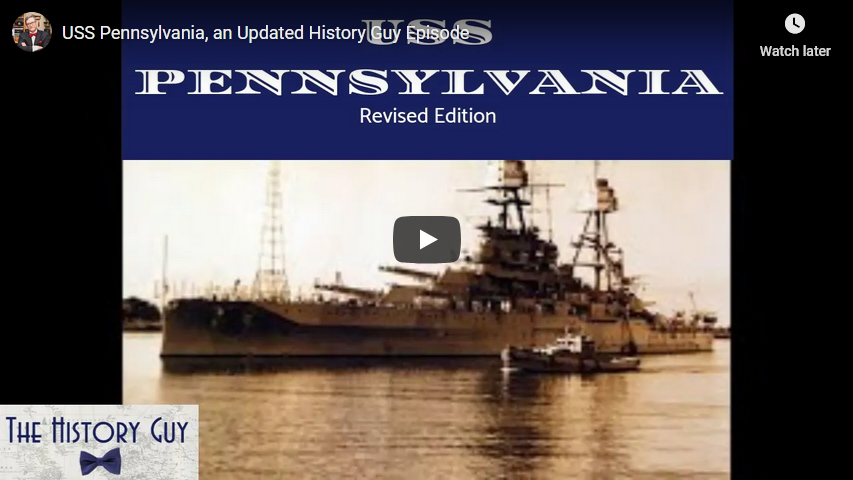
USS Pennsylvania was in dry dock when the attack came at Pearl Harbor. The History Guy remembers part of her history that may have been forgotten.
This episode was originally posted December 7, 2017. It has been updated to correct some errors in the original, and new footage of USS Pennsylvania has been added.
This is original content based on research by The History Guy. Images in the Public Domain are carefully selected and provide illustration. As images of actual events are sometimes not available, images of similar objects and events are used for illustration.
All events are portrayed in historical context and for educational purposes. No images or content are primarily intended to shock and disgust. Those who do not learn from history are doomed to repeat it. Non censuram.
The History Guy: History Deserves to Be Remembered is the place to find short snippets of forgotten history from five to fifteen minutes long. If you like history too, this is the channel for you.