
One of the grand joys of being ignorant on a subject is that it’s possible to project one’s own insistences onto the findings of others. This explains Gazza on wealth, Sir Lenworth on reparations and Spud on any aspect of economics. Given the fun they’re having why not partake?
The Reich Lab article on genetic selection in Europe over the last 10,000 years is finally online, and it includes such interesting results as:
— Intelligence has increased
— People got lighter
— Mental disorders became less common
Clearly, given Gazza, Sir Lenworth and Spud less common is not a synonym for does not happen. But to proceed to my own ignorance:
In a sort-of confirmation of the Cochran-Harpending thesis, they also found that, for several traits, the intensity of selection appears higher more recently in time.
Specifically, selection intensity increased in the Bronze Age compared to the Neolithic, then it stabilized!
At which point I get to project my own mental wibbles onto the results of others.
Now, think of that deep history. Up until agriculture — roughly that Bronze Age — the driver of human evolution was the wolves trying to eat us. OK, mebbe the staphilococci, the crocs, hippoes, Venus Human Traps and so on. We were, as with most species, not really competing against ourselves but against those who saw us as either food or as competitors for an ecological niche.
Yes, yes, I know, this isn’t true but it’s a reasonable pencil sketch start to an argument.
OK, so now Bronze Age. We’ve got agriculture. We also, at this exact same time, see human populations change quite a lot. There’s a massive expansion of certain Y chromosomes and much less of maternal mitochondria. You know, the blokes from over the hill come in, kill all the men and shag the birds. We’ve — perhaps through agriculture, perhaps through bronze, perhaps through the simple absence of any more terra nullius — made the major threat to human other humans.
Or, of course, given the genetics here we could say that the major threat to male humans is now other male humans but that doesn’t make much difference to the argument — men, after all, the only ones who ever do anything.
Well, if the major threat is now humans then that means that the major evolutionary pressure is other humans. And they’re fighting with the same weapons we are. Same basic DNA possibilities, roughly the same physique, about the same IQ and on and on. This is going to have much more pressure on that evolution than being chased by a hippo is — that’s a one time win or lose event. Whether your genes persist is now a permanent battle with others who share near all of your capabilities. The importance being that word “near”.
Yes, I do know that it’s possible to make much the same argument for any species and their access to breeding. But the thing we’re interested in explaining here is why did this speed up in humans at one point? I claim that’s it’s because of the above — the rough settlement of decent agricultural land, worldwide, (or in the case here, in Europe. This doesn’t apply to Wales, say, or Scotland, which explains both of them now neatly) means that the competitor is other humans, not the more general environment. We’ve changed the evolutionary pressure. We’re no longer trying to outhink a pig — something Gazza, Spud etc often don’t — but that other bastard with his eye on our field and our wife.
So, that’s the thing. Human evolution sped up because it was the other bastard humans we were competing with, not the general environment. QED, I’m right and go boil your heads.
Tim Worstall, “Human Beings Were The Enemy In Human Evolution”, It’s all obvious or trivial except …, 2026-04-24.
July 25, 2026
QotD: “… the major evolutionary pressure is other humans”
July 24, 2026
Did This Meal Kill Mozart?
Tasting History with Max Miller
Published 27 Jan 2026Sliced pork loin with a rye bread crumb and cinnamon crust
City/Region: Vienna
Time Period: 1742Mozart is one of my favorite composers of all time. When he fell ill and died in 1791 at the age of 35, rumors flew about what caused his death. Speculation continues to this day. Was it poison from a jealous rival or the Freemasons? Was it one of many possible illnesses? We don’t know for sure, but one theory is that it was trichinosis from undercooked pork, and we do know that he ate pork 44 days before he became sick.
This recipe from a Viennese cookbook in 1742 is for mutton loin, but it says that you can use the recipe for pork or venison as well. While boiling meat is not the most delicious way to prepare it, the crust that you prepare after it’s boiled is delicious. It’s slightly sweet with a hint of cinnamon and a very nice crunch, so if you’re not worried about sticking to the historical recipe exactly, try the crust on some pork chops (cooked however you like) or a roasted pork loin.
No. 239 — Mutton Loin
Take from a mutton the loin, as large as it can be, and dress it as one does a venison loin. Boil it in water, wine, and vinegar with bay leaves, onion, rosemary, and strips of lemon peel until it is quite tender. When it is cooked, arrange it on a casserole dish and pour melted butter over it. Take grated dark bread, mix it with cinnamon and sugar, sprinkle this over the loin, pour more butter over it, and put it into the oven, so that it becomes nicely brown, turning it once or twice. Make a good broth, pour it underneath, and serve it warm at the table.
— Nützliches Koch-Buch (The Useful Cookbook) by Johann Holzmayer (1742 edition)
QotD: The first rule of strategic analysis
Wars are theatres of chaos, noise, confusion and premature certainty. The temptation to declare victory, defeat or historical turning point within the first few hours or days is not analysis. It is posturing. Yet the modern media cycle, with its appetite for endless commentary and instant verdicts, cannot tolerate silence. The result is a steady stream of confident assertions, most of which will age badly.
The current conflict between the alliance of the United States and Israel and Iran has followed this pattern almost perfectly. Within days, it was announced that America was winning; America was losing; Iran is winning; Iran had been neutralised; Iran remained undeterred; Trump doesn’t have clear plan; he does have a clear plan; this was the start of a forever war; it wasn’t a forever war; the war is a catastrophe for the US; the war is a triumph for the US.; that the war would soon be over; the war is over.
Obviously, these claims cannot be true simultaneously. Most of them will turn out not to be true at all.
Resisting the customary rush to instant judgement and adopting a more analytical frame of mind, what can we, discerning sceptics that we are, sensibly say six weeks into the war? Which claims survive contact with reality, and which are, for now, better treated as conjecture?
Michael Rainsborough, “A Sceptical Stocktake of the Iran War So Far”, The Daily Sceptic, 2026-04-21.
Update, 27 July: Welcome, Instapundit readers! Have a look around at some of my other posts you may find of interest. I send out a daily summary of posts here through my Substack – https://substack.com/@nicholasrusson that you can subscribe to if you’d like to be informed of new posts in the future.
July 23, 2026
The Korean War Week 109 – One Step From Peace! – July 21, 1952
The Korean War by Indy Neidell
Published 22 Jul 2026There’s only one thing left at the Panmunjom Peace Talks standing in the way of an armistice — Article 51. However, this article deals with the release of POWs and the two sides have very different interpretations of it. The UN is however, currently releasing all the civilian internees they hold. In the field, the fighting for Old Baldy flares up again as the Chinese attack, and an anti-guerrilla campaign comes to its end.
QotD: The development of the Main Battle Tank (MBT) and Infantry Fighting Vehicle (IFV)
The result is the modern “main battle tank” (MBT), typically between 45 and 75 tons, with a single powerful direct-fire cannon as its primary armament. That’s not to say design differences between militaries drop away; there are still decisions to be made: the level of emphasis between speed, armor and firepower for instance. Another major decision is whether a tank is designed with a three-person turret (one of whom is a dedicated loader) or a two-person turret with an autoloader (that is, a machine that does the loading for you). It used to be that now I’d have to go on about why going autoloaders aren’t simply obviously the best but given the live demonstrations of some of the drawbacks of Soviet/Russian carousel autoloaders going on right now [in Ukraine] I’ll just say that both options have advantages and drawbacks and move on. So there is variety within the idea of an MBT, but by and large most countries field just one type of MBT (or one family of MBTs for countries which can’t afford to retire older systems) and that covers their tank needs.
But of course nothing could easy so just as tanks were getting easier to keep track of, APCs get much more complicated. Even before they were fully enclosed, APCs had generally carried some kind of defensive weapon (usually a heavy machine gun), but you weren’t supposed to fight with it if you could avoid it. Beginning in the 1950s, designers – first in West Germany – began experimenting with the idea that an APC could be armed to not merely deliver the infantry (“dismounts”) but to actually fight when they got there. The thing is, there are a lot of situations where an infantry formation might want more firepower but where a tank would be overkill: armored vehicles lighter than tanks, or enemies with lighter fortifications, for instance. West Germany pioneered the idea by putting a 20mm autocannon on their APC, the Schützenpanzer Lang HS.30, enabling it to put out some meaningful firepower, albeit much less than a tank.
The USSR cottoned on to the idea and liked it, resulting in the Soviet BMP-1 and the subsequent BMP family of what we call “infantry fighting vehicles” (IFV). Initially resistant to the idea (American doctrine was that APCs move troops and should not fight if they could help it), the United States, noticing the effectiveness of these sorts of platforms, got into the act with the Bradley Fighting Vehicle (these days the M2 Bradley). And IFVs, especially the Bradley, look like tanks. And indeed, they are sometimes called on to do the kind of armored reconnaissance and infantry support jobs that in a previous era would have gone to a light tank.
But they are also notably not tanks in several key ways. The primary job of an IFV is to move infantry and support them against lighter targets; some IFVs do maintain some kind of anti-tank capability, but it tends to be more limited (e.g. the Bradley’s pair of TOW AT missiles). The requirement that an IFV needs to be fairly fast but also needs to fit a bunch of dismounts means they can’t carry the firepower or the armor of a tank, often using lighter aluminum armor rather than steel or heavy composites. Finally, the tendency is for IFVs to mount lighter primarily armaments – again, space and weight concerns – like the Bradley’s 25mm M242 Bushmaster chain gun. The BMP-3 is probably the most heavily armed IFV out there with a low-velocity 100mm rifled gun and a 30mm autocannon, which is still a far cry from the firepower of the high-velocity 125mm main gun of a contemporary T-80 or the 120mm high velocity gun of a M1A1 Abrams. Instead, most IFVs would rely on anti-tank missile systems to engage tanks (although IFV autocannons can cause a tank serious problems if they can engage the rear or side armor, which is thinner).
Note that the IFV did not mean the end of the APC just as the APC didn’t bring the end of soft-skinned troop transports. In the US military, the Bradley serves alongside lighter-but-still-IFV Strykers, the venerable M113 APC along with soft-skinned HMMWV (Humvees; to be in theory replaced with the Oshkosh L-ATV) and trucks of various kinds and uses. Likewise, the Russian army has its BMPs (which are IFVs), and BTRs (which are APCs) as well as soft-skinned vehicles – or at least it did until, I am now being told, they were all towed away by Ukrainian farmers. The real Iron Harvest.
The final category worth noting here are variations on the concept of the MRAP (Mine-Resistant, Ambush-Protected): infantry transport vehicles designed to resist the sort of dangers one encounters in counter-insurgency operations, mostly mines, IEDs and small-arms ambushes. In essence, these vehicles are a purpose-built version of the up-armored Humvees designed to operate in a very particular combat environment (insurgencies and particularly urban insurgencies). These sort of vehicles have gotten more visibility in the United States because many of them have been shifted into the hands of law enforcement, where their utility is questionable, to say the least.
Bret Devereaux, “Collections: When is a ‘Tank’ Not a Tank?”, A Collection of Unmitigated Pedantry, 2022-05-06.
July 22, 2026
The Ancient Greeks 03 – Enter the Persians 4 – The Ionian Revolt and the Fatal Intervention
seangabb
Published 16 Feb 2026The Persian Wars begin not in Athens, but in Miletus. In this lecture we explore the failed Naxos expedition, Aristagoras’ desperate gamble, and the outbreak of the Ionian Revolt in 499 BC. We examine Aristagoras’ appeals to Sparta and Athens, Herodotus’ famous scene before Cleomenes, and the fateful decision of Athens to send twenty ships.
We also analyse the burning of Sardis, Darius’ calculated response, and the suppression of Ionia. This is not yet a world war — but it is the moment when Athens introduces itself to empire.
QotD: Burnside’s Army of the Potomac
This was the country of the boisterous forty-niner, the hell-roaring lumberjack, and the riverman who was half horse and half alligator. Without rancor (and also without the slightest hesitation) it annihilated Indian tribes so that it could people a wilderness, asserting that the only good Indian was a dead Indian and remarking casually of its own pioneers that the cowards never started and the weak died along the road. As it faced the cathedral aisles of endless virgin forests it shouted for immediate daylight in the swamp, even if whole generations must be brutalized for it. It was the country that invented the bucko mate and the Shanghai passage, and if the skysails of its incredible clippers gleamed on the farthest magic horizon they were taken there by men under the daily rule of clubs and brass knuckles. This nation accepted boiler explosions as the price of steamboat travel and it would boast presently of a dead gandy-dancer for every cross-tie on the transcontinental railroad. It wore seven-league boots and scorned to look where it planted them, and each of its immense strides was made at immense human cost. And the army of this country, buckling down to it at last in a fight which had to go to a finish, was going to be very rough on enemy civilians, not because it had anything against them but simply because they were there.
Of genuine hatred this army had practically none. The wild young men who ruined ancestral portraits and pranced in the smoky streets wearing the embroidered undergarments of gentlewomen were expressing nothing but plain hooliganism, which somehow was the obverse side of the medal that had laid nine hundred corpses in front of the stone wall west of town. Both sides of the medal bespoke raw youth which cheered and guffawed by turns, whose noble best forever went arm in arm with its ugly worst.
Bruce Catton, Army of the Potomac: Glory Road, 1952.
July 21, 2026
Frederick the Great’s 1741 book, The Anti-Machiavel
At SteynOnline, Tal Bachman continues his look at all things Machiavelli, including Prussian king Frederick the Great’s polemic against the author of The Prince:
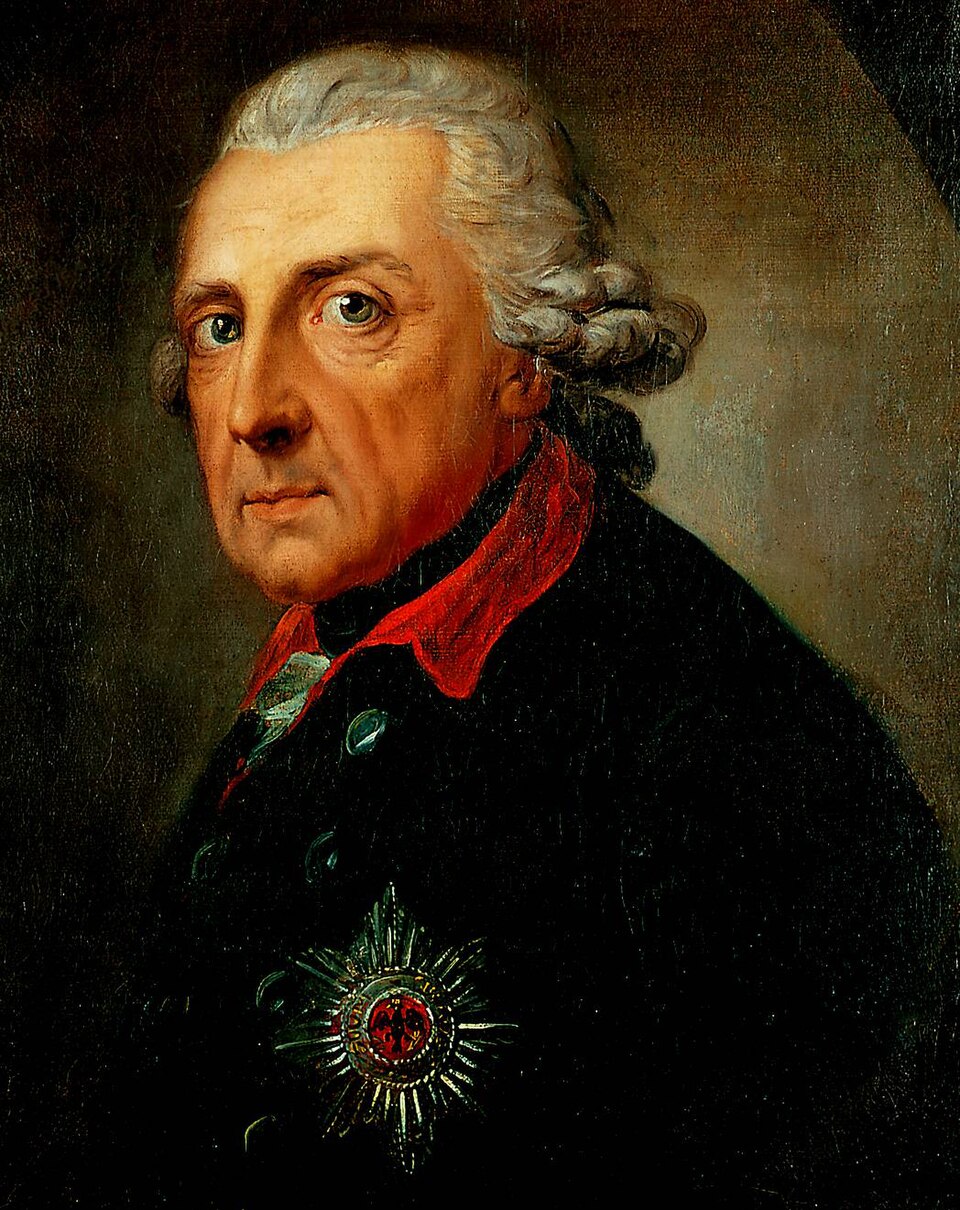
Frederick the Great, 1781
Oil portrait by Anton Graff (1736-1813) in the Sanssouci Palace collection via Wikimedia Commons.
Maybe Machiavelli’s teachings have no relevance in any remotely civilized political system. Maybe they’re far worse than irrelevant: maybe they’re all entirely evil (as they appear), and in addition, would prove the ruin of both the people and their ruler.
This was, as it happens, the view espoused by one important ruler: the Prussian king Frederick the Great. In his 1741 book, The Anti-Machiavel, he claims Machiavelli’s book is “one of the most dangerous that ever appeared in the world”, in that the political crimes it encourages would impose “a lasting misery upon whole nations”. Truly great rulers, says Frederick, aren’t the avaricious, amoral, self-serving, shape-shifting demons that Machiavelli describes. Rather, they are those “whose business it is to administer justice, and to set examples of justice to their subjects; and who, by their magnanimity, mercy, and goodness, ought to be the living images of Deity”. Thus, Frederick sees his rebuttal as “a defense of humanity against a monster who would destroy it”; it is “an antidote to poison”.
Frederick ruled Prussia for nearly 50 years. Most historians rate him a success. On the face of things, he seems like the kind of critic who knows what he’s talking about.
But Machiavelli would say, not so fast. What did Frederick do almost immediately after assuming power? Without any provocation, he launched a war to seize the large, prosperous, populous province of Silesia (now in southwestern Poland) from the Habsburg Monarchy. And he did so on a convoluted, centuries-old dynastic claim which sounded as unconvincing to his contemporaries as it does to us now. In the three Silesian wars which followed (the third turning into the Seven Years War), well over a million soldiers died fighting. Millions more wound up maimed, psychologically scarred, or otherwise ruined. Of course, millions of non-combatants also suffered: wives lost husbands, mothers and fathers lost sons, children lost fathers and uncles and brothers. Those non-combatants also suffered displacement, terror, deprivation, and injury. Over two decades, Frederick’s wars — particularly the Seven Years War — convulsed Europe. Frederick gained 30% more territory and 50% more citizens, but the cost was losing 10% of the Prussian population to combat or disease (the modern equivalent of 35 million Americans, 6 million English, or 3 million Australians). The point is: if his actions are anything to go by, Frederick didn’t oppose Machiavellian power moves as much as he professed, if at all. Machiavelli might even argue that in taking pains to proclaim his opposition to Machiavelli even as his wars of acquisition injured and killed millions, he was doing exactly what Machiavelli had advised: seeming to be good even as he was doing whatever the hell he wanted, for his own purposes. Most people will buy the act anyway, says Machiavelli, so why not?
This brings me back to Machiavelli’s claims about how rulers do in fact act, and how they must act to avoid ruin. And that in turn brings me back to the original wording of The Prince, and what real-world credibility Machiavelli might have as a political commentator.
As it happens, Machiavelli was no armchair quarterback. Even if he hadn’t spent nearly fifteen years at the highest levels of Florentine government (which he did), he might well have qualified as a political expert just by virtue of growing up in the tumultuous time and place he did. Between the jockeying Italian states, the myriad (and ever-changing) foreign alliances and enemies and designs, the political influence of the papacy, and Florence’s own internal politics, Machiavelli’s home city furnished more than enough lessons in how the political world could, and often did, operate.
Mauser M90 DA: Not Mauser and Not a High Power
Forgotten Weapons
Published 25 Feb 2026In the late 1980s and early 1990s, the Mauser firm was not in good shape. It had no new products, and its ability to survive marketing its name and legacy pistols was waning. Without much vision for the future, it turned to rebranding production from other companies, like Renato Gamba in Italy and FÉG in Hungary. From FEG they got the “Mauser Model 80” — a licensed copy of the Browning High Power — and the “Mauser Model 90” — a rebadged FEG P9R.
The P9R / Mauser 90 is often assumed to simply be a double-action modification of the High Power, but this is not true. The slide is almost identical in appearance to the High Power slide except for the decocking lever, but the frame has several important differences. The barrel lockup is taken from the S&W series of automatic pistols instead of the High Power, and the trigger mechanism is a stirrup around the magazine well instead of moving through the slide like a High Power.
In total, FEG made 26,000 of these pistols for Mauser. The plan was to sell them in Europe, but by 1995 sales remained poor and about 18,000 remained in Mauser inventory. In order to get rid of them, they were offered on the American market, where they were gobbled up by importers like Century between 1995 and 2001.
(more…)
July 20, 2026
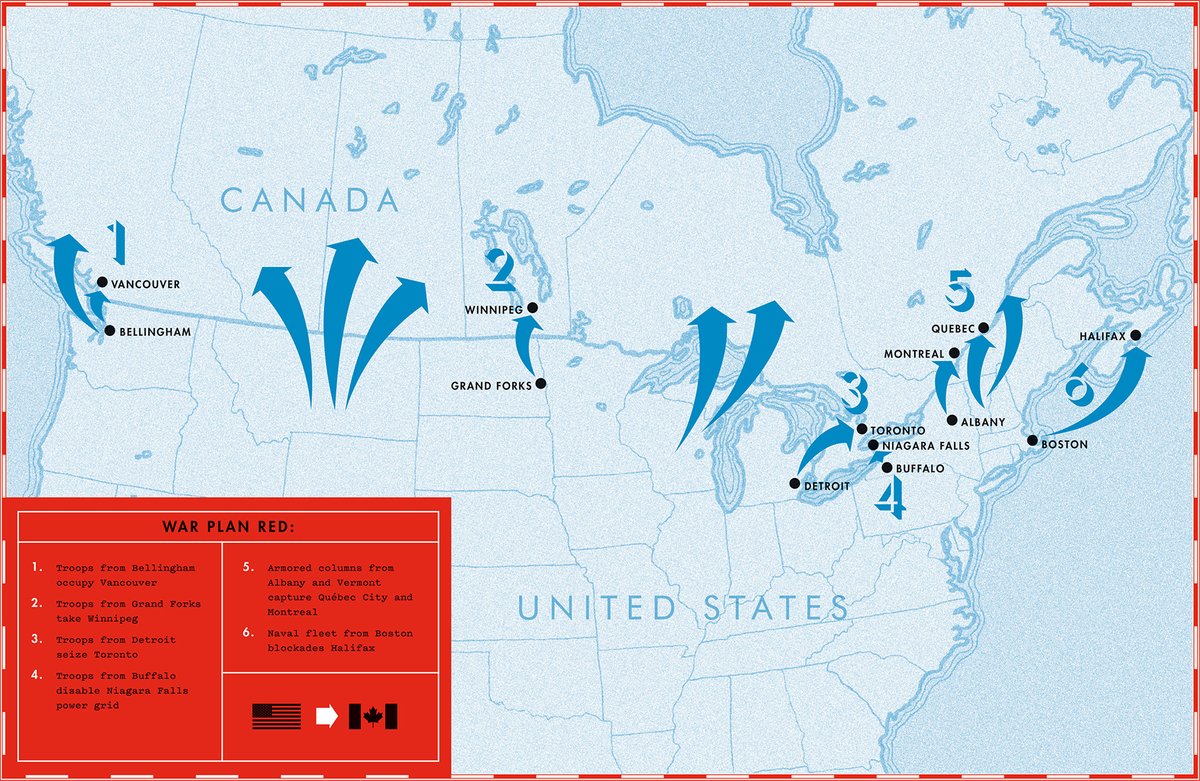
“Blame Canada”: evergreen. “Invade Canada”? It’s been done before
Upper Canadian Cavalier points out the obvious … that the United States absolutely could invade Canada and there’s not a lot the Canadian Armed Forces could do to stop them. But that would be the easy part:
“A mere matter of marching …”
The question of “could America ever invade Canada?” is wrong before it is even asked. Picture the MAGA politicos huddled in D.C. and the anon poasters spamming maps of how America could take Canada, as if it were even a question, as if the border were a wall and the wall the point. The whole conversation is midwits who never grasped what America already occupies.
Occupation is the crude instrument of the conqueror who arrives too late, who finds the ground already held by another and must break it by force, and that has never once been the American position in the north. The American position is that of the covert shareholder rather than the invader, and a shareholder does not knock down the door of a house whose deed already sits in his desk.
Empire in its highest form neither occupies nor marches, because it has learned to administer instead, and it does not plant a flag on the palace, since the flag is a confession that the palace was not yet yours. The genius of the modern Global American imperium has been to take without ever confessing, to hold Canada so completely that Canadians experience the holding as their own free choice. To reach for the army now would throw all of that away, trading a profitable and invisible dominion for a visible and bloody one, and teaching the empire at ruinous cost the difference between owning a country and holding it.
The republic was born reaching north with a bayonet, and it should remember how that went. In the winter of 1775 it sent Brigadier General Richard Montgomery and Colonel Benedict Arnold (yes, that Benedict Arnold) up through the snow to seize Quebec. The spirit of the country rose up in the snow to meet them, and Quebec killed Montgomery in a blizzard at the walls, the land itself passing sentence on the invasion before a single treaty could be signed.
That was first offensive act of the American project, it was a failed invasion of Canada that froze to death in the cold for its own arrogance. There is a symmetry waiting at the end of this essay that the reader should carry from the beginning, because a republic that opened its history reaching north may yet close its history the same way. America could invade Canada, but then it would not be able to conquer it, and in that attempt it would destroy the very thing that made its northern dominion worth having, because the soft empire cannot survive being seen and that invasion is nothing other than the act of trading quiet profits for overt pain and suffering.
Eating the Food of Homer’s Odyssey
Tasting History with Max Miller
Published 14 Jul 2026Skewer of roast pork covered in seasoned barley meal, accompanied by the Ancient Greek potion, Kykeon
City/Region: Greece
Time Period: c. 1650-1100 B.C.E., Mycenaean PeriodWhen Odysseus finally makes it back to his home of Ithaca, he goes to the home of the swineherd Eumaeus. Disguised as a beggar, Odysseus is welcomed into Eumaeus’s home, and Eumaeus prepares skewers of roasted pork sprinkled with barley meal.
While I could just make plain roast pork sprinkled with plain barley flour, let’s assume that Eumaeus does the disguised Odysseus the courtesy of seasoning the meal. Archaeologists have found evidence that the people living in Greece during the Mycenaean Period, when The Odyssey is supposed to have taken place, commonly used coriander, cumin, celery, and fennel, so that’s what I used to season the barley flour coating.
This dish is very simple, and surprisingly flavorful. I made mine in the oven, but if you can cook it over an open fire, it would be even better. The cumin and fennel seeds are both very strong flavors, so choose one or the other so as not to completely overpower everything else.
Eumaeus went off to the sties where the pigs were penned. Choosing two sucklings, he carried them in, slaughtered and singed them both, then cut them in pieces and spitted them on skewers. Then, when all was well roasted, he served it to Odysseus piping hot on the skewers, sprinkling the meat with white barley meal.
— The Odyssey, Book XIV
Eight Great Powers Invade China: the Boxer Uprising 1900-1901
Real Time History
Published 20 Feb 2026After the defeat in the 1st Sino-Japanese War, the Qing Dynasty is under pressure: Some are calling for domestic reforms and ousting Western influence, while the Great Powers want to further open up China for their businesses. Violence erupts when the so called Boxer movement kills several Westerners.
(more…)
QotD: The real, but unacknowledged, Global American Empire
Not for sentimental reasons, I hasten to add. What am I, a Liberal, and / or a girl? I’m an Historian; I have no problem with Empires.
What I do have a problem with — an enormous problem, yuuuuuge, the biggest — is empires that don’t acknowledge themselves as such. A LOT of the 20th century would’ve gone very, very differently had the USA either acknowledged herself to be an Empire starting in 1898, or stuck to her anti-Imperial rhetoric and bowed out of the international power game. But — as we always do — we tried to have it both ways, acting like the most bellicose Empire on the planet while deliberately undermining the Imperial policies of everyone else. Woodrow Wilson, for example, tried to run the entire Western Hemisphere as an American satrapy while promising any micro-group with their own goulash recipe in the Balkans a State of their very own.
Consider what all our Middle Eastern adventures, 1948-present, would look like if the American Empire declared itself to be such. We might still be bombing Iran, but the “exit strategy” is simple: They’ve made sufficient obeisance to the Imperial standard; we’ll be sailing away now. “Air policing” is still retarded — it’s the kind of idea only your best Old School Tie toff could come up with, over tea and crumpets at Eton — but it works ok as a publicity stunt. Things get fuzzy out there on The Fringes of Empire, and while you occasionally have to slap the wogs around, just to remind them that you can, it doesn’t have to be anything more than that.
But alas.
Severian, “Friday Mailbag”, Founding Questions, 2026-04-03.
July 19, 2026
How to Set a Militia Free on a Minority – Death of Democracy 24 – Q4 1938
World War Two and Spartacus Olsson
Published 18 Jul 2026In this episode of Death of Democracy, Spartacus Olsson examines Germany in Q4 1938 — the quarter in which Nazi persecution exploded from exclusion and intimidation into open, state-sponsored terror.
From the occupation of the Sudetenland and the Polenaktion, to the assassination of Ernst vom Rath, the orchestrated violence of Kristallnacht, the mass arrest of 30,000 Jewish men, the acceleration of Aryanization, and the first Kindertransport, this episode traces how the Nazi regime turned antisemitic hatred into systematic plunder, social death, and mass fear.
It is also the quarter in which the illusion of “peace in our time” began to unravel. While Britain and France clung to the hope that Munich had preserved peace, Hitler was already preparing the next stage of expansion — and the wider road to war.
This is the story of how a dictatorship unleashes paramilitary violence against its own citizens, how ordinary people react, and how appeasement abroad helped convince the regime that it could escalate even further.
Rome’s Greatest Enemy: Bloodbath in Africa | EP 3
The Rest Is History
Published 9 Feb 2026Would the Roman general Publius Cornelius Scipio successfully march on Africa? What happened when Hannibal and Scipio — the greatest commanders of their age — came head to head at the Battle of Zama, in the ultimate showdown? And, what would be the fate of these two titans of the ancient world?
Join Tom and Dominic, as they discuss the Roman Republic’s audacious invasion of North Africa under the leadership of the dashing Scipio, and his clash with Hannibal.
00:00 Scipio’s night attack in Numidia
02:16 Hannibal as a commander
08:07 The rise of Scipio Africanus
13:05 The Roman invasion of Africa begins
21:56 The Battle of the Great Plains
25:29 Hannibal recalled from Italy
28:18 Preparing for the final showdown
33:02 The Battle of Zama begins
36:03 Could Hannibal have won?
40:25 Hannibal urges acceptance of defeat
42:40 Hannibal as a civilian reformer
44:22 Scipio after the war
46:45 Cato’s rise and the conservative backlash
49:29 Rome turns east after victory
52:32 The Hellenistic world after Alexander
56:45 Hannibal and Scipio compare great generals
58:31 Rome defeats Antiochus
1:00:18 Hannibal’s final flight and death
1:01:40 Scipio’s death and exile
(more…)


