
World War Two
Published 16 Jul 2026Virginia Hall was one of the most extraordinary spies of World War II. An American operative for Britain’s Special Operations Executive and later the OSS, Hall built resistance networks in occupied France, coordinated intelligence, organized safe houses, helped escaped prisoners and airmen, and supported maquis fighters who sabotaged German operations during the liberation of France.
Known to the Gestapo as “the Limping Lady”, Hall worked with a wooden prosthetic leg she nicknamed Cuthbert. After escaping over the Pyrenees, she returned to France in 1944 in disguise, operating a radio, arranging parachute drops, and helping organize resistance forces against the German occupation.
This is the true story of Virginia Hall: the disabled American spy who became one of the most feared Allied agents in Nazi-occupied Europe — and one of the most important women in WWII intelligence history.
July 18, 2026
The Top WW2 Spy Was a Disabled Woman
Jevons and Baumol, and why they matter now
On the social media site formerly known as Twitter, Matt Ridley talks about the ideas of William Stanley Jevons and William Jack Baumol, whose ideas have become far more important over the last few decades:
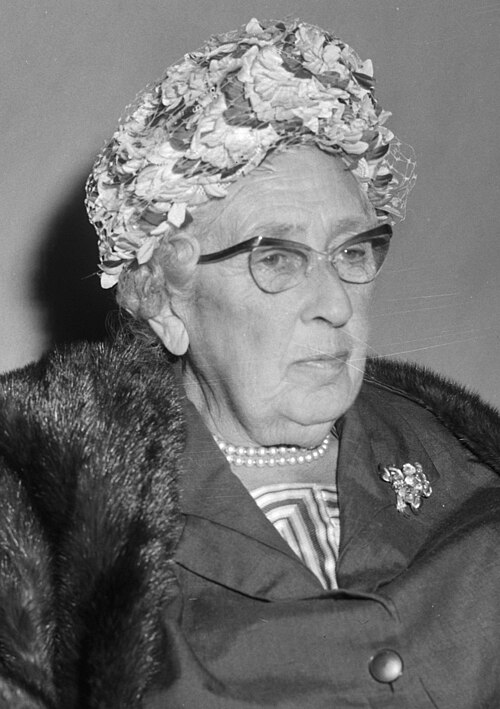
English mystery novelist Agatha Christie (1890-1976) at Schiphol Airport in Amsterdam on 17 September, 1964.
Photo by Joop van Bilsen for Anefo via Wikimedia Commons.
Agatha Christie once remarked that she had never expected to grow rich enough to own a car or poor enough not to have servants.
The reason this strikes us as bizarre today boils down to two names that you hear invoked a lot in the tech industry: Jevons and Baumol. One is shorthand for the expansion of products or professions with rising efficiency, the other for the shrinkage of products or professions with stagnant efficiency.
There’s a pleasing chronological symmetry between these twin ideas: William Stanley Jevons coined the Jevons paradox in 1865; William Jack Baumol described Baumol’s cost disease exactly a century later in 1965.
… For every industry that experiences efficiency gains, there’s another that does not. And this latter industry inevitably becomes less affordable. Baumol’s first example was string quartets: violinists are no more productive but you have to pay them more to prevent them running off to become software engineers. The productive industries drive up the labour costs in the rest of the economy.
Marc Andreessen jokes that if a hole appears in the wall of your house in California these days it is probably cheaper to glue a flat-screen television over it than hire a builder to repair it: a Jevons-deflated cost beats a Baumol-inflated one.
The big question of our age is can AI drag Baumol-shaded industries back into the sunlight of Jevons? Can it make things like healthcare, education, or government switch from rising costs to falling costs?
I fear not in the case of government because of a bureaucratic version of the Jevons and Baumol effects. As Cyril Northcote Parkinson put it in an article in the Economist in 1955: “Politicians and taxpayers have assumed (with occasional phases of doubt) that a rising total in the number of civil servants must reflect a growing volume of work to be done. Cynics, in questioning this belief, have imagined that the multiplication of officials must have left some of them idle or all of them able to work for shorter hours. But this is a matter in which faith and doubt seem equally misplaced.”
Since 1997, the British public sector has seen zero increase in productivity. That is to say, the average civil servant generates about the same output today as he did three decades ago.
Think about this for a second. Thirty years ago fax machines were high-tech, the internet was in its infancy, emails were new, Wi-Fi was scarce, mobile phones were voice-only. How is it remotely possible to be no more productive today than then?
We know the answer. Each email is now copied to a dozen people, each report is pasted and copied till it is twice as long, each Zoom call has five times as many attendees, each mobile call is followed up by three times as many WhatsApp messages – and each day at the desk is interrupted by a training session on transgender anticolonial sustainability. That’s a sort of Jevons-Baumol effect: a Jevol?
QotD: Britain’s National Trust wants to eliminate the “outdated mansion experience”
Think of the National Trust, and what probably comes to mind is an image of a middle-aged, middle-class couple pottering round a neo-classical pile built at vast expense by a spendthrift earl in the 18th century, and then surrendered to the Nation in lieu of inheritance tax sometime in the late 1940s. After all, its purpose is surely to preserve historically significant houses and gardens for the enjoyment and education of the general public.
Well, it seems not. Seek out the National Trust’s Strategy to 2025, and the first words you read are: “Our 21st-century ambition is to meet the needs of an environment under pressure, and the challenges and expectations of a fast-moving world … Underpinning this is our renewed commitment to diversity and inclusion and playing our part to create a fair, equal society, free from discrimination.”
In their “10-year Vision”, written in the same hideous identikit jargon, they talk about a “revolutionary” move away from the “outdated mansion experience”. The Trust provides little evidence that stately homes are becoming less popular; reading between the lines the main problem that the Vision’s authors seem to have with the English country house is that it is old and traditional and popular with comfortably-off white people.
I don’t particularly want to get stuck into the National Trust. But they do provide a particularly interesting example of a problem afflicting institutions in modern Britain, namely the relentless politicisation of parts of life which should represent an escape from politics.
Niall Gooch, “What is the point of the National Trust?”, UnHerd, 2020-10-19.
July 17, 2026
British logistics in the Falklands, 1982
A new post at the Operational Art of War considers the amazing achievements in logistical support that allowed the British to re-take the Falkland Islands so soon after the Argentine invasion in 1982:
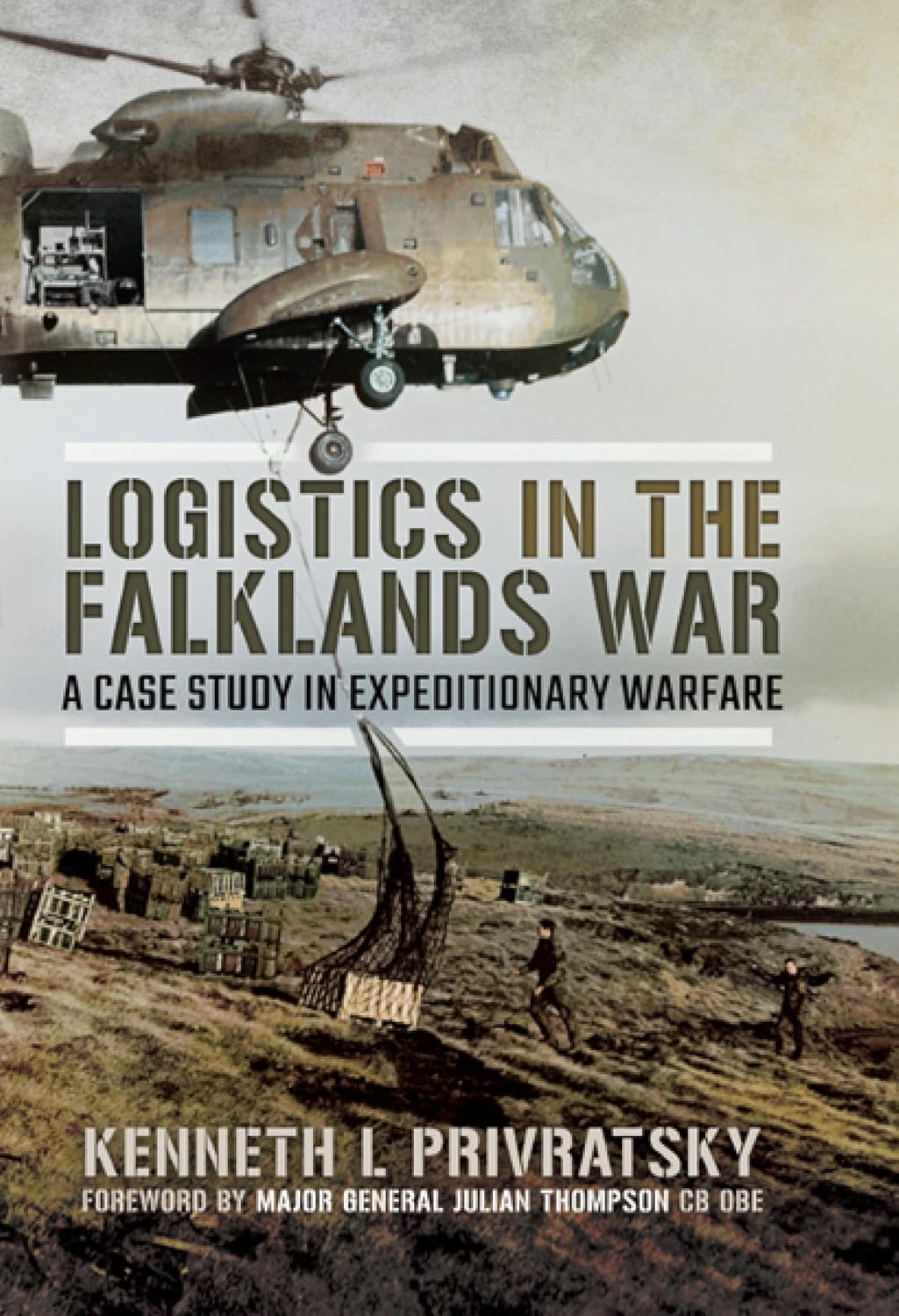
This post is largely highlights from a book I think everyone should buy, called Logistics in the Falklands War: A Case Study in Expeditionary Warfare by US retired MGen Privratsky.
[…]
I read the book as part of a long term project on the history of command and communications in the Falkland War. I couldn’t figure out how the British managed to pull off victory given the logistical challenges, so I purchased this book hoping to find answers.
Having now read the book I know WHAT the British did to win the war, but I have ZERO clue how they managed to make it work. The conditions and limitations they faced were so much worse than I thought.
I can honestly say this is the most interesting book I have read in years, which is a shock to me as I’m typically as bored by logistics as the next non-logistician. It was genuinely more engaging and entertaining than the battlefield accounts of that war.
The Logistics Challenges of the Falklands War
The task eventually given to the British task force was to retake the Falkland islands from the Argentines. This was a daunting task, both logistically and in terms of the actual ground combat.
Strategic Logistics
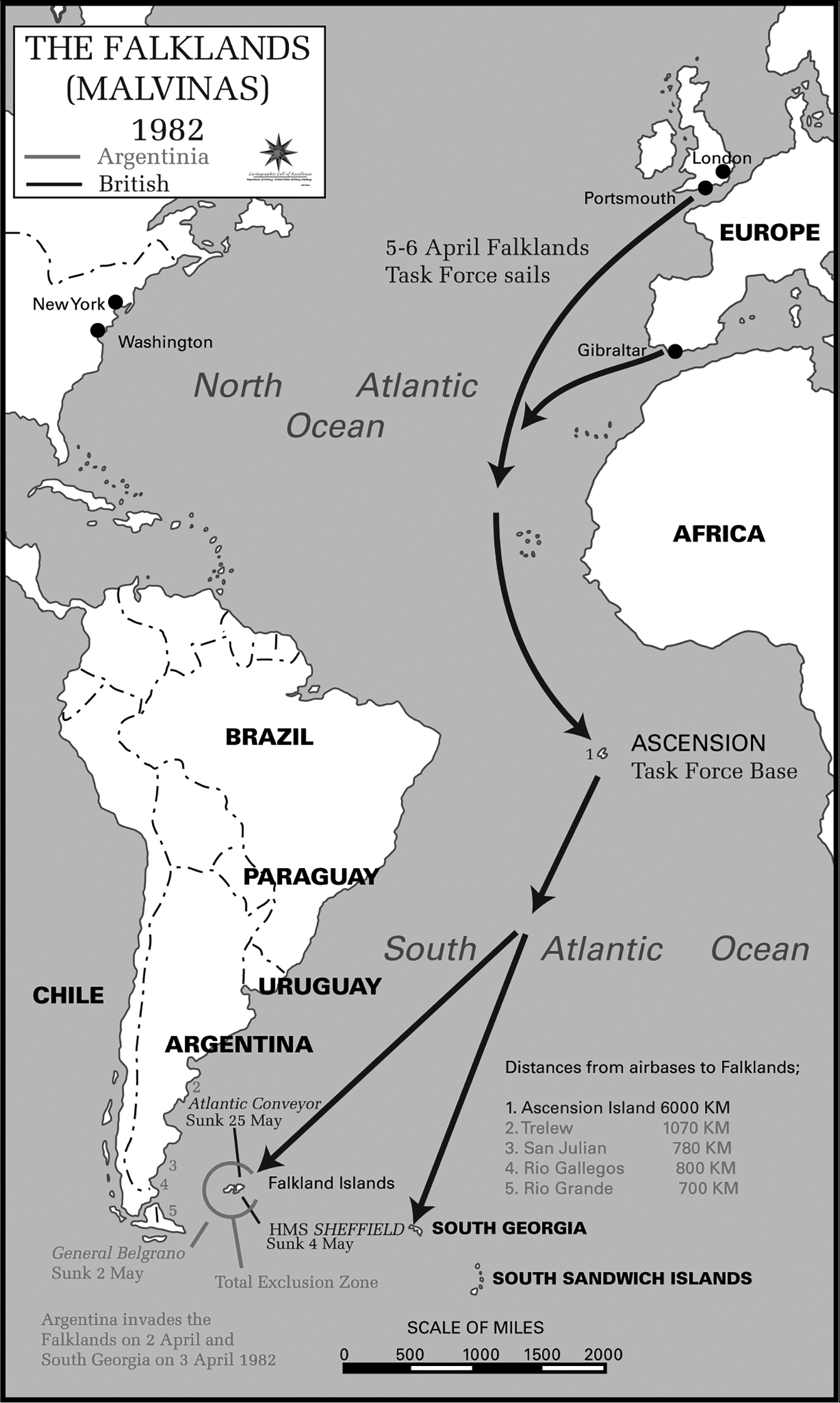
Strategic logistics is providing the lifeline of supplies, personnel, maintenance and health care between the home country and a staging area about 300km outside the combat zone. British strategic logistics involved a link from England to a small British held island half way between Brazil and Africa called Ascension. This link was 4,300 miles (6,900 km) by sea from Portsmouth. It had an airport and one jetty capable of handling one or two small commercial ships.
The next link was a further 3,600 miles (5,800 km) from Ascension to a logistics loitering area about 200 miles (320 km) short of the Falkland Islands. This was just a box drawn on a map in the middle of the ocean where the larger supply ships would loiter, outside the range of the Argentine air force.
[…]
Tactical Logistics
Tactical Logistics holds a few days’ supply (eventually the BSA/DSA held about 30 days supply ashore at San Carlos) but it’s main job is to move supplies, broken equipment, replacements and injured personnel between the BSA/DSA and the manoeuvre units.
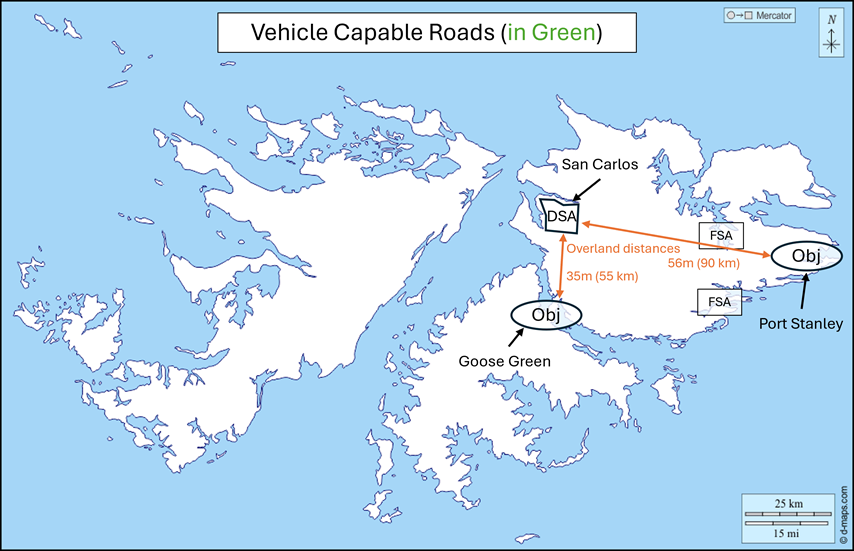
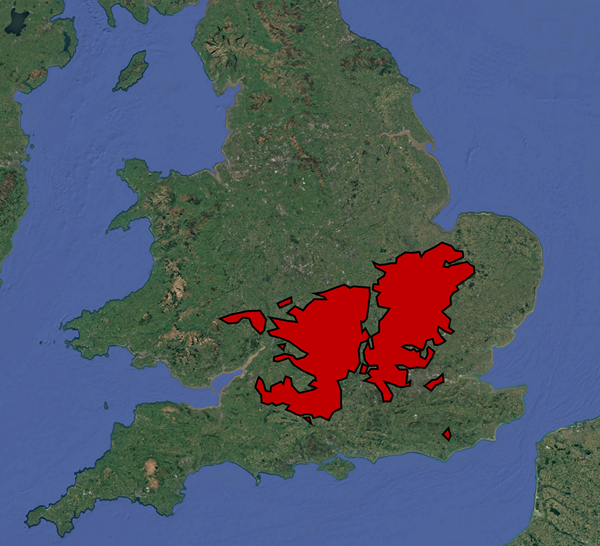
Normally the backbone of Tactical Logistics is trucks. Here there was a problem, as the image below is a comprehensive of all the paved and unpaved vehicle capable roads in the Falklands, excluding those in the vicinity of Port Stanley.
“Roads? Where we’re going Marty we don’t need roads.”
The details of tactical logistics take up several chapters of the book. The brief version is:
- The troops marched from the DSA to the Objective;
- For the attack on Port Stanley two days supply of Ammunition, Shells, fuel and shells were brought to the two Forward Support Areas (FSAs) along with skeletal field hospitals;
- Helicopters spent about 2 weeks bringing the artillery from the DSA to outside Port Stanley; and
- Limited emergency resupply of ammunition and casualty evacuation was available from the FSA to the troops in combat. However, most of the ammunition going brought and casualties evacuated rearward was done on foot over what can charitably be described as walking tracks.
Tactical Logistics in the Falklands was so difficult because there were no roads and the distances involved were enormous. While the orange arrows above give a sense of the distances involved, the image blow shows the size of the Falkland Islands superimposed over England.
[…]
Conclusion
Prior to reading Logistics in the Falklands I couldn’t quite figure out how the British managed to pull a victory out the hat, given the challenges of projecting power literally on the opposite end of the globe. Having read the book I am now convinced the British military in 1982 was either the best improvisational armed force in history or under some kind of Divine mandate.1
- Maybe both.
Why Did the Best Woodworking Vise Disappear?
Rex Krueger
Published 16 Jul 2026AI-generated video summary: Rex Krueger investigates the historical evolution of woodworking vises, comparing modern metal clamps with traditional wooden designs inspired by an 1812 manual. By constructing a classic English face vise, the process examines how economic pressures and shifts in manufacturing trades influenced the tools favored by woodworkers across several centuries.
Eating Like a Victorian Workhouse Inmate – Scouse & Suet Dumplings
Tasting History with Max Miller
Published 20 Jan 2026Thickened vegetable and meat stew with suet dumplings with parsley
City/Region: England
Time Period: 1901The food served in Victorian workhouses could vary widely depending on the time, place, and management of a particular establishment. Operating under the notion that if the food served to the inmates (yes, that’s what they were called) of a workhouse was worse than the average, it would encourage them to choose to not be poor (yes, those in power believed that being poor was a choice), workhouse food tended to be … not great.
The recipes for this stew and dumplings come from actual workhouse cookbooks, and they’re actually quite tasty, though the Victorian reality was often far from what you might make today with fresh ingredients. Meat could be too tough to eat, bugs and rat droppings were not uncommon, vegetables could be rotten, and the stew watered down.
As written, it makes a simple, hearty, thick meat and vegetable stew with dumplings that are rather dense, though they have a bit of fluffiness. It’s quite good, though I’m under no impression that it’s close to what the poor were actually being served.
Meat Stew (or Scouse)
Ingredients.
5 ozs. Raw Beef free from bone (Stickings or similar quality).
1 oz. Flour.
½ oz. Dripping or Fat.
4 ozs. Potatoes.
4 ozs. Carrots and Turnips.
½ oz. Onions
Pepper and Salt to taste.
Water to make 1 pint.
Method. — Cut up the meat and vegetables. Fry the flour in the fat till brown, stir in the water, add pepper and salt; then put in the meat and vegetables. Simmer gently for two hours. To make 1 pint of stew.
— Manual of Workhouse Cookery (1901)Suet Dumplings. 6 oz. flour, 2 oz. chopped suet, 1/16 oz. baking powder, ¾ oz. chopped parsley, salt and pepper. Mix all the dry things, rubbing the suet through the flour; make into a firm paste with the cold water; divide into ten or twelve small pieces, which roll up into balls, having the outsides well floured. Drop the balls into the stew, and cook for half an hour longer; then serve.
— Miss F. A. Merchant in Management and Construction of Poorhouses and Almshouses by George A. Mackay
QotD: Catapults in pre-gunpowder armies
The very oldest catapults, first invented by the Greeks were tension catapults (the gastrophetes and oxybeles), which functioned like large bows, with a bow-staff being bent backwards to store and then release the launching energy. This sort of design, common in pop-cultural depictions of catapults, is actually quite limited as with the materials available, there is a real limit to how much energy can be stored via tension. Fortunately for the Greeks, by the early fourth century, they had developed a better method.
Instead, the Greeks, Macedonians and Romans began using torsion catapults (where the energy is stored in wound-up sinews like a spring). While the devices used in field battles (and for city defense) were often smaller, arrow-launching devices, siege catapults could be very large; the standard engine for the purpose could fling a 1 talent stone (26.2kg) about 400m (though effectiveness was far higher if you could get closer to the wall, which as we’ll see will be a trend for most of this post); much larger engines did exist as well. That said, Roman catapults were mostly not for collapsing walls but for destroying towers and suppressing defenders in order to aid in escalade (usually by mole, rather than ladders or towers, though the Romans used those too).
And here once again the distinction between the “big army siege package” and the “small army siege package” matters quite a bit. Roman torsion artillery was complex, expensive and required lots of technical skill, and so sees far diminished use in the early Middle Ages where that technical skill is hard to come by. Vespasian, we are told, brought 160 torsion catapults to besiege Jotapata in 67 (Josephus BJ 3.166) while Titus brings a stunning 340 to besiege Jerusalem in 70 (Josephus BJ 5.356). By contrast, the construction of a single catapult is often a major event in a medieval siege (see Rogers, op. cit. 121-3 for some examples) and while later medieval catapults were often more powerful than the earlier Roman torsion devices, they were not that much more powerful.
Consequently, Hellenistic and Roman fortifications (especially city walls, like the Theodosian Walls we discussed last time) were designed with massed catapults in mind. As noted, the multiple walls ensured that the main curtain wall, the inner wall, was extremely difficult to target with catapults or indeed any kind of artillery: even if you knocked down the low wall and the outer wall, their rubble would mostly block shots at the base of the inner wall. Meanwhile, the inner wall was built to be practically immune to catapult fire anyway: up to 6m thick without any internal passages (the outer wall was much thinner, only 2m). That was more than enough to render the walls effectively immune to anything catapults can do; the walls in many places still stood up to Ottoman cannon in 1453. Finally, ancient city defenses were built assuming they’d often have their own stone and arrow throwing torsion artillery set up on the towers to return “counter-battery” fire. Not every city had the “complete package” that Constantinople, as the imperial capital head, of course, but some mix of thick walls, low out-walls and catapults designed for counter-battery fire were fairly standard defensive arrangements for Roman cities that could afford them and felt sufficiently threatened to invest the resources.
As we move into the Middle Ages, two paradoxical things happen. On the one hand, the ability for societies in Europe to deploy large numbers of finicky, high-tech torsion artillery decreases dramatically (and the machines that we do see tend to be the simpler, less accurate single-armed variety, what the Romans called the onager or “wild ass” because it kicked like one when it fired). On the other hand, by the sixth century, we start to see a clever new design of catapult, the traction trebuchet.
Originating in China in the 4th century BC, the traction catapult used muscle power directly to swing a long pole around a central frame. In terms of engineering complexity, it was a simpler device, and could be scaled up quite large so long as one could add more pullers (around 100 seems to have been normal for a large engine), but the range and power it offered as a result of the mechanical advantage offered by the long throwing arm were considerable. Given the number of pullers required, it is little surprise these were generally only used in small numbers in medieval Europe (again, often in reports it is merely a single device, described as a mangonel or a fenevol), but on the other hand, as I understand the physics, the range and striking power had the potential to be superior to a torsion catapult. Nevertheless, if we look at the kinds of fortifications emerging during this period, it certainly seems like in Europe, the concern that artillery might produce a breach in the wall (as opposed to merely degrading towers and the wall-walk) was fairly low.
Just to throw down a note here because we’ll come back to it, it is striking that while the small numbers of traction trebuchets in Europe seem to have represented a decline in the “catapult threat” to walls (recall last week’s contrast between castle walls and the much older Theodosian Walls), that was not the case in China, where walls continued to be made very thick – a design quirk that will matter quite a lot in a moment. I am not an expert on ancient and medieval Chinese siege tactics, alas, but my brief encounters with accounts of them often seem to describe traction catapults used en masse, in dozens or even hundreds, much more the way that the Romans used massed siege artillery. Likewise, Michael Fulton (Artillery in the Era of the Crusades (2018)) notes nearly a hundred Mamluk trebuchets (a mix of counter-weight and traction) at the Siege of Acre (1291); my sense is that such large siege trains were very rare within Europe. Presumably the ability to deploy so many engines was a consequence of greater state capacity in China and the Near East during this period as compared to fragmented, decentralized medieval Europe.
The late 12th century sees a major variation on the trebuchet design: the use of a counter-weight, instead of traction to provide the force; this innovation seems to have emerged in the West broadly defined, though it isn’t clear if that means in Europe or the Middle East (in any event both Christian and Muslim armies start using them at almost exactly the same time). This allows for much more energy to put into the shot, as the counter-weight can be very heavy and only slowly winched into place, allowing the work crew to spend more time “storing” energy in the counter-weight than they could with the quick pull of a traction trebuchet. Larger counter-weight trebuchets could also make use of animals to provide the power, or large wheels to make it easier to raise the counter-weight. The upper-limits on the size of projectiles were very high: Warwolf is thought to be the largest such trebuchet known, and threw a nearly 300lbs shot. That said, while counter-weight trebuchets hit harder (but fired slower), in function they do not seem to have been meaningfully different from traction trebuchets; they were used the same way in sieges.
What’s really striking is not the vast impact of catapults, but the muted impact of catapults. The counter-weight trebuchet was clearly good: the innovation makes its way all the way back to China, carried by the Mongols who presumably picked it up in the Middle East (ironically moving the opposite direction but at the same time as gunpowder, suggesting that at this point in the 13th century the two technologies were not considered mutually exclusive). Castle design does respond to catapults, but only in relatively modest ways: walls get somewhat thicker, but as Fulton (op cit.) notes, only by about half a meter or so (leaving even the newly thickened medieval castle walls somewhat thinner than the best old Roman defenses). In at least some areas, towers and keeps become more frequently rounded in shape, to resist catapult fire.
Certainly it was possible for catapults to open breaches in weaker walls to enable assault. The aforementioned Warwolf opened large breaches in the stone walls of Stirling Castle in 1304. But I note both Rogers (op. cit.) and Fulton (op. cit.) seem to confirm that while true breaches from trebuchets could happen, it was far more common that walls resisted trebuchet strikes and that the real work of the machines was degrading the wall defenses by striking off battlements and smashing towers, in order to enable escalade. Which is little surprise: that’s precisely what the Romans used catapults for too. While there is still some argument about the degree to which the counter-weight trebuchet was a revolutionary military technology, on the balance, the siege playbook changed only modestly to accommodate it, and castle design likewise shifted only in degrees.
And then Charles VIII of France (r. 1483-1498) decided to take a holiday on the Bay of Naples.
Bret Devereaux, “Collections: Fortification, Part IV: French Guns and Italian Lines”, A Collection of Unmitigated Pedantry, 2021-12-17.
July 16, 2026
“Only fans – Europe’s approach to air conditioning”
From the free-to-cheapskates portion of Ed West‘s most recent article on his Substack:
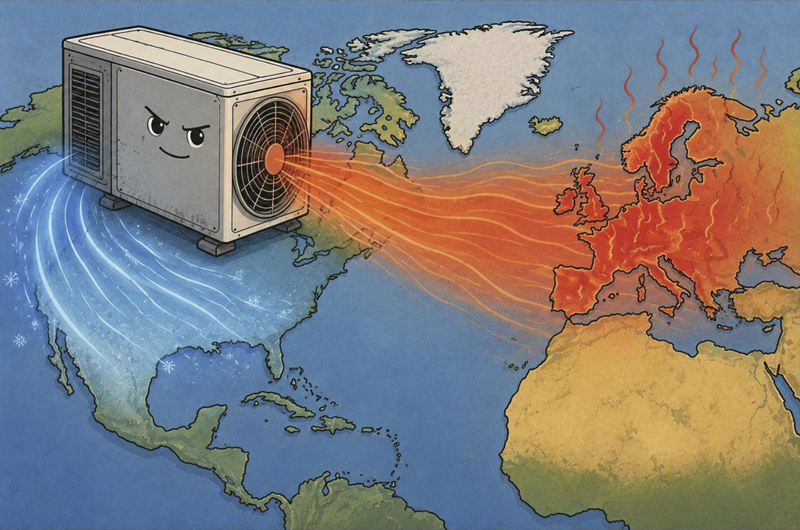
The EU may not actually believe this, but they thought you would …
Different climates have enjoyed advantages at different points in time. For most of history, industry and scholarship in southern Europe benefitted from significantly longer hours of sun and daylight much of the year compared to the north, allowing for more hours of work and study. James Belich noted in The World the Plague Made that this all changed with the expansion of the Basque whaling trade in the late medieval period, providing cheap wax for candles.
England and the Netherlands subsequently overtook the south in their levels of literacy, a transformation usually attributed to Protestantism, although this technical solution to a physical disadvantage certainly helped. As the northern countries grew richer, and were able to use more energy, so the climate came to be an advantage. Cooler areas of Europe in particular benefitted from a relative absence of vector-borne disease, dangerous insects and food poisoning, which made hotter regions of the world more lethal.
Yet the biggest curse of the lower latitudes is that heat makes us sluggish — since people struggle to work above 23° centigrade. As Maarten Boudry writes on his substack, “For every degree above 25°C (77°F), our cognitive performance declines by around two percent. And if synapses suffer, so does economic activity. At 30°C, office performance drops by almost 9 percent.”
I see that. I’ve been trying to write this in temperatures of up to 34°, which equates to a production level similar to a moderate hangover. If only there was some sort of technology that could make my home cooler.
Until relatively recently the world was dominated by a handful of relatively cold regions, and Paul Johnson observed in his history of the United States that human industry thrives in what Fahrenheit appreciators would call “the 60s”, a Goldilocks zone that turned New England and Greater Yankeedom into a powerhouse. The southern states, in contrast, were held back by higher mortality and the impossibility of productive work in the sweltering summer months, and until the mid-20th century were about 40 per cent poorer than the Union states.
The northerners were especially known for their work ethic and their inventiveness, a characteristic epitomised by the Boston-born Benjamin Franklin. Then in 1902, New York’s Willis Carrier changed everything with the one of the most world-changing inventions, the air conditioning unit; aircon has notably shifted population and power in the US southwards, but Dixieland is just part of a broader, global “sunshine belt”.
Among the most notable beneficiaries of this technology are the financial powerhouses of Dubai and Singapore. Lee Kuan Yew famously said of air conditioning that it was “perhaps one of the signal inventions of history. It changed the nature of civilization by making development possible in the tropics … The first thing I did upon becoming prime minister was to install air conditioners in buildings where the civil service worked.” Indeed, it has often been noted as characteristic of the city-state that the aircon is usually set to icy levels, reflecting their determination to be on work mode throughout the day.
While Singapore is the most famous beneficiary of Carrier’s invention, Japan has almost universal air conditioning, with 91 per cent of homes equipped, compared to 88 per cent in the US. China is home to more than 500 million aircon units, is the world’s largest manufacturer, and has also seen an economic shift towards the south. Vietnam, also likely to be a major economic power by mid-century, is as dependent on this technology as it is on its people’s ingenuity. The development of aircon, and medical breakthroughs in the treatment of tropical diseases, has shifted the centre of gravity away from the cold regions of the earth — just as the globe is warming up.
This year’s European heat wave, still ongoing, saw temperatures reach 37 last month in England, a June record. Many schools shut early, although one in Kent instead used air raid tunnels to teach children. London’s Central Line hit 39.4c, presenting a real risk of heat stroke.
Across Europe the hot weather has closed down not just schools but factories, offices and rail lines, and led to an estimated 10,000 deaths, with France top of the heat mortality charts. Indeed as Boudry writes, Europe has the worst heat-related excess deaths of any region — while fatalities in the US have declined by 75 per cent since the adoption of air conditioning.
Update, 17 July: Welcome, Instapundit readers! Have a look around at some of my other posts you may find of interest. I send out a daily summary of posts here through my Substack – https://substack.com/@nicholasrusson that you can subscribe to if you’d like to be informed of new posts in the future.
How Few Remain: The Second War Between the States
Feral Historian
Published 13 Mar 2026Let’s take a look at Harry Turtledove’s How Few Remain and its many themes and historical extrapolations. And probably argue about the Civil War a little along the way.
If there’s enough interest, this may be the start of a dive into the entire sprawling series that follows.
00:00 Intro
01:37 A War Unfinished
07:09 Adapting and Evolving
10:12 Abraham Lincoln and Frederick Douglass
13:15 The Horace Greeley Letter
15:40 Freddie’s Louisville Adventure
18:07 Turtledove, Lost Cause, and Spoilers
(more…)
QotD: The nostalgic British elements of Canadian nationalism
Britishness survives as civic nationalism. Old British Canada may be gone, but aspects of that Britishness live on. We should celebrate our history and our historic symbols, but this alternative shouldn’t set about restoring it all. A future oriented embrace of our history needs to be built around the active parts of this Britishness that have now become truly Canadian. For example, the Crown in Canada is not now just a British institution, it’s a Canadian institution. Same with our democratic institutions and parliamentary traditions, which we must work to strengthen and renew.
Embracing this enables us to thread the needle on our relationship with America. Part of what makes us different historically, culturally, ideationally, and in disposition from America, is this history. Just as Canadian Britishness has survived to the present day in unique ways, our desire not to become Americans is alive and well. A homegrown Canadian Britishness enables us to continue this without falling into crass anti-Americanism, and without requiring us to embrace the new Liberal nationalism to reject America. We should see America as an amicable cousin, but one that we are distinct and different from.
But most importantly, what this new kind of national identity needs to build around needs to be an evolution of the liberal nationalism that emphasizes and consciously builds around our regional pluralism. […] but the kind of rationalistic liberalism that our modern national identity is built around, while sold as a way of dealing with diversity, suffers from some serious internal tensions. Liberalism, especially the Canadian variant of it, implicitly depends upon and encourages a degree of homogenization that flattens hard cultural differences. We need to become more pluralistic, and less liberal.
Ben Woodfinden, “True North Patriotism and a Distinctly Canadian Conservatism”, The Dominion, 2020-10-20.
July 15, 2026
The Prince – “The only people who haven’t read it are the ones who keep losing”
I didn’t intend to turn this into Machiavelli week, but after the discussion of correctly translating “virtù“ for modern audiences, here’s Krzysztof Szczawinski with more about that famous/infamous book:
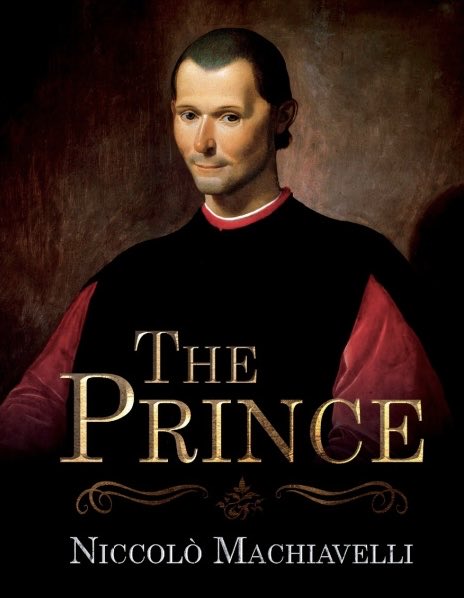
Niccolò Machiavelli wrote The Prince in 1513 as a practical manual for power. For five centuries, polite society has pretended to be shocked by it. Meanwhile, every successful political operator — on every side — has been quietly following it. The only people who haven’t read it are the ones who keep losing.
1. Machiavelli’s central insight is not that the ends justify the means. That is the misquote that lets comfortable people dismiss him. His actual insight is simpler and more disturbing: power has its own logic, independent of morality, and those who refuse to understand that logic will be defeated by those who do. The Prince is not a villain’s manual. It is a description of reality that makes virtuous people uncomfortable – because reality doesn’t care about their virtue.
2. The current progressive system applies Machiavelli more fluently than any of its opponents. His first rule: the appearance of virtue matters more than virtue itself. The DEI statement while systematically excluding dissent. The democracy rhetoric while suppressing opposition. The compassion branding while destroying careers. This is Machiavelli’s prince – not good, but performing goodness to maintain legitimacy. The performance is the power.
3. His second rule, which the current system also applies perfectly: cruelty, when necessary, should be delivered swiftly, completely, and early. Cancellation is Machiavellian – total, swift, exemplary. The point isn’t the individual being cancelled. The point is the ten thousand people watching who quietly adjust their behavior. One public destruction purchases a million private silences. Machiavelli would have recognized the mechanism immediately. He invented the theory.
4. Communism applied the fear side of Machiavelli with full conviction – Stalin made the explicit choice Machiavelli described: better to be feared than loved. The show trial is pure Machiavellian theater – a public demonstration of power functioning as a warning to everyone who isn’t on trial. But communism made his fatal mistake: it destroyed the people’s goodwill so completely that it generated not just fear but hatred. And Machiavelli is unambiguous – you can rule through fear, you cannot survive through hatred.
5. His most important democratic insight — the one nobody quotes — is that the prince who builds his power on the people is more secure than one who builds it on elites. Elites are few, demanding, and treacherous. The people are many, ask only not to be oppressed, and are a more stable foundation. The political movement that actually connects with ordinary people against the credentialed elite is applying Machiavelli more correctly than the elite relying on institutional capture alone.
6. What should we do? Stop bringing virtue to a knife fight. The chronic error of the opposition is the naive prince Machiavelli explicitly warns against – the leader who assumes truth wins automatically, who believes that being right is a strategy. It is not a strategy. It is a precondition. Being right gives you something worth fighting for. Machiavelli tells you how to fight: build your own power base, never rely entirely on others, control your narrative before your enemies do, and treat fortune as something to be seized, not waited for. Fortune favors the bold. Not the righteous. The bold.
7. Machiavelli is taught in universities as cynical amoralism – the thing decent people reject. This framing is itself Machiavellian – it keeps the manual out of the hands of the people who most need it. The current establishment didn’t reject Machiavelli. It institutionalized him, rebranded him in the language of social justice, and uses him daily. The opposition reads Augustine and loses. The system reads Machiavelli and wins. Until the side that is actually right decides that understanding power is not a betrayal of principle but a precondition for defending it – the result will be the same. Virtue without strategy is just a dignified way of losing.
Update, 16 July: Welcome, Instapundit readers! Have a look around at some of my other posts you may find of interest. I send out a daily summary of posts here through my Substack – https://substack.com/@nicholasrusson that you can subscribe to if you’d like to be informed of new posts in the future.
The Korean War Week 108 – The Republican Candidate – July 14th, 1952
The Korean War by Indy Neidell
Published 14 Jul 2026In Chicago, the US Republican Party Convention comes to its end and they have chosen Dwight “Ike” Eisenhower as their Presidential Candidate. Part of the official platform is ending the Korean War. The war continues, of course, with a new UN operation designed to take prisoners, massive aerial bombing of Pyongyang, and the build up of the South Korean Army — the ROKA — to one day hopefully take over from the UN forces.
“Communism no longer comes for your property”
On the social media site formerly known as Twitter, Krzysztof Szczawinski explains why western countries are perhaps more in danger of communist subversion, because we have an out-of-date mental model of what communism looks like:

On communism – in summary:
1. Communism no longer comes for your property. It comes for your reality. The West still pictures bread lines and gulags, a failed economic theory safely buried in 1989 – that was only ever the surface symptom. Leftism-communism is the most insidious destructive force in our world today, and it survives every empirical refutation for one reason: it was never really an economic theory. It doesn’t care about the truth. It only seeks power.
2. At its core it is a civilizational cancer – a machine for distorting reality through constant lies, rewritten history, and the systematic corruption of truth. It practices negative selection: it promotes the ambitious sociopaths, the ideologues, and the conformists, while the honest and the competent are sidelined or destroyed. Talent, integrity, and productivity become liabilities. The body count runs to roughly a hundred million. But the deeper kill is spiritual – trust eroded, excellence punished, reality itself subordinated to raw power.
3. What has changed is the method, not the logic. Tanks and gulags were crude, visible, self-defeating. Today it does not confiscate – it destabilizes. Chaos is the new collectivization. Every manufactured crisis follows the same structural logic: disorder is produced, fear is maximized, and in the panic that follows, transfers of power occur that would have been politically impossible in calm times. You do not notice the expropriation, because you are too busy surviving the emergency they built for you.
4. The fuel running this engine is the Systemic Lie – not ordinary propaganda, but a managed reality in which the categories of thought themselves are corrupted. Productivity is renamed exploitation. Order is renamed fascism. Resistance is renamed hate. A population that cannot name extraction cannot resist it – that is the design, not a side effect. Polish has a word for what results: zakłamanie, a society so saturated with lies that truth becomes almost inaccessible. Obłuda is the mask of falsehood worn so long it begins to feel like a face.
5. This is why the ideology did not die in 1989. It mutated, migrated, and entrenched itself inside the institutions of the civilization it had set out to destroy. Under a system of institutionalized lying, the loyal are promoted and the honest are pushed out, until the institution fills, top to bottom, with people selected specifically for their unreliability. That is not inefficiency. That is institutional rot at the genetic level. People learn to say the words, attend the meetings, sign the statements – and inwardly check out entirely.
6. The damage was never only in the ideology. It was in the people – the habits of mind that decades inside a system of lies produce, habits that do not evaporate with a change of government. The decisive terrain now is institutional: the schools, the media, the corporations, and above all the artificial intelligence systems being trained at civilizational scale on values that half the civilization never chose and was never consulted on. Whoever writes the values into the machines will have more influence over the next century than any election result.
7. This is where civilizations are actually won and lost – not in grand gestures, but in millions of daily, invisible decisions about whether to say what you actually see. Every person who refuses to perform the lie one more time is doing something larger than they know. Name the chaos. Name the lie. The naming is the resistance.
Tell the truth, have courage, and build.
The Ancient Greeks 03 – Enter the Persians 3 – Darius, Ionia, and the Fragile Peace
seangabb
Published 16 Feb 2026Greece: A Brief History, c.700 BC – 500 AD
With Darius I, the Persian Empire reaches its greatest extent. This lecture explores how Darius reorganised the empire into satrapies, imposed taxation systems, and stabilised rule across vast territories. We examine Persian cultural policy, military discipline, and the integration of Greek communities within the imperial system.
But beneath the surface of order, tension grows. The Ionian Greek cities resent indirect rule through tyrants. Persian administrative logic collides with Greek political volatility. The peace is real — but unstable.
QotD: First up against the wall, come the revolution
A real-life individual named Savva Morozov (1862–1905) was one of the wealthiest men in pre-revolutionary Russia.
He was a textile magnate, a patron of the arts, and a genuine philanthropist. His Moscow mansion was said to be the most expensive in the city. He and his wife, Zinaida, hosted famous writers, composers, and scientists. Morozov also worked to improve conditions for workers in his factories. He gave pregnant women paid leave. He funded scholarships for students. He built a hospital and a theater for his workers. He pushed for constitutional reform: freedom of the press, freedom of association, workers’ rights to organize and strike, and public oversight of the state budget.
Morozov also bankrolled the Bolsheviks.
Reports from this period suggest he gave hundreds of thousands of rubles to the revolutionary cause. He personally financed an underground newspaper of the banned social-democratic party that would eventually become the Russian Communist Party.
Morozov’s goal was almost certainly not to ignite a civil war or hand power to a dictatorship. He likely saw the radicals as useful pressure on the tsar, a way to force real reforms from a regime that would not move on its own.
When revolution came in January 1905, the violence shocked him.
He had set forces in motion that he could not control.
He suffered a nervous breakdown and fell into depression. His doctors and family sent him to the French Riviera to recover. He checked into a hotel in Cannes. There, he apparently shot himself, though rumors persisted for years that he had been murdered and the suicide had been staged.
His wife Zinaida returned to Russia and continued living off the enormous fortune her husband had left behind. Then came 1917. The Bolsheviks seized everything. She survived by selling off the few pieces of jewelry she had managed to keep.
The lavish country estate she and her husband owned later became the personal residence of Vladimir Lenin, leader of the communist revolution. Today it is a museum called Lenin’s Gorki, filled with the possessions and mementos of the first leader of the Soviet Union.
In his book End Times: Elites, Counter-Elites and the Path of Political Disintegration, Peter Turchin points out that in most cases of societal collapse and state breakdown, “the overwhelming majority of precrisis elites … were clueless about the catastrophe that was about to engulf them. They shook the foundations of the state and then were surprised when the state crumbled.”
Rob Henderson, “Dark Shadows Fall, One Upon The Other”, Rob Henderson’s Newsletter, 2026-03-22.


